Kawasaki disease, also known as mucocutaneous lymph node syndrome, was first reported in 1967 by Japanese doctor Tomisaku Kawasaki. Reference Kawasaki1 The clinical symptoms of Kawasaki disease are persistent high fever, oral mucositis, conjunctival congestion, rigid swelling of hands and feet, pleomorphic rash, non-suppurative lymph node enlargement, hands and feet peeling, etc. Kawasaki disease, as a multisystem vasculitis, can lead to coronary artery lesions Reference Newburger, Takahashi and Burns2 and is commonly observed in young children. In fact, 80% of Kawasaki disease cases occur in children between 6 months and 5 years old, with males outnumbering females by approximately 1.5 times. Reference Agarwal and Agrawal3 Although Kawasaki disease occurs in different parts of the world and among different ethnic groups, the incidence rate varies widely. Asia has a higher incidence of Kawasaki disease, with Japan, South Korea, and Taiwan (China) having the highest incidence. Reference Greco, De Virgilio and Rizzo4 The incidence of Kawasaki disease in the siblings and offspring of parents with a history of Kawasaki disease is higher than in the general population, suggesting that genetic predisposition may play an important role in the pathogenesis of the disease. Reference Uehara, Yashiro and Nakamura5 With the development of molecular genetics, many studies have focused on the relationship between gene polymorphisms and Kawasaki disease. Current research on the prevalence of Kawasaki disease gene polymorphisms has shown that the inositol 1,4,5-trisphosphate 3-kinase C (ITPKC), Reference Onouchi, Gunji and Burns6 caspase-3 (CASP3), Reference Onouchi, Suzuki and Suzuki7 and calcium release-activated calcium modulator 1 (ORAI1) Reference Onouchi, Fukazawa and Yamamura8 genes were identified as susceptibility genes for Kawasaki disease in Japanese children, and the early B cell factor 2 (EBF2) Reference Bae, Shin and Nam9 and the inositol 1,4,5-trisphosphate 3-kinase C (ITPKC) Reference Kim, Bae and Ji10 genes were associated with Kawasaki disease and coronary artery lesion in Kawasaki disease in Korean patients. Previous studies by our group have found that the Platelet endothelial cell adhesion molecule-1 (PECAM-1) 373A/G gene polymorphism is related to Kawasaki disease and may be a genetic risk factor for coronary artery lesion development in Chinese children, Reference Li, Han and Jiang11 and the genotype CT and allele T of the thrombomodulin (TM) gene C1418T may be predisposing factors of Kawasaki disease. Reference Lu, Liu and Zha12
Oxidative stress is a balanced response between oxidation and antioxidation in the body. In organisms, reactive oxygen species orchestrate the oxidation reaction. Reactive oxygen species are usually eliminated as a biological consequence of antioxidative reactions. Excessive reactive oxygen species can damage proteins, lipids, and DNA and can cause many diseases such as cardiovascular disease. Reference Yahata and Hamaoka13 Manganese superoxide dismutase (MnSOD), one of the most important antioxidases in the human body, is mainly found in the mitochondrial matrix of cells, where the main energy used by organisms is produced. During the process of energy synthesis, the electron transfer process of the oxidation respiratory chain is the most important route for production of free radicals. Free radicals can be first removed by MnSOD in the mitochondrial matrix to prevent their accumulation and spread; thus, MnSOD plays a key role in maintaining the balance of free radicals in the human body. Reference Sheshadri and Kumar14 MnSOD gene polymorphisms are associated with a variety of oxidative stress-related diseases.
In recent years, studies have shown that the incidence of Kawasaki disease and its coronary artery injury may be related to oxidative stress. Reference Yahata and Hamaoka13 However, whether the pathogenesis of Kawasaki disease is related to MnSOD gene polymorphisms has not yet been reported. The purpose of this study was to explore the possible relationship between MnSOD gene polymorphisms and Kawasaki disease susceptibility.
Materials and methods
Subjects
Kawasaki disease group
A total of 100 Kawasaki disease children (Han nationality, 62 males and 38 females, age ranging from 2 months to 9 years 5 months, average age 34.7 ± 25.4 months) hospitalised in the Third Xiangya Hospital of Central South University from 2015 to 2018 were selected by the Japanese Kawasaki Disease Research Committee’s Kawasaki disease diagnostic criteria. Reference Ayusawa, Sonobe and Uemura15 None of the children from the Kawasaki disease group received aspirin or IVIG before hospitalisation. To further evaluate the relationship between MnSOD gene polymorphisms and Kawasaki disease coronary artery injury, we divided the children into Kawasaki disease-coronary artery lesion group and Kawasaki disease-without coronary artery lesion group according to whether there was coronary artery injury. Coronary artery lesions were diagnosed as follows: a lumen diameter of the left or right coronary artery >3 mm (children under 5 years old) or >4 mm (children over 5 years old), or the inner diameter of a segment of the coronary artery at least 1.5 times that of the adjacent coronary artery or the markedly irregular coronary cavity. 16
Control group
A total of 102 healthy children (Han nationality, 56 males and 46 females, age ranging from 3 months to 11 years old, average age 24.2 ± 25.2 months) were selected from the Child Health Management Center, the Third Xiangya Hospital of Central South University. The healthy control children did not have any previous history of Kawasaki disease, infectious diseases, cardiovascular diseases, or rheumatic diseases. There was no statistically significant difference in the gender distribution between the Kawasaki disease and control groups (p > 0.05).
We used EDTA-Na2 disposable blood collection vessels to collect 3-ml blood samples from the children. The blood samples were immediately transferred to the freezing tubes and stored at −80°C. Written informed consent was obtained from either the parents or legal guardians of the children. The study was approved by the Ethics Review Committee and Institutional Review Board of the Third Xiangya Hospital (No. 2020-S002).
DNA extraction
We used a Nucleic Acid Purification Kit (Beijing Jin Biotechnology Co., Ltd, China) for blood DNA extraction. After extraction, an ultramicro UV spectrophotometer was used to detect the concentration and purity of the DNA samples, which were then stored in a −20°C refrigerator.
SNP selection and genetic typing
Two polymorphism sites selected from the MnSOD gene (rs4880 and rs5746136) were evaluated. We amplified the MnSOD gene by polymerase chain reaction using primers designed by the authors (rs4880, forward primer: GTGTGCGGGTGAGAAGAAAGG, reverse primer: CGTGGTGCTTGCTGTGGTG, amplification fragment: 432 bp; rs5746136, forward primer: GTAGGGATGCCTTTCTAG, reverse primer: AGTTTGCCTTTACTGTGC, amplification fragment: 294 bp) in a Thermal Cycler 9700 (Applied Biosystem, Foster City, CA, USA). The polymerase chain reaction system was a total of 25 μl, including 22 μl of T3 Super PCR Mix (Tsingke Biotech Co., Beijing), 1 μl of forward primer (Tsingke), 1 μl of reverse primer (Tsingke), and 1 μg of DNA. The polymerase chain reaction conditions for rs4880 were as follows: 98°C predenaturation for 2 minutes, 98°C denaturation for 10 seconds, 60°C annealing for 10 seconds, and 72°C extension for 5 seconds, ×35 cycles, followed by 72°C extension for 2 minutes, and 4°C for preservation. The polymerase chain reaction conditions for rs5746136 were as follows: 98°C predenaturation for 2 minutes, 98°C denaturation for 10 seconds, 54°C annealing for 10 seconds, and 72°C extension for 5 seconds, × 35 cycles, followed by 72°C extension for 2 minutes, and 4°C for preservation. The amplified products were sent to the sequencing company (Boshang Biotech Co. Ltd, China) for gene sequencing. The sequencing results were read and analysed in Chromas software.
Data analysis
All data were analysed using SPSS 24.0. The χ2 test was used to assess the differences in genotype and allele frequencies between the two groups. We used the χ2 test with 1 degree of freedom to assess Hardy–Weinberg genetic equilibrium, which was used to determine the genetic balance of each genotype frequency. Odds ratio and 95% confidence interval were used to estimate the association between the Kawasaki disease genotype and risk allele. All tests were two-sided, and p < 0.05 was considered statistically significant.
Results
Detection of MnSOD gene polymorphisms
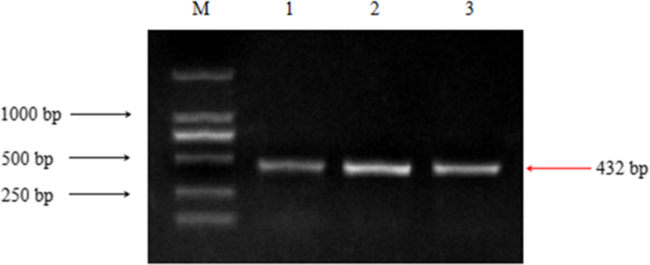
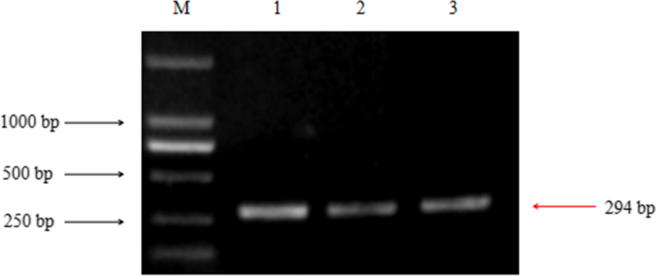
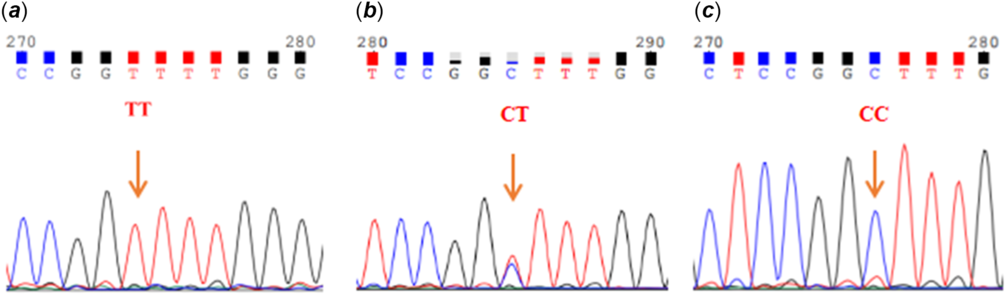
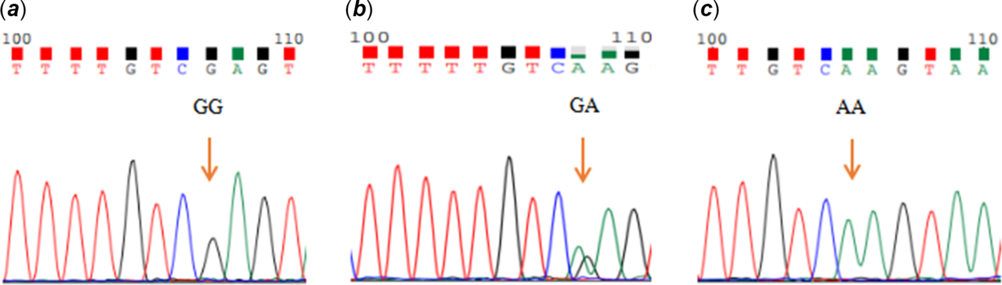
The 432-bp amplification products for locus rs4880 and the 294-bp amplification products for locus rs5746136 were separated with agarose gel electrophoresis (Figs 1 and 2). The sequencing results of the direct gene sequences are shown in Figures 3 and 4. The MnSOD rs4880 genotype frequencies of both the Kawasaki disease group and the control group conformed to Hardy–Weinberg equilibrium: χ2 = 5.00 and 4.41, respectively, both p > 0.05. The MnSOD rs5746136 genotype frequencies of both the Kawasaki disease group and the control group also conformed to Hardy–Weinberg equilibrium: χ2 = 2.51 and 0.85, respectively, both p > 0.05.
Agarose electrophoresis chart of the MnSOD gene locus rs4880 polymerase chain reaction amplification segments. Lane M: DNA marker. Lanes 1–3: MnSOD gene locus rs4880 polymerase chain reaction amplification segments (amplification length: 432 bp).

Agarose electrophoresis chart of the MnSOD gene locus rs5746136 polymerase chain reaction amplification segments. Lane M: DNA marker. Lanes 1–3: MnSOD gene locus rs5746136 polymerase chain reaction amplification segments (amplification length: 294 bp).

Genotype test at locus rs4880 in the MnSOD gene. ( a ) TT genotype; ( b ) CT genotype; ( c ) CC genotype.

Genotype test at locus rs5746136 in the MnSOD gene. ( a ) GG genotype; ( b ) GA genotype; ( c ) AA genotype.

Association between MnSOD gene polymorphisms and Kawasaki disease susceptibility
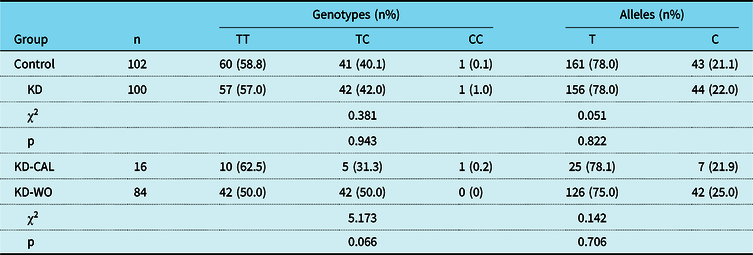
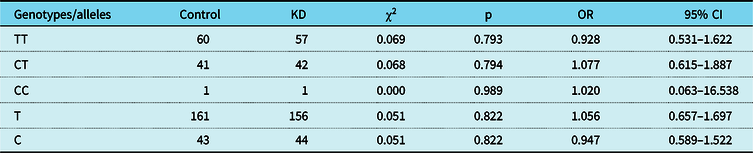
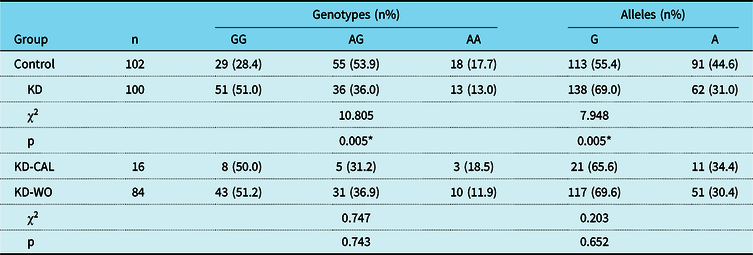
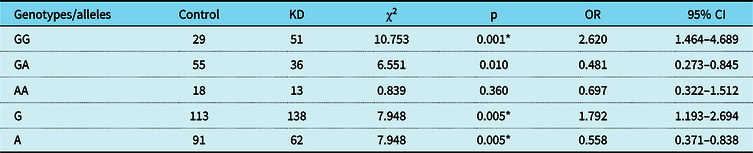
There were significant differences between the Kawasaki disease group (genotype frequency: GG 51.0%, GA 36.0%, AA 13.0%, and allele frequency: G 69.0%, A 31.0%) and the control group (genotype frequency: GG 28.4%, GA 53.9%, AA 17.7%; and allele frequency: G 55.4%, A 44.6%) for the locus rs5746136 genotype frequency (χ2 = 10.805, p = 0.005) (Tables 3 and 4) and allele frequency (χ2 = 7.948, p = 0.005). Children with allele A had a 0.558 times lower risk of Kawasaki disease than those without allele A (χ2 = 7.948, p = 0.005, odds ratio = 0.558, 95% confidence interval = 0.371–0.838). As shown in Tables 1 and 2, there were no significant differences between the Kawasaki disease group (genotype frequency: TT 57.0%, TC 42.0%, CC 1.0%, and allele frequency: T 78.0%, C 22.0%) and the control group (genotype frequency: TT 58.8%, TC 41.1%, CC 0.1%; and allele frequency: T 78.9%, C 21.1%) for the genotype and allele frequencies of the locus rs4880 (p > 0.05).
The relationship between MnSOD gene locus rs4880 genotype/allele frequencies and KD susceptibility

KD = Kawasaki disease; KD-CAL = KD-coronary artery lesions; KD-WO = KD-without coronary artery lesions.
The relationship between MnSOD gene locus rs4880 genotype/allele frequencies and the risk of KD

KD = Kawasaki disease; OR = odds ratio; CI = confidence interval.
The relationship between MnSOD gene locus rs5746136 genotype/allele frequencies and KD susceptibility

* p < 0.05; KD, Kawasaki disease; KD-CAL, KD-coronary artery lesions; KD-WO, KD-without coronary artery lesions.
The relationship between MnSOD gene locus rs5746136 genotype/allele frequencies and the risk of KD

KD = Kawasaki disease; OR = odds ratio; CI = confidence interval.
* p < 0.05.
Association between MnSOD gene polymorphisms and coronary artery injury
As shown in Table 1, for the locus rs4880 in Kawasaki disease-coronary artery lesion group, the genotype frequency is TT 62.5%, TC 31.3%, CC 0.2%, and the allele frequency is T 78.1%, C 21.9%; and in Kawasaki disease-without coronary artery lesion group the genotype frequency is TT 50.0%, TC 50.0%, CC 0%, and the allele frequency is T 75.0%, C 25.0%. As shown in Table 3, for the locus rs5746136 in Kawasaki disease-coronary artery lesion group, the genotype frequency is GG 50.0%, GA 31.2%, AA 18.8%, and the allele frequency is G 65.6%, A 34.4%; and in Kawasaki disease-without coronary artery lesion group, the genotype frequency is GG 51.2%, GA 36.9%, AA 11.9%, and the allele frequency is G 69.6%, A 30.4%. There was no significant difference in the genotype and allele frequencies at rs4880 and rs5746136 between the Kawasaki disease-coronary artery lesion and Kawasaki disease-without coronary artery lesion groups (p > 0.05).
Discussion
Kawasaki disease is a type of acute febrile rash disease with multiple cases in children and is characterised by primary lesions of systemic middle and small vasculitis. Some patients may have a coronary artery injury. Reference Newburger, Takahashi and Burns2 At present, the aetiology and pathogenesis of Kawasaki disease remain unclear. Previous studies have focused on vasculitis caused by overactivation of the immune system and the activation of various cytokines and extensive damage to the vascular endothelial system. It is believed that vascular endothelial dysfunction is an important link in the occurrence and development of Kawasaki disease and coronary artery injury. Reference Shulman and Rowley17 Recent studies have shown that vascular endothelial dysfunction in Kawasaki disease patients may be related to increased oxidative stress and lipid metabolism disorders. Reference Yahata and Hamaoka13 In the acute stage of Kawasaki disease, monocyte/macrophage-dominant inflammatory cell invasion extends to the entire arterial wall. Reference Takahashi, Oharaseki and Naoe18 These cells are activated by inflammatory cytokines and then migrate and infiltrate. These activated inflammatory cells are highly stimulatory, promoting the production of a large number of reactive oxygen species. Reference Griendling, Sorescu and Ushio-Fukai19 Simultaneously, the expression level of MnSOD in the antioxidant enzyme system is significantly reduced. This will lead to the failure of the timely elimination of reactive oxygen species in the accumulation of blood vessels, which will then induce a series of chain lipid peroxidation reactions, destroy the integrity of the endothelial cell membrane, cause calcium overload in the endothelial cells, and aggravate the abnormal endothelial function. As a result, the endothelium-dependent vasodilation response will be weakened, and the vasoconstriction response will be enhanced . Reference Lin, Sheen and Tain20 Takamichi et al compared 25 Kawasaki disease children with 25 children from a control group and found that oxidative stress was closely related to abnormal endothelial function in Kawasaki disease children. Reference Ishikawa and Seki21 In addition, the longer the fever lasted in these children, the higher the risk of oxidative stress-induced endothelial dysfunction.
To our knowledge, this is the first study to determine the association between the polymorphisms rs4880 and rs5746136 in MnSOD gene and Kawasaki disease in Chinese children. For locus rs4880, the allele frequency in our control group (C allele: 21.1%) differs from those reported in Japanese (C allele: 13.4%), Reference Teranishi, Uchida and Nishio22 Korean (C allele: 11.8%), Reference Park, Kim and Lim23 and French (C allele: 46.3%) Reference Mohammedi, Bellili-Muñoz and Driss24 populations. For locus rs5746136, the allele frequency in our control group (A allele: 44.6%) differs from those reported in Korean (A allele: 40.8%), Reference Park, Kim and Lim23 Iran (A allele: 37.1%), Reference Boroumand, Mahmoudinasab and Saadat25 and French (A allele: 28.9%) Reference Mohammedi, Bellili-Muñoz and Driss24 populations. These differences in C allele frequency in the locus rs4880 and A allele in the locus rs5746136 suggest that these alleles may have important roles in the disease occurrence and development in these ethnically distinct populations.
The MnSOD gene is located on chromosome 6q25. Reference Pourvali, Abbasi and Mottaghi26 It have multiple transcripts and different protein isoforms, which plays an important role in the clearance of oxygen-free radicals in the mitochondria. However, MnSOD can only play its role in scavenging oxygen-free radicals when it is transferred from the cytoplasm to the mitochondria. If the transfer process is hindered, oxygen-free radicals in the mitochondria will accumulate due to insufficient scavenging, leading to oxidative stress and cell damage. Mitochondrial targeting sequence of the MnSOD gene encodes a signal peptide containing 24 amino acids. The function of this signal peptide is to guide the transfer of MnSOD from the cytoplasm to the mitochondria. Mutations in the MnSOD coding region will change the coding sequence, which may be one of the mechanisms by which antioxidant effect of MnSOD is weakened. Reference Bresciani, Cruz and de Paz27
Locus rs4880 is located on the signal-peptide coding region of the MnSOD gene, and its polymorphism refers to the 47th nucleotide; specifically, the C base in codon GCT is replaced with a T base. Consequently, this forms codon GTT and causes the 16th amino acid of the signal peptide of MnSOD to replace alanine with valine (Ala16Val). Reference Bresciani, Cruz and de Paz27 This amino acid substitution results in spatial structural change of the signal peptide from α-helix to β-fold. The α-helix conformation has a double affinity, which can guide MnSOD transfer from the cytoplasm to the mitochondria. However, the β-fold can affect the correct recognition of the signal peptide and related receptors in the mitochondrial inner membrane; thus, the rate of MnSOD transfer from the cytoplasm to the mitochondria is reduced by 30–40%, and the antioxidant function of MnSOD in the mitochondria is affected. Reference Yahya, Ismail and Nordin28 This will lead to the failure of timely elimination of the reactive oxygen species in the accumulation of blood vessels. Excessive reactive oxygen species production represents endothelial and smooth muscle dysfunction, which leads to the progression of Kawasaki disease and coronary artery lesions. Reference Takahashi, Oharaseki and Naoe18,Reference Griendling and FitzGerald29
The MnSOD gene polymorphism locus rs4880 affects the occurrence and development of coronary heart disease, diabetes, and other diseases related to oxidative stress. Yosra et al Reference Souiden, Mallouli and Meskhi30 studied the MnSOD gene polymorphism in 203 control cases and 164 patients and found that the Ala16Val MnSOD polymorphism and decreased antioxidant defences contribute to the risk of coronary heart disease in Tunisian men. Furthermore, the Val-encoding MnSOD allele and decreased SOD activity were significantly correlated with CHD stenosis progression. Li et al Reference Li, Tao and Wu31 also demonstrated that MnSOD gene locus rs4880 (Ala16Val) gene variants confer an increased risk of type 2 diabetes mellitus in the Chinese Han population. Tetik et al Reference Tetik, Harman and Bozok32 studied MnSOD gene polymorphisms in 217 patients with diabetic dyslipidemias and 212 age- and sex-matched healthy individuals and found that the MnSOD gene locus rs4880 polymorphism affects oxidative metabolism and increases the risk of dyslipidemia in diabetes patients. However, in our study, there was no significant difference in the genotype and allele frequencies in the MnSOD gene locus rs4880 between the Kawasaki disease group and the control group or between the Kawasaki disease-coronary artery lesion and Kawasaki disease-without coronary artery lesion groups. This indicates that the MnSOD gene locus rs4880 polymorphism is not strongly related to Kawasaki disease susceptibility and coronary artery lesions in children with Kawasaki disease; however, it may be caused by the insufficient sample size of this study.
Locus rs5746136 is located in last intron for some transcripts or in the 3′-UTR for other transcripts of MnSOD gene which may play important function in splicing of transcripts or regulation of protein translation, and the rs5746136 point mutation is also related to the antioxidant effect of MnSOD, which has been widely studied in various diseases related to oxidative stress. Isikli et al Reference Isikli, Kubat-Uzum and Satman33 studied 20 diabetic patients and found that the rs5746136 genotype TT could increase the risk of diabetes mellitus and diabetic multiple neuropathy. Wang et al Reference Wang and Karmaus34 studied 126 children with asthma and 327 children in the control group and found that impaired oxidative defence was an important cause of asthma. Children with the TT genotype of the MnSOD gene locus rs5746136 had higher mono(2-ethyl-5-hydroxyhexyl)phthalate levels, which significantly increased the risk of asthma. Zhou et al Reference Zhou, Shuai and Li35 found that the MnSOD gene locus rs5746136 polymorphism is related to the occurrence of angle-closure glaucoma in the Chinese population, which may be related to the antioxidation of MnSOD. Ding et al Reference Ding, Liu and Shen36 studied the genetic polymorphisms of 1388 Chinese Han patients with prostate cancer and found that the MnSOD gene locus rs5746136 T/C polymorphism was closely related to the occurrence and development of prostate cancer.
The results of our study showed that the genotype frequency (GG, GA, and AA) and allele frequency (G and A) of the MnSOD gene locus rs5746136 differed significantly between the Kawasaki disease group and the healthy control group, and the risk of Kawasaki disease in children with the allele A gene was 0.558 times lower than that in children without allele A. There was no significant difference in the genotype and gene frequencies between the Kawasaki disease-coronary artery lesion and Kawasaki disease-without coronary artery lesion groups. These findings suggest that the MnSOD gene locus rs5746136 genotype AA and allele A may be Kawasaki disease protection factors. Their protective effect may be due to the controlled production of too much hydrogen peroxide by MnSOD when scavenging superoxide radicals. Under normal circumstances (genotype GG), MnSOD catalytically removes superoxide radicals by converting it to hydrogen peroxide and oxygen. Reference Bresciani, Cruz and de Paz27 While MnSOD helps to remove dangerous superoxides, the by-products like hydrogen peroxide pose a threat to cells in the absence of sufficient catalase activity. The increase in MnSOD activity may cause cell damage due to the excessive production of hydrogen peroxide. Reference Valdivia, Perez-Alvarez and Aroca-Aguilar37 Excessive hydrogen peroxide in the cell may inhibit the nitric oxide synthase (NOS) activity and promote the predominant nuclear factor-κB pathway. Reference Janus, Szahidewicz-Krupska and Mazur38 Nuclear factor-κB in inflammatory nucleus is activated by oxidative stress and promotes the production of other cytokines and the expression of cell adhesion molecules, resulting in endothelial dysfunction and chronic inflammation. This leads to the progression of Kawasaki disease and coronary artery lesions. Reference Buttery, Springall and Chester39 The MnSOD expression and activity may be affected in the children carrying allele A in rs5746136 locus since this SNP plays important function in transcript splicing or protein translation. This may avoid cell damage due to the excessive production of hydrogen peroxide and protect the vascular endothelium, thereby reducing the risk of Kawasaki disease and coronary artery lesion. However, the sample size was not large enough in this experiment, and the frequency of gene polymorphisms may vary in different regions and different races. Therefore, multiple centres and large sample studies are still necessary to further reveal the relationship between MnSOD gene polymorphisms and Kawasaki disease.
In conclusion, our study demonstrated that the MnSOD gene locus rs5746136 polymorphism was significantly associated with susceptibility to Kawasaki disease, that is, the genotype AA and the allele A of the rs5746136 locus of MnSOD gene may be a protective factor for the occurrence of Kawasaki disease, although it was not significantly associated with coronary artery damage in Kawasaki disease. To make clear, the relationship between the expression of MnSOD gene in patients with coronary artery lesion and explore the guiding significance for the treatment of Kawasaki disease will be the directions of our further research.
Data availability
The data used to support the findings of this study are available from the corresponding author upon request.
Financial Support
This work was supported by the medical research and development fund project, Beijing Bethune commonweal foundation (Grant no. SLE010BS).
Conflicts of Interest
The authors declare that there are no competing interests regarding the publication of this article.
Ethical Standards
The study was approved by the Ethics Review Committee and Institutional Review Board of the Third Xiangya Hospital.