INTRODUCTION
Bunodosoma is a sea anemone genus comprising 13 valid species (Fautin, Reference Fautin2013), eight of which are distributed throughout the Americas. Bunodosoma grande and Bunodosoma granuliferum have been previously reported for the Pacific and Caribbean coasts of Costa Rica, respectively (Acuña et al., Reference Acuña, Garese, Excoffon and Cortés2013). Bunodosoma californicum was first described by Carlgren (Reference Carlgren1951) and is distributed from the Gulf of California to El Salvador (Daly, Reference Daly2004). Here, we extend the southern distribution of this species to Costa Rica.
MATERIALS AND METHODS
Four specimens of Bunodosoma californicum were collected from an artificial breakwater (9°55′15′N 84°42′53′W) in Mata de Limón, Puntarenas, on Costa Rica's Pacific coast. Specimens were collected from the lower littoral zone on 19 January 2013 during a low tide. The breakwater was colonized by a mat of microalgae, barnacles, serpulid polychaetes, small bivalves and the recently reported sea anemone species Anthopleura nigrescens (see Acuña et al., Reference Acuña, Alvarado, Garese and Cortés2012). The B. californicum specimens were removed from the rocky substrate and transported live in seawater to the laboratory, where they were placed in a small aquarium and photographed. Then, specimens were placed in jars, fixed in 5% formalin and later preserved in 70% alcohol. Species identification was based on the cnidae composition and description given in Daly (Reference Daly2004). Analyses of the cnidom were conducted at the Centro de Investigación en Ciencias del Mar y Limnología (CIMAR) of the Universidad de Costa Rica. Cnidae from four individuals were analysed using an inverted microscope at a magnification of 1000x. Cnida nomenclature follows England (Reference England1991). Cnidae measurements were made to the nearest 0.5 μm. After examination, the specimens were deposited in the Museo de Zoología of the Universidad de Costa Rica (MZUCR-2426).
RESULTS
SYSTEMATICS
Order ACTINIARIA
Suborder NYNANTHEAE Carlgren, 1899
Infraorder THENARIA Carlgren, 1899
Superfamily ACTINIOIDEA Rafinesque, 1815 (~Endomyaria Stephenson, 1921)
Family ACTINIIDAE Rafinesque, 1815
Genus Bunodosoma Verrill, 1899
Bunodosoma californicum Carlgren, Reference Carlgren1951
DESCRIPTION
Green-grey oral disk with white patches (Figure 1). Mouth elevated into an oral cone in the centre of the disk. Oral disk diameter in the studied individuals was 45–55 mm. Tentacles arranged in three cycles, the inner two light red in colour, the outer cycle similar in colour to the oral disk. Tentacles look red when contracted. The number of tentacles in the studied specimens varied between 74 and 79. Tentacles with multiple white spots of variable size. Each tentacle tapers to a point. Variable number of non-adhesive vesicles in rows covering the entire column. Column dark green-grey, although some vesicles are a lighter colour than the column. Some specimens appeared to have very light reddish or yellowish vertical stripes along the column. No gravel attached to the column. In some specimens, the vesicles at the top of the column are lighter in colour, forming a visible yellowish ring when the sea anemone contacts. White acrorhagi form a ring at the top of the column beneath the outer cycle of tentacles. However, one of the specimens collected lacked acrorhagi. Pedal disk light orange in colour. One specimen had a division scar (i.e. a portion of the column lacked vesicles).
Bunodosoma californicum Carlgren, 1951: (A) top view, (B) side view of a semi-contracted specimen, (C) side view of a fully expanded specimen, (D) contracted specimens in the field during low tide. The images shown have different scales.

CNIDAE
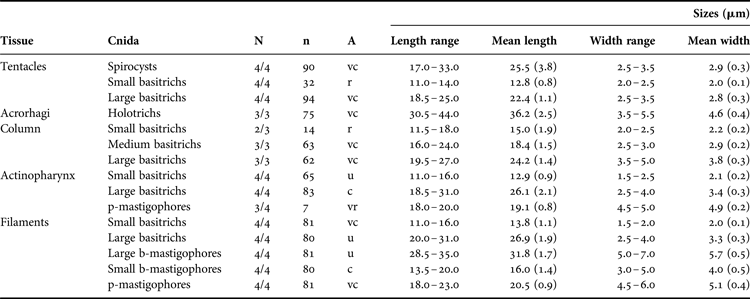
Spirocysts, basitrichs, microbasic p-mastigophores, microbasic b-mastigophores and holotrichs (Table 1). The cnidae makeup and sizes agree with previous descriptions of this species (Carlgren, Reference Carlgren1951; Daly, Reference Daly2004). However, we also found small basitrichs in the tentacles and observed three size-classes of basitrichs in the column. Nematocysts were scarce in the actinopharynx tissue and p-mastigophores were very rare, which coincides with Daly's (Reference Daly2004) observations.
Cnidae of Bunodosoma californicum. N is the proportion of examined specimens with a given type of cnida, n is the number of capsules measured, A (abundance) indicates how common a given type of cnida was in each tissue type (vc, very common; c, common; u, uncommon; r, rare; vr, very rare). Parentheses next to the mean length and width indicate standard deviation.
PREVIOUS RECORDS
The Gulf of California in Mexico (Carlgren, Reference Carlgren1951; McCommas, Reference McCommas1991; Daly, Reference Daly2004) and the Pacific coast of El Salvador (Daly, Reference Daly2004).
DISCUSSION
This is the first record of Bunodosoma californicum for Costa Rica. Because this species was found on an artificial breakwater near a major port (Caldera), it is possible that it has been recently introduced. However, sea anemone diversity in Costa Rica has only recently been studied in depth (see Acuña et al., Reference Acuña, Garese, Excoffon and Cortés2013), so it is possible that species were overlooked during previous benthic surveys due to a lack of taxonomic specialists. This new record increases the biodiversity of sea anemones (sensu stricto) in Costa Rica to 15 species.
ACKNOWLEDGEMENTS
We thank the Centro de Investigación en Ciencias del Mar y Limnología (CIMAR) for providing the equipment necessary for this study. We also thank Brian Bingham for reviewing the manuscript.