Introduction
In addition to pharmacotherapy, potential strategies to help smokers in their quit attempts include group therapy and social support. It has been shown that the chances of quitting in group level interventions are almost double that of self-help interventions (Stead & Lancaster, Reference Stead and Lancaster2005). Further, smoking behaviour is thought to be influenced by immediate and distant social connections, and social support is important to cessation (Christakis & Fowler, Reference Christakis and Fowler2008). Another potential cessation technique includes incorporating physical activity into quit attempts. For example, bouts of physical activity may help alleviate withdrawal symptoms and cravings (Hassova et al., Reference Haasova, Warren, Ussher, Janse Van Rensburg, Faulkner and Cropley2014; Roberts, Maddison, Simpson, Bullen, & Prapavessis, Reference Roberts, Maddison, Simpson, Bullen and Prapavessis2012). Suggesting that there is still more work to be done in the area, Ussher, Taylor, and Faulkner (Reference Ussher, Taylor and Faulkner2014) found that only 4 of 20 studies showed a significantly higher abstinence rate for the exercise groups compared to control, and only two of twenty studies supported the effectiveness of exercise for smoking cessation long-term. Limitations such as small sample sizes, lack of resources for exercise and insufficient exercise dose were identified. Most interventions also tend to be small in scale and reliant on supervised, dedicated exercise facilities (Ussher, Taylor, & Faulkner, Reference Ussher, Taylor and Faulkner2014). As such, community-based interventions that are scalable need consideration.
Run to Quit is a national program in Canada designed to target two health behaviours, smoking and physical activity through group running clinics. Run to Quit involves a partnership between the Canadian Cancer Society, Running Room Canada and the Public Health Agency of Canada. To address smoking cessation, the program incorporates evidence-based behaviour change techniques of self-monitoring, imagery and goal setting with use of additional resources including: Smokers’ Helpline counselling support, and the One Step at a Time booklet (Canadian Cancer Society, 2013). As part of the program, participants also receive information from pharmacists about nicotine replacement therapies (NRT) and receive free samples of NRT gum which they are encouraged to try. The physical activity portion incorporates Running Room Canada's learn-to-run curriculum, a progressive learn to run 5 km program over 10 weeks using walk/run intervals. For the in-person clinics, the smoking cessation and running curriculums are combined and integrated in a group setting so participants learn to run, while receiving social support in their smoking cessation attempts. Run to Quit participants met at a Running Room store with other participants and a coach for weekly training sessions. These sessions included classroom time to cover the running and smoking related curriculum (e.g., use of NRT, injury prevention information; see Priebe, Atikinson, & Faulkner, Reference Priebe, Atkinson and Faulkner2017 for all techniques utilized). After the classroom portion, participants walked or ran with their coach and group. Participants were encouraged to walk or run two other times each week at the Running Room or on their own. In this first year, the in-person Run to Quit intervention was delivered at 21 clinic locations in the Canadian provinces of British Columbia (2), Alberta (2), Ontario (13), Quebec (2), Newfoundland (1) and Nova Scotia (1). Further details regarding the entire mixed methods evaluation approach used to assess the program has been published elsewhere (see Priebe et al., Reference Priebe, Atikinson and Faulkner2016).
Quantitative outcomes of the first year of the program identified that 50.8% of participants who completed the program achieved seven-day point prevalence assessed by carbon monoxide testing (intent-to-treat = 19.6%). There was also a significant increase in self-reported running frequency (times/week) (see Priebe et al., (Reference Priebe, Atkinson and Faulkner2017)). These results were promising in that cessation rates were comparable to other multimodal smoking cessation interventions while also contributing to increased physical activity (Stead, Koilpillai, Fanshawe, & Lancaster, Reference Stead, Koilpillai, Fanshawe and Lancaster2016). However, attrition was high (43.4%). Thus, it is important to explore the experience of participants as it may provide insight into the overall strengths and weaknesses of the Run to Quit intervention. In turn, this information could inform future program modifications prior to expansion across Canada. Therefore, the aim of the current study was to explore participant experiences of the Run to Quit program after its first year, and identify potential areas of improvement for future iterations of the program.
Methods
Research Design and Procedures
The evaluation was approved by the University of British Columbia (UBC) Institutional Ethics Review Board. Semi-structured phone interviews lasting 20–40 minutes were conducted with participants by a research assistant working in the Population-Physical Activity lab at UBC.
Participants
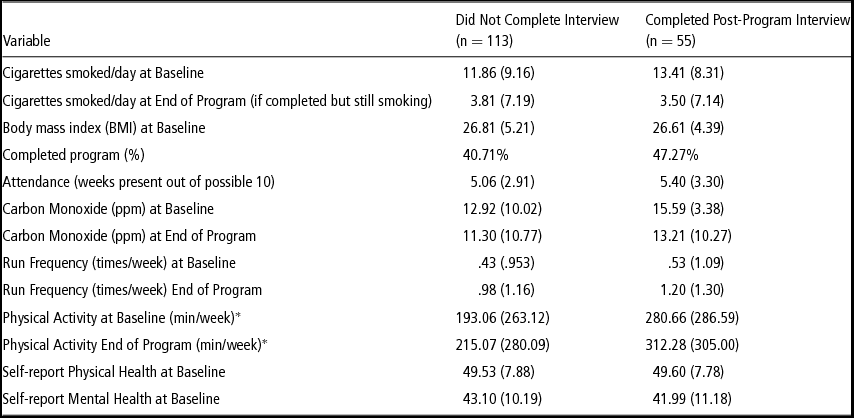
All Run to Quit participants who started the program (n = 168) were invited to participate in interviews. Of the total participants who started, 55 completed interviews at the end of the program. These 55 participants included a mix of participants who completed the program (n = 30) and those who did not (n = 25). In terms of demographics and outcome variables, participants interviewed did not differ from those who were not interviewed with the exception of one variable. Participants who were able to be reached and were willing to be interviewed were higher in moderate to vigorous physical activity at baseline and end of program (p < 0.05). For further comparisons see (Table 1). Like the overall sample (see Priebe et al., Reference Priebe, Atkinson and Faulkner2017), the majority of participants interviewed were female, middle-aged and Caucasian. Of the 55 participants interviewed, 15 (27%) completed the program and quit smoking, 15 (27%) completed the program but did not quit smoking, 21 (38%) did not complete and were still smoking and 4 (7%) did not complete Run to Quit and were no longer smoking. This quit rate for those interviewed who completed the program (50%) is nearly identical to that of the whole sample (50.8%) and was substantially higher than the quit rate for those who did not complete.
Differences between those participants interviewed and those who did not complete the post-program interview

*Though highly variable, physical activity at baseline approached significance between the two groups (p = .057) and physical activity minutes per week at end of program was significantly different (p = 0.045). There were no other differences between those interviewed and those not at baseline or end-of-program.
Measures
Participant Interviews
Interviews included questions about their experience with various elements of the program (the structure of the running and classroom sessions, the coaches, the quit aids, quit and group support provided) and open-ended questions about what participants found the most and the least helpful elements for quitting smoking and taking up running, benefits of the program, and suggested future changes to the program.
Data Analyses
All interviews were audio-recorded and transcribed. To maintain confidentiality, participant numbers were assigned to each participant. Thematic analysis (Braun & Clarke, Reference Braun and Clarke2006) was used to identify, name, categorize and describe broader themes regarding concepts such as satisfaction, program strengths and weaknesses, and reasons for not completing the program. The transcribed interviews were all read and participant quotations were coded based on these concepts. QSR International's NVivo 11 Software was used to facilitate qualitative data analysis. We adopted a number of criteria to enhance the ‘trustworthiness’ of our study. First, interview transcripts were analysed individually by the first three authors (KG, MO & CP) and the primary outcomes identified were consistent. Second, throughout the analysis process, interpretations were discussed within the broader research team to challenge the identified themes and sub-themes in a form of peer debriefing (Lincoln & Guba, Reference Lincoln and Guba1985). These are now presented as broader themes: satisfaction with the program, what helped with smoking cessation, program strengths and weaknesses, and reasons for not completing the program.
Results
Satisfaction with Program
Regardless of completing the program or not, participants found the program to be beneficial in assisting them with their quit smoking and physical activity goals. Irrespective of smoking cessation outcome, participants enjoyed the health benefits of becoming more physically active. One participant expressed,
“What I really gained out of this program is learning how to run. I love how it makes me feel, and I know I will keep this up” (Participant, non-completer, smoker at end, female).
Another participant speaks to her positive experience with the program in general saying,
“It was fantastic. . . everybody was motivating me and you had cheerleaders. . . and they're all going through the same thing you're going through which is fantastic, because usually when you quit smoking you've got your family members wagging their fingers at you. This time you have a group of people who are all going through the same thing so it definitely helps in the quitting process” (Participant, completer, non-smoker at end, female).
Overall the program was well received by participants, and participants indicated that that they would recommend it to other smokers intending to quit.
Smoking Cessation
For those who quit, one theme captured a primary reason for success. For those that did not, another theme captured a major barrier to success.
Accessing Quit Aids
Participants were provided with information and instructed on how to access a variety of smoking cessation aids through the One Step at a Time booklet (CCS, 2013). Overall, participants that experienced the most success with quitting smoking were also the ones who described taking advantage of other quit aids and using them in conjunction with the group and running support provided throughout the program. As one participant explained:
“I was on Zyban for a while. . .it kind of took away the edge like the actual craving for the cigarette, so that really helped” (Participant, completer, non-smoker at end, female).
In the participants’ view, smoking cessation aids also helped maintain abstinence from smoking when in stressful situations and when social supports provided throughout the program were not available (e.g., on a non-clinic day).
Mindset: Being Ready to Quit
Participants that did not quit smoking perceived themselves as not ‘being ready’ to quit, which represented a barrier to quitting. Participants expressed other reasons for joining the program other than to quit smoking which included reducing smoking, forming new social connections, or learning to run. As one non-quitting participant expressed:
“I went in to just try to adopt a new healthy habit, not necessarily with the mindset that I was going to quit smoking, but it's like- okay, we'll try this and see how it goes” (Participant, completer, smoker at end, female).
Participants also expressed that they did not quit at the end of the program because they did not feel ready to quit when they started.
Program Strengths
The Group Dynamic
Participants, regardless of program completion status, identified group support as one of the largest strengths of the program. Many participants valued group discussions as an avenue to share personal stories of successes and failures in their quit attempts. Once relationships were established, a sense of accountability to one another became a strong factor that motivated participants to overcome setbacks in reaching their goals. As one participant explained:
“The level of support amongst our peers, if you will, was unsurpassed. I've never felt this level of support in anything I've done before. . . for us as a group it was about supporting each other in this process” (Participant, completer, smoker at end, male).
Another participant highlighted the group aspect, as well as the running, as being something novel for her quit smoking attempts saying,
“The big thing for me was the group. . . especially combining the group with the run –I desire to learn to get back to running too, so when you put the group and the running together, that was great” (Participant, Completer, non-smoker at end, female).
Many participants developed relationships that extended outside of the program and mentioned planning informal social get-togethers with other participants.
Supervised Participation
Many participants explained how impactful the Run to Quit coaches were in motivating them to reach their smoking and physical activity goals during the program. This came out particularly for those participants that completed the program. Some of the personal qualities that made an exceptional coach according to participants were an encouraging, supportive and non-judgmental attitude. Creating an inclusive atmosphere where participants could progress through the program at their own pace was important, as one participant explained:
“They just encouraged you, and it didn't matter how fast or slow you were running or how fast or slow you were reaching your quit date, they were totally on your side cheering you on no matter what” (Participant, completer, non-smoker at end, female).
Many of the Run to Quit coaches were previous smokers themselves which enhanced their ability to relate to the hurdles that participants experienced in their efforts to quit smoking.
Running Component
Many participants felt that the running component of the program was integral in supporting their efforts to reduce or quit smoking, and that they enjoyed this aspect of the program. One participant expressed:
“. . .learning how to run it just helps so much . . . it helps get you back in shape and helps you breathe easier. . .it instantly makes a difference in feeling the effects of being a smoker and not a smoker” (Participant, completer, non-smoker at end, female).
Exercising seemed to make the benefits of quitting smoking more prominent as many participants mentioned that breathing became easier and running endurance increased during the program.
Program Weaknesses
Wide Range in Participant Walking and Running Abilities
Difficulty for coaches in dealing with the wide range of running abilities was perceived as a weakness by some participants particularly among those who did not complete the program. Some individuals that joined the program had years of running experience and were fitter, while other participants had little to no experience and were deconditioned. One participant stated that:
“. . .I was the only walker in the group, everybody else ran, so of course they had to dedicate a coach to me which I felt guilty about . . .and the group would come back and we would regroup and all that sort of thing. . . it was a bit of a deterrent” (Participant, non-completer, smoker at end, female).
A progressive run curriculum that was not tailored to individual physical fitness levels was identified as a contributing factor for non-completion.
Smokers’ Helpline
The Smokers’ Helpline was intended as an additional, evidence-based resource for support and encouragement for participants. It was planned that the participants would receive a call from the Helpline once the program started. However, this did not happen in most cases while a few participants reported negative experiences. One participant recalled:
“. . . I called and my experience about calling the quit line, it could have been the person, it could have been the day, it could have been myself, but I had a bad experience. . . it didn't help me off that ledge” (Participant, completer, smoker at end, female).
Overall, the helpline component of the Run to Quit program was not implemented as intended.
Reasons for not Completing the Program
Logistical and Personal Reasons
For program non-completers, most voiced a combination of logistical and personal reasons that prevented them from attending the in-person clinics. Participants found it difficult to attend regularly due to overtime work, rush hour traffic and the development or reoccurrence of injury. One participant explained how factors outside of her control impacted program completion, but that a closer clinic may have helped her finish the program:
“Work was a big thing, good excuse and everything but also even where the runs were taking place it was kind of a hassle at six o'clock in rush hour. Like if they had a location closer to me- that actually would have helped” (Participant, non-completer, smoker at end, Female).
When participants continually missed clinics, they perceived it as difficult for them to come back and keep up with the increase in pace of walking or running. This also contributed to program dropout.
Discussion
The findings from the first phase of the national Run to Quit program give insight into participant experiences to help guide and inform future program implementation. The results elucidate factors that affected drop out from the program as well as program strengths and weaknesses, and commonalities amongst individuals who quit smoking compared to those who did not. Overall, participants were satisfied with the program and appreciated its group-based nature, the running component and the support of the coaches. Several areas for improvement were identified including the need to improve access to the Smokers’ Helpline, to tailor the program for differing levels of running abilities and fitness levels, and to reduce logistical challenges to adherence.
The group based aspect of Run to Quit likely generated social support and accountability. Other researchers have reported that group aspects and social support may have been contributing factors to program completion and health behaviour change (Benson, Stronks, Willemsen, Bogaerts, & Nierkens, Reference Benson, Stronks, Willemsen, Bogaerts and Nierkens2014). Participants also had overwhelmingly positive experiences with their coaches, seeing them as non-judgemental and encouraging. Some of the coaches were previous smokers, whom participants found relatable. The peer support from coaches and the group likely aided quitting for those who were able to (Ford, Clifford, Gussy, & Gartner, Reference Ford, Clifford, Gussy and Gartner2013).
Participants in this program not only enjoyed the running aspect, but viewed it as a facilitator in helping to quit smoking. While it is unclear if the exercise itself helps people quit (Ussher, Taylor, & Faulkner, Reference Ussher, Taylor and Faulkner2014), individuals in this program certainly perceived that it did. Some participants felt that to improve performance in their running they needed to reduce their intake of cigarettes, and this was viewed as a motivator to quit. Notably, quitters also attributed their success to their use of other aids such as NRT suggesting that exercise was not necessarily a standalone intervention for smoking cessation. Some evidence shows that providing information and problem solving techniques in addition to the use of NRT may help with adherence to the medication, and increase abstinence (Hollands et al., Reference Hollands, McDermott, Longson-Hawley, Vogt, Farley and Aveyard2015). The One Step at a Time booklet (CCS, 2013) utilizes such strategies, which in conjunction with guest speakers such as pharmacists during the program, may have helped participants identify the right mix of cessation aid(s) that were personally beneficial. This reflects the nature of the Run to Quit program which was designed to provide participants with exposure to a wide range of smoking cessation supports within the context of a learn-to-run program.
One component of this multifaceted program was not successfully implemented. Most participants did not report receiving a call from the Smokers' Helpline as originally intended as part of the program design (see Priebe et al., Reference Priebe, Atikinson and Faulkner2016). Some participants who contacted the Helpline directly had a negative experience with the Smokers' Helpline or found it was not helpful for their personal quit smoking attempts. Participants said that they did not learn anything new, and that the conversation felt scripted. This is similar to the participant experiences in another study of a quit smoking telephone counselling based service (Morphet, Partrdige, Gartner, Carter, & Hall, Reference Morphett, Partridge, Gartner, Carter and Hall2015).
Insight into participant experiences will assist in the future implementation of Run to Quit, and potentially other exercise-aided smoking cessation and maintenance programs. The strengths of the program should be highlighted in future years, with an emphasis on the importance of fostering supportive relationships among group members and the Running Room coaches. The identified weaknesses provide room for improvement for future iterations of the program. The program is delivered by Running Room coaches with little training in smoking cessation support, and so there is a need to examine the partnership with the hotline service, and encourage closer collaboration at the start (e.g., one coach suggested having a conference call style question and answer time with the Smokers' Helpline at a training session) so all participants can be exposed to it.
To address the need for a greater variety in walking or running progressions, the program should be tailored to a wider range of running abilities. There may be a need to add a complementary ‘walking’ group and potentially broaden the marketing of the program to ‘run or walk to quit’. Additional support should also be provided through mentors or group leaders to manage diversity in physical abilities within clinics. The program is expanding to more Running Room locations across Canada in future years to hopefully address the logistical barriers participants experienced that affected program completion. It should also be conveyed to participants that attendance is not ‘all or nothing’ and that accommodations within the program (e.g., walking or running at a slower pace) will be made when participants return after an absence from the program.
A strength of this study was that participants were interviewed regardless of completing the program or not, and if they quit smoking or not, gaining insight into a variety of experiences. While activity levels differed slightly between those interviewed and those not, indicators of smoking status did not. The interviews provided additional insights that were not available through the quantitative assessment at week 10 (e.g., quit rates were compared for this sample in those who completed the program, 50% quit smoking, versus those who did not, 16% quit). A limitation is that participants that did agree to be interviewed may not be representative of the views of all participants that participated in the program. However, we were successful in receiving feedback from approximately a third of the sample. Notably, the sample was more physically active than those who did not complete the interview and this may have influenced in the generally positive perceptions of our participants. More broadly, the Run to Quit participants and the participants interviewed in this study were predominantly female, middle-aged and Caucasian, and were moderate smokers. Caution is required in broadly generalizing the findings.
In conclusion, The Run to Quit program was well received by participants. Multiple health behaviour interventions at a scalable level appear feasible and the above recommendations should be considered for future implementation of this program, and other community-based exercise and smoking cessation interventions.
Acknowledgements
We sincerely thank the staff and management at Running Room Canada and the Canadian Cancer Society for providing the opportunity to collaborate on this project. Guy Faulkner is supported by a Canadian Institutes of Health Research-Public Health Agency of Canada (CIHR-PHAC) Chair in Applied Public Health.
Financial Support
This work was supported by the Public Health Agency of Canada (Grant # 5R25344).
Conflict of Interest
None.
Ethical Standards
The authors assert that all procedures contributing to this work comply with the ethical standards of the relevant national and institutional committees on human experimentation and with the Helsinki Declaration of 1975, as revised in 2008.