


Introduction
The education and training of supervisees has not received the same level of attention as the education and training of supervisors, and the present paper is concerned with preparing mental health nursing staff to be supervisees. Clinical supervision is most often not a formally integrated part of nursing education, as, for instance, seen in educational programmes in psychology. This means that graduate nurses often have limited knowledge and experience of clinical supervision practices and their aims. Weak or non-existing organizational structures supporting clinical supervision and limited resources in clinical work settings may add to a general misconception and resistance towards clinical supervision in nursing (Cutcliffe, Reference Cutcliffe, Cutcliffe, Hyrkäs and Fowler2011).
In the introductory paper to the Special Issue, Milne & Reiser (Reference Milne and Reiser2016) suggest that supervisors need substantial organizational assistance in order to support (a restorative function), guide (a normative function) and develop (a formative function) their clinical supervision. In the present paper, we extend on Milne & Reiser's core argument about the necessity of organizational support of clinical supervision by highlighting the support required for supervisees. We will approach this issue by drawing on a previously reported study of the development and test of a meta-supervision intervention on mental health nursing supervisees. Based on two supplementary analyses, we will emphasize how the meta-supervision intervention engaged the supervisees more actively in the process of supervision and enhanced their reflections and capacity to develop concrete strategies for improving their own supervision experience and supervision practices.
Background: motivation for developing a meta-supervision intervention
In most parts of the Danish mental health services, clinical supervision is offered regularly to nursing staff. However, there is no solid evidence for any effects of supervision, neither on the nursing staff nor on the people they care for (Buus & Gonge, Reference Buus and Gonge2009). Therefore, we conducted a sequential mixed methods study aiming at mapping and exploring factors influencing mental health nursing supervision practices (Buus & Gonge, Reference Buus and Gonge2012). In the following section, we will emphasize some of the key findings of the study.
The quantitative part of the study included administrative database data, self-report data, and a longitudinal registration of attendance (Gonge & Buus, Reference Gonge and Buus2010, Reference Gonge and Buus2011). These analyses indicated that during a 3-month observation period 81 (47.4%) out of 171 survey respondents did not participate in the provided supervision sessions. Furthermore, survey respondents who reported high cognitive demands in their job were less likely to participate in clinical supervision, and reports of high social support from colleagues in everyday work was associated with a higher participation rate. The qualitative part of the study included semi-structured interviews with 22 mental health hospital nurses. The analysis indicated that the nurses understood supervision to be beneficial, but without much influence on clinical practice, and, furthermore, that the nurses found participation in the group-based supervision anxiety-provoking because of pressure towards exposing professional uncertainty in open groups. Finally, although the interviewees were in favour of clinical supervision they stated that neither management or nor staff effectively prioritized supervision (Buus et al. Reference Buus, Angel, Traynor and Gonge2010, Reference Buus, Angel, Traynor and Gonge2011).
The results from the study underscored a challenging issue: considering the reports of collective low prioritization of clinical supervision and avoidance of participation because of anxiety and stress, how is it possible to intervene and organize supervision in ways that will increase the number of staff participating regularly in supervision? We engaged with this challenge by designing a meta-supervision intervention.
Meta-supervision
Several authors have used the term ‘meta-supervision’ to describe the on-going supervision of supervision, see for instance Wellington (Reference Wellington2010). Mostly, the focus has been on the meta-supervision of supervisors’ practices. Newman (Reference Newman2013) described the contents and processes of a graduate training course in cognitive behaviour therapy (CBT) supervision of new supervisors. In the subsequent discussion of how to further facilitate the low-risk development of supervisors’ skills, Newman suggested ‘simulated supervisory situations’ and ‘meta-supervision’ as possible strategies. Meta-supervision referred ‘to situations in which a highly experienced clinician serves as a consultant to a clinical supervisor’ (Newman, Reference Newman2013, p. 13). The consulting role meant that the meta-supervisor had minimal authority over the supervisor's work, and the central role of the meta-supervisor was an enthusiastic and knowledgeable engagement in the supervisory process. In a similar vein, Barney et al. (Reference Barney, Andersen and Riggs1996) described a training programme for sports psychologist graduates, which was followed up by meta-supervision, ‘supervision of supervision’ (p. 208), of the neophyte supervisors’ supervision in situations where a client presented an issue that lay outside the supervisor's expertise. Meta-supervision was ad hoc and initiated when a supervisor sought help for his/her own supervision practices.
In line with the two above-mentioned approaches’ emphasis on ‘supervising supervision’, we developed a meta-supervision programme for mental health nursing supervisees. However, it differed significantly from the two approaches mentioned above by focusing exclusively on supervisees and their supervision practices and by being a short-term group-based intervention initiated and led by an external ‘meta-supervisor’. Furthermore, the method differed by systematically drawing on principles of action learning to activate and inspire supervisees to develop strategies for influencing their own supervision and supervision practices (cf. Hawkins & Shohet, Reference Hawkins and Shohet2006). The meta-supervision drew on two pedagogical strategies: to educate supervisees as a preparation for supervision and to supervise supervisees to systematically reflect on and strategically change their own supervision practices (Buus et al. Reference Buus, Cassedy and Gonge2013).
In the following sections, we refer to the mental health nurses participating in meta-supervision as supervisees and to the external ‘meta-supervisor’ as consultant.
Pilot and test of the meta-supervision intervention
The meta-supervision intervention was designed as a supplement to usual supervision to strengthen nursing staff clinical supervision practices and their sense of ownership of these practices. As the challenge was to improve the prioritization of supervision and increase the level of participation, the supervisees were encouraged to reflect on personal and organizational benefits and barriers to their supervision and to develop and implement strategies to overcome these barriers (Buus et al. Reference Buus, Cassedy and Gonge2013).
The intervention included three sessions: a 3-hour introductory session and two 75-min follow-up sessions, which were held at 6- to 8-week intervals. At the beginning of the introductory session, the consultant set the agenda and introduced the purpose of the intervention. The first part of the introductory session included teaching about the core characteristics and basic functions of clinical supervision as well as about supervisees’ role, tasks and responsibilities during supervision. In the second part, the supervisees described how much supervision they had participated in as well as the type and structure of the present supervision on the ward. In the third and fourth part, the supervisees explored their experienced benefits and barriers to fulfilling the potential benefits of supervision. The fifth part had a strong problem-solving focus and supervisees formulated individual and concrete strategies for overcoming the perceived barriers, thereby strengthening the ‘receipt’ (Johnston & Milne, Reference Johnston and Milne2012) of their supervision.
Action learning at the core of parts three, four and five was facilitated by a procedure where the consultant asked the supervisees to reflect on a topic (benefits, barriers or strategies) and summarize his/her reflections in writing. Thereafter, the supervisees presented their reflections to the group and the consultant would inquire further about the meaning of the reflections and write down the central issues on a poster. The interactive inquiry allowed the supervisees to learn with and from each other and served as a way of instantly validating (Brinkmann & Kvale, Reference Brinkmann and Kvale2014) the consultant's paraphrases of the reflections. With regards to the formulation of the individual strategies, the consultant actively challenged each supervisee to make the project specific and feasible.
The two follow-up sessions were also based on principles of action learning and were aimed at continuing the joint development of new behavioural strategies on the basis of systematically exploring reflections on previous experiences in the context of new experiences (Hawkins & Shohet, Reference Hawkins and Shohet2006), namely the implementation of the personal strategies. Depending on the supervisees’ evaluations, these reflections would lead to a corroboration of the personal strategies, an adaption of the strategies and/or to the formulation of additional strategies.
The pilot study and the randomized controlled trial (RCT) took place at different mental health hospital wards where group-based supervision had been implemented for several years. The usual supervisor did not participate in the three sessions. During the pilot, there were two consultants; however, the second consultant had an observational role primarily.
After the pilot study, we tested the meta-supervision intervention in a RCT comparing meta-supervision and usual supervision to usual supervision (Gonge & Buus, Reference Gonge and Buus2015). The sample (n = 83) included nursing staff from three general mental health hospital wards. The study indicated, that staff in the intervention group participated significantly more frequently in supervision compared to the control group. However, more frequent participation did not influence positively on the experienced effectiveness of the clinical supervision or on the general formative or restorative benefits.
The two supplementary analyses
In the following two sections, we will illustrate the meta-supervision process by presenting supplementary data collected during the intervention. The first data sample is based on an audio recording from the pilot study (Buus et al. Reference Buus, Cassedy and Gonge2013) and the aim of the analysis was to examine and illustrate the verbal content and the conversational group interactions during the meta-supervision process. The second data sample consists of supervisees’ descriptions of benefits, barriers and personal strategies formulated during the RCT intervention sessions (Gonge & Buus, Reference Gonge and Buus2015) as paraphrased by the consultant. The aim of this analysis was to characterize and summarize the participants’ own concerns about engaging in their own supervision.
Audio recordings from the meta-supervision process in the pilot study
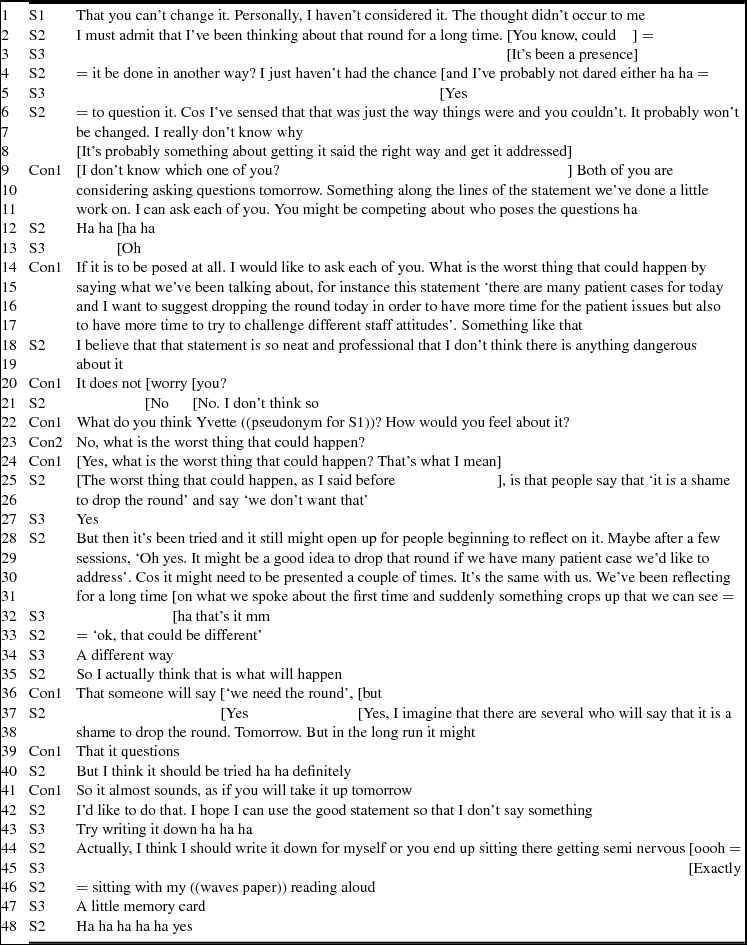
In this section, we present and interpret a relatively lengthy data extract (see Table 1) to illustrate some of the basic interactive features of the meta-supervision intervention. The data extract is a transcription of a sample of an audio recording made during a first follow-up intervention session. It exemplifies how the supervisees had started to reflect on and formulate ideas for strategically changing their supervision practices. The particular sample was chosen because the content and the group dynamics were both illustrative and common for the intervention.
An illustration from a first follow-up session

Transcription symbols: [square brackets] indicate the beginning/end of overlapping talk on horizontally adjacent lines; ‘ = ‘ at the end of a line indicates that it latches onto a following line (beginning with an ‘ = ‘).
((Double parentheses)) contain contextual information.
The transcription was translated from Danish into English by the authors.
The sample's duration was approximately 2 min, and it was transcribed with indications of basic turn-taking and selected extra-linguistic features, such as laughing, but not details of speech delivery, such as false starts, pauses, emphasis, etc. (cf. Hutchby & Wooffitt, Reference Hutchby and Wooffitt2008). The decision to limit the transcription details was taken in order to preserve the readability of the text. The transcription begins approximately 45 min into the session and at this point in time the verbal interactions were informal and conversational with frequent interruptions and overlapping speech.
There were three supervisees (S1, S2 and S3, all female) and two consultants (Con1 and Con2, both male) present at the pilot session. The five participants had met for the first time during the introductory session, 6 weeks earlier. A fourth supervisee, the ward manager, had participated in the introductory session, but had called in sick for this session. At the previous introductory intervention session, the supervisees had articulated some preliminary ideas about changes they would like to see happening in their own supervision. Coincidentally, a usual supervision session had been cancelled and the first usual supervision session since the initiation of the intervention was scheduled for the following day. This meant that the supervisees had been reflecting on their supervisory practices without an opportunity to act on them, but that they were keen to try out changes the following day. Prior to the conversation reported in the sample, the supervisees had been considering their relationship to the usual supervisor as a potential barrier to making changes to the supervisory practices because supervision practices were so conventionalized that they had never considered requesting changes.
The first speaker in the data extract was S1 (line 1) who explained that she had not previously considered suggesting changes to the supervision and emphasized that she had not even thought about such changes. S2 (line 2) picked up on S1's statement by respectfully disagreeing, ‘I must admit’, and stated that she had thought about alternatives to the introductory round made at the supervision sessions. She continued (lines 4 and 6) by making excuses as to why she had not previously suggested changes, which included lack of opportunity and courage. The potential trouble of stating that she was not courageous enough, ‘I’ve probably not dared either ha ha’, was downgraded by adding the modifiers ‘probably’ and ‘I really don't know why’ (line 7), and a short laughter, which could also indicate a liberating recognition of a communal problem.
In lines 8–9, S2 and Con1 started talking at the same time and S2 left the conversational floor. Con1 continued with a humoristic reflection on S1 and S2 sharing the task of addressing the supervisor (lines 9–11), which was found surprising and humorous by S2 and S3. Con1 continued by posing a question about the potential outcome of addressing the supervisor ‘what is the worst thing that could happen?’ and by rehearsing the core argument that had previously been forwarded in the session, that the round is lengthy and takes time away from other important issues. S2 responded to this by using reported thought twice, ‘I think’ and ‘I don't think’ (lines 18 and 21), as to indicate the rationale behind her personal reflections, and stated that she did not think that the strategy would be dangerous to forward at supervision. Con1 followed up by asking a leading question about feelings in relation to addressing the supervisor, ‘It does not worry you?’ (line 20), which was confirmed by S2 (line 21).
Con1 continued by addressing S1, but this time he continued the conversational topic and phrased the question in terms of feelings (line 22). This was immediately repaired by Con2 who self-selected as speaker and posed the original question again, ‘what is the worst thing that could happen?’ (line 23). S2 self-selected as speaker and took the conversational floor after a period of speaking at the same time as Con1, who had started repairing the trouble created by Con2's repair (lines 24–25). S2 continued to respond to the question and stated how she imagined a response from her fellow supervisees at the usual supervision to a suggestion about changing the round. She did not expect immediate changes and downgraded the potential outcome (lines 25–26). However, she indicated a fundamentally optimistic stance by emphasizing that change often presupposes several attempts, and she compared the situation to what had happened to the present group of supervisees as an engaging example of change over time, ‘It's the same with us’ (line 30). S3 found the comparison amusing and confirmed it (line 32).
S2 repeated her vision of the response from her fellow supervisees at usual supervision and both S3 and Con1 contributed with short phrases acknowledging S2's ideas (lines 34, 36 and 39). S2 concluded by stating, ‘But I think it should be tried ha ha definitely’ (line 40), where the laughter seemed to legitimize an attempt to ask for change, although the opposition was probably too hard for creating immediate change. Con1 carefully re-phrased the conclusion as a question about the following day (line 41), which was acknowledged by S2, who considered how to challenge the usual supervisor without appearing stupid. ‘Stupid’ was omitted at the end of line 42, ‘so that I don't say something [stupid]’. S3 suggested that S2 should write the question down and laughed (line 43). S2 acknowledged this suggestion as helpful, and S3 continued by joking about having a supportive ‘memory card’ (line 47).
A central issue running through the data extract was S2's fear of raising a different view on supervision practices and appearing stupid in front of the usual supervisor and supervision group, e.g. ‘I’ve probably not dared’ (line 4) and ‘so that I don't say something [stupid]’ (line 42). Fear was not discussed extensively, which was probably because S2 explicitly rejected being worried about addressing the supervisor (line 21). However, the cognitive and practical preparations for overcoming fear and addressing the usual supervisor successfully were rehearsed by S2 who also generated and received social support from the group. At a more general level the data extract illustrated how the meta-supervision assisted the supervisees in: (1) imagining change, (2) creating opportunity for change, (3) crafting concrete steps towards change, and (4) creating a sense of collective action.
The staff's descriptions of barriers and personal strategies
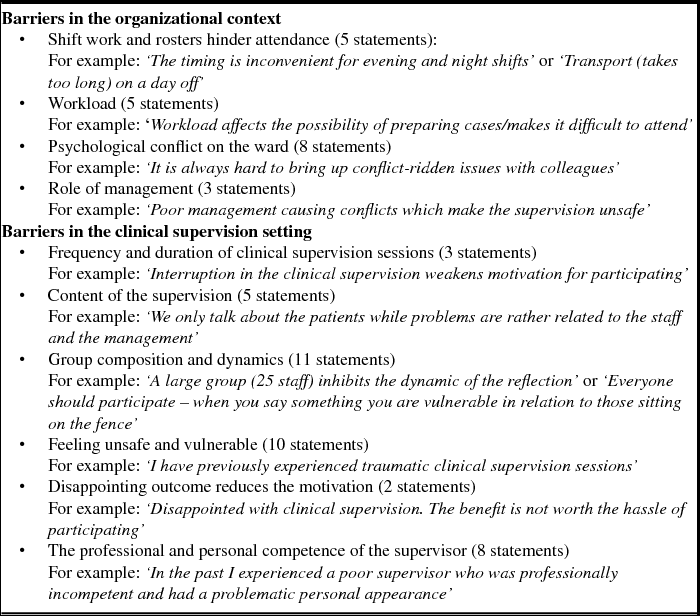
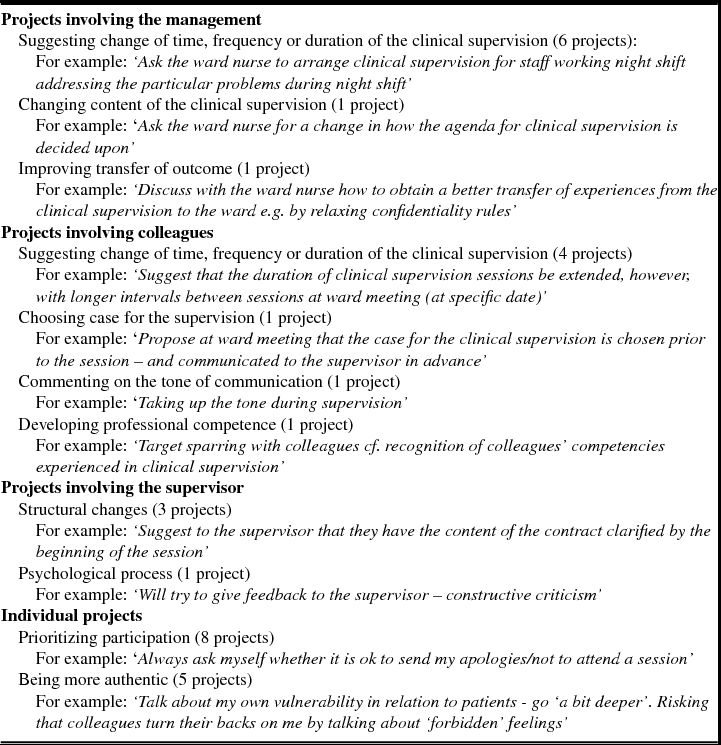
In this section, we present supervisees’ ideas about the perceived barriers to the potential benefits of supervision and personal strategies for overcoming these barriers as stated during the RCT. Supervisees’ articulation of these issues was a central part of the meta-supervision intervention, and it resulted in personal scrap notes and in several collectively written posters. We collected the posters after each introductory session, and a critical reading of these statements allowed us to create the categories of benefits, barriers and strategies/projects. In this paper, we focus on the intervention's capability to change supervision practices, and therefore we only present and discuss the barriers and the projects (see Tables 2 and 3).
Barriers to participation in and effectiveness of clinical supervision

Projects aiming at strengthening clinical supervision

The barriers to supervision identified by the supervisees were categorized into barriers from an organizational perspective or barriers within the clinical supervision sessions. These barriers were both structural and psychological.
Barriers in the organizational context
A common structural barrier was shift work and rosters, which hindered attendance, particularly for night-shift workers who found it hard to participate in clinical supervision sessions, which were often scheduled during daytime. Workload often made it challenging for staff to find time for participation, but also impacted on their ability to prepare themselves mentally for clinical supervision. Psychological conflicts at the ward inhibited staff from bringing up precarious issues or from confronting certain colleagues during the clinical supervision sessions. Moreover, the role of management was potentially a barrier either indirectly through a poorly managed conflict-ridden work environment or directly if supervisees did not welcome the manager's participation in clinical supervision sessions.
Barriers in the clinical supervision setting
Frequency and duration was a structural barrier to the actual clinical supervision sessions, because cancelled sessions were demotivating. However, there was not consensus about the optimal frequency as too frequent supervision could lead to giving participation low priority. The content of the supervision was said to constitute a structural barrier, such as a dispensable/unwarranted round, as well as a psychological barrier, such as too much ‘emotion archaeology’ or conflict-avoiding agendas. The most frequently mentioned barrier was the group composition and dynamics where it was believed that the group had to be a certain size for clinical supervision to have an impact, but also that too many supervisees could reduce the openness to discuss sensitive issues. The constellation of the group was said to affect the psychological dynamics if too many supervisees were reluctant or were resisting participation and hence contributing minimally to the reflective processes. This left the rest of the supervisees with a sense of vulnerability when they exposed themselves during supervision. The psychological barrier feeling unsafe and vulnerable also included the issue of self-exposure if clinical supervision took place at a time where supervisees already felt emotionally exposed or – even worse – if they had reason to fear being traumatized or stigmatized in the clinical supervision. Moreover, supervisees described experiences of disappointing outcome as demotivating as the benefits of participating were not worth the efforts. Finally, supervisees experienced the professional and personal competence of the supervisor as causing barriers to effective clinical supervision as the supervisor's lack of skills or resources imposed a limitation to the reflective process.
The supervisees developed projects aiming at strengthening their clinical supervision. Some projects targeted management, colleagues and the supervisor while others were focused on what they needed to do to improve their own clinical supervision experience and practices.
Projects involving the management
Several projects addressed time, duration and frequency of the clinical supervision sessions. Here, the supervisees decided to approach the ward manager asking for a change so that, for instance, staff working night shifts would get access to clinical supervision at a time convenient to them. Other projects involved talking to the ward manager about how the content of the clinical supervision was decided upon and how to ensure a better transfer of the clinical supervision outcome into the daily work.
A vignette illustrating a project aimed at influencing management is given below:
Two supervisees predominantly working night shifts found it most inconvenient that clinical supervision was always scheduled during the daytime and was focused on issues arising during day shifts. They took on the challenge to change this by having clinical supervision scheduled at night-time making it more accessible for evening and night-shift staff to participate and to decide the agenda of the session. They approached the ward manager and explained the need for separate clinical supervision practices especially for night-shift staff. They were successful and additional clinical supervision was subsequently organized in the evening, which facilitated access.
Projects involving colleagues
To discuss time, duration and frequency with colleagues at ward meetings in order to allow more staff to participate and to decide on a frequency and duration that would motivate participation. Projects by individual staff addressed issues to be raised with colleagues such as choosing the case for supervision prior to the session, thematizing the tone of the communication among themselves and seeking opportunities for developing professional competence by engaging in robust and dynamic conversations with competent colleagues.
Projects involving the supervisor
Some supervisees had the intention to propose the supervisor to implement structural changes of the supervision, e.g. by clarifying the contract, providing more education during the sessions or by starting each session with a summary of the previous session. One staff also wanted to practice the psychological process of giving the supervisor positive feedback and constructive criticism.
Individual projects
Almost half of the projects implied that the supervisee would try to start acting differently. The most commonly mentioned ambition was prioritizing participation in clinical supervision, e.g. by planning work or private life differently to be better able to attend clinical supervision. Questioning one's own excuses for not turning up or remembering that by turning up you always allow your colleagues a better chance of reflection or feedback were also described as projects. Being more authentic in the sense of attempting to be more sensitive to what you really think and feel and/or to share own thoughts and feelings more openly with colleagues in the supervision were also projects described by several supervisees during the intervention.
A vignette illustrating an individual project is given below:
A supervisee was scared of bringing up hot issues when the number of supervisees in a session was large. In order to be more authentic, she intended to start practising speaking out what she feared could be ‘dangerous’ issues. She would prepare by testing out her ideas with a trusted colleague in order to find constructive ways of expressing herself.
The supervisees crafted a variety of strategies for strengthening their clinical supervision practices. There was a tendency that barriers in the organizational context outside the clinical supervision setting primarily called for strategies aiming at structural changes. Conversely, barriers inside the actual setting of the clinical supervision to a larger extent inspired actions aimed at creating some kind of psychological change.
Discussion
The central argument in this paper is that the implementation of sustainable clinical supervision must involve organizational support for the supervisee. Most commonly, the organizational support is directed at supervisors. There is a focus on providing education and training and even ‘supervision’ of the supervisor, while there is little attention – if any – given to preparing supervisees. The meta-supervision intervention provided a supportive framework for supervisees, and within this intervention the supervisees demonstrated they were willing and able to actively engage and take charge and personal ownership of their own supervision. Through this activation they not only had the opportunity to enhance their own supervision experience they also demonstrated their capacity to develop strategies to challenge a number of the structural and/or psychological barriers that impacted on clinical supervision and affected other nurses within their organization.
Many psychotherapeutic supervision models are analogous to the interventions used by the supervisees, which can add to supervisees’/therapists’ understanding of the therapeutic methods and their therapeutic skills. For instance, cognitive therapy supervision parallels cognitive therapy by establishing a problem list, setting goals, conceptualizing barriers to the goals and strategizing to overcome the problems (Padesky, Reference Padesky and Salkovskis1996). Likewise, Newman (Reference Newman2013) suggested that a consultant (meta-supervisor) assists in improving general supervision skills and teaches specific CBT supervision. He emphasized that a consultant is in an ideal situation to give feedback, which can assist the supervisor in managing his/her concrete supervision. Newman's approach to meta-supervision was linked to training neophyte supervisors, which meant that teaching and the actual delivery of supervision were central. However, as our meta-supervision targeted supervisees’ supervision practices, and not concrete mastery of therapy methods or client–therapist relationships, etc., the benefits of a strong analogy between meta-supervision and supervision of therapy became less pronounced. This legitimized the development of a more generic model of meta-supervision focused on collaboration and active learning, which is consonant with most supervision models.
Our approach's emphasis on identifying barriers and on problem-solving highlighted a very different set of concerns and a different type of meta-supervision. While supervisors’ and supervisees’ needs for support may not converge completely, we believe, in line with Milne & Reiser (Reference Milne and Reiser2016), that generating organizational support is paramount for developing supervision practices and that the empowerment of supervisors and supervisees can create organizational opportunities.
Exploration of supervision practices begins with a greater understanding of the organizational culture. The literature supports the initial analysis of the culture of the organization as an essential part of change in management and engaging staff in clinical supervision (Driscoll, Reference Driscoll2000; Daly et al. Reference Daly, Speedy and Jackson2004; Grossman & Valiga, Reference Grossman and Valiga2013). A number of the key findings in the meta-supervision study highlighted a number of cultural factors that influenced the supervisees’ participation and engagement in supervision. Through the meta-supervision intervention supervisees not only began to explore some of these cultural elements as barriers but also to explore how they could gently – and in some cases somewhat tentatively – begin to test and even challenge the culture.
Formal assessment of the culture can be undertaken in a variety of ways including conducting a ‘force field analysis’ (Driscoll, Reference Driscoll2000). Lynch et al. (Reference Lynch, Hancox, Happell and Parker2008), for example, described an organizational initiative to implement and sustain clinical supervision. The implementation process was guided by Driscoll's (Reference Driscoll2000) ‘force field analysis’ of the organizational culture. The key steps were: (1) to identify pushing and resisting forces on the implementation process, (2) to discuss these findings in order to define how important each of the forces are, and (3) to develop an action plan for addressing each of the forces, including roles and responsibilities within the action plan. Lynch et al. (Reference Lynch, Hancox, Happell and Parker2008) found that once the culture was assessed the management team developed an action plan that focused on enhancing and strengthening the pushing forces and weakening the resisting forces. While seen as a successful ‘marketing strategy’, it failed to convince staff to attend supervision. One of the key issues was that the top-down process did not, despite the good intentions of the management, activate and engage supervisees.
The meta-supervision intervention resembled Lynch et al.'s (Reference Lynch, Hancox, Happell and Parker2008) approach by thematizing the forces affecting supervision practices, but differed by focusing on the individual supervisees’ perspective and adopting a bottom-up process. Unlike Lynch et al.'s (Reference Lynch, Hancox, Happell and Parker2008) approach, the meta-supervision intervention was effective in increasing the numbers of nurses who participated in clinical supervision. However, it also had some important shortcomings. First, there was considerable individual and inter-ward variation in the preparedness to participate actively in the meta-supervision intervention. Interestingly, within the meta-supervision sessions this was also observed in the supervisees’ reluctance to identify resisting forces and the effort required to encourage supervisees to generate individual strategies for breaking down barriers and promoting their own clinical supervision. In this sense, the meta-supervision intervention shared the same problems of resistance and reluctance often observed in the ‘usual’ clinical supervision. The study's findings, including the data presented above, should be interpreted within this context. The meta-supervision intervention inadvertently appeared to engage the most resourceful supervisees that were already engaged, and additional strategies for activating and supporting reluctant supervisees need to be designed and implemented in meta-supervision interventions. Second, the bottom-up approach resulted in several supervisees taking ownership of their supervision and engaging in promoting clinical supervision personally and/or at the ward. However, in some cases it was evident that the supervisee was not able to influence all of the changes that were required, organizational and managerial support was also needed to break down a number of the barriers and develop and sustain clinical supervision. Approaches and interventions for strengthening clinical supervision practices must include all levels of the organization.
Summary of conclusions
In line with Lynch et al. (Reference Lynch, Hancox, Happell and Parker2008), we believe it is time to change the general expectation of the supervisee as a passive recipient of supervision to the recognition that supervisees can (and should) be activated and engaged. Education for supervisees on the aims and objectives of supervision is required in order to unlock the secret of supervision and assist in dispelling myths and misconceptions (Hancox et al. Reference Hancox, Lynch, Happell and Biondo2004). The importance of educating and activating supervisees not only has potential individual impact it may also have significant organizational benefits in exploring the organizational culture and in breaking down the identified organizational barriers to the implementation of clinical supervision.
Acknowledgements
This study was supported by a grant from the Psychiatric Research Foundation in Southern Denmark Region.
Declaration of Interest
None.
-
(1) To appreciate how supervisees are in need of substantial organizational assistance to support their supervision practices.
-
(2) To understand that meta-supervision can activate supervisees to be more engaged in their own clinical supervision.
-
(3) To appreciate that the training and education of supervisors should not only focus on the specifics of performing supervision, but also on strategies for transforming passive supervision attendants into active responsible supervisees.



Comments
No Comments have been published for this article.