INTRODUCTION
The importance of the service sector in today’s global economy is greater than ever. The service sector now generates more than 70% of the aggregate production and employment in OECDFootnote 1 economies and is continuing to grow (Wölfl, Reference Wölfl2005). In Israel, according to OECD reports, service industries, including the public sector, account for 60% of the country’s economic activity (Carmeli, Reference Carmeli2008). Furthermore, in an ever-more dynamic environment, organizations are constantly looking for ways to retain their current clients and attract those of their competitors. Driving the performance of the service sector ‘is important to enhance aggregate economic growth … since the service sector has become the quantitatively most important sector in all OECD economies’ (Wölfl, Reference Wölfl2005).
A key subject of inquiry in the service quality literature has to do with the delivery of quality service (e.g., Zeithaml & Bitner, Reference Zeithaml and Bitner2000; Schneider & White, Reference Schneider and White2004) in particular in consumer service organizations. Organizations engage in various forms of service quality improvement including training (Noe, Reference Noe1986), and enablers of service climate (Schneider, Ehrhart, Mayer, Saltz, & Miles-Jolly, Reference Schneider, Ehrhart, Mayer, Saltz and Miles-Jolly2005). However, quality improvement can also be achieved through the direct influence of leaders (Hui, Lam, & Schaubroeck, Reference Hui, Lam and Schaubroeck2001). Researchers have indicated that to acquire a better understanding of the antecedents of service quality, further attention should be paid to the leader–employee relationship (Schneider et al., Reference Schneider, Ehrhart, Mayer, Saltz and Miles-Jolly2005). By encouraging employees to provide high-quality service to customers, managers signal genuine commitment to service quality and related behaviors.
To expand this line of research, this paper explores the role of leaders’ normative expectations (as perceived by employees) in driving employee service performance. This definition of leader expectations draws on the construct of normative expectations [the socially expected mode of conduct of organization members (Ajzen, Reference Ajzen1991)]. Normative expectations are beliefs people have about the expectations of significant others in their lives as to whether or not to engage in a particular behavior. According to the Theory of Planned Behavior, normative expectations (i.e., subjective norms) have influence individual’s intention to perform (or not perform) a certain behavior (Ajzen, Reference Ajzen1991; Jimmieson, Peach, & White, Reference Jimmieson, Peach and White2008; Ardhanari, Hadiwidjojo, Rahayu, & Rohman, Reference Ardhanari, Hadiwidjojo, Rahayu and Rohman2013; Lee, Yang, & Chen, Reference Lee, Yang and Chen2016). Previous research has concentrated on service leadership behaviors that set an example for quality service and communicate a commitment to a desirable service outcome (Schneider et al., Reference Schneider, Ehrhart, Mayer, Saltz and Miles-Jolly2005). When managers signal these expectations, employees are likely to try to meet their manager’s expectations as regards the kind of service they provide to the organization’s clients.
Thus, here it was posited perceived leaders’ normative expectations should result in improved service performance when they cultivate employees’ self-expectations to provide high-quality service to customers. However, leaders’ normative expectations can take a deep-rooted form of social influence when they are embedded in employees’ role identity. Thus, leaders’ normative expectations are also likely to reinforce employees’ service role identity (i.e., their perceptions that providing quality service defines who they are and what they stand for), and hence their high-quality service.
By investigating self-expectations and the role identity of employees and their connection to service performance, this study extends research that calls for work examining the effects of employee attributes in service settings. This study focuses on service quality, not on actual sales, based on the reasoning that high-quality service is likely to affect potential customers’ decisions concerning present and future sales. This article thus aims to contribute to managerial expectations and service research in several ways. First, researchers have underscored the need to examine how leaders can foster service quality (Schneider et al., Reference Schneider, Ehrhart, Mayer, Saltz and Miles-Jolly2005). Integrating leadership theory with service quality research is an area that deserves further research attention (Liao & Chuang, Reference Liao and Chuang2007). This article is an attempt to integrate both external and internal expectations in the context of service organizations. Specifically, it deals with expectations communicated by significant others, in this case leaders, in facilitating employee self-expectations and service role identity to build attitudes and behaviors that are conducive to improved service performance in the workplace.
The following sections present the theoretical development of the research models and their examination on service employees in one of the branches of a large supermarket chain in Israel (Study 1), and in three units in a large communication company where the employees provide technical support to customers (Study 2).
LITERATURE REVIEW AND HYPOTHESIS DEVELOPMENT
Employee service performance at work
Increasingly intense competitive pressures are pushing organizations to improve their service quality level. Service quality is important because it is associated with cost, financial performance, and customer retention. Increasing the service quality enhances customer satisfaction, which ultimately retains valued clientele. This effect of service quality has been found for retail banking (Krishnamurthy, SivaKumar, & Sellamuthu, Reference Krishnamurthy, SivaKumar and Sellamuthu2010; Mittal & Gera, Reference Mittal and Gera2012), the restaurant industry (Qin & Prybutok, Reference Qin and Prybutok2008; Tam, Reference Tam2004), lodging industry (Olorunniwo, Hsu, & Udo, Reference Olorunniwo, Hsu and Udo2006), and in telecommunications companies (Song, Lee, & Lee, Reference Song, Yu, Zhang and Jiang2013).
The service literature has emphasized the importance of studying how organizations can promote the delivery of service quality (e.g., Zeithaml & Bitner, Reference Zeithaml and Bitner2000; Schneider & White, Reference Schneider and White2004). This interest has produced research from several perspectives. Grönroos (Reference Grönroos1990) differentiated between technical and functional service quality: technical service quality is concerned with the result or outcome that the customer actually receives from the service (‘what’), whereas functional service quality refers to the manner in which the service is delivered (‘how’).
Another approach to assess service quality relates to the comparison of customers’ expectations (based on customers’ requirements, previous experience, and public reputation) and their perceptions of the service experience (Parasuraman, Zeithaml, & Berry, Reference Parasuraman, Zeithaml and Berry1994). The higher the service quality, the more new and existing customers can be attracted and retained, and even lured away from competitors (Li, Shue, & Lee, Reference Li, Shue and Lee2006).
Parasuraman, Zeithaml, and Berry (Reference Parasuraman, Zeithaml and Berry1994) evaluated service quality by identifying the disparity between expectations and perceptions on five dimensions of service: tangibility (the physical surroundings, equipment and appearance of employees), reliability (accurate and dependable service), responsiveness (providing fast and efficient service performance), assurance (providing trust and confidence, such as knowledge and politeness on the part of the employees), and empathy (personal service, individualized attention). Through interactions between service providers and customers, ‘moments of truth’Footnote 2 emerge and play a key role in shaping customer purchasing decisions (Schneider & White, Reference Schneider and White2004).
Research evidence has consistently demonstrated the importance of employee–customer interactions on customers’ perceptions of service quality. Studies suggest that the more satisfied employees are the higher the quality of service they provide to customers (Schneider & Bowen, Reference Schneider and Bowen1985; Hartline & Ferrell, Reference Hartline and Ferrell1996). Thus, increasing service quality is a key managerial challenge, because it involves managing and shaping employee work behaviors. Organizations realize the importance of creating an enabling service context in which employees can provide quality services to customers (Schneider et al., Reference Schneider, Ehrhart, Mayer, Saltz and Miles-Jolly2005). As Schneider et al. noted:
‘Managers … must behave in ways that make it clear to followers that service quality is important. They must model service for employees, they must set goals for customer satisfaction, and they must plan for making service happen….’ (Reference Schneider, Ehrhart, Mayer, Saltz and Miles-Jolly2005: 1029)
Leader normative expectations for quality service
Normative expectations refer to socially expected modes of conduct of organization members (Ajzen, Reference Ajzen1991). Ajzen and Fishbein’s well-established Theory of Reasoned Action (Ajzen & Fishbein, Reference Ajzen and Fishbein1977) and its derivative, the Theory of Planned Behavior (Ajzen, Reference Ajzen1991; Jimmieson, Peach, & White, Reference Jimmieson, Peach and White2008; Ardhanari et al., Reference Ardhanari, Hadiwidjojo, Rahayu and Rohman2013; Lee, Yang, & Chen, Reference Lee, Yang and Chen2016) suggest that the beliefs people have about the expectations of significant others in their lives to engage or not in a particular behavior have a strong influence on behavioral intentions. Social norms are an influential mechanism for shaping behaviors in a variety of domains such as health (Albarracin, Johnson, Fishbein, & Muellerleile, Reference Albarracin, Johnson, Fishbein and Muellerleile2001; Louis, Davies, Smith, & Terry, Reference Louis, Davies, Smith and Terry2007), local government (Jimmieson, Peach, & White, Reference Jimmieson, Peach and White2008), consuming (Ardhanari et al., Reference Ardhanari, Hadiwidjojo, Rahayu and Rohman2013), and customer service (Lam & Schaubroeck, Reference Lam and Schaubroeck2000). Further, research has shown that managers’ and other referents’ expectations (coworkers, customers, family) are important in reinforcing one’s self-expectations and involvement in corresponding behaviors (Farmer, Tierney, & Kung-McIntyre, Reference Farmer, Tierney and Kung-McIntyre2003; Carmeli & Schaubroeck, Reference Carmeli and Schaubroeck2007; Ardhanari et al., Reference Ardhanari, Hadiwidjojo, Rahayu and Rohman2013). Thus, normative expectations are likely to account for variations in employee work performance.
Theory and research evidence suggest that leaders’ expectations play a role in shaping followers’ expectations and behaviors (Eden, Reference Eden1990; Eden et al., Reference Eden, Geller, Gewirtz, Gordon-Terner, Inbar, Liberman, Pass, Salomon-Segev and Shalit2000; Edwards, Reference Edwards2001). One widely studied form of expectation is the ‘Pygmalion Effect,’ which refers to the likelihood that positive expectations on the part of significant others (e.g., leaders, coworkers, customers, family) will shape people’s behavior to coincide with these expectations.
Although both the Pygmalion Effect and normative expectations refer to the leader’s expectations and their positive impact on employees’ outcomes, these concepts are not identical. Whereas the Pygmalion Effect refers to the leader’s expectations concerning a particular employee (which can be distinct from other employees), a leader’s normative expectations cover general expectations for all employees in the same job.
This study focuses on employee perceptions of leader normative expectations regarding employees’ service quality. Leaders communicate their expectations to provide high-quality service through a variety of practices such as periodic performance appraisals, rewards, training, supportive feedback, setting challenging goals, etc.
Leader normative expectations and employee self-expectations for quality service
Employees notice their managers’ expectations and behaviors, and adjust their self-expectations and behaviors accordingly (Tyler & Lind, Reference Tyler and Lind1992). Thus, manager expectations and behaviors shape followers’ perceptions and behaviors because they set an example of how to behave. Leader normative expectations direct employees’ attention and efforts to achieve what is important for the organization to survive and thrive in its market. These expectations enable employees to channel personal energies and resources to focus on their work tasks. This process increases employee self-expectations for performing their tasks as expected.
This effect of leader expectations on employee self-expectations is consistent with abundant research on ways in which transformational leaders transform or change followers’ values, beliefs, and attitudes. Transformational leaders communicate their expectations to followers regarding excellence, quality, and/or high performance. The effectiveness of high performance expectations has been explained through several theoretical lenses (Bommer, Rich, & Rubin, Reference Bommer, Rich and Rubin2005). First, a leader who communicates specific and challenging standards is assumed to be more competent, and thus more deserving of employee effort than other leaders who do not know what they are looking for. Second, when a leader conveys high performance expectations to a subordinate, there is an implicit communication of the leader’s confidence in the employee’s ability to meet this standard (Bommer, Rich, & Rubin, Reference Bommer, Rich and Rubin2005). The leader sends a message implying ‘I know you can do this well,’ which nurtures subordinates’ belief that they can accomplish certain goals, and shapes perceptions of self-worth. This type of message develops higher self-expectations as regards the ability to perform better (Eden, Reference Eden1990; White & Locke, Reference White and Locke2000).
The leader’s confidence in the follower’s abilities is also translated into increased employee self-efficacy. Self-expectations and self-efficacy differ conceptually, but both have an important place in social and behavioral research (Ajzen, Reference Ajzen1991). Self-expectations do not mean that the individual has the confidence or competence to successfully complete tasks and achieve goals. For instance, research has shown that self-expectations for creativity interact with creative self-efficacy in predicting individual involvement in creative work (Carmeli & Schaubroeck, Reference Carmeli and Schaubroeck2007). In addition, the literature indicates that self-efficacy is embedded within the process of a leader’s influence on employee performance. Research on management in service settings shows that managers who commit to a high level of service performance display empowering behaviors that support employees in their efforts to shape customer perceptions of service quality (Hartline & Ferrell, Reference Hartline and Ferrell1996). Thus,
Hypothesis 1 : Leader normative expectations (as perceived by employees) are positively related to employee self-expectations to provide high-quality service.
Employee self-expectations and employee service performance
Employees with higher self-expectations are often more highly motivated to devote an effort to their performance. White and Locke (Reference White and Locke2000) showed the importance of expectancy theories of motivation (Vroom, Reference Vroom1964; Hackman & Porter, Reference Hackman and Porter1968) in accounting for employees’ motivation and performance. Expectancy theories suggest, in part, that individuals will make greater efforts to perform a task if they have high expectations that their efforts will pay off in terms of increased performance. Based on the expectancy theory, Yen (Reference Yen2015) found that salespersons worked harder to excel in their sales performance when they expected to achieve the outcome they valued. This is indicative of the positive links between expectations, effort, and performance (White & Locke, Reference White and Locke2000).
People’s behaviors tend to be consistent with their expectations, and these behaviors in turn influence outcomes. People’s self-expectations thus drive a self-fulfilling prophecy (McNatt & Judge, Reference McNatt and Judge2004). Self-produced expectations that result in improved performance are known as the ‘Galatea effect’ (Eden, Reference Eden1986). The Galatea effect occurs when subordinates’ raised expectations of themselves are realized in their higher performance. Raised self-expectations can come from different sources, such as verbal persuasion (when individuals are told that they have high potential), and trait self-expectation differences (when people have expectations about what they can accomplish in terms of their abilities and competencies (Eden, Reference Eden1990). Thus,
Hypothesis 2 : Employee self-expectations for service quality are positively related to employee service performance.
The mediating role of employee self-expectation in the relationship between leader normative expectations and service quality
Higher subordinate expectations may mediate the relationship between higher leader expectations and improved subordinate performance. When leaders expect their subordinates to perform at a higher level, the latter are likely to develop higher self-expectations. Much of the effect of expectation raising on performance operates through subordinates’ own self-expectations, suggesting that the latter are a strong mediating variable in the process (Eden, Reference Eden1990, Reference Eden1986). Furthermore, once high performance has been attained, the model becomes cyclical in two senses. When a subordinate performs well, high self-expectations are reinforced and the motivation and high performance are elicited via the Galatea effect (Eden, Reference Eden1986). Subordinate’s high performance confirms the leader’s expectations that the subordinate had high performance capabilities. The leader then maintains (or increases) his or her high expectations of the subordinate. For example, Carmeli and Schaubroeck (Reference Carmeli and Schaubroeck2007) found that self-expectations as regards creativity mediate the relationship between leader perceived expectations and creative involvement at work. Tierney and Farmer (Reference Tierney and Farmer2004) also found that leaders’ higher expectations for employee creativity indirectly resulted in higher creative performance of their employees. Thus it was posited here that leaders’ normative expectations as regards service quality should be associated with employees’ self-expectations for service quality, and should in turn, result in enhanced service performance. Managers attempt to concretize their expectations by signaling, cultivating and reinforcing employees’ expectations of themselves to provide high-quality service to customers. Furthermore, when employees have a clear vision of service quality and are motivated to engage in the delivery of this service, they report higher service performance. This may imply that clarifying managerial expectations reduces feelings of stress and uncertainty in employees, and thus releases personal energy and resources for performance at work. Thus,
Hypothesis 3 : Employees’ self-expectations for service quality mediate the relationship between leaders’ normative expectations and employees’ service performance.
STUDY 1: METHOD
Respondents and data collection
The respondents in the current study were sampled from a branch of one of the largest supermarket chains in Israel. This supermarket chain operates more than 150 stores and has reported annual revenues of more than US$ 1 billion. The supermarket branch is located in the Tel Aviv-Jaffa metropolitan area and employs about 175 service employees.
Contacts were made with store’s managing director to explain the study in general terms to obtain his support and that of the executive team. The goal was framed as a study of the service performance of employees engaged in serving and helping customers directly. The team was first to identify those employees who had close (daily) interactions with customers. In total, 96 employees working as butchers, pastry salespeople, cashiers, and customer service agents composed the target research sample.
Data were collected from employees and their direct managers/leaders through structured surveys that were administered by two research assistants during normal working hours. Data on leaders’ expectations regarding service quality and employee self-expectations were collected through a survey administered to employees. Data about employee service performance were collected from their leader (a total of five leaders). Participation was voluntary for all employees and their managers, and response confidentiality was guaranteed. In total, 72 questionnaires were received from the employees, which represented a response rate of 75%. Women comprised 58.3% of the sample. This is representative of the population of women employed in this supermarket branch. The average respondent age was 33.25 years (SD 17.81), and the mean tenure in the organization was 5.16 years (SD 3.50). In total, 78% of the employees were married or living with a partner. About 22% of the respondents had a BA degree. This is a representative sample that reflects the store’s total population.
Measures
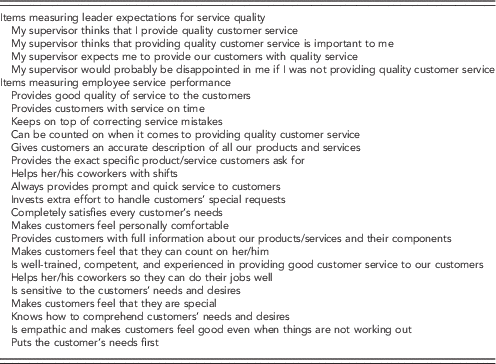
The survey questions can be found in Appendix 1.
Employee quality service performance
Employees’ service performance was assessed by the employees’ leaders. Drawing on the service quality literature (e.g., Stevens, Knutson, & Patton, Reference Stevens, Knutson and Patton1995; Parasuraman, Zeithaml, & Malhotra, Reference Parasuraman, Zeithaml and Malhotra2005), a 20-item measure of employee service performance was constructed. The leaders were asked to indicate the extent to which their employees provided quality service to store customers. These included aspects of reliability, assurance, responsiveness, empathy, and caring. Responses were made on a 7-point Likert-type scale ranging from 1=‘not at all’ to 7=‘to a large extent.’ Sample items are ‘completely satisfies every customer’s needs’ and ‘makes customers feel personally comfortable.’ The Cronbach’s α for this scale was 0.97.
Leaders’ normative expectations regarding service quality
Based on Callero’s (Reference Callero1985) subjective social norm scale, Farmer, Tierney, and Kung-McIntyre (Reference Farmer, Tierney and Kung-McIntyre2003) constructed a six-item measure of perceived coworker expectations for creativity. As in Carmeli and Schaubroeck’s (Reference Carmeli and Schaubroeck2007) study, four items from Farmer, Tierney, and Kung-McIntyre (Reference Farmer, Tierney and Kung-McIntyre2003) scale were adapted to assess leaders’ normative expectations for service quality. The extent to which leaders’ normative expectations influence employees is contingent on the employee’s interpretation of these expectations (Tierney & Farmer, Reference Tierney and Farmer2004). Thus, this measure was evaluated by employees, because what was important was how each employee perceived his/her normative expectations. Responses were made on a 5-point Likert-type scale ranging from 1=‘not at all’ to 5=‘to a large extent.’ Sample items are ‘My supervisor expects me to provide our customers with quality service’ and ‘My supervisor would probably be disappointed in me if I was not providing quality customer service.’ The Cronbach’s α for this scale was 0.87.
Employee self-expectations for service quality
Based on Carmeli and Schaubroeck’s (Reference Carmeli and Schaubroeck2007) study, a 3-item scale was used to assess employees’ own expectations for service quality (i.e., self-expectations for service quality). The items are ‘Providing quality customer service at work is very important to me,’ ‘I expect myself to provide quality customer service at work,’ and ‘I would probably be disappointed with myself if I was not providing quality customer service at work.’ Responses were made on a 5-point Likert-type scale ranging from 1=‘strongly disagree’ to 5=‘strongly agree.’ The Cronbach’s α for this scale was 0.83.
Control variables
Employee gender, age, and job tenure in the organization were controlled for because they may account for variation in service performance.
STUDY 1: RESULTS
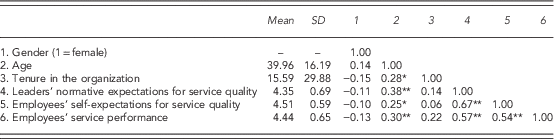
Table 1 shows the means, standard deviations, and correlations among the research variables. The bivariate correlations indicated that employee self-expectation for service quality was significantly correlated with employee service performance (r=0.54, p<.01). Leader normative expectation was positively related to both employee self-expectation for service quality and employee service performance (r=0.67, p<.01; r=0.57, p<.01, respectively).
Study 1, means, SD, and correlations

Notes: N=72, two-tailed test.
*p<.05, **p<.01.
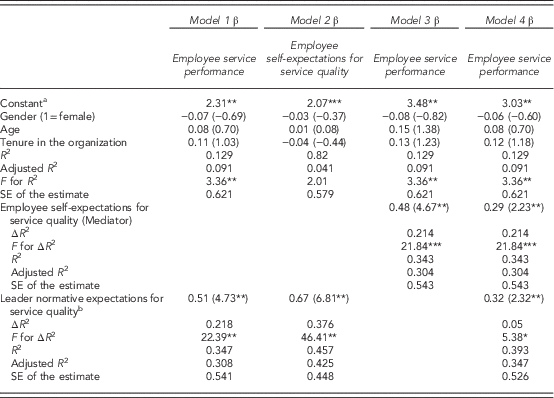
To test the research hypotheses, a series of hierarchical regression analyses were conducted. Each regression equation entered the control variables in the first step. The results of model 2 in Table 2 support Hypothesis 1, which posited a positive relationship between leaders’ normative expectations for service quality and employees’ self-expectations for service quality (β=0.67, p<.01).
Study 1, hierarchical regression results for the prediction of employee self-expectations and employee service performance

Notes:
a Unstandardized coefficients.
b Independent variable.
*p<.05,**p<.01.
The next tests explored whether employee self-expectations were positively related to employee service performance (Hypothesis 2), and whether employee self-expectations for service quality mediated the relationship between the leader’s normative expectations for service quality and employee service performance (Hypothesis 3).
According to Kenny, Kashy, and Bolger (Reference Kenny, Kashy and Bolger1998), a variable (M) mediates the relationship between an antecedent variable (X) and an outcome variable (Y) if (a) X is significantly related to Y; (b) X is significantly related to M; (c) after X is controlled for, M remains significantly related to Y; and (d) after M is controlled for, the X–Y relationship is 0. Kenny, Kashy, and Bolger described these steps as ‘the essential steps in establishing mediation’ (Reference Kenny, Kashy and Bolger1998: 260).
The results of both model 3 and model 4 in Table 2 did not lend support to the hypothesized mediating role of employee self-expectations for quality service in the relationship between leaders’ normative expectations for service quality and employee service performance. Leaders’ normative expectations for service quality were positively associated with employee service performance (β=0.51, p<.01) (model 1, Table 2), and employee self-expectations for service quality were positively related to employee service performance (β=0.48, p<.01) (model 3, Table 2). However, when the mediator (employee self-expectations for service quality) was specified, the effect of leaders’ normative expectations for service quality on employee service performance, though decreased in magnitude, remained statistically significant (β=0.51, p<.01 vs. β=0.32, p<.01); namely, the results indicated a partial mediation. Results of a Sobel test also did not support mediation (p>.10). There was only evidence for a partial mediation model; hence Hypothesis 3 was not supported.
STUDY 1: DISCUSSION
The findings of Study 1 indicated a positive relationship between leaders’ normative expectations for service quality and employees’ self-expectations for service quality (Hypothesis 1) and between employee self-expectations and service performance (Hypothesis 2). There was also found a positive direct relationship between leaders’ normative expectations for service quality and employee service performance, and a partial mediation of employee self-expectations on leaders’ expectations and employee performance (Hypothesis 3).
The social influence of leaders’ normative expectations reflects the impact of conforming to expectations from significant others, which are based largely on dependent relationships; that is, the need to obtain a favorable reaction from others (a specific reward or approval, or to avoid blame and punishment) (Jimmieson, Peach, & White, Reference Jimmieson, Peach and White2008). This mode of social influence is defined as compliance in Kelman’s (Reference Kelman1974, Reference Kelman2006) classification.
Thus, the results of Study 1 raise the question of whether the effect of a leader’s normative expectations on employee self-expectations reflects pressures to comply with the authority figure, or as posited, involves deeper roots of social influence. One route of social influence is through identification, where an employee identifies with the leader as a role model, and may seek to be like him or her (Kelman, Reference Kelman1974, Reference Kelman2006). However, the findings here point to another, more basic and profound route of social influence – internalization (Kelman, Reference Kelman1974, Reference Kelman2006). This occurs when the induced behavior is congruent with the employee’s value system or self-concept and thus is intrinsically rewarding. Following Kelman’s (Reference Kelman1974, Reference Kelman2006) typology, Study 2 further examined whether a leader’s normative expectations for high-quality service become internalized in an employee’s role identity,Footnote 3 and whether this in turn would enhance employee service performance. This line of research provided the basis for Study 2.
STUDY 2: LITERATURE REVIEW AND HYPOTHESIS DEVELOPMENT
The purpose of Study 2 was to expand Study 1 by testing the importance of leader normative expectations on employee service role identity, and the role of this identity in enhancing employee service performance. Service role identity was defined as employees’ self-concept of what service means to them as service providers. Despite the abundant work on role identity (Ashforth, Harrison, & Corley, Reference Ashforth, Harrison and Corley2008), research on service role identity has been slow to accumulate.
The leader’s normative expectations and service role identity
A role identity refers to a self-view, or the meanings a person attributes to a specific role (Burke, Reference Burke1991). When individuals attribute meaning and significance to their roles, this becomes part of what they believe in, and thus maintains and reinforces their self-concept. A role identity emerges from the role’s shared meaning of a reference group (i.e., expectations, behaviors, perspective), and from a schema that represents the self in that role (Collier & Callero, Reference Collier and Callero2005). Thus, a role identity reflects an internalized set of role expectations of others (Stryker & Burke, Reference Stryker and Burke2000; Farmer, Tierney, & Kung-McIntyre, Reference Farmer, Tierney and Kung-McIntyre2003). These expectations reflect behavioral expectations and, more importantly, expectations about what others expect one to be (Farmer, Tierney, & Kung-McIntyre, Reference Farmer, Tierney and Kung-McIntyre2003). Research has provided ample support for the effect of perceived social expectations of significant others on role identity (e.g., Grube & Piliavin, Reference Grube and Piliavin2000; Piliavin, Grube, & Callero, Reference Piliavin, Grube and Callero2002; Farmer, Tierney, & Kung-McIntyre, Reference Farmer, Tierney and Kung-McIntyre2003). As such, normative expectations of important ‘social others’ are a major source of individual’s role identity through reflexivity, responses of others to one’s own actions, or seeing oneself through such expectations.
The perceived rewards for shaping self-concept are based upon one’s perceptions of others’ expectations, especially those who are higher in status (Gore & Cross, Reference Gore and Cross2014). Significant authority (i.e., the leaders) in the workplace is a key to shaping and cultivating self-concept. This is because employees attend to the signals that their leader sends them. They are sensitive to the ways their leader judges how they fulfill their role, reflect on it, and try to find meaning from signals they receive such that they maintain their self-concept and its congruence with what they believe is expected from them at work. They seek to create congruence between what is expected from them and the meaning they ascribe to carrying out their assigned role such that their self-conception is maintained and strengthened. Research has shown that the more valued the relationships with others, the more important the role identity, and the more likely it is that the person will strive to affirm that identity (Burke & Reitzes, Reference Burke and Reitzes1991). Thus, employees whose leader has high expectations for service quality are likely to have a high service role identity. This led to the following hypothesis:
Hypothesis 4 : Leaders’ normative expectations for high-quality service are positively related to employees’ service role identity.
Service role identity and employee service performance
Role performance involves the adoption of a clear role identity by the service provider. However, only limited efforts have been directed toward examining whether and why one’s self-concept of role identity (Burke, Reference Burke1991; Stryker & Burke, Reference Stryker and Burke2000) can enhance work outcomes (Farmer, Tierney, & Kung-McIntyre, Reference Farmer, Tierney and Kung-McIntyre2003). Further, little is known about the ways in which an individual’s identity accounts for variation in performance in a service context.
Identities motivate behaviors (Rise, Sheeran, & Hukkelberg, Reference Rise, Sheeran and Hukkelberg2010). Role identity establishes an intrinsic motivation to act, and thus enables a wide range of individual and collective acts (Collier & Callero, Reference Collier and Callero2005). For example, variance in role identity salience is expected to be reflected in variance in the behavior associated with the role identity (Callero, Reference Callero1985). When role identity is realized and affirmed it is likely to relate to behaviors that reinforce this conception. Self-identity drives intention, which in turn promotes behavior beyond the traditional components of the Theory of Planned Behavior, such as subjective norms (Rise, Sheeran, & Hukkelberg, Reference Rise, Sheeran and Hukkelberg2010). Employees’ outcomes were found to be higher when they had a stronger role identity related to their jobs. For example, employee creative role identity was positively related to employee creativity (Farmer, Tierney, & Kung-McIntyre, Reference Farmer, Tierney and Kung-McIntyre2003; Song, Yu, Zhang, & Jiang, Reference Song, Lee and Lee2015). As such, if quality service to customers is meaningful to employees, they will make a substantial effort to deliver it. This is because failing to do so may undermine their self-concept. This role congruence is vital for employees to feel satisfied with what they do and thereby is likely to engender high-quality service (Schneider, Reference Schneider1980). Thus,
Hypothesis 5 : Service role identity is positively related to employee service performance.
The mediating role of service role identity in the relationships between leader normative expectations and service quality
Perceived expectations of others have been found to be a significant predictor of role identity, whereas role identity appears to be crucial in predicting intentions to behave in a certain way over a long period of time (Grube & Piliavin, Reference Grube and Piliavin2000; Piliavin, Grube, & Callero, Reference Piliavin, Grube and Callero2002). In a longitudinal study, Tierney and Farmer (Reference Tierney and Farmer2011) found that employee role identity and perceived relevant expectation from leaders were positively associated with an enhanced sense of employee capacity for related performance.
Drawing on these theories and research, it is likely that a leader’s normative expectations for quality service will impact employees’ service performance, through the development of the employee’s service role identity. Thus,
Hypothesis 6 : Service role identity mediates the relationship between leaders’ normative expectations for quality service and employees’ service performance.
STUDY 2: METHOD
Respondents and data collection
In total, 250 employees from three units in a large communication company were invited to participate in the study. All employees were service providers and engaged in providing technical support to customers. The units do business in the appliance, electronics, and personal computer industries. As in Study 1, the participants were asked to complete a structured survey. However, in this study respondents were asked to complete electronic surveys sent to them during work time. The average time for completing the questionnaire was 15 min.
Benefitting from strong co-operation on the part of employees who worked in the company and the electronic format of the survey, 226 completed questionnaires were received, for a response rate of 90.04%. The respondents’ average age was 32.77 years (SD 7.61), and their average job tenure was 7.39 years (SD 5.60). In total, 24% of the respondents were female; 29% of the participants had a high school or equivalent degree, 46.9% had a BA degree, and the remainder of the participants had an MA degree.
Measures
Employee service performance
As was the case in Study 1, scales found in the service quality literature (e.g., Stevens, Knutson, & Patton, Reference Stevens, Knutson and Patton1995; Parasuraman, Zeithaml, & Malhotra, Reference Parasuraman, Zeithaml and Malhotra2005) were used to assess employee service performance. Nine items were used to assess employee service performance with a focus on the research context. Employees were asked to indicate the extent to which their manager thinks that they exhibit high or low service performance. Johnson (Reference Johnson1996) found a positive correlation between employee and customer perceptions of service quality, consistent with previous studies (e.g., Schneider & Bowen, Reference Schneider and Bowen1985). Sample items are: ‘my manager thinks that I provide effective responses to customers’ requests,’ and ‘my manager thinks that I provide high-quality service to the customers.’ Responses were made on a 5-point Likert-type scale ranging from 1=‘not at all’ to 5=‘to a large extent.’ The Cronbach’s α for this scale was 0.84.
Leaders’ normative expectations regarding service quality
As in Study 1, following Carmeli and Schaubroeck’s (Reference Carmeli and Schaubroeck2007) study, four items from Farmer, Tierney, and Kung-McIntyre (Reference Farmer, Tierney and Kung-McIntyre2003) scale were used to assess leaders’ normative expectations for service quality (as construed by employees). Responses were made on a 5-point Likert-type scale ranging from 1=‘not at all’ to 5=‘to a large extent.’ Sample items are ‘My supervisor expects me to provide our customers with quality service’ and ‘My supervisor would probably be disappointed in me if I was not providing quality customer service.’ The Cronbach’s α for this scale was 0.70.
Service role identity
Three items were adapted from Farmer, Tierney, and Kung-McIntyre (Reference Farmer, Tierney and Kung-McIntyre2003) scale to assess the extent to which an employee views the service role as his/her identity. Responses were made on a 5-point Likert-type scale ranging from 1=‘not at all’ to 5=‘to a large extent.’ Sample items are ‘I often think about being a service provider’ and ‘To be a quality service provider is an important part of my identity.’ The Cronbach’s α for this scale was 0.80.
Control variables
Employee gender, age, and job tenure in the organization were controlled for. In addition, potential differences between the three organization’s units were controlled for by creating dummy variables.
STUDY 2: RESULTS
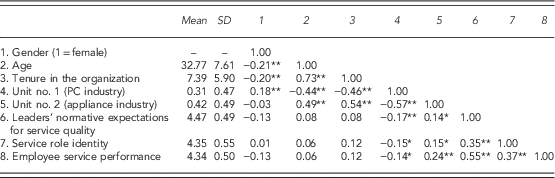
Table 3 shows the means, standard deviations, and correlations among the research variables. The bivariate correlations indicate that service role identity was positively related to employee service performance (r=0.37, p<.01). The leader’s normative expectation was positively related to both service role identity and employee service performance (r=0.35, p<.01; r=0.55, p<.01, respectively).
Study 2, means, SD, and correlations

Notes:
N=226, two-tailed test.
*p<.05, **p<.01.
To test the research hypotheses, a series of hierarchical regression analyses were conducted. Each regression equation entered the control variables in the first step. The results of model 2 in Table 4 support Hypothesis 4, which posited a positive relationship between leaders’ normative expectations for service quality and service role identity (β=0.33, p<.01).
Study 2, hierarchical regression results for the prediction of service role identity and employee service performance

Notes:
a Unstandardized coefficients.
b Independent variable.
*p<.05, **p<.01.
As in Study 1, guidelines by Kenny, Kashy, and Bolger (Reference Kenny, Kashy and Bolger1998) for testing a mediation relationship were adhered to. With regard to the mediating role of service role identity in the relationship between leaders’ normative expectations for service quality and employee service performance, the results of both model 3 and model 4 in Table 4 did not support a full mediation relationship, but rather indicated a partial mediation model. Leaders’ normative expectations for service quality were positively associated with employee service performance (β=0.52, p<.01) (model 1, Table 4), and service role identity was positively related to employee service performance (β=0.35, p<.01) (model 3, Table 4), in support of Hypothesis 5. However, when the mediator (service role identity) was specified, the effect of leaders’ normative expectations for service quality on employee service performance, though decreased in magnitude, remained statistically significant (β=0.52, p<.01 vs. β=0.46, p<.01). The results of a Sobel test did not support mediation either (p>.10). Thus, a full mediation model was not found and Hypothesis 6 was not supported.
STUDY 2: DISCUSSION
The finding of Study 2 indicated a positive relationship between a leader’s normative expectations for service quality and employees’ service role identity (Hypothesis 4), as well as between employee service role identity and service performance (Hypothesis 5). There was also a positive direct relationship between leaders’ normative expectations for service quality and employee service performance, and a partial mediation of employee service role identity on leaders’ expectations and employee performance (Hypothesis 6).
These findings extend the results in Study 1 by providing evidence for the notion that a social influence (Kelman, Reference Kelman1974, Reference Kelman2006) can emerge not only from shaping and inducing self-expectations but also from cultivating and reinforcing one’s role identity. The Study 2 findings point to the importance of the leader’s normative expectations of service quality in enhancing service performance directly and indirectly, through service role identity in the context studied here.
GENERAL DISCUSSION
Customers’ positive experiences with a service depend to a large extent on the service quality of frontline workers. Customer satisfaction ultimately translates into customer retention and thus to organizational financial performance. The main goal of the current inquiry was to explore the ways in which leaders can induce employees’ engagement in service efforts and shape their behaviors toward customers. The findings in Study 1 indicated that leader normative expectations were related directly and indirectly to employee service performance, through employee self-expectations, and in Study 2, through individual role identity.
Theoretical implications
The findings make several important theoretical contributions. By showing how employees’ service quality is associated with their leaders’ normative expectations for service quality, the findings lend further support to the literature [e.g., Theory of Planned Behavior and Theory of Reasoned Action (Ajzen, Reference Ajzen1991; Ajzen & Fishbein, Reference Ajzen and Fishbein1977; Albarracin et al., Reference Albarracin, Johnson, Fishbein and Muellerleile2001; Ardhanari et al., Reference Ardhanari, Hadiwidjojo, Rahayu and Rohman2013)] on the influence of people’s beliefs about the expectations of significant others in their lives regarding their behavioral intentions.
The current research is part of a growing attempt to apply features of the expectation model to broader work contexts. Scholars acknowledge that to date, very few studies have applied or examined the expectation process in the business sector, and none have considered the relevance of leaders’ normative expectations on employee service performance (McNatt, Reference McNatt2000; Tierney & Farmer, Reference Tierney and Farmer2004). This is of importance, since research in retail settings has produced mixed findings about the role of leader expectations on employee performance. For example, Chowdhury (Reference Chowdhury2007) found that leaders’ expectations for greater performance affected salespersons’ self-expectations, which in turn influenced their performance, whereas Sutton and Woodman (Reference Sutton and Woodman1989) found no effects of leadership expectations on subordinates’ sales performance. In addition, only a handful of studies have examined the role of service leadership in fostering service quality (e.g., Schneider et al., Reference Schneider, Ehrhart, Mayer, Saltz and Miles-Jolly2005) and they mainly employed a more general predictor construct of work climate, mostly at the level of the business unit rather than the individual level (Borucki & Burke, Reference Borucki and Burke1999). The current studies respond to Schneider et al. (Reference Schneider, Ehrhart, Mayer, Saltz and Miles-Jolly2005) call to devote more efforts to the study of leader effects on service outcomes. They go beyond Pygmalion-related effects to expose the internalization of leader expectations into employee role identity.
Consistent with the notion that role identity is crucial to self-concept building (Stryker & Burke, Reference Stryker and Burke2000), this study sheds further light on the vital role of managers in cultivating and reinforcing the perceptions of employees about their work role. Employees develop their self-conception of what service means to them by finding meaning in the signals (e.g., assessments) that their leaders send them.
However, the main theoretical contribution of this study lies in integrating the two studies through the lens of Kelman’s Social Influence Theory (1974, 2006). This theory suggests that an individual’s attitudes, beliefs and behaviors are shaped by referent others through three processes: compliance, identification, and internalization. The findings here show how leaders signal their expectations to employees through all three processes of social influence: employees’ service performance is influenced by the leader’s normative expectations (as perceived by employee), not only as a result of compliance with an authority figure or identification with the leader as a role model, but rather as a deep-rooted process of internalization of these expectations into the employee’s role identity. This process is not about subordinates looking up to their supervisors, but rather realizing expectations as congruent with their values and thus internalizing them into their role identity as service employees.
Limitations and future research directions
This study has several limitations which could be addressed in future research. Both studies (especially the first) were based on a small sample in a homogeneous context (a large supermarket chain and a communication company) in Israel. Although both are interesting contexts for service settings and are different from each other, it still raises concerns about sample bias. Workers in different business contexts may encounter different types of customers, suggesting that some macroeconomic or cultural bias could have influenced the results. Hence, generalizations of the findings to other industries should be made with caution. For better generalization of results, future studies should attempt to seek additional empirical evidence from larger and randomized samples from different cultures and industries.
Furthermore, because of the correlational nature of this study and the use of same-method (survey) data, no causal relationship between the research model variables can be derived. Nevertheless, the results of this study are consistent with previous research that has explored the potential effects of expectation. In addition, in Study 1 different sources were used to obtain the data: leaders’ expectations and employees’ self-expectations were obtained from employees and employees’ service performance were obtained from managers. In Study 2 there was an attempt to mitigate the effects of same-source bias by evaluating construed external service performance. Moreover, the results are consistent across the two studies in the two different service settings. Clearly, longitudinal experimental studies are needed even though this would not completely resolve the difficulty of substantiating causality.
Further, when attempting to explain variance in employee outcomes, it is important to acknowledge unobserved variables. Although a coherent theory to explain employee service performance was provided, there is a need to investigate additional factors that may enhance employees’ service quality such as employee personality, commitment and satisfaction, among others.
Some important theoretical issues emerge and should be further explored in future endeavors. Little is known about the factors that shape leaders’ expectations concerning their employees. What is the role of organizational leaders’ values in guiding their expectations, and their respective behaviors? If leaders’ expectations are related to followers’ self-expectations and ultimately their outcomes, what are the effects of organizational constituencies such as analysts, stockholders, customers, and suppliers on leaders’ expectations concerning their employees and themselves? Future research could also explore how expectations of organizational leaders are shaped (e.g., do common beliefs held by competitors in the industry influence a manager’s expectations). The results here indicated a positive relationship between leaders’ normative expectations and employees’ self-expectations regarding service quality, but tell us nothing about how conflicting expectations are resolved.
Given the interdependent nature of today’s work structure, a number of questions can be raised concerning the role of manager expectations in creating an organizational context in which people are expected to display certain behaviors. For example, under which conditions would high, medium, or low expectations for employees be the most beneficial? Do expectations always lead to improved work outcomes? Under which conditions does ‘too much of a good thing’ (i.e., expectations) become destructive? These questions certainly merit future research. Finally, future studies could investigate the links between service role identity and self-expectations for quality service and their potentially reinforcing effects and mediating role in the relationship between leaders’ expectations for quality service and employees’ service performance.
Practical implications
The findings suggest several implications for managers who are engaged in improving the service performance of their employees. First, managers need to be aware of their expectations and how these expectations are conveyed to their employees. Employees look up to their managers, interpret the messages they send as well as their behaviors, and come to conclusions. To avoid misinterpretation, managers need to convey specific expectations that are reinforced with adequate behaviors such that these expectations can be transformed into meaningful outcomes. Managers use a wide variety of persuasive tactics and communicative strategies to convey expectations to their employees and other organizational constituencies. The important thing is to convey consistency so that expectations and corresponding behaviors reinforce one another in a manner that helps employees to develop higher expectations of themselves and ultimately lead to better work outcomes. This process is complex and suggests the need for managers to develop expectations, set goals, display certain behaviors and make sure they are embedded in the organizational system as a whole.
Overall, the findings suggest a positive link between employee self-expectations regarding service quality and service role identity and service performance. However, managers should realize that certain conditions may strengthen or weaken this relationship. In addition, when seeking to enhance their employees’ performance, managers need to bear in mind that good quality service may not necessarily be related to either creativity or efficiency. Hence, balancing a set of expectations which are imperative for organizational viability is a major managerial challenge that is extremely complex and requires a capacity to harmonize different, sometime contradictory, performance facets.
Acknowledgements
The author thank Professor Abraham Carmeli and Professor Yitzhak Fried for their invaluable contribution. The author also acknowledge the editorial comments of Esther Singer.
Appendix 1
Items used to measure the study variables

About the authors
Galy Binyamin is a senior lecturer at Ariel University, Department of Economics and Business Management. She received her PhD from the Graduate School of Business Administration, Bar-Ilan University, and her MBA from the Hebrew University of Jerusalem, Business School. She has held senior positions in leadership development and HR management in organizations in Israel. Her current research interests include structuring of HRM processes, leadership, creativity, and positive work relationships.