


Introduction
Physiological seed dormancy is an inner seed property influencing the environmental conditions under which germination can occur (Vleeshouwers et al., Reference Vleeshouwers, Bouwmeester and Karssen1995; Finch-Savage and Leubner-Metzger, Reference Finch-Savage and Leubner-Metzger2006). In many species, the dormancy state is not fixed but changes over time in response to environmental signals (Baskin and Baskin, Reference Baskin and Baskin2004). At dispersal, seeds frequently exhibit primary dormancy, either as an absolute failure to germinate or as conditional dormancy, in which germination is possible only under a restricted range of conditions (Baskin and Baskin, Reference Baskin and Baskin1998; Fenner and Thompson, Reference Fenner and Thompson2005). Environmental signals can progressively reduce dormancy, allowing germination to occur under a broader set of conditions (Batlla and Benech-Arnold, Reference Batlla and Benech-Arnold2003; Finkelstein et al., Reference Finkelstein, Reeves, Ariizumi and Steber2008; Orrù et al., Reference Orrù, Mattana, Pritchard and Bacchetta2012). Conversely, when conditions remain unsuitable for germination, seeds may re-enter secondary dormancy, contributing to seasonal cycles of dormancy loss and induction (Batlla and Benech-Arnold, Reference Batlla and Benech-Arnold2006; Kępczyński et al., Reference Kępczyński, Bihun and Kępczyńska2006; Finkelstein et al., Reference Finkelstein, Reeves, Ariizumi and Steber2008). These recurrent shifts have been conceptualized as a dormancy continuum, in which dormancy tracks the environment until germination is initiated (Baskin and Baskin, Reference Baskin and Baskin1985; Finch-Savage and Footitt, Reference Finch-Savage and Footitt2012). Dormancy responses to the environment are a major component of seed ‘memory’, i.e. the capacity of seeds to integrate and respond to signals from different timescales (Fernández-Pascual et al., Reference Fernández-Pascual, Mattana and Pritchard2019). It is also an essential mechanism to ensure germination at the moment that maximizes fitness, a widespread strategy of temperate plants (Fernández-Pascual et al., Reference Fernández-Pascual, Carta, Rosbakh, Jiménez-Alfaro, Cruz-Tejada, Wagner, Pinzani, Lukács and Phartyal2026). Therefore, understanding how dormancy reacts to environmental cues is essential for understanding a species’ regeneration niche.
Among these cues, temperature is one of the main drivers of dormancy loss in buried seeds (Baskin and Baskin, Reference Baskin and Baskin1988). Dormancy status determines the range of environmental conditions under which seeds are able to germinate, and this range can change progressively as seeds experience dormancy-relieving temperatures (Vleeshouwers et al., Reference Vleeshouwers, Bouwmeester and Karssen1995; Finch-Savage and Footitt, Reference Finch-Savage and Footitt2012; Trotta et al., Reference Trotta, Ceriani, Casolo, Bellingardi, Boscutti, Vuerich and Petrussa2024). Quantitative studies have subsequently shown that thermal conditions experienced during dormancy loss can alter the thermal limits of subsequent germination and the proportion of the seed population able to respond at a given temperature (Batlla and Benech-Arnold, Reference Batlla and Benech-Arnold2003, Reference Batlla and Benech-Arnold2015; Just et al., Reference Just, Cross, Lewandrowski, Turner, Merritt and Dixon2023). In Aesculus hippocastanum, cold-induced dormancy loss has also been described through changes in germination thermal-time parameters, including base temperature and thermal-time requirement (Pritchard et al., Reference Pritchard, Steadman, Nash and Jones1999; Steadman and Pritchard, Reference Steadman and Pritchard2004). Thus, thermal history is known to modify subsequent germination behaviour; a more specific question is how the temperature and duration of dormancy-relieving exposure are quantitatively reflected in germination capacity, timing and thermal requirements within the same system.
This distinction is important in species with physiological dormancy, where dormancy loss and germination are consecutive phases of the same regeneration process (Liu et al., Reference Liu, Bradford, Huang and Venable2020). A seed may therefore fail to germinate not only because current incubation conditions are unsuitable but also because previous thermal conditions have not reduced dormancy sufficiently to allow germination and thermal-time accumulation (Batlla and Benech-Arnold, Reference Batlla and Benech-Arnold2015). Quantifying the links between the temperature requirements for dormancy loss and those for germination is essential for developing mechanistic models of the seed regeneration niche (Donohue et al., Reference Donohue, Burghardt, Runcie, Bradford and Schmitt2015).
The germination ecology of Centaurium somedanum (Gentianaceae), a narrow endemic of calcareous mountain springs in the Cantabrian Mountains, Spain, has been investigated in several previous studies. Its seeds have non-deep simple morphophysiological dormancy, require light for germination and germinate preferentially at relatively cool temperatures, with germination declining at higher temperatures (Fernández-Pascual et al., Reference Fernández-Pascual, Jiménez-Alfaro, García-Torrico, Pérez-García and Díaz2012). Stratification is known to promote dormancy loss, although previous experiments indicated that cold was not an obligatory requirement under the conditions tested (Fernández-Pascual et al., Reference Fernández-Pascual, Jiménez-Alfaro and Díaz2013a). Dormancy also varies among populations along an altitudinal and climatic gradient and is associated with both genetic differentiation and the seed maturation environment (Fernández-Pascual et al., Reference Fernández-Pascual, Jiménez-Alfaro, Caujapé-Castells, Jaén-Molina and Díaz2013b), while interannual variation in dormancy and sensitivity to dormancy-breaking factors is related to seasonal temperatures experienced by the maternal plants (Fernández-Pascual and Jiménez-Alfaro, Reference Fernández-Pascual and Jiménez-Alfaro2014).
What remains unresolved is how the temperature and duration of dormancy-relieving exposure quantitatively affect the subsequent thermal response of germination. In particular, previous work has not determined whether differences in thermal history are expressed primarily through changes in germination capacity and timing, shifts in thermal thresholds or changes in the thermal time required for radicle emergence. Here, we addressed this gap by exposing seeds to different combinations of stratification temperature and duration and quantifying their subsequent germination responses. Specifically, we asked how stratification temperature and duration affect final germination and germination speed, and whether these effects are accompanied by changes in base temperature and thermal-time requirements. We predicted that increasing stratification duration would progressively enhance germination capacity and accelerate germination, and tested whether the magnitude of these responses depended on stratification temperature.
Materials and methods
Study species
Centaurium somedanum M. Laínz (Gentianaceae) is a perennial forb, typically 3–10 cm tall (Jiménez-Alfaro et al., Reference Jiménez-Alfaro, Fernández-Pascual, García-Torrico, Bañares, Blanca, Güemes, Moreno and Ortiz2010), that grows in small-sedge and brown moss communities associated with tufa-forming springs (Jiménez-Alfaro et al., Reference Jiménez-Alfaro, Fernández Menéndez, Bueno and Fernández Prieto2013). Seeds are approximately spherical and very small, about 390 µm wide, with a mean mass of approximately 20 µg (Fernández-Pascual et al., Reference Fernández-Pascual, Jiménez-Alfaro, García-Torrico, Pérez-García and Díaz2012). Its distribution is limited to a 210 km2 area in the Cantabrian Mountains of north-western Spain, where discrete populations can be found from 600 to 1700 m above sea level (Jiménez-Alfaro et al., Reference Jiménez-Alfaro, Fernández-Pascual, García-Torrico, Bañares, Blanca, Güemes, Moreno and Ortiz2010). The regional climate is transitional between Oceanic and Continental-Mediterranean, with local differences depending on elevation, exposure and continentality. Flowering peaks in July, seeds mature during August and September, dispersal lasts until October and seedlings have been observed in the field in August (Jiménez-Alfaro et al., Reference Jiménez-Alfaro, Fernández-Pascual, García-Torrico, Bañares, Blanca, Güemes, Moreno and Ortiz2010; Fernández-Pascual et al., Reference Fernández-Pascual, Jiménez-Alfaro, García-Torrico, Pérez-García and Díaz2012).
Field work
To obtain representative sampling across the species distribution, we visited eight C. somedanum populations during the autumn of 2014 (i.e. October), representing the altitudinal gradient (Tables S1 and S2). In subsequent experiments, populations were treated separately and were included as random factors in the models when appropriate. However, since population identity is not part of our research objectives, the results are presented pooling all populations.
In each population, we collected seeds from all the individuals that we found bearing ripe capsules (brown and dry). For each plant, we collected one or two capsules, depending on individual size. Capsules remained for 3 weeks at c. 22 ºC and 50 % relative humidity (RH) to ensure homogeneous maturation. Afterwards, we extracted and cleaned the seeds. Because the experiments could not start immediately, we dried the seeds and kept them at 15 ºC and 15 % RH until further use. Based on previous experiments (Fernández-Pascual et al., Reference Fernández-Pascual, Jiménez-Alfaro, Caujapé-Castells, Jaén-Molina and Díaz2013b), under these conditions, the seeds would not lose viability or change their dormancy status.
Germination experiments
In February 2015, we set up a laboratory experiment to measure the thermal thresholds for dormancy loss and germination in C. somedanum. To this end, we stratified seeds for 0, 6 and 12 weeks in Petri dishes with 1% agar. Stratification was at one of three temperatures (0, 5 or 10 ºC) programmed inside incubators (LMS Ltd., Sevenoaks, UK). Seeds from the 0- and 6-week stratification treatments went on to incubation at 0, 5, 10 and 15 ºC. Seeds from the 12-week stratification treatments were incubated across an integrated 0–30 °C thermal range, combining individual incubators set at 0, 25 and 30 °C with a thermogradient plate (GRD1, Grant Instruments, Cambridge, UK) programmed from 5 to 20 °C across 13 positions. This broader thermal range was used after 12 weeks of stratification to characterize the full thermal response of germination. The thermogradient plate provided fine resolution across the suboptimal-to-optimal range, while higher temperatures were included to capture the supraoptimal decline in germination rate and allow estimation of T o and T c. Data loggers (Tinytag Plus 2, Gemini Data Loggers, Chichester, UK) recorded temperatures inside the incubators and along the thermogradient plate. Stratification was in darkness (i.e. two layers of aluminium foil), while germination incubations were coupled to a 12/12 h photoperiod. No seeds germinated during the stratification period. As a standard, there were four Petri dishes per experimental treatment, except for the incubations after 12 weeks of stratification, in which there was one dish per temperature. We sowed 25 seeds per dish for the AR, CM, MA, PU and TE populations, and 16 seeds for ML, TR and VA. During the germination incubations, we scored germination and removed germinated seeds every working day. Radicle emergence was the germination criterion. The incubations with previously stratified seeds lasted 12 (i.e. for the 6 weeks’ stratification) or 6 weeks (i.e. for the 12 weeks’ stratification), while the experiments with fresh seeds ran for the entire duration of the experiment (18 weeks). The experimental design is reported in Figure 1. At the end of each incubation, we cut open non-germinated seeds to score infected (3.7 %) and empty (0.4%) seeds. We only considered full, non-infected seeds to calculate germination percentages and for subsequent statistical analyses.
Experimental design used to test the effect of stratification temperature and duration on germination responses in Centaurium somedanum.

Figure 1 Long description
The process of seed stratification and germination incubation for C. somedanum. It begins with seeds undergoing stratification in darkness. There are three pathways: 0 weeks (fresh seed), 6 weeks stratification and 12 weeks stratification. Fresh seeds are incubated at 0, 5, 10 and 15 degrees Celsius for 18 weeks. Seeds stratified for 6 weeks are incubated at the same temperatures for 12 weeks. Seeds stratified for 12 weeks are incubated at 0, 5-20 (using a thermal gradient with 13 positions), 25 and 30 degrees Celsius for 6 weeks. Each incubation condition is represented with an icon of an incubator and Petri dishes and the duration is indicated with a calendar icon.
Data analyses
Cumulative germination curves were modelled for each population, pretreatment and incubation temperature using a three-parameter log-logistic model with binomial errors, fitted with the drc package (Ritz et al., Reference Ritz, Baty, Streibig and Gerhard2015). Germination proportion through time was modelled as the number of germinated seeds divided by the number of germinable seeds, using the number of germinable seeds as weights. The fitted curve model returned two ecologically meaningful parameters: the upper asymptote, d, interpreted as maximum germination; and the inflection-time parameter, e, representing the time at which the fitted curve reached 50% of its upper asymptote. Thus, lower e values indicate faster germination. Curves were fitted only when germination data were sufficient to support model estimation. We therefore excluded treatment combinations with no germination, fewer than three observation times with non-zero cumulative germination, or fewer than four distinct cumulative germination proportions.
To test the effects of pretreatment and incubation temperature on curve shape, the fitted parameters were analysed using linear mixed-effects models (Bates et al., Reference Bates, Mächler, Bolker and Walker2015). The upper asymptote d was logit-transformed, while e was log-transformed. Each model included pretreatment, incubation temperature and their interaction as fixed effects, and population as a random intercept. Pairwise comparisons among pretreatments within each incubation temperature were performed on estimated marginal means with Tukey adjustment (Lenth, Reference Lenth2022).
Final germination was also analysed at dish level using binomial generalized linear mixed models, with the number of germinated and non-germinated seeds as the response and population as a random intercept. Tukey-adjusted pairwise comparisons were used to identify differences among treatments.
Full percentile-based thermal threshold models were fitted only to seeds germinated after 12 weeks of stratification at 0 °C, because this treatment was the only one that achieved sufficient germination across the thermal range to support robust estimation. Modelling followed the methodology established in previous works (Orrù et al., Reference Orrù, Mattana, Pritchard and Bacchetta2012; Porceddu et al., Reference Porceddu, Mattana, Pritchard and Bacchetta2013; Fernández-Pascual et al., Reference Fernández-Pascual, Jiménez-Alfaro, Hájek, Díaz and Pritchard2015). For each germination percentile g, the rate of germination was plotted against germination temperature. The suboptimal and supraoptimal temperature ranges were separated by visual inspection, and linear regressions were fitted to them. This allowed us to estimate the cardinal temperatures for germination: the base thermal threshold (T b) was calculated as the x-intercept of the suboptimal regression line, the ceiling thermal threshold (T c) as the x-intercept of the supraoptimal regression line and the optimal temperature (T o) as the intersection between the two regression lines. The thermal time required to reach percentile g (θg, °Cd) was estimated as the inverse of the slope of the suboptimal regression line. Estimates obtained for the different germination percentiles were averaged to obtain one set of parameters for each population. As a complementary comparison among stratification treatments, we performed a pooled t50-based analysis to estimate apparent T b and thermal-time requirements from the linear relationship between germination rate (1/t50) and incubation temperature in the suboptimal range, retaining estimates only when at least three incubation temperatures supported the fit and the resulting T b was biologically plausible. All calculations were performed in R (R Core Team, 2025).
Results
Effects of stratification on germination trajectories and final germination
Germination responses varied markedly with both stratification treatment and incubation temperature (Figure 2). At 0 °C of continuous incubation, seeds were not able to germinate and were therefore excluded from analyses. In fresh seeds (Figure 2A), germination was generally slow and strongly temperature-dependent, with comparatively high final germination at 5 and 15 °C but much lower values at 10 °C. After 6 weeks of stratification (Figure 2B), germination diverged according to stratification temperature. Seeds stratified at 0 °C showed consistently improved germination across incubation temperatures, whereas seeds stratified at 5 or 10 °C showed weaker and more variable germination. After 12 weeks (Figure 2C), these differences became more pronounced. In particular, seeds stratified at 0 °C reached near-complete germination at 10 and 15 °C, whereas seeds stratified at 5 or 10 °C reached substantially lower final germination at the same incubation temperatures. At 5 °C incubation, seeds stratified for 12 weeks showed little or no germination within the 6-week incubation period, regardless of stratification temperature.
Germination trajectories of fresh (a) and stratified seeds of Centaurium somedanum for 6 weeks (b) and 12 weeks (c) under different incubation temperatures.

Figure 2 Long description
A multi line graph with title text, Fresh seeds. Legend title, Incubation temperature, with entries 5, 10, 15. The horizontal axis label is Time (days) with tick labels 0, 50, 100. The vertical axis label is Cumulative germination with tick labels 0.00, 0.25, 0.50, 0.75, 1.00. Three plotted series are shown as lines with circular markers. The series labeled 15 rises gradually from near 0.00 and reaches a plateau near 0.70 by about 100 to 120 days. The series labeled 5 stays near 0.00 until after about 110 days, then rises steeply and reaches about 0.70 by about 125 to 130 days. The series labeled 10 stays near 0.00 for most of the time range and rises slightly late in the time range, ending near about 0.15. The image B showing three multi line graphs under the left label text, b) 6 weeks. Each graph uses the horizontal axis label Time (days) with tick labels 0, 20, 40, 60, 80 and the vertical axis label Cumulative germination with tick labels 0.00, 0.25, 0.50, 0.75, 1.00. Each graph shows three plotted series as lines with circular markers, labeled 5, 10, 15 in the legend. Stratified at 0 degrees C: The series labeled 15 rises steeply early and reaches about 0.85 to 0.90 by about 20 to 30 days, then stays near that level through about 80 days. The series labeled 10 rises early and reaches about 0.60 to 0.65 by about 25 to 35 days, then stays near that level through about 80 days. The series labeled 5 stays near 0.00 until close to 80 days, then rises sharply to about 0.85 to 0.90 at about 80 days. Stratified at 5 degrees C: The series labeled 15 rises early and reaches about 0.50 by about 50 to 60 days, then stays near that level through about 80 days. The series labeled 10 rises slowly and reaches about 0.20 by about 60 to 80 days. The series labeled 5 stays near 0.00 until close to 80 days, then rises sharply to about 0.65 to 0.70 at about 80 days. Stratified at 10 degrees C: The series labeled 15 rises early and reaches about 0.60 to 0.65 by about 40 to 50 days, then stays near that level through about 80 days. The series labeled 10 rises slowly and reaches about 0.20 by about 40 to 60 days, then stays near that level through about 80 days. The series labeled 5 stays near 0.00 through about 80 days, with a single plotted point near about 0.55 at about 80 days. The image C showing three multi line graphs under the left label text, c) 12 weeks. Each graph uses the horizontal axis label Time (days) with tick labels 0, 10, 20, 30, 40 and the vertical axis label Cumulative germination with tick labels 0.00, 0.25, 0.50, 0.75, 1.00. Each graph shows three plotted series as lines with circular markers, labeled 5, 10, 15 in the legend. Stratified at 0 degrees C: The series labeled 15 rises steeply and reaches about 0.90 to 0.95 by about 15 to 20 days, then stays near that level through about 40 days. The series labeled 10 rises later and reaches about 0.90 to 0.95 by about 30 to 35 days. The series labeled 5 stays near 0.00 through about 40 days, with a small rise near the end to about 0.05. Stratified at 5 degrees C: The series labeled 15 rises and reaches about 0.35 to 0.40 by about 20 to 25 days, then stays near that level through about 40 days. The series labeled 10 rises later and reaches about 0.35 to 0.40 by about 35 to 40 days. The series labeled 5 stays near 0.00 through about 40 days. Stratified at 10 degrees C: The series labeled 15 rises and reaches about 0.35 to 0.40 by about 20 to 25 days, then stays near that level through about 40 days. The series labeled 10 rises later and reaches about 0.30 to 0.35 by about 35 to 40 days. The series labeled 5 stays near 0.00 through about 40 days.
Final germination percentages closely mirrored the patterns observed in the cumulative germination curves (Figure 3). At 5 °C incubation, fresh seeds and seeds stratified for 6 weeks still reached moderate germination, particularly after stratification at 0 °C, whereas seeds stratified for 12 weeks showed little or no germination during the shorter incubation period. At 10 °C incubation, final germination was strongly enhanced by cold stratification, with seeds stratified for 12 weeks at 0 °C showing the highest values and those stratified for 6 weeks at 0 °C also performing clearly better than the remaining treatments. By contrast, fresh seeds and seeds stratified at 5 or 10 °C generally showed lower final germination. At 15 °C incubation, final germination was again highest after stratification at 0 °C, especially after 12 weeks, whereas seeds stratified at 5 or 10 °C remained consistently lower. Overall, Tukey post hoc comparisons confirmed that final germination differed markedly among pretreatments within each incubation temperature.
Final germination of fresh and stratified seeds at different incubation temperatures.

Figure 3 Long description
The box plots display final germination proportions of seeds under different stratification temperatures and durations. The horizontal axis categorizes seeds as Fresh, 6 weeks and 12 weeks, with stratification temperatures of 0 degrees C, 5 degrees C and 10 degrees C. The vertical axis represents the final germination proportion, ranging from 0.00 to 1.00. Each box plot is divided by incubation temperatures of 5, 10 and 15 degrees Celsius. The median, quartiles and whiskers are shown, with points representing individual Petri dishes. Outliers are indicated by points outside the whiskers. Different letters above the box plots indicate significant differences among pretreatments within each incubation temperature. Generally, seeds stratified at 0 degrees C for 12 weeks show higher germination proportions, while fresh seeds and those stratified at higher temperatures tend to have lower medians. Variability is widest in some fresh seed treatments and narrowest in seeds stratified at 0 degrees C for 12 weeks.
The analysis of germination-curve parameters was consistent with these visual patterns. Both the upper asymptote, d, representing maximum germination, and the inflection-time parameter, e, used here as an indicator of germination speed, were significantly affected by pretreatment, incubation temperature and their interaction (Tables 1, S3 and S4). Stratification at 0 °C generally produced the highest estimated values of d, particularly at 10 and 15 °C. Likewise, fresh seeds showed consistently higher values of e than stratified seeds at 10 and 15 °C, indicating slower germination in the absence of prior dormancy loss. Interpretation at 5 °C should, however, be made with caution, because several treatment combinations did not allow robust estimation of germination-curve parameters, in agreement with the very low germination observed under those conditions.
Results of linear mixed-effects models testing the effects of pretreatment, incubation temperature and their interaction on germination-curve parameters

Table 1 Long description
Fixed-effects test results are listed for two response parameters, d and e, with columns for fixed effect, numerator df, denominator df, F-value, and P-value. For d, pretreatment has numerator df 6 and denominator df 89.3 with F-value 56.65 and P-value less than 0.001. For d, incubation temperature has numerator df 2 and denominator df 89.5 with F-value 53.18 and P-value less than 0.001. For d, pretreatment times incubation temperature has numerator df 8 and denominator df 89.3 with F-value 8.37 and P-value less than 0.001. For e, pretreatment has numerator df 6 and denominator df 90.1 with F-value 76.22 and P-value less than 0.001. For e, incubation temperature has numerator df 2 and denominator df 90.8 with F-value 201.89 and P-value less than 0.001. For e, pretreatment times incubation temperature has numerator df 8 and denominator df 90.0 with F-value 8.45 and P-value less than 0.001.
Note: Parameter d represents the upper asymptote of the fitted log-logistic curve and therefore maximum germination, whereas e represents the inflection time and is used as an indicator of germination speed.
Cardinal temperatures after 12 weeks of cold stratification
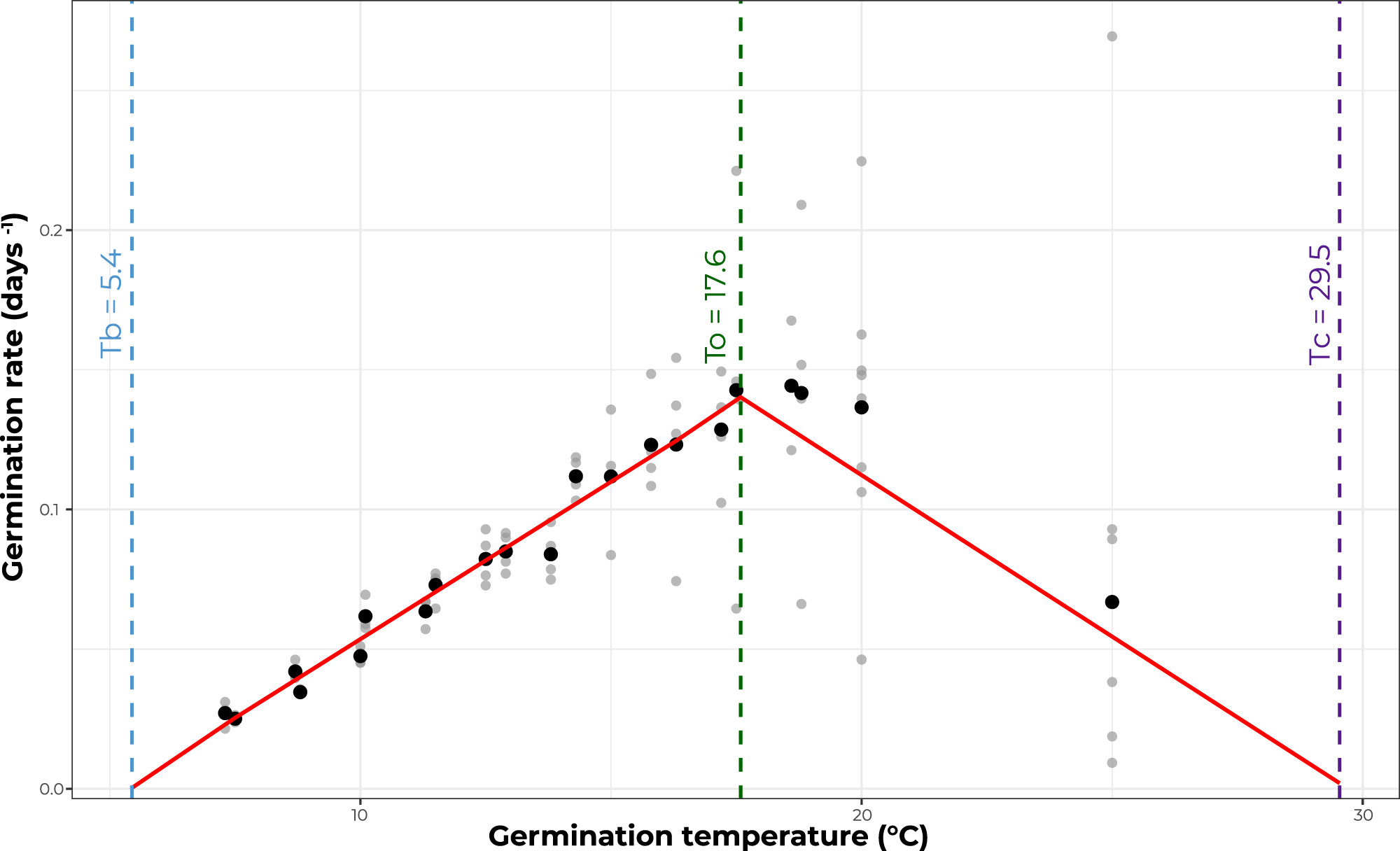
Mean T b across populations after 12 weeks of stratification at 0 °C was 5.44 °C, with population-specific estimates ranging from 3.89 to 7.68 °C, whereas mean T o was 17.59 °C, with population-specific estimates ranging from 13.8 to 19.9 °C. Reliable population-specific estimates of T c were obtained for seven of the eight populations and averaged 29.54 °C, ranging from 24.7 to 34.7 °C. One population (ML) yielded a higher T c estimate (42.8 °C) but did not meet the reliability criterion and was therefore excluded from the summary for this parameter, while remaining visible in the graphical display. Estimates of θ sub ranged from 58.0 to 112 °Cd across populations.
The complementary pooled t50-based analysis showed that apparent T b could not be retained for fresh seeds because it yielded a biologically implausible value, and could not be estimated after 6 weeks of stratification at 10 °C. For the remaining stratified treatments, apparent T b did not show a consistent decline with colder stratification, whereas the apparent thermal-time requirement showed a clearer pattern. After 6 weeks of stratification, θ sub was lower at 0 °C than at 5 °C (131.8 vs 238.2 °Cd). After 12 weeks of stratification, θ was lowest after stratification at 0 °C (89.0 °Cd), compared with 144.7 and 159.1 °Cd after stratification at 5 and 10 °C, respectively.
Despite among-population variation, pooled germination rates after 12 weeks of stratification at 0 °C showed a common unimodal relationship with temperature. Mean germination rate increased from approximately 0.03 d−1 at 7–8 °C to a maximum of about 0.14 d−1 at 17.5–18.7 °C, and then declined at higher temperatures, reaching 0.086 d−1 at 25 °C (Figure 4).
Thermal response of germination rate in Centaurium somedanum after 12 weeks of cold stratification at 0°C.

Figure 4 Long description
The horizontal axis label is, Germination temperature degree C. The horizontal axis range is 5 to 30. The vertical axis label is, Germination rate days superscript minus 1. The vertical axis shows tick labels 0.0, 0.1 and 0.2. A set of scattered circular points is plotted across the graph. A segmented line is drawn with one segment rising from near 5 on the horizontal axis at 0.0 on the vertical axis to a peak near 17.6 on the horizontal axis at about 0.14 on the vertical axis and a second segment descending to near 30 on the horizontal axis at 0.0 on the vertical axis. Three vertical dashed lines are drawn and labeled, Tb equals 5.4, To equals 17.6 and Tc equals 29.5.
Discussion
The main finding of this study is that thermal history during dormancy loss affected subsequent germination mainly through changes in thermal-time requirement rather than through a consistent shift in base temperature. Although progressive dormancy loss in temperate species is often associated with a lowering of the thermal limits for germination (Vleeshouwers et al., Reference Vleeshouwers, Bouwmeester and Karssen1995), apparent T b did not consistently decrease with colder stratification in C. somedanum. By contrast, the thermal-time requirement declined markedly with colder and longer stratification, reaching its lowest value after 12 weeks at 0 °C. Prolonged cold stratification also increased final germination and accelerated subsequent germination at favourable temperatures. Together, these results indicate that temperature acts sequentially during regeneration: thermal conditions experienced by hydrated dormant seeds first determine dormancy loss, while subsequent incubation temperature controls thermal-time accumulation towards radicle emergence (Bradford, Reference Bradford2002; Finch-Savage and Footitt, Reference Finch-Savage and Footitt2012).
Prolonged cold stratification was clearly the most effective condition for reducing dormancy in C. somedanum. Seeds stratified at 0 °C showed the highest final germination and the fastest responses during subsequent incubation, whereas seeds stratified at higher temperatures remained less responsive. This pattern suggests that dormancy loss in this species is favoured by cold winter-like conditions rather than by merely cool conditions (Porceddu et al., Reference Porceddu, Mattana, Pritchard and Bacchetta2013), allowing the species to germinate under most favourable conditions in the subsequent spring (Fenner, Reference Fenner2000; Orrù et al., Reference Orrù, Mattana, Pritchard and Bacchetta2012). In this sense, cold stratification appears to shift the thermal responsiveness of the seed population, progressively widening the range of temperatures at which germination can occur. The estimation of cardinal temperatures after prolonged cold stratification further supports the idea that dormancy loss and thermal-time accumulation are sequential components of the same regeneration process (Scholten et al., Reference Scholten, Donahue, Shaw and Serpe2009; Liu et al., Reference Liu, Bradford, Huang and Venable2020).
Once dormancy was sufficiently reduced, germination followed a clear unimodal thermal response, with increasing rates up to an optimum near 18 °C and a decline at warmer temperatures. The cardinal temperatures estimated after 12 weeks at 0 °C indicate that germination could proceed under relatively cool conditions. More importantly, the reduction in thermal-time requirement with colder and longer stratification suggests that cold exposure increased the physiological readiness of seeds to complete germination. This partly agrees with the thermal-time framework developed for A. hippocastanum, where cold-induced dormancy loss was associated with changes in both base temperature and thermal-time requirements (Pritchard et al., Reference Pritchard, Steadman, Nash and Jones1999; Steadman and Pritchard, Reference Steadman and Pritchard2004).
This pattern is consistent with a seasonal regeneration strategy in which seeds dispersed at the end of the growing season do not germinate immediately (Wang et al., Reference Wang, Baskin, Baskin, Yang, Liu, Zhang, Ye and Huang2017; Qin et al., Reference Qin, Geng, Yang and Peng2023) but require exposure to cold conditions before becoming fully responsive. Such a mechanism may reduce the risk of germination before winter and synchronize radicle emergence with the onset of favourable post-winter conditions (Jaganathan et al., Reference Jaganathan, Dalrymple and Liu2015; Wang et al., Reference Wang, Baskin, Baskin, Yang, Liu, Zhang, Ye and Huang2017). The fact that germination was fastest and most complete at 10 or 15 °C after cold stratification suggests that winter-like temperatures act primarily on dormancy loss, whereas subsequent cool to mild temperatures allow thermal-time accumulation and radicle emergence, consistent with the cool-temperature germination niche reported for other range-restricted species (Panero et al., Reference Panero, De Vitis, Dell’Orco, Cuccaro, Cambria, Trotta, Attorre and Fabrini2025).
These results also suggest that climate warming could have contrasting effects on different phases of regeneration: warmer spring conditions may accelerate thermal-time accumulation once dormancy has been released, whereas milder or shorter winters could delay or reduce cold-driven dormancy loss (Walck et al., Reference Walck, Hidayati, Dixon, Thompson and Poschlod2011; Trotta et al., Reference Trotta, Vuerich, Petrussa, Hay, Assolari and Boscutti2023). Therefore, the demographic outcome of warming will depend not only on temperatures during the germination window but also on whether winter conditions remain sufficient to move seeds through the dormancy-loss phase (Orrù et al., Reference Orrù, Mattana, Pritchard and Bacchetta2012). In spring-fed wetlands, this response may be further modulated by groundwater supply, because hydrological conditions can influence both soil temperature buffering and the moisture conditions required for seedling establishment (Fernández-Pascual et al., Reference Fernández-Pascual, Jiménez-Alfaro, Hájek, Díaz and Pritchard2015).
In conclusion, our study shows that the regeneration niche of C. somedanum is shaped before germination occurs. Prolonged cold stratification determines whether seeds become able to germinate, whereas subsequent cool to mild temperatures determine the rate at which these seeds accumulate thermal time towards radicle emergence. This sequential control provides a mechanistic explanation for the temperature dependence of germination in this narrow endemic of calcareous mountain springs. It also highlights the need to consider dormancy loss and germination timing as linked but distinct phases of a plant regeneration continuum, in which the seed integrates past and present environmental cues to match regeneration phenology with favourable windows.
Supplementary material
The supplementary material for this article can be found at https://doi.org/10.1017/S0960258526100270.
Acknowledgements
The authors thank E. Correia Álvarez and N. Martínez Vázquez for their participation in seed collecting, and P. Gómez Barreiro for his help with the laboratory experiments. The authors used generative artificial intelligence as a support tool for language refinement during manuscript preparation. The AI tool did not generate original data, perform analyses or determine scientific conclusions. All interpretations and final decisions were made by the authors, who take full responsibility for the content.
Author contributions
G.T.: conceptualization, formal analysis, visualization, writing – original draft, writing – review and editing; E.M.: methodology, writing – review and editing; H.W.P.: conceptualization, methodology, resources, writing – review and editing; E.F.-P.: conceptualization, funding acquisition, investigation, writing – review and editing
Funding statement
This research was supported by the Government of Asturias and the FP7 – Marie Curie – COFUND programme of the European Commission (Grant ‘Clarín’ ACA14-19). The Royal Botanic Gardens, Kew, received a grant-in-aid from Defra. Project SeedAnthropic PID2024-156390NB-I00 was funded by MICIU/AEI/10.13039/501100011033/FEDER, EU. This research was also supported by the Grant ‘Laboratorio de Vegetación y Biodiversidad’ (IDE/2024/000720, Principality of Asturias-Sekuens-EU-FEDER).




 Open access

