The Eleanor Powell memorialized in That's Entertainment! III (1994) has become ingrained in Hollywood mythology. Dressed in a top hat and tails, Powell performs rapid-fire rhythms, acrobatic walkovers, and breathtaking turns, all while smiling broadly at the camera. “In Broadway Melody of 1938 and almost all of her films,” narrator Gene Kelly intones, “Eleanor becomes a huge sensation by the last reel.” She is that rare female star who is famous not for her beauty or sex appeal, but for her undeniable talent. Her tuxedo, it seems, signals her liberation from the cumbersome high heels and extravagant dresses that hindered the likes of Ginger Rogers.
Yet Powell's performances—spectacular as they are—are not nearly as emancipatory as That's Entertainment! III suggests. The film, a retrospective of the MGM musical, separates musical numbers from their original narrative contexts, highlighting spectacle over story, and in many cases editing quite lengthy numbers into brief excerpts. That's Entertainment! III features just two minutes of Powell's tuxedoed tapping from Broadway Melody of 1938's “Your Broadway and My Broadway,” whereas the original thirteen-minute production number also features Powell dancing with George Murphy in a conventional ballroom duet and ends with her and love interest Robert Taylor kissing onstage. When viewed within the context of the complete number and the preceding film, it is clear that Powell's tuxedo is wedded to a narrative of marriage rather than of liberation.
Powell's other films are similar. Most are labeled backstage musicals, or simply “backstagers”: they take place in a show business setting, where Powell's character, an ingénue, strives to find a job dancing on Broadway. During her show business journey, she falls in love, and the success of her relationship becomes linked to that of her burgeoning career. Extended production numbers like “Your Broadway and My Broadway” end each film, celebrating, as Rick Altman writes, “the successful conclusion of show and romance alike.”Footnote 1 Powell's early musicals at MGM established this paradigm—Broadway Melody of 1936 (1935), Born to Dance (1936), and Broadway Melody of 1938 (1937). Later films—Honolulu (1939), Broadway Melody of 1940 (1940), Lady Be Good (1941), Ship Ahoy (1942), and I Dood It (1943)—cast Powell as an established star; nonetheless, a performing career and offstage romance continue to define her onscreen characters.
That's Entertainment! III is not the only work to dissociate Powell's routines from these backstage narratives: scholars have described a conflict between the “feminine” characters she plays in the stories and the “masculine” performing persona displayed in her numbers. Jerome Delamater blames, for example, the “aggressive individuality which was the Powell persona” for the failure of dramatic “integration” in her musicals. The MGM staff, in his account, rarely attempted to link her dance performances to the surrounding narrative. Steven Cohan also assumes a conflict but celebrates its subversive potential: Powell's gender nonconformity in her tap routines, he argues, serves to “mock” and “destabilize the constructed ideal of feminine glamour established by the Ziegfeld revues” and by the backstage musical more generally.Footnote 2 For Delamater and Cohan, narrative has little influence on Powell's numbers, whose power, for better or for worse, comes from their difference.
In this article, I argue against dissociating Powell's tuxedoed tapping from the narratives of her films. The backstage setting and romantic storyline in fact provide a vital context for Powell's tuxedoes and, more broadly, her song and dance routines; indeed, instead of highlighting difference, her musical numbers reinforce the sociocultural work of the surrounding narrative. As noted above, show-within-a-film numbers like “Your Broadway and My Broadway” thematically link onstage performance to the backstager's romantic storyline. Moreover, MGM's backstage musicals explicitly address performance within the diegesis, directly and indirectly shaping the choreographic, musical, and cinematic structure of subsequent numbers. Perhaps most importantly, backstage stories about women in show business provide an obvious and important framework for how one might interpret those same women once they finally take the stage. The narratives of MGM's backstagers hold the key to understanding Powell's performances, illuminating how the 1930s backstage musical shaped and reflected a Depression-era understanding of women's place in the entertainment industry.
Powell's first three musicals with MGM, those that deal explicitly with a female dancer hoping to “make good” on Broadway, offer the clearest examples of how the MGM staff shaped its dancing star and thus serve as my primary examples. I begin by describing the narrative precedents for these films; so-called Cinderella musical comedies like Irene (1919), Mary (1921), and especially Sally (1920) provided the studio's writing staff with familiar stereotypes and conventions, which they altered to suit the evolving Depression-era context. Next, I turn to Powell's tap aesthetic and the male impersonation tradition that she inherited, arguing that in the 1930s, her tuxedoes and performing style did not subvert the feminine identity so carefully constructed in MGM's narratives. The second half of the article turns to the films themselves, analyzing the musical underscoring in key dialogue scenes and the structure and content of finale numbers, especially “Your Broadway and My Broadway.” In both narrative scenes and musical numbers, music and dance shape the MGM Cinderella, contributing not only to the films’ stories but also their sociocultural work. Finally, I close by examining how my rereading of Powell's films alters our conception of the backstage musical and illuminates its unique approach to narrative and number.
Reworking Sally
It is tempting to position Powell's first successful musical, Broadway Melody of 1936, as the descendent of the numerous backstage films produced by MGM and Warner Bros. in the late 1920s and early 1930s. After all, the film borrowed its title and a few songs from the original MGM backstager, The Broadway Melody (1929), and capitalized on the success of 42nd Street (1933) and Gold Diggers of 1933 (1933), the Warner Bros. musicals credited with revitalizing the genre in the early 1930s. But though such films encouraged MGM to return to the backstage setting, the studio did not remake their early talkie nor did they attempt to duplicate the brashness of the Warner chorus girls. Instead, the MGM staff turned to the stage for inspiration, specifically the Cinderella musical comedies of the 1920s. Particularly influential was Florenz Ziegfeld's Sally (1920), which featured, if not exactly a backstage setting, an appealing female lead, a romantic storyline, and a show-within-a-show.Footnote 3 Sally, an orphan with dreams of theatrical success, works as a dishwasher at the Elm Tree Alley Inn. There, she meets and falls in love with Blair Farquar, the son of a wealthy Long Island family. Later, she attends his family's ball, masquerading as a Russian dancer when the evening's entertainment fails to appear. Blair does not recognize her, but Sally's dancing lands her a starring role in the Ziegfeld Follies. After a breakout performance in the “Butterfly Ballet,” the production number that represents the Follies within the musical, Sally reunites with Blair, and the show ends with their wedding. Dancer and impersonator Marilyn Miller starred in the original production, which ran for three seasons in the New Amsterdam Theatre.
There are several connections between Sally, other Broadway Cinderellas, and Powell's Broadway Melody series. Jack McGowan, who wrote the script for Broadway Melody of 1936 and supervised the stories for Born to Dance, Broadway Melody of 1938, Broadway Melody of 1940, and Lady Be Good, started his show business career playing the romantic lead in the Cinderella shows Mary (1921) and The Rise of Rosie O'Reilly (1923), which competed with Sally on Broadway. Under his supervision, Powell's early films incorporate Sally's show-within-a-show format, in particular the spectacular finale that precedes the romantic happy ending. Even more telling, Broadway Melody of 1936 borrows a specific plot device from the musical comedy: Moss Hart, who devised the story outline for the film, has Powell's character impersonate a foreign dancer (in this case, a French star rather than a Russian ballerina) in hopes of landing a role in a Broadway show. If this narrative similarity seems coincidental or simply conventional, the names of Powell's characters were not. In Broadway Melody of 1936, Powell is Irene, a reference to the Cinderella musical Irene (1919); in Broadway Melody of 1938, Sally; and in Lady Be Good, Marilyn, a tribute to Sally's star Marilyn Miller.
Indeed, McGowan and the MGM staff likely turned to the Cinderella musicals because Powell reminded them of Miller. Like Miller, her personality paralleled (and was constructed to parallel) that of the sweet-but-practical stage Cinderella. Like Miller, she was known primarily as a dancer, who transitioned from child vaudeville star to dance soloist in small-time revues and musical comedies. Also like Miller, Powell found her way to Hollywood when a stage show in which she performed was adapted to the screen: in Fox's George White's 1935 Scandals (1935), Powell played the role of dancer Marilyn Collins, rehashing her tap routine from George White's Music Hall Varieties (1932). This filmed number served as a screen test for MGM head Louis B. Mayer; her subsequent contract with the studio marked the beginning of the Broadway Melody series.Footnote 4
The MGM screenwriting team changed a key aspect of the Cinderella story for Powell's films, however. Prince Charming no longer represents the wealthy urban elite, the demographic that many people blamed for the Great Depression; instead, he hails from a middle class background similar to that of Powell's characters. In Broadway Melody of 1936, producer Bob Gordon (Robert Taylor) and Irene (Powell) are childhood sweethearts from Albany, New York; in Born to Dance, Nora (Powell) falls in love with working-class sailor Ted Barker (Jimmy Stewart); and in Broadway Melody of 1938, Sally (Powell) pairs with songwriter Steve Raleigh (Taylor, again). Unlike the 1920s Sally, who happily moved from rags to riches with her marriage to the wealthy Blair Farquar, Powell's relationships do not guarantee her an immediate fortune. She and her love interest face the realties of Depression-era Broadway, seeking support from wealthy backers, most of who are portrayed as inept.
Moreover, the success that Powell's show business boyfriends do finally achieve remains tied to Powell, the star of their stage productions. In 1930s popular culture, linking a shared financial or class goal to a romantic relationship was rather common. Barbara Melosh argues, for example, that New Deal–sponsored murals and theater projects typically depicted strong-willed, working women who coexisted with men and served leftist politics, all while reaffirming a commitment to marriage and motherhood.Footnote 5 In Hollywood, what Melosh labels the “comradely ideal” manifested as the backstage ideal: rather than fight for progressive causes, women worked together with men to create a successful stage production, an allegory for the nation's economy. In the Warner Bros. backstage musicals, the 1930s chorus girl, Susan Glenn argues, is the “gutsy heroine whose energy and determination helped solve the unemployment problem.”Footnote 6 Powell's Cinderella characters evoke the female comrade as well: she is able to, in the words of Fred Astaire, “‘put ‘em down’ like a man” and, most importantly, willing to dedicate those abilities to her boyfriend's production.Footnote 7
As noted above, however, the Warner Bros. chorus girl and the MGM Cinderella were not equivalent; whereas Warner Bros. embraced the brassy chorus girl and her gold digger associations, MGM avoided direct links between Powell and questionable women of the stage. When Powell's character auditions for a chorus job in Broadway Melody of 1936, for example, she is clearly smarter and more talented than any of the other prospective chorines, one of whom answers the question, “How tall are you?” by placing her outstretched hand next to her forehead and commenting, “Oh, about up to here.” Powell's good-natured characters contrast even more explicitly with Broadway Melody of 1938's Caroline Whipple (Binnie Barnes), a conniving ex-chorus girl whose marriage to a rich entrepreneur places her at the helm of the show within the film. The ways that Powell differs from these chorus girls and gold diggers—she is smart, talented, and chaste—paves the way for her triumph on stage and in love. Powell and her middle class suitors carefully navigate around Broadway's underbelly of wealthy businessmen and suspect women, and together, they create entertainment that celebrates his show business acumen, her talents, and their romance.
Powell's Tap Aesthetic
If Sally offered MGM a prototype for Powell's films, it did not resolve how Powell would perform or what she would wear during the final production numbers. One might argue that the MGM staff dressed Powell in tuxedoes and military costumes because they understood her dancing as “masculine.” To be sure, her primary teachers were men, and she borrowed liberally from two male African American tappers, John Bubbles, whom she studied from the sidelines during a joint vaudeville tour, and Bill Robinson, who taught her his stair routine. Bubbles's “heel-dropping rhythm tap dancing” was key to her rapid footwork, and she also absorbed his “casual approach” and “nonchalant manner,”Footnote 8 but newspapers and fan magazines of the era cited the Robinson connection more frequently. Washington Post critic Nelson Bell noted, for example, that like Robinson, “her male counterpart in the art of ‘picking them up and laying them down,’ Miss Powell has that rare gift of achieving a maximum effect with minimum effort.”Footnote 9 Powell acknowledged this influence in the 1970s, albeit indirectly. “You know, there must be some colored blood in me somewhere,” she told John Kobal, “I often used to kid my mother, asking her, ‘Did you have a colored milkman or something?’ Because it's a black sound.”Footnote 10
Although black male tappers inspired Powell's rhythms, her dance aesthetic was not based solely on their steps; a fusion of dance styles was her goal. In some steps, she sonifies ballet movement, as in her “taps on turns,” which add syncopated taps to a rapid succession of pencil turns.Footnote 11 In most routines, she intersperses ballet steps like the tour jeté, echappé, and arabesque sauté. In almost every dance, she displays balletic comportment. “Though her lower body is bound as she kicks and taps,” Melinda Nielsen observes, “Powell's upper body is free and distinctively aerial. . .. The fluidity and loose quality of [her] upper torso, arms, and head make even her rapid movement seem sustained.”Footnote 12 For Powell, retaining this posture was important, for she believed ballet was “the foundation of all dancing.”Footnote 13 She never wanted to be a hoofer: “A tap dancer is a frustrated dancer,” she said, “and a hoofer is a tap dancer who doesn't know how to use his arms or hands. I prefer to be called a rhythm dancer. Better yet, I would like to be known as a character rhythm dancer.”Footnote 14
Tellingly, most critics in the 1930s described her dancing in ways that evoked both masculine and feminine qualities: she was the “femme Astaire,” “the most expert feminine tap dancer,” “the first of the lady hoofers,” and, in the most interesting turn of phrase, “Fred Astaire, Ray Bolger, and Bill Robinson all rolled into one distaff entity.”Footnote 15 Comparing her to male tappers was perhaps inevitable, for as Adrienne McLean writes, “there was no other model for being a superbly competent unpassive female performer in a musical that could be read as anything other than ‘drag.’”Footnote 16 There was still a sense, however, that Powell effectively negotiated masculine and feminine elements in her performances. Joe Bigelow, reviewing Born to Dance for Variety, writes,
Miss Powell is called upon to accomplish the difficult feat of reconciling a story character overbrimming with sweet femininity with a style of dancing that's ultra-sophisticated and not always completely feminine. Buck dancing, which is Miss Powell's forte, is basically lacking in grace and anyone who tries it is apt to very often appear awkward. Miss Powell manages to overcome that by the inclusion of ballet work in her tap routines and thus offers the most versatile display of solo hoofing that motion pictures have yet produced.Footnote 17
Powell's fusing of ballet and tap resulted, it seems, in an aesthetic that solidified her femininity even as it showcased the “ultra-sophisticated” form of dance that Hollywood associated with male stars.
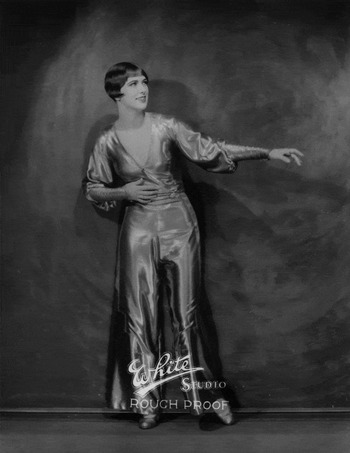
The choice of a tuxedo for Powell's film characters did not originate, however, solely from her tapping prowess nor, for that matter, from her Broadway career of the 1920s and early 1930s. Portraits of Powell taken by New York's White Studio show her in a variety of feminine costumes: a simple leotard, decorated with an accordion-pleated collar and a large flower sewed on the waist; a form-fitting, beaded dress with a short jacket tied at the neckline; a black, V-neck dress with gathered frills at the shoulders. A few costumes suggest a more masculine style. The gold pajamas designed by John Harkrider, which she wore for her specialty in Hot-Cha! (Figure 1), feature the wide-legged pant popularized in the 1920s, and another photographed costume incorporates a top hat paired with a lamé bodice, a fringed choker, and cuffs worn on the forearms.Footnote 18 Reviews of her stage performances corroborate the styles depicted in these portraits. There are no references to tuxedoes specifically, only to pajama-inspired costumes like the Charles LeMaire design she wore for George White's Music Hall Varieties (1932), which featured beaded black pants, a white blouse, and a bow tie, but no top hat or coat jacket.Footnote 19
Eleanor Powell, Hot-Cha! (1932). Reproduced with permission from the Billy Rose Theatre Division, The New York Public Library for the Performing Arts, Astor, Lenox and Tilden Foundations.

If Powell herself never donned a tuxedo on stage, her costumes at MGM do extend a sixty-year history of women performing solo acts in explicit male dress. In the late nineteenth-century, women such as the British Annie Hindle and her U.S. counterparts Ella Wesner, Augusta Lamoureaux, and Blanche Selwyn wore such costumes while performing as male impersonators. At first, these women strove for “realistic” impersonation: they wore suits, had low singing voices, and convincingly depicted upper-class men even as they cast doubt on their characters’ masculinity.Footnote 20 By the late-1880s, a younger generation of British performers active on stages in the United States began to emphasize a “feminine” impersonation aesthetic; costumes that referenced male dress now emphasized the women's curves, and many male impersonators chose to sing in a soprano rather than alto range. Gillian Rodger argues that, in part, this aesthetic shift responded to the working-class audience, who preferred acts that poked fun at effeminate, fashionable men as opposed to those that satirized middle and upper class masculinity.Footnote 21
After 1900, increased anxiety about gender transgression affected popular male impersonators like Vesta Tilley, Hetty King, Ella Shields, Della Fox, Kathleen Clifford, and Kitty Doner. “Whereas earlier performers were praised for skills such as acting, singing, dancing, or comedy,” Rodger explains, “later performers were often described as having a singular personality that carried the act regardless of their other talents.”Footnote 22 This interest in a consistent personality went hand in hand with the expectation of a singular gender identity; as a result, many early-twentieth-century female actors and singers avoided realistic male impersonation so as not to contradict their “inherent femininity.”Footnote 23 By the early 1930s, Rodger writes, “there was little except their costumes to distinguish male impersonators from other female singers in vaudeville.”Footnote 24
Given this historical context, it is unlikely that Powell's tuxedoes contradicted the feminine roles she inhabited within the narratives of her films. Indeed, for Powell, male dress was one of the few costuming choices left. The scriptwriters had dissociated Powell from the chorus women, so they could not dress her in a simple leotard and tights. Neither could they place her in a luxuriant dress, which would conjure associations with the gold digger. The pajama pants from her days performing as a dance specialty act were not suited for a star, and the tutu worn by Marilyn Miller in Sally would not work because Powell was not performing as a ballerina. A tuxedo, especially one that highlighted her curves, was a perfect fit, complementing her unique dance aesthetic that already meshed masculine and feminine elements.
Men's Work as Women's Work
Most importantly, Powell's male dress connects her finale numbers to the comradely ideal established in the backstage stories: in order to “make good” on the stage and contribute to a successful production, she works with and like her man, impersonating him even as she maintains her own identity (Figure 2). In Born to Dance, Powell's suitor is in the military, and in that film's finale, she takes on the role of a drum major, wearing a black leotard designed to mimic a military jacket and a hat decorated with a feather plume.Footnote 25 The two films in which she dons a tuxedo—Broadway Melody of 1936 and Broadway Melody of 1938—are those in which she dates a man of show business. In Broadway Melody of 1938, she and producer Steve Raleigh even wear the same outfit during the course of the final number: she performs onstage in a top hat and tails, while he watches from the wings wearing the same tux. The more accurately she impersonates her boyfriend's appearance, in fact, the more accepting he is of her stage career. Though Powell's characters express a desire to become a Broadway star in each film, her leading man supports her only in Broadway Melody of 1938, the film in which she looks most like him.
Powell in finale performances (left) and her love interests in their professional clothing (right).

The man's shifting response to Powell's ambitions is evident in dialogue scenes that discuss her career. In Broadway Melody of 1936, the overall tone is patronizing. “I know how it is,” producer Bob Gordon (Robert Taylor) tells Irene (Powell),
You worked hard at what you were doing, saved your money, and deprived yourself of a lot of little things that you should have had, just so you could come to New York and get a chance at what you've wanted all your life. I did that too. But it isn't worth it. What you get isn't what you came after. I know that too.
After this diatribe, Bob refuses to give her a job in the chorus and continues, “I know what'd happen to you here in New York. . . . The easiest thing for me to do would be to give you the chance you're looking for, and put you away and forget about it. But I can't. So I'm taking the hard way.” Denying Irene her chance on Broadway becomes an act of chivalry in Bob's mind—he will not let her become a fallen woman of the stage.
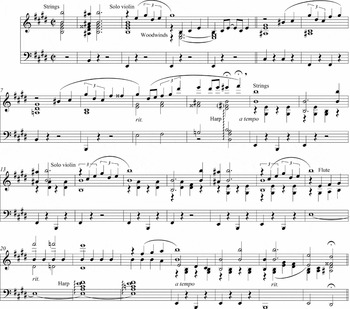
The musical underscoring, an instrumental arrangement of Arthur Freed and Nacio Herb Brown's “You Are My Lucky Star,” echoes the tone of Bob's rhetoric. Earlier in the film, the song is closely associated with Irene: she sings it as she imagines herself performing on the stage. Here, though, the music and the camerawork follow Bob's lead, shaping his lines into a forceful spoken chorus (Example 1). The arrangement begins mid-phrase after Bob pulls a chair next to Irene and informs her, “I want you to go back to Albany.” A wistful violin responds, questioning the tune's confidence with pleading countermelodies that reach to the upper register of the instrument (mm. 9–10). After a brief pause, the song continues unabated (m. 11 ff.), just when Bob is his most blunt: “Look, Irene,” he sighs, “there's nothing for you here in New York.” His next big proclamation—“I know what'd happen to you here in New York”—coincides with the final eight bars of the chorus (m. 19 ff.). Here, Bob is filmed in close up, while Irene, otherwise depicted in profile during this conversation, disappears from the screen completely. The solo violin continues to work chromatically against the main melody (m. 20) but like Irene, it too capitulates to Bob's forceful logic, blending into the orchestration by chorus end (m. 23). Bob has successfully appropriated the song associated with Irene's dream of stardom.
Underscoring, “You Are My Lucky Star,” Broadway Melody of 1936.

In Born to Dance, by contrast, the male lead seems at first supportive of Powell. “Course you're gonna make good,” Navy man Ted Barker (Jimmy Stewart) tells Nora (Powell), “You're gonna have one big booster anyway. I'll be right down in the front row opening night.” Ted is still leery of show business, however, given his recent experience with stage diva Lucy James, and he hesitates when Nora confirms her desire to be with him after he leaves the Navy. “You really want to go on the stage?” he asks, and then poses the crucial question, “Success and all that, do you think that'll change you?” Nora laughs, but his concern is real. “I dunno, just seems like that kind of success always does something to people,” he explains. Like Bob in Broadway Melody of 1936, Ted worries that a woman of the stage becomes a problem.
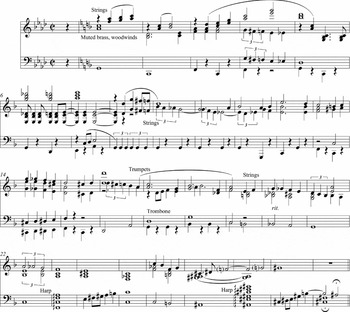
The scoring for Ted and Nora's conversation is less biting than the arrangement that frames Bob's warnings of New York in Broadway Melody of 1936, in part because their conversation is accompanied by Cole Porter's “Easy to Love,” a song associated with Ted's feelings for Nora. A full instrumental chorus plays unobtrusively as, seated next to each other and filmed primarily in two-shot,Footnote 26 they discuss Ted's gallant efforts at saving Lucy James's dog and Nora's determination to find a job. As the discussion turns to their future, a shot-reverse shot patternFootnote 27 highlights each characters’ shifting emotions, and the arrangement modulates from A-flat major to the brighter F major, a shift that reflects their growing excitement at the prospect of being together (see Example 2, mm. 1–8). Ted pauses, however, at the return to the A phrase (m. 9), the chromatic countermelody pointing to his increasing uncertainty; the final bars of the chorus (mm. 17–25) underscore his crucial question, “do you think that'll change you?” Their conversation devolves into hesitations and incomplete sentences, and the music follows suit, slowing to the point where the song's metrical structure is obscured (m. 20 ff.) and transitioning to newly composed underscoring (m. 23). Unlike the music for Bob's speech, in which “You Are My Lucky Star” frames his objections to Irene's career, the arrangement of “Easy to Love” disintegrates as Ted voices concerns about loving a woman of the stage.
Underscoring, “Easy to Love,” Born to Dance.

In Broadway Melody of 1938, anxiety about Powell's career disappears altogether. Her love interest Steve Raleigh (Taylor) is once again a man of show business, but this time, he campaigns for Sally (Powell) to star in his revue against the advice of his colleagues. “I believe in you, Sally,” Steve says, “I'm going to take a chance with you, a big chance.” That show business may be a dangerous place for Sally never crosses his mind, and when she confesses that Broadway “scares [her] a little,” he replies nonchalantly, “Oh, it shouldn't. It's really not such a bad place. Look at the thousands of careers it's given to people.” Sally has still other fears: if she does not perform well, she worries, she will ruin Steve's show. Steve once again assures her, noting that he would not cast her if he did not believe in her. Together, he proclaims, they will “put a ring through Broadway's nose and lead it around.” If Bob in Broadway Melody of 1936 is Powell's protector, in Broadway Melody of 1938, Steve is the instigator in her rise to fame.
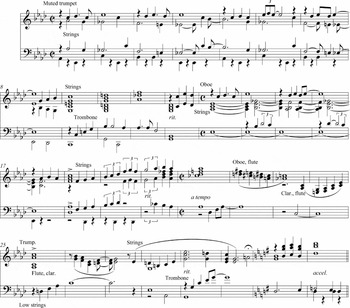
Fittingly, the underscoring for Sally and Steve's conversation is an arrangement of Freed and Brown's “Yours and Mine,” a song that Sally helps Steve write after they meet. The collaborative nature of that original context, echoed in the song's title, points to the professional and romantic partnership that develops in this scene, in which two-shots consistently frame the couple and the underscoring highlights the mutuality of their dialogue. The first instrumental chorus in A-flat major begins when Sally confesses her feelings about Broadway and continues as Steve responds with his assurances. The two face each other for the last four measures of that chorus (see Example 3, mm. 13–17), and the camera pulls closer, suggesting they will kiss. Instead, Steve makes the remark about leading Broadway by the nose, and accordingly, the strings ascend in quarter-note triplets (mm. 18–20), conveying the excitement the couple feels at working together. The ensuing music, however, is neither harmonically stable nor rhythmically regular (mm. 21–30), paralleling Sally's worry that Steve cast her simply because he likes her. The woodwinds and the strings trade short gestures, none of which lead anywhere in particular and one of which floats off the beat (mm. 26–27). Steve's reassurances calm this musical confusion, and the two finally kiss, just as the melody of “Yours and Mine” returns, now in G major (m. 31). Unlike the arrangement of “You Are My Lucky Star,” which accents Bob's pointed dialogue, this arrangement follows the general direction of Steve and Sally's conversation. And unlike the arrangement of “Easy to Love,” in which the music traces one character's conflicted emotions, here each section flows into the next, reflecting the shared feelings of the couple. Steve's decision to help Powell's character pursue her dreams of stardom, something Bob and Ted were reluctant to do, leads to her donning a tuxedo that, in looking exactly like his, advertises his full support and approval.
Underscoring, “Yours and Mine,” Broadway Melody of 1938.

Our Broadway
Steve's proclamation that together Sally and he will conquer Broadway places symbolic weight on the final production number, which represents the show within the film. In this finale, as well as in the finales of Broadway Melody of 1936 and Born to Dance, Powell's male impersonation brings her boyfriend on stage with her, even as he remains behind the scenes or in the audience. This simultaneous presence and absence of the male lead is exactly what the narrative requires. Powell cannot dance with him because she is the star—the backstage story is about her theatrical success, not his. And yet, the comradely ideal asks that she work with and for him, even as she dances alone.Footnote 28
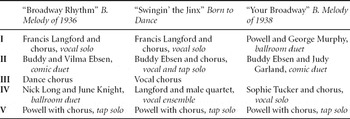
The finale numbers of each MGM backstager thematically address the comradely ideal in Powell's costuming as well as their musical, choreographic, and cinematic structure. Each number builds to a Powell tap solo, a format that the Broadway Melody of 1936 finale established. Music supervisor Roger Edens explains: “I had the song ‘Broadway Rhythm’ split up into five parts. Powell came on with a slam-bang finale—everything built up to her.”Footnote 29 Similarly, “Swingin’ the Jinx” (Born to Dance) consists of five sections, and “Your Broadway and My Broadway” (Broadway Melody of 1938) features four, including a balletic waltz performed by Powell and George Murphy, a comic tap duet performed by Buddy Ebsen and Judy Garland, a vocal performance by Sophie Tucker, and a tap finale, in which Powell performs in a tux and is joined by chorus men (see Table 1 for a comparison of the finale numbers). Of these three finales, “Your Broadway and My Broadway” articulates the comradely ideal most clearly. The number moves from a couple performing a romantic ballroom routine, to a parody of that traditional couple, to men and women dressed in the same clothes performing the same movement.
Sectional outline of MGM finale numbers, 1935–1937.

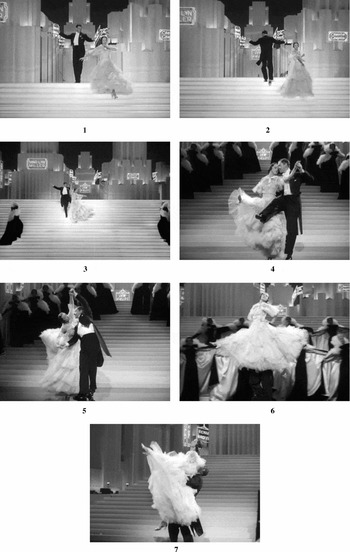
The waltz at the beginning of “Your Broadway and My Broadway” differentiates between female and male dance roles, borrowing from ballet as much as social dance (Figure 3). The couple appears at the top of a long staircase: Powell wears a white, tiered gown of lace and sequins, not unlike a wedding dress, and Murphy wears a tux (1). As they progress down the stairs, she turns, first to stage left then to stage right, and Murphy echoes her movement a few steps behind (2, 3). Once on the stage proper, Murphy partners Powell through dévoloppés (4), attitudes (5), and lifts, which suspend her in the air as she faces the audience (6, 7). In Steven Cohan's account, this performance is unconvincing and Powell's femininity even less so: Murphy is awkward, he claims, and Powell stern, her gown covering her legs, “which amounts to hiding her dancing from view.” As Adrienne McLean notes, however, Powell's serious demeanor in this duet “is part of any Powell dance that is performed to ballad-like or adagio music.”Footnote 30 And surely, given her expressive upper body, Powell's dancing consists of more than visible legs. In my reading, she is weightless, graceful—the choreography and her performance convincingly place her in a conventionally feminine role.
Powell and Murphy's opening waltz in “Your Broadway and My Broadway.” Scene from Broadway Melody of 1938. Directed by Roy Del Ruth. Metro-Goldwyn-Mayer, 1937. Burbank, CA: Warner Home Video, 2008.

Notably, the waltz's camerawork and musical accompaniment focus on Powell and Murphy as a couple rather than as individual stars. Neither is shot in close up; a long shot captures their entrance, and the next medium shot tracks backward from the couple to reveal the staircase as they move to the stage below (see Figure 3, shots 1, 2, and 3). The rest of the routine is presented in three tracking shots, which keep the couple center frame (Figure 3, shots 4, 5, 6, and 7). The musical arrangement, meanwhile, highlights their interactions: the initial chorus hints at an AABA form, but the last A phrase elides into another B phrase, paralleling Powell and Murphy's transition into a new choreographic phrase. The subsequent bridge is interrupted with a four-bar motive that sequences upwards each time Powell and Murphy perform a series of fast turns.Footnote 31 Like the camerawork, the accompaniment focuses on the couple's movements, tying Powell's conventional femininity to a partner rather than distinguishing her as a star.
As soon as Powell and Murphy complete their duet, Buddy Ebsen and Judy Garland satirize it. Ebsen and Garland are awkwardly matched. Top hat askew, he is gangly and tall, his long limbs barely under his control. Garland, in a knee-length version of Powell's bridal gown, is compact and short, full of boundless energy. Their difference in age and stature is the point. When Ebsen and Garland assume a closed ballroom position, he comically bends over, and when he turns her around his body, she runs to keep up with his movement. They are the butt of the joke, yet their comic duet also challenges the traditional gender roles of the preceding waltz.
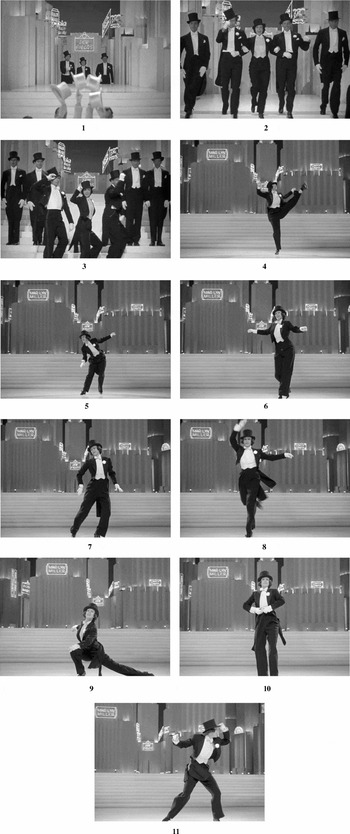
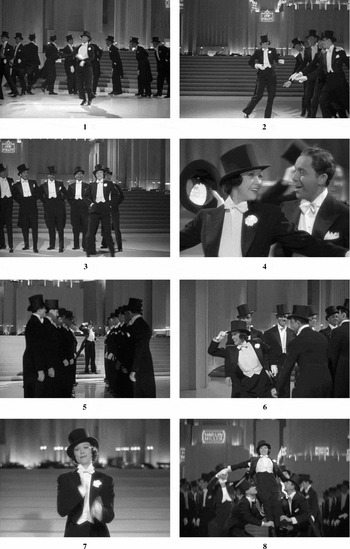
Powell's following tap dance offers an alternative to their challenge and also marks her arrival as a star. Although the routine, like the waltz, begins at the top of the staircase, it dispenses with the heteronormative couple (Figure 4). The camera tracks upwards, moving over Sophie Tucker and a group of chorus men to capture Powell, Murphy, and Ebsen as they summit the stairs (1). Rather than move away from her, as in the waltz, the camera locates Powell within the crowd and keeps her center frame. She wears a tuxedo like Ebsen and Murphy, and they perform the same movement at the same time (2). Twenty-five chorus men join them (3), and they all dance to an arrangement of “Follow in My Footsteps,” the song that established the three characters’ friendship earlier in the film. Here, Powell and the men act as single unit with a shared purpose, interested not in each other but in entertaining the audience they address.
Powell's first tap chorus in “Your Broadway and My Broadway.” Scene from Broadway Melody of 1938. Directed by Roy Del Ruth. Metro-Goldwyn-Mayer, 1937. Burbank, CA: Warner Home Video, 2008.

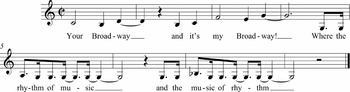
After the chorus men exit, Powell confirms her star status and commences her solo, accompanied by an arrangement of Freed and Brown's “Your Broadway and My Broadway.” The songwriters likely tailored the lyrics and melodic structure to Powell's dance abilities. Freed describes how “the rhythm of music, and the music of rhythm” encourage one to “live in that gay tempo.” The actual music of the song suggests tap dance in particular, as Brown creates a call-and-response structure that provides ample space for tap rhythms (Example 4). The three-note fanfare that begins the tune sequences upwards and then rests on the fifth scale degree. In the first, second, and fourth eight-bar phrases of the chorus, this fanfare motive is answered by swung pitches in the lower register, which anticipate and likely inspired the tap steps that Powell creates in the associated solo.
First eight measures from “Your Broadway and My Broadway.”

Crucially, Powell's choreography to “Your Broadway and My Broadway” retains “feminine” elements, which counterbalance her male dress as well as the masculine associations of tap. The four-bar fanfare motive, orchestrated as a blustery call from the brass, receives high kicks (Figure 4, shot 4) and snappy poses (5), steps that feature Powell's clean, balletic lines. A muted trumpet sounds during the measures Freed and Brown left open for tap rhythms, and Powell responds with noisier, more flirtatious movement: she travels downstage leading with her back foot (6) and follows with cheeky bumps to each side (7). The remainder of the chorus has Powell performing balletic turns (8) and deep pliés (9) as well as more sly gestures, like comically adjusting her bowtie and vest (10) and glancing from side to side to see if anyone is watching (11). Even as her tuxedo recalls her boyfriend backstage and her fellow chorus men, her movements and demeanor do not suggest realistic male impersonation.Footnote 32
The next chorus, a nonchalant soft shoe, brings back the waltz music, but it, like Powell, has changed. The melody is now set in common time rather than 3/4; an unseen female chorus sings about a Broadway melody; and a straightforward thirty-two bar chorus replaces the waltz's irregular structure.Footnote 33 If the music has morphed into a Broadway song, Powell has transformed into a Broadway star. Her upper body and arms convey lightness and fluidity, but balletic steps disappear as she performs a series of triplet rhythms that keep her feet close to the floor. At one point, she casually places her hands in her pockets as she turns around herself, bringing to mind the masculine nonchalance of tappers like John Bubbles. Near the end of the first eight bars, however, the film editor includes a medium shot of Powell smiling broadly, her soft curls clearly visible beneath her hat; this shot and another close up of Powell at the end of the chorus serve as a reminder that she is indeed a woman.
When the tuxedoed chorus men rejoin Powell in the next chorus, her interactions with them are telling: the men follow Powell's lead and copy her steps, treating her like the star she is (Figure 5). She spins past the chorus, causing them to turn in a wave-like motion (1). They point and look at her feet as she taps (2). When she introduces a Latin rhythm, they imitate her “rhumba” movement (3). A breathless collage of Freed and Brown hooks about Broadway and stardom accompany this choreography, creating an aural montage not only of Powell's rise to fame within the narrative of Broadway Melody of 1938, but also within the Broadway Melody series more broadly: Powell has “gotta dance,” and she is also a “lucky star,” as tenor Charles Igor Gorin sings during a momentary pause in the action (4).Footnote 34
Powell and male chorus in “Your Broadway and My Broadway.” Scene from Broadway Melody of 1938. Directed by Roy Del Ruth. Metro-Goldwyn-Mayer, 1937. Burbank, CA: Warner Home Video, 2008.

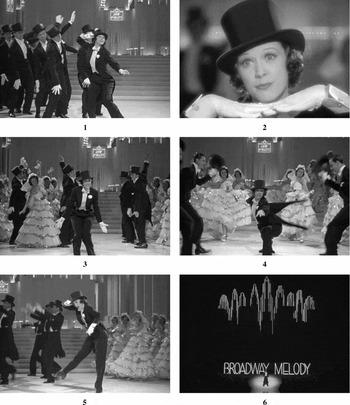
If the opening waltz featured rather stodgy editing, the next chorus of Powell's solo uses the most innovative camerawork of the entire number, linking her stardom to modern cinematic energy. The men form a long corridor, with the camera placed near the end of their vertical lines so that the audience has a sense of depth; Powell moves through the men and towards the camera, executing athletic kicks as the men support her (5). Then, as Powell acknowledges the audience with a tip of her hat, another perspective is introduced, showing Powell and the chorus lines from the side (6). The performers rearrange once again to form a new corridor. Before Powell throws herself down this acrobatic gauntlet, however, a medium shot shows her dusting off her hands (7) in preparation for the most impressive stunt of the number (8). This combination of intimacy and spectacle is exactly what the ballroom segment lacked: as tuxedoed acrobat, Powell is depicted as vibrant entertainer, engaged with her audience.
In the final chorus, Powell participates most fully in the tradition of male impersonation, referencing a male star of yesteryear, George M. Cohan. The structure of the choreography—a freeze chorus—is itself a throwback to chorus routines of the 1920s like the shim sham shimmy, which typically incorporated unexpected “freezes” in the middle of a well-known tap chorus. Here, four asymmetrical phrases, lasting four bars, ten bars, seven bars, and eight bars, respectively, are separated by silence and a pause in stage action (shots 1, 2, 3, and 4 in Figure 6 mark each staged pause). Within the ten-bar phrase, Powell adopts Cohan's trademark posture: bent at the waist, her arms hang loosely as she lopes from foot to foot (5). The impersonation of Cohan is short lived, however, and she quickly morphs his movement into her own style, lifting her knees to waist height and launching herself in the air. Her own star personality returns for the rest of the number, which ends with twenty-odd measures of tap and acrobatics, accompanied only by the trap set. The lights fade, leaving Powell, hands on hips, against the glittering skyline of New York (6). Although she stands alone, the men and the women of show business past resonate in her body, her tuxedo symbolizing his Broadway but also hers.
Freeze chorus in “Your Broadway and My Broadway.” Scene from Broadway Melody of 1938. Directed by Roy Del Ruth. Metro-Goldwyn-Mayer, 1937. Burbank, CA: Warner Home Video, 2008.

MGM's Backstage Cinderella
Powell's journey from waltz partner to tuxedoed tapper suggests a progressive narrative, yet the fact that Powell's character ends her stage performance in a tux does not mean she finds a different fate than other women in musical comedies. The final shot of “Your Broadway and My Broadway” divides in half as a screen wipe reveals a medium shot of Powell, now in a white dress, kissing Robert Taylor. Her marriage is assumed. Meanwhile, Powell's own career casts doubt on her characters’ theatrical success. Although she was a popular star in the mid- to late-1930s, her career flatlined in the 1940s. The reasons, as McLean notes, were numerous. The rise of Judy Garland reportedly pushed Powell further down MGM's pecking order of female stars. The repetitious nature of the Powell films may have diminished her popularity. The increasing prominence of the integrated musical, which claimed to depict realistic, psychologically coherent characters, left little room for a competent female dancer more invested in the pleasure of movement than in depicting a character's emotions through dance.Footnote 35
Although these circumstances contributed to Powell's disappearance, Powell herself decided against pursuing work after her MGM contract ended. In 1943, Powell, like her onscreen characters, married a man of show business, actor Glenn Ford. She spoke candidly about her early married life after their divorce in the early 1960s. “I desperately wanted my marriage to succeed,” Powell told the newspaper magazine Parade, “I was always over-protected about love and romance as a girl—knew absolutely nothing about them even though I've spent my life in show business—but I realized that our marriage wouldn't stand a chance in this town unless I quit my career. Glenn is terribly sensitive, and I knew he couldn't stand being called ‘Mr. Eleanor Powell.’”Footnote 36 Powell's own backstage story, it seems, did not feature a husband as supportive as Steve Raleigh, and despite the efforts of her MGM films, she was not able to mesh a career and marriage in her real life.
Powell's personal difficulties point to the conservative elements of the MGM Cinderella. Although the studio's backstage musicals provided performative spaces for Powell to showcase her talents, the surrounding narratives shaped those performances to suit the broader cultural context, at least as it was interpreted by the films’ creative staff. MGM was happy to showcase its new star dancing on a Broadway stage, but it was not ready to let her onscreen characters achieve success in show business without the guidance of a man. Nor was the studio ready to depict a beautiful, talented, and well-adjusted female star in clothing that, to borrow Nadine Wills’ turn of phrase, advertised the “110 percent woman.”Footnote 37
In this light, the MGM Cinderella musical works in a different way from the backstage musicals produced at Warner Bros. Pamela Robertson argues that in Gold Diggers of 1933, narrative scenes depict chorus women as “jokingly and knowingly manipulat[ing] their commodity status and further promulgat[ing] their commodification,” a context that allows a viewer to understand the feminine spectacle of Busby Berkeley's lavish production numbers through “a double vision”: “as a camp spectator who simultaneously identifies with and laughs at her image.”Footnote 38 The oversexed, untalented chorus girl in the numbers was, in other words, an acknowledged stereotype within the Gold Diggers narrative, a costume that could be put on at will. Although playful, the MGM backstagers are not nearly so self-reflexive, nor so easily read as subversively campy: Powell plays straightforward characters and then performs honestly and wholeheartedly, highlighting her craft and talent. In part, this seriousness was due to Powell's personality and abilities; she did not possess the comedic timing of the Warner Bros. “gold diggers” Joan Blondell, Ginger Rogers, and Aline MacMahon. But at the same time, Powell's scripts left little room for her to play, as Jack McGowan and other scriptwriters assigned the numerous and conflicting chorus girl stereotypes to different characters: Powell became the Cinderella, the onscreen chorus girls absorbed the dumb and untalented associations, and the films’ female villains were painted as the gold diggers. Unlike the Warner Bros. musical heroines, female characters in the MGM musicals could not as easily challenge or comment on their constructed identities.
The differences between the Warner Bros. Gold Digger series and the MGM Broadway Melody films further demonstrate how differently individual studios interpreted the backstage musical in their understanding of Depression-era culture. On the one hand, the backstage musical's doubleness—its show-within-a-show formula—encouraged a character to take on a performative identity that deconstructed her narrative identity or a narrative identity that challenged her performative one. Warner Bros. frequently took this approach in their reworking of the chorus girl from a 1920s gold-digging villain into a 1930s engine of economic recovery. Alternatively, a stage performance within a backstage musical could reinforce a narrative identity, even when a number ostensibly had nothing to do with story or character development. MGM relied on this structural capability of the backstage musical in the Broadway Melody films, which simultaneously reinforced several chorus girl stereotypes and altered one—the Broadway Cinderella—to fit Hollywood's version of the comradely ideal. This modern Cinderella, played capably by Powell, was emphasized in narrative and number, even though the films’ stories and Powell's tap performances seem incompatible to many modern critics.
More broadly, the gender politics of the Warner Bros. and MGM backstage musicals reveal the structural complexity of the backstage musical itself, which challenges the notion of integration even as it relies on conceptual links between narrative and number. Neither theater historians nor film scholars have fully explored this intricacy. Scott McMillin notes that in its stage form the backstage musical is undertheorized, but his own observations remain rather broad: a number framed as performance within a narrative “is called for in the book” and thus “seems to be integrated into book time,” yet, he writes, it retains a “built-in detachability.”Footnote 39 Film scholars have confronted the backstage musical in more detail, likely because the backstager, as Martin Rubin writes, “has always been far more popular and important on the screen than it has been on the stage.”Footnote 40 Rubin, for his part, theorizes that in the backstage mode, there is a distinct separation between narrative and number, one defined by “a space (or a series of homologous spaces) that are, to a certain extent, self-enclosed and independent.” This spatial separation, he argues, has narrative and discursive ramifications: numbers “bear little relation to the surrounding plot” and, as a result, “do not impinge on the ‘realistic’ discourse of the narrative.”Footnote 41 Rubin interprets detachability, in other words, as autonomy: the presence or suggestion of a proscenium arch disconnects a number from its narrative world.
The intertwining of love and career in the narrative and the finale numbers of Powell's films suggests otherwise and points to Rick Altman's discussion of the Hollywood “show musical,” in which he adapts his dual-focus narrative model to the backstage setting. The male and female leads in all film musicals, Altman argues, represent conflicting values, their separate, gendered worlds constructed in parallel scenes and musical numbers that rarely abide by the cause and effect logic of classical Hollywood. The marriage at the end of the film resolves these personal differences and also mediates a secondary thematic opposition between work and entertainment, high art and popular culture, or age and youth.Footnote 42 As noted above, backstage musicals produced after the release of 42nd Street, including the Broadway Melody series, conflate the romantic couple with the success of the show within the film, thus thematically tying numbers to narrative.
However, even Altman's paradigm does not accurately capture the structural flexibility of Powell's films. As McLean observes, the MGM backstagers devote as much screen time to novelty acts as to the romantic leads.Footnote 43 More pressing, the men in Powell's films do not inhabit a different sphere from Powell: they are middle-class, like she is, and if not involved in show business, interested in it. The narrative obstacle in her early films is not, in other words, a conflicting worldview between man and woman, but rather the anxiety caused by her stage ambitions. Moreover, because Powell's leading men are not singers or dancers themselves, they do not star in solo numbers equal in length or quality to hers; hence, MGM backstagers never establish a difference between the leads through musical numbers. When the female lead of a backstage musical is also the primary star of the film, it seems, Altman's dual-focus narrative theory crumbles, along with its understanding of the role of musical performance in the backstage film.
Most useful in theorizing Powell's films, and the backstage musical more generally, are the subcategories of musical numbers outlined by John Mueller, especially those not designated as “truly integrated.”Footnote 44 Mueller notes, for example, that numbers “whose existence is relevant to the plot, but whose content is not” are common in “musicals which use show business as background.” Many of Powell's dance routines fit this category given that her character is identified as a dancer in each film. Another category, numbers “which advance the plot, but not by their content,” are a good description of Powell's final stage performances: without them, the audience would have no evidence of her characters’ theatrical success, a crucial plot point of the backstage narrative. Mueller's most ambiguous category, numbers “which contribute to the spirit or theme” of a film musical, remains the most tantalizing regarding Powell's backstagers. A musical's “spirit or theme” may seem too broad a topic when interrogating the specifics of an individual number, and yet Powell's spectacular finales do focus on the theme, or more accurately, the sociocultural work of her films, as she embodies the comradely ideal espoused by her boyfriends.
The caginess of the backstage musical is not necessarily a structural or aesthetic weakness; in fact, its elusive approach to musical numbers is often its strength, providing numerous methods for engaging narrative and giving performers the opportunity to inhabit a variety of performative roles. For women, this flexibility proved especially important. The integrated stage musical of the 1940s and 1950s usually enforced a much narrower definition of how women could act, sing, dance, and dress, leaving little room for performers like Powell.Footnote 45 To be sure, the backstager's manipulation of performance qua performance did not mean women were free from gender stereotypes; Powell's characters, after all, dress like men in order to secure theatrical success and allay fears about a dancing woman, reinforcing her films’ conservative narratives rather than deconstructing them. Nonetheless, female performers in the 1930s experienced performative options not always available in later decades of the American musical. Powell's tapping remains tied to the flexibility, the doubleness, of the backstage musical.
In this light, Powell's finale numbers point to the way McMillin argues that every musical number, integrated or otherwise, operates: they proceed in a different kind of time from the narrative, one that ultimately creates a “double characterization,” or in a more evocative turn of phrase, a doubling of selves. The musical number and its lyric time, he continues, “gives the pleasure that follows from rhyme, melody, and meter, and it takes effect not because it blends into the plot in the spirit of integration but because it stands apart and declares that there is another order of time in the theater.”Footnote 46 Unlike the integrated musical, the backstage musical—like Powell's tuxedo—makes lyric time and its doubling effect explicit. It celebrates and manipulates double characterization, asking audience members to view female performers, and male performers as well, from multiple angles. In song and dance, it asks us to think beyond clichéd narratives about Broadway stardom to cultural and social concerns that extend far beyond the theater.