



1 Introduction
In this note we prove that the asymptotics of the equidistribution of unstable (or stable) curves for any
 $C^r$
(
 $r>1$
) pseudo-Anosov ‘diffeomorphism’ (see Definition 1.1 below) of a compact surface is entirely determined by the action of the map on the first cohomology (or homology) group, up to a logarithmic error. This work was motivated by the question whether non-trivial resonances, in the interval
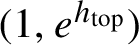
 $(1, e^{h_{\mathrm {top}}})$
, do appear in the asymptotics of ergodic integrals of Giulietti and Liverani [Reference Giulietti and LiveraniGL19] for Anosov maps of the torus and in the spectrum of the relevant transfer operator. By comparing our asymptotics with that of Giulietti and Liverani [Reference Giulietti and LiveraniGL19], we conclude that no such non-trivial resonance exists. A direct, self-contained proof that there are no non-trivial resonances for the transfer operator has been given simultaneously and independently by Baladi [Reference BaladiBa21]. Her proof was an additional motivation to write up the argument presented below.
The argument is inspired by the author’s proof [Reference ForniFo02] of deviation of ergodic averages for generic (almost all) translation flows on higher-genus surfaces. Here we only deal with the special case of unstable foliations of diffeomorphisms, but we do not assume that the diffeomorphism is volume-preserving. For this reason we work in Hölder or bounded variation spaces instead of Sobolev
 $L^2$
spaces (with respect to the invariant volume). A complete description of Ruelle resonances, as well as a complete asymptotics of ergodic averages and results on cohomological equations for linear pseudo-Anosov maps, has been given recently in the paper by Faure, Gouëzel and Lanneau [Reference Faure, Gouëzel and LanneauFGL19]. Our argument gives a simplified proof of the part of their result concerning the Ruelle resonances in the interval
 $(1, e^{h_{\mathrm {top}}})$
and the deviation of ergodic averages up to a logarithmic error. It also extends to the ‘nonlinear’ case, which to the best of our knowledge has not been studied so far.
Definition 1.1
-
(a) A linear pseudo-Anosov diffeomorphism A of class
 $C^r$
(with
$r\geq 1$
) of a compact orientable surface M is a homeomorphism of M with a finite set
$\Sigma \subset M$
of fixed points, which is of class
$C^r$
on the open manifold
$M\setminus \Sigma $
and is hyperbolic in the following sense. There exist smooth transverse measured foliations
$\mathcal F^s$
and
$\mathcal F^u$
with singularity set equal to
$\Sigma $
, and there exists a dilation coefficient
$\lambda>1$
such that (that is, the foliations
$$ \begin{align*}A_* (\mathcal F^s) = \lambda \mathcal F^s \quad \text{and} \quad A_* (\mathcal F^u) = \lambda^{-1} \mathcal F^u \end{align*} $$
$\mathcal F^s$
and
$\mathcal F^u$
are invariant under A, and the transverse measures
$\mathcal F^s$
and
$\mathcal F^u$
are dilated by factors
$\lambda>1$
and
$\lambda ^{-1}<1$
).
-
(b) A pseudo-Anosov diffeomorphism A of class
$C^r$
of a compact orientable surface M is a homeomorphism of M with a finite set
$\Sigma \subset M$
of fixed points, which is of class
$C^r$
on the open manifold
$M\setminus \Sigma $
, and is topologically conjugate to a linear pseudo-Anosov diffeomorphism on M.


Remark 1.2 Linear pseudo-Anosov diffeomorphisms of the torus are classical hyperbolic toral automorphisms. Linear pseudo-Anosov diffeomorphisms of higher-genus surfaces are not in fact differentiable at the set of common singularities of the invariant measured foliations. By the work of Gerber and Katok [Reference Gerber and KatokGK82] a linear pseudo-Anosov diffeomorphism cannot be conjugate to a diffeomorphism of class
 $C^1$
by a homeomorphism which is
 $C^1$
on the complement of the singularity set. However, every linear pseudo-Anosov diffeomorphism has a smooth model [Reference Gerber and KatokGK82], that is, it is topologically conjugate to a smooth diffeomorphism. According to the above definition, Gerber–Katok smooth models are examples of nonlinear pseudo-Anosov diffeomorphisms.
Let
 $A:M\to M$
be an orientation-preserving pseudo-Anosov diffeomorphism, of class
 $C^r$
for any
 $r>1$
, of a compact surface M, with a finite set of fixed points (singularities) at
 $\Sigma \subset M$
and orientable invariant foliations. Under the latter assumption, the invariant foliations of A (which exist by topological conjugacy to a linear model) can be written as kernels of continuous closed 1-forms.
Let
 $E^+ \subset H^1(M, {\mathbb C})$
and
 $E^- \subset H^1(M, {\mathbb C})$
denote respectively the unstable and the stable spaces of the finite-dimensional linear map
 $A^\#: H^1(M, {\mathbb C}) \to H^1(M, {\mathbb C})$
induced by A on cohomology. Let
 $\{\mu _1, \ldots , \mu _{2s}\}\subset {\mathbb C}$
denote its spectrum ordered so that
 $$ \begin{align*}\mu_1=\lambda> \vert \mu_2 \vert \geq \cdots \geq \vert \mu_k\vert > \vert \mu_{k+1}\vert = \cdots =\vert \mu_{s}\vert =1, \end{align*} $$
with each eigenvalue repeated according to its geometric multiplicity.
Let
 $J_1 (=1), \ldots , J_k \in { \mathbb N}\setminus \{0\}$
denote the dimensions of the Jordan blocks of each of the expanding eigenvalues
 $\mu _1=\lambda , \mu _2, \ldots , \mu _k$
or, by symmetry, of the contracting eigenvalues
 $\mu _{2s}= \lambda ^{-1}, \mu _{2s-1}, \ldots , \mu _{2s-k+1}$
, and let
 $$ \begin{align*}\{\mathcal C^\pm_{i,j} \vert i\in \{1,\ldots, k\}, \, j \in \{1, \ldots, J_i\} \}\end{align*} $$
denote Jordan bases for the linear map
 $A^\#: H^1(M, {\mathbb C}) \to H^1(M,{\mathbb C})$
of the spaces
 $E^\pm \subset H^1(M,{\mathbb C})$
respectively.
Let
 $J^0_A$
denote the maximal dimension of Jordan blocks of eigenvalues of A on the unit circle, that is, of eigenvalues
 $\mu _{k+1}, \ldots , \mu _{2s-k}$
of
 $A\vert E^0$
.
Let
 $\mathcal L^\pm $
denote the conditional measures of the Margulis measure (measure of maximal entropy) along the leaves of the unstable and stable foliations
 $\mathcal F^+$
and
 $\mathcal F^-$
, respectively. For any
 $(x, \mathcal L) \in M\times { \mathbb R}^+$
, let
 $\gamma _{\mathcal L}(x) \subset M\setminus \Sigma $
denote an oriented unstable curve with initial point
 $x \in M$
and unstable Margulis ‘length’
 $\mathcal L^ +( \gamma _{\mathcal L}(x) ) = \mathcal L$
(whenever it exists).
Since A is, by assumption, topologically conjugate to a linear pseudo-Anosov map, there exists a set of full measure (with respect to the Margulis measure) of
 $x\in M$
such that
 $\gamma _{\mathcal L}(x) $
is well defined for all
 $\mathcal L>0$
.
1.1 Deviation of ergodic averages: invariant foliations
Let
 $\Omega _{\mathrm {BV}}^1(M)$
denote the space of 1-forms of bounded variation on M, defined as the space of 1-forms
 $\eta $
on M whose distributional exterior differential
 $d\eta $
and co-differential
 $\delta \eta $
(with respect to a given Riemannian metric on M) are (signed) finite Radon measures on M. Alternatively, we can define the space
 $\Omega _{\mathrm {BV}}^1(M)$
as the space of 1-forms whose coefficients in any smooth coordinate system are functions of bounded variation functional coefficients. We recall that a function
 $f\in C^0(M)$
has bounded variation if all of its distributional directional derivatives are finite Radon measures on M. The space
 $\Omega _{\mathrm {BV}}^1(M)$
, endowed with the total variation norm, is a Banach space.
Let
 $\mathcal R(M)$
denote the Banach space of finite (signed) Radon measures, endowed with the total variation norm. The total variation norm can be defined as follows:
 $$ \begin{align*}\Vert \eta \Vert_{\Omega_{\mathrm{BV}}^1(M)} = \Vert d\eta\Vert_{\mathcal R(M)} + \Vert \delta \eta\Vert_{\mathcal R(M)} \quad \text{for all }\eta \in \Omega^1_{\mathrm{BV}}(M). \end{align*} $$
Let
 $ \Omega _{\mathrm {BV}}^{\ast }(M)$
denote the dual space of the Banach space
 $\Omega _{\mathrm {BV}}^1(M)$
of 1-forms of bounded variation on M, endowed with the above total variation norm, and let
 ${\mathcal Z}^{\ast }_{\mathrm {BV}}(M) \subset \Omega ^{\ast }_{\mathrm {BV}}(M)$
denote the subspace of closed currents. We recall that a closed current is defined by the condition that its boundary or, equivalently, its exterior derivative vanishes in the distributional sense. Thus
 $C\in \Omega ^{\ast }_{\mathrm {BV}}(M)$
is closed if
 $$ \begin{align*}dC(f) = C(df) =0 \quad \text{for all } f \in C^{1+\mathrm{BV}}(M). \end{align*} $$
Theorem 1.3 Let A be a pseudo-Anosov diffeomorphism of class
 $C^r$
with
 $r>1$
. There exist injective maps
 ${\mathcal B}^\pm : E^\pm \to {\mathcal Z}^{\ast }_{\mathrm {BV}}(M) \subset \Omega ^{\ast }_{\mathrm {BV}}(M)$
into the subspace
 ${\mathcal Z}^{\ast }(M)$
of closed currents (of degree and dimension 1) dual to the space
 $\Omega ^1_{\mathrm {BV}}(M)$
of bounded variation differential 1-forms on M such that
 $$ \begin{align*}A_* \circ {\mathcal B}^\pm = {\mathcal B}^\pm \circ A^\# \quad \text{on } E^\pm \subset H^1(M, {\mathbb C}). \end{align*} $$
For
 $i\in \{1,\ldots , k\}$
and
 $j \in \{1, \ldots , J_i\}$
let us adopt the notation
 $$ \begin{align*}B^\pm_{i, j} := {\mathcal B}^\pm ( \mathcal C^\pm_{i, j} ) \in \Omega_{\mathrm{BV}}^\ast(M). \end{align*} $$
There exists a constant
 $C>0$
such that the following statement holds. For any oriented unstable curve
 $\gamma _{\mathcal L}(x)\subset M \setminus \Sigma $
of initial point
 $x\in M$
and unstable length
 $\mathcal L>1$
, there exists a set of uniformly bounded coefficients
 $$ \begin{align*}\{c_{i, j} (x, \mathcal L) \mid i\in \{2, \ldots k\}, \, j\in \{1, \ldots, J_i\} \}\end{align*} $$
such that, for any differential 1-form
 $\eta \in \Omega ^1_{\mathrm {BV}}(M)$
, we have
 $$ \begin{align} &\bigg\vert \int_{\gamma_{\mathcal L}(x)} \eta - \mathcal L B^+_1(\eta) - \sum_{i=2}^k \sum_{j=1}^{J_i} c_{i,j} (x, \mathcal L) B_{i, j} ^+(\eta) (\log \mathcal L)^{j-1} \mathcal L^{ { \log \vert \mu_i\vert}/{h_{\mathrm{top}}(A)}} \bigg\vert \nonumber\\ &\quad\leq C \vert \eta \vert_{\Omega^1_{\mathrm{BV}}(M)} [\log (1+ \mathcal L) ]^{\max(J^0_A,1) }. \end{align} $$
Under the assumption that the invariant unstable and stable foliations are orientable, the currents
 $B^+_1:= {\mathcal B}^+(\mathcal C^+_{1,1})$
and
 $B^-_1:= {\mathcal B}^-(\mathcal C^-_{1,1})$
can be explicitly written as follows: there exist one-dimensional Margulis measures
 $\mathcal M^+$
and
 $\mathcal M^-$
, respectively unstable and stable, such that, for any 1-form
 $\eta $
of class
 $C^1$
on M, we have
 $$ \begin{align} B^+_1 (\eta ) = \int_M \eta \otimes \mathcal M^- \quad \text{and} \quad B^-_1 (\eta ) = \int_M \mathcal M^ + \otimes \eta. \end{align} $$
In addition, there exists
 $c>0$
such that for every
 $x\in M$
and for every
 $i\in \{2, \ldots , k\}$
and
 $j\in \{1, \ldots , J_i\}$
, there exists a sequence
 $\mathcal L_n:=\mathcal L^{(i,j)}_n(x)$
such that
 $$ \begin{align} \inf_{n\in { \mathbb N}} \vert c_{i,j} (x, \mathcal L_n) \vert \geq c. \end{align} $$
Under the additional assumption that the unstable, respectively the stable, foliation of A is of bounded variation on
 $M\setminus \Sigma $
, in the sense that it can be given as the kernel of a 1-form
 $\eta ^\pm \in \Omega ^1_{\mathrm {BV}}(M)$
(of bounded variation on M), from the above asymptotic result of formula (1), together with the lower bound of formula (3), we can derive a posteriori additional invariance properties of the closed currents
 $B^\pm _1$
,
 $B^\pm _{i,j}$
which are not apparent from their construction.
Remark 1.4 The above regularity assumptions on the invariant foliations are reasonable for uniformly hyperbolic maps of surfaces. Indeed, the stronger assumption that the invariant foliations are of class
 $C^1$
is verified for toral Anosov diffeomorphisms (without singularities) [Reference Katok and HasselblattKH95, Corollary 19.1.11], and the invariant foliations of classical linear pseudo-Anosov diffeomorphisms of higher-genus surfaces are of class
 $C^{\infty }$
(even real analytic). In general, it is well knownFootnote
†
that invariant foliations of uniformly hyperbolic
 $C^{1+\alpha }$
diffeomorphisms (
 $\alpha>0$
) of surfaces are of class
 $C^1$
.
However, Gerber–Katok type smooth models of pseudo-Anosov maps of higher-genus surfaces [Reference Gerber and KatokGK82] (see also [Reference VeconiVc21]) are not uniformly hyperbolic on the whole surface (the differential at the singular points is equal to the identity) and may have invariant foliations which are not of bounded variation. The question of the optimal smoothness of invariant foliations of Gerber–Katok diffeomorphisms does not seem to have been addressed in the literature.
In order to state the invariance properties of our currents we recall the following definition.
Definition 1.5 A current B is called basic for a foliation
 $\mathcal F$
on a smooth manifold if, for all vector fields Y tangent to
 $\mathcal F$
,
 $$ \begin{align*}\mathcal L_Y B = \imath_Y B=0. \end{align*} $$
If the current has dimension
 $1$
, by the identity
 $\mathcal L_Y B = \imath _Y dB + d\imath _Y B$
it follows that B is basic if and only
 $$ \begin{align*}d B = \imath_Y B=0. \end{align*} $$
Addendum 1.6 Under the additional assumption that the unstable, respectively the stable, foliation
 $\mathcal F^\pm $
of A is of bounded variation on
 $M\setminus \Sigma $
, the currents
 $B^\pm _1$
and
 $B^\pm _{i,j}$
, for
 $i\in \{2, \ldots , k\}$
,
 $j\in \{1, \ldots , J_i\}$
, of Theorem 1.3, which are currents on M, restrict to basic currents for the foliations
 $\mathcal F^\pm $
on the open invariant set
 $M\setminus \Sigma $
.
The asymptotic expansion of Theorem 1.3 can be refined by introducing finitely additive functionals on rectifiable arcs, following the work of Bufetov [Reference BufetovBu14] on translation flows (see also [Reference Bufetov and ForniBuF14] on horocycle flows and [Reference Forni, Kanigowski, Crovisier, Krikorian, Matheus and SentiFoKa] on nilflows).
Theorem 1.7 Let
 $\Gamma _r$
be the set of all rectifiable arcs (considered as a subset of the space of currents). There exists a map
 $\hat \beta ^+: \Gamma _r \to \mathcal B^+(E^+)\subset \mathcal Z^{\ast }_{\mathrm {BV}}(M)$
into the space of closed currents (with image in the space of basic currents for the unstable foliation) such that the following statement holds. The map
 $\hat \beta ^+$
has the following properties.
-
(1) (Additive property) For any decomposition
$\gamma = \gamma _1 +\gamma _2$
into subarcs,
$$ \begin{align*} \hat \beta^+(\gamma)= \hat \beta^+(\gamma_1) + \hat\beta^{+}(\gamma_2). \end{align*} $$
-
(2) (Scaling) For any
$\gamma \in \Gamma _r$
, we have
$$ \begin{align*} \hat\beta^{+}(A\gamma ) = A_\ast \hat\beta^{+}(\gamma). \end{align*} $$
-
(3) (Stable holonomy invariance) For all pairs of arcs
$\gamma _1$
,
$\gamma _2\in \Gamma _r$
equivalent under the stable holonomy, we have
$$ \begin{align*} \hat\beta^{+} (\gamma_1) = \hat \beta^{+}(\gamma_2). \end{align*} $$


In addition, the functional
 $\hat \beta ^+$
has the following asymptotic property: there exists a constant
 $C>0$
such that, for every arc
 $\gamma \in \Gamma _r$
we have
 $$ \begin{align*}\vert \gamma - \hat \beta^+ (\gamma) \vert_{\Omega^{\ast}_{\mathrm{BV}}(M)} \leq C (1+\mathcal L^- ( \gamma)) [\log (1+\mathcal L^+ ( \gamma))]^{\max(J^0_A,1)}. \end{align*} $$
1.2 Deviation of ergodic averages: unstable (horocyclic) flows
Let us then assume that the pseudo-Anosov map A of class
 $C^r$
on
 $M\setminus \Sigma $
with
 $r>1+\alpha $
(
 $\alpha> 0$
) preserves the orientation of the unstable foliation which we assume is of class
 $C^{1}$
. As in [Reference Giulietti and LiveraniGL19], let X denote a vector field of class
 $C^{1}$
, tangent to the unstable foliation and normalized to have constant norm with respect to a fixed Riemannian metric on M. By definition, for all
 $n \in { \mathbb N}$
there exists a function
 $\nu _n: M\setminus \Sigma \to { \mathbb R}$
such that (see [Reference Giulietti and LiveraniGL19, formula (1.3)])
 $$ \begin{align*}D_x A^n (X_x)= \nu_n (x) X_{A^n(x)} \quad \text{for all } x \in M\setminus \Sigma. \end{align*} $$
From Theorem 1.3 we derive a result on the asymptotics of ergodic integrals for the flow
 $h^X_{ \mathbb R}$
generated by the unstable vector field X on
 $M\setminus \Sigma $
.
For linear pseudo-Anosov maps on higher-genus surfaces, a sharper asymptotics of ergodic integrals of the stable and unstable translation flows was obtained by Faure, Gouëzel and Lanneau [Reference Faure, Gouëzel and LanneauFGL19], who also proved complete results on the existence and regularity of solutions of the cohomological equation.
For the case of toral Anosov diffeomorphisms, the asymptotics of ergodic integrals of stable and unstable vector fields was studied in the pioneering work of Giulietti and Liverani [Reference Giulietti and LiveraniGL19]. Baladi [Reference BaladiBa21] has given a proof, independent of ours, that in the toral case there are no ‘deviation resonances’ in the Giulietti–Liverani asymptotics (see Remark 1.9 below). Her argument also proves that for the stable or unstable vector fields of sufficiently regular Anosov diffeomorphisms every zero-average function is a continuous coboundary, a result which is beyond the reach of our cohomological approach.
Let
 $\hat X$
be a 1-form of class
 $C^{1}$
dual to the vector field X, in the sense that
 $$ \begin{align*}\hat X (X) \equiv 1 \quad \text{on } M\setminus \Sigma. \end{align*} $$
Let
 $\mathrm {BV}_X (M)$
denote the space of functions f such that the 1-form
 $f \hat X$
extends to a bounded variation 1-form on M (which will be denoted by the same symbol, that is,
 $f \hat X \in \Omega ^1_{\mathrm {BV}}(M)$
). Note that the space
 $\mathrm {BV}_0(M\setminus \Sigma )$
of functions of bounded variation with compact support in
 $M\setminus \Sigma $
is a subspace of
 $\mathrm {BV}_X (M)$
.
The unique invariant probability measure
 $\mu _X$
of the flow
 $h^X_{ \mathbb R}$
is given by the condition
 $$ \begin{align*}\mu_X \in { \mathbb R}^+ ( B^+_1 \wedge \hat X) \quad \bigg(\text{defined as } \int_M f\, d\kern-1pt\mu_X = \frac{B^+_1 (f \hat X)} {B^+_1 (\hat X)}, \text{ for all } f \in \mathrm{BV}_X(M) \bigg). \end{align*} $$
Let
 $\{D^X_{i,j} \mid i\in \{2, \ldots , k\}, j \in \{1, \ldots , J_i\} \}$
be the finite set of distributions
 $$ \begin{align*}D^X_{i,j} := B^+_{i,j} \wedge \hat X \quad \text{for all } i\in \{2, \ldots, k\}, j \in \{1, \ldots, J_i\}. \end{align*} $$
It follows from Addendum 1.6 (see §5) that, for all
 $i\in \{2, \ldots ,k\}$
and for all
 $j\in \{1, \ldots , J_i\}$
, the distributions
 $D^X_{i,j}$
are X-invariant, in the sense that
 $$ \begin{align*}X D^X_{i,j} =0 \quad \text{in }\mathcal D' (M\setminus \Sigma). \end{align*} $$
The following asymptotic expansion of ergodic integrals holds.
Corollary 1.8 There exist a constant
 $C_X>0$
and, for all
 $(x,T) \in (M\setminus \Sigma ) \times { \mathbb R}^+$
, a finite set of uniformly bounded coefficients
 $$ \begin{align*}\{ c^X_{i,j} (x,T) \mid i\in \{2, \ldots, k\}, j \in \{1, \ldots, J_i\} \}\end{align*} $$
such that, for all
 $f\in \mathrm {BV}_X(M)$
and for all
 $(x,T) \in (M\setminus \Sigma )\times { \mathbb R}^+$
with
 $h^X_{[0,T]} (x) \subset M\setminus \Sigma $
, we have
 $$ \begin{align} &\bigg\vert\! \int_0^T \! f \circ h^X_t(x)\, dt - T \!\int_M f\kern1.5pt d{\kern-1.2pt\mu}_X - \!\sum_{i=2}^k \sum_{j=1}^{J_i} \! c^X_{i,j} (x, T) D_{i, j} ^X(f) (\log T)^{j-1} T^{\,{ \log \vert \mu_i\vert}/{h_{\mathrm{top}}(A)}} \bigg\vert \nonumber\\ &\quad\leq C_X \vert f \hat X\vert_{\Omega^1_{\mathrm{BV}}(M)} [\log (1+ T) ]^{\max(J^0_A,1) }. \end{align} $$
In addition, there exists
 $c>0$
such that, for every
 $x\in M$
and for every
 $i\in \{2, \ldots , k\}$
and
 $j\in \{1, \ldots , J_i\}$
, there exists a sequence
 $T_n:=T^{(i,j)}_n(x)$
such that
 $$ \begin{align} \inf_{n\in { \mathbb N}} \vert c_{i,j} (x, T_n) \vert \geq c. \end{align} $$
Remark 1.9 (Comparison with a result of Baladi [Reference BaladiBa21, Corollary 2.3]) A similar, but more refined, asymptotics of ergodic averages is proved in [Reference BaladiBa21] for the case of
 $C^r$
Anosov diffeomorphisms of the
 $2$
-torus, a case for which the spectrum of
 $A^\#: H^1({ \mathbb T}^2)\to H^1({ \mathbb T}^2)$
has a unique expanding eigenvalue
 $\mu _1=\lambda>1$
(and no neutral eigenvalues).
In fact, she proves (see [Reference BaladiBa21, Corollary 2.3]) that there exist
 $r_0, r_1>1$
such that for any
 $r\geq \max \{r_0, r_1\}$
there exist constants
 $C>0$
and
 $\theta _{\min } <0$
such that, for all
 $f \in C^{r-1}({ \mathbb T}^2)$
and for all
 $T>0$
,
 $$ \begin{align*}\bigg \vert \int_0^T f \circ h^X_t (x)\, dt - T \int_{{ \mathbb T}^2} f\kern1.2pt d\kern-1.2pt\mu_X \bigg\vert \leq C ( T^{\theta_{\min}} \vert f \vert_{C^{r-1}} + \mathop{\mathrm{sup}}\limits \vert f \vert). \end{align*} $$
In particular,
 $\mu _X(f) =0$
if and only if f is a continuous coboundary.
In comparison with the asymptotics of Corollary 1.8 above, Baladi’s asymptotics has bounded, not logarithmic, error terms. However, such terms cannot be neglected for general functions of class
 $C^1$
. A refined asymptotics with bounded error terms may hold for general functions of class
 $C^{1+\alpha }$
, for some
 $\alpha>0$
, and for such functions one can derive results on existence of solutions of the cohomological equation (see [Reference ForniFo07, Reference Marmi and YoccozMY16] also in the higher-genus case). Such refined results are beyond the purely cohomological approach presented here.
1.3 Ruelle–Pollicott asymptotics
The above equidistribution results are derived from an asymptotics for the action of the pseudo-Anosov map on the space of closed currents and on currents which stay at a controlled distance (with respect to the dual metric on the dual space
 $\Omega _{\mathrm {BV}}^\ast (M)$
of the space of 1-forms of bounded variation) from the subspace of closed currents (see Theorem 3.1). From the same result we derive a Ruelle–Pollicott asymptotics for pseudo-Anosov maps with orientable invariant foliations.
For linear pseudo-Anosov maps on higher-genus surfaces, a complete Ruelle–Pollicott asymptotics has been obtained by Faure, Gouëzel and Lanneau [Reference Faure, Gouëzel and LanneauFGL19]. In this case our partial Ruelle–Pollicott asymptotics can be derived directly from the above equidistribution results.
For toral Anosov diffeomorphisms the Ruelle–Pollicott asymptotics follows from the work of Giulietti and Liverani [Reference Giulietti and LiveraniGL19]. Baladi [Reference BaladiBa21] has given an independent proof that in the toral case there are no ‘deviation resonances’ in the Giulietti–Liverani asymptotics (see Remark 1.12 below).
Let
 $\eta ^+$
and
 $\eta ^- \in \Omega ^1_{\mathrm {BV}}(M)$
be 1-forms of bounded variation on M, transverse on
 $M\setminus \Sigma $
respectively to the unstable and stable foliation of the pseudo-Anosov map, which we assume to be orientable.
The tensor products
 $\mathcal H^+:= \eta ^+ \otimes \mathcal M^-$
and
 $\mathcal H^-:= \mathcal M^+ \otimes \eta ^-$
of the transverse measure induced by the 1-form
 $\eta ^\pm $
with a conditional Margulis measure
 $\mathcal M^{\mp }$
are well-defined finite (signed) measures, although not A-invariant. We first prove a Ruelle–Pollicott asymptotics for correlations with respect to the measures
 $\mathcal H^\pm $
(which we assume normalized to have unit total mass). We define the spaces of functions
 $$ \begin{align*}\mathrm{BV}^1(M, \eta^\pm):=\{ f\in C^0(M) \mid f\eta^\pm \in \Omega_{\mathrm{BV}}^1(M) \}. \end{align*} $$
Both such spaces contains the space of functions of bounded variation with compact support on
 $M\setminus \Sigma $
.
Theorem 1.10 Let A be a pseudo–Anosov diffeomorphism of class
 $C^r$
with
 $r>1$
on the invariant open set
 $M\setminus \Sigma $
with orientable invariant foliations. Then A has a Ruelle–Pollicott asymptotics in the sense that, for any
 $f\in \mathrm {BV}^1(M, \eta ^+)$
and
 $g \in C^1(M)$
, the correlations
 $\langle f, g \circ A^{-n} \rangle ^+$
with respect to the measure
 $\mathcal H^+$
and, for any
 $f \in C^1(M)$
and
 $g\in \mathrm {BV}^1(M, \eta ^-)$
, the correlations
 $\langle f\circ A^n, g \rangle ^-$
with respect to the measure
 $\mathcal H^-$
have expansions
 $$ \begin{align} \begin{aligned} \langle f , g \circ A^{-n} \rangle^+ &= \bigg(\int_M f\kern1.2pt d\mathcal H^+\bigg) \bigg(\int_M g \circ A^{-n}\, d\mathcal H^+\bigg) \\ &\quad+ \sum_{i=2}^k \sum_{j=1}^{J_i} \kappa^+_{i,j}(f,g) n^{j-1} \bigg(\frac{\mu_i}{e^{h_{\mathrm{top}}(A)}}\bigg)^n + \rho^+(f,g,n) \frac{n^{\max(J^0_A,1)}}{e^{n h_{\mathrm{top}}(A)}} , \\ \langle f \circ A^n , g \rangle^- &= \bigg(\int_M f \circ A^n\, d\mathcal H^-\bigg) \bigg(\int_M g\, d\mathcal H^-\bigg) \\ &\quad+ \sum_{i=2}^k \sum_{j=1}^{J_i} \kappa^-_{i,j}(f,g) n^{j-1} \bigg(\frac{\mu_i}{e^{h_{\mathrm{top}}(A)}}\bigg)^n + \rho^-(f,g,n) \frac{n^{\max(J^0_A,1)}}{e^{n h_{\mathrm{top}}(A)}} , \end{aligned} \end{align} $$
with
 $\kappa ^\pm _{i, j} (f,g)$
bounded and
 $\rho ^\pm (f,g,n)$
uniformly bounded as follows: there exists a constant
 $C>0$
such that, for all
 $n\in { \mathbb N}$
, we have
 $$ \begin{align*}\begin{aligned} &\sum_{i=2}^k \sum_{j=1}^{J_i} \vert \kappa^+_{i, j} (f,g) \vert + \vert \rho^+(f,g,n) \vert \leq C ( \vert f \eta^+ \vert_{\Omega^1_{\mathrm{BV}}(M)} + \vert g\vert_{C^1(M)} ) ,\\ &\sum_{i=2}^k \sum_{j=1}^{J_i} \vert \kappa^-_{i, j} (f,g) \vert + \vert \rho^-(f,g,n) \vert \leq C ( \vert f \vert _{C^1(M)} + \vert g \eta^- \vert_{\Omega^1_{\mathrm{BV}}(M)} ). \end{aligned} \end{align*} $$
In addition, the coefficients
 $\kappa ^\pm _{i, j}$
define non-trivial continuous bilinear maps on the space
 $C^1(M)^2$
, for all
 $i\in \{2, \ldots , k\}$
and
 $j\in \{1, \ldots , J_i\}$
.
In the special case that either the stable or the unstable Margulis conditional measure is given by a 1-form of bounded variation on
 $M\setminus \Sigma $
the above theorem gives a partial Ruelle–Pollicott asymptotics for the Margulis measure. In fact, by assumption in this case it is possible to choose 1-forms
 $\eta ^\pm $
of bounded variation on
 $M\setminus \Sigma $
such that
 $$ \begin{align*}\mathcal H^+ = \eta^+ \otimes \mathcal M^- = \mathcal H^- =\mathcal M^+ \otimes \eta^- = \mathcal M. \end{align*} $$
This assumption is verified for pseudo-Anosov diffeomorphisms which are
 $C^1$
conjugate to classical linear pseudo-Anosov diffeomorphisms. In the general case, we can derive the asymptotics stated below. The sharpness of the asymptotics depends on the assumptions on the growth of the maximal expanding or the minimal contracting derivative of the map A, that is, on the exponential rate of growth of the quantities
 $$ \begin{align*}\mathop{\mathrm{sup}}\limits_{x\in M\setminus \Sigma} \vert D^+ A^{\ell}(x)\vert \quad \text{and} \quad \mathop{\mathrm{sup}}\limits_{x\in M\setminus \Sigma} \vert D^- A^{-\ell}(x)\vert. \end{align*} $$
Here
 $D^+$
and
 $D^-$
denote respectively the derivatives in the direction of the unstable and the stable bundle
 $E^+$
and
 $E^-$
of the pseudo-Anosov diffeomorphism A on
 $M\setminus \Sigma $
.
Corollary 1.11 Let A be a pseudo–Anosov diffeomorphism of class
 $C^r$
with
 $r>1$
on the invariant open set
 $M\setminus \Sigma $
with orientable invariant foliations. Then A has a Ruelle–Pollicott asymptotics in the sense that, for any
 $f, g\in C^1(M)$
, the correlations
 $\langle f\circ A^n, g \rangle $
with respect to the Margulis measure
 $\mathcal M$
have the following expansions: for every
 $n\in { \mathbb N}$
and for any
 $\ell \in { \mathbb N}$
, we have
 $$ \begin{align} \langle f \circ A^n , g \rangle &= \bigg(\int_M f\, d\mathcal M\bigg) \bigg(\int_M g\, d\mathcal M\bigg) + \sum_{i=2}^k \sum_{j=1}^{J_i} \kappa^\pm_{i,j}(f,g, \ell) n^{j-1} \bigg(\frac{\mu_i}{e^{h_{\mathrm{top}}(A)}}\bigg)^n \nonumber\\ &\quad+ \rho^\pm(f,g,n,\ell) \frac{n^{\max(J^0_A,1)}}{e^{n h_{\mathrm{top}}(A)}} + \sigma^\pm(f,g,\ell) , \end{align} $$
with
 $\kappa ^\pm _{i, j} (f,g, \ell )$
,
 $\rho ^\pm (f,g,n, \ell )$
and
 $\sigma ^\pm (f,g,\ell )$
bounded as follows: there exists a constant
 $C>0$
such that, for all
 $n\in { \mathbb N}$
, we have
 $$ \begin{align*}\begin{aligned} \quad &\mathrm{(i)} \ \ \sum_{i=2}^k \sum_{j=1}^{J_i} \vert \kappa^\pm_{i, j} (f,g, \ell) \vert + \vert \rho^\pm (f,g,n,\ell) \vert \leq C \vert f \vert_{C^1(M)} \vert g \vert_{C^1(M)} \mathop{\mathrm{sup}}\limits_{x\in M} \frac{\vert D^\pm A^{\pm \ell}(x)\vert}{\lambda^\ell} , \\ \quad &\mathrm{(ii)} \ \ \vert \sigma^\pm (f,g,\ell)\vert \leq C \vert f \vert_{C^1(M)} \vert g \vert_{C^1(M)} \lambda^{-[\ell/2]} [\log (1+\lambda^{[\ell/2] })]^{\max(J^0_A,1)}. \end{aligned} \end{align*} $$
In particular, the map A is exponentially mixing with respect to its Margulis measure.
(See [Reference VeconiVc21] for a proof of exponential mixing for Gerber–Katok type smooth models of pseudo-Anosov maps.)
Remark 1.12 (Comparison with a result of Baladi [Reference BaladiBa21, Corollary 2.5]) A similar, but more refined, Ruelle–Pollicott asymptotics is proved in [Reference BaladiBa21] for the case of
 $C^r$
Anosov diffeomorphisms of the
 $2$
-torus, a case for which the spectrum of
 $A^\#: H^1({ \mathbb T}^2)\to H^1({ \mathbb T}^2)$
has a unique expanding eigenvalue
 $\mu _1=\lambda>1$
(and no neutral eigenvalues).
In fact, she proves (see [Reference BaladiBa21, Corollary 2.5]) that for any
 $r>1$
there exist constants
 $C>0$
and
 $\rho \in (0,1)$
such that, for all
 $f ,g \in C^{r-1}({ \mathbb T}^2)$
and for all
 $n\in { \mathbb N}$
,
 $$ \begin{align*}\bigg \vert \langle f \circ A^n , g \rangle - \bigg(\int_{{ \mathbb T}^2} f\, d\mathcal M\bigg) \bigg(\int_{{ \mathbb T}^2} g\, d\mathcal M\bigg) \bigg\vert \leq C \rho^n \vert f \vert_{C^{r-1}} \vert g \vert_{C^{r-1}}. \end{align*} $$
The error term in the above estimate is refined as follows. Let
 $\lambda ^+> 1 > \lambda ^-$
denote the minimal expansion and contraction of the diffeomorphism. There exists
 $\tilde \rho _A < e^{h_{\mathrm {top}}(A)} \min (\lambda ^+, (\lambda ^-)^{-1})^{-({r-1})/{2}}$
such that for
 $\tilde \rho _A<1 $
the estimate holds for some
 $\rho < e^{-h_{\mathrm {top}}(A)}$
. In particular, there exists
 $r_1>1$
such that whenever A is of class
 $C^r$
for
 $r>r_1$
we have
 $\tilde \rho _A<1$
and the estimates hold for some
 $\rho < e^{-h_{\mathrm {top}}(A)}$
. For
 $\tilde \rho _A \geq 1$
the estimate holds for any
 $\rho> e^{-h_{\mathrm {top}}(A)} \tilde \rho _A$
.
The paper is organized as follows. In §2 we prove a representation lemma for stable and unstable cohomology classes in terms, respectively, of stable and unstable closed (basic) currents in the dual space of 1-forms of bounded variation (Lemma 2.1). From the representation lemma and de Rham theorem we derive a result on the asymptotics of the action of the pseudo-Anosov diffeomorphism on the space of closed currents dual to the space of 1-forms of bounded variation. In §3 we extend the result of §2 to subspaces of currents which remain at a controlled (bounded) distance from the subspace of closed currents (with respect to a dual bounded variation norm on the space of currents). We then complete the proof of the main result, Theorem 1.3. Finally, in §5 we derive the proof of Corollary 1.8 on the deviation of ergodic averages, and of Theorem 1.10 and Corollary 1.11 on the Ruelle–Pollicott asymptotics.
2 Growth of closed currents
Let
 $\Omega ^1_{\mathrm {BV}}(M)$
denote the space of 1-forms of bounded variation on the compact surface M, endowed with the
 $\mathrm {BV}$
topology. Let
 $\Omega ^{\ast }_{\mathrm {BV}}(M)$
denote its dual, that is, the space of currents of degree and dimension
 $1$
, defined as continuous linear functionals on
 $\Omega ^1_{\mathrm {BV}}(M)$
, and let
 ${\mathcal Z}^{\ast }_{\mathrm {BV}}(M) \subset \Omega ^{\ast }_{\mathrm {BV}}(M)$
denote the subspace of closed currents. In general, since we are not assuming that the map A is differentiable at the invariant singularity set
 $\Sigma \subset M$
, the pull-back operator
 $A^\ast $
on forms may not leave
 $\Omega ^1_{\mathrm {BV}}(M)$
invariant, hence the dual
 $A_\ast $
operator is not defined on the dual space
 $\Omega ^{\ast }_{\mathrm {BV}}(M)$
.
The pull-back operator
 $A^\ast $
nevertheless leaves invariant the subspace
 $\Omega ^1_{\mathrm {BV}\!,c}(M\setminus \Sigma )$
of forms with compact support on
 $M\setminus \Sigma $
, and as a consequence the push-forward operator
 $A_\ast $
is well defined on the dual space
 $\Omega ^1_{\mathrm {BV}\!,c}(M\setminus \Sigma )^\ast $
of currents on
 $M\setminus \Sigma $
, hence it is well defined on the subspace
 $\Omega ^{\ast }_{\mathrm {BV}\!,c}(M) \subset \Omega ^{\ast }_{\mathrm {BV}}(M)$
of currents in
 $\Omega ^{\ast }_{\mathrm {BV}}(M)$
with compact support in
 $M\setminus \Sigma $
.
Although the push-forward map is not well defined on the whole space
 $\Omega ^\ast _{\mathrm {BV}}(M)$
, we prove below that stable and unstable cohomology classes of the induced linear map
 $A^{\#}: H^1(M, { \mathbb R}) \to H^1(M, { \mathbb R})$
can be represented by closed currents which are generalized eigenvectors for the push-forward
 $A_\ast : \Omega ^\ast _{\mathrm {BV}\!,c}(M\setminus \Sigma ) \to \Omega ^{\ast }_{\mathrm {BV}\!,c}(M\setminus \Sigma )$
.
Lemma 2.1 There exist injective maps
 ${\mathcal B}^\pm : E^\pm \to {\mathcal Z}^{\ast }_{\mathrm {BV}}(M) \subset \Omega ^{\ast }_{\mathrm {BV}}(M)$
into the subspace
 ${\mathcal Z}^{\ast }_{\mathrm {BV}}(M)$
of closed currents (of degree and dimension
 $1$
) dual to the space
 $\Omega ^1_{\mathrm {BV}}(M)$
of 1-forms of bounded variation on M such that
 $A_* \circ {\mathcal B}^\pm \in {\mathcal Z}^{\ast }_{\mathrm {BV}}(M)$
and
 $$ \begin{align*}A_* \circ {\mathcal B}^\pm = {\mathcal B}^\pm \circ A^\# \quad \text{on } E^\pm \subset H^1(M, {\mathbb C}). \end{align*} $$
Proof. There exists a linear map
 $\eta : H^1(M, {\mathbb C}) \to Z^\infty _0(M\setminus \Sigma ) \subset \Omega ^1_{\mathrm {BV}}(M)$
, the subspace of closed 1-forms of class
 $C^\infty $
with compact support in
 $M\setminus \Sigma $
, such that, for any
 $C\in H^1(M, {\mathbb C})$
we have that
 $[\eta (C)] = C \in H^1(M,{\mathbb C})$
, hence there exists a (bounded) linear map
 $u: H^1(M, {\mathbb C}) \to C^{r+1}(M)$
such that
 $$ \begin{align*}A^\ast \circ \eta = \eta \circ A^\# + d u \quad \text{on } H^1(M, {\mathbb C}). \end{align*} $$
We note that since the exterior derivative is elliptic and, for every
 $C\in H^1(M, {\mathbb C})$
, the 1-form
 $\eta (C)$
is of class
 $C^\infty $
with compact support in
 $M\setminus \Sigma $
, it follows that the function
 $u(C) \in C^{r+1}(M)$
under the hypothesis that A is a
 $C^r$
diffeomorphism of
 $M\setminus \Sigma $
onto itself. By iterating the above identity, for any
 $C\in H^1(M, {\mathbb C})$
, we have
 $$ \begin{align*}(A^\ast)^n (\eta(C)) = \eta [{(A^\#)^n(C)}] + d [u ((A^\#)^{n-1}(C))] + \cdots + d [(A^\ast)^{n-1} \circ u(C)]. \end{align*} $$
It follows that
 $$ \begin{align*}(A^\ast)^n \circ \eta \circ (A^\#)^{-n} = \eta + d \circ u \circ ( A^\#)^{-1} + \cdots + d \circ (A^\ast)^{n-1} \circ u \circ (A^\#)^{-n}. \end{align*} $$
Let us give the argument for the unstable space
 $E^+ \subset H^1(M,{\mathbb C})$
, otherwise we replace A with it inverse
 $A^{-1}$
. We claim that, since the restriction
 $A^\#\vert E^+$
is (strictly) expanding, it follows by completeness that for every
 $C\in E^+ \subset H^1(M, {\mathbb C})$
, the following limit exists in
 $C^0(M)$
(and in
 $L^2(M)$
in the volume-preserving case):
 $$ \begin{align*}\begin{aligned} U (C) &:= \lim_{n\to +\infty} u (( A^\#)^{-1} C) + \cdots + ((A^\ast)^{n-1} \circ u) ((A^\#)^{-n}C) \\ &= \sum_{k=1}^\infty ((A^\ast)^{k-1} \circ u) ( (A^\#)^{-k}C ) \in C^0(M). \end{aligned} \end{align*} $$
In fact, for every function
 $u \in C^0(M)$
and for all
 $k\in { \mathbb N}$
, we have that
 $$ \begin{align*}\vert (A^\ast)^k (u) \vert_{C^{0}(M)} = \vert u \vert_{C^{0}(M)} \end{align*} $$
and, in the volume-preserving case, also
 $$ \begin{align*}\vert (A^\ast)^k (u) \vert_{L^{2}(M, \text{vol} )} = \vert u \vert_{L^{2}(M, \text{vol} )}. \end{align*} $$
Thus, since
 $A^\#\vert E^+$
is (strictly) expanding, there exists
 $\rho>1$
such that, for all
 $k\in { \mathbb N}$
,
 $$ \begin{align*}\vert ((A^\ast)^{k-1} \circ u) ( (A^\#)^{-k}C ) \vert_{C^0(M)} \leq \Big( \max_{\vert C\vert=1} \vert u(C) \vert_{C^0(M)} \Big) \vert C\vert \,\rho^{-k} , \end{align*} $$
which implies the absolute convergence of the series, hence the claim.
It follows that the following limit exists in
 $\Omega ^{\ast }_{\mathrm {BV}}(M)$
:
 $$ \begin{align*}\mathcal B^+(C):= \lim_{n\to + \infty} (A^\ast)^n \circ \eta \circ (A^\#)^{-n} (C) = \eta (C) + d U(C). \end{align*} $$
By construction we clearly have
 $[\mathcal B^+(C)] = [\eta (C)] = [C] \in H^1(M,{\mathbb C})$
and
 $$ \begin{align*}\begin{aligned} A_\ast (\mathcal B^+(C) )& = \lim_{n\to + \infty} (A^\ast)^{n+1} (\eta ( (A^\#)^{-n} (C) )) \\ & = \lim_{n\to + \infty} (A^\ast)^{n+1} ( \eta ( (A^\#)^{-(n+1)} ( A^\# C) )) = \mathcal B^+ ( A^\# C). \end{aligned} \end{align*} $$
The map
 $\mathcal B^+: E^+ \to \mathcal Z^{\ast }_{\mathrm {BV}}(M)$
is therefore defined, it is linear by its definition and it is injective since
 $[\mathcal B^+(C)] =[C] \in H^1(M, {\mathbb C})$
.
Remark 2.2 By definition of the Margulis measure, the currents in formula (2) are distributional eigenvectors for the diffeomorphism A for the eigenvalues
 $\lambda ^{\pm 1}$
since
 $$ \begin{align*}\begin{aligned} A_\ast B^+_1 (\eta)&= B^+_1 ( A^\ast \eta ) = \int_M \mathcal M^- \otimes A^\ast \eta = \int_M A^{-1}_\ast \mathcal M^- \otimes \eta = \lambda B^+_1 (\eta ) , \\ A_\ast B^-_1(\eta)&= B^-_1( A^\ast \eta ) = \int_M A^\ast \eta \otimes \mathcal M^+ = \int_M \eta \otimes A^{-1}_\ast \mathcal M^+ = \lambda^{-1} B^-_1 (\eta ). \end{aligned} \end{align*} $$
Since the eigenvalues
 $\lambda ^{\pm 1}$
for the action
 $A^{\#}$
of the diffeomorphism A on
 $H^1(M, {\mathbb C})$
are simple, it follows that the Margulis currents
 $B^\pm _1$
in formula (2) are (up to multiplicative constants) the unique distributional eigenvectors of eigenvalues
 $\lambda ^{\pm 1}$
for the linear map
 $A_\ast $
on the space of closed
 $1$
-currents.
Let us recall that
 $\mathcal Z^{\ast }_{\mathrm {BV}}(M)$
denotes the space of closed currents of dimension and degree
 $1$
on M dual to the space of 1-forms of bounded variation. Let
 $E^+$
,
 $E^-$
and
 $E^0$
denote, respectively, the unstable, the stable and the central stable space of the linear map
 $A^\#: H^1(M, {\mathbb C}) \to H^1(M, {\mathbb C})$
induced by
 $A:M\to M$
on the first cohomology of M. There is a direct decomposition
 $$ \begin{align} H^1(M, {\mathbb C})= E^+ \oplus E^- \oplus E^0. \end{align} $$
By Lemma 2.1 there exist maps
 $\mathcal B^\pm : E^\pm \to \mathcal Z^{\ast }_{\mathrm {BV}}(M)$
such that
 $$ \begin{align*}A_* \circ \mathcal B^\pm = \mathcal B^\pm \circ A^\# \quad \text{on } E^\pm. \end{align*} $$
There is also a linear map
 $\mathcal B^0: E^0\to {\mathcal Z}^\infty (M)$
, with values in the space
 ${\mathcal Z}^\infty (M)$
of closed smooth 1-forms with support in
 $M\setminus \Sigma $
, and a linear map
 $F: E^0 \to C^{r+1}(M)$
such that
 $$ \begin{align*}A_* \circ \mathcal B^0 = \mathcal B^0 \circ A^\# + d F \quad \text{on } E^0. \end{align*} $$
The restriction
 $A^\# \vert E^0$
is by definition a unipotent linear operator. Let
 $J^0_A$
be the dimension of the largest Jordan block of
 $A^\# \vert E^0$
.
For every closed current
 $\gamma \in \mathcal Z^{\ast }_{\mathrm {BV}}(M)$
, let
 $[\gamma ] \in H^1(M, { \mathbb R})$
denote its cohomology class and let
 $[\gamma ]^+$
,
 $[\gamma ]^-$
and
 $[\gamma ]^0$
denote, respectively, the projections of the cohomology class
 $[\gamma ]$
on the subspaces
 $E^+$
,
 $E^-$
and
 $E^0$
according to the decomposition in formula (8), that is, for all
 $\gamma \in \mathcal Z^{\ast }_{\mathrm {BV}}(M)$
we have
 $$ \begin{align*}[\gamma] = [\gamma] ^+ + [\gamma]^- + [\gamma] ^0 \quad \text{with } [\gamma]^\pm \in E^\pm \text{ and } [\gamma]^0 \in E^0. \end{align*} $$
Lemma 2.3 There exists a constant
 $C>0$
such that, for all closed currents (of dimension
 $1$
and degree
 $1$
)
 $\gamma \in \mathcal Z^{\ast }_{\mathrm {BV}\!,c}(M\setminus \Sigma ) \subset \Omega ^{\ast }_{\mathrm {BV}\!,c}(M\setminus \Sigma )$
, with compact support in
 $M\setminus \Sigma $
, and for all
 $n\in { \mathbb N}$
, we have
 $$ \begin{align*}\vert A_\ast^n(\gamma) - \mathcal B^+( (A^\#)^n [\gamma]^+ ) \vert_{\Omega^{\ast}_{\mathrm{BV}}(M)} \leq C ( \vert [\gamma] \vert\, n^{\max(J^0_A,1)} + \vert \gamma\vert_{\Omega^{\ast}_{\mathrm{BV}}(M)} ). \end{align*} $$
Proof. For every
 $n\in { \mathbb N}$
, there exist
 $X^\pm (n) \in E^\pm $
,
 $X^0(n) \in E^0$
and a current
 $U_n$
of dimension
 $2$
(and degree
 $0$
) in the dual space
 $\mathcal R(M)^\ast $
of the space
 $\mathcal R(M)$
of signed (Radon) measures on M (which are currents of dimension
 $0$
and degree
 $2$
),
 $$ \begin{align*}A^n_\ast (\gamma)=\mathcal B^+ (X^+(n)) + \mathcal B^- (X^-(n)) + \mathcal B^0 (X^0(n) ) + dU_n. \end{align*} $$
We note that the space
 $\Omega ^2_{R} (M)$
can be identified with the space of signed Radon measures on M.
We therefore have the identities
 $$ \begin{align*}\begin{aligned} A^{n+1}_\ast (\gamma)&=\mathcal B^+ (X^+(n+1)) + \mathcal B^- (X^-(n+1)) + \mathcal B^0 (X^0(n+1) ) + dU_{n+1} \\ &= A_\ast ( \mathcal B^+ (X^+(n)) + \mathcal B^- (X^-(n)) + \mathcal B^0 (X^0(n) ) + dU_{n} ) \\ &= \mathcal B^+ (A^\# X^+(n)) + \mathcal B^- (A^\# X^-(n)) + \mathcal B^0 (A^\# X^0(n) ) + dF (X^0(n)) + dA^\ast U_{n}. \end{aligned} \end{align*} $$
By projecting the above identity on cohomology we have
 $$ \begin{align*} &X^\pm (n+1) = A^\# X^\pm(n), \quad X^0(n+1) = A^\# X^0(n) \quad \text{and }\\ &\quad\qquad\qquad\ \, U_{n+1}= F(X^0(n)) + A^\ast(U_{n}), \end{align*} $$
from which we derive that
 $$ \begin{align*}\begin{aligned} X^\pm (n) &= (A^\#)^n( X^\pm (0))= (A^\#)^n( [\gamma]^\pm) , \\ X^0 (n) &= (A^\#)^n(X^0 (0))= (A^\#)^n ([\gamma]^0) , \end{aligned} \end{align*} $$
and that there exists a constant
 $C>0$
such that
 $$ \begin{align*}\vert U_n\vert_{\mathcal R (M)^\ast} \leq C \vert [\gamma]^0 \vert\, n^{\max(J^0_A,1)} + \vert U_{0}\vert_{\mathcal R (M)^\ast}. \end{align*} $$
In fact, since the total variation of a Radon measure is
 $A_\ast $
-invariant,
 $$ \begin{align*} \vert U_{n+1}\vert_{\mathcal R (M)^\ast} &\leq \vert A^\ast(U_{n}) \vert_{_{\mathcal R (M)^\ast}} + C_F \vert X^0 (n) \vert \\ &\leq \vert U_{n} \vert_{\mathcal R (M)^\ast} + C^\prime_F (n+1)^{\max(J^0_A,1)-1} \vert X^0(0) \vert , \end{align*} $$
hence
 $$ \begin{align*}\vert U_{n}\vert_{\mathcal R (M)^\ast} \leq C^\prime_F \vert [\gamma]^0\vert \sum_{m=0}^n (m+1)^{\max(J^0_A,1)-1} + \vert U_{0}\vert_{\mathcal R (M)^\ast} , \end{align*} $$
thus the argument is concluded.
3 Near-closed currents
In this section we extend the results on the dynamics the pseudo-Anosov map on closed currents (Lemma 2.3), with compact support in
 $M\setminus \Sigma $
, to all currents with compact support in
 $M\setminus \Sigma $
, which remain at a controlled distance from the subspace of closed currents in the dual space
 $\Omega ^{1}_{\mathrm {BV}}(M)$
.
For every
 $\gamma \in \Omega ^{\ast }_{\mathrm {BV}}(M)$
, let
 $$ \begin{align*}\text{dist} (\gamma, {\mathcal Z}^{\ast}_{\mathrm{BV}}(M)):= \inf_{z\in {\mathcal Z}^{\ast}_{\mathrm{BV}}(M)} \vert \gamma - z \vert_{\Omega^\ast_{\mathrm{BV}}(M)}. \end{align*} $$
For every
 $\mu \geq 1$
, let
 $\Gamma ^+_\mu \subset \Omega ^{\ast }_{\mathrm {BV}\!,c}(M)$
denote the subspace of currents
 $\gamma \in \Omega ^{\ast }_{\mathrm {BV}\!,c}(M)$
such that
 $$ \begin{align*}\delta_\mu(\gamma) := \mathop{\mathrm{sup}}\limits_{n\in { \mathbb N}} \mu^{-n} \text{dist} (A_\ast^n(\gamma), {\mathcal Z}^{\ast}_{\mathrm{BV}}(M)) \, < \, +\infty. \end{align*} $$
Let
 $E^+_\mu $
denote the subspace of the unstable space
 $E^+\subset H^1(M, { \mathbb R})$
, defined as the sum of generalized eigenspaces
 $E^+(\lambda ), E^+(\mu _2), \ldots , E^+(\mu _j)$
of all expanding eigenvalues
 $\lambda , \mu _2, \ldots , \mu _j$
in the spectrum
 $\sigma (A^\#)$
of the map
 $A^\#: H^1(M, { \mathbb R}) \to H^1(M, { \mathbb R})$
of modulus greater or equal than
 $\mu \geq 1$
:
 $$ \begin{align*}E^+_\mu := \oplus_{\vert \mu_i \vert \geq \mu} E^+ (\mu_i). \end{align*} $$
We let
 $J^\mu _A$
denote the maximal size of the corresponding Jordan blocks if
 $\mu \in \sigma (A^\#)$
is an eigenvalue of
 $A^\#$
, and let
 $J^\mu _A=0$
if
 $\mu \not \in \sigma (A^\#)$
.
The next result is applied in what follows to currents
 $\gamma $
given by rectifiable arcs, for which
 $\delta _0 (\gamma ) <+\infty $
and we can take
 $\mu =0$
. It is proved below under the more general hypothesis that there exists
 $\mu \geq 0$
such that
 $\delta _\mu (\gamma ) <+\infty $
.
Theorem 3.1 For every
 $\mu \geq 1$
, there is a bounded map
 ${\mathcal C}_\mu : \Gamma ^+_\mu \to E^+_\mu \subset H^1(M,{ \mathbb R})$
such that the following statement holds. There exists a constant
 $C>0$
such that, for every
 $\gamma \in \Gamma _\mu ^+ \subset \Omega ^{\ast }_{\mathrm {BV}\!,c}(M)$
and for every
 $n\in { \mathbb N}$
, we have
 $$ \begin{align*}\vert A^n_\ast (\gamma) - \mathcal B^+ [ (A^\#)^n (\mathcal C_\mu(\gamma) ) ] \vert_{\Omega^\ast_{\mathrm{BV}}(M)} \leq C (\vert \gamma\vert_{\Omega^{\ast}_{\mathrm{BV}}(M)}+ \delta_\mu(\gamma)) (n+1)^{\max(J^\mu_A,J^0_A,1)} \mu^n. \end{align*} $$
The maps
 ${\mathcal C}_\mu $
satisfy the following bounds: for all
 $\gamma \in \Gamma ^+_\mu $
,
 $$ \begin{align*}\begin{aligned} \vert {\mathcal C}_\mu(\gamma) \vert &\leq C (\vert \gamma\vert_{\Omega^{\ast}_{\mathrm{BV}}(M)}+ \delta_\mu(\gamma)). \end{aligned} \end{align*} $$
Proof. Let us consider the direct splitting
 $$ \begin{align*}\mathcal Z^{\ast}_{\mathrm{BV}}(M)= {\mathcal B}^+ (M) \oplus {\mathcal B}^0 (M)\oplus {\mathcal B}^- (M) \end{align*} $$
of the space of
 $\mathcal Z^{\ast }_{\mathrm {BV}}(M)$
of closed currents as a sum of the images
 ${\mathcal B}^\pm (M)$
of the maps
 ${\mathcal B}^\pm : E^\pm \to \mathcal Z^{\ast }_{\mathrm {BV}}(M)$
defined in Lemma 2.1 and of the subspace
 ${\mathcal B}^0 (M)$
of all currents with cohomology class in the neutral space
 $E^0 \subset H^1(M, { \mathbb R})$
.
For every
 $n\in { \mathbb N}$
, there exist a closed current
 $B_n:= B^+_n(\gamma ) \in {\mathcal B}^+ (M)$
and currents
 $B^\prime _n:= B^\prime _n(\gamma ) \in {\mathcal B}^0 (M)\oplus {\mathcal B}^- (M) $
and
 $R_n:= R_n(\gamma ) \in \Omega ^{\ast }_{\mathrm {BV}}(M)$
(not closed) such that
 $$ \begin{align} A_\ast^n (\gamma) = B^+_n + B^\prime_n + R_n \quad \text{and} \quad \vert R_n \vert_{\Omega^{\ast}_{\mathrm{BV}}(M)} \leq 2 \inf_{z\in {\mathcal Z}^{\ast}_{\mathrm{BV}}(M)} \vert A_\ast^n(\gamma) - z \vert_{\Omega^{\ast}_{\mathrm{BV}}(M)}. \end{align} $$
By the above definition it follows that, for all
 $n\in { \mathbb N}$
,
 $$ \begin{align*}B^+_{n+1} + B^\prime_{n+1} + R_{n+1} = A_\ast (B^+_n) + A_\ast (B^\prime_n) + A_\ast (R_n), \end{align*} $$
which in turn (since
 ${\mathcal B}^+ (M) \cap ({\mathcal B}^0 (M) \oplus {\mathcal B}^- (M)) = \{0\}$
) implies that for all
 $n\in { \mathbb N}$
there exist currents
 $R^+_n \in {\mathcal B}^+ (M)$
and
 $R^\prime _n \in {\mathcal B}^0 (M) \oplus {\mathcal B}^-(M)$
such that we have the identities
 $$ \begin{align*}B^+_{n+1} = A_\ast (B^+_n) + R^+_n \quad \text{and} \quad B^\prime_{n+1} = A_\ast (B^\prime_n) + R^\prime_n\, \end{align*} $$
and there exists a constant
 $C>0$
(independent of
 $n\in { \mathbb N}$
) such that
 $$ \begin{align*} &\vert R^+ _n \vert_{\Omega^{\ast}_{\mathrm{BV}}(M)} + \vert R^\prime_n \vert_{\Omega^{\ast}_{\mathrm{BV}}(M)} \leq C ( \vert R_n \vert_{\Omega^{\ast}_{\mathrm{BV}}(M)} + \vert R_{n+1} \vert_{\Omega^{\ast}_{\mathrm{BV}}(M)} ) \\ &\quad\leq 2 C \bigg ( \inf_{z\in {\mathcal Z}^{\ast}_{\mathrm{BV}}(M)} \vert A_\ast^n(\gamma) - z \vert_{\Omega^{\ast}_{\mathrm{BV}}(M)} + \inf_{z\in {\mathcal Z}^{\ast}_{\mathrm{BV}}(M)} \vert A_\ast^{n+1}(\gamma) - z \vert_{\Omega^{\ast}_{\mathrm{BV}}(M)} \bigg). \end{align*} $$
We conclude by finite induction that
 $$ \begin{align*}B^+_n := A^n_\ast \bigg( B^+_0 + \sum_{\ell=0}^{n-1} A^{-(\ell+1)}_\ast (R^+_\ell) \bigg) \quad \text{and} \quad B^\prime_n := A^n_\ast \bigg( B^\prime_0 + \sum_{\ell=0}^{n-1} A^{-(\ell+1)}_\ast (R^\prime_\ell) \bigg). \end{align*} $$
The first identity above can be projected, for each
 $i\in \{1, \ldots , k\}$
, onto the generalized eigenspace
 ${\mathcal B}_{\mu _i}^+(M):= \mathcal B^+(E^+(\mu _i))$
of the linear operator
 $A_\ast $
on
 $\mathcal B^+(M)$
:
 $$ \begin{align} B^+_{i, n} := A^n_\ast \bigg( B^+_{i,0} + \sum_{\ell=0}^{n-1} A^{-(\ell+1)}_\ast (R^+_{i,\ell}) \bigg). \end{align} $$
Since by hypothesis there exist constants
 $C'>0$
and
 $\mu \geq 1$
such that, for all
 $n\in { \mathbb N}$
,
 $$ \begin{align*}\text{dist}( A_\ast^n(\gamma), \mathcal Z^{\ast}_{\mathrm{BV}}(M))= \inf_{z\in {\mathcal Z}^{\ast}_{\mathrm{BV}}(M)} \vert A_\ast^n(\gamma) - z \vert_{\Omega^{\ast}_{\mathrm{BV}}(M)} \leq C' \delta_\mu (\gamma) \mu^n , \end{align*} $$
it follows that there exists a constant
 $C''>0$
such that
 $$ \begin{align} \begin{aligned} \bigg\vert \sum_{\ell=n}^{+\infty} A^{-(\ell+1)}_\ast (R^+_{i,\ell}) \bigg\vert_{\Omega^{\ast}_{\mathrm{BV}}(M)} &\leq C'' \delta_\mu (\gamma) \bigg( \frac{ \mu}{\vert \mu_i \vert}\bigg)^n \quad &\text{if } \vert \mu_i \vert>\mu, \\ \bigg\vert \sum_{\ell=0}^{n-1} A^{-(\ell+1)}_\ast (R^+_{i,\ell}) \bigg\vert_{\Omega^{\ast}_{\mathrm{BV}}(M)} &\leq C'' \delta_\mu (\gamma) (n+1)^{ \max (J^\mu_A,1)} \quad &\text{if } \vert \mu_i \vert = \mu, \\ \bigg\vert \sum_{\ell=0}^{n-1} A^{-(\ell+1)}_\ast (R^+_{i,\ell}) \bigg\vert_{\Omega^{\ast}_{\mathrm{BV}}(M)} &\leq C'' \delta_\mu (\gamma) \bigg( \frac{ \mu}{\vert \mu_i \vert}\bigg)^n \quad &\text{if } \vert \mu_i \vert < \mu, \end{aligned} \end{align} $$
and by a similar estimate we have
 $$ \begin{align} \bigg\vert \sum_{\ell=0}^{n-1} A^{-(\ell+1)}_\ast (R^\prime_{\ell}) \bigg\vert_{\Omega^{\ast}_{\mathrm{BV}}(M)} \leq C'' \delta_\mu (\gamma) (1+n)^{\max (J^0_A,1)} \mu^n. \end{align} $$
The map
 ${\mathcal C}_\mu $
is then defined as
 $$ \begin{align} {\mathcal C}_\mu (\gamma) := ({\mathcal B}^+)^{-1} \bigg [ \sum_{\vert \mu_i \vert> \mu} \bigg( B^+_{i, 0} + \sum_{\ell=0}^{+\infty} A^{-(\ell+1)}_\ast (R^+_{i,\ell})\bigg) \bigg]. \end{align} $$
The statement then follows, by Lemma 2.1, from the identities (10) for the projections on the generalized eigenspaces and from the bounds in formula (11).
4 Arcs of unstable leaves
In this section we derive the asymptotics for currents given by integration along arcs of leaves of the unstable foliation.
The crucial remark concerning such currents is that they stay at bounded distance from closed currents under the action of the map.
Lemma 4.1 There exists a constant
 $C_M>0$
such that for every current
 $\gamma \in \Omega ^{\ast }_{\mathrm {BV}\!,c}(M)$
(of dimension
 $1$
and degree
 $2$
) of integration along an arc of the unstable foliation of the diffeomorphism A on
 $M\setminus \Sigma $
we have the estimate
 $$ \begin{align*}\inf_{z\in \mathcal Z^{\ast}_{\mathrm{BV}}(M)} \vert A^n_\ast(\gamma) - z \vert_{\,\Omega^{\ast}_{\mathrm{BV}}(M)} \leq C_M. \end{align*} $$
Proof. There exists
 $L_M>0$
such that any pair of points
 $x, y\in M$
are endpoints of the smooth oriented path
 $\gamma (x,y) \subset M\setminus \Sigma $
of length at most
 $L_M$
(with respect to a fixed Riemannian metric). It follows that there exists a constant
 $C_M>0$
such that the current of integration along
 $\gamma (x,y)$
(denoted by the same symbol) has norm bounded as follows: for all
 $x, y\in M$
,
 $$ \begin{align*}\vert \gamma (x,y) \vert_{\,\Omega^{\ast}_{\mathrm{BV}}(M)} \leq C_M. \end{align*} $$
Let
 $\gamma $
be any oriented arc of the unstable foliation and, for any
 $n\in { \mathbb N}$
, let
 $x_n$
,
 $y_n$
denote the endpoints of the curve
 $A^n(\gamma )$
. We then have that the current of integration
 $z_n= \gamma - \gamma (x_n,y_n)$
along the union of the curve
 $A_\ast ^n(\gamma )$
and the path
 $\gamma (x_n,y_n)$
(taken with the appropriate orientation) is closed, since it is given as a current of integration along a loop. Finally, for all
 $n\in { \mathbb N}$
, we have
 $$ \begin{align*}\vert A_\ast^n( \gamma) - z_n\vert_{\,\Omega^{\ast}_{\mathrm{BV}}(M)} \leq \vert \gamma (x_n,y_n) \vert_{\,\Omega^{\ast}_{\mathrm{BV}}(M)} \leq C_M , \end{align*} $$
thus, since as we have remarked above
 $z_n \in \mathcal Z^{\ast }_{\mathrm {BV}}(M)$
, the argument is complete.
We measure distances on M along the unstable and stable foliations by (fixed) conditional measures
 $\mathcal L^\pm $
of the Margulis measure.
Theorem 4.2 There exists a map
 $\mathcal C^+: \Gamma ^+ \to E^+$
on the set
 $\Gamma ^+ $
of oriented unstable curves with bounded range in
 $E^+\subset H^1(M, {\mathbb C})$
, such that for any unstable curve
 $\gamma $
of unstable length
 $\mathcal L^+(\gamma )>1$
we have
 $$ \begin{align} \vert \gamma - \mathcal B^+ ( (A^\#)^{[{\log (\mathcal L^+(\gamma))}/{h_{\mathrm{top}}(A)}]} ( \mathcal C^+(\gamma) ) ) \vert_{\Omega^{\ast}_{\mathrm{BV}}(M)} \leq C [\log (1+\mathcal L^+ (\gamma))]^{\max(J^0_A,1)}. \end{align} $$
Proof. The statement follows from Theorem 3.1. For any unstable arc
 $\gamma \subset M\setminus \Sigma $
, let
 $n(\gamma ):=[\log (\mathcal L^+(\gamma )) / h_{\mathrm {top}}(A)] \in { \mathbb N}$
be the unique integer such that
 $$ \begin{align*}\mathcal L^+ ( A^{-n(\gamma)}(\gamma) ) \in [1, \lambda). \end{align*} $$
Since by Lemma 4.1 all currents in
 $\Gamma ^+$
(given by integration along unstable arcs) stay at bounded distance from the space
 $\mathcal Z^{\ast }_{\mathrm {BV}}(M)$
of closed currents, we can derive the result by applying Theorem 3.1. We define the map
 $\mathcal C^+: \Gamma ^+ \to E^+$
in terms of the maps
 $\mathcal C_\mu $
of Theorem 3.1 with
 $\mu =1$
, as follows. Let
 $\pi ^+: H^1(M, { \mathbb R}) \to E^+$
denote the spectral projector onto the expanding subspace. For all
 $\gamma \in \Gamma ^+$
we let
 $$ \begin{align} \mathcal C^+ (\gamma) := \pi^+ ( \mathcal C_1( A^{-n(\gamma)}_\ast(\gamma) )). \end{align} $$
The statement is then a direct consequence of Theorem 3.1. In fact, the currents of integration along the unstable arcs
 $A^{-n(\gamma )}(\gamma )$
of normalized Margulis length (
 $=1$
) have uniformly bounded norm.
We then derive Theorem 1.3 on deviation of ergodic averages from Theorem 4.2 proved above.
Proof of Theorem 1.3
The theorem follows from Theorem 4.2 by writing the asymptotics in formula (14) with respect to a Jordan basis of
 $A^\# \vert E^+$
. The lower bound on the coefficients along subsequences in formula (3) holds by Lemma 2.3 along sequences of (closest) return leaves. In fact, it is known that, for every projection given by a Jordan basis of
 $A^\#$
in
 $H^1(M, { \mathbb R})$
and for all
 $x\in M\setminus \Sigma $
with infinite forward orbit, there exists a return loop
 $\bar {\gamma }(x)$
(the union of a return orbit with a transverse subinterval) with non-zero projection (see, for instance, [Reference BufetovBu14, Proposition 2.9] or [Reference Delecroix, Hubert and LelièvreDHL14, §5.3]). We recall below a proof of this statement for the convenience of the reader.
Let I denote any stable arc. The return map of the unstable flow
 $h^X_{ \mathbb R}$
to I is an interval exchange transformation and the flow
 $h^X_{ \mathbb R}$
is a suspension of that interval exchange transformation under a piecewise constant roof function.
It is well known that the set of loops equal to the union of a first return orbit of
 $h^X_{ \mathbb R}$
(to any given transverse stable arc I) with a transverse (stable) segment joining the endpoints spans the relative homology group
 $H_1(M \setminus \Sigma , { \mathbb Z})$
(see, for instance, [Reference YoccozYoc10, §4.5]). By the Poincaré duality, it follows that, for every given Jordan projection (induced by a Jordan basis of the map
 $A^\#$
on
 $H^1(M , { \mathbb R})$
), there exists a subinterval
 $J \subset I \subset M$
such that the cohomology class of the loop
 $\bar {\gamma }_I(x)$
, given by the union of the return orbit of any point
 $x\in J$
with a transverse (stable) arc
 $I_x\subset I$
, has a non-zero projection.
Now let
 $x \in I \subset M\setminus \Sigma $
be an arbitrary point with infinite forward orbit. Let
 ${\gamma }'(x)$
denote the orbit arc until the first visit of the forward orbit
 $h^X_{{ \mathbb R}^+}(x)$
to the subinterval J and let
 $\bar {\gamma }'(x)$
denote the loop given by the union of
 ${\gamma }'(x)$
with a transverse (stable) interval
 $I' \subset I$
. Let
 ${\gamma }''(x)$
denote the smallest return orbit arc of the forward orbit
 $h^X_{{ \mathbb R}^+}(x)$
which is strictly larger than the orbit arc
 ${\gamma }'(x)$
and let
 $\bar {\gamma }''(x)$
denote the loop given by the union of
 ${\gamma }''(x)$
with a transverse (stable) interval
 $I''\subset I$
. We state the following claim.
Claim. The given Jordan projection of either
 $[\bar {\gamma }'(x)]\in H^1(M, { \mathbb Z})$
(the cohomology class of the loop
 $\bar {\gamma }'(x)$
) or
 $[\bar {\gamma }''(x)]\in H^1(M, { \mathbb Z})$
(the cohomology class of the loop
 $\bar {\gamma }''(x)$
) is non-zero.
In fact, let
 $x'\in J \subset I$
denote the endpoint of the orbit arc
 ${\gamma }'(x)$
and let
 $\bar {\gamma }_I(x')$
denote the loop given by the union of the return orbit of
 $x'\in J$
with a transverse (stable) arc
 $I_{x'}\subset I$
. On the one hand, by hypothesis we have that the given Jordan projection of the class
 $[\bar {\gamma }_I(x')]$
is non-zero; on the other hand, by construction we have
 $$ \begin{align*}[\bar{\gamma}''(x)] = [\bar{\gamma}'(x)] + [\bar{\gamma}_I(x')] \quad \text{in }H^1(M, { \mathbb Z}), \end{align*} $$
hence the claim follows.
We remark that since the return map is an interval exchange transformation (on a fixed finite number of intervals), there are only finitely many cohomology classes corresponding to all loops
 $\bar {\gamma }'(x)$
,
 $\bar {\gamma }''(x)$
for all
 $x\in M$
with semi-infinite unstable leaf. As a consequence, from the fact, stated in the above claim, that the given Jordan projection
 $\pi $
on
 $H^1(M, { \mathbb R})$
of either
 $[\bar {\gamma }'(x)]$
or
 $[\bar {\gamma }''(x)]$
is non-zero, it follows that there exists a constant
 $c>0$
such that
 $$ \begin{align*}\inf_{x\in M} \vert \pi [\bar {\gamma}'(x)] \vert_{H^1(M,{ \mathbb R})} + \vert \pi [\bar {\gamma}''(x)]_{H^1(M,{ \mathbb R})} \vert \,\geq \, c>0. \end{align*} $$
We have thus established the following property. Given any Jordan projection
 $\pi$
on
 $H^1(M, { \mathbb R})$
and any
 $x\in M$
with semi-infinite unstable leaf, there exists an arc
 $\gamma ^{(\pi )}(x)$
, starting at
 $x$
, of the oriented infinite unstable half-leaf through
 $x$
, such that the following holds: the associated loop
 $\bar {\gamma }^{(\pi )}(x)$
, the union of
 $\gamma (x)$
with the shortest transverse arc of a stable leaf with the same endpoints, viewed as a current of dimension
 $1$
and degree
 $2$
, has non-zero cohomology class with
 $$ \begin{align*}\vert \pi [\bar {\gamma}^{(\pi)}(x)] \vert_{H^1(M,{ \mathbb R})} \geq c/2. \end{align*} $$
For any
 $x\in M\setminus \Sigma $
with semi-infinite unstable leaf and for all
 $n\in { \mathbb N}$
, we consider the following sequence of arcs of the unstable leaf through x:
 $$ \begin{align*}\gamma^{(\pi)}_n (x) := A^n [ \gamma^{(\pi)} (A^{-n} (x) )] \quad \text{for all } n\in { \mathbb N}. \end{align*} $$
Let
 $\bar {\gamma }^{(\pi )} _n(x)$
be the associated loop, the union of the arc
 $\gamma ^{(\pi )}_n(x)$
with the shortest arc of stable leaf having the same endpoints.
Let
 $\pi _{i,j} $
denote the projection onto the jth element of the Jordan basis relative to the eigenvalue
 $\mu _i$
, for all
 $i\in \{2, \ldots , k\}$
and
 $j\in \{1, \ldots , J_i\}$
. Then, for
 $\pi = \pi _{i, J_i}$
, let
 $$ \begin{align*}\gamma^{(i)}(x) := \gamma^{\pi}(x)\end{align*} $$
and, for all
 $n\in { \mathbb N}$
,
 $$ \begin{align*}\gamma^{(i)}_n(x) := \gamma^{\pi}_n(x).\end{align*} $$
In other terms, the arc
 $\gamma ^{(i)}(x)$
is chosen so that the projection of the cohomology class
 $[\bar {\gamma }^{(i)}(x)] \in H^1(M, { \mathbb R})$
in the direction of the highest vector of the Jordan basis relative to the eigenvalue
 $\mu _i$
has norm uniformly bounded below.
It finally follows by properties of Jordan bases that, for all
 $i\in \{2, \ldots , k\}$
and
 $j\in \{1, \ldots , J_i\}$
and for n sufficiently large, we have
 $$ \begin{align*}\vert \pi_{ij} (\gamma^{(i)}_n(x) ) \vert_{H^1(M, { \mathbb R})} \geq (1/2) n^{j-1} \vert \mu_i\vert^n \vert \pi_{iJ_i} ( \gamma^{(i)}(x))\vert_{H^1(M, { \mathbb R})} \geq c n^{j-1} \vert \mu_i\vert^n/4, \end{align*} $$
hence the lower bound part of the statement of Theorem 1.3 follows from Lemma 2.3 applied to the closed current given by integration along the loops
 $ \bar {\gamma }^{(i)}(x)$
, for all
 $x\in M\setminus \Sigma $
with semi-infinite unstable leaf and for all
 $i\in \{2, \ldots , k\}$
.
From the statement of Theorem 1.3 we derive the following proof.
Proof of Addendum 1.6
Since the currents
 $B^\pm _1$
and
 $B^\pm _{i,j}$
are closed, it is enough to prove that, for every vector field
 $Y^\pm $
tangent to the unstable/stable foliation
 $\mathcal F^\pm $
, we have that
 $$ \begin{align*}\imath_{Y^\pm} B^\pm_1 = \imath_{Y^\pm} B^\pm_{i,j} =0 \quad \text{for all }i\in \{2, \ldots, k\}, j\in \{1, \ldots, J_i\}. \end{align*} $$
By Theorem 1.3 for any vector field
 $Y:=Y^+$
tangent to the unstable foliation, and for every
 $2$
-form w of class
 $C^1$
, we have, since
 $\int _{\gamma _{\mathcal L} (x)} \imath _{Y} w =0$
,
 $$ \begin{align} \bigg\vert \mathcal L B^+_1(\imath_{Y} w) &- \sum_{i=2}^k \sum_{j=1}^{J_i} c_{i,j} (x, \mathcal L) B_{i, j} ^+(\imath_{Y} w) (\log \mathcal L)^{j-1} \mathcal L^{ { \log \vert \mu_i\vert}/{h_{\mathrm{top}}(A)}} \bigg\vert \nonumber\\ &\quad\leq C \vert \imath_{Y} w \vert_{C^1(M)} [\log (1+ \mathcal L) ]^{\max(J^0_A,1)}. \end{align} $$
The above inequality immediately implies that
 $(\imath _{Y} B^+_1)(w)=B^+_1(\imath _{Y} w) =0$
, and then by the lower bound on coefficients
 $c_{i,j} (x, \mathcal L)$
given in Theorem 1.3 it also follows by finite induction on
 $(i,j)$
, with respect to the lexicographic order (such that
 $(i,j)<(i',j')$
if and only if
 $i<i'$
or
 $i=i'$
and
 $j>j'$
), that
 $$ \begin{align*}(\imath_{Y} B^+_{i,j})(w)=B^+_{i,j}(\imath_{Y} w) =0 \quad \text{for all }i\in \{2, \ldots, k\}, j\in \{1, \ldots, J_i\}. \end{align*} $$
Since w is an arbitrary
 $2$
-form of class
 $C^1$
, the addendum is proved in the case of the unstable foliation. The statement for the stable foliation follows by considering the case of the unstable foliation for the inverse map
 $A^{-1}$
.
Finally, we detail the construction of asymptotic functionals.
Proof of Theorem 1.7
Let
 $ \gamma $
be any unstable arc. Let
 $\mathcal B^+: E^+ \to \mathcal Z^{\ast }_{\mathrm {BV}}(M)$
be the map constructed in Lemma 2.1 and, for all
 $\mu \geq 1$
, let
 ${\mathcal C}_\mu : \Gamma ^+_\mu \to E^+_\mu $
denote the map constructed in Theorem 3.1. We claim that, for all
 $\mu \geq 1$
, the following limit exists:
 $$ \begin{align*}\beta^+_\mu (\gamma) := \lim_{\ell \to \infty} A_\ast^{-m} \mathcal B^+ ( \mathcal C_\mu ( A^m(\gamma)) ) = \mathcal B^+ ( \mathcal C_\mu (\gamma) ). \end{align*} $$
We note that the decomposition of formula (9) is not uniquely determined, unless the currents
 $B^+_n(\gamma )$
and
 $B^\prime _n(\gamma )$
can be chosen as the unique minimizers of the norm
 $$ \begin{align*}\vert A_\ast^n(\gamma) -( B^+_n(\gamma) + B^\prime_n(\gamma)) \vert_{\Omega^{\ast}_{\mathrm{BV}}(M)}.\end{align*} $$
However, it follows by our claim that the map
 $\mathcal C_\mu :\Gamma ^+_\mu \to H^1(M, { \mathbb R})$
is well defined.
In the notation of the proof of Theorem 3.1 we have
 $$ \begin{align*}\mathcal B^+ ( \mathcal C_\mu (\gamma) )= \sum_{\vert \mu_i\vert>\mu} \bigg( B^+_{i,0}(\gamma) + \sum_{\ell=0}^\infty A_\ast ^{-(\ell+1)} (R^+_{i, \ell}(\gamma) ) \bigg). \end{align*} $$
The currents
 $B^+_n(\gamma )$
and
 $R^+_n(\gamma ) \in \mathcal B^+ (M)$
are defined, for all
 $n\in { \mathbb N}$
, by the following identities. Let
 $B^+_n(\gamma )\in \mathcal B^+(M)$
,
 $B^\prime _n(\gamma ) \in \mathcal B^0(M)\oplus \mathcal B^-(M)$
and
 $R_n(\gamma ) \in \Omega ^{\ast }_{\mathrm {BV}}(M)$
be currents such that
 $$ \begin{align*}A_\ast^n(\gamma) = B^+_n(\gamma) + B^\prime_n(\gamma) + R_n(\gamma) \end{align*} $$
with
 $$ \begin{align*}\vert R_n(\gamma) \vert_{\Omega^{\ast}_{\mathrm{BV}}(M) } \leq 2 \inf_{z\in \mathcal Z^{\ast}_{\mathrm{BV}}(M)} \vert A^n_\ast(\gamma) -z \vert_{\Omega^{\ast}_{\mathrm{BV}}(M)}. \end{align*} $$
We then have, for all
 $n\in { \mathbb N}$
, by definition
 $$ \begin{align*}R^+_n(\gamma) := B^+_{n+1}(\gamma) - A_\ast B^+_{n}(\gamma). \end{align*} $$
By the definitions there exists a constant
 $C>0$
such that, for all
 $m, n \in { \mathbb N}$
,
 $$ \begin{align*}\begin{aligned} \vert B^+_{n}( A_\ast^m(\gamma)) - B^+_{n+m} (\gamma)\vert_{\Omega^{\ast}_{\mathrm{BV}}(M) } & \leq C \inf_{z\in \mathcal Z^{\ast}_{\mathrm{BV}}(M)} \vert A^{n+m}_\ast(\gamma) -z \vert_{\Omega^{\ast}_{\mathrm{BV}}(M)}, \\ \vert R^+_{n}( A_\ast^m(\gamma)) - R^+_{n+m}( \gamma)\vert _{\Omega^{\ast}_{\mathrm{BV}}(M) }& \leq C \inf_{z\in \mathcal Z^{\ast}_{\mathrm{BV}}(M)} \vert A^{n+m}_\ast(\gamma) -z \vert_{\Omega^{\ast}_{\mathrm{BV}}(M)}. \end{aligned} \end{align*} $$
In addition, for all
 $n\in { \mathbb N}$
and for all
 $i\in \{1, \ldots , k\}$
, the currents
 $B^+_{i,n}(\gamma )$
and
 $R^+_{i,n}(\gamma )$
denote, respectively, the spectral projections of the currents
 $B^+_{n}(\gamma )$
and
 $R^+_{n}(\gamma )$
onto the generalized eigenspace of
 $A_\ast : \mathcal B^+(M) \to \mathcal B^+(M)$
for the eigenvalue
 $\mu _i \in \sigma (A)$
. Thus there exists a constant
 $C(\gamma )>0$
such that, for any
 $\mu \geq 1$
and for all
 $m\in { \mathbb N}$
,
 $$ \begin{align*}\bigg \vert \mathcal B^+ ( \mathcal C_\mu (A_\ast^m\gamma) )- \sum_{\vert \mu_i\vert>\mu} \bigg(B^+_{i,m}(\gamma) + \sum_{\ell=0}^{\infty} A_\ast ^{-(\ell+1)} (R^+_{i, \ell+m}(\gamma) ) \bigg) \bigg\vert_{\Omega^{\ast}_{\mathrm{BV}}(M)} \leq C(\gamma) \mu^m. \end{align*} $$
From the above bound we derive that
 $$ \begin{align*}\beta^+_\mu (\gamma) := \lim_{m\to \infty} A_\ast^{-m} \sum_{\vert \mu_i\vert>\mu} \bigg(B^+_{i,m}(\gamma) + \sum_{\ell=0}^{\infty} A_\ast ^{-(\ell+1)} (R^+_{i, \ell+m}(\gamma) ) \bigg), \end{align*} $$
and since
 $$ \begin{align*}\begin{aligned} \sum_{\vert \mu_i\vert>\mu}& \bigg(B^+_{i,m}(\gamma) + \sum_{\ell=0}^{\infty} A_\ast ^{-(\ell+1)} (R^+_{i, \ell+m}(\gamma) ) \bigg)\\ &= \sum_{\vert \mu_i\vert >\mu} \bigg( A_\ast ^m \bigg( B^+_{i,0}(\gamma ) + \sum_{\ell=0}^{m-1} A_\ast ^{-(\ell+1)} (R^+_{i, \ell}(\gamma) ) + A_\ast ^m \sum_{\ell=m}^\infty A_\ast ^{-(\ell+1)} (R^+_{i, \ell}(\gamma) ) \bigg) \\ &= A_\ast ^m \sum_{\vert \mu_i\vert >\mu} \bigg(B^+_{i,0}(\gamma) + \sum_{\ell=0}^\infty A_\ast ^{-(\ell+1)} (R^+_{i, \ell}(\gamma) ) \bigg) = A_{\ast} ^{m}\mathcal B^+ ( \mathcal C_\mu (\gamma) ) \end{aligned} \end{align*} $$
we conclude that the limit exists as stated.
The scaling property then follows since the definition is well posed, in fact
 $$ \begin{align*}\begin{aligned} \beta^+_\mu (A\gamma) &:= \lim_{m\to \infty} A_\ast^{-m} \mathcal B^+ ( \mathcal C^+_\mu(A^{m+1}_\ast \gamma) ) \\ &= A_\ast \lim_{m\to \infty} A_\ast^{-(m+1)} \mathcal B^+ ( \mathcal C^+_\mu(A^{m+1}_\ast \gamma) ) = A_\ast \beta^+_\mu (\gamma). \end{aligned} \end{align*} $$
It is clear by the definition that the map
 $\beta ^+_\mu $
is invariant under (regular) stable holonomies of unstable arcs. In fact, for any pair of unstable arcs
 $\gamma $
and
 $\gamma '$
, related by a holonomy along the stable foliation, we have
 $$ \begin{align*}\mathop{\mathrm{sup}}\limits_{m\in { \mathbb N}} \vert A^m_\ast( \gamma) - A^m_\ast (\gamma') \vert_{\Omega^{\ast}_{\mathrm{BV}}(M)} < +\infty. \end{align*} $$
As a consequence, it is possible to extend the functional
 ${\mathcal B}^+$
to any rectifiable arc by decomposition into finitely many subarcs, which are equivalent to unstable arcs under stable holonomies.
Finally, it follows immediately from Theorem 3.1 that there exists a constant
 $C'>0$
such that, for any
 $\mu \geq 1$
and for any unstable arc
 $ \gamma $
, we have
 $$ \begin{align*}\vert \gamma - \beta^+_\mu (\gamma) ) \vert_{\Omega^{\ast}_{\mathrm{BV}}(M)} \leq C' [\log (1+\mathcal L^+ ( \gamma))]^{\max(J^0_A,1)} \mathcal L^+(\gamma)^{ {\log \mu}/{h_{\mathrm{top}}}}. \end{align*} $$
The statement of Theorem 1.7 corresponds to the special case of
 $\mu =1$
, which is allowed since rectifiable arcs in
 $M\setminus \Sigma $
remain at bounded distance from loops (hence from closed currents) under the dynamics induced by the map.
5 Deviations of ergodic integrals and Ruelle–Pollicott asymptotics
In this final section we complete the proofs of Corollary 1.8 on deviations of ergodic integrals for unstable vector fields and Corollary 1.11 on the Ruelle–Pollicott asymptotics.
We first verify our claim that, as a consequence of Addendum 1.6, the measure
 $D_1^X =B_1^+\wedge \hat X$
and, for all
 $i\in \{2, \ldots , k\}$
and all
 $j\in \{1, \ldots , J_i\}$
, the distributions
 $D_{i,j}^X =B_{i,j} ^+\wedge \hat X$
are X-invariant. Let B be any basic current of degree and dimension
 $1$
for the unstable foliation on
 $M\setminus \Sigma $
. The current
 $B \wedge \hat X$
is a current of degree
 $2$
and dimension
 $0$
. Since the contraction operator
 $\imath _X$
is surjective onto the space of functions, it is enough to prove that
 $\imath _X \mathcal L_X (B \wedge \hat X)=0$
, as the latter identity then implies
 $\mathcal L_X (B \wedge \hat X)=0$
. Indeed, since
 $\imath _X B=dB=0$
and
 $\imath _X \hat X=1$
we have
 $$ \begin{align*}\imath_X \mathcal L_X (B \wedge \hat X) = \imath_X d \imath_X (B \wedge \hat X) = - \imath_X d B =0. \end{align*} $$
Thus our claim is proved. We then prove our result on deviations of ergodic averages.
Proof of Corollary 1.8
For all
 $x\in M\setminus \Sigma $
, let
 $\gamma ^X_T(x)$
denote the orbit of the unstable vector flow
 $h^X_{ \mathbb R}$
on
 $M\setminus \Sigma $
(which we assume defined). Let
 $\mathcal L_T(x)$
denote the Margulis unstable measure of the orbit
 $\gamma ^X_T(x)$
, that is, according to the notation in the statement of Theorem 1.3 we have
 $$ \begin{align*}\gamma^X_T(x) = \gamma_{{\mathcal L}_T(x)} (x). \end{align*} $$
For any
 $f \in C^1(M)$
, let
 $\eta _f := f \hat X$
. By Theorem 1.3, formula (1) and our definitions, since
 $$ \begin{align*}\int_{\gamma_{\mathcal L}(x)} \eta_f = \int_0^T f \circ h^X_t (x)\, dt , \end{align*} $$
we have the expansion (for some constant
 $C_X>0$
)
 $$ \begin{align} &\bigg\vert \int_0^T f \circ h^X_t (x)\, dt - \mathcal L_T(x) D^X_1(f) \nonumber\\ &\quad-\sum_{i=2}^k \sum_{j=1}^{J_i} c_{i,j} (x, \mathcal L_T(x)) D_{i, j} ^X(f) (\log \mathcal L_T(x))^{j-1} \mathcal L_T(x)^{ { \log \vert \mu_i\vert}/{h_{\mathrm{top}}(A)}} \bigg\vert \nonumber\\ &\qquad\leq C_X \vert f \vert_{C^1(M)} [\log (1+ \mathcal L_T(x)) ]^{\max(J^0_A,1) }. \end{align} $$
For the case of the constant function
 $f=1$
we have that, for some constant
 $C^\prime _X>0$
,
 $$ \begin{align} &\bigg\vert T - \mathcal L_T(x) D^X_1(1) \nonumber\\ &\quad- \sum_{i=2}^k \sum_{j=1}^{J_i} c_{i,j} (x, \mathcal L_T(x)) D_{i, j} ^X(1) (\log \mathcal L_T(x))^{j-1} \mathcal L_T(x)^{ { \log \vert \mu_i\vert}/{h_{\mathrm{top}}(A)}} \bigg\vert \nonumber\\ &\qquad\leq C^\prime_X [\log (1+ \mathcal L_T(x)) ]^{\max(J^0_A,1) }. \end{align} $$
The statement then follows from formulas (17) and (18). Indeed, by formula (18) the ratio
 $\mathcal L_T(x)/T$
is uniformly bounded from above and below, so that the coefficients
 $$ \begin{align*}c^X_{ij} (x, T):= c_{i,j} (x, \mathcal L_T(x)) \bigg( \frac{\log ({\mathcal L_T(x)}/{T})}{\log T} + 1\bigg)^{j-1}\bigg( \frac{\mathcal L_T(x)}{T}\bigg)^{ { \log \vert \mu_i\vert}/{h_{\mathrm{top}}(A)}} \end{align*} $$
are uniformly bounded from above, and from formula (17), for any function f of class
 $C^1$
, of zero average with respect to the invariant measure
 $\mu _X$
, we have
 $$ \begin{align} &\bigg\vert \int_0^T f \circ h^X_t (x)\, dt -\sum_{i=2}^k \sum_{j=1}^{J_i} c^X_{i,j} (x,T)D_{i, j} ^X(f) (\log T)^{j-1} T^{ { \log \vert \mu_i\vert}/{h_{\mathrm{top}}(A)}} \bigg\vert \nonumber\\ &\quad\leq C_X \vert f \vert_{C^1(M)} \bigg[\log \bigg(1+ \frac{\mathcal L_T(x)}{T} T\bigg) \bigg]^{\max(J^0_A,1) }. \end{align} $$
For general functions of class
 $C^1$
the conclusion follows by considering their projections onto the subspace of functions of zero average.
Proof of Theorem 1.10
Let
 $\eta ^+$
be a 1-form of bounded variation on M transverse to the unstable foliation of the pseudo-Anosov diffeomorphism on
 $M\setminus \Sigma $
. The tensor product
 $\mathcal H^+:= \eta ^+ \otimes \mathcal M^-$
of the transverse measure induced by the 1-form
 $\eta ^+$
with a Margulis measure
 $\mathcal M^-$
on the stable foliation is well defined. We will assume that this measure is normalized to have unit total mass. The case of correlations with respect to the measure
 $\mathcal H^-:= \mathcal M^+ \otimes \eta ^-$
is similar (and symmetric by considering the inverse map).
Let
 $X^+$
be a vector field tangent to leaves of the unstable foliation, such that the contraction
 $\imath _{X^+} \eta ^+=1$
on
 $M\setminus \Sigma $
. The vector field
 $X^+$
is in general Hölder continuous, since its regularity is at most that of the unstable foliation. By its definition it is, however, integrable and has smooth integral curves.
For every function
 $g\in C^{1}(M)$
we define the current
 $$ \begin{align*}\mathcal C_g (\eta) : = \int_M g \,d (\eta\otimes \mathcal M^-) = \int_M (\imath_{X^+} \eta) g \, d\mathcal H^+ \quad \text{for all } \eta\in \Omega^1_{\mathrm{BV}}(M). \end{align*} $$
The current
 ${\mathcal C}_g$
is not in general closed, but its iterates
 $A^n_\ast ( {\mathcal C}_g)$
, for all
 $n\in { \mathbb N}$
, stay at uniformly bounded distance under the dynamics from the subspace of closed currents. In fact, for all
 $f\in C^{1+\mathrm {BV}}(M)$
, we have
 $$ \begin{align*}d A^n_\ast ({\mathcal C}_g) (f)= \int_M g \,d ( [d (A^*)^n f]\otimes \mathcal M^-) , \end{align*} $$
or, in other terms, since the measure
 $\mathcal H^+$
is by definition invariant under the flow
 $\phi ^{X^+}_{ \mathbb R}$
generated by the vector field
 $X^+$
, we can write
 $$ \begin{align*}d A^n_\ast ({\mathcal C}_g) (f)= \int_M X^+ (f\circ A^n) g \, d\mathcal H^+ = - \int_M (f\circ A^n) (X^+ g) \, d\mathcal H^+. \end{align*} $$
It follows that we have a uniform estimate, that is, for all
 $n\in { \mathbb N}$
,
 $$ \begin{align*}\vert d (A^n_\ast ({\mathcal C_g} ) (f) \vert \leq \vert \mathcal H^+ \vert \, \vert f \vert_{C^0(M)} \vert g \vert_{C^1(M)}. \end{align*} $$
We remark that the total variation
 $ \vert \mathcal H^+ \vert $
of the measure
 $\mathcal H^+$
depends only on the total variation of the
 $1$
-formy
 $\eta ^+$
and on the Margulis measure
 $\mathcal M^-$
.
By the Poincaré inequality (since we can assume that f has zero average) we have that there exist constants
 $C_0, C_1>0$
such that
 $$ \begin{align*}\vert f \vert_{C^0(M)} \leq C_0 \vert df \vert _{L^\infty(M)} \leq C_1 \vert df \vert _{ \Omega^{1}_{\mathrm{BV}}(M)} , \end{align*} $$
hence we derive that, for all
 $n\in { \mathbb N}$
,
 $$ \begin{align*}\vert d A^n_\ast (\mathcal C_g) \vert_{ \Omega^{\ast}_{\mathrm{BV}}(M) } \leq C_1 \vert g \vert_{C^1(M)}. \end{align*} $$
It follows that, for all
 $n\in { \mathbb N}$
, there exists a current
 $\mathcal U_n$
such that
 $d\mathcal U_n = d A^n_\ast (\mathcal C _g)$
with norm bounded as follows:
 $$ \begin{align*}\vert \mathcal U_n \vert_{\Omega^{\ast}_{\mathrm{BV}}(M)} \leq C_1 \vert g \vert_{C^1(M)}. \end{align*} $$
The current
 $ \mathcal U_n$
can be defined by the identity
 $d \mathcal U_n = d A^n_\ast (\mathcal C_g)$
on the subspace
 $\mathcal E^{\ast }_{\mathrm {BV}} (M) \subset \Omega ^{\ast }_{\mathrm {BV}}(M)$
of exact 1-forms and can then be extended by the Hahn–Banach theorem to the space
 $\Omega ^{\ast }_{\mathrm {BV}}(M)$
of all 1-forms. Since by construction the current
 $z_n:= A^n_\ast (\mathcal C_g)-\mathcal U_n$
is closed, it follows that
 $$ \begin{align*}\inf_{z\in \mathcal Z^{\ast}_{\mathrm{BV}}(M)} \vert A^n_\ast (\mathcal C_g)-z \vert_{\Omega^{\ast}_{\mathrm{BV}}(M)} \leq \vert A^n_\ast (\mathcal C_g)- z_n \vert_{\Omega^{\ast}_{\mathrm{BV}}(M)} = \vert \mathcal U_n \vert_{\Omega^{\ast}_{\mathrm{BV}}(M)} \leq C_1 \vert g \vert_{C^1(M)} , \end{align*} $$
hence by definition
 $$ \begin{align*}\delta_1(\mathcal C_g) := \mathop{\mathrm{sup}}\limits_{n\in { \mathbb N}} \text{dist}( A^n_\ast (\mathcal C_g), \mathcal Z^\ast_{\mathrm{BV}}(M)) \leq C_1 \vert g \vert_{C^1(M)}. \end{align*} $$
By Theorem 3.1 we can derive an asymptotics for the currents
 $A^n_\ast (\mathcal C_g)$
of the form
 $$ \begin{align} &\vert A^n_\ast (\mathcal C _g) (\eta) - c_1(g) \lambda^n B^+_1(\eta) - \sum_{i=2}^k \sum_{j=1}^{J_i} c_{i,j} (g) B_{i, j} ^+(\eta) n^{j-1} \mu_i^n \vert \nonumber\\ &\quad\leq C_2 \vert g \vert_{C^1(M)} \vert \eta \vert_{ \Omega^{1}_{\mathrm{BV}}(M)} [(1+n) ]^{\max(J^0_A,1) }, \end{align} $$
with coefficients
 $c_1(g)$
and
 $c_{i,j} (g)$
, given by non-trivial continuous linear functionals, bounded in terms of the norm of the current
 $\mathcal C_g$
and the distance
 $\delta _1( \mathcal C_g)$
of its orbits under the map from the subspace of closed currents:
 $$ \begin{align*}\vert c_1(g)\vert + \sum_{i=2}^k \sum_{j=1}^{J_i} \vert c_{i,j} (g)\vert \leq C_2 (\vert \mathcal C_g \vert_{ \Omega^{\ast}_{\mathrm{BV}}(M)} + \delta_1(\mathcal C_g) ) \leq C^\prime_2 \vert g \vert_{C^1(M)}. \end{align*} $$
We then write correlations in terms of the currents
 $A^n_\ast (\mathcal C_g)$
.
By taking into account that for the Margulis conditional measure
 $\mathcal M^-$
the identity
 $A_\ast ( \mathcal M^-) = \lambda ^{-1} \mathcal M^-$
holds, we have
 $$ \begin{align*}\begin{aligned} A^n_\ast(\mathcal C_g) (\eta) &= \int_M g \,d ( [(A^\ast)^n(\eta)] \otimes \mathcal M^-) = \lambda^n \int_M g \, d[(A^{-n})_\ast ( \eta \otimes \mathcal M^-)] \\ & = \lambda^n \int_M (g \circ A^{-n} ) \, d( \eta \otimes \mathcal M^-)= \lambda^n \int_M (\imath_{X^+} \eta) (g \circ A^{-n}) \,d \mathcal H^+. \end{aligned} \end{align*} $$
Thus, for the 1-form
 $\eta _f= f \eta ^+$
of bounded variation we have
 $$ \begin{align*}A^n_\ast(\mathcal C_g) (\eta_f) = \int_M g \,d [ (A^n)^\ast(\eta_f) \otimes \mathcal M^-] =\lambda^n \int_M f (g \circ A^{-n}) \,d \mathcal H^+, \end{align*} $$
hence from formula (20) we derive the asymptotics
 $$ \begin{align} &\bigg\vert \int_M f (g \circ A^{-n}) \,d \mathcal H^+ - c_1(g) B^+_1(\eta_f) - \sum_{i=2}^k \sum_{j=1}^{J_i} c_{i,j} (g) B_{i, j} ^+(\eta_f) n^{j-1} \bigg( \frac{\mu_i}{\lambda}\bigg)^n \bigg\vert \nonumber\\ &\quad\leq C_2 \vert g \vert_{C^1(M)} \vert \eta_f \vert_{ \Omega^{1}_{\mathrm{BV}}(M)} \frac{[(1+n) ]^{\max(J^0_A,1) }}{\lambda^n}, \end{align} $$
for correlations with respect to the measure
 $\mathcal H^+$
. A similar asymptotic formula holds for the correlations of the form
 $$ \begin{align*}\int_M f \circ A^n g \,d \mathcal H^- \end{align*} $$
with respect to measures of the form
 $\mathcal H^- = \mathcal M^+ \oplus \eta ^-$
for any 1-form of class
 $C^1$
transverse to the stable foliation.
The leading term of the asymptotics can be found as follows. The leading term of the above asymptotics for
 $ \int _M f (g \circ A^{-n}) \,d \mathcal H^+$
vanishes under the assumption that
 $$ \begin{align*}B^+_1(\eta_f) = \int_M f \eta^+ \otimes \mathcal M^- =0, \end{align*} $$
hence, by subtracting the constant
 $B^+_1(\eta _f)$
from f, we can assume the leading term vanishes (since the measure is normalized).
Proof of Corollary 1.11
We first prove a dynamical approximation result for the unstable and stable Margulis measures,
 $\mathcal M^+$
and
 $\mathcal M^-$
, by 1-forms of class
 $C^1$
.
Let
 $\gamma ^+$
denote an unstable arc of unstable Margulis measure
 $\mathcal L^+ (\gamma ^+) <1$
. Let
 $m= [ \vert\kern-2pt \log \mathcal L^+ (\gamma ^+)\vert / \log \lambda ]$
be the smallest integer such that
 $\lambda ^m \mathcal L^+ (\gamma ^+) \in [1, \lambda )$
.
By Theorem 4.2, applied to the arc
 $A^m(\gamma ^+)$
, for
 $\ell \geq m$
we have
 $$ \begin{align*}\begin{aligned} \vert (A^{\ell})_* (\gamma^+) - \mathcal B^+ [ (A^\#)^{\ell-m} ( {\mathcal C}^+&( A^{\ell}_\ast (\gamma^+)) )] \vert_{\Omega_{\mathrm{BV}}^\ast(M)} \leq C [\log (1+\lambda^{\ell-m})]^{\max(J^0_A,1)}. \end{aligned} \end{align*} $$
Let
 $\eta ^+$
be a closed 1-form of class
 $C^1$
, with compact support in
 $M\setminus \Sigma $
, such that
 $$ \begin{align*}B^+_1 (\eta^+)= \int_M \mathcal M^- \otimes \eta^+\not= 0 \end{align*} $$
and
 $$ \begin{align*}B^+_{i,j} (\eta^+) =0 \quad \text{for all } i\in \{2, \ldots, k\} , j\in \{1, \ldots, J_i\}. \end{align*} $$
It follows from Theorem 4.2, since
 $\lambda ^m \mathcal L^+ (\gamma ^+) \in [1, \lambda )$
, that there exists a constant
 $C>0$
such that the following statement holds. For all
 $\ell \geq m$
there exists a coefficient
 $c_1\not =0$
, uniformly bounded in absolute value above and below, such that
 $$ \begin{align} &\bigg\vert \int_{\gamma^+} (A^\ast)^\ell (\eta^+) - \lambda^\ell c_1 B^+_{1} (\eta^+) \mathcal L^+ (\gamma^+) \bigg\vert \nonumber\\ &\quad\leq C \mathcal L^+ (\gamma^+) \vert \eta^+\vert_1 \lambda^m [\log (1+\lambda^{\ell-m})]^{\max(J^0_A,1)} \end{align} $$
In fact, in the cohomology
 $H^1(M, { \mathbb R})$
and since the form
 $(A^\ast )^\ell (\eta ^+)$
is closed, we have
 $$ \begin{align*}\vert [(A^\ast)^\ell (\eta^+)] \,-\, \lambda^\ell B^+_{1} (\eta^+) [ \mathcal L^+ (\gamma^+)] \vert \leq \lambda^{-\ell} , \end{align*} $$
so that we have
 $c_1= 1$
in the above estimates for currents, and we can write that there exists a constant
 $C'>0$
such that for all
 $\ell \geq m$
we have
 $$ \begin{align} &\bigg\vert \int_{\gamma^+} (A^\ast)^\ell (\eta^+) - \lambda^\ell B^+_{1} (\eta^+) \mathcal L^+ (\gamma^+) \bigg\vert \nonumber\\ &\quad\leq C' \vert \eta^+\vert_{C^1(M)} [\log (1+\lambda^{\ell-m})]^{\max(J^0_A,1)}. \end{align} $$
We have thus found a sequence of smooth approximations of the unstable Margulis measure: for all
 $\ell \geq 0$
we let
 $$ \begin{align*}\eta_\ell := \lambda^{-\ell} B^+_{1} (\eta^+) ^{-1} (A^\ast)^\ell (\eta^+). \end{align*} $$
Since the function
 $ f (g \circ A^{-n})$
is of bounded variation, uniformly over
 $n\in { \mathbb N}$
, along the leaves of the unstable foliation, it follows from formula (23) that, for every
 $\ell \geq m$
and for all
 $n\in { \mathbb N}$
, we have
 $$ \begin{align} &\bigg\vert \int_M f (g \circ A^{-n}) d ( \eta^+_\ell \otimes \mathcal M^-) - \int_M f (g \circ A^{-n})\, d ( \mathcal M^+ \otimes \mathcal M^-) \bigg\vert \nonumber\\ &\quad\leq C'' \vert f \vert_{\mathrm{BV}(M)} \vert g \vert_{C^1(M)} ( \lambda^{-m} + \lambda^{-(\ell-m)} [\log (1+\lambda^{\ell-m})]^{\max(J^0_A,1)} ). \end{align} $$
Theorem 1.10 establishes an asymptotics for the correlations
 $$ \begin{align*}\int_M f g \circ A^{-n}\, d ( \eta^+_\ell \otimes \mathcal M^-) \end{align*} $$
with an error bounded in terms of the
 $C^1$
norm of the smooth
 $1$
-formy
 $\eta _\ell = (A^\ast )^\ell (\eta ^+)$
, which can in turn be bounded, for every
 $\ell \in { \mathbb N}$
, in terms of the maximal (infinitesimal) expansion
 $\lambda ^+_\ell $
along the unstable leaves, that is,
 $$ \begin{align*}\vert \eta_\ell \vert_{C^1(M)} \leq C' \lambda^{-\ell} B^+_{1} (\eta^+) ^{-1} \lambda^{-\ell} \mathop{\mathrm{sup}}\limits_{x\in M\setminus \Sigma} \vert D^+A^\ell (x) \vert. \end{align*} $$
The stated asymptotics for the correlations with respect to the Margulis measure then follows from Theorem 1.10 and from the above approximation formula for the unstable Margulis measure. A similar approximation holds for the case of the stable Margulis measure and leads to a similar asymptotics for the correlations.
Acknowledgements
The author wishes to thank V. Baladi, P. Giulietti, S. Gouëzel and C. Liverani for their interest in the cohomological perspective presented here and their encouragement to write up this note. He is also grateful to the participants of the Oberwolfach Seminar on Anisotropic Spaces and their Applications to Hyperbolic and Parabolic Systems (9–15 June 2019) for the stimulating environment and to MFO for making the seminar possible. Part of the paper took shape while the author was preparing his lectures at the seminar. This research was supported by the NSF grant DMS 1600687 and by a Research Chair of the Fondation Sciences Mathématiques de Paris. The author is grateful to the Institut de Mathématiques de Jussieu for its hospitality during the preparation of the first draft of this paper.



