




No CrossRef data available.
Decision making in general practice: The availability and use of a specific laboratory analysis
Published online by Cambridge University Press: 04 August 2005
Abstract
Objectives: The aim of this investigation was to study the effect of general practitioners' (GP's) characteristics on two decisions: whether to have the Helicobacter pylori rapid test (HPRT) in the office laboratory and whether to use this test or a similar hospital-based serological test in a typical clinical situation described in a vignette.
Methods: Discrete choice analysis with binary logit models were used to predict the probability that a general practice has the HPRT, as well as the GP's probability of using the HPRT or a similar test in this clinical situation.
Results: We found that the number of consultations per week has a positive effect on the probability of having the HPRT, indicating that the size of the practice affects the decision to have such a test in the repertoire. Furthermore, four variables significantly increased the probability of using one of the lab tests: more if located in urban practices, more by solo practitioners, more when the GP stated a high probability for H. pylori associated disease, and more when the GP had the rapid test available in the practice. In our analysis, the remuneration system is endogenous and does not have a significant effect on the two decisions.
Conclusions: Our study demonstrates that characteristics of the GP affect the availability and use of a specific laboratory analysis.
Information
- Type
- GENERAL ESSAYS
- Information
- International Journal of Technology Assessment in Health Care , Volume 21 , Issue 3 , July 2005 , pp. 386 - 392
- Copyright
- © 2005 Cambridge University Press
Laboratory tests have been used for many years in general practice (family medicine) in Norway and are essential for reaching diagnoses and monitoring patients. Compared with other European countries such as Denmark and England, vast amounts of laboratory analyses in general practice are carried out decentralized in Norway, due in part to geographical factors and economic incentives. In Norway, approximately 1,900 offices have laboratory facilities run by general practitioners (GPs), serving a population of 4.5 million.
In this study, our main purpose is to study the effect of socioeconomic- and laboratory-related variables on two decisions: whether to have and whether to use a specific laboratory analysis. Our study was designed to develop a method for economic evaluation of in-office patient tests, using data from a questionnaire designed in cooperation with NOKLUS (The Norwegian Quality Improvement of Laboratory Services in Primary Health Care). NOKLUS is an organization that was established in 1992, and all Norwegian general practices participate on a voluntary basis to improve the analytical quality and clinical use of laboratory tests. Still, resources deployed in quality improvements have an opportunity cost, so benefits of quality-improving measures must be sufficiently great. Our first step in researching these benefits is to study characteristics of GPs who have and use in-office laboratory tests.
A clinical vignette, describing a 30-year-old woman with dyspepsia, was used to assess the clinical reasoning and decisions made by general practitioners having the Helicobacter pylori rapid test (HPRT) in their office laboratory. The bacterium Helicobacter pylori (H. pylori) can induce peptic ulcers and is the main cause of this disease. Information about H. pylori is from Atherton and Blaser (1) and Friedman (4). HPRT is a simple test kit for single use, on to which a drop of blood is applied to test for the presence of antibodies to this bacterium. The advantage of having the test is that the GP can get the result of the test immediately, during the consultation. In contrast, if the GP sends a blood sample for serological (“hospital”) testing, it takes 3 to 4 days to get the result, and this process usually demands more follow-up by the GP.
There are many rapid laboratory tests available for use in primary health care, and the reasons for choosing the HPRT test were several: it is a fairly new test, it may be a crucial test in that other laboratory tests are not needed, and there are more complex procedures or gold standards available to evaluate the benefit (predictive value) of the test. Upper endoscopy is the definitive examination if the GP suspects peptic ulcer, because one can detect whether the bacteria have done any damage to the stomach or duodenum, as well as detecting the presence of viable H. pylori bacteria.
We use discrete choice analysis with binary logit models to predict the probability that a general practice has the HPRT in the lab repertoire, and the probability that the GP uses this test or the similar hospital-based test in the situation described in the vignette. We suggest that the GP's decision depends on what he or she thinks is best for the patients, based on the best clinical evidence available to the GP.
The main results of the study may be summarized as follows: We found that the number of consultations per week has a positive effect on the probability of having the HPRT, indicating that the size of the practice affects the decision to have such a test in the repertoire. Furthermore, four variables significantly increased the probability of using one of the lab tests: more if located in urban practices, more by solo practitioners, more when the GP stated a high probability for H. pylori–associated disease, and more when the GP had the rapid test available in the practice. The remuneration system was found to be endogenous and did not have a significant effect on the acquisition or use of this rapid test.
We are not aware of other studies related to HPRT using this methodology. Thue and Sandberg (12) have studied the influence of characteristics of general practices on the choice of laboratory repertoire, but this was done before the HPRT was introduced in Norway. They found that group practices had a larger repertoire of laboratory tests than solo practices, and that the repertoire increased with the number of GPs in the practice. Grytten and Sørensen (8) have examined whether supplier-induced demand exists in primary care physician services in Norway. They did not find any difference between GPs paid fee-for-service and GPs on a fixed salary regarding laboratory tests per consultation. They found that the variable “type of payment” depended on characteristics of the GP and solved this problem by estimating an instrumental variable. In conclusion, our study demonstrates that characteristics of the GP affect the availability and use of a specific in-office laboratory test.
SURVEY
We had two sets of questionnaires mailed to GPs in the spring of 1999, one set to all GPs (n = 739) who had HPRT in their office laboratories, and a different set to a random sample (n = 717) of GPs who did not. The response rate after one reminder was 57 percent in both groups. The questionnaire contained a clinical vignette, describing a 30-year-old woman with dyspepsia, which was used to assess the clinical reasoning and decisions made by GPs. The vignette should be fairly familiar to the GP, and in fact, with some modifications, this case history was based on journal notes of a real patient. Minor modifications were made in collaboration with several clinicians (GPs and gastroenterologists) and a microbiology specialist. It was an important element of the vignette that additional tests should not be necessary.
The GPs were asked to state:
- – the pre-test probability that Mrs. Hansen's dyspepsia was caused by H. pylori,
- – whether or not they would order HPRT or the serological test in this situation,
- – which actions they would take based on the history or on the history in addition to the HPRT result (not dealt with in this paper).
In addition, we obtained information on the characteristics of all the GPs.
HYPOTHESES
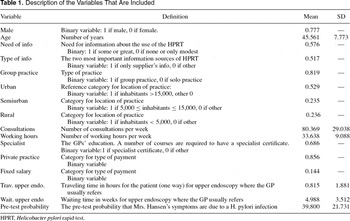
Table 1 gives an overview of the variables included. The fixed cost of using a test consists of resources related to evaluating the information about the test in addition to the expenses of performing test in the office laboratory (the staff and the lab utilities needed). The variable cost is the cost of the actual test kit. Hence, with a considerable fixed cost, the average cost of having and using a test is a declining function of the number of tests. We therefore predict that the probability of having and using HPRT will increase with the number of consultations per week. Likewise, the average cost of having HPRT will decrease with the number of GPs in the practice, and we therefore assume that group practices have a higher probability of having HPRT. As a consequence of more intercollegiate exchange of information in group practices, doctors are more aware of its limitations and, thus, use it differently than solo practitioners.

General practices in urban areas face competition for patients, and one way of competing is to give quicker service to the patients. Thus, we assume that GPs in the cities have a higher probability of having the HPRT and using it in the office lab than GPs in rural or semi-urban areas.
Primary health care in Norway is the responsibility of the municipalities. In principle, GPs are either in private practice being paid fee-for-service, or they are on a fixed salary as employees. In our study, most were fee-for-service, and their income derives from three sources: a fixed grant from the municipality (or a per capita fee for list doctors), patient copayment, and reimbursement from the National Health Insurance according to a negotiated tariff (approximately one third each).
In contrast to GPs on a fixed salary, GPs in private practice in general may increase their income by using lab tests. The reimbursement for the HPRT was NOK 90, and the cost of the test was around NOK 77, so the net surplus is quite small. However, when the test was introduced on the market, the reimbursement was NOK 175, thus promoting the inclusion of this test in the repertoire. The GPs who submit a serological test to an approved laboratory were reimbursed with only NOK 25 in 1999. We assume here that the expenses connected with performing the test in the office laboratory are covered by the reimbursement, but direct economic incentives for using this test are weak, and non-existent for GPs on a fixed salary. Still, use of this in-office laboratory test may be less time-consuming than sending away a serological test, because the doctor will get the result the same day, with less need for a follow-up appointment. Thus, the GPs perceived availability of his services may be of importance but is probably independent of the remuneration system.
Upper endoscopy is the preferred diagnostic procedure for detecting peptic ulcer and is done in hospitals. Especially in younger patients, HPRT is an alternative to upper endoscopy. Norway is a scarcely populated country, and many inhabitants live hours away from the nearest hospital. The inconvenience to the patient increases with increasing waiting and traveling times and is lessened if an office lab is used.
The pre-test probability is the GP's assumption that the patient in our case history had an H. pylori infection before the HPRT is administered. We assume that each GP generally has his own threshold value at or above which he considers the patients' probability of having an H. pylori–related dyspepsia sufficiently great to take some kind of action The exception is when the probability is very high or low; then the GP feels confident of the diagnosis, making the use of the HPRT superfluous. We test this hypothesis by including a squared pre-test variable that we assume is negative, because the probability of using lab is increasing after a lower threshold value and decreasing after a higher threshold value.
Having HPRT in the general practice may indicate a higher general awareness of peptic ulcer disease caused by H. pylori infection; hence, this category of GPs would be more apt to use the lab test.
We asked the GPs whether they need more information about the use of the HPRT. GPs not having the HPRT may need information to evaluate whether they should have the test. For GPs having the test, it's important to be aware of how to use the test and its characteristics (sensitivity and specificity). Accordingly, we cannot a priori say whether how the need for information influences the probability of having the test.
DATA
With the exception of the GPs pre-test probability, we have only used the background variables in the questionnaire (ref. Table 1). We use the same data for having HPRT (level A) and using lab (level B), except that at level B we include the variable “pre-test probability,” and use “has HPRT” as an independent variable.
A total of 210 of 425 GPs with HPRT decided to use this test, but only 100 GPs of 410 GPs without HPRT decided to use the serological test. We excluded a few observations when the GP clearly had misunderstood the question, or groups of GPs with deviant characteristics: GPs on internship in general practice, those over 67 years of age, those with working hours more than 60 or less than 10 per week, number of consultations more than 160 or less than 10 per week, and waiting time more than 26 weeks (for referral).
After exclusion, we had 201 GPs with HPRT and 84 GPs without HPRT who requested this analysis (9 and 16 doctors, respectively, excluded). Overall, 14.4 percent of GPs included were publicly employed, but more detailed data show that only 6 percent of GPs having HPRT and only 8 percent of GPs using the test in the lab were publicly employed.
The decision at level A is common to all the GPs in the practice. In our data, we had 432 general practices; and of them, 233 were solo practices. To estimate the effect of characteristics by the general practice, we grouped the data per general practice, and divided by the number of general practitioners in the practice responding to the questionnaire to get the average or share.
We compared the characteristics age, male, and type of payment of our sample of GPs with the total population of GPs (from a registry kept by the Norwegian Medical Association). We found that our sample had the same mean values regarding age, had a higher share of men (77 percent versus 73.6 percent), and only had half the share of GPs on fixed salary (14.4 percent versus 28 percent).
EMPIRICAL MODELS
The theoretical framework is based on discrete choice analyses from Ben-Akiva and Lerman (2) and Greene (6). We want to establish models for predicting the probability of a general practice choosing to have the HPRT (level A) and the probability of a GP using the test in the office lab (level B), as a function of the characteristics of the general practice at level A and as a function of the characteristics of the GP at level B. At both levels, the GP has two possibilities that are mutually exclusive and we use binary models.
All the GPs evaluates the same patient vignette—so the focus here is on the GP's own objectives and preferences, knowledge, experience, and uncertainty, not knowing the patient's preferences in this clinical situation.
We suppose that the GPs have preferences for the different alternatives that can be represented by a utility function. We suppose that the utility of an alternative depends on the GP's income, or cost (income to the GP) associated with the alternative. Furthermore, we also assume that the welfare of the patient is associated with the GP's utility. There is a trade-off between time and quality. The HPRT is time saving, but the serological test is better (higher sensitivity and specificity).
The utility of the HPRT depends on the type of patient in question, how important it is to get the answer during the same consultation, and the GP's knowledge about the use of the HPRT. We assume that the income is included in the GP's utility function. For GPs with fee-for-service, we assume that the considerable fee when the test was introduced in 1996 (NOK 175) and to some degree the GP's perception of the development of the fee of the HPRT will be of importance.
The GPs' choice setting can be compared with choices between lotteries, because of the uncertainty of the initial health status of the patient and the laboratory analysis. The uncertainty of the laboratory analysis occurs because the HPRT measures antibodies to the H. pylori bacteria and not the disease as such and because healthy carriers of the H. pylori bacteria exist. In younger people, the prevalence of the bacteria may be as high as 15 percent.
The GP may also have unstable preferences, meaning that he or she may have problems in evaluating the expected utility of the different alternatives. This possibility means that he may make different responses when faced with the same choices (bounded rationality). The degree of bounded rationality may vary in apparently identical situations because colleagues, medical journals, and experience gained from treating other patients have a continuous influence on the GP. Furthermore, there will be variation in the choices that cannot be explained by the variables available to us, especially those stemming from the patient–doctor interaction.
We assume that the utility Uij is stochastic and can be interpreted as the expected utility for the general practicei at level A and for the GPi at level B, given alternative j, j = 1,2. Our binary logit models can be formulated as follows:

where Yi* is unobservable and Privpri is a dummy for type of payment: Privpri =1 for GPs in private practice, and Privpri =0 for GPs on fixed salary. Xi is a vector of the other independent variables and εi is a random variable that is supposed to count for unobserved variables of the GP that affects his preferences.
If every independent variable did not correlate with the random variable, εi, the derivation of the probability for choosing between alternatives 1 and 2 would be straightforward. But other studies have shown that the variable “Privpr” depends on characteristics of the GP. Grytten and Sørensen (8) have shown that there is a self-selection, that GPs on fixed salary give more priority to family and leisure. If unobserved characteristics of the GP influence the variable “Privpr,” it becomes an endogenous variable and will correlate with the error term.
We want to study the factors that influence the GP's type of payment. GPs with a high activity (number of consultations and working hours) may prefer payment by activity. The selection effect will be that GPs with high activity prefer contracts with reimbursement. To study the effect of selection, we will apply a particular instrumental variable approach. To this end, we will estimate a model for g(Zi) = E(Privpri[mid ]Zi), which we will use as an instrumental variable for the variable Privpri, where Zi is a vector of the independent variables (working hours, Xi [vector of the other independent variables]). One problem is that the error terms in the models with and without the instrumental variable are different, because the instrumental variable is not perfect, and we cannot directly compare the coefficients.
ESTIMATION RESULTS
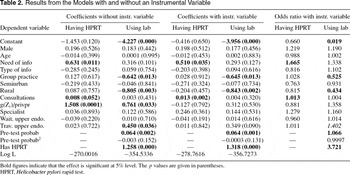
The results are estimated using LIMDEP (7). Table 2 shows the values, the p values, and odds ratios of the coefficients in the model. For the variable location, urban area is used as reference. We have included results from the model both without and with an instrumental variable (Table 2).

Availability of the HPRT in General Practice (Level A)
Here, we examine the importance of the characteristics of the general practice (with one or more GPs) for the probability of having HPRT by estimating a binary logit model where Has HPRT (Y =1)/Does not have HPRT (Y =0) is the dependent variable.
We had 420 observations, and the log Likelihood function for the model with the instrumental variable is -278.7616.
The only difference between the models with and without the instrumental variable is that the remuneration variable is only significant without the instrumental variable. This finding means that the effect of the variable “Privpr” without the instrumental variable was due to the selection of GPs choosing fee for service.
In estimating the instrumental variable (g[Zi]) the dependent variable is private practice and the independent variables are the variables we believe influence the GP's choice of payment: male, age, education, location of the practice, and number of consultations. McFaddens R2 for the instrumental variable is 33.37.
Table 2 shows that the following factors increase the probability of having HPRT on the lab repertoire: whether the GPs in the general practice want information about the use of HPRT and whether the GPs in the general practice have many consultations.
Use of the H. pylori Analysis (Level B)
In this section, we study the effect of different characteristics on the probability of using the test in the lab by estimating a binary logit model with “Uses lab (Y =1)/Does not use lab (Y =0)” as the dependent variable.
The main difference between the models with and without the instrumental variable is that the remuneration variable is only significant without the instrumental variable. This finding means that the effect of the variable “Privpr” without the instrumental variable was due to the selection of GPs choosing type of payment. Also, traveling time (for gastroscopy) just falls short of significance when the instrumental variable is included, probably because location of the practice is included in this variable.
We had 663 observations and the value of the log likelihood function was -356.7273 for the model with the instrumental variable, which in this analysis is calculated for the individual GP. McFaddens R2 for the instrumental variable is 28.6.
Table 2 shows that the following factors have a significant effect on the probability of using the test in the office lab: GPs in group practices use office lab tests less than solo practitioners, this lab test is used less by rural GPs, the availability of the rapid test increases test use substantially, and in-office lab use increases with pre-test probability.
CONCLUSIONS
By using discrete choice analyses and binary logit models, we have seen that certain GP characteristics are important factors for the GP's choice of having versus not having the HPRT and using versus not using the lab (rapid test or hospital-based test) in an important clinical situation described in a paper vignette. In writing the vignette, it was important to describe a situation from reality to get valid results. But in a questionnaire, we loose the interaction between the patient and the GP. The patient could have wanted to have this laboratory test taken, but the H. pylori analysis is not very well-known by patients, so it is not very likely.
The answer to the question “Need for information about the use of the test” is the GP's own evaluation. It seems plausible that having this test in the repertoire results in an increased awareness and, therefore, a greater need for information, on the limitations of this test.
In the literature, there have been discussions about the validity of written case scenarios in medical decision making. One might say that by using a clinical vignette, we measure competence (what a physician is capable of doing) and not performance (what a physician actually does in his day-to-day practice). Kuyvenhoven et al. (10) conclude that written simulations give a realistic impression of a GP's diagnostic and therapeutic approach to patients with vague symptoms like those in our clinical vignette. In a review of 74 published studies using written simulations, the validity issue was addressed in only 11 studies, and the conclusions were conflicting (9). Peabody et al. (11) have validated clinical vignettes as a method for measuring the competence of physicians and the quality of their actual practice and conclude that the quality of care can be measured by using clinical vignettes.
Bias is more likely if the respondents feel obliged to display some kind of expected behavior or/and if the written scenario differs from a typical situation. Our case history depicts a real patient with some minor modifications, to make the situation as realistic as possible, and Norwegian GPs are used to responding to clinical scenarios like these, making a realistic response probable. However, it is reasonable to expect that the more knowledgeable GPs are more likely to respond.
Because we have a situation with bounded rationality, we used binary logit models. If we had had a model with several cues and/or different hypothetical patients, it would be relevant to consider fast and frugal models. These models imply that individuals do not integrate all relevant information (5) and are said to be more compatible with evidence of flexible judgment as in a situation with different hypothetical cases, versus the regression models that uses the same available information in the same way on each case (3). In our study, the GPs have only one hypothetical patient and we only have one patient-related variable (the pre-test probability) in addition to characteristics of general practitioners.
In our future work, we will like to do similar studies for several laboratory analyses to see if our results on the HPRT are representative, although we assume so at least for “crucial” in-office laboratory tests. Finally, we want to develop a method that can be used to evaluate the economical consequences of good quality of a laboratory analysis through a cost-benefit analysis.
We think that our study helps to clarify the health policy issue of the effects of economic incentives on clinical practice. In this work, the remuneration system was endogenous, and by using an instrumental variable, it was found not to have a significant effect. The study confirms that quality of in-office lab in general practice is very important, because when the GP has a lab test available, he has a higher probability of using it compared to sending material to a hospital laboratory for analysis.
CONTACT INFORMATION
Siri Fauli, MBE, PhD student (siri.fauli@legeforeningen.no), Institute of Health Management and Health Economics, University of Oslo, P.O. Box 1089 Blindern, NO-0317 Oslo, Norway; Adviser, Department of Professional Affairs, The Norwegian Medical Association, P.O. Box 1152 Sentrum, N-0107 Oslo, Norway
Geir Thue, MD, PhD, Professor (geir.thue@isf.uib.no), Department of Public Health and Primary Health Care, The Norwegian Center for Quality Improvement of Laboratory Services in Primary Care (NOKLUS), University of Bergen, UNIFOB AS, Boks 6165 Postterminalen, 5892 Bergen, Norway
This work was funded by the Norwegian Medical Association's Quality Improvement Fund III, which was established by The Government, The Norwegian Association of Local and Regional Authorities, and the Norwegian Medical Association (NMA). The authors are grateful to Tor Iversen, HERO, and John Dagsvik, Statistics Norway for valuable guidance.
References
Atherton JC,
Blaser MJ.
1999.
Helicobacter infections.
Available at:
http://www.harrisononline.com/server-java/Arknoid/harrisons/1096-7133/Ch156/Page1.htm.
Accessed October 19
Ben-Akiva M,
Lerman S.
1985.
Discrete choice analysis: Theory and application to travel demand.
Massachusetts:
MIT Press Cambridge;
Dhami MK,
Harries C.
2001;
Fast and frugal versus regression models of human judgement,
Thinking and Reasoning.
7:
5–
27.Google Scholar
Friedman LS.
1999.
Helicobacter pylori: What's new. Editorial related to Chapter 284: Peptic ulcer and related disorders.
Available at: http://www.harrisononline.com/server-java/Arknoid/harrisons/1096-7133/.../edl1426.htm. Accessed October 19
Gigerenzer G,
Goldstein DG.
1996
Reasoning the fast and frugal way: Models of bounded rationality.
Psychol Rev.
103:
650–
669.Google Scholar
Greene WH.
1993.
Econometric analysis.
Englewood Cliffs, NJ:
Prentice-Hall International;
Greene WH.
1998.
LIMDEP version 7.0. Users manual..
Australia:
Econometric Software;
Grytten J,
Sørensen RJ.
2001
Type of contract and supplier-induced demand for primary physicians in Norway.
J Health Econ.
20:
379–
393.Google Scholar
Jones TV,
Gerrity MS,
Earp J.
1990
Written case simulations: Do they predict physicians' behaviour?
J Clin Epidemiol.
43:
805–
815.Google Scholar
Kuyvenhoven MM,
Jacobs HM,
Touw-Otten FW,
Van Es JC.
1983
Written simulation of patient-doctor encounters. 1. Research instrument for registration of the performance of general practitioners.
Fam Pract.
1:
14–
19.Google Scholar
Peabody JW,
Luck J,
Glassman P,
Dresselhaus TR,
Lee M.
2000
2000. Comparison of vignettes, standardized patients and chart abstraction.
JAMA.
283:
1715–
1722.Google Scholar
Thue G,
Sandberg S.
1994
Survey of office laboratory tests in general practice.
Scand J Prim Health Care.
12:
77–
83.Google Scholar
Description of the Variables That Are Included
Results from the Models with and without an Instrumental Variable
 You have
Access
- 2
- Cited by