INTRODUCTION
Among the rare pre-Hispanic codices that have come down to us today, there is a corpus of seven manuscripts known as the “Borgia Group,” dubbed after the Codex Borgia, the principal manuscript in the group, which in turn was named after its European owner at the end of the eighteenth century, Cardinal Stefano Borgia (1731–1804; Anders et al. Reference Anders, Jansen and García1993:29–40; Nowotny Reference Nowotny and de Durand-Forest1977:11–13; Seler Reference Seler1963 [1904]:vol. I, pp. 9–10). These pre-Hispanic manuscripts, particularly the Codex Borgia, are enormously important for the knowledge they provide on pre-conquest indigenous religion, in part given the lack of detailed iconographic materials of other kinds, and for the complexity and quality of divine, ritual, and calendrical representations in this manuscripts created by highly specialized, priestly painters.
Two of the codices of the Borgia group—the Codex Porfirio Díaz and the Fonds Mexicain n° 20—come from the state of Oaxaca (Jansen Reference Jansen1998; Doesburg Reference Doesburg2001). On the other hand, the geographic origin of the five other codices—the Vaticanus 3773 (Seler Reference Seler1902–1903), the Cospi (Anders et al. Reference Anders, Jansen and van der Loo1994), the Fejérváry-Mayer (Reference SelerSeler 1901–1902), the Laud (Anders and Jansen Reference Anders and Jansen1994), and the Borgia (Seler Reference Seler1963 [1904])—has been the subject of various interpretations, which range from the Mixteca zone of Oaxaca, the Gulf Coast, and the region of Tlaxcala and Cholula (Anders et al. Reference Anders, Jansen and van der Loo1994:45–98; Boone Reference Boone2007:211–230). Recent studies on the materiality of colors in Borgia group codices, in particular non-invasive physicochemical studies, shed light on the connections between the different members of this group and on their possible regions of origin (Domenici et al. Reference Domenici, Buti, Miliani, Brunetti, Sgamellotti, Sgamellotti, Brunetti and Miliani2014; Dupey García Reference Dupey García2017).
Wherever they were actually produced, these codices display stylistic similarities—collectively known as the Mixteca-Puebla style (Nicholson and Quiñones Keber Reference Nicholson and Keber1994)—and, above all, similarities in content. In fact, these codices deal with religious matters and all contain sections devoted to deities, myths, and rituals, especially divination, a practice closely linked to the 260-day divinatory calendar that the Nahuas called the tonalpohualli. Therefore, we can find images in several of these codices that show the days, the thirteen-day periods, the trecenas, and even the group of 260 days, associated with their patron gods and mantic signs that were used for divinatory practices, such as reading the destiny of newborn infants. Other sections are dedicated to the nine lords, the rain gods, or the merchant deities. We can also find images of predictions for marriages, agricultural rites, and a small number of offerings dedicated to specific deities, such as those that oversaw hunting activities (Anders et al. Reference Anders, Jansen and van der Loo1994; Boone Reference Boone2007; Nowotny Reference Nowotny, Everett and Sisson2005 [1961]).
For the proper interpretation of the meaning and functions of their complex imagery, cases of repetition in the different codices of the Borgia group as well as in other related pictorial manuscripts from the colonial period have been of enormous help. Related manuscripts include the Codex Telleriano-Remensis (Quiñones Keber Reference Quiñones Keber1995), the Codex Vaticanus A (Anders and Jansen Reference Anders and Jansen1996b), the Codex Tudela (Tudela de la Orden Reference Tudela de la Orden1980), and the Codex Magliabecchiano (Anders and Jansen Reference Anders and Jansen1996a), which present scenes identical to those in the Borgia group codices but in a different style. Moreover, they offer the advantage of including Spanish or Italian glosses that explain the significance of the images. Therefore, since the eighteenth century, generations of specialists have relied on these “mixed” manuscripts to interpret pre-Hispanic religious codices, recognizing the calendrical signs, identifying the deities, and trying to understand the meanings and functions of the different sections of these manuscripts. Ethnographic studies have also been of major use in interpreting certain illustrations from the codices, for instance the few sections dedicated to counted offerings (Anders et al. Reference Anders, Jansen and van der Loo1994:267–330; Nowotny Reference Nowotny, Everett and Sisson2005 [1961]:302–306).
In this paper, I will address the central section of the Codex Borgia, which is clearly the most complex and enigmatic part of the manuscript. Composed of eighteen plates, this long section of the Codex Borgia (Seler Reference Seler1963 [1904]:Plates 29–47) includes an enormous number of elements: gods, human figures, temples, animals, stars, calendrical signs, and so forth. It is difficult, however, to fully comprehend because of the absence of similar scenes in the other manuscripts of the Borgia group. Recently, Batalla Rosado (Reference Batalla Rosado and José2008:314, 412–413; see also Mikulska (Reference Mikulska2015:171–172) and Díaz (Reference Díaz2019:149) has pointed out that this section is an insert, in other words an addition that
made it necessary to alter the length of the codex when it was already physically assembled with its structure of sections; we believe the space was adjusted to the form of a relationship based on previously defined sections. Thus, after the decision to include the 9 Rites, the next step was to cut and add new pieces of leather to be able to extend the content of the Codex Borgia.
It is worth noting that there are no Colonial-period codices with glosses that might help us understand the meaning of the complex plates in this part of the Codex Borgia. Therefore, the interpretations of the scenes in this section have been highly varied, ranging from the journey of Venus through the underworld (Seler Reference Seler1963 [1904]), a trip to different levels of the underworld (Batalla Rosado Reference Batalla Rosado and José2008), rituals in temples (Anders et al. Reference Anders, Jansen and García1993; Byland Reference Byland, Díaz and Rodgers1993; Nowotny Reference Nowotny, Everett and Sisson2005 [1961]), a cosmogony (Boone Reference Boone2007:171–210), rites conducted for the eighteen veintenas or 20-day periods (Brotherson Reference Brotherston2003; Milbrath Reference Milbrath, Ruggles and Urton2007, Reference Milbrath2013), and rituals focused on the consecration and legitimation of a man-god associated with Quetzalcoatl (Baena Ramírez Reference Baena Ramírez2018).
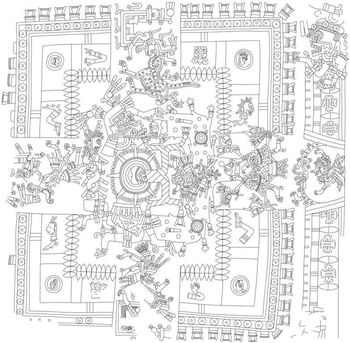
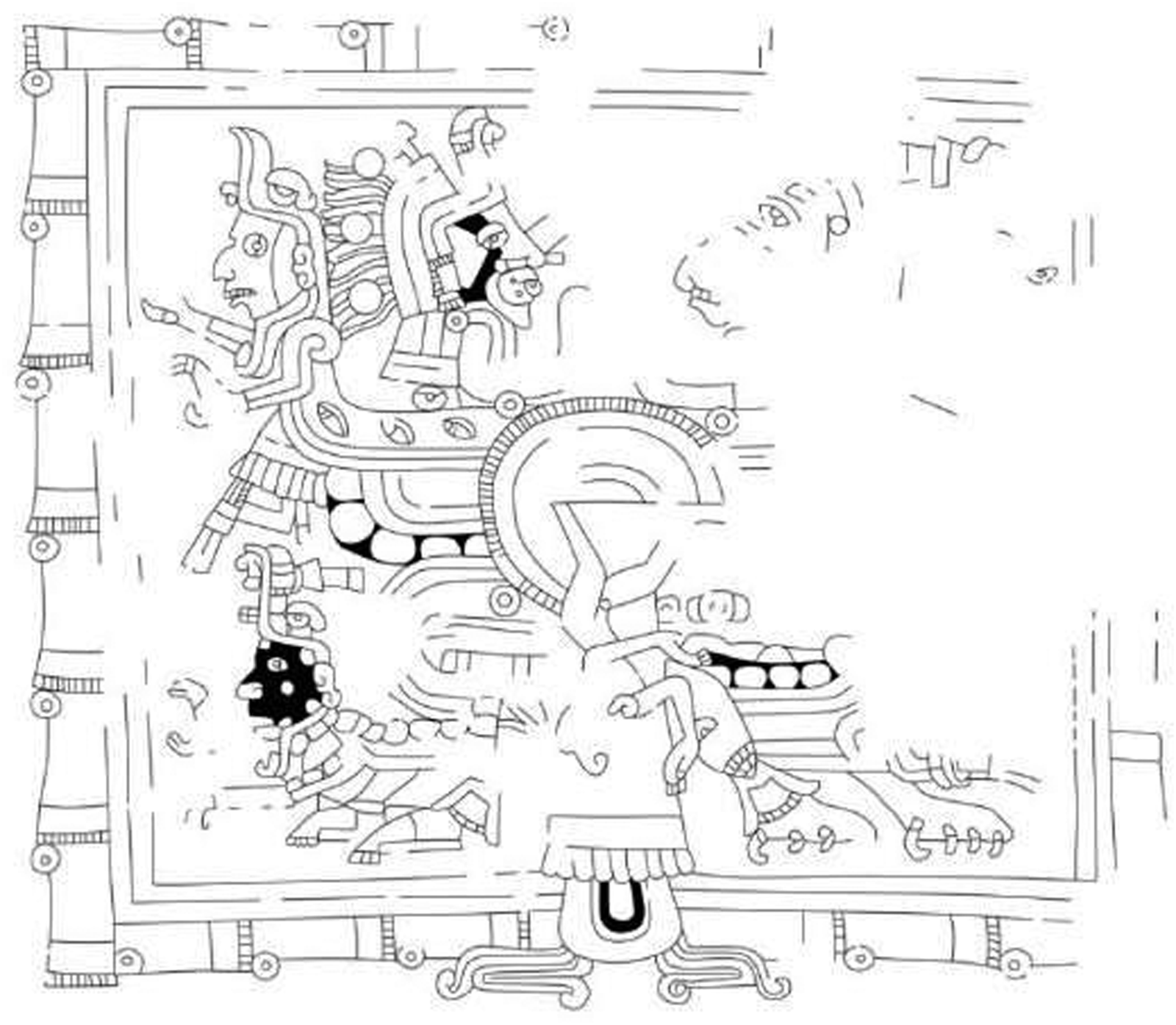
In this paper, I focus on plate 44 of the Codex Borgia and offer a new interpretation of its content, which may perhaps augment current understanding of this ancient indigenous masterpiece (Figure 1). Before describing this plate, it is important to note that in addition to the sources commonly used to interpret Borgia group codices—Mixteca-Puebla iconographic materials and sixteenth-century chronicles from central Mexico—I have elected to include other historical and ethnographic materials from other areas of Mesoamerica, such as the Maya zone. This choice can be justified by the presence of shared traits among the Borgia group codices and Maya codices—especially the Madrid Codex—highlighted in recent publications (Vail and Hernández Reference Vail and Hernández2010). That said, after presenting my interpretation of plate 44 of the Codex Borgia, at the end of this article, I will mention significant parallels with South American indigenous—Inca and Amazonian—as well as North American—Sioux, Papago, and Cocopa—materials that speak of possible “similar mechanisms or understanding of the surrounding reality.” (I owe this expression, for which I am grateful, to one of the reviewers of my article). In the same sense, Lévi-Strauss (Reference Lévi-Strauss1988:21) states, “Despite the enormous differences in time and place, nothing precludes that identical configurations can appear in the customs, beliefs, myths, and rites, if the elements of the combinations to which men dedicate much of their mental activity are not exist unlimited.” From there arises the possibility of again examining more general anthropological reflections beyond Mesoamerica of authors such as Frazer (Reference Frazer, Sayn and Peyre1981–1984 [1913–1924]) and Bettelheim (Reference Bettelheim1954) on subjects such as sacred royalty and rites of passage.
Plate 44 from the central part of the Codex Borgia (Seler Reference Seler1963 [1904]:Plate 44). Drawing by Elbis Domínguez.

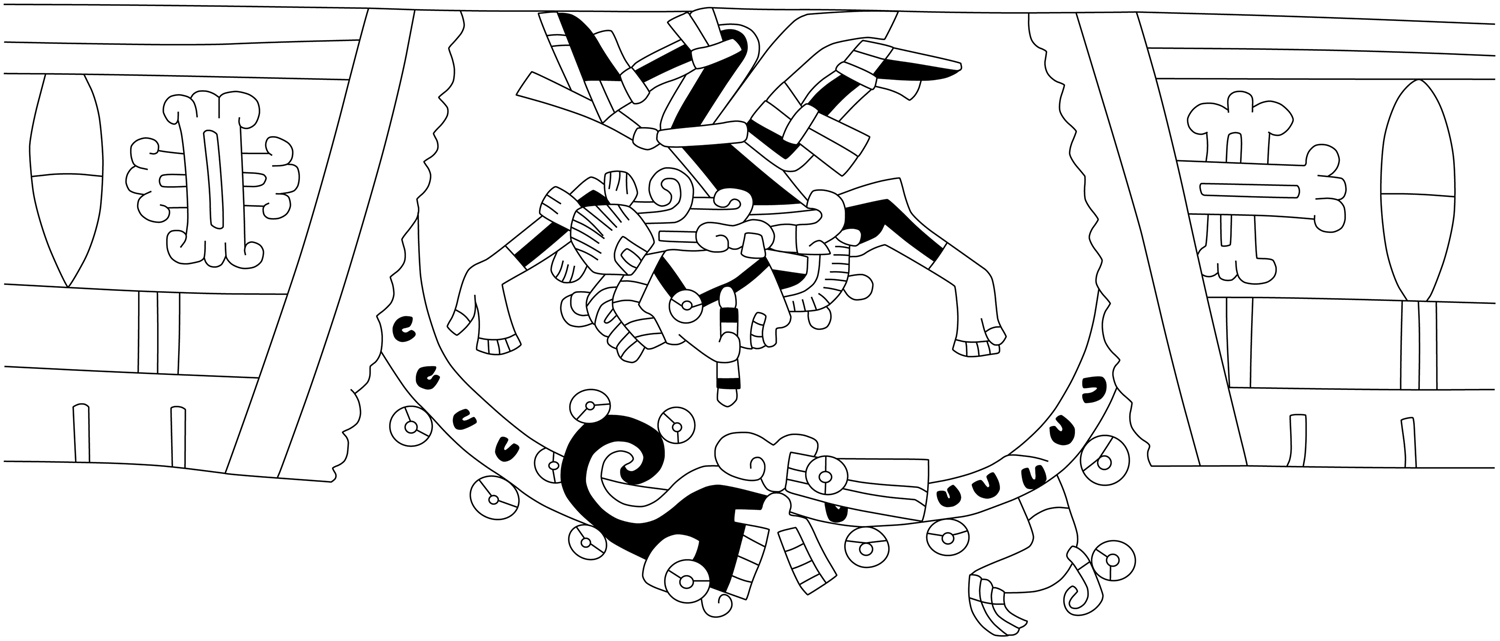
But let us begin our analysis by describing plate 44 of the Codex Borgia, relying primarily on Seler's (Reference Seler1963 [1904]:vol. II, pp. 49–58) iconographic readings. The upper part of the illustration shows the severed body of a goddess that displays elements characteristic of Tlaltecuhtli, the earth goddess, and Mictecacihuatl, the death goddess. Her body is formed of white bands of paper, colored squares, and a row of crossed bones alternating with flint knives; her head is a skull with a fleshless jaw; her eye has a thick brow; her curly black hair has star eyes; and a strip of cotton is tied over her forehead. The goddess also wears a conical red headdress, a necklace with turquoise and gold bells, pleated paper on her arms, has claws instead of hands and feet, and displays a white paper skirt. Quetzalcoatl, the Feathered Serpent, with his body painted black and wearing a white loincloth, displays a semicircular black line on his cheek, a nose bar, a shell epcololli ear ornament, and a turquoise and gold bell necklace. He also has curly hair decorated with down and is shown descending from the opening in the middle of her body (Figure 2). Facing him, a black skeleton with a curved headdress and star eyes appears in the center of a nocturnal band that contains star eyes and a claw. The rest of the plate depicts complex scenes in the framework of a building composed of four, L-shaped corner walls (Figure 1). Red-roof ornaments that represent flowers (Seler Reference Seler1963 [1904]:vol. II, p. 50) are placed on the top of these walls, while a row of flint knives appears on the lower part. Three squares occupy the intermediate space. In the central square of each L, we can see calendrical signs: eagle, dog, serpent, and flower. Seler (Reference Seler1963 [1904]:vol. II, p. 50) indicates that the same calendrical signs appear in the flint house represented in plate 32 of the Codex Borgia, and that “they are part of the initial column of the fifth room—corresponding to the South—of the tonalamatl arranged in columns of four members.” The other squares of these “walls” are occupied by severed extremities (legs or arms); a decapitated head, a cut, red skull; and a heart placed in a bone recipient—a thorax bone, according to Seler (Reference Seler1963 [1904]:vol. II, p. 50). The German scholar proposed that, “the red skull symbolizes the destroyed Moon, the waning Moon (in its final quarter), while the decapitated head with two upright curls represents a phase of the planet Venus” (Seler (Reference Seler1963 [1904]:vol. II, p. 50).
Quetzalcoatl descends from the body of a deity with Tlaltecuhtli and Mictecacihuatl features (Seler Reference Seler1963 [1904]:Plate 44). Drawing by Elbis Domínguez.

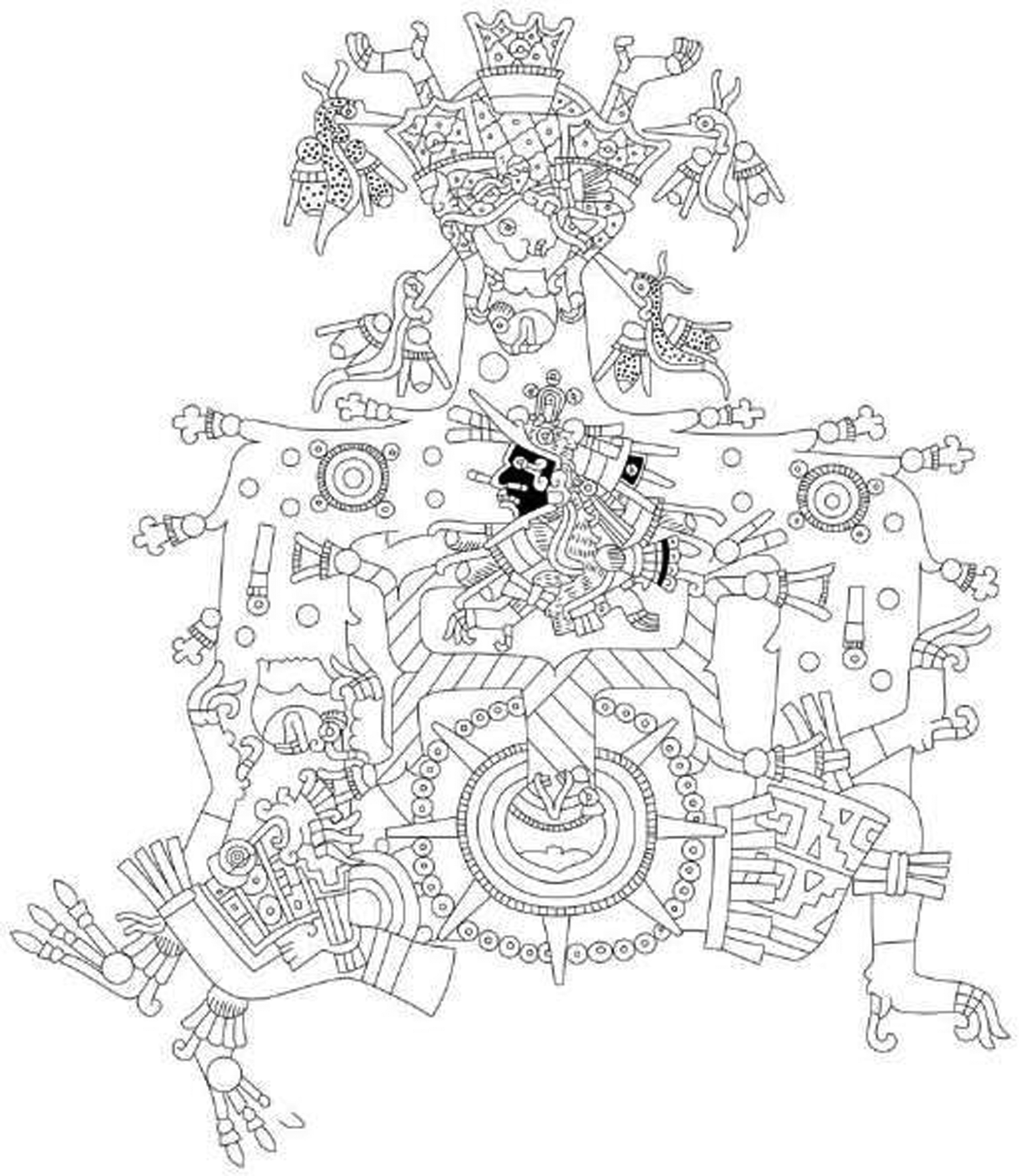
In the middle of the plate, the recumbent goddess Xochiquetzal appears with her characteristic face paint—red lines (squares and circles) on a yellow background—her blue butterfly (yacapapalotl) nose plug, a cloth headdress with down and two quetzal plume crests, and a skirt with stepped-fret motifs (Figure 3). She also has long teeth and claws instead of hands and feet, features that relate her to the Tzitzimime and Itzpapalotl. In the middle of her body, in the center of a solar disk surrounded by small disks, a heart sprouts a flowering tree with interlaced bands of color. Between the branches, Quetzalcoatl—with black face paint and a nose bar—appears with a hummingbird's body. His headdress is composed of two bands of red and white paper and a long, black semicircle and displays a star eye inside and three others around it. It is the same costume worn by Quetzalcoatl, Xolotl, and Xochipilli (Spranz Reference Spranz and Peñaloza1964:147, 385, 423). A figure wearing a bat costume and holding a heart in its claws descends from above the hummingbird-god. Four small hummingbirds surround him. An abundant flow of blood—with circles, jade motifs, and flowers—issues from this bat-figure and splits into two channels: one descends toward the mouth of the reclining goddess and the other goes toward her skirt. Another goddess appears below the Xochiquetzal figure and blends traits of Tlaltecuhtli and Mictecacihuatl. She seems to wear a red mask in the shape of a skull. She has curly hair with two paper banners (insignia characteristic of the Tzitzimime), claws instead of hands and feet, a red skirt edged with paper, and a body composed of two interlaced colored bands.
From the heart of the goddess Xochiquetzal grows a tree, topped by Quetzalcoatl with a hummingbird costume. A bat god surrounded by hummingbirds descends with a double flow of blood (Seler Reference Seler1963 [1904]:Plate 44). Drawing by Elbis Domínguez.

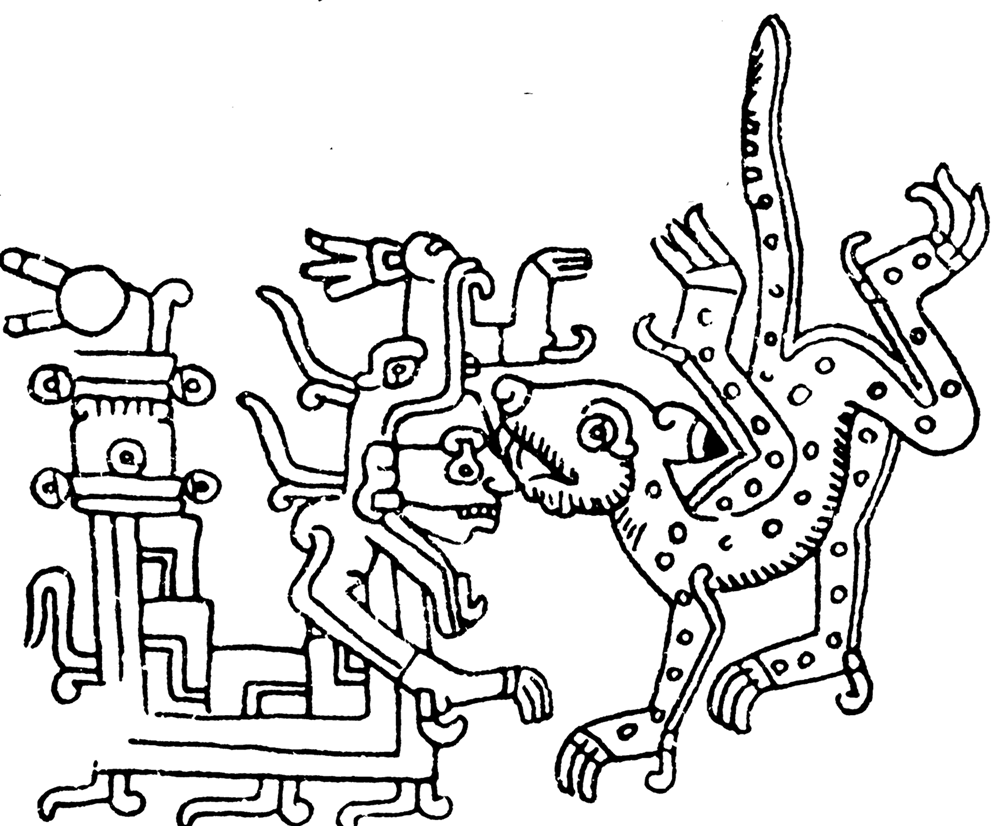
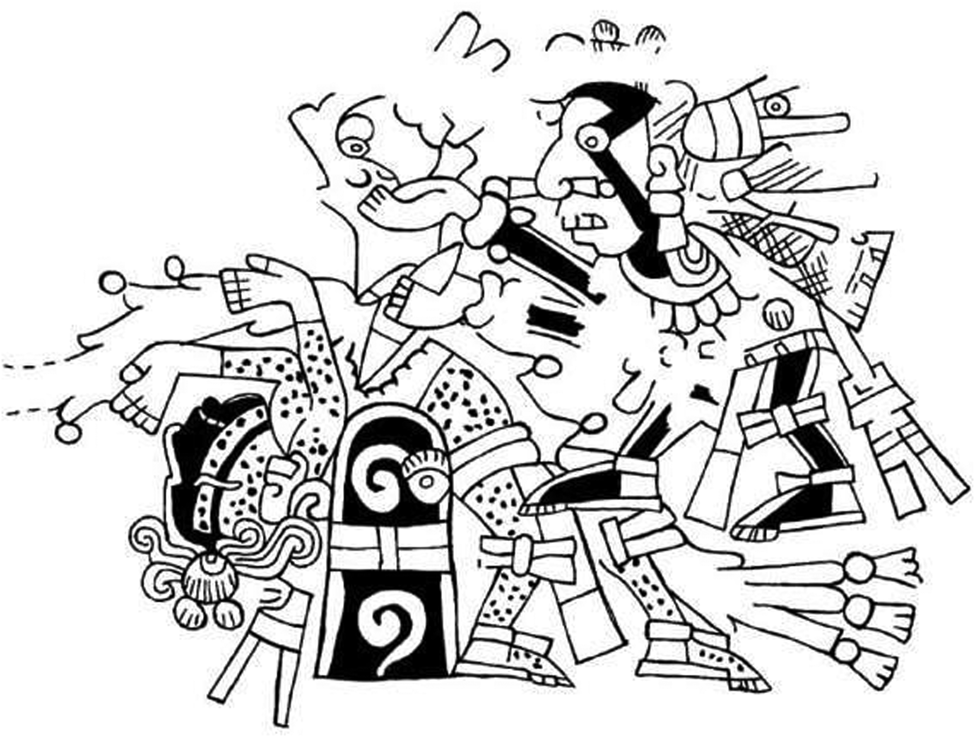
Three scenes unfold in the openings between the L-shaped wall sections. On the left appears a red serpent with a stepped body and two bands, one yellow and the other blue, with volutes; a face with the eye popped out of the socket and two, fine black lines, one at the level of the eye and the other by the mouth. Seler (Reference Seler1963 [1904]:vol. II, p. 56) regards this as a turquoise serpent (xiuhcoatl), the face of which resembles that of the Fire God and that of Otontecuhtli. At the same time, a jaguar bites his nose (Figure 4). On the right side of the plate, we can see a similar scene, but it is less clear: a serpent with red and white stripes on the body, surrounded by star eyes and perhaps volutes, with another eye on its body and a motif that might be part of the Venus glyph. Seler (Reference Seler1963 [1904]:vol. II, pp. 53–54) considers this serpent a “sky serpent” (citlalcoatl), a symbol of the Sky and Air, or perhaps the Milky Way.” The face in the serpent's maw is a dark color and it might have a white spot on the forehead, which could be part of the motif in the shape of a quincunx that adorns Tlahuizcalpantecuhtli's face. An eagle is biting his nose. The third scene shows another brown and red serpent with jade motifs around it. Seler (Reference Seler1963 [1904]:vol. II, p. 56) calls it “precious stone serpent (chalchiuhcoatl).” The yellow face of the figure that emerges from the serpent jaws does not display features that would permit identification, although Seler (Reference Seler1963 [1904]:vol. II, p. 56) proposes it is Xochipilli. A quetzal is biting his nose.
A jaguar bites the nose of a figure whose face emerges from a serpent body (Seler Reference Seler1963 [1904]:Plate 44). Drawing by Rodolfo Ávila.

The totality of this remarkable scene has been interpreted by Seler (Reference Seler1963 [1904]:vol. II, pp. 49–58) as part of the journey of Venus through the underworld. This image would represent “the period of invisibility of the planet Venus after its appearance as the evening star.” The place would be “the house of flints, the house of flowers, which designates the South,” where the four [animals] act, “animals [that] represent the gods corresponding to the cardinal directions, which tear parts of their bodies from the large stars, producing in this way the different phases, above all those of the Moon” (Seler Reference Seler1963 [1904]:vol. II, p. 54). We notice that Seler's opinions on this plate changed; in an earlier publication on the Codex Vaticanus 3773, he (Seler Reference Seler1901–1902:vol. I, p. 123–126) proposed that the four houses represented in plates 43–46 of the Codex Borgia corresponded to the west, while plate 44 represented “the north part in the West region.” In the same publication, Seler (Reference Seler1901–1902:vol. I, p. 126) suggested that that four animals were “special forms of the deity of the evening star.”
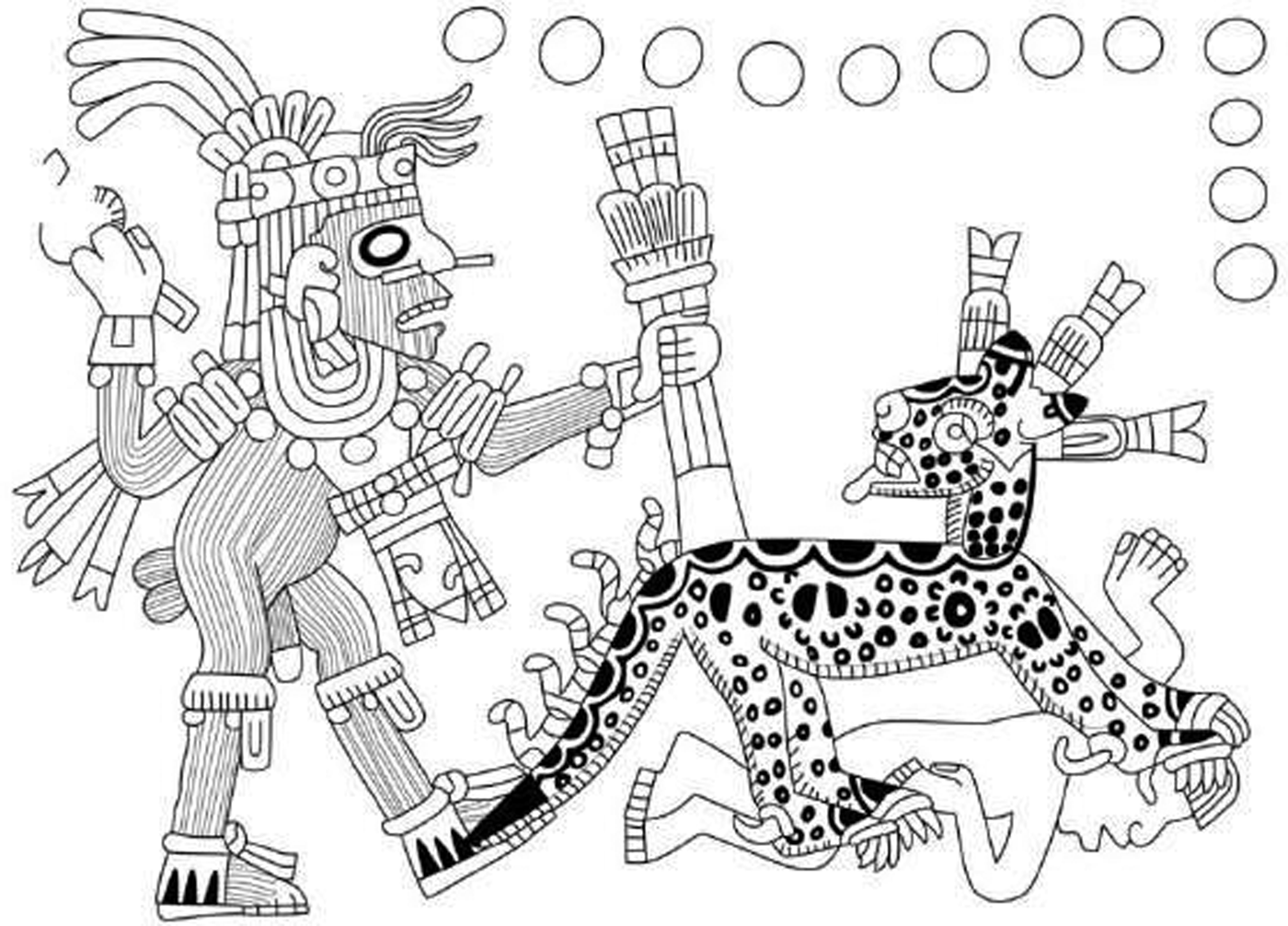
In his commentary of Codex Borgia the German scholar establishes a parallel between the animals in plate 44 of the Codex Borgia and the other four animals—bat, jaguar, cipactli (earth monster), and eagle—all of which appear in other manuscripts (Codex Fejérváry-Mayer (Seler Reference Seler1902–1903:Plates 41–42), Codex Vaticanus 3773 (Seler Reference Seler1901–1902:Plates 24–27), and the Codex Borgia itself (Seler Reference Seler1963 [1904]:Plates 49–52) in aggressive poses, which he interprets as entities that are tearing the stars apart (Seler Reference Seler1963 [1904]:vol. II, p. 54). Despite the fact that it displays an aggressive attitude, the jaguar is hunted by Mixcoatl in the scenes that Seler mentions as equivalents to that of Codex Borgia plate 44 (Figure 5; Codex Borgia (Seler Reference Seler1963:Plate 50), Codex Fejérváry-Mayer (Seler Reference Seler1902–1903:Plate 41), and Codex Vaticanus 3773 (Seler Reference Seler1901–1902:Plate 25); as for the cipactli, it was not represented here and it would be difficult to explain a supposed replacement by a quetzal. In fact, Seler's proposal is not very convincing: “This is surely a strange anomaly, but it can be easily explained by the association of ideas that existed in ancient Mexico between the green feather adornment, quetzalli, the precious greenstone or jadeite, chalchihuitl, and water, atl” (Seler Reference Seler1963 [1904]:vol. II, p. 54).
Representation of Mixcoatl shooting a jaguar in the Codex Vaticanus 3773 (Seler Reference Seler1901–1902:Plate 25). Drawing by Rodolfo Ávila.

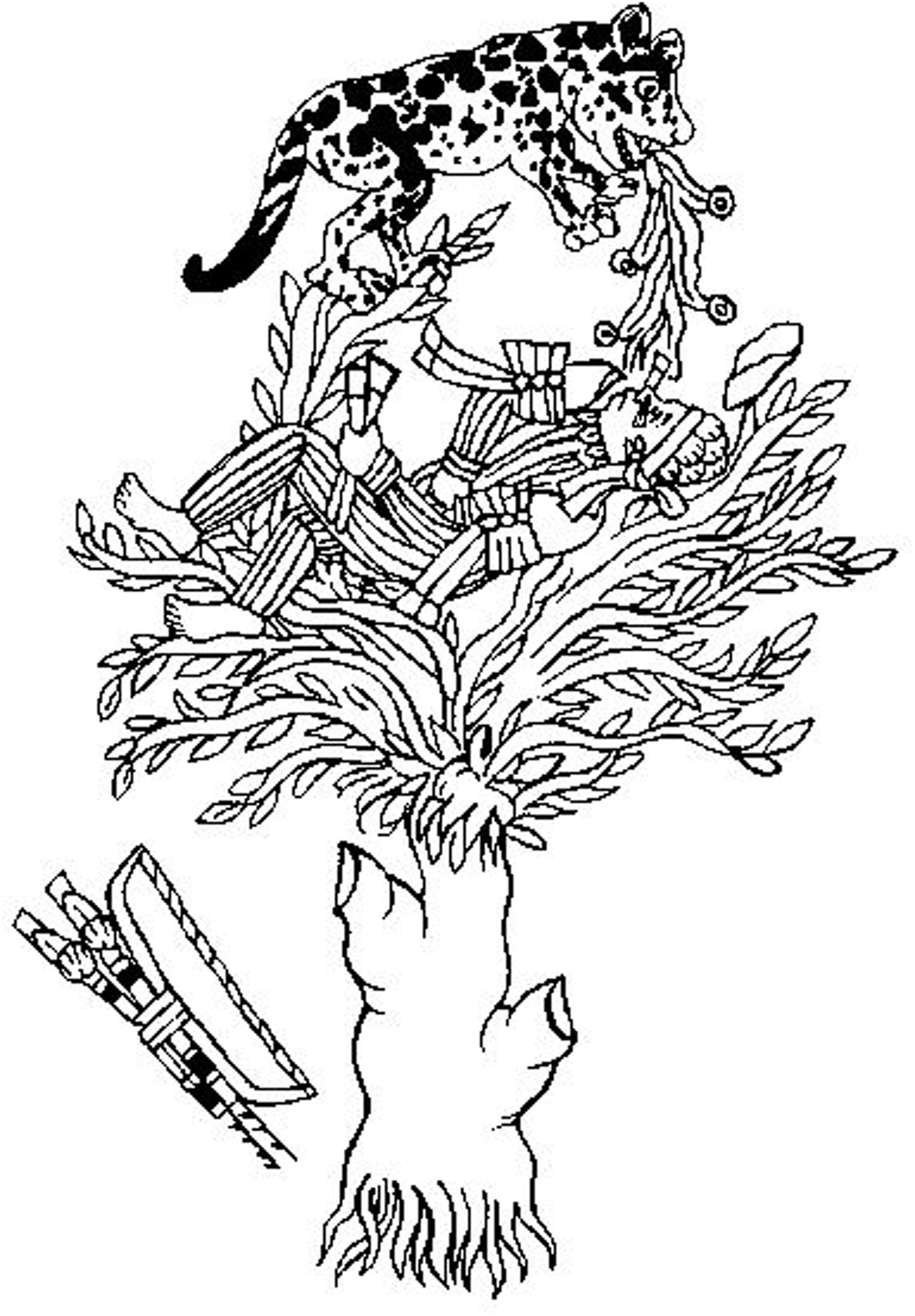
In contrast, Nowotny (Reference Nowotny and de Durand-Forest1977:30–31, Reference Nowotny, Everett and Sisson2005 [1961]:32–33, 274–275) proposes quite a different interpretation: he identifies plate 44 as a representation of enthronement rites, as indicated by two parallel images from the Historia tolteca chichimeca (Kirchoff et al. Reference Kirchoff, Güemes and García1976:ff. 20r, 21r), which he describes as follows (Figure 6):
The place for veneration with four entrances is completely similar to that of the Historia tolteca chichimeca. Just as in the latter manuscript, one of the candidates in the Codex Borgia is positioned in a tree and is mystically fed by a bat. The other three aspirants in the Codex Borgia wear the fire serpent costume. An eagle, a jaguar, and a quetzal perforate the nostrils of the aspirants with their beaks or teeth, respectively, to insert the princely ornament.
A jaguar feeds a future tlatoani, recumbent on a mesquite during a rite of accession to power (Kirchoff et al. Reference Kirchoff, Güemes and García1976:f. 20r). Drawing by Rodolfo Ávila.

Anders et al. (Reference Anders, Jansen and García1993:234) accept Nowotny's interpretation. They identify the figure that descends from the upper part with Xolotl (instead of Quetzalcoatl, according to Seler (Reference Seler1963 [1904]:vol. II, pp. 49–58). They believe that the stream of blood makes the goddess Xochiquetzal sprout “the vital force, the Sun's light, a tree of jade…[a] seat for the ghost-like priest, the black hummingbird.” The lords consecrated to Tlahuizcalpantecuhtli, to Xiuhtecuhtli, and to Quetzalcoatl are presented as nahuales (alter-egos), as serpents, to receive “the sign of royal dignity: the nose perforation,” given by the brave creatures, the eagle, jaguar, and quetzal. Recently, Jansen and Pérez Jiménez (Reference Jansen and Jiménez2017:512–517) expanded on the preceding interpretation: the central tree emerging from the sun above Xochiquetzal would represent a stone monument to commemorate the fast of the Chichimecs on an acacia depicted in the Historia tolteca-chichimeca. The hummingbird man and bat man would correspond to Quetzalcoatl and Tezcatlipoca, respectively, who would represent the Tlalquiach and Aquiach, the rulers of Cholula. They also identify the jaguar and eagle biting the nose of the figures within the serpents with these rulers. At the same time, they relate this plate with the veintena fiestas of Teotl Eco and Tepeilhuitl. Finally, the composition as a whole “is about invoking and mobilizing the forces of the ancestral rulers and dead warriors, contributing to the sustenance and energy (heart, blood) wealth (jade, gold) and happiness (flowers) of the rulers, which will be installed or confirmed in this period through the septum-piercing ritual in Tollan Cholollan” (Jansen and Pérez Jiménez Reference Jansen and Jiménez2017:516).
Even though the group of plates 29–46 of the Codex Borgia should be considered, Seler's interpretation of plate 44 poses problems, and I have noted in particular those that refer to the role of animals. The parallelism that Nowotny establishes between details of the Codex Borgia plate 44 and those of the Historia tolteca chichimeca seems to be correct, although it does not explain the scene as a whole: I do not believe that the hummingbird god is receiving food from the bat. Instead, the latter seems be feeding the recumbent goddess, which Nowotny does not mention at all. Nor does the author explain why the “candidates” for the nose perforation rite appear as “fire serpents” (they are actually three different serpents, as Seler rightly describes). Anders et al. (Reference Anders, Jansen and García1993:234) propose that they are the nahuales of the lords consecrated to Tlahuizcalpantecuhtli, the fire god, and Quetzalcoatl.
As to the rites of accession to power alluded to in these scenes, it is important to mention that several written sources and some depictions in codices describe the complex rituals performed by future rulers in many regions of Mesoamerica, such as in the Central Highlands Mexico, the zone of Cholula-Tlaxcala, the region of Oaxaca, and the Maya zone (Olivier Reference Olivier2015:461–633). They describe ritual fasting and autosacrifice, offerings to fire, and even drilling New Fire, as well as perforating the nasal septum (Benavente or Motolinía Reference Benavente or Motolinía and O'Gorman1971:339–344; Carrasco Reference Carrasco1966; Muñoz Camargo Reference Muñoz Camargo and García1998:85–89; Sahagún Reference Sahagún, Dibble and Anderson1950–1981:bk. VIII, pp. 61–65). The nose perforation ritual was carried out with jaguar and eagle bone awls, and nose plugs crafted from precious materials were placed in the septum piercing as a symbol of the ruler's new status. The extensive Nahuatl vocabulary for the nose plugs worn by kings and dignitaries reveals the material with which they were made (jade, gold, turquoise, and so forth), the context of their use (dances, wars, and diverse rituals), as well as the rulers’ connections with certain gods (Huitzilopochtli, Tezcatlipoca, and Mixcoatl, amongst others), who also display specific nose ornaments (Olivier Reference Olivier2015:531–537; Olko Reference Olko2005:167–170). A marker of ethnic and social identity in Mesoamerica, wearing the noseplug was associated with great feats in war and, above all, with the status of rulers. There are indications that having a perforated nasal septum was related to the status of sacrificial victim. For example the Huastecs, who had prominent holes in the nose, were regarded by the Mexicas as prototypical captives for sacrifice (Olivier Reference Olivier2015:541–547). Later, we will see another significance of perforating the nasal septum, which complements this sacrificial symbolism. Therefore, the symbolism of rites of accession to power emphasized the ritual death of the candidate and his rebirth as a king (Olivier Reference Olivier and Olivier2008). A remarkable example appears in Mixtec codices in which the future king is represented as positioned on a sacrificial stone where his nose is perforated, in an act staging a symbolic sacrifice of the new king (Figure 7; Caso Reference Caso1960:Plate 9, Reference Caso1966:Plate 13; Nowotny Reference Nowotny1961:Plate 15). After his death, the king is reborn as the sun. He receives weapons as well as a new name in a ritual akin to a baptism (Olivier Reference Olivier and Olivier2008, Reference Olivier2015:596–607).
As part of an enthronement ceremony, 4 Jaguar bores the nasal septum of the future king 4 Wind (Nowotny Reference Nowotny1961:Plate 15). Drawing by Rodolfo Ávila.

Returning to plate 44 of the Codex Borgia, we saw that in addition to the depiction of serpent-attired individuals whose noses are perforated by animals—scenes that represent the prototype for accession ceremonies—there is another major scene surrounding the goddess Xochiquetzal, who significantly occupies the center of the image (Figure 3). At this stage of the analysis, it is important to mention Boone's (Reference Boone2007:171–210) brilliant reading of this enigmatic section of this manuscript. After indicating the importance of the fact that the central section of the Codex Borgia is oriented perpendicularly to the rest of the codex, Boone (Reference Boone2007:171, 173) writes that,
The interpretation I advance here is that the section is a cosmogony, one that generally parallels but does not coincide with creation stories that have survived for the Aztecs, Mixtecs and Maya… Many of the section's features point not to a cycle of festivals or series of rituals but to a narrative of creation. Many of the structural and iconographic elements that one would expect to find in a Mesoamerican cosmogony are present: scenes of birth, emergence, and organization and the nearly constant actions of Quetzalcoatl, who is supremely a creator god for both the Aztecs and Mixtecs.
Based on this new interpretation, Boone proceeds to analyze each of the 18 plates in the central part of the Codex Borgia and establishes suggestive parallels with Mesoamerican creation myths. For example, Boone (Reference Boone2007:204) insightfully relates the scene depicted in plate 44 to the myth of the origin of flowers from the Codex Magliabecchiano (Anders and Jansen Reference Anders and Jansen1996b:f. 61v). A bat, born from Quetzalcoatl's sperm, bit Xochiquetzal and took a piece of her vulva to the gods. They washed it, but “roses that lack fragrance appeared from the water that spilled from it.” Then, the bat took the piece of her vulva to the dwelling place of Mictlantecuhtli, “and there it was washed again and sweet-smelling roses grew from the water that came from it.” According to Boone (Reference Boone2007:204), plate 44 from the Codex Borgia presents a variant of this myth in which “the bat brings blood to nourish Xochiquetzal, who gives birth to the multi-colored flowering plant” that she identifies with the tree of Tamoanchan. As for the scenes with the serpents with human faces in their maws and the animals biting their noses, Boone (Reference Boone2007:204) tentatively explains that “they may be aggressively attacking the serpents or defending the center of the quadrangle from the serpents’ “entrance” and then confesses that “[i]n either case, the meaning of this act accomplished by these beings eludes us for the present.”
In the framework of her interpretation from the perspective of archaeoastronomy, Milbrath (Reference Milbrath2013:94–96) relates plate 44 of the Codex Borgia to the veintena of Tepeilhuitl or Hueypachtli, and suggests Xochiquetzal represents the new moon in conjunction with Venus and the sun. It would be a “seasonal myth of the origin of flowers linked to the festival of Hueypachtli, or more specifically, the ceremony of Atamalcualiztli which the Aztecs celebrated every eight years in Hueypachtli or Quecholli” (Milbrath Reference Milbrath2013:95).
Returning to Boone's interpretation I agree with her proposal concerning the central scene that involves Xochiquetzal, although no satisfactory explanation is given of the role of the figures wearing serpent costumes that face the animals. In the first place, I would like to point out that we can also find serpents with human faces in their maws in the lower part of plate 38 of the Codex Borgia (Figure 8). Four serpents of different colors occupy the four corners of the rectangular jade frame filled with blood. The two creator gods—Tonacatecuhtli and Tonacacihuatl—appear in the upper central part. Their legs are intertwined in a pose that symbolizes the sexual act. In the middle of the scene, a small man and a corncob rise from a jade stone. The entire scene would represent the birth of maize (Anders et al. Reference Anders, Jansen and García1993:221; Seler Reference Seler1963 [1904]:vol. II, p. 40) or the birth and subsequent washing of the first human (Boone Reference Boone2007:194–195; Taube Reference Taube1986:62). The presence in both images of the serpents with a human face in their maws might allude to the recurrent symbolism of birth or rebirth, which might explain why future rulers—whose noses are to be pierced—appear in the form of serpents, their alter egos or nahuales (Anders et al. Reference Anders, Jansen and García1993:234).
Scene of the birth of men of maize (Seler Reference Seler1963 [1904]:Plate 38). Drawing by Elbis Domínguez.

We can add that, according to Sahagún's informants (Reference Sahagún, Dibble and Anderson1950–1981:vol. I, p. 2), Huitzilopochtli wears his fire serpent nahual (xiuhcoanaoale) on his back. In this regard, we could propose an interpretation of the 8 serpents with a human face which were painted on an altar dedicated to Tezcatlipoca in Ocotelulco, Tlaxcala. The complex iconography of these serpents has been analyzed by Peperstraete (Reference Peperstraete2006:20–23), who relates them to deities, or “deity blends,” such as Quetzalcoatl, Tezcatlipoca, and Xiuhtecuhtli. With some caution, it might be that the descending position of the serpents alludes to the birth of future nobles and/or their nahuales, related to the power deities. In fact, we find these three same gods in a plate in the Codex Borgia (Seler Reference Seler1963:Plate 46) that represents the rite of lighting New Fire and the accession of Tezcatlipoca and Quetzalcoatl, which will be discussed at the end of this article. Furthermore, in the Puebla Valley, an important part of the rites of accession to nobility was carried out in the “main temple of Te[te]zcatepuca and Camaxtle” (Carrasco Reference Carrasco1966:135).
Returning to this ceremony of investiture, what was the symbolism of the act of perforating the nose? Earlier, we saw the sacrificial connotations association with nasal septum perforation. The same act of perforation is mentioned repeatedly in descriptions of the creation of human beings by the gods. A discourse dedicated to the firstborn son of a nobleman reads: “Your mother, your father, Ometecuhtli, Omecihuatl, and verily the master Topiltzin Quetzalcoatl, have cast you, have perforated you (Omjtzpitz, omjtzmamal in monan, in mota, in vme tecutli, in vme cihoatl: auh nelli iehoatl, â in tlacatl in topiltzin in Quetzalcoatl”; Sahagún Reference Sahagún, Dibble and Anderson1950–1981:bk. VI, p. 183 [translation by Dibble and Anderson]).
The newborn was thus the product of a process of perforation on the part of the supreme deity and Quetzalcoatl. What is interesting is that the same expressions can be found in exhortations addressed to young noblemen about to enter the temple school called the calmecac:
where the sons of the men are blown, they are perforated, where they sprout and open like flowers; where our lords—the nobles, the kings, those who watch over the people—emerge; from the place of origin of he who makes the woven mat, who makes the seat [he who rules]; where our lord, the Owner of the Near and Far chooses those who are on the eagle mat, the jaguar mat [i.e., rulers]…
Vncã mopitza momamali yn oncã xotla cueponi in tepilhua yn onca cozcateuh quetzalteuh motemanilia motehuipanilia in to.° in tloque nahuaque . . . yn oncã quiça in totecuiyohuã yn tetecuhti yn tlatoque yn apia yn tepepia yn õcã quica in petlatl yn icpalti yn yncã quinmanilia in yncã quinmopepenilia yn to.° in tloque yn nahuaque in quauhpetlatl ocelopetlatl ypan cate… (Sahagún Reference Sahagún and Anderson1993:118–119 [translation by Anderson]).
Thus, the calmecac is identified with a place of creation where the supreme deity comes to “blow and perforate” the sons of nobles, who are also compared to flowers that bloom. In another text on the calmecac, it also states that, “there our lords, the children of the lords are forged, are perforated, are raised” (in vncã pitzalo, mamalioa in izcaltilo in totecujooa, in tepilhoan; Sahagún Reference Sahagún, Dibble and Anderson1950–1981:bk. III, p. 62; translation by Dibble and Anderson). In this case, the Nahuatl verb izcaltia, “to raise a child,” is used to further emphasize the idea according to which the time spent in the calmecac represented a true rebirth; in fact, the verb izcalia has the same root and means “revive, resuscitate” (Molina Reference Molina and León-Portilla1970 [1571]:pt. II, ff. 48v–49r). In this context, it is important to note that, during the rites conducted in the veintena of Izcalli, which means “growth,” the ears of boys and girls were perforated in the framework of an initiation rite that took place there, in the calmecac (Figure 9; Díaz Barriga Cuevas Reference Díaz Barriga Cuevas2013; Sahagún Reference Sahagún, Dibble and Anderson1950–1981:bk. II, pp. 164, 170).
Ceremony of boring a hole in the ears of children during the twenty-day period of Izcalli (Codex Florentino 1979:vol. I, bk. II, f. 104v). Drawing by Elbis Domínguez.

Similar expressions related to perforation appear in discourses in The Bancroft Dialogues, in which heirs to the throne are mentioned, as well as the recently chosen king. In one of these discourses uttered after the marriage of the tlatoani of Tezcoco, the desire is expressed for the king's sons to be born soon:
Let us be hoping that perhaps we will be so fortunate that one or two of the creatures of our Lord the Giver of Life will bloom and flower, perhaps there will be forged and perforated the precious emerald and fine turquoise which (who) will take up your burden [in other words, someone will take your place in governing] and through whom there will be light [that is, with whom the sun is born and a new government begins] when the Master of heaven and earth summons and takes you.
Aço xotlaz aço cueponiz ce ome in itlachihualtzitzinhuan totecuiyo in ipalnemoani, aço mopitzaz aço momamaliz in tlaçochalchihuitl teoxihuitl in aquin mitzonmocacaxpatiliz in mitzonmoquimilpatiliz, in itech tonaz in itech tlathuiz, in iquin mitzhualmonochiliz in iquin mitzhualmaniliz in ilhuicahua in tlalticpaque (Karttunen and Lockhart Reference Karttunen and Lockhart1987:126–127 [translation by Karttunen and Lockhart]; see also Hinz Reference Hinz and Hinz1987:52–53).
Finally, I would like to add this fragment of a discourse, in which Tezcatlipoca is asked for “his help for the recently established and chosen lord.” (Sahagún Reference Sahagún and Cíntora1995:15, 19). To express his accession to power, it is said that,
Now it has grown light, dawn has broken, the sun has come out, to shine; the chalchihuite [jade], the bracelet, the precious stone [i.e., the new tlatoani] has been cast, has been perforated…
In axcan at ye nellaxcan otonac, otlathuic, omomanatiuh in tonatiuh, otlanez; ca opitzalo, omamalihuac in chachiuhtli in maquiztli in teuxihuitl… (Sahagún Reference Sahagún and Cíntora1995:15, 19 [translation by Díaz Cíntora]).
Therefore, the same expression can be found in three contexts: a rite of passage, namely birth, then entering the calmecac, and finally accession rites. The symbolism of rebirth that can be inferred from rites of puberty and accession to power are thus conveyed by this expression of “casting,” “perforating,” or “drilling” the individual who is undergoing a change in status.
In light of this association, let us return to plate 44 of the Codex Borgia and propose a new interpretation that incorporates part of Nowotny's and Boone's proposals. On the one hand, the representation of the myth of the origin of flowers from Xochiquetzal's vulva taken by the bat most likely corresponds to the origin of menstruation (Graulich Reference Graulich1987:190; López Hernández Reference López Hernández, Rodríguez-Shadow and Hernández2011). Thus, among the Yucatec Mayas, the word hula means both “flower” and “a woman's menstruation or period,” which is an equivalence that we can also find among the ancient Cakchiquel Mayas of Guatemala (Barrera Vásquez Reference Barrera Vásquez1980:242; Coto Reference Coto and Acuña1983:235). Modern-day Totonacs and Nahuas from Guerrero also compare a woman's menstrual period to flowers (Ichon Reference Ichon1969:95; Neff Reference Neff2005:66). Finally, it is highly significant that the modern-day Mochos in the state of Chiapas employ the word ahau—which in ancient Maya means “noble” and “flower,” which will be seen later—to refer to a lunar period and menstrual cycles (García-Ruiz and Petrich Reference García-Ruiz and Petrich1984).
About the same topic, we can add some significant south American ethnographic materials. Among the Kogis in Colombia, the same association can be found between the bat and a woman's menstruation; in fact, women ask “Did the bat bite you?” to find out if a woman is menstruating (Lévi-Strauss Reference Lévi-Strauss1966:329–330; Reichel-Dolmatoff Reference Reichel-Dolmatoff1990:154). The strong connection between bats and the female genitalia is also found among the Uitotos and Mirañas in Colombia. The latter group claims that to produce a child, it is necessary to wait for women to have their “bat,” in other words, their period (Karadimas Reference Karadimas2005:179–186). Moreover, it is worth noting the presence of bat-shaped nose ornaments on gold statues of shamans in the ancient Taïrona culture of Colombia (Reichel-Dolmatoff Reference Reichel-Dolmatoff1990:143). According to Karadimas (Reference Karadimas2005:184–186), the presence of a bat near the mouth converts the organ of the word into a womb capable of generating words that are offered to the owners of animals in exchange for prey.
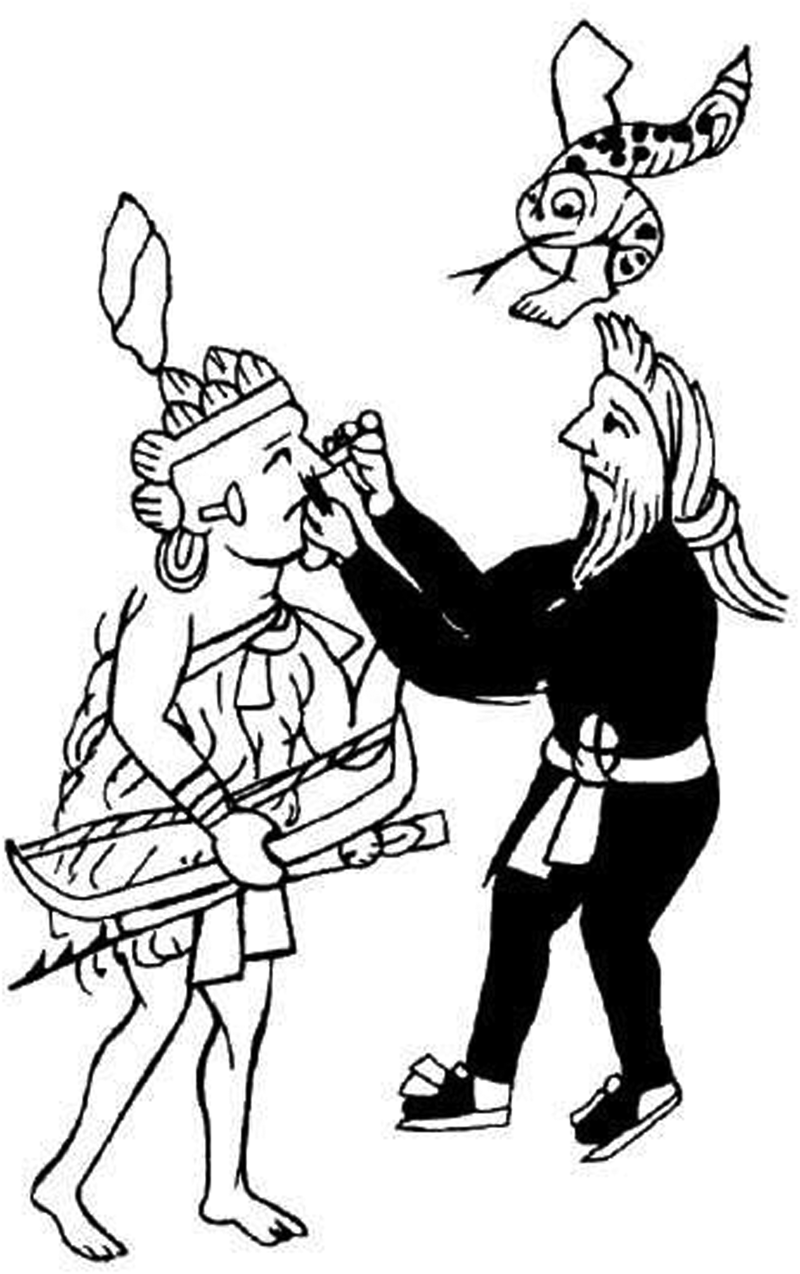
Returning to the ancient nahua texts that we have cited, they abound in flower metaphors to describe newborns, the development of calmecac students, and the accession to power of a new tlatoani. A text in Nahuatl that describes the enthronement of Chichimec rulers states the following (Figure 10):
…then Icxicóatl and Quetzaltehuéyac perforated the septum of the tepilhuan chichimeca with the eagle bone and the jaguar bone. This is the sign that shows that they were established as rulers, the moquiuixca, the quauhtinchantlaca; how they were adorned with flowers.
…auh yn icxicouatl yn quetzalteueyac niman ya yc quinyacaxapotla yn chichimeca yn tepilhuan yca quaomitl ocelohomitl auh yzcatqui yn machiyotl y nezcayotl ynic motlatocatecaque y moquiuixca yn quauhtichantlaca ynic xochiyouaque (Kirchoff et al. Reference Kirchoff, Güemes and García1976:158 [translation of Reyes García]).
Icxicoatl, a Toltec priest, perforates the nasal septum of a Chichimec who will go on to become a tlatoani (Kirchoff et al. Reference Kirchoff, Güemes and García1976:f. 21r). Drawing by Rodolfo Ávila.

Therefore, the ritual of perforating the nasal septum was equated with an act of “being adorned with flowers.” Among the Cakchiquel Mayas, the same ritual is accompanied by a gift of flowers: “They came before Mevac and Nacxit who was in truth a great king. Then they honored Ahauh Ahpop and Ahpop Qamahay [who] were elected rulers. Then they dressed them, they perforated their noses, and they gave them their positions and flowers called Cinpual” (Recinos Reference Recinos1950:67). Nobles and flowers were closely tied in Mesoamerica, a connection that is expressed in the name of the Aztec deity of nobles, who was known as Xochipilli, Flower Prince or Flower Noble (Heyden Reference Heyden1983:49–54; Olivier Reference Olivier2003:214–215). The use of flowers was among the prerogatives of nobles and outstanding warriors: “He who does not dare go to war, even though he be the king's son… He will not wear cotton garments. He will not wear feathers, he will not receive flowers like the great lords” (Durán Reference Durán, Romero and Camelo1995:vol. I, p. 290, Reference Durán and Heyden1994:234). In addition, certain flowers “incur the death penalty if the wearer is not a lord or if he does not have permission” (López de Gómara Reference López de Gómara and Aguilera1965–1966:vol. II, p. 439). The same association of flowers and the nobility has been noted among the Classic-period Mayas (Houston et al. Reference Houston, Taube and Stuart2006:141). In the first place, the calendrical sign ahau, which means “lord” or “noble” in several Mayan languages, corresponds to the sign xochitl, or flower, among the Nahuas (Thompson Reference Thompson1985 [1950]:87–88). Also worth noting is the presence of numerous floral elements in the decoration of House E in the Palace in Palenque, a building that has been associated with rites of accession to power (Houston et al. Reference Houston, Taube and Stuart2006:141). In this regard, it is worth recalling that the four structures that serve as a framing device in plate 44 of the Codex Borgia also have roof ornaments in the shape of flowers (Figure 1).
What is more, flowers were identified with dead warriors. For example, in the poem called “Tezozomoctli Was Thus Enthroned (Teçoçomoctli ic motécpac),” the speaker asks: “Where do the flowers go? Where do those called eagle, jaguar go? (Can on yeh yauh xochitl cano ye yauh yeh intoca quauhtli ocelotl huia”; León-Portilla Reference León-Portilla, León-Portilla, Defossé, de León-Portilla, Villagómez and Equiguas2011:vol. II, pp. 96–97) (see also Bierhorst Reference Bierhorst1985:154–155). Other poetic texts confirm that many flowers—actual species as well as those created by the poet's fertile imagination—were used as metaphors for eagle and jaguar warriors killed in battle or on the sacrificial stone (Sautron-Chompré Reference Sautron-Chompré2003:221–227). In the fragment of the poem “Tezozomoctli Was Thus Enthroned (Teçoçomoctli ic motécpac),” what is especially interesting is that the flower-warrior identification is expressed in a context of an accession to power ritual. In this regard the proposal of Angélica Baena Ramírez (Reference Baena Ramírez2018:302) is suggestive. She associates the presence of flowers in Codex Borgia's plate 44 to the flowery death of warriors by obsidian blade or itzmiquixochitl.
How can this coincidence in the same image of the myth of the origin of flowers—the menstruation of women—and of the origin myth for the nose perforation ceremony be explained? The first mythical event evokes the transition to the age of female fertility, which is blended with its “male counterpart,” in other words, the origin myth of the nose perforation performed by animals in connection with rulers, which serves as a model for rites of accession to power.
Let us turn our attention now to Peru where the Incas performed the ceremony of Huarochicoy in Cuzco. During this rite, youths of 14 to 16 years of age, particularly the sons of the Incas (i.e., the kings), participated in a ritual of accession to the nobility. After fasting, racing, ritual fights, and the sacrifice of llamas whose blood was smeared on the young men, the principal ceremony consisted of having their earlobes perforated, which represented the act of granting of the symbol of nobility par excellence (Cobo Reference Cobo and de la Espada1893:vol. IV, pp. 95–103, 178; de la Vega Reference Vega and de la Riva-Agüero1984:254–261; Rowe Reference Rowe and Steward1946:283–284). The youths were also given new names at the end of the ritual (Cobo Reference Cobo and de la Espada1893:vol. IV, p. 178). Significantly, the nobility of Cuzco were known for the prominent holes in their earlobes, which earned them the nickname pakoyoq, “men with earspools,” or “big ears,” as the Spaniards called them (Figure 11; Rowe Reference Rowe and Steward1946:261).
Pakoyoq, “men with earspools” or “big ears,” was the name for nobles from Cuzco, who had enormous holes in their earlobes (Guamán Poma de Ayala Reference Guamán Poma de Ayala1980 [1615]:vol. I, p. 290). Drawing by Elbis Domínguez.

Zuidema (Reference Zuidema1974–1976:221–222, Reference Zuidema1989:322) has underscored the parallel between certain ritual acts of the Huarochicoy and enthronement rites; he also notes that “the perforation of ears symbolically marked the beginning of [an individual's] sexual life.” Likewise, Classen (Reference Classen1993:70) has highlighted the sexual dimension of the Inca rite that she characterized as:
the male counterpart of the first menstruation and thus an inauguration of fertility. However, the fact that the organ made to bleed was not the penis but the ear suggests that men were supposed to control their sexuality by listening to and obeying oral tradition…Piercing the ears, then, can be understood as both inaugurating male fertility and opening up the ear to be fertilized by sound, in particular, the oral communications of the sacred.
Among other significant ethnographic examples from the twentieth century, I would like to mention the case of the Cocopas of northern Baja California. They had ritual complexes for young women during their first six or seven menstruations, which included tattooing, while the young men were taken to a location away from the village where their nasal septums were perforated (Álvarez de Williams Reference Álvarez de Williams and Ortiz1983:110; Désveaux Reference Désveaux2001:128).
We have few information on the rites associated with the first menstruation in Mesoamerica. However Landa (Reference Landa and Tozzer1941:102–106) has a description of the rite of passage of Yucatec Maya girls around the age of 12—called caputzihil, “to be born anew”—in which “the young girls were first dismissed; and their mothers went up to them to take off the cords, which they had worn up to that time tied around their loins and the little shell, which they wore as a token of their purity. This was, as it were, a license allowing them to marry whenever it should please their fathers.” As for Nahua women in central Mexico, the following ritual was recorded: “This day [7 Eagle in the trecena or thirteen-day period that begins with the day 1 Water] was applied to the Moon and women who suffered menstruation made sacrifices to it [the day] on that day (Era questo giorno aplicato alla luna, e’ le donne che pativano del menstruo li sacrificavano in quelle giorno”; Anders and Jansen Reference Anders and Jansen1996b:f. 28v). Even though we lack descriptions on rituals associated with the first menstruation in central Mexico, with plate 44 from the Codex Borgia we would seem to have the image of a mythical model that explains the parallel between the rites that women performed when they reached the age of fertility and that men conducted when they assumed the status of ruler. It would appear to be a matter of expressing the start of fertility, the sacrificial connotations of accession to power, as well as the symbolism of flowers associated with rulers.
Some time ago, Frazer (Reference Frazer, Sayn and Peyre1981–1984 [1913–1924]:vol. IV, pp. 7–63) noted the strange coincidence in many parts of the world between the taboos that affected women who were having their first period and prohibitions that concerned sacred kings; for example not stepping on the ground or not looking at the sun, in other words, as the Scottish scholar put it, to be positioned “between heaven and earth.” It was a means of controlling the power—which was positive and, at the same time, dangerous—of those beings (that is, rulers and women who had reached childbearing age), whose functions were essential for the survival of human communities. Turning to other ethnographic examples among the Tupinambas of Brazil and other South American groups, as well as among the Pápagos, the Sioux, and other groups from North America, similarities have been pointed out between rites associated with a woman's first menstruation and those that were conducted by warriors after killing their first enemy (see Underhill Reference Underhill1946:192–210, 253–260; Désveaux Reference Désveaux2001:174–176; Fausto Reference Fausto2007:505; Menget Reference Menget, Izard and Smith1979; Viveiros de Castro Reference Viveiros de Castro and Howard1992:274). As Viveiros de Castro (Reference Viveiros de Castro and Howard1992:274) succinctly describes it among the Tupinambas: “Both women and killers spilled blood vital for the reproduction of society,” an observation that fits perfectly with the massive presence of blood in the middle of the plate from the Codex Borgia that we have been examining (Figure 3). It also brings to mind the book Symbolic Wounds, in which Bettelheim (Reference Bettelheim1954) proposes that the ultimate purpose of rituals that involve making some part of the body of young initiates bleed was to reproduce the female process of menstruation, in other words, the capacity to generate life.
To conclude, it is worth relocating plate 44 in the context of the central part of the Codex Borgia. If we were to consider the sequence of mythical events captured in this section, we would have the myth of origin of men (plate 38), the sacrifice of the Night Sun (plates 39 and 40), and the first human sacrifice (plates 41 and 42), according to Boone's (Reference Boone2007:192–202) reading. Now then, the first sacrificial victim is Itztlacoliuhqui, “the god of maize” (Figure 12; Olivier Reference Olivier and Sosa2000). Therefore, it is possible to better understand the next scene (plate 43), which represents the gods feeding on maize. Once men were created and the practice of human sacrifice was established and equated with the consumption of corn on the part of the gods, then plate 44 captured the origin of flowers and menstruation and the myth of the origin of the ceremony to perforate the nasal septum. It suggests that humankind by that time possessed the indispensable tools to perform the tasks of human reproduction and rulership to fulfill the functions of generating newborns equivalent to enemies (Olivier Reference Olivier2014–2015), waging war, and feeding the gods.
Quetzalcoatl sacrifices Itztlacoliuhqui, the corn god (Seler Reference Seler1963 [1904]:Plate 42). Drawing by Rodolfo Ávila.

It is worth continuing with a brief description of the last two illustrations in the central section of the Codex Borgia. In plate 45, Quetzalcoatl appears in his manifestation as the night wind carrying a sacrificial banner and arriving from the preceding plate. In the middle of the illustration we can see Tlahuizcalpantecuhtli, the god of the planet Venus, armed and positioned on a skull altar (tzompantli) where a double tree sprouts, decorated with sacrificial banners. Quetzalcoatl-Venus is captured in the lower part of the illustration, seated on an altar covered with a cloth showing the nine heads of the Venus god, surrounded by four priests. In the four corners of the plate, there are four buildings with eagles surrounded by flint knives on their roofs that contain thrones of power (icpalli), each one with Quetzalcoatl seated on it (Figure 13). These buildings are eagle houses where the lords reign (Anders et al. Reference Anders, Jansen and García1993:238; Boone Reference Boone2007:204–205; Seler Reference Seler1963 [1904]:vol. II, p. 58). A scene of human sacrifice takes place in the middle of the buildings—Quetzalcoatl as an eagle sacrifices a victim with Mimixcoa insignia and Venus face paint—as well as a representation of a huge pulque vessel that displays symbols of sacrifice—banners and cotton ear pendants—above which appear the Black Tezcatlipoca and the Red Tezcatlipoca, as “warrior representatives” (Seler Reference Seler1963 [1904]:vol. II, p. 58). As Seler (Reference Seler1963 [1904]:vol. II, p. 58) rightly indicates, these scenes represent “the fate of the warrior, his life and death.” Similarly, Boone (Reference Boone2007:207) explains that this composition “links Venus to warriors and, indirectly, to the lords who orchestrate the wars by putting Tlahuizcalpantecuhtli in association with the Eagle Houses, the precious white pulque, and a heart sacrifice by an eagle.” In sum, plate 45 emphasizes the central role of Venus in warrior activities linked to sacrifice, as well as the responsibility of the king to foster these activities.
House with an eagle surrounded by flint knives on the roof that have a seat of power (icpalli), with Quetzalcoatl on it (Seler Reference Seler1963 [1904]:Plate 45). Drawing by Elbis Domínguez.

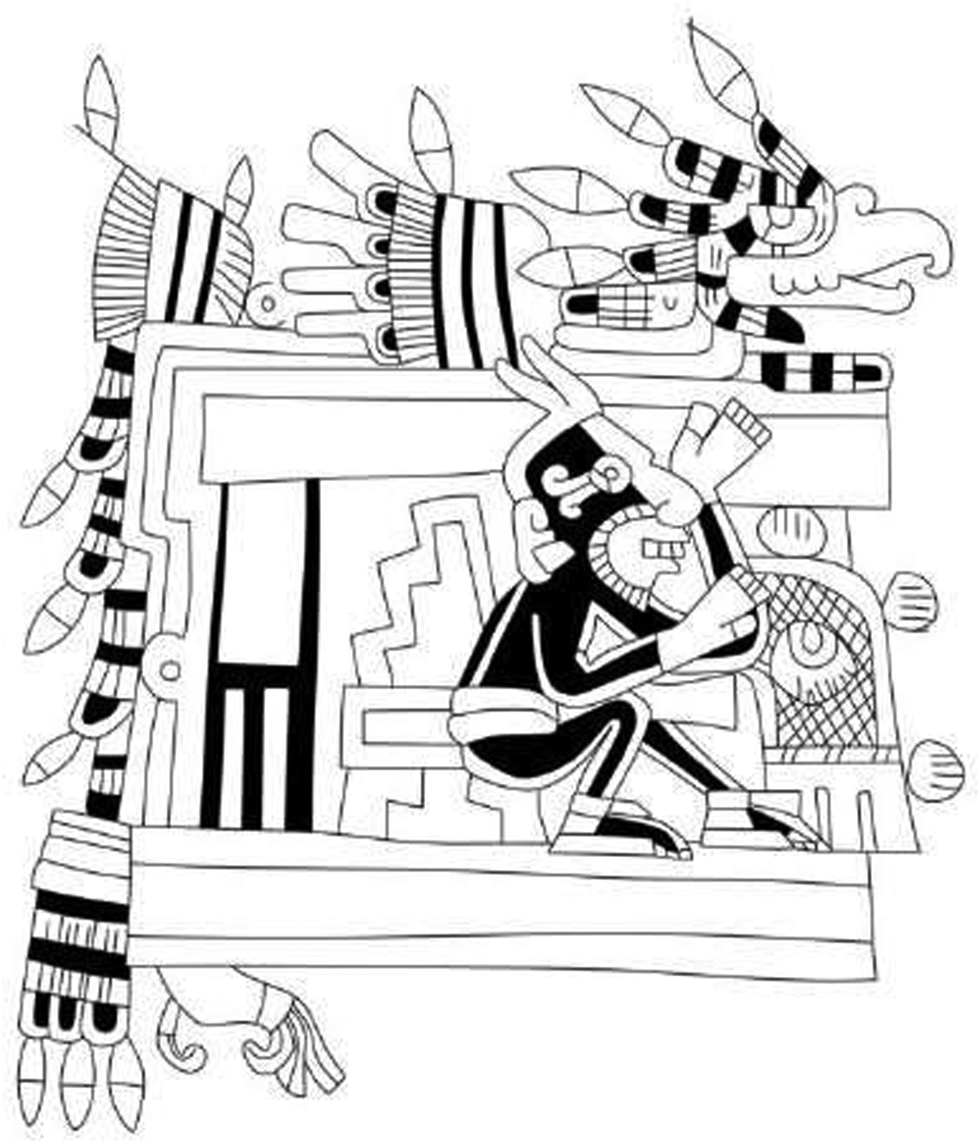
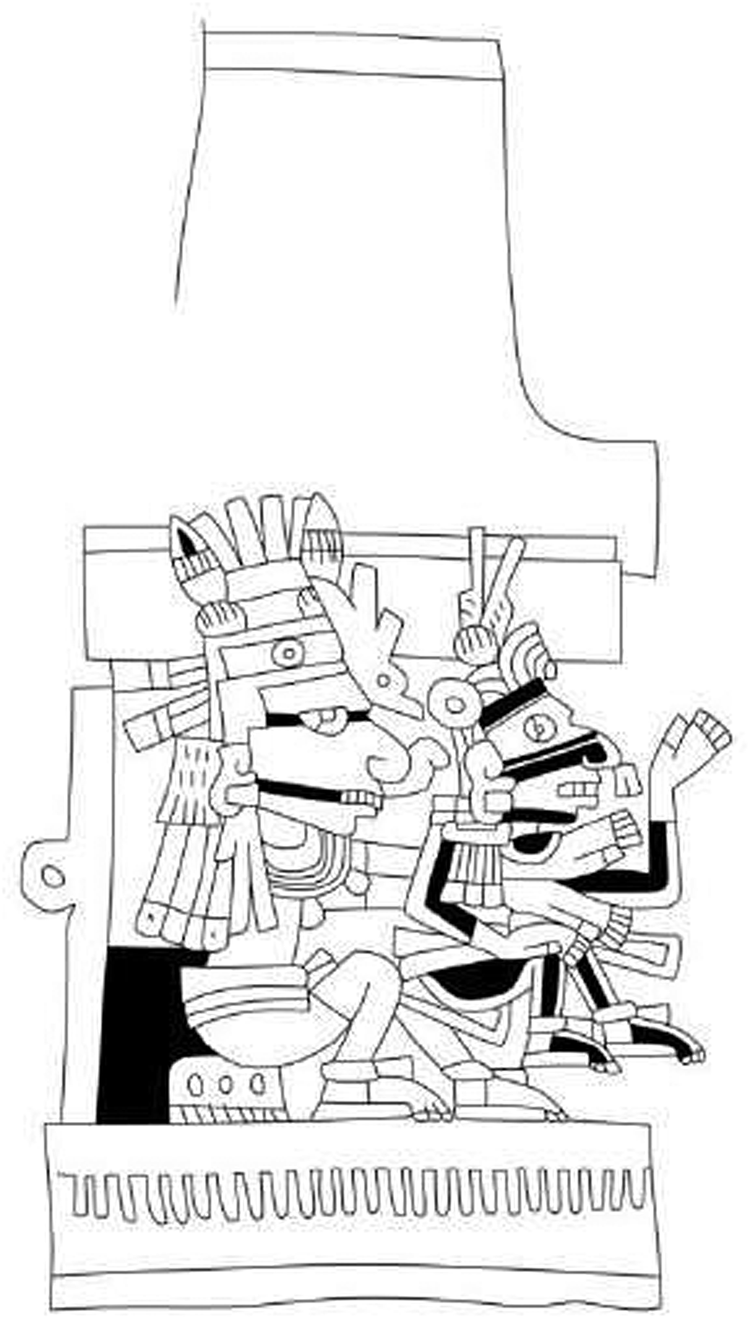
The following plate—the last one of the series of 18 comprising the central section of the Codex Borgia—is dedicated to lighting New Fire. In the central part of the plate, Quetzalcoatl appears in a burning pot inside of a square structure composed of four fire serpents of different colors. Four goddesses with the insignia of Chantico, the goddess of fire—including down in her headdress, a red band around her head, and a turquoise noseplug—contemplate the scene. At the left end of the scene there is a temple in which Xiuhtecuhtli is seated on a jaguar pelt, holding a tiny representation of Tezcatlipoca in his hands (Figure 14). At the other end of the illustration, we can see another temple with a roof in the shape of a fire serpent. In its interior another image of the fire god, also seated on a jaguar pelt, holds in his hands a tiny representation of Quetzalcoatl. In the lower central part of plate 46, Quetzalcoatl is shown lighting New Fire on the chest of a fire god who is recumbent on a royal throne. We may add that Seler (Reference Seler1963 [1904]:vol. II, p. 61) refers to this deity as “the fire goddess,” Boone (Reference Boone2007:209) considers it “the fire god Xiuhtecuhtli, here enveloped in the body of the fire serpent Xiuhcoatl,” and Anders et al. (Reference Anders, Jansen and García1993:241) speak of the “Serpent of Fire Xiuhtecuhtli-Chantico.” This latter composite term is what perhaps best describes the complex deity represented. On the sides of this scene, Tezcatlipoca and Quetzalcoatl, respectively, stand on two other thrones of power (Figure 15). As Boone (Reference Boone2007:209) puts it nicely, “the Borgia narrative ends with the final strip goddess at the bottom of the page, through whom Quetzalcoatl flies to exit the story. It is a Mesoamerican equivalent of the western cowboy hero who rides off into the sunset.”
Temple with a straw roof in which Xiuhtecuhtli, seated on a jaguar pelt cushion, presents in his hands a tiny representation of Tezcatlipoca (Seler Reference Seler1963 [1904]:Plate 46). Drawing by Elbis Domínguez.

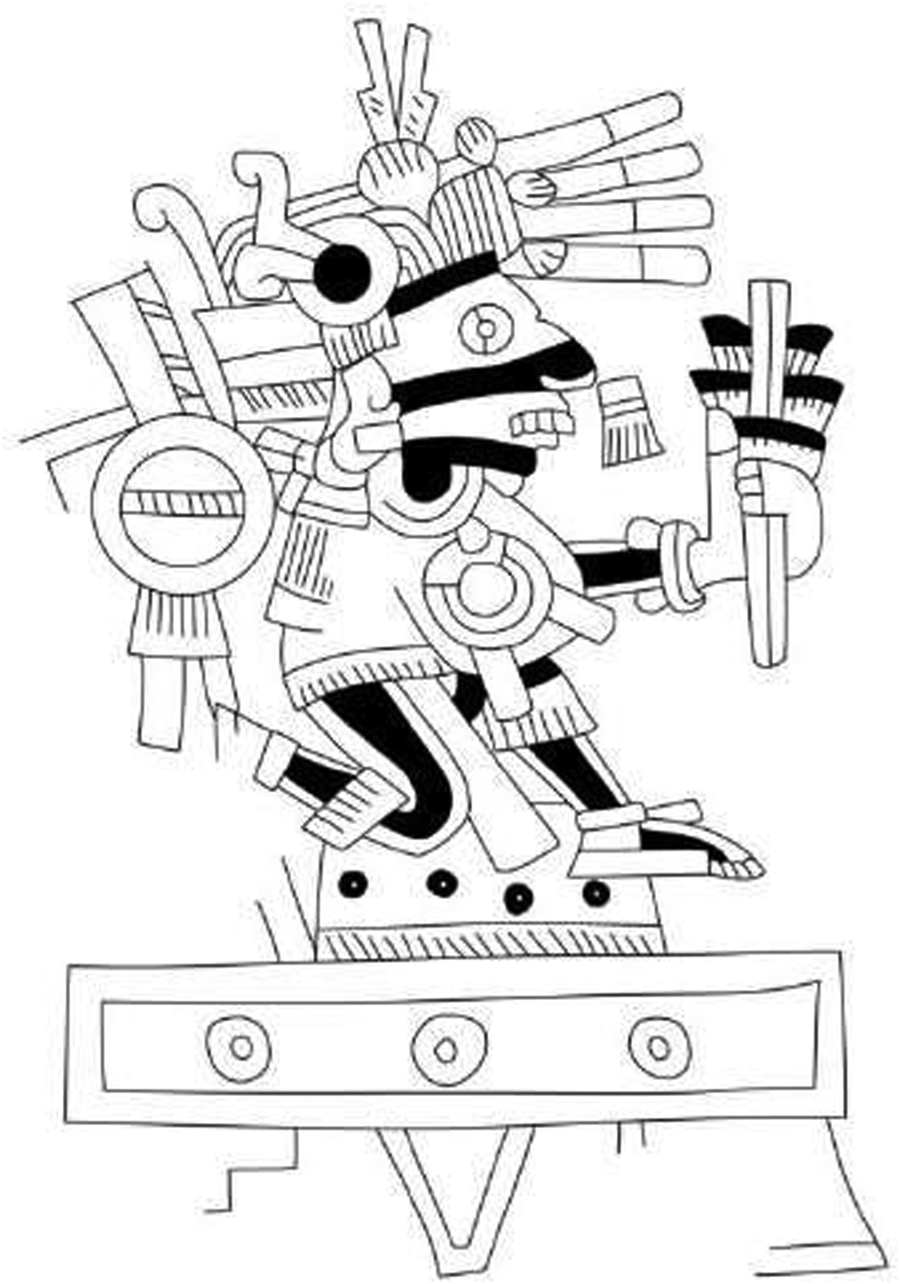
Tezcatlipoca on a seat of power (icpalli), with jaguar pelt back and cushion (Seler Reference Seler1963 [1904]:Plate 46). Drawing by Elbis Domínguez.

The representation of the rite of lighting New Fire at the end of the mythical section of the Codex Borgia serves to express the end of a temporal cycle, at the same time as the beginning of a new era equated with the foundation of a new kingdom or a new dynasty (Anders et al. Reference Anders, Jansen and García1993:241; Boone Reference Boone2007:207). Another element worthy of note is Xiuhtecuhtli's presentation of Tezcatlipoca and of Quetzalcoatl, who again appear on thrones of power in the lower part of this plate. Leading actors in the creation myth, Tezcatlipoca and Quetzalcoatl, are enthroned to witness the final mythical act of this section of the manuscript (Boone Reference Boone2007:209; Olivier Reference Olivier, Olavarría, Millan and Bonfiglioli2010).
In addition to the preceding, we might add that the pose of Xiuhtecuhtli holding tiny representations of Tezcatlipoca and Quetzalcoatl is similar to the pose of the gods who have children in their hands in the sections on rites related to birth (Boone Reference Boone2007:140–141; Seler Reference Seler1901–1902:Plates 24–26, Reference Seler1902–1903:Plates 35–37, Reference Seler1963 [1904]:Plates 15–16). This parallel would confirm the fact that accession to power was equated with a new birth under the patronage of the Fire God. Therefore, as a whole, plate 46 expresses the importance of the New Fire ceremony as an end, as well as the beginning of a new cycle or of a new kingdom.
In conclusion, we can say that within the framework of the presentation of diverse creation myths, the central part of the Codex Borgia includes mythical accounts that have to do with the origin of power, which is strongly associated with the generative power of women as the source of life itself.
RESUMEN
Por la ausenca de glosas y de escenas paralelas en otros manuscritos pictográficos prehispánicos, la parte central del Códice Borgia es la más difícil de interpretar. Por lo anterior muy pocos investigadores han abordado el estudio de este espléndido manuscrito pictográfico y los pocos que lo hicieron reprodujeron en general las interpretaciones de Seler (Reference Seler1904) o las de Nowotny (2005 [Reference Nowotny1961]). Después de casi medio siglo, el libro de Boone, Cycles of Time and Meaning in the Mexican Books of Fate (Reference Boone2007), representa una valiosa aportación, ya que propone de manera convincente una nueva lectura mítica de la parte central del Códice Borgia. En este artículo propongo una nueva interpretación de la lamina 44 en el contexto de la parte central de este manuscrito. El reto consiste en demostrar que la lectura de Nowotny de esta lamina como representación de un ritual de accesso al poder se puede combinar con la interpretación de Boone que considera que representa el mito de origen de las flores. El estudio del simbolismo de la ceremonia de agujeramiento de la nariz representado en esta lamina—en un contexto amplio incluyendo datos históricos y etnográficos de Mesoamerica y de América del Sur—revela que es parte esencial de un rito de paso. En Mesoamerica, durante el ritual de agujeramiento de la nariz, el candidato aparece simbólicamente como una victima de sacrificio, muriendo antes de su renacimiento como señor o rey. El mito de origen de las flores es también el mito de origen de las menstruaciones, que constituye el equivalente femenino del rito de acceso a la condición de mujer. Así, la lamina 44 del Códice Borgia ilustraría con la representación del mito de origen de las flores y el modelo mítico de la ceremonia de agujeramiento de la nariz, el paralelismo entre las mujeres que acceden a la fertilidad y los hombres que acceden al poder. Esta nueva interpretación contribuye a elucidar la interrogación, hace años de Frazer (Reference Frazer, Sayn and Peyre1981–1984 [1913–1924]) acerca de las coincidencias entre los tabús sobre las mujeres que tenían sus primeras reglas y los que conciernen al rey sagrado en muchas partes del mundo.
ACKNOWLEDGMENTS
I thank Debra Nagao for the translations in this article, Elbis Domínguez and Rodolfo Ávila for preparing the illustrations, and the two anonymous reviewers of Ancient Mesoamerica for their useful comments.