Once again we encounter the question of the future. Until recently, the future was still ‘suppressed’ under the condition of postmodernism, in which, as Ruth Levitas asserts, it ‘fails to present itself’.Footnote 1 However, our renewed interest in the future and its prospects has become tragically associated with a new sense of wild, unruly risk (note, for example, the millennium bug, 9/11, the Indian Ocean tsunami of 2004). Such risk was already observed in the late 1980s by the German sociologist Ulrich Beck, who postulated in the context of ecological and technological politics that the nature of contemporary, late modern risk indicated a return to the premodern notion of ‘incalculable insecurities’.Footnote 2 However, whereas premodern risk was believed to be generated by supernatural forces beyond human control, contemporary, incalculable risk is generated by humankind.
Risk has also become a significant feature of contemporary live performance. Looking at the annals of theatre and performance in the twentieth century, one finds that the notion of risk has played a major role in characterizing new trends. However, given the contextual nature of risk as a concept fed on cultural beliefs and world views,Footnote 3 what, then, is the purpose and effect of risk-taking in performance in times when risk is being obsessively analysed and assessed in order to be tamed? What follows are some of my thoughts on the notion of risk as an inherent aspect of modern performance.
Modern risk at a glance
Under the rule of rational thinking and the emergence of ideas about human responsibility and social progressivity, the modern subject assumes that everything is measurable, predictable and controllable, including risk. In late modern society, which Ulrich Beck and Anthony Giddens call the ‘risk society’ or ‘risk culture’, respectively, risk has become a concept tightly connected to ideas about the future. ‘Living in a “risk society”’, explains Giddens, ‘means living with a calculative attitude to the open possibilities of action, positive and negative, with which, as individuals and globally, we are confronted in a continuous way in our contemporary social existence’.Footnote 4 Giddens would later reformulate his observation, when arguing in the late 1990s that ‘it is a society increasingly preoccupied with the future (and also with safety) which generates the notion of risk’.Footnote 5 Thus, while being utterly consumed by the doubt and existential anxiety that result from its characteristic reflexivity, ‘modernity’, according to Giddens, ‘continually draws the future into the present . . . A territory, as it were, is carved out and colonized’.Footnote 6
Much effort has been invested in developing representational procedures that might enable modern subjects to objectify risk and ascribe readable and controllable parameters to it. In addition, modern forms of expertise direct subjects on how to organize their lives reflexively, to plan and to prepare better for the future.Footnote 7 In view of this, it is reasonable to suggest that in modern society, where one can and is expected to gain control over one's life and future by implementing rational thinking, unnecessary and excessive risk is commonly associated with deviation from the scientifically or culturally determined norm. On the other hand, it would seem that modern reflexivity, which supposedly helps individuals to plan the future, also makes them aware of the risks they have to take – such as financial, professional and health- and family-related risks – in order to adopt and realize a prospective life style. Moreover, the unprecedented level of suspicion towards positivist thinking, expert knowledge and authority has generated a new attitude towards risk. It appears that in late modern society risk-taking is no longer considered deviant or negative, but is rather an accepted, even trendy, mode of interrupting the flow of everyday life, of transcending the mundane (such as through extreme sport, extreme tourism or urban exploration). In short, it has become an attempt to engage and explore an alternative reality.Footnote 8
Risk: a performance strategy
The notion of risk in a theatrical or performance context does not necessarily refer to life-threatening acts, such as those we see in certain circus manoeuvres and in body art, but rather to strategies that accentuate and problematize the fundamental actional/performative notion of the ‘here and now’, which, especially when put in inverted commas, refers both to itself and to its deliberate representation. The ‘here and now’ is probably the most challenging quest of (theatrical) performance, and its presentation is the incarnation of reflexivity on the modern stage; it is the epistemological axis on which this time-based art rotates and creates its past shadows and future potentials, its ‘befores’ and ‘afters’, both fictive and real.
The unfolding in real time of a performance and the promise, inherently expected in such a preformed situation, of its successful completion, qualifies it as a risk-taking activity. At the very moment when the decision to perform is made, a plunge into the unknown is taken, no matter how many times the resolution of this very moment has been rehearsed. For this very moment of emergence (of what Barba identifies as ‘to be decided’Footnote 9) combines three orders of time that are instantly interwoven through three modes of action/presentation: repetition of past occurrences that have already been intentionally or habitually moulded into practice or an actional model (something along the lines of Richard Schechner's ‘restored behavior’Footnote 10), followed by the implementation and tuning of that actional model ‘here and now’ under similar fictive or real circumstances, and finally acting in the face of emerging unpredictable circumstances. This is when improvisation is employed. This term, so common among actors and directors in the theatre and elsewhere, originates from the Latin improvisus (im- = ‘not’ + provisus = ‘foreseen’). It thus means acting in the face of the unforeseen, in varying conditions of time, space, spectatorship and atmosphere, with no preconceived idea of the future course of action, and without any real control over the results. Risk is inherent to performance and to the performative, which on a very basic cognitive level always involve decision-making, weighing alternatives in terms of their desirability and likelihood, as well as the performer's responsibility for the future outcomes of his or her acts.
In the modern theatre, risk is quite extensively employed in order to undermine certain pervasive regimes of performance that serve realist representation and reflect the modern idea of the calculability of uncertainties. Indeed, most modern methods of acting and directing reflect the rationalist assumption that risk can be forecast and thwarted. Thus, according to Barry Edwards, founder of the Optik performance group, these methods draw the future into the present and ‘generate the illusion of spontaneity in the moment of repetition/recall . . . that is the end of the action is already present in the beginning, and the performer's job is to time the resolution in line with rehearsal decisions’.Footnote 11 Other less rationalist approaches embrace risk and its integral uncertainties, regarding it as a positive force. It is possible to distinguish between two major views of risk-taking as a strategy or performative device. The first is typical of modernist performance. It sees risk-taking as an indispensable strategy of ethical and aesthetic change, which reflects and encourages the transformation (‘here and now’, within the ontological–epistemological terms and conditions of the event) of society and self towards a better future. The other view, which I suspect is typical of late twentieth-century performance, is simultaneously critical and self-indulgent. Its self-reflexive approach expresses a discomfort with both social and aesthetic orders, but refrains from producing an image of the future as positively transformed.
Risk-taking in modernist and postmodernist performance
The discourse on risk-taking in performance as a strategy in relation to futuristic ideals is entangled with radical discourses on modern sensibility. Through elements of risk, the future looms as an epistemological horizon to the imaginary ‘here and now’ of performance, engaging its ontology and politics of the static with the dialectical principles of expectation and unpredictability.Footnote 12 In general, the concept of risk has proliferated in reference to performance that wishes to regain its function as a cultural site where venturing into the unknown, beyond an accepted positivist reality, is legitimately exercised. This is why the term ‘risk-taking’ is so meaningful in this context. Rooted in the modern conception of risk, it implies voluntarily engaging risk (unlike the option of risk being a condition or state, or being forced upon one). It follows that if risk can be ‘taken’, it can also be manipulated strategically to one's benefit, and serve as a performative device to generate a desired effect.
Consequently Marinetti, founder and leader of the Futurist movement, urged his devotees to ‘sing the love of danger’,Footnote 13 and lauded variety theatre because, in his own words, ‘it creates on the stage the strong, sane atmosphere of danger’.Footnote 14 No less enthusiastic was Artaud's head-on attack against the cultural–ethical status quo, which he steadfastly rejected in order to enable the birth of a new, arguably saner, humanity. Regarding the establishment of the Alfred Jarry Theatre, he wrote,
we stake our lives on the spectacle that unfolds on the stage . . . The spectator who comes to our theatre knows that he is to undergo a real operation in which not only his mind but his senses and his flesh are at stake . . . such is the fatality that we evoke, and the spectacle will be this fatality itself.Footnote 15
Risk-taking, in Artaud's view, is probably as negative as the dark forces of the plague, to which he compares his theatre of cruelty, but it is also inevitable if transformation, the goals of which are the rebirth of a spontaneous and total individual, is to be achieved. There can be neither transformation nor longed-for redemption without risk. Finally, en route to his conception of holiness in the theatre, Jerzy Grotowski proclaimed that
every performance is as hazardous, as risky, as a rehearsal . . . nothing protects me from the risk of losing, during a performance, all I have obtained. Such are the conditions under which my spontaneity and my totality appear in all their authenticity.Footnote 16
As anyone who deals with ghosts (real or imaginary) in the theatre knows, the only possible strategy for achieving presence and presentness (even more so spontaneity and totality) is to be, to act, to perform, and thus to challenge Fortuna, and, as Hamlet says, to face ‘a sea of troubles’.Footnote 17 This is undoubtedly a risk-taking experience. In light of this existential speculation one might reasonably infer that the only way to avoid risk is not to perform. However, here lies precisely the heart of the risk question. When considered in the context of modern theatre and theories of performance and the performative, ‘not to perform’ is either impossible or else the riskiest and most fatal experience for the subject. Hamlet might have put it this way: the performance is the thing; otherwise it would be phrased, I perform, therefore I am.
Postmodernist practitioners are suspicious of the modernist discourse of redemption, which justifies risk-taking in order to achieve totality and authenticity. In their view, risk is simultaneously inevitable and banal. Not only is it a fact of the constructed and regulated reality, of life as a continuous performance of social codes and roles, but it is also a condition of surviving performance. Tim Etchells, director of Forced Entertainment, notes,
The live situation that in theatre at least always carries a burden of expectations: that you will do something, that you will entertain, that something will be revealed . . . Why is one embarrassed or reluctant in this way? Because there is no possibility of owning representation . . . Because a force bears upon you from society and culture, a violent force; you are subjected to its economies, pressed inside its limits, framed and made by its language.Footnote 18
What the artist in fact is risking, as Etchells suggests, is the fictive scaffolding of the social symbolic system we live by, and on which all of our secured, believable and trustworthy existence leans. What this scaffold supports, too, is the secured, believable and trustworthy situation of performance itself, in which certain pre-established conventions and coded behaviors dictate certain expectations and interpretations. Etchells concludes his observation with a sincere statement: ‘It is simple, more or less: you stand there and you fail’.Footnote 19
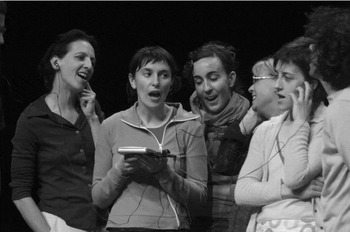
Jérôme Bel's The Show Must Go On, which presents ordinary movement carried out by seemingly untrained performers on a bare stage, not only questions what sort of movement qualifies as dance (an aspect already explored in the 1960s), but examines the performance situation as an obvious, unproblematic cultural–artistic experience as well. Bel's spectacular-less spectacle challenges the spectators’ reactions and expectations, risking the much-cherished convention referred to in the work's title that ‘the show must go on’. For whom must the show go on, and why? At its performance in Tel Aviv in March 2004, the show did not have to go on for the many audience members who left the theatre in protest before it ended. Others were quite determined to interfere with it (and perhaps even stop it) by going onto the stage in an attempt to control it. Undoubtedly, Bel failed them, betrayed their faith, although I am not sure that they failed him. He manipulated their faith and expectation in such a way that put his proclamation to ‘go on’ in spite of everything (attempting to fulfil the promise of colonizing the future) at risk.
The Show Must Go On, Jérôme Bel. Photo: Mussacchio Laniello. Courtesy of R. B. Jérôme Bel.

In Franko B's live body works the question is not whether the show must go on, but rather for how long it can go on. Franko B's performances problematize the distinction between the physiological condition of the body (at risk of losing blood) and its theatrical representation, between the beautiful images he forms with his whitened body and the presence of red blood draining from his veins. This makes Etchells's assumption that ‘there is no possibility of owning representation’ a disturbing reality. Franko B's bleeding body is spectacularly staged for consumption, contemplation and appreciation. The risk he takes very concretely conditions the work's length and pace; it is aesthetically experienced by the audience. In I Miss You (2003), the naked, white-painted and bleeding Franko B walks up and down a canvas laid out in the shape of a catwalk, beautifully lit and surrounded by the audience as in a fashion show. Unlike earlier manifestations of body art, where the body at risk usually provoked a sense of shock, which in some cases caused spectators to interfere with the performance and stop it (such as Valie Export's Erosion (1970) and Marina Abramovic's Rhythm 0 and Rhythm 5 (1974)), Franko B's bodily risk is contained and banalized by the force of theatricality and the aesthetic distance it compels, thus reflecting and commenting on the inevitable sadomasochistic mechanism of media culture and the entertainment industry, which produce and present risk for consumption.
To conclude: modernist practitioners of performance employ risk-taking as an attempt to transcend the representational aspects of performance, with the expectation of reaching and presenting a truer reality. In contrast, postmodern manifestations of performance risk-taking are employed as a metareflexive strategy that sheds light on the constructed nature of performance and on the nature of reality as performance. It grants its participants the possibility of reflexively experiencing the compelling powers of convention, mediation and representation ‘here and now’, while at the same time questioning the fixed and homogeneous patterns of time, place and identity, accentuating instead uncertainty, complexity and, no less important, vulnerability.