In April 2009, the World Digital Library opened its digital portal (www.wdl.org). The library makes “available on the Internet, free of charge and in multilingual format, significant primary materials from countries and cultures around the world” (World Digital Library 2009a). Among its original holdings was an early Colonial period manuscript on the Maya that is cited here as the “Pintura manuscript.” Its Spanish text explains Maya culture and contains drawings of Maya deities and, mostly, calendrical glyphs. A friar supposedly wrote the Pintura manuscript in a.d. 1548 in northern Yucatan (World Digital Library 2009b). Spaniards had conquered this part of the Maya area only a few years earlier and were still struggling to control it (Chamberlain Reference Chamberlain1948). Few similarly-early Spanish documents treat Maya culture in detail. The Pintura manuscript therefore promised sensational insights, were it not a forgery.
The following analysis was submitted on May 25, 2009 for publication, only a few weeks after the publication of the Pintura manuscript. Preliminary assessments appeared online and in print (Eberl and Prem Reference Eberl and Prem2009a, Reference Eberl and Prem2009b). The manuscript remained available online throughout the summer of 2009 but was taken offline around August 21, 2009. While it is no longer available for study and should no longer be considered relevant as a historical source, the Pintura manuscript exemplifies the ways in which forged historical documents can be identified.
AUTHENTICATING HISTORICAL DOCUMENTS
The first and most fundamental step in the analysis of documents is to prove that they are authentic; that is, that they were composed at the time, at the place, and by the author stated. Forensic scientists have developed an arsenal of tools and techniques to identify forged documents (Ellen Reference Ellen1997; Nickell Reference Nickell1996). They focus on modern documents and on methods that can be used in a court of law. As potential legal evidence, every document is suspicious and its authenticity has to be proven. Scholars often regard historical documents, on the other hand, as genuine unless proven otherwise (Pitt Reference Pitt1972:47). A more critical stance is warranted.
Historical documents have been forged in both ancient and modern times. The boundary between genuine and fake can be fluid for historical documents. The títulos primordiales or “primordial titles” provide, for example, histories and land boundary descriptions of Colonial period indigenous communities in Mesoamerica (Horn Reference Horn and Carrasco2006). They emerged during Late Colonial times when escalating land disputes forced indigenous communities to defend their land claims in Spanish courts. The títulos primordiales “typically claim to date from the sixteenth century, although their vocabulary, orthography, script, and paper indicate a later date of composition” (Horn Reference Horn and Carrasco2006). Many títulos primordiales, especially a subgroup known as Techialoyan manuscripts (Noguez Reference Noguez and Carrasco2006), claim to be of sixteenth-century origin but were produced in Late Colonial times and are therefore not authentic. The ability to identify such non-authentic documents is important for scholars in order to avoid misunderstanding and misinformation. Their study can also be redeeming. For example, scholars appreciate the títulos primordiales as unique sources on how natives perceived the conquest and on the social and intellectual context of their production (e.g., Lockhart Reference Lockhart1991:39–64).
In the holistic approach presented here, a historical document is examined from six angles in order to authenticate it (Barber and Berdan Reference Barber and Berdan1998:148–177; Nickell Reference Nickell1996:95–98). What are its physical makeup, its penmanship, and its linguistic properties? Authentic documents should have a traceable history of documentation (here termed a “pedigree”). Their contents should be consistent with well-established sources and with culture- and time-specific conventions. Suspicions based on a few inconsistencies are not enough to condemn a historical document. It is necessary to accumulate as much evidence as possible and to show patterns of error. The following discussion focuses on modern forgeries of historical documents.
A historical document is created at a certain moment in the past with a definite purpose in mind. It is then acquired by and exchanged—traded, bought, gifted—among institutions and individuals. Collectors may have left their own traces by stamping or marking the document. Notes of acquisitions and sales may create a separate paper trail. An authentic document, then, has what might be called a “pedigree” and can ideally be traced from the moment of its creation to the present. This becomes more difficult for older documents (see Deckert Reference Deckert1975 for a relevant example of the Dresden Codex). Many historical documents survive, in addition, only in the form of subsequent copies. Textual criticism is then charged with detecting modifications and restoring the original text (Greg Reference Greg1950–51; see also, for example, Diego de Landa's Relación [Restall and Chuchiak 2002]). It is often the case that the entire pedigree can no longer be reconstructed. One then has to consider the circumstances of discovery, as well as the relevant people and institutions involved. Forgeries often appear ‘out of the blue’ and come from notorious dealers and collectors (Nickell Reference Nickell1996:95–96).
The next step is the physical examination of the document. What are the surface, the writing medium, and the applicator (Barber and Berdan Reference Barber and Berdan1998:150)? In most cases this means analyzing the type of paper, ink, and pen used in creating the document (Millares Carlo and Mantecón Reference Millares Carlo and Mantecón1955:46–48). Many techniques are available to do this (Ellen Reference Ellen1997:89–115). Almost all of them, however, require the document to be handled physically, and some techniques even require the document to be partially destroyed. Problems here include the inherent fragility of the document or the reluctance of the document's owners to allow physical examination.
Penmanship is a third aspect of authentication. If the author is known, the document should be in his or her handwriting (for a detailed discussion see Huber and Headrick Reference Huber and Headrick1999). More or less professional scribes were, however, the authors of many (if not most) historical documents. Their handwriting should match the style of writing, orthography, and abbreviations for the period and region of a document's creation (for colonial Spanish documents see Carlin Reference Carlin2003 and Millares Carlo and Mantecón Reference Millares Carlo and Mantecón1955). Paleographers are acquainted with the ways in which penmanship changed over time and in specific areas. A Maya hieroglyphic inscription on a bone was, for example, identifiable as forgery because the text combined glyphs from an a.d. 445 stela at Tikal and an a.d. 705 panel at Palenque (Eberl and Prager Reference Eberl and Prager2000).
The linguistic properties of a document may also be considered. Phonology, morphology, syntax, and vocabulary of the language change over time (for Spanish see Cano Aguilar Reference Cano Aguilar2005; Lapesa Reference Lapesa1981, Reference Lapesa2000; Penny Reference Penny2002). To date, linguistic research has not been integrated very well with the ethnohistoric and historic study of documents, which continues to focus on words (see Barber and Berdan Reference Barber and Berdan1998:97–113). Little has been published on changing text genres and the changing of formulaic phrases (for genres in Spanish colonial documents see Garcés G. Reference Garcés G.1949:293–295 and Restall et al. Reference Restall, Sousa and Terraciano2005:13–15 [with examples in León-Portilla and Shorris Reference León-Portilla and Shorris2001 and in Restall et al. 2005]; for phrases see Carbonell Basset Reference Carbonell Basset2002). At the word level, anachronisms are, in James Farrer's (1907:2) words, “the rock on which counterfeit works almost always run most risk of shipwreck.” An etymological dictionary allows for their identification (especially useful for Spanish are Real Academia Española 1933, the Diccionario de Autoridades [Real Academia Española 1969 [1726–1739]], and Covarrubias Reference Covarrubias Orozco1977 [1611]). The chronological misplacement can be anticipatory, that is, it refers to something that has yet to be created. For example, in Shakespeare's Julius Caesar, Cassius proclaims that “the clock hath stricken three” (Shakespeare Reference Shakespeare1824:24). Written around a.d. 1599, this sounded unremarkable for Shakespeare's audience but was supposedly uttered in 44 b.c., hundreds of years before the invention of the mechanical clock. Retrospective anachronisms, on the other hand, invoke “something that existed at an earlier time but has passed out of currency” (Barber and Berdan Reference Barber and Berdan1998:154). For example, near replaced nigh in the sixteenth century (Campbell Reference Campbell1999:93). The latter is not used in modern texts but survives in phrases like “the end is nigh.” While anticipatory anachronisms provide striking evidence, retrospective anachronisms need to occur in unusual patterns to expose a forgery.
The contents of a historical document that promises sensational insights deserve especially close study. They should be compared to the information from well-established sources. By applying the Maxim of the Five Ws, the differences among sources regarding the same event can be charted: Who participated in the event? Where and when did it take place? What happened? Why and how did it happen? During the conquest of the Itza Maya at the end of the seventeenth century a.d., Friar Andrés de Avendaño y Loyola undertook several journeys to the central Peten to Christianize the population and wrote his experiences down in 1696. He departed, for example, on his second journey in December of 1695 (after Prem Reference Prem1999:302, Table 2). The Buenaventura and the Roldán manuscripts—two of the Canek group documents (Prem Reference Prem1999)—state that he left on December 15, together with two companions (Joseph de la Buenaventura and Francisco de Izaguirre according to the Buenaventura manuscript and Joseph Antonio Maria Roldán and Faustino Estrada Monzón according to the Roldán manuscript). Avendaño's own account differs. He departed on December 13 and had three companions (Fray Antonio Pérez de San Román, Fray Joseph de Jesús María, and Fray Diego de Echabarría). The details of the Buenaventura and Roldán manuscripts coincide, on the other hand, with Sylvanus Morley's version in The Ancient Maya (Morley Reference Morley1946, Reference Morley1947a, Reference Morley and Brainerd1956, Reference Morley, Brainerd and Sharer1983:587; Sharer Reference Sharer1994:749) that Avendaño departed on December 15, 1695, accompanied by two unnamed Franciscans. Andrés de Avendaño y Loyola's report was not published until 1996, that is, after the appearance of the Canek group documents and after the publication of the first five editions of Morley's The Ancient Maya. Different authors have, of course, different memories and a historical document is seldom perfectly consistent with other sources. It was therefore not surprising that the Canek group documents differ from Avendaño's description. However, they were revealed as forgeries because they coincided consistently with Morley (Prem Reference Prem1999).Footnote 1
Currency, units of measurement, and calendrical calculations are notorious stumbling blocks for forgers. According to the Canek manuscript, a friar died on July 8, 1623, on the feast day of Saint Elizabeth of Portugal (Prem Reference Prem1999:309–310). Saint Elizabeth was canonized in 1625 and her feast was initially celebrated on July 4. A papal decree in 1695 changed the feast day to July 8, but the decree was not published until 1701. The reform of the Catholic Calendar of Saints in 1969 restored the feast to July 4. The feast day of Saint Elizabeth fell on July 8 only between 1695 and 1969. The author of the Canek manuscript who supposedly wrote it in 1695 could not have known the papal decree. The modern forger, on the other hand, likely produced the manuscript before 1969. The content of a document helps not only to identify a forgery but also to reconstruct the context in which a forger was working.
Finally, inconsistencies and subtle clues can lead to the sources that a forger used. Features in a historical document that require specialized knowledge and expertise in different fields are particularly telling. The erroneous use of Maya hieroglyphs in the Canek group forgeries are good examples (Prem Reference Prem1999). Widely available books on particular subjects mentioned in a historical document are a good starting point to narrow down sources (see the above example of Andrés de Avendaño y Loyola's second journey). In the case of the fake Maya carved bone mentioned earlier, hieroglyphs were copied from an exhibit catalogue (Eberl and Prager Reference Eberl and Prager2000). The drawings in the Canek group manuscripts reproduce illustrations from Morley's (Reference Morley1947a, Reference Morley and Recinos1947b, Reference Morley and Brainerd1956) The Ancient Maya (see Prem Reference Prem1999:300–306). If a source is found, it needs to be compared in detail with the historical document to establish the degree of similarity.
It is easy to suspect forgery but difficult to confirm. The above discussion detailed six aspects—pedigree, physical properties, penmanship, linguistics, content, and sources—as keys to authenticating a historical document.
THE PINTURA MANUSCRIPT
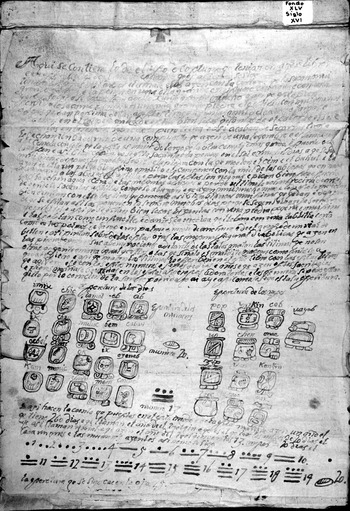
When the World Digital Library went online in April 2009, it contained thirty-nine items from Mexico. The Pintura manuscript, along with ten others, came from the Centro de Estudios de Historia de México CARSO (“Center for the Study of the History of Mexico”). The industrial group Condumex founded the Centro de Estudios de Historia de México in 1965. When Mexican industrialist Carlos Slim Helú bought Condumex in 1992, the institution became part of the industrial conglomerate CARSO in Mexico City. The Pintura manuscript has the call number “Fondo XLV Siglo XVI” (see upper right corner in Figure 1) which corresponds to the system used by the center's archive, the Archivo de Historia de México Condumex. The Pintura manuscript was, however, neither listed in the archive's online catalogue nor mentioned at the center's homepage (Centro de Estudios de Historia de México CARSO 2009). Only the Museo Soumaya, another Carlos Slim foundation, presented the Pintura manuscript as one of its primary possessions (Museo Soumaya 2009). No information is available on its pedigree. It was unknown until its inclusion in the World Digital Library.
The first page (folio 1 recto) of the Pintura manuscript in the World Digital Library (all images of the Pintura manuscript from World Digital Library 2009b; the images were enlarged using Adobe Photoshop's bicubic interpolation to increase their low online resolution).

Among the many holdings of the Centro de Estudios de Historia de México is the Buenaventura manuscript, one of the Canek group forgeries (see below and Prem Reference Prem1999:297, note 2). The Archivo de Historia de México Condumex acquired the Buenaventura manuscript in the 1970s and continues to list it among its holdings (Centro de Estudios de Historia de México CARSO 2010).
The Pintura manuscript was available online at the World Digital Library under the title El modo de cómo hacían la pintura los indígenas (“How the Indians Made Their Paintings”) (see Figure 1) (World Digital Library 2009b). It consists of three folios that measure 32.5 × 22.5 cm. It could not be analyzed physically and it remains unclear whether it is written on sixteenth-century paper with authentic ink. The accompanying text provided the following description:
“This manuscript, dated 1548, is from Salamanca in the present-day state of Yucatan, Mexico. Apparently written by a Franciscan monk, it describes different elements of Mayan culture. The text introduces various Mayan deities and explains the manner in which the Mayans prepared the cloths on which their codices were written. The text uses Mayan numbers and includes detailed calendar glyphs of the 13 months and 20 days of the Tzolkin year, the 260-day ritual calendar used throughout Mesoamerica.” (World Digital Library 2009b)
If authentic, the Pintura manuscript would have been one of the earliest Colonial period sources on Maya culture and thus of great significance. Its presence in the same institution, however, as the forged Buenaventura manuscript and its lack of pedigree raised red flags. The authenticity of the Pintura manuscript could not be assumed but had to be proven.
THE CANEK GROUP OF FORGED MANUSCRIPTS
Several manuscripts describing historical episodes of contact between Maya and Spaniards, supposedly of sixteenth- to eighteenth-century origin, have surfaced since the 1970s. These include Las Memorias de Guerrero, Historias de la Conquista del Mayab, por fray Joseph de San Buenaventura (held, as mentioned above, by the Archivo de Historia de México Condumex), Historia de la pazificazion de las tierras de los indios itzaes y las ganzias de el tayasal y de todos los poeblos de la alaguna en el año 1697, and the Canek manuscript. While some of these were published and have received scholarly attention (e.g., Aguirre Rojas Reference Aguirre Rojas1975; Solís Robleda and Bracamonte y Sosa 1994), none became as famous as the Canek manuscript (Jones Reference Jones1992, Reference Jones1994, Reference Jones1999), which deals with the conquest of the Itza Maya at the end of the seventeenth century a.d. It recounts the arrival of three Franciscan friars to Tayasal and their meeting with Canek, the last Itza king.
Hanns Prem (Reference Prem1999) has shown that the four manuscripts mentioned above form a single group (now known as the “Canek group”). At least three of the manuscripts were written by the same hand and all four share similar stylistic characteristics, lexicon, orthography, and content. More importantly, Prem established that their texts and illustrations were drawn from the Spanish translation of Sylvanus G. Morley's The Ancient Maya (1947b). They are modern forgeries from the 1950s and 1960s.
HANDWRITING AND STYLISTIC FEATURES
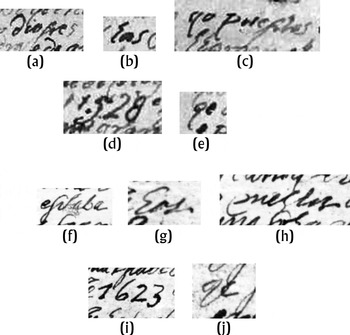
The Centro de Estudios de Historia de México holds the Pintura manuscript and the forged Buenaventura manuscript. A comparison of the former to the latter and to the Canek group in general suggested itself as a starting point for the authentication of the Pintura manuscript. It quickly became evident that the Pintura manuscript and the Canek group forgeries share the same handwriting (Figure 2) (see also Prem Reference Prem1999:308–309, 310 note 7; for a facsimile of the Canek manuscript see Jones Reference Jones1992:244–247):
• The letter “s” (Figures 2a and 2c) consists of a long “s” with a small appendage to the side (often transcribed as “ss” in Jones Reference Jones1992; Figures 2f and 2h);
• The letter “l” is written with a small step in its top part (compare Figures 2b and 2g);
• The vertical stroke in the letter “p” is written downwards, similar to ones in the Canek manuscript (compare Figures 2c and 2h; see also the caption ah puch below God A in Figure 5a);
• The capitalized “A” is written cursively (compare, for example, the initial “A” on folio 1 recto, line 1 of the Pintura manuscript [Figure 1] with the “A” in the signature in the Roldán manuscript; Prem Reference Prem1999:307 Figure 5 bottom);
• The Arabic numbers on folio 1 recto and verso are similar to the numbers in the Canek manuscript (compare Figures 2d and 2i; see also the numbers at the bottom of Figure 1 and between the Tzolk'iin day signs and Haab’ months in Figure 4a).
The Pintura manuscript is, in addition, stylistically similar to the Canek group. Words like que and se sigue are written qe and se sige by omitting the silent “u” (Figures 2e and 2j). This convention never appears in colonial Spanish documents (Carlin Reference Carlin2003; Millares Carlo and Mantecón Reference Millares Carlo and Mantecón1955). Que was shortened to  but never to qe (Carlin Reference Carlin2003:122–123; Millares Carlo and Mantecón Reference Millares Carlo and Mantecón1955:68). The letter o often stands for “u” in words like coenta for “cuenta” (Figure 1, line 30; and, Figure 6a: “años de la coenta larga”). Anomalous noun phrases like “con los estos numeros” or “en el este año” are common (Figure 1, lines 27 and 30) (see Hanks Reference Hanks1992; Prem Reference Prem1999:309, Table 4). The Pintura manuscript has the same handwriting and the same stylistic characteristics as the forged documents of the Canek group.
Comparison in the handwriting of the Pintura and the Canek manuscripts: (a) dioses (Pintura manuscripts folio 1 verso line 40); (b) las (Pintura manuscripts folio 1 recto line 23); (c) qopuestas for “compuestas” (?) (Pintura manuscript folio 1 recto line 30); (d) year 1528 (Pintura manuscript folio 1 verso line 19); (e) qe for “que” (Pintura manuscript folio 1 recto line 27); (f) estaba (Canek manuscript line 34); (g) las (Canek manuscript line 89); (h) puestos (Canek manuscript line 41); (i) year 1623 (Canek manuscript line 53); (j) qe for “que” (Canek manuscript line 76) (Canek manuscript examples from the facsimile in Jones Reference Jones1992).

MAYA NUMBERS
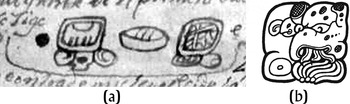
Bar-and-dot numbers appear several times in the Pintura manuscript (folio 1 recto [Figure 1] and verso [Figure 3a], folio 2 verso, folio 3 recto [Figure 6a]). In all cases these employ the codex variant of zero—a shell—and copy the corresponding glyph in Morley's The Ancient Maya (1956:239, Figure 23). Folio 1 verso employs the shell to write “0 Pop” (Figure 3a). This use of the shell is not attested in Maya writing. Modern epigraphers transcribe the beginning of a Haab’ month as “0 Pop” or “0 Muwan” but they refer to an ancient Maya expression that literally translates as the “seating of Muwan” and that does not employ the shell or other glyphs for zero (Figure 3b) (see also Coe and Van Stone Reference Coe and Van Stone2001:42 and Thompson Reference Thompson1950:119–120).
Glyphic expressions for the beginning of a new Haab’ month: (a) Date 1 Imix 0 Pop on folio 1 verso of the Pintura manuscript; (b) Typical Classic Maya expression: “Seating of Muwan” or 0 Muwan (after Coe and Van Stone Reference Coe and Van Stone2001:42).

TZOLK'IIN DAY SIGNS AND HAAB’ MONTHS
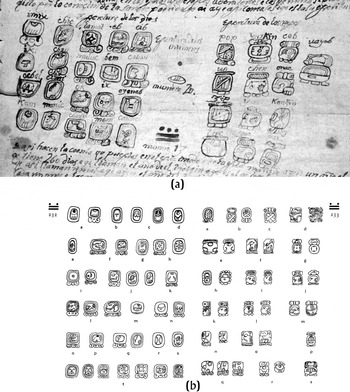
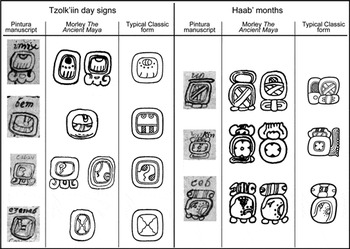
The lower portion of folio 1 recto shows twenty day signs of the Tzolk'iin next to thirteen Haab’ months (Figure 4a).Footnote 2 Morley's The Ancient Maya (1956:232–233) illustrates the 20 day signs of the Tzolk'iin on the left side (page 232) and the Haab’ months on the right side of a page (page 233) (Figure 4b). The Pintura manuscript copies not only the layout of Morley's illustrations but also the cartouches, glyph outlines, and affixes. In authentic hieroglyphic texts Tzolk'iin cartouches vary freely between variants with and without pedestals (Bricker Reference Bricker1995:218). The cartouches in the Pintura manuscript, however, copy Morley's examples exactly, that is, they have pedestals if Morley shows them as such and they have none if Morley does not. Four of Morley's examples—the day signs Imix, Lamat, Ok, and Kab'an—come in a variant both with and without a pedestal. The forger of the Pintura manuscript chose one variant and copied it without exception. The Imix sign in the Pintura manuscript has, for example, the pedestal, interior half-sphere, and simple parallel strokes of Morley's right example whereas Morley's left example has no pedestal, an interior dot, and ‘i’-shaped parallel strokes (Table 1). The pedestal of the Kimi cartouche (labeled ‘Chan’ in the Pintura manuscript) contains an inverted Ajaw sign (glyph T534 in Thompson Reference Thompson1962) both in the Pintura manuscript and in one of Morley's examples.
Tzolk'iin and Haab’ glyphs: (a) Glyphs from folio 1 recto of the Pintura manuscript; (b) Pages 232 and 233 from Morley Reference Morley and Brainerd1956.

Comparison of specific Tzolk'iin day signs (Imix, B'en, Kab'an, and Etz'nab’) and Haab’ months (Wo, Yaxk'iin, and Keh) in the Pintura manuscript, in Morley's The Ancient Maya, and in typical Classic texts (the Morley examples are from Morley [1956:232–233]; the typical Classic forms of Tzolk'iin day signs are from Thompson [1962:452–453] and of Haab' months from Coe and Van Stone [2001:43]; for more site- and time-specific Tzolk'iin and Haab' glyphs see Figures 6–10 and Figures 16–19 in Thompson [1950]). Table by Markus Eberl.

Many Tzolk'iin day signs in Morley and in the Pintura manuscript have double outlines, an otherwise rare feature. The examples in the Pintura manuscript are again faithful copies of Morley's illustrations. The only exceptions are the day signs Imix, Manik’, Muluk, and Eb’. A single outline replaces the double outline in these four cases. The forger's tendency to simplify (see also note 2) may explain why the Pintura manuscript deviates in these cases from Morley.
The position of affixes is variable in Maya writing. Prefixes can be before and on top of a main sign whereas suffixes can be below or after a main sign without a change in meaning (Beyer Reference Beyer1934). The Haab’ month Wo includes for example, the glyph for black. This glyph is on top of the main sign in Morley but often in front of the main sign in regular Classic texts (Table 1). It is highly unusual, then, that every affix in the Pintura manuscript occupies the same position as in Morley's illustrations.
A detailed comparison of individual Tzolk'iin and Haab’ glyphs in the Pintura manuscript with Morley's illustrations uncovers unique similarities (Table 1):
• Tzolk'iin day sign Imix: The day sign normally has an interior dot; in the Pintura manuscript and in one of Morley's examples, the dot has become a half-sphere that adheres to the upper portion of the outline;
• Tzolk'iin day sign B'en: Two stubs that are normally parallel and vertically attached to the top of the glyph are asymmetrical and form a continuous loop; the horizontal line that divides the glyph has two rounded loops; both features are absent in regular texts;
• Tzolk'iin day sign Kab'an: The characteristic query mark in the interior of the Kab'an sign normally attaches to a separate line that surrounds three-quarters of the interior of the glyph and not (as in Morley and the Pintura manuscript) to the outline of the glyph itself;
• Tzolk'iin day sign Etz'nab’: Instead of two wiggling lines that form an ‘X’, the drawings in the Pintura manuscript and Morley show intersecting double lines;
• Haab’ month Wo (Ik'at): Empty superfix in Morley (left example) and the Pintura manuscript instead of the cross-hatched interior of the glyph for ik’ “black;”
• Haab’ month Yaxk'iin: The Pintura manuscript employs the codex form of k'iin “day” with two parallel interior strokes whereas Morley shows the typical form with V-shaped interior spikes; this is the only difference between the Tzolk'iin and Haab’ glyphs in the Pintura manuscript and in Morley; Morley's The Ancient Maya contains, however, codex variants of k'iin that may have served as a template (see, for example, Figure 7b);Footnote 3
• Haab’ month Keh (Chak Sihom): The chak “red” superfix has two groups of parallel vertical lines that cut through the entire affix in the Pintura manuscript and in Morley's examples; this feature is uncommon in real glyphic texts.
The Tzolk'iin day signs and Haab’ months in the Pintura manuscript reproduce the corresponding illustrations in Morley's The Ancient Maya. Their arrangement, the choice of Tzolk'iin cartouches with or without pedestals, the double outlining, and the affix position in Haab’ months are exactly the same. Individual day signs and months in the Pintura manuscript share similarities with Morley's glyphs that are rare or nonexistent in authentic hieroglyphic texts.
DEITIES AND SUPERNATURAL BEINGS
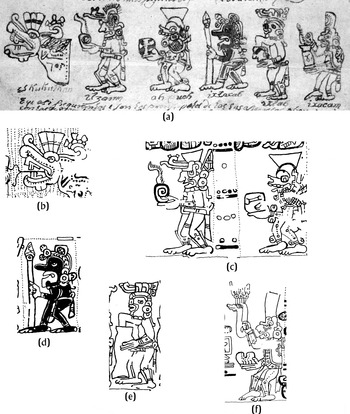
The verso of folio 1 depicts six Maya supernatural beings that include Quetzalcoatl, God A, and God C (Figure 5a). Morley's The Ancient Maya contains a table with major Maya deities (1956:241, Plate 29), but this illustration does not contain all of the supernatural beings shown in the Pintura manuscript. The images are instead very similar to examples in the Madrid Codex:
• Quetzalcoatl is a copy of the feather-crested serpent on Madrid page 17b (Figure 5b); the Madrid Codex contains more serpents in the lower register of pages 12 through 18 but the one on page 17b is the only serpent with this particular combination of feather crest, forked tongue (misdrawn as upper mandible in the Pintura manuscript), and an elaborate back curl; the triangular shape of Quetzalcoatl's body in the Pintura manuscript can be explained by the partial erosion and the position at the edge of the page of the Madrid example;
• God B is likely from Madrid page 82cA (Figure 5c left); the Madrid example has a triangular hat and crossed bands behind the head whereas God B has a mohawk in the Pintura manuscript;
• God A is very similar to an example on Madrid page 82cB with the exception of death eyes that replace his mandible (Figure 5c right); Gods B and A appear in the same Madrid Codex almanac (Figure 5c) and were copied in exactly the same order into the Pintura manuscript;
• The drawing of God M is a faithful copy of the drawing of the god on Madrid page 54bB (Figure 5d);
• God C is taken from Madrid page 74bC, yet his right hand is shown inside a head instead of a jar or drum (Figure 5e);
• God D is possibly a copy of the drawing on Madrid page 106a (Figure 5f); the arm, leg, and body positions are the same; in the Madrid Codex he wears a simple rectangular miter and holds a snake aspergillum in the right and an Imix sign in the left hand; the miter is more elaborate in the Pintura example; God D raises the right fist and holds a feathery jar in the left hand.
The differences between images in the Pintura manuscript and in the Madrid Codex are limited to minor details (especially to the objects held by the deities). Little doubt remains that the Pintura images were copied from the Madrid Codex. Carlos A. Villacorta's drawings of the Madrid Codex are the likely source (published in Villacorta and Villacorta Reference Villacorta and Villacorta1930 and in various installments in the Anales de la Sociedad de Geografía e Historia de Guatemala from issue 8(2) in 1931 through issue 9(4) in 1932). The captions below each image (e.g., ah puch below the image of God A), however, are possibly taken from Morley, since J. Antonio Villacorta used Schellhas's nomenclature to identify the gods.
Depictions of Maya deities and supernaturals: (a) Supernaturals at the bottom of folio 1 verso of the Pintura manuscript; (b) Feather-crested serpent on Madrid page 17b (after Villacorta and Villacorta Reference Villacorta and Villacorta1976:258); (c) God B and God A on Madrid page 82c (after Villacorta and Villacorta Reference Villacorta and Villacorta1976:388); (d) God M on Madrid page 54bB (after Villacorta and Villacorta Reference Villacorta and Villacorta1976:332); (e) God C on Madrid page 74bC (after Villacorta and Villacorta Reference Villacorta and Villacorta1976:372); (f) God D on Madrid page 106a (after Villacorta and Villacorta Reference Villacorta and Villacorta1976:436).

LONG COUNT PERIODS
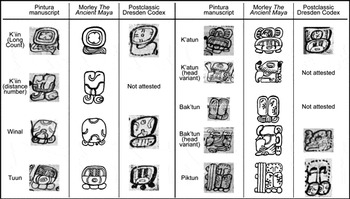
The upper part of folio 3 recto shows the periods of the Long Count (“años de la coenta larga” in Figure 6a) and the text explains how it works. Two problems arise here. The ancient Maya abandoned the Long Count at the end of the first millennium a.d. and it was no longer in use during the Early Colonial period when the Pintura manuscript was allegedly composed. Moreover, Sylvanus G. Morley (Reference Morley1909:553) first coined the term “Long Count” at the beginning of the twentieth century and it was later translated into Spanish as cuenta larga.Footnote 4 Its use in the Pintura manuscript is an anticipatory anachronism.
Depictions of period glyphs: (a) Glyphs from folio 3 recto of the Pintura manuscript; (b) Figure 22 in Morley (Reference Morley and Brainerd1956:238).

The glyph drawings (Figure 6, Table 2) copy examples in Morley's Figure 22 (1956:238) faithfully. Morley's examples are from Classic period carved stone monuments. They differ from the cursive versions on vessels and codices that one would expect to see in the handwritten Pintura manuscript (see also Prem Reference Prem1999:305). The Piktun glyph has two coefficients in the Pintura manuscript (Table 2)—the prefixed number 18 (as it appears in one of Morley's examples) and a superfixed number one. The combination of two coefficients with a Piktun is impossible in Maya writing. The shell-shaped k'iin glyph (T574 in Thompson Reference Thompson1962) forms part of the explanation of the Long Count in the Pintura manuscript (Table 2). This variant is never used in the Long Counts of authentic hieroglyphic inscriptions but appears only in distance numbers (e.g., Coe and Van Stone Reference Coe and Van Stone2001:54; Thompson Reference Thompson1950:167–168 [Shell Variant]). Prem (Reference Prem1999:304–305) identified the same mistake in the Buenaventura manuscript. The forger of the Pintura manuscript copied Morley without understanding the Maya calendar.
Comparison of period glyphs in the Pintura manuscript, in Morley's The Ancient Maya, and in the Dresden Codex (the Morley examples are from Morley Reference Morley and Brainerd1956:238; the Dresden Codex examples [pages 69 and 70] are from Förstemann Reference Förstemann1880; table by Markus Eberl).

CARDINAL DIRECTIONS
At the bottom of folio 3 recto the Pintura manuscript contains the Maya glyphs for the cardinal directions (Figure 7a). These are copies of the glyphs on the frontispiece to Morley Reference Morley and Brainerd1956 (Figure 7b). Shared characteristics include:
• The glyphs for west and east (left and center-left examples in Figures 7a and 7b) include the codex variant of the k'iin glyph as main sign (the glyph interior has four sets of two parallel lines while Classic period variants have V-shaped interior spikes [e.g., Yaxk'iin in Table 1 and K'iin in Table 2]); the ni-suffixes (T116) also have the codex form without parallel interior strokes;
• The glyph for north (center-right in Figures 7a and 7b) has a T1 u-like prefix in the Pintura manuscript and in Morley instead of the T4 NAH prefix (Figure 7c) that occurs in Classic and Postclassic period texts; the same error appears in the Buenaventura manuscript (Prem Reference Prem1999:306, Figure 4);
• The glyph for south (right examples in Figures 7a and 7b) copies the T17 YAX-like main sign from Morley who took it from Postclassic codices; it differs in its tri-lobed shape and the parallel lines flanked by dots from the common Classic variant (T575);
The glyphs for cardinal directions in the Pintura manuscript are faithful copies of Morley's examples. They are also very similar to the corresponding glyphs in the Buenaventura manuscript (Prem Reference Prem1999:306, Figure 4) and link the Pintura manuscript yet again to the Canek group forgeries.
Depictions of cardinal directions: (a) Glyphs from folio 3 recto of the Pintura manuscript; (b) Directional glyphs from the frontispiece of Morley (Reference Morley and Brainerd1956); (c) Typical glyph for “north” (after Coe and Van Stone Reference Coe and Van Stone2001:124).

The Maya glyphs for cardinal directions are absent in the first two English editions of The Ancient Maya (Morley Reference Morley1946, Reference Morley1947a). They appear for the first time in the third English edition (Morley Reference Morley and Brainerd1956) and in the second Spanish edition (Morley Reference Morley, Recinos and Tercero1972). This implies that the Pintura manuscript was forged after 1956. Textual analysis of Canek group manuscript suggested that the forger used a Spanish translation of The Ancient Maya (Prem Reference Prem1999:310). If this is also true for the Pintura manuscript, the forger fabricated it in the 1970s, that is, ten or twenty years after the other manuscripts of the Canek group (Prem Reference Prem1999:310).Footnote 5
A MEMBER OF THE CANEK GROUP OF FORGED MANUSCRIPTS
The text of the Pintura manuscript shares handwriting and stylistic features found in other forged documents of the Canek group. The reference to the coenta larga for “cuenta larga” or Long Count is particularly striking because this term was coined about 350 years after the alleged composition of the manuscript.
The drawings in the Pintura manuscript copy illustrations in the third English or the second Spanish edition of Sylvanus Morley's The Ancient Maya (Morley Reference Morley and Brainerd1956, Reference Morley, Recinos and Tercero1972). In addition, some of these were taken from the Madrid Codex. The only drawings whose source remains unclear are seven glyphs at the bottom of folio 2 verso. They depict symbols that often occur in the skyband.
By plagiarizing different sources, the forger created a stylistically incoherent document. The Tzolk'iin and Haab’ glyphs (Figures 3a and 4a, Table 1) and the period glyphs (Figure 6a, Table 2) have forms that occur on Classic period monumental inscriptions (the only exception is the codex-variant of the Yaxk'iin glyph [Table 1]). Since they were originally carved in stone, they appear out of place in a handwritten document. They are retrospective anachronisms and are absent from contemporaneous Early Colonial period manuscripts (e.g., the Books of Chilam Balam or Diego de Landa's Relación) (Tozzer Reference Tozzer1941:134, 151–166). The glyph for zero (Figures 1 and 3a), supernatural beings (Figure 5a), and the cardinal directions (Figure 7a), on the other hand, are drawn in the Postclassic codex style. The mixture of Classic carved forms and Postclassic drawn forms is implausible for an authentic handwritten document.Footnote 6 In light of this evidence, a full transcription of the text to compare its content was deemed unnecessary. The Pintura manuscript is yet another Canek group forgery.
The Pintura manuscript was available online at UNESCO's World Digital Library from April through August 2009. James H. Billington, a librarian at the Unites States's Library of Congress, proposed the World Digital Library to UNESCO in 2005 and was instrumental in its realization over the past several years (Pfanner Reference Pfanner2009). The World Digital Library aims to expand the volume and variety of cultural content on the Internet and to provide important and culturally significant content about every UNESCO member country for educators, scholars, and general audiences (World Digital Library 2009a). How could the forged Pintura manuscript be included in such a prestigious project? UNESCO outsourced the selection of primary materials to contributing institutions, stating that “[e]ach partner is responsible for the content of its Web site” (World Digital Library 2009c). There was and still is no clear scientific oversight. The goals of the World Digital Library are seriously at risk if forgeries are displayed as genuine testimonies of the world's cultures. Instead of promoting international and intercultural understanding, it misleads a public that trusts UNESCO.
PORTRAIT OF AN UNIDENTIFIED FORGER
The Pintura manuscript is the fifth known forgery of the Canek group. The five manuscripts contain subtle clues regarding the forger (see also Prem Reference Prem1999:310). Their literary qualities (Hanks Reference Hanks1992) point to a skilled writer. The forger used Morley's The Ancient Maya and a limited number of additional Spanish sources that include Recinos's translation of the Popol Vuh (Reference Recinos1947) as well as popular Mexican calendars (discussed in Prem Reference Prem1999:310). He or she was well read but had a poor grasp of the complexities of colonial Maya history and culture. The Pintura manuscript adds the Madrid Codex as additional source that was likely accessed in the form of the Villacorta drawings (Villacorta and Villacorta [Reference Villacorta and Villacorta1930] or issues of the Anales de la Sociedad de Geografía e Historia de Guatemala). In contrast to the other sources, the Madrid Codex is rather specialized and would have required access to an academic library.
Institutions and collectors in Mexico City hold four of the five Canek group documents (see Prem Reference Prem1999:297–298). Two of these (the Pintura and the Buenaventura manuscript) are in the Centro de Estudios de Historia de México. Together with textual references to highland Mexican culture, this suggests that the Canek group forgeries were created in central Mexico.
The Pintura manuscript was fabricated after 1956 and possibly after the publication of the second Spanish edition of The Ancient Maya in 1972. This makes it one of the youngest members of the Canek group. The forger must have been active from the 1950s (starting with Las Memorias de Guerrero) to the 1970s. More faked documents from the same person likely exist (see also Prem Reference Prem1999:297). This includes a codex-like document written on pieces of leather strung together with leather laces that has shown up on the antiquities market at various times.
The following portrait of the unidentified forger can be sketched out: Spanish-speaking and likely living in central Mexico; active during the second half of the twentieth century; well read with access to scholarly resources; a skilled writer with an interest in Maya culture but with a poor understanding of its historical background.
TRIUMPHS AND FRAUDS, TREASURES AND FAKES
Forged documents have been created since the inception of writing (Farrer Reference Farrer1907). The Pintura manuscript is a modern forgery that belongs to the Canek group of faked Maya manuscripts. In the identification of this group of forgeries we have exemplified the use of a holistic approach, which seeks to analyze historical documents from six angles, namely: “pedigree,” physical properties, penmanship, linguistics, content, and sources. It is fundamentally necessary to prove the authenticity of a historical document, especially those with particular claim to historical importance, such as the Pintura manuscript. Institutional context, missing pedigree, peculiar penmanship, and unusual linguistic properties all raised suspicions about the authenticity of the Pintura manuscript. Even in the absence of a physical examination, these elements were compelling in that they also appear similarly in known forgeries and can be traced to specific sources such as Morley's The Ancient Maya and the Madrid Codex.
RESUMEN
A finales de abril del 2009, la Biblioteca Digital Mundial inauguró su página de Internet www.wdl.org. En su colección existía un manuscrito sobre los mayas, cuya supuesta fecha databa de 1548 y lleva como título El modo de cómo hacían la pintura los indígenas (antes disponible en: http://www.wdl.org/en/item/2961). El manuscrito contiene dibujos de números, de períodos de tiempo y de deidades mayas. El análisis detallado demuestra que este manuscrito es una falsificación perteneciente al grupo Canek. Las características de la escritura del manuscrito Pintura y de los demás documentos del grupo Canek son las mismas. Sus dibujos copian ilustraciones de la tercera edición inglesa o de la segunda edición española del libro “La civilización maya” por Sylvanus G. Morley. Otros fueron copiados del Códice de Madrid. Precisamente porque se trataba de una falsificación, no había valido la pena mencionarlo; sin embargo sí fue incluido en la Biblioteca Digital Mundial que “pone a disposición en Internet, de manera gratuita y en formato multilingüe, importantes materiales fundamentales de culturas de todo el mundo” (http://www.wdl.org/es/about/). Las instituciones participantes seleccionan los materiales relevantes sin supervisión científica clara. La inclusión de documentos apócrifos como el manuscrito Pintura socava la importancia y la fiabilidad de este proyecto eminente. El manuscrito Pintura fue quitado de la Biblioteca Digital Mundial en agosto de 2009. Sin embargo, el estudio integral que permitió la identificación del manuscrito como falsificación sigue siendo relevante. Incluye la revisión de procedencia, características físicas, caligrafía, lingüística, contenido y fuentes.
ACKNOWLEDGEMENTS
We are thankful for Victoria R. Bricker's and Harvey Bricker's very helpful advice on content and style. Allen J. Christenson, Robert Carmack, and an anonymous reviewer provided very helpful comments. Julia Martínez Fuentes proofread the Spanish abstract. Jeffrey T. Shenton improved style and orthography. M. Eberl wrote this manuscript in part while he was a post-doctoral fellow in the Department of Anthropology at Tulane University and he would like to thank the Anthropology faculty for their help and advice during this time.