Introduction
The formerly recognized Cladonia section Unciales (Delise) G. Merr. (e.g. Vainio Reference Vainio1887: 235; Ahti Reference Ahti2000; note the corrected author citation; the combination by Merrill Reference Merrill1908: 109 has been overlooked) included species typically defined by characters such as the soon evanescent primary thallus, the absence of podetial squamules and soredia, the presence of a more or less distinct cortex and the cortical substance usnic acid. This acid gives a visible yellowish tint to these species, depending on its concentration. There are over 40 Cladonia species in the world with these features (Ahti Reference Ahti2000).
The status of the section Unciales as a whole has been discussed by a few authors, including Nylander (Reference Nylander1866), Vainio (Reference Vainio1880, Reference Vainio1897), Mattick (Reference Mattick1938, Reference Mattick1940, Reference Mattick1951), Dahl (Reference Dahl1952) and Aasamaa (Reference Aasamaa1961). Vainio (Reference Vainio1897: 98) attempted a preliminary subdivision of the Unciales and distinguished three major lineages: Cladonia divaricata, C. peltasta, and the rest of the group. Choisy (Reference Choisy1928) claimed that, against common belief, C. uncialis (L.) F. H. Wigg. and C. amaurocraea were not closely related. In Mattick’s (Reference Mattick1951) final scheme, the Unciales were placed as a subsection under the section Perviae. Ahti (Reference Ahti1973) recognized the so-called C. boryi group within the Unciales, including the species that develop needle crystals (presumably triterpenoids) on the tips of podetia. Finally, Stenroos et al. (Reference Stenroos, Hyvönen, Myllys, Thell and Ahti2002) presented the first comprehensive phylogeny of the genus Cladonia, based on DNA sequences. Unciales was resolved as a non-monophyletic group, but recognized in the strict sense, many species being placed into other, provisionally recognized and informally named groups. The following species from the Unciales were transferred to other groups of Cladonia: C. capitellata, C. peltastica and C. perforata were placed in the Supergroup Perviae, and C. subchordalis in the Supergroup Cladonia. The Supergroup Crustaceae included most of the taxa of the former section Unciales, but they were placed in several Groups: Group Amaurocraeae, Group Divaricatae, and Group Unciales. Group Unciales was divided into two Subgroups: Subgroup Borya, which included the taxa that Ahti (Reference Ahti1973) assembled in the C. boryi group, and Subgroup Unciales, including our current target species Cladonia uncialis.
Cladonia uncialis itself is morphologically and chemically variable. Typically, its podetia are continuously corticate, yellowish, moderately branched, erect, brown-tipped and spine-like, with a well-developed and fairly smooth cortex (or sometimes with a slightly rough surface). These characters distinguish it from the reindeer lichens (former Cladina), which are its common associates in thick lichen mats on forest floors.
Vainio (Reference Vainio1922) distinguished by morphology as many as six forms of C. uncialis in Finland. Kärenlampi (Reference Kärenlampi1964) and Kärenlampi & Pelkonen (Reference Kärenlampi and Pelkonen1971) examined in detail its various morphological characters, such as the number of branches, the coverage of the podetial surface by algal cells, and the production of conidiomata and apothecia. As a result, two varieties of C. uncialis were distinguished, namely var. uncialis and var. dicraea (Ach.) Räsänen (author citation corrected here). The former variety was characterized by a polytomic branching pattern, a relatively low coverage of algal cells, and its common production of conidiomata and apothecia. The latter variety was described as mainly dichotomous, with a higher coverage of algal cells, and rare production of conidiomata and apothecia. Brodo & Ahti (Reference Brodo and Ahti1996) distinguished several morphotypes among C. uncialis s. lat. These morphs were based on branching patterns, surface structure, and chemical composition.
Today, the two morphotypes mentioned above are better known as subsp. uncialis and subsp. biuncialis (Hoffm.) M. Choisy (e.g. Ahti & Stenroos Reference Ahti and Stenroos2013). The subspecies concept was also suggested by Hawksworth (Reference Hawksworth1973), who studied the variability of C. uncialis in Britain and introduced the combination C. uncialis subsp. dicraea (Ach.) D. Hawksw. Ahti (Reference Ahti1978) noted that subsp. biuncialis is an older name at subspecies level. However, the taxonomic treatment of the subsp. biuncialis has varied. In addition to being distinguished as a subspecies, variety or form (originally as a species, C. biuncialis Hoffm.), it has often not been given any formal status. A chemotype of C. uncialis s. lat. containing hypothamnolic acid was found in Japan. Asahina described it as a different species, C. pseudostellata. However, Brodo & Ahti (Reference Brodo and Ahti1996) considered C. pseudostellata as synonymous with C. uncialis s. lat., since they did not find any correlation between the presence of hypothamnolic acid and morphology. To date, the taxonomic status of C. uncialis and its postulated segregates has not been resolved.
The goals of the present study therefore are: 1) to clarify the status of Cladonia uncialis s. lat. and test if its segregates can be distinguished and possibly warrant a species status, and 2) try to resolve the relationships of the members formerly referred to section Unciales.
Material and Methods
Taxon sampling
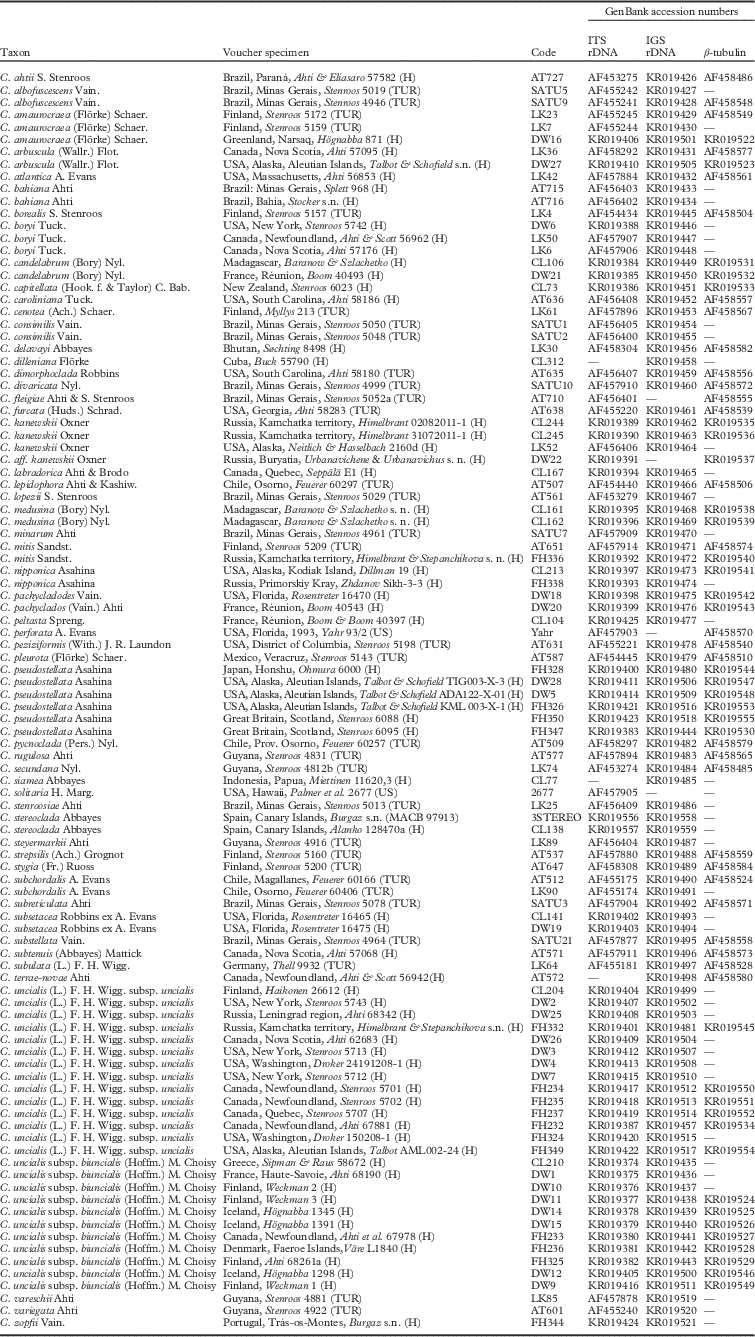
In the present study, 74 samples from 32 species of section Unciales (Ahti Reference Ahti2000) were included (Table 1). Our work emphasizes the circumscription of Cladonia uncialis s. lat. Therefore we included 14 specimens of C. uncialis subsp. uncialis, 11 specimens of C. uncialis subsp. biuncialis, and six specimens of C. pseudostellata. Specimens of other Cladonia groups, representing all the major clades outlined in the previous phylogeny of the genus (Stenroos et al. Reference Stenroos, Hyvönen, Myllys, Thell and Ahti2002), were included in this study: eight specimens of Cladina, three of Cocciferae, six of Divaricatae, three of Miniatae, three of Perviae, and five of Cladonia (Table 1). The taxa related to Unciales members (sensu Stenroos et al. Reference Stenroos, Hyvönen, Myllys, Thell and Ahti2002) were selected. Cladonia furcata was used to root the tree. The collections studied are deposited in the herbarium H (Botanical Museum, University of Helsinki).
List of Cladonia specimens used in this study with voucher information and GenBank accession numbers.

Chemical study
The secondary metabolites of all the samples of C. uncialis subsp. uncialis, C. uncialis subsp. biuncialis, and C. pseudostellata were analyzed using thin-layer chromatography (TLC), in solvents A and B, according to White & James (Reference White and James1985).
DNA extraction, PCR and sequencing
DNA was extracted using DNeasy Blood and Tissue Kit (Qiagen), according to the manufacturer’s protocol. The extracted DNA was eluted in 160 µl of elution buffer included in the kit. Several potential loci (including mtSSU, ef1α, mcm7, ITS rDNA, IGS rDNA, ß-tubulin and other unpublished markers) were tested in a subset of specimens in order to check the variation and the PCR success of each one. On the basis of the preliminary results, we decided to choose ITS rDNA, IGS rDNA and ß-tubulin for the molecular study. The ITS rDNA region was amplified using the primers ITS1F (Gardes & Bruns Reference Gardes and Bruns1993) and ITS4 (White et al. Reference White, Bruns, Lee and Taylor1990) or ITS1-LM (Myllys et al. Reference Myllys, Lohtander, Källersjö and Tehler1999) and ITS2-KL (Lohtander et al. Reference Lohtander, Myllys, Sundin, Källersjö and Tehler1998); the IGS rDNA region using IGSf and IGSr (Wirth et al. Reference Wirth, Printzen and Lumbsch2008); and the ß-tubulin gene using the primer pair Bt3-LM and Bt10-LM (Myllys et al. Reference Myllys, Lohtander and Tehler2001). The amplification programmes were as follows: 95°C for 5 min; 5 cycles of 30 s at 95°C, 30 s at 58°C, 60 s at 72°C; 30 cycles of 30 s at 95°C, 30 s at 56°C, 60 s at 72°C; 7 min at 72°C for ITS rDNA; 95°C for 5 min; 35 cycles of 30 s at 95ºC, 30 s at 54ºC, 60 s at 72ºC; 10 min at 72ºC for IGS rDNA; 95°C for 5 min; 5 cycles of 30 s at 95°C, 30 s at 55 or 56°C, 60 s at 72°C; 30 cycles of 30 s at 95°C, 30 s at 52 or 54°C, 60 s at 72°C; 7 min at 72°C for ß-tubulin. PCR was carried out using Ready-To-Go PCR Beads (GE Healthcare), with 25 µl of final volume, 1 µl of each primer at 10 µM concentration, and 4 or 5 µl of DNA. PCR was performed in PTC-200 Thermal Cyclers (MJ Research) and Mastercycler ep gradient S (Eppendorf). PCR products were purified using illustra GFX PCR DNA and Gel Band Purification Kit (GE Healthcare). Sequencing reactions were carried out at Macrogen Inc. (http://www.macrogen.com).
Phylogenetic analyses
The alignments were assembled using MUSCLE (Robert Reference Robert2004) for each locus separately. The ambiguously aligned regions were manually delimited (13 positions in ITS rDNA and four in IGS rDNA) and excluded from the analyses. Each locus was analyzed by maximum likehood (ML), using RAxML 7.04 (Stamatakis Reference Stamatakis2006), assuming a GTRGAMMA model. The best ML trees were searched using every fifth bootstrap tree as a starting tree (100 independent searches). The nodal support was assessed with 500 bootstrap pseudoreplicates using the rapid bootstrap option. The β-tubulin locus was analyzed using two partition approaches: 1) considering it as a single subset, 2) considering the introns and each codon position from the coding regions as a different subset (in total eight subsets) and analyzed with the same model. The introns were delimited by comparing Cladonia sequences in GenBank (AF458533 and AF458550) with our sequences. The topology of β-tubulin trees obtained with both approaches was the same and we decided to use the whole locus as a single subset in the combined analyses. The clades with bootstrap support >75% were examined to assess the congruence among the loci according to the method of Kauff & Lutzoni (Reference Kauff and Lutzoni2002, Reference Kauff and Lutzoni2003). No strongly supported incongruence was detected among the loci, and the different datasets were therefore combined. In the combined matrix, only those samples were included for which the sequences of at least two loci were available, except for C. nipponica FH338, C. siamea CL77 and C. solitaria 2677. Only IGS rDNA or ITS rDNA sequences were obtained for these samples, but they were included because the species are rare and no fresh material was available. The combined dataset was analyzed by maximun parsimony (MP), ML and Bayesian inference.
The MP analysis was performed in PAUP ver. 4.0.b.10 (Swofford Reference Swofford2003) using heuristic searches with 1000 random taxon-addition replicates, and with TBR branch swapping and the MulTrees option. All the characters were treated as equally weighted and gaps were coded as missing data. The clade support was determined by bootstrap analysis, with 1000 replicates, using the heuristic option. The ML analyses were implemented using RAxML 7.04, considering a partition with three subsets: ITS rDNA, IGS rDNA, and ß-tubulin, assuming a GTRGAMMA model, and using the same options as for single gene analyses. Bayesian analysis was carried out using MrBayes 3.1.2 (Huelsenbeck & Ronquist Reference Huelsenbeck and Ronquist2001). The best-fit evolutionary model for each locus was selected by MrModeltest 2.3 (Nylander Reference Nylander2004) under the AIC criterion. The three models are listed in Table 2. Two simultaneous runs with 10 000 000 generations, each starting with a random tree and employing four simultaneous chains, were executed. Every 1000th tree was saved into a file. The average standard deviation of split frequencies between the runs was below 0·01, indicating convergence of the chains. The first 1 000 000 generations (i.e., the first 1000 trees) were deleted as the ‘burn-in’ of the chain. Cumulative split frequency plot in AWTY (Nylander et al. Reference Nylander, Wilgenbusch, Warren and Swofford2008) was used to determine when the chains reached the stationary stage. The 50% majority-rule consensus tree was calculated using the ‘sumt’ command of MrBayes.
Summary of variation in each locus studied in the Cladonia uncialis phylogeny: alignment length in number of bases (positions), number of variable characters, parsimony informative characters and evolutionary models selected by MrModeltest using AIC criterion.

Tree topology test
The phylogenetic estimates of the concatenated dataset revealed that C. pseudostellata is not monophyletic. In order to dismiss the possibility that this result is an artefact of the phylogenetic analyses, we conducted a Shimodaira-Hasegawa test (SH; Shimodaira & Hasegawa Reference Shimodaira and Hasegawa1999) and used the expected likelihood weight test (ELW; Strimmer & Rambaut Reference Strimmer and Rambaut2002). RAxML 7.04 was used to estimate the maximum likelihood tree consistent with the alternative hypotheses (monophyly of C. pseudostellata, Unciales and Cladina). The topological constraints analyses enforced only the monophyly of the taxa under study (C. pseudostellata, Unciales taxa or Cladina taxa). The SH and ELW tests were run in TREE-PUZZLE 5.2 (Schmidt et al. Reference Schmidt, Strimmer, Vingron and von Haeseler2002), using the GTR+I+G model and with four-category approximation to the gamma distribution for substitution rate among sites. The tests were estimated using 1000 replicates under the RELL method.
Genetic distances
The pairwise distances within and between C. uncialis subsp. uncialis and C. uncialis subsp. biuncialis were calculated in PAUP*, using the K2P model (Kimura Reference Kimura1980) for each locus separately (ITS rDNA, IGS rDNA and β-tubulin). We applied this model as it was used in Pino-Bodas et al. (Reference Pino-Bodas, Martín, Burgaz and Lumbsch2013). To compare the genetic variability between C. uncialis subsp. uncialis and C. uncialis subsp. biuncialis, the mean nucleotide difference within and between taxa was calculated in DnaSP 5.1 (Librado & Rozas Reference Librado and Rozas2009). In addition, the genetic similarity (GD) for each locus was calculated as GD=1−(genetic distance between sample pairs). Histograms of genetic distances and genetic similarity within and between taxa were created for each marker (Fig. 3).
Results
The combined dataset contained 102 sequences and 1819 characters. Table 2 summarizes the variation of the sequences. A total of 186 new sequences were generated for the study. The MP analysis yielded a total of 1000 equally parsimonious trees with 2058 steps, CI=0·5042 and RI=0·7781. The ML analysis yielded a tree with lnL (log likelihood)=−13871·90, while the Bayesian analyses yielded a consensus tree with lnL=−13798·10 (arithmetic mean). All three methods yielded trees with the same topology and only the 50% majority-rule tree from the Bayesian analysis is presented in Fig. 1. The provisional clade names mostly correspond to those presented in Stenroos et al. (Reference Stenroos, Hyvönen, Myllys, Thell and Ahti2002).
Phylogeny of the section Unciales resulting from the Bayesian analysis of the combined dataset of ITS rDNA, IGS rDNA and β-tubulin. 50% consensus majority tree from the Bayesian analysis. The support values ≥70% MP bootstrap, ≥70% ML bootstrap, ≥0·95 posterior probalility of Bayesian analysis appear on the branches. Branches supported in the three analyes (MP, ML & Bayesian) are indicated with thick lines. Grey rectangles show the species of the section Unciales. Black vertical bars indicate the provisional classification of the species according to Stenroos et al. (Reference Stenroos, Hyvönen, Myllys, Thell and Ahti2002).
The section Unciales is non-monophyletic, and most of the species appear in four groups, viz. Amaurocraeae, Borya, Divaricatae and Unciales. Other species from section Unciales fall within Perviae (C. candelabrum, C. capitellata, C. dilleniana, C. medusina, C. pachyclados, C. rugulosa, C. siamea and C. subsetacea), and Cladonia (C. subchordalis); C. delavayi is closely related to Impexae. The SH and ELW tests rejected the monophyly of section Unciales with a P-value of <0·01. Furthermore, the former genus Cladina splits into three entities (Cladinae, Impexae, and Tenues), all of which are nested within the genus Cladonia. The ELW test rejected the monophyly of Cladina (P=0·0464) but it was not rejected by the SH test (P=0·3340). Cladonia uncialis s. lat. appears monophyletic, and can be divided into two well-supported clades.
In all the phylogenetic analyses, C. pseudostellata was resolved as non-monophyletic (Fig. 1). The specimens of this taxon were clustered in the Cladonia uncialis s. lat. clade. The SH and ELW tests rejected the monophyly of C. pseudostellata with a P-value of <0·01 in both tests.
Cladonia uncialis s. lat. contains usnic acid as a major, constant substance. The presence of squamatic acid did not correlate with any of the clades obtained within C. uncialis or its subclades. This compound can be found in subsp. uncialis as well as in subsp. biuncialis (Fig. 2). The six specimens of C. pseudostellata contained usnic and hypothamnolic acids (Fig. 2).
The clade Cladonia uncialis s. lat. from the 50% consensus majority tree of the Bayesian analysis based on the concatenated dataset. The different chemotypes and the specimen localities are indicated for each specimen. HTHA=hypothamnolic acid, SQU=squamatic acid, USN=usnic acid.
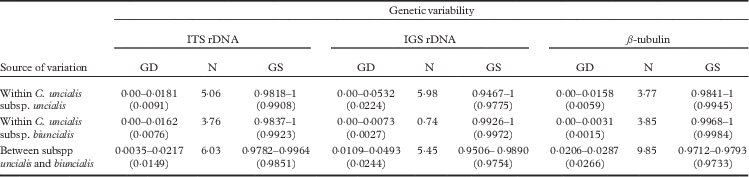
The genetic distances and genetic similarity are shown in Table 3 and Fig. 3. In all the loci, C. uncialis subsp. uncialis had greater variation in the genetic distances and average nucleotide differences than C. uncialis subsp. biuncialis. The locus IGS rDNA showed the highest intra- and inter-clade distance values. Fig. 3 shows the similarity in C. uncialis subsp. uncialis, C. uncialis subsp. biuncialis and between them. In all cases, the similarity was very high (greater than 0·94). The lower values of similarity were obtained in IGS rDNA within C. uncialis subsp. uncialis, and between C. uncialis subsp. uncialis and C. uncialis subsp. biuncialis.
Histograms illustrating variation in genetic distance and genetic similarity in Cladonia uncialis subsp. uncialis ( ), C. uncialis subsp. biuncialis (
 ), and between the subspecies (
 ) A, ITS rDNA; B, IGS rDNA; C, β-tubulin.
Genetic variability between and within C. uncialis subsp. uncialis and C. uncialis subsp. biuncialis for each locus.
GD= ranges of genetic distances; N= average nucleotide differences; GS= ranges of genetic similarities. The mean genetic distances are given in brackets.
Discussion
Phylogenetic reconstructions have enormously changed the classification in several groups of lichenized fungi. Changes are still taking place, even in Cladonia, a conspicuous and fairly well studied genus (for example Ahti Reference Ahti2000; Stenroos et al. Reference Stenroos, Hyvönen, Myllys, Thell and Ahti2002; Burgaz & Ahti Reference Burgaz and Ahti2009; Ahti & Stenroos Reference Ahti and Stenroos2013). Stenroos et al. (Reference Stenroos, Hyvönen, Myllys, Thell and Ahti2002) distinguished three informal Subdivisions within the genus Cladonia. These Subdivisions were further divided into Supergroups, Groups and Subgroups. Some of their Supergroups essentially corresponded with former sections (such as Cladonia, Cocciferae, Perviae, etc.), but in many cases the formal sections were found to be non-monophyletic. Therefore, new groupings were distinguished, but no nomenclaturally accurate names were introduced for them. A new multigene analysis for the Cladoniaceae is currently under preparation, and while waiting for the results, we will not formalize any of the used group names here either.
Most Cladonia clades (Fig. 1) are well supported (with the exception of Divaricatae and Amaurocraeae); nonetheless the phylogenetic relationships among them remain unresolved in this study (Fig. 1). A greater number of taxa will be necessary to clarify this question; we confine ourselves here to discussing the taxa compositions.
According to our results, Unciales includes only C. uncialis s. lat. (C. uncialis is the type species of the formal section). The other species earlier assigned to Unciales are nested in other clades, primarily in Borya, Divaricatae and Amaurocraeae. In addition, quite a few species turned out to belong to Perviae, which includes taxa that have open branch axils and are typically without usnic acid. However, species such as C. capitellata, C. dilleniana, and C. vareschii, all with usnic acid, clearly belong to Perviae. In fact, Ahti (Reference Ahti2000) already noted that some species from Unciales were morphologically similar to Perviae species but had a different chemical composition.
Borya is characterized by the production of needle-like ‘steroid’ crystals in the apical parts of the podetia (except for C. solitaria), and a fibrous skeletal tissue in the medulla (Ahti Reference Ahti1973). Altogether 11 species appear in the Borya clade, confirming the species composition of Borya presented by Ahti (Reference Ahti2000). There might yet be an additional species in the group. Our C. aff. kanewskii DW22 collected from South Siberia, Russia, and which morphologically resembles C. kanewskii, is probably an undescribed species. However, it is a single specimen and its placement is not clear (only supported in the Bayesian analysis). Other than that, we believe that all of the potential Borya species of Cladonia have now been analyzed.
Divaricatae includes species with a spiny appearance. Usnic acid may be present or absent, without a correlation with morphological characters. We included eight species, the same as in Stenroos et al. (Reference Stenroos, Hyvönen, Myllys, Thell and Ahti2002). Divaricatae appears basal to the clade consisting of the red-fruited Cocciferae and Miniatae, as well as Amaurocraeae and Perviae. In the phylogenetic analysis presented by Stenroos et al. (Reference Stenroos, Hyvönen, Myllys, Thell and Ahti2002), this group appeared closely related to Borya, Unciales, and Cladinae. A few more species still await placement (C. crassiuscula, C. ibitipocae, C. spinea, and C. sufflata).
Amaurocraeae is a small, enigmatic group consisting only of C. amaurocraea and the now newly placed C. peltasta. The former species is elongated and slender, and the smoothly corticated podetia are often tipped with scyphi. Cladonia peltasta is also slender, but scyphi are absent and it produces ochraceous apothecia. Both species produce usnic and barbatic acid as secondary metabolites (Huovinen & Ahti Reference Huovinen and Ahti1986a). However, the relationship of C. peltasta with C. amaurocraea is not supported, therefore other relationships cannot be ruled out.
The following species have now been placed using phylogenetic analyses for the first time: C. candelabrum, C. dilleniana, C. medusina, C. pachyclados, C. siamea, and C. subsetacea belong to Perviae in the present analysis; C. peltasta belongs to Amaurocraeae, and C. kanewskii, C. labradorica and C. pachycladodes belong to Borya.
The increase of taxa in future studies will clarify whether other species of the former and widely delimited section Unciales are phylogenetically closely related to C. uncialis or belong to the other segregates of the section. The taxa not yet analyzed are: C. bangii, C. chimantae, C. congesta, C. crassiuscula, C. glabra, C. hokkaidensis, C. ibitipocae, C. papuana, C. recticaulis, C. robusta, C. southlandica, C. spinea, C. sufflata and C. usambarensis.
Taxonomic status of Cladonia uncialis s. lat.
The phylogenetic analyses based on three loci showed that Cladonia uncialis s. lat. is monophyletic. It is divided into two well-supported clades, which correlate with the two previously described subspecies, C. uncialis subsp. uncialis and C. uncialis subsp. biuncialis. In Stenroos et al. (Reference Stenroos, Hyvönen, Myllys, Thell and Ahti2002), the two subspecies were non-monophyletic. However, the present study is based on an increased sampling of three loci, and therefore our results are more robust. Four specimens originally identified as C. pseudostellata (containing hypothamnolic acid, Fig. 2) were referred to C. uncialis subsp. uncialis, and two specimens to C. uncialis subsp. biuncialis. The monophyly of C. pseudostellata was also rejected by the SH and ELW tests. These results agree with the taxonomic proposal of Brodo & Ahti (Reference Brodo and Ahti1996) that C. pseudostellata is a chemotype of C. uncialis, although this suggestion has not been accepted by all lichenologists (e.g., Kurokawa & Kashiwadani Reference Kurokawa and Kashiwadani2006). This chemotype has now also been detected in Scotland, in subsp. biuncialis, and is a new record to Europe.
In the present work, we use genetic distances to discuss what the most appropriate taxonomic rank is for C. uncialis subsp. uncialis and C. uncialis subsp. biuncialis. In the genus Cladonia, the genetic distance variation ranges have been studied for 35 species that belong to the Supergroup Cladonia (sensu Stenroos et al. Reference Stenroos, Hyvönen, Myllys, Thell and Ahti2002; Pino-Bodas et al. Reference Pino-Bodas, Martín, Burgaz and Lumbsch2013). The average values of the intraspecific genetic distances were 0·0094 for the ITS rDNA and 0·0289 for the IGS rDNA. Our results show that the average genetic distance for IGS rDNA between C. uncialis subsp. uncialis and C. uncialis subsp. biuncialis is lower than the average for Cladonia, which could be interpreted as a species including two subspecies. In the ITS rDNA, the average value of the genetic distances between the two clades was higher than the average found by Pino-Bodas et al. (Reference Pino-Bodas, Martín, Burgaz and Lumbsch2013) in Cladonia. However, these authors found monophyletic species with higher values (e.g. C. acuminata, C. cariosa, and C. rei). The ß-tubulin gene has not been used in previous barcoding studies with Cladonia, or other closely related genera of lichenized fungi, and therefore no genetic distance values are available for comparison. However, the three loci showed an overlapping of intra- and inter-clade genetic distances (Table 3, Fig. 3) and the genetic similarity among the taxa is very high. Therefore we consider that the subspecies status is the most appropriate one for our taxa. In addition, the genetic distances of ITS rDNA fell inside the intraspecies threshold (0·015–0·017) for the Parmeliaceae (Del-Prado et al. Reference Del-Prado, Cubas, Lumbsch, Divakar, Blanco, Amo de Paz, Molina and Crespo2010).
The genetic divergence within the clade C. uncialis subsp. uncialis is higher than within the clade C. uncialis subsp. biuncialis for the three loci, particularly in IGS rDNA (Fig. 3, Table 3). This could indicate that the clade C. uncialis subsp. uncialis hides several infraspecific taxa. From a morphological viewpoint, this clade is much more variable than the clade C. uncialis subsp. biuncialis (Fig. 4). A wider sampling is necessary to test this hypothesis. Based on the observations by Ahti (Reference Ahti2000) and J. Lendemer (pers. comm.) on the deviating populations of C. uncialis in the eastern United States (well-developed on Long Island, New York, for example; for description, see Hinds & Hinds Reference Hinds and Hinds2007; Fig. 4F), we expected that the specimens from there would represent a distinct clade. However, though they clustered together, they were not resolved as a distinct group. Therefore, we are not recognizing a taxonomic entity there. These populations need special attention when additional loci are used in future analyses.
Morphological variation of Cladonia uncialis s. lat. A, C. uncialis subsp. biuncialis, Finland (photo: V. Haikonen); B, C. uncialis subsp. biuncialis, C. N. Tavares VIII-51, Portugal; C, C. uncialis subsp. uncialis, Finland; D, C. uncialis subsp. biuncialis, T. Ahti 2603, Canada, Newfoundland; E, C. uncialis subsp. uncialis, T. Ahti 67881, Canada, Newfoundland; F, C. uncialis subsp. uncialis, R. C. Harris 56802, USA, New York; G, C. uncialis subsp. uncialis, G. W. Scotter 8097, Canada, Northwest Territories; H, C. uncialis subsp. uncialis, T. Ahti 39182, Canada, British Columbia; I, C. pseudostellata, S. Talbot & W. B. Schofield KML003-X-1, USA, Alaska. Scales = 1cm. In colour online.
As to secondary chemistry, the yellow pigment usnic acid is constantly present in C. uncialis. Now that C. pseudostellata is included into the species, both subspecies may produce hypothamnolic acid, but as far as is known, only in some coastal areas such as Japan, Alaska (especially Aleutian Islands), and Scotland. In subsp. uncialis, only usnic acid is usually present (Leuckert et al. Reference Leuckert, Bärmann and Schug1971; Carlin Reference Carlin1981; Huovinen & Ahti Reference Huovinen and Ahti1986a; Burgaz & Ahti Reference Burgaz and Ahti2009; Ahti & Stenroos Reference Ahti and Stenroos2013). However, squamatic acid is sometimes present as well, for example in Finland (Fig. 2). The somewhat deviating morph in eastern North America (Ahti Reference Ahti2000: 343), included here in subsp. uncialis, normally contains squamatic acid. On the other hand, subsp. biuncialis almost always produces squamatic acid. Very rarely, small amounts of barbatic acid are perhaps present (Ahti & Stenroos Reference Ahti and Stenroos2013), but the report might be based on confusion with C. amaurocraea which always contains barbatic acid, looks similar, and grows intermixed with C. uncialis.
There are obvious ecological differences between the two subspecies of Cladonia uncialis. In Europe, subsp. biuncialis is characteristic of oceanic, coastal conditions but extends far inland in the Iberian Peninsula (maps in Burgaz & Ahti Reference Burgaz and Ahti2009: 106) and Central Europe (Austria, Czech Republic, Germany, Poland, Slovakia, Switzerland, not reaching Russia beyond the Baltic Sea coast). Outside Europe it is known only from Newfoundland in eastern Canada (and the adjacent French possession St. Pierre & Miquelon), being absent from the Pacific coast. Subsp. uncialis is more continental, and is the only subspecies present within most of the wide, holarctic range of C. uncialis s. lat. (map in Litterski & Ahti Reference Litterski and Ahti2004), although absent or rare right on the coast in Europe (e.g. absent from Iceland).
Although the two taxa are often easily identified morphologically, it is not always so. Kärenlampi & Pelkonen (Reference Kärenlampi and Pelkonen1971) and Ahti & Stenroos (Reference Ahti and Stenroos2013) pointed out that there are seemingly intermediate populations in areas where the subspecies meet, especially in southern Sweden and south-western Finland. Some authors (Coppins Reference Coppins1978; Burgaz & Ahti Reference Burgaz and Ahti2009) have paid attention to the inner surface of the podetial wall, which seems to be pulverulent in subsp. biuncialis and smooth in subsp. uncialis. The reliability of this character has not been tested.
Details of nomenclature and typification of the recognized subspecies
The treatment below includes a new typification and other nomenclatural notes.
Cladonia uncialis subsp. biuncialis (Hoffm.) M. Choisy
Bull. Mens. Soc. Linn. Lyon 20: 9 (Jan 1951).—Cladonia biuncialis Hoffm. Deutschl. Fl. 2: 116 (1796); type: [Germany?], hb. G. F. Hoffmann 8614 (MW-Hoffmann, neotype, designated by Ahti Reference Ahti1978: 9, as ‘lectotype’, corr. by Ahti Reference Ahti1993: 100).
Cladonia uncinata Hoffm., Deutschl. Fl. 2: 116 (1796); type: drawing in Dillenius, Hist. Musc. t. 16, fig. 21B (1742) (lectotype designated here by T. Ahti); sine loco, hb. Dillenius, Hist. Musc. No. 98.21B (OXF, epitype designated here by T. Ahti).
Baeomyces uncialis var. dicraeus Ach., Methodus: 353 (Jan–Apr 1803).—Cladonia uncialis var. dicraea (Ach.) Räsänen, Meddeland. Soc. Fauna Fl. Fenn. 46: 171 (1921) [not Kärenlampi & Pelkonen Reference Kärenlampi and Pelkonen1971: 55].—Cladonia uncialis subsp. dicraea (Ach.) D. Hawksw. in Heywood, Taxonomy and Ecology: 41 (1973); type: Sweden (‘Suecia’) (H-ACH 1625B=H 950273, lectotype, designated by Kärenlampi & Pelkonen Reference Kärenlampi and Pelkonen1971: 55).
Baeomyces aduncus Ach., Methodus: 353 (Jan–Apr 1803), nom. illeg. superfl. for Cladonia uncinata Hoffm.
Cladonia uncialis (L.) F. H. Wigg.
Fl. Holsat.: 90 (29 Mar 1780) subsp. uncialis Lichen uncialis L., Sp. Pl.: 1153 (1 Mai 1753); type (cons.): Sweden, Dalarna, Stora Kopparberg, Rotneby (‘Rottneby prope urbem Fahlun Dalekarliae’), C. Stenhammar in Stenhammar, Lich. Suec. Exs., ed. 2, No. 210 (UPS; isotypes H, MIN).
Cladonia pseudostellata Asahina, J. Jap. Bot. 18: 620 (10 Nov 1942); type: Japan, Hokkaido, Kamikawa Dist. (Prov. Ishikari), Mt. Daisetsu, 1937, Y. Asahina 37016 (TNS, lectotype designated by Ahti Reference Ahti1993: 91; isolectotype US-Evans).
Polyphyly of the old genus Cladina
It has already been shown many times that Cladina (reindeer lichens) do not warrant a generic status but should be included in Cladonia (Hyvönen et al. Reference Hyvönen, Ahti, Stenroos and Gowan1995; Stenroos et al. Reference Stenroos, Ahti and Hyvönen1997, Reference Stenroos, Hyvönen, Myllys, Thell and Ahti2002; DePriest et al. Reference DePriest, Piercey-Normore, Sikaroodi, Kärkkäinen and Oksanen1999; Ahti & DePriest Reference Ahti and DePriest2001). These lichens commonly appeared monophyletic within Cladonia (Stenroos et al. Reference Stenroos, Hyvönen, Myllys, Thell and Ahti2002), but non-monophyly was also demonstrated in some cases (DePriest et al. Reference DePriest, Piercey-Normore, Sikaroodi, Kärkkäinen and Oksanen1999, Reference DePriest, Piercey-Normore, Sikaroodi, Kärkkäinen, Oksanen, Yahr and Ahti2000). Interestingly, as early as in Choisy (Reference Choisy1928), Cladina was treated as non-monophyletic and three different lineages were distinguished. In the present analyses, Cladina is non-monophyletic (but the monophyly of Cladina was rejected only by the ELW test) and is divided into three lineages, referred to here as Impexae, Tenues and Cladinae. They all correspond to the former sections defined by Ahti (Reference Ahti1984, under genus Cladina; see also Huovinen & Ahti Reference Huovinen and Ahti1986b and Ahti Reference Ahti2000). Guo & Kashiwadani (Reference Guo and Kashiwadani2004) obtained a similar result based on ITS rDNA. In their analysis, C. uncialis is placed as sister to either the Tenues or Cladinae, depending on the model used. In our analyses, the phylogenetic relationships between Impexae, Tenues and Cladinae remain unresolved (Fig. 1). The proper placing of these clades will therefore have to wait for a broader sampling.
As stated above, we are using the infrageneric group names informally for the time being. The lineages concur with chemical characters in addition to the branching types.
Impexae, represented here by C. pycnoclada and C. terrae-novae, are typically defined by richly branched, curly thalli and the presence of the depside perlatolic acid. The Himalayan C. delavayi is placed surprisingly close to Impexae. Although it was originally placed in Unciales (also in Huovinen & Ahti Reference Huovinen and Ahti1986a), it is not related to any current segregates of former Unciales. A similar result was obtained by Stenroos et al. (Reference Stenroos, Hyvönen, Myllys, Thell and Ahti2002). This species is, however, different from other Impexae by containing 4-O-methylcryptochlorophaeic and cryptochlorophaeic acids, and having very slender, little branched podetia. In the present analyses, C. delavayi is positioned on a long branch separate from the rest of the Impexae, implying that it is substantially different from the others.
Tenues are represented here by C. stygia and C. subtenuis. A diagnostic character of Tenues was a red pigment in the conidiomata. The inclusion of C. rangiferina in this group (Stenroos et al. Reference Stenroos, Hyvönen, Myllys, Thell and Ahti2002) indicates that the red pigment is not diagnostic after all.
The third lineage of former Cladinae includes C. arbuscula and C. mitis, and is referred to here as Cladinae. Stenroos et al. (Reference Stenroos, Hyvönen, Myllys, Thell and Ahti2002) also showed Cladinae (C. arbuscula and allies) and Tenues (C. subtenuis and allies) as separate clades, although as sister to each other, and due to the overall topology the two clades were differently ranked.
Morphologically, C. arbuscula (Cladinae) as well as C. stygia and C. rangiferina (Tenues) are very similar in branch architecture, although they differ in chemistry and surface structure (Ahti & Stenroos Reference Ahti and Stenroos2013). The traditionally recognized characters, such as branching patterns, presence of cortex, and chemistries may be quite misleading, when related clades are compared. It appears that the former Unciales are spread across the sequence-based phylogenetic tree of the genus Cladonia.
We thank several people who sent us material or discussed various problems with us: R. Droker, D. Himelbrant, J. Lendemer, and S. Talbot. F. Högnabba worked as an adviser for Diana Weckman’s M.Sc. thesis on the subject. This thesis was used as a basis for the present study. The Academy of Finland is cordially acknowledged for financial support to SS (grant 211171). RP-B was funded by a Marie Curie Intra-European Fellowship (PIEF-GA-2013-625653).