Introduction
The constant increase on world population with subsequent demand for food is a challenging task. In this scenario, while capture fisheries remain relatively stable, aquaculture significantly expands, becoming a key point for finfish production (FAO, 2018). The use of sterile triploid fish is then an interesting approach to optimize the somatic growth and increased productivity (Fraser et al., Reference Fraser, Fjelldal, Hansen and Mayer2012; do Nascimento et al., Reference do Nascimento, Pereira-Santos, Piva, Manzini, Fujimoto, Senhorini, Yasui and Nakaghi2017b). Such a strategy is also important to minimize the impact of farmed or exotic fish on natural populations (due to sterility) (Taranger et al., Reference Taranger, Carrillo, Schulz, Fontaine, Zanuy, Felip, Weltzien, Dufour, Karlsen, Norberg, Andersson and Hausen2010). For instance, the introduction of alien (exotic) species is considered the second main cause of threat to native fish in Brazil (ICMBio, 2018), one of the richest ichthyofauna worldwide.
Although promising, the large-scale production of sterile triploid fish still presents bottlenecks. For triploid induction, common procedures are the use of heat or pressure shocks to inhibit the extrusion of the second polar body (Adamov et al., Reference Adamov, Nascimento, Maciel, Pereira-Santos, Senhorini, Calado, Evangelista, Nakaghi, Guerrero and Fujimoto2017). However, these methods may lead to decreased survival, larval abnormalities and may be not 100% effective (Peruzzi et al., Reference Peruzzi, Kettunen, Primicerio and Kaurić2007; Piferrer et al., Reference Piferrer, Beaumont, Falguiere, Flajshans, Haffray and Colombo2009). Therefore, to avoid such problems, a simple alternative is to fertilize oocytes using diploid spermatozoa from tetraploid individuals (Sakao et al., Reference Sakao, Fujimoto, Kimura, Yamaha and Arai2006; Lebeda and Flajshans, Reference Lebeda and Flajshans2015). However, protocols for tetraploid induction are difficult to establish, limited to a few species and generally result in low survival (Yoshikawa et al., Reference Yoshikawa, Morishima, Fujimoto, Arias-Rodriguez, Yamaha and Arai2008; Piferrer et al., Reference Piferrer, Beaumont, Falguiere, Flajshans, Haffray and Colombo2009). In the Neotropical region, studies on the production of tetraploid fish have been restricted to only two species, the silver catfish Rhamdia quelen (Garcia et al., Reference Garcia, Júnior, Yasui, Liebl, Souto and Zaniboni-Filho2018) and the yellowtail tetra Astyanax altiparanae (do Nascimento et al., Reference do Nascimento, Pereira-Santos, Levy-Pereira, Monzani, Niedzielski, Fujimoto, Senhorini, Nakaghi and Yasui2020b).
Among such species, the A. altiparanae has recently been considered a model organism for basic and applied studies (Pereira-Santos et al., Reference Pereira-Santos, Yasui, Xavier, de Macedo Adamov, do Nascimento, Fujimoto, Senhorini and Nakaghi2016; do Nascimento et al., Reference do Nascimento, Lázaro, Alcântara, Senhorini, Santos, Nakaghi and Yasui2018, Reference do Nascimento, Monzani, Pereira-Santos, Niedzielski, Senhorini, Silva, Nakaghi and Yasui2020a; dos Santos et al., Reference dos Santos, do Nascimento, Yasui, Pereira, Fujimoto, Senhorini and Nakaghi2018), especially for chromosome set manipulation, such as induction (Adamov et al., Reference Adamov, Nascimento, Maciel, Pereira-Santos, Senhorini, Calado, Evangelista, Nakaghi, Guerrero and Fujimoto2017; Piva et al., Reference Piva, de Siqueira-Silva, Goes, Fujimoto, Saito, Dragone, Senhorini, Porto-Foresti, Ferraz and Yasui2018) and rearing of triploid fish (Bertolini et al., Reference Bertolini, Senhorini, Nascimento, Pereira-Santos, Nakaghi, Peres, Silva and Yasui2018). Other studies have also shown that triploid females are sterile (do Nascimento et al., Reference do Nascimento, de Siqueira-Silva, Pereira-Santos, Fujimoto, Senhorini, Nakaghi and Yasui2017a) and present increased carcass yield (do Nascimento et al., Reference do Nascimento, Pereira-Santos, Piva, Manzini, Fujimoto, Senhorini, Yasui and Nakaghi2017b). Therefore, we standardized a protocol for tetraploid induction in A. altiparane using heat shock (do Nascimento et al., Reference do Nascimento, Pereira-Santos, Levy-Pereira, Monzani, Niedzielski, Fujimoto, Senhorini, Nakaghi and Yasui2020b). Such study showed that tetraploid males could produce viable and diploid spermatozoa for mass production of triploid fish (100%). However, survival at hatching using the best treatment was just 10% and optimization of the current protocol is therefore necessary.
Four stages are needed for the production of tetraploid fish: (1) fertilization; (2) incubation at physiological temperatures; (3) extreme temperature or pressure shocks to induce tetraploids; and (4) return to incubation at physiological temperature. Most of the previous studies have focused on the evaluation of timing to initiate shock (Zhu et al., Reference Zhu, Lin, Wu, Li and You2017), its intensity (Hartono et al., Reference Hartono, Witoko and Purbosari2016) and duration (Christopher et al., Reference Christopher, Siva and Ezilrani2019). However, it is still unknown how the return temperature may affect the production of tetraploids.
For the yellowtail tetra, the temperature for polyploidization (40ºC) was determined in our previous studies (Adamov et al., Reference Adamov, Nascimento, Maciel, Pereira-Santos, Senhorini, Calado, Evangelista, Nakaghi, Guerrero and Fujimoto2017; do Nascimento et al., Reference do Nascimento, Pereira-Santos, Piva, Manzini, Fujimoto, Senhorini, Yasui and Nakaghi2017b). To induce tetraploids, timing was determined based on cytological observation of pronucleus fusion (Pereira-Santos et al., Reference Pereira-Santos, Yasui, Xavier, de Macedo Adamov, do Nascimento, Fujimoto, Senhorini and Nakaghi2016) and then tetraploids were produced (do Nascimento et al., Reference do Nascimento, Pereira-Santos, Levy-Pereira, Monzani, Niedzielski, Fujimoto, Senhorini, Nakaghi and Yasui2020b). However, the physiological temperature range for this species is 22–30ºC, in which the optimum temperature is at a lower range (22–26 ºC). For this range of temperature, despite the lower optimum temperature, the temperature change returning from heat shock (40ºC) will be high. To our knowledge, this variable has never been tested for tetraploid induction in fish. Therefore, the aim of this study was to evaluated, for the first time, the effect of post-shock temperature on tetraploid induction in A. altiparanae.
Materials and methods
Induced reproduction
Adult males and females of yellowtail tetra Astyanax altiparanae were previously maintained in 1000-m2 earthen ponds. Fish were fed twice a day with commercial diets (45% crude protein and 4200 kcal kg−1). For induced spawning, sexually mature couples of A. altiparanae were selected in accordance with the criteria adopted by Yasui et al. (Reference Yasui, Senhorini, Shimoda, Pereira-Santos, Nakaghi, Fujimoto, Arias-Rodriguez and Silva2015). Females were selected based on morphological traits such as reddish papilla and protuberant ventral region. Males, conversely, were selected by the presence of bony hooks in the anal fin. The selected fish were transported and maintained at 80-L aquaria with constant aeration and water temperature set at 28°C. The animals were then hormonally induced to reproduction using a single injection of pituitary extract at 5 mg kg−1. At 6 h later, the fishes were anaesthetized in Eugenol solution (100 mg L–¹, Êxodo Científica, Hortolândia, Brazil) for gamete collection. Semen was collected using a 1000-µl pipette (Eppendorf, Hamburg, Germany) and immediately transferred to a 1.5-ml macrotube containing 400 µl modified Ringer solution (128.3 mM NaCl, 23.6 mM KCl, 3.6 mM CaCl2, 2.1 mM MgCl2) and maintained refrigerated (4°C) until use. Oocytes were stripped in a 90-mm Petri dish covered with polyvinylidene chloride film (Saran wrap, Alpfilm, São Paulo, Brazil) and immediately used.
Tetraploid induction
Two couples of fish were used for fertilization trials. Oocytes from each female (n = 2) were inseminated using the sperm from different males (n = 2) and the gametes were activated by adding 5 ml distilled water. The fertilized eggs were separated in a floating plastic incubator, in which the bottom was removed and placed a 100-µm nylon mesh. The floating incubator was placed in a 60-L aquarium with the temperature set at 22°C for 24 min. To induce tetraploids, three groups of fertilized eggs were immediately submitted to heat shock at 40°C for 2 min. After heat shock, the egg batches were then returned to three aquaria with temperatures at 22°C, 26°C or 28°C, for 60 min. The control group remained intact at 22°C (also for 60 min). Afterwards, a small aliquot of 100 eggs from each treatment was transferred to 90-mm Petri dishes at room temperature (~26°C) for observation of survival at 2-cell, blastula, gastrula and somite stages, as well hatching and subsequent normal and abnormal larvae (see Pereira-Santos et al., Reference Pereira-Santos, Yasui, Xavier, de Macedo Adamov, do Nascimento, Fujimoto, Senhorini and Nakaghi2016). Embryos were visualized using a stereomicroscope (Nikon SMZ 1500, Tokyo, Japan) and digital images obtained using a charge coupled device (CCD) camera and Nis-Ar Elements software (Nikon, Tokyo, Japan).
Ploidy confirmation
At hatching, 40 larvae from each treatment were selected randomly and evaluated for ploidy confirmation by flow cytometry in accordance with Xavier et al. (Reference Xavier, Senhorini, Pereira-Santos, Fujimoto, Shimoda, Silva, dos Santos and Yasui2017). Briefly, each larva was lysed in 100 µl of detergent solution for enucleation (9.53 mM MgSO4.7H2O, 47.67 mM KCl, 15 mM Tris, 74 mM sucrose, 0.8% Triton X-100) and then the isolated nuclei were stained with 4′,6-diamidino-2-phenylindole dihydrochloride (DAPI; in Dulbecco’s PBS). Relative DNA content was measured with a flow cytometer (CyFlow Ploidy, Analyzer, Partec, GMBh, Munster, Germany). All samples were confirmed for DNA content using spermatozoa from diploid males (1 C) as reference. Data from flow cytometry were used to calculate tetraploid rate (%) and viable tetraploids (% of tetraploid fish × % of normal larvae).
Statistics
Results are shown as mean ± standard error (SE). Data were submitted to analysis of variance (ANOVA) followed by Tukey test (5%) using STATISTICA software (v.10.0, Statsoft, Tulsa, USA).
Results
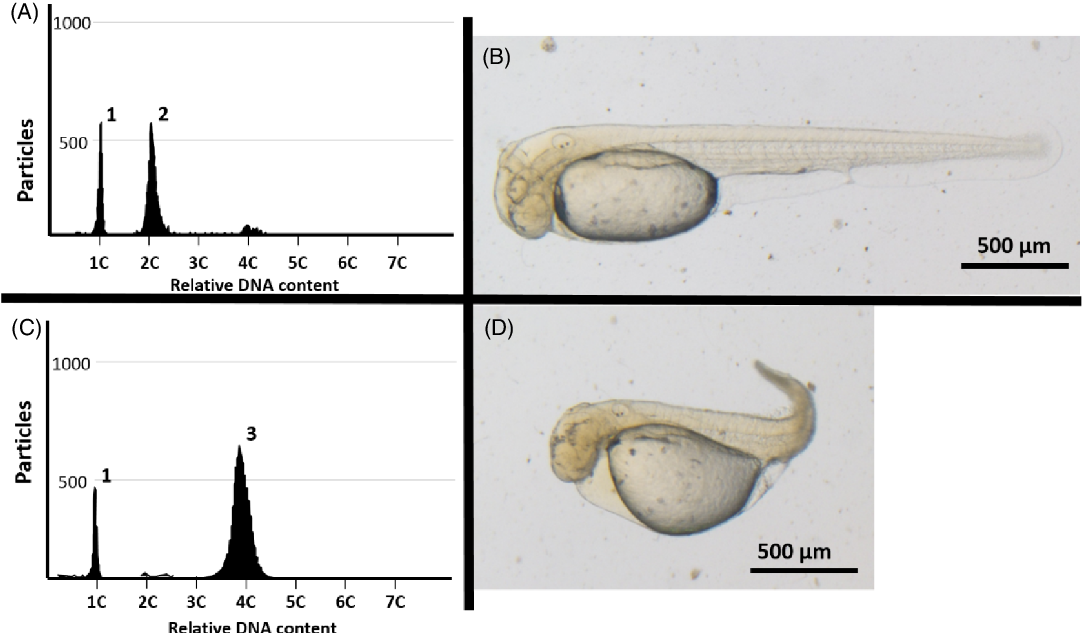
Survival during development is detailed in Table 1. No differences among treatments were observed in fish for 2-cell (P = 0.9539), blastula (P = 0.9541), gastrula (P = 0.7943), somite (P = 0.4872) and hatching (P = 0.6431) stages. For hatched embryos, heat shock increased the percentage of abnormal larvae (Fig. 1B, D) (Table 1) compared with the control (2.46 ± 0.07%; P = 0.0421).
Survival (%) of yellowtail tetra Astyanax altiparanae (±SE) after different post-shock temperatures for tetraploid induction

a,b Distinct superscript letters within a column indicate statistical differences by Tukey multiple range test (ANOVA; P < 0.05). SE, standard error.
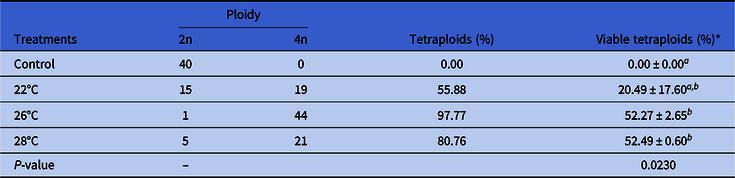
Ploidy status of Astyanax altiparanae larvae after different post-shock temperatures for tetraploid induction

a,b Distinct superscript letters denote statistical differences by the Tukey test (ANOVA, P < 0.05).
*Viable tetraploids = % hatching × % normal larvae.
Relative DNA content of a diploid (A) and tetraploid (C) Astyanax altiparanae. Normal diploid (B) and abnormal tetraploid larvae (D). 1, Spermatozoa (haploid); 2, control (diploid); 3: tetraploid.

Data from flow cytometry (Fig. 1A, C) showed that higher percentages of tetraploids were observed for post-shock at 26°C (99.77%) and lower at 22°C (55.88%,) compared with the control, in which no tetraploids were detected. The number of viable tetraploids, conversely, was significantly lower at 22°C (P = 0.0421), with no difference between 26°C and 28°C (Table 2).
Discussion
The procedures used in this study were based on do Nascimento et al. (Reference do Nascimento, Pereira-Santos, Levy-Pereira, Monzani, Niedzielski, Fujimoto, Senhorini, Nakaghi and Yasui2020b), who used heat shock (40°C for 2 min) for tetraploid induction in Astyanax altiparanae. In addition, the authors used pre-shock and post-shock temperatures of 22° and 26°C, respectively, and no other post-shock temperatures were evaluated. Therefore this study showed, for the first time, that this variable could affect the production of tetraploid in fish.
After heat shock, lower survival rates were observed for all treatments, which was expected and described in other studies (Piferrer et al., Reference Piferrer, Beaumont, Falguiere, Flajshans, Haffray and Colombo2009; do Nascimento et al., Reference do Nascimento, Pereira-Santos, Levy-Pereira, Monzani, Niedzielski, Fujimoto, Senhorini, Nakaghi and Yasui2020b). Several factors have been described to explain lower survival in tetraploids, including genetic factors such as mosaicism, aneuploidy, asynchronous development or high homozygosity (Zhang and Onozato, Reference Zhang and Onozato2004; Fujimoto et al., Reference Fujimoto, Sakao, Oshima, Yamaha and Arai2013) and also physiological or developmental problems caused by extreme conditions such as the temperatures or the high pressures used for tetraploidization. As described in Hartami et al. (Reference Hartami, Carman, Zairin and Alimuddin2018), increased abnormalities in treated embryos were related to heat shock due to damage of the embryonic membrane.
Surprisingly, lower percentages of tetraploids were observed with a post-shock temperature at 22°C, which is a suitable temperature to incubate A. altiparanae embryos (Pereira-Santos et al., Reference Pereira-Santos, Yasui, Xavier, de Macedo Adamov, do Nascimento, Fujimoto, Senhorini and Nakaghi2016). These results are probably related to the higher change in temperature from heat (40ºC) to 22°C (a change of 18°C). Several studies have shown that temperature significantly affects the rate of development in fish (Ninhaus-Silveira et al., Reference Ninhaus-Silveira, Foresti and de Azevedo2006; Pereira-Santos et al., Reference Pereira-Santos, Yasui, Xavier, de Macedo Adamov, do Nascimento, Fujimoto, Senhorini and Nakaghi2016). For A. altiparanae, at 30°C and 22°C, hatching occurred approximately after 11 and 25 h, respectively (Pereira-Santos et al., Reference Pereira-Santos, Yasui, Xavier, de Macedo Adamov, do Nascimento, Fujimoto, Senhorini and Nakaghi2016).
Adamov et al. (Reference Adamov, Nascimento, Maciel, Pereira-Santos, Senhorini, Calado, Evangelista, Nakaghi, Guerrero and Fujimoto2017) showed that the optimum temperature for triploid induction was 40°C; however, temperatures of 38°C and 42°C resulted in lower rates of triploids and decreased survival, respectively. Therefore only a 2°C difference for heat shock significantly affected the results. Hartono et al. (Reference Hartono, Witoko and Purbosari2016) also stated that in Pangasius hypophthalmus differences of only 1°C for heat shock significantly influenced yields (%) of triploids.
Consequently, it is expected that other variables, such as pre-shock and post-shock can also affect the survival and success of polyploidization in fish. As described by Diaz et al. (Reference Diaz, Iturra, Veloso, Estay and Colihueque1993), pre-shock and post-shock temperatures are essential for triploid induction in rainbow trout (Oncorhynchus mykiss) and an increased thermal amplitude resulted in a higher percentage of triploids. Therefore, our data indicated that it is possible to optimize tetraploid induction in A. altiparanae, by increasing survival and yield of polyploids. Additionally, as protocols for tetraploid induction are scarce and difficult to perform (Yoshikawa et al., Reference Yoshikawa, Morishima, Fujimoto, Arias-Rodriguez, Yamaha and Arai2008; Piferrer et al., Reference Piferrer, Beaumont, Falguiere, Flajshans, Haffray and Colombo2009), such optimizations are essential.
In conclusion, we showed that post-shock temperatures affected the production of tetraploids in A. altiparanae. Those data are innovative and could be used in future basic and applied studies for this and other correlated species.
Acknowledgements
We acknowledge CEPTA/ICMBio for kindly providing the facilities and experimental fish.
Financial support
The authors are grateful to the São Paulo Research Foundation (FAPESP) for financial support of this research (Young Investigators Award Grant #2010/17429-1; Young Researcher Scholarship #2011/11664-1 and the PhD Scholarship #2016/12383-0) and CNPq #471140/2012-0.
Conflict of interest
None.
Ethics
This study was performed in accordance with the Care and Use of Laboratory Animals of the National Research and Conservation of Continental Fish (CEUA/CEPTA#0231.000070/2018-63).