Introduction
Of Canadians who retire, 27 per cent retire involuntarily (Schellenberg & Silver, Reference Schellenberg and Silver2004), and illness or disability is the number one reason for involuntary retirement in Canada (Statistics Canada, 1997). Persons with a disability have a much higher rate of involuntary retirement than the general population. Of those who retired during the 2001–2006 period, 39 per cent retired from the labour force involuntarily (Denton, Plenderleith, & Chowhan, Reference Denton, Plenderleith and Chowhan2010a). Their higher rate of involuntary retirement means that many persons with disabilities are excluded, prematurely, from the labour market. Very little research has focused on factors associated with involuntary retirement, and only one study in Canada has focused on involuntary retirement for persons with disabilities.
The voluntary nature of retirement refers to retirees’ perception of whether the retirement was voluntary or not. Most research on retirement assumes that individuals are active, purposeful agents in planning their retirement. However, when retirement is involuntary in the face of a change in health, corporate downsizing, or mandatory retirement, then individuals have very little control or choice over the timing of their retirement. Retirement is voluntary when individuals perceive that they have control over the decision. For example, some disabled workers may perceive their retirement was voluntary because they, rather than their employers, initiated it, whereas those who had to leave because of a change in health or because of job loss may feel the retirement was involuntary. Thus, the costs of remaining in the labour force, especially when the costs arise from situations beyond the individual’s control, can lead to perceptions of involuntary retirement even when the individual had the choice to remain employed (Szinovacz & Davey, Reference Szinovacz and Davey2005). The relationship between health and involuntary retirement is well-established in the literature. Disability is not a measure of health, but it is often omitted from analyses or considered together with health as a reason for involuntary retirement (Morissette, Schellenberg, & Silver, Reference Morissette, Schellenberg and Silver2004; Schellenberg & Silver, Reference Schellenberg and Silver2004).
This article contributes to knowledge through an analysis of the factors associated with the perception of involuntary retirement in Canada, for adults aged 45–74 with disabilities. In particular, we consider the association between no choice and the perception of involuntary retirement, and we distinguish between the effects of health at the time of retirement and disability characteristics as factors associated with involuntary retirement for persons with a disability.
Literature Review
The literature review examines existing research on labour force participation, early retirement, and involuntary retirement to develop a conceptual model to guide the study of factors associated with the type of retirement for adults with disabilities. It focuses on the Canadian case but also includes international literature and research where appropriate. While early retirement may be voluntary or involuntary, illness and disability are among the primary reasons for early retirement. Therefore, a review of the early retirement literature may shed light on factors that may be associated with involuntary retirement for persons with a disability.
The literature on retirement for health and disability reasons is limited; the focus of research has been on the impact of health and disability on labour force participation. Study after study has demonstrated a consistent negative employment effect for factors such as self-perceived health, activity limitation, functional health, chronic disease, type of disability, the severity of the disability, and the age of onset, which are all-important determinants of labour force participation (Baldwin & Johnson, Reference Baldwin and Johnson1994, Reference Baldwin and Johnson1995, Reference Baldwin and Johnson2001; Jones, Reference Jones2008; Kidd, Sloane, & Ferko, Reference Kidd, Sloane and Ferko2000; McGarry, Reference McGarry2004; Mein et al., Reference Mein, Martikainen, Stansfeld, Brunner, Fuhrer and Marmot2000; Pelkowski & Berger, Reference Pelkowski and Berger2004; Yelin & Trupin, Reference Yelin and Trupin2003).
The literature on factors associated with early retirement is more limited, particularly for studies focusing on health as a determinant of early retirement. Studies show that poor health or a change in health is a risk for or pathway to early retirement. A number of studies have investigated the dynamic effects of health on the labour force participation and transitions of older workers using the United States (U.S.) longitudinal Health and Retirement Survey (HRS). Bound, Schoenbaum, Stinebrickner, and Waidmann (Reference Bound, Schoenbaum, Stinebrickner and Waidmann1999) found that it was not just poor health but “health shocks” or declines in health that help explain early retirement behaviour. Dwyer and Mitchell (Reference Dwyer and Mitchell1999) used both self-rated health and objective measures of health from the HRS to show that the likelihood of retirement was greatest for chronic health conditions such as functional limitations and circulatory disorders. Using longitudinal data from the U.S.-based Panel Study of Income Dynamics, McDonough and Amick (2001) found evidence that the hazard of labour market exit in the context of perceived ill-health was dependent on gender and education.
Studies from the United Kingdom and Europe have also confirmed the impact of health on early retirement. Using longitudinal data from the Whitehall II study, Mein et al. (Reference Mein, Martikainen, Stansfeld, Brunner, Fuhrer and Marmot2000) demonstrated that self-perceived health is a predictor of early retirement. Disney, Emmerson, and Wakefield (Reference Disney, Emmerson and Wakefield2004), using the British Household Panel Survey, confirmed that it is the deterioration in self-reported health that is associated with the transition into non-employment. Schuring, Burdorf, Kunst, and Mackenbach (Reference Schuring, Burdorf, Kunst and Mackenbach2009) used five waves of the European Community Household Panel to show that, among participants aged 55 years and older, those with poor health (as measured by perceived poor health and a chronic health problem) had a higher chance than those in good health of retiring the next year. Being married reduced the likelihood of retirement, and those with poor health who had higher levels of education were less likely to retire.
A recent Canadian study showed that one third of recent retirees left employment for health reasons (Morissette et al., Reference Morissette, Schellenberg and Silver2004). In an analysis of the 2003 Canadian Community Health Survey, Pyper (2006) found that while retirement was the reason given most often by Canadians aged 50–69 as their reason for not working, nearly half a million retired Canadians were not working for health-related reasons. Interestingly, the proportion not working for health-related reasons decreased with age from 41 per cent for those aged 50–54 to 6 per cent for those aged 65–69. Among those not working because of their health, about half had mobility limitations, and they were much more likely to have severe activity limitations (Williams, Reference Williams2006).
Studies on Voluntary and Involuntary Retirement
A review of the literature revealed four studies that focused on involuntary or forced retirement. McDonald, Donahue, and Marshall (Reference McDonald, Donahue, Marshall, Spencer and Denton2000) used a human capital theory approach to identify factors associated with involuntary retirement in Canada. In an analysis of the Canadian Survey of Persons Not in the Labour Force, the authors compared persons aged 45–69 who retired unexpectedly early and those who retired when they expected to, and estimated a model predicting planned retirement. They found that nearly half of the participants stated that they had retired earlier than planned. Compared to persons aged 66–69, those aged 45–54 were most likely to experience higher rates of unplanned retirement, followed by those aged 55–64. Both men and women working in the non-market service industry were less likely to experience unplanned retirement compared to those working in traditional services (such as retail trade and personal services). However, other factors associated with unplanned retirement differed by gender. For men, previously working in the goods-producing sector as opposed to working in the traditional services sector, and having experienced a longer period of unemployment, increased the likelihood of unplanned retirement. For women, marriage and having a smaller family reduced the likelihood of unplanned retirement. Also, women previously employed in goods and producing services were less likely to experience unplanned retirement compared with those working in traditional services. Lastly, part-time work also increased the likelihood of unplanned retirement for women.
Shultz, Morton, and Weckerle (Reference Shultz, Morton and Weckerle1998) utilized a push-pull economic model of retirement to consider two sets of factors to explain the retirement decision. Push factors that induce workers to retire are negative considerations, such as poor health or dislike of one’s job. Pull factors for early retirement are typically positive such as the desire to pursue leisure interests or volunteer opportunities or financial security through retirement savings and pension benefits (Shultz et al., Reference Shultz, Morton and Weckerle1998). Some factors such as early retirement schemes or mandatory retirement can be either push or pull factors depending on how the individual perceives them.
Motivation to retire will be high if benefits (e.g., expected pensions, time for leisure or family activities, decreased job stress) outweigh the costs of retirement (e.g., loss of time with co-workers, loss of benefits, and loss of sense of work-related accomplishment). Shultz et al. (Reference Shultz, Morton and Weckerle1998), using one wave of the HRS study, reported finding that different push and pull factors distinguished voluntary from involuntary early retirees. In particular, for those who retired involuntarily, the negative push factor of poor health was most influential to their decision to retire, while the voluntary group were more attracted by the positive pull factors of the desire to “do other things” or no need to work based on adequate finances. For those who retired voluntarily, the desire to relax or spend time with their spouse was important. In contrast, for those whose retirement was involuntary, spending time with their spouse and financial concerns were not as important as their health. Shultz et al. also reported that the voluntary retirees were more educated, had higher incomes, and were more likely to be retired from managerial and professional occupations.
The life course perspective provides an important lens for studying involuntary retirement decisions because it incorporates human agency into the model, and in particular, it considers individual choice. Using a life course perspective and a sample from the U.S. Health and Retirement Study, Szinovacz and Davey (2005) considered predictors of type of retirement such as no-choice factors (i.e., health and job disruption), work context, retirement context, timing of retirement, care obligations, human capital factors, and demographic background factors. They found that nearly one third of older workers perceived their retirement as forced or involuntary. The two most important reasons for involuntary retirement were job displacement and health/disability. Care obligations also predicted forced retirement, but to a lesser extent. They did not find that work context played a significant role in the perception of forced retirement. In terms of retirement timing, older workers retiring earlier than expected were more than twice as likely as on-time retirees to perceive their retirement as forced – demonstrating that lack of control over the retirement transition leads to a perception of involuntary retirement.
In terms of benefits, having a pension (for men) and having health insurance led to perceptions that retirement was voluntary. In terms of demographic background, human capital, and financial characteristics, non-married Americans, those with children, and those with financial assets were less likely to perceive their retirement as forced. Szinovacz and Davey (Reference Szinovacz and Davey2005) also found gender differences in the factors that predict perceived involuntary retirement. Men who remarried and men having financial dependents were less likely to perceive retirement as forced. Married women with an employed partner were more likely to view their retirement as forced, confirming research that shows that couples prefer joint retirement and that separate retirement of spouses can often be attributed to adverse circumstances (Szinovacz, Reference Szinovacz, Adams and Beehr2003). Furthermore, women whose marriages had ended were much more likely to view their retirement as forced.
Denton, Plenderleith, and Chowhan (Reference Denton, Plenderleith and Chowhan2010a, Reference Denton, Plenderleith, Chowhan, Mayer and Denmark2010b) investigated key factors associated with the retirement decisions of people with disabilities between ages 15–74, using the 2006 Statistics Canada Participation and Activity Limitation Survey. A tabular analysis showed that voluntary and involuntary retirement for people with disabilities were differentially associated with socio-demographic, socioeconomic, and geographic characteristics (such as age, education, home ownership, income, and region of residence). Fair or poor health at the time of retirement, later age of disability onset, severe or very severe disabilities, and multiple disabilities were also associated with the type of retirement. Some types of disability put people at greater risk of involuntary retirement than other types; persons with communication, memory, learning, and psychological limitations were most at risk of involuntary retirement. In addition, their analysis considered the relationship of choice or control over the decision to retire. They found that those who retired due to their condition, either completely or partially, were much more likely to report involuntary retirement.
Our review did not reveal any literature that investigated the separate and independent effects of health and disability on the retirement decision. Consequently, the aim of this article is to distinguish the effects of health and disability on involuntary retirement in Canada. It also considers the role that choice plays in the perception of involuntary retirement for persons with disabilities.
Conceptual Model
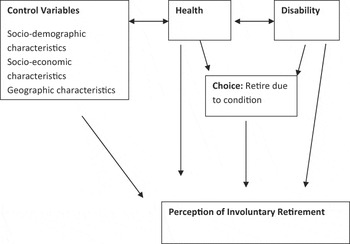
Following Szinovacz and Davey (Reference Szinovacz and Davey2005), we used a life course perspective to propose a conceptual model of the predictors of involuntary or forced retirement using data from the Canadian 2006 Participation and Activities Survey. As already noted, the life course perspective provides an insightful lens for studying the retirement decisions of people with disabilities because it considers human agency or choice in the model. In Figure 1, we distinguish the influence of subjective health at the time of retirement and disability characteristics (measured by age of onset, severity of the disability, and type of limitation).
Conceptual model of predictors of perceptions of involuntary retirement

Researchers recognize that there may be socio-demographic and productivity differences between disabled and non-disabled workers that might magnify the impact of “health effects” on employment outcomes (Baldwin & Johnson, Reference Baldwin and Johnson2001; Smith & Twomey, Reference Smith and Twomey2002). Differences in socio-demographic characteristics (i.e., gender, age, marital status), socioeconomic characteristics (i.e., education, work experience, economic incentives – namely, wages), and regional effects (Jenkins & Rigg, 2003; Jones, Latreille, & Sloane, Reference Jones, Latreille and Sloane2003) also impact the employment outcomes of the disabled. The model incorporates factors identified in the literature review as determinants of early retirement as control variables. On the basis of this model, we hypothesize that (1) health and disability have separate and independent effects on the perception of involuntary retirement, and (2) having no control over the decision to retire is associated with the perception of involuntary retirement.
Methodology
The 2006 Participation and Activity Limitations Survey (PALS) data were used for the analysis. PALS is a post-censal national survey that collects information on adults and children who have a disability. Access to the PALS data is available through the Statistics Canada Research Data Centres (RDCs).
In the PALS, the definition of disability uses the bio-psychosocial framework from the World Health Organization in which
Disabilities is an umbrella term, covering impairments, activity limitations, and participation restrictions. An impairment is a problem in body function or structure; an activity limitation is a difficulty encountered by an individual in executing a task or action; while a participation restriction is a problem experienced by an individual in involvement in life situations (World Health Organization, 2013).
Disability is, therefore, not defined merely as being the direct result of a health problem or any physical or mental limitation but, rather, occurs when a person experiences activity limitations and restrictions in participation. Statistics Canada uses this definition in selecting participants to the PALS survey.
The PALS sampling plan can be considered as having a two-stage stratified design. The 2006 Census long-form sample was used as the sampling frame. The filter question used on the 2006 Census to identify people with a disability who were subsequently included in the PALS asked about (1) difficulties with daily living activities, or (2) physical or mental conditions or a health problem that reduced the kind or amount of activities that they can do (Statistics Canada, 2007). The 2006 PALS selected a sample of individuals from respondents on the census long form who reported a positive response to at least one of these two filter questions. These respondents are “individuals with disabilities” according to the census. PALS repeats the filter questions on the long-form census, and if respondents answer no when interviewed by PALS, they go through a sizable module in the PALS survey investigating why the answers were different to filter out the false positive answers. Statistics Canada uses the information on the two filter questions in PALS to derive a variable to indicate if the respondent had a limitation, and this is the sample of persons with disabilities used for this analysis. PALS may be interpreted as providing a conservative estimate of the population with disabilities, but a significantly better estimate than that provided by the census (correspondence from Human Resources Skills Development Canada , 17 March 2010).
The sample selected for analysis from PALS included persons with disabilities who were aged 45–74 who had retired either voluntarily or involuntarily from the labour force during the period 2001 to 2006 (sample size: 716).1 The retirement questions were asked of people aged 15–74 who had retired within this period. Furthermore, the sample was selected so that disability onset occurred before the age of 65. The sample was weighted using sample weights derived by Statistics Canada so that it was representative of the Canadian population, although respondents from the far north were excluded due to small sample size.
To measure voluntary/involuntary retirement, PALS asked respondents who were permanently retired, “Was this retirement voluntary?” Retirement was considered to be involuntary if the respondent answered no to this question. Involuntary retirement was coded as 1 and voluntary retirement as 0. Based on the literature review, the theoretical perspectives on retirement, and the information available in PALS, we selected several socio-demographic, geographic, socioeconomic, health and disability characteristics for the analysis. Socio-demographic characteristics included gender, marital status, immigration status and education. Geographic characteristics were measured by region, urban/rural residence, and home ownership. Since PALS is a cross-sectional survey, socioeconomic information on work context was retrospective. It included employment status prior to retirement (full- versus part-time) and employment compensation (wages, salary, or commission versus self-employed). Unfortunately, Statistics Canada did not code or include in the data file the occupation or industry of the respondent’s last job, although the question was asked.
Several retrospective characteristics were included that relate to disability or health status at the point of retirement including self-perceived health, age of onset, and whether the respondent permanently retired due to their condition. The type of limitation (hearing, seeing, communication, mobility, agility, pain, learning, memory, psychological/emotional) and the degree of severity of the disability refer to the respondents’ current disability status, but may also be descriptive of their disability status at the time of retirement, and so we included them here. Type of retirement was coded as a dichotomous variable with 1 = involuntary retirement and 0 = voluntary retirement. Similarly, gender, immigration status, urban/rural residence, home ownership, employment status, and employment compensation were all measured as dichotomous variables. Education, region, self-perceived health at retirement, the age of onset and degree of severity of disability, and whether the respondent permanently retired due to their condition were measured as categorical variables. For a detailed description of the variables and questions used to derive variables, see Appendix A in Denton et al. (Reference Denton, Plenderleith and Chowhan2010a).
Analysis
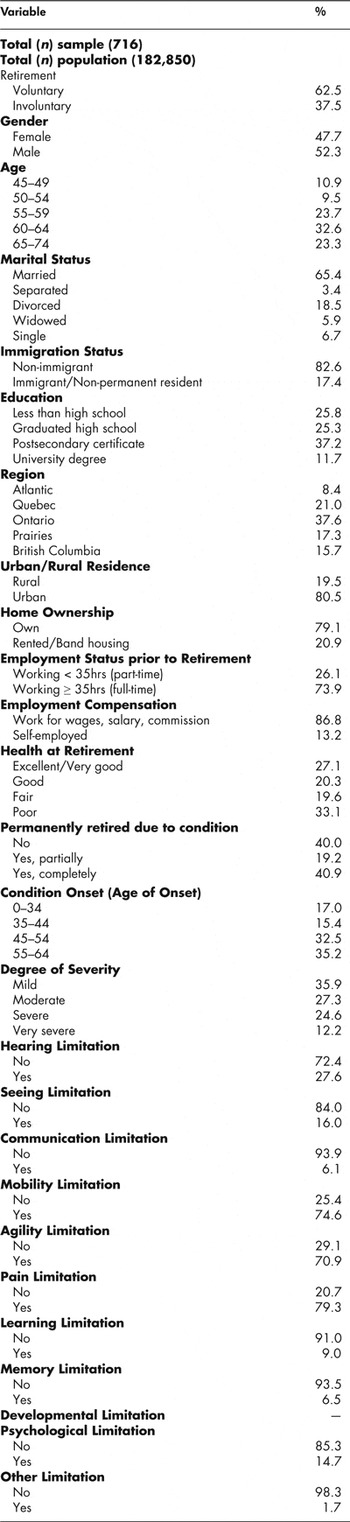
In step 1 of the analysis, the characteristics of this sample of retired persons with disabilities were described. Table 1 presents the percentages for the socio-demographic, socioeconomic, geographic, health, and disability characteristics of persons with disabilities.
Socio-demographic, socioeconomic, and health characteristics of persons with disabilities who retired from the labour force in the years 2001–2006, ages 45–74

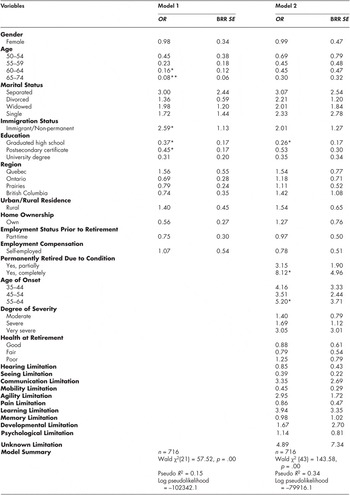
Step 2 considered the association of socio-demographic and socioeconomic characteristics with involuntary retirement (as opposed to voluntary retirement) through a multivariate logistic regression analysis. Sample weights were used to adjust for the different probabilities of selection of respondents into the sample, and bootstrap weights were used to adjust for any downward bias in the standard errors that might have been due to the complex survey design. StataCorp’s Stata 12 statistical software was used for the all analyses, and the svy commands were used to include the sample and bootstrap weights. Listwise deletion of missing data was utilized. The multivariate logistic analyses show the relationship of each of the possible determinants of involuntary retirement when other determinants are controlled or held constant (see Table 2, model 1). Results are shown as odds ratios.
Multivariate logistic regression and involuntary retirement by socio-demographic, socioeconomic, and health characteristics of persons with disabilities, ages 45–74a

a Reference Categories are male, ages 45–49, married, non-immigrant, less than high school, Atlantic province, urban, rental/band housing, employed full-time, employee (i.e., earning wages, salary, or commission), did not retire due to condition, age of onset 0–34), mild severity, excellent/very good health at time of retirement, and no specific limitation.
BRR = balanced repeated replication
OR = odds ratio
SE = standard error
*p < .05; ** p < .01;
Source: Statistics Canada, 2006 Participation and Activity Limitations Survey
Researchers recognize that there may be socio-demographic and productivity differences between disabled and non-disabled workers that may magnify the “health effects” on employment outcomes (Baldwin & Johnson, Reference Baldwin and Johnson2001; Smith & Twomey, Reference Smith and Twomey2002). Differences in socio-demographic characteristics (i.e., gender, age, marital status), human capital characteristics (i.e., education, work experience), economic incentives (i.e., wages), and regional effects (Jenkins & Rigg, 2003; Jones, Latreille, & Sloane, Reference Jones, Latreille and Sloane2003) also affect the employment outcomes of the disabled. When these differences are controlled, about half of the difference in labour market outcomes is explained (Blackaby et al., Reference Blackaby, Clark, Drinkwater, Leslie, Murphy and O’Leary1999; Madden, Reference Madden2004).
Step 3 in the analysis used a logistic regression analysis to consider the impact of health and disability characteristics on involuntary retirement when the socio-demographic, socioeconomic, and geographic characteristics were controlled (see Table 2, model 2).
The analysis also included a collinearity investigation. The full correlation matrix that includes all variables in the full model is not releasable due to low cell counts (from the Statistics Canada Research Data Centres Program where the analyses were conducted). Nonetheless, we have reviewed the correlation matrix and found that none of the pairings has a value greater than approximately .52 and that most of the correlations in the matrix were between 0 and .30, with only a minority of pairings being in the .30 to .50 range. We ran the variance inflation factors (VIFs) following ordinary least squares regressions using identically specified models as the logit regression (i.e., the VIF option is not permitted for the logit command). An examination of these VIF values lead us to the conclusion that the analysis does not have collinearity problems.
Results
The analysis of the 2006 PALS has shown that Canadians with a disability have a high rate of involuntary retirement. Of those who retired during the 2001–2006 period, 38 per cent retired involuntarily from the labour force.
The sample was composed of persons aged 45 to 74 with a disability and who retired from the labour force between the years 2001–2006, as shown in Table 1. There were slightly more men (52%) in the sample than women. Most respondents were married (65%), followed by divorced (19%), single (7%), widowed (6%), and separated (3%). Seventeen per cent were landed immigrants or non-permanent residents. In terms of education, 26 per cent had less than a high school diploma, 25 per cent had graduated from high school, 37 per cent had some postsecondary education, and 12 per cent had a university degree. Nearly 40 per cent (38%) were living in Ontario. Most lived in an urban area (81%) and owned their own residence (79%).
With regard to health and disability characteristics, most respondents reported that their health at retirement was fair (20%) or poor (33%). In fact, 41 per cent said they permanently retired due to their condition, and 19 per cent said their condition partly factored into the retirement decision. In terms of their disability, the age of onset varied from 17 per cent who reported onset before the age of 34; 15 per cent at ages 35–44, 33 per cent at ages 45–54, and 35 per cent at ages 55–64. When asked to classify the severity of their disability, 36 per cent said mild, 27 per cent said moderate, 25 per cent said severe, and 12 per cent said very severe. The types of health limitations varied. The most prevalent were pain, mobility limitations, and agility limitations (see Table 1). Many respondents had multiple limitations.
Logistic Regression Analyses of Involuntary Retirement
Table 2, model 1, shows the odds ratios for each of the socio-demographic, socioeconomic, and geographic determinants of involuntary retirement (as compared to voluntary retirement). This analysis indicates that age, immigration status, and education level are associated with type of retirement. Compared to persons with disabilities under the age of 50, those over the age of 60 were less likely to have retired involuntarily. Immigrants and non-permanent residents were more likely to have retired involuntarily than non-immigrants (OR: 2.59/1). Compared to those with less than high school education, those who had graduated with a high school education or had a postsecondary certificate were much less likely to retire involuntarily.
The literature suggests that the relationship of health at the time of retirement and key disability characteristics (such as the type, severity of disability, the age of onset, and type of limitation) may be due to differences in socio-demographic, socioeconomic, or geographic characteristics. For example, differences by the severity or type of disability may reflect differences in education and age. Therefore, using multivariate logistic regression, we regressed type of retirement on health and disability characteristics, controlling for differences in the socio-demographic, socioeconomic, and geographical characteristics. As noted, involuntary retirement was coded as 1 and voluntary retirement as 0, and sample and bootstrap weights were used for the analysis. We did not include the number of disabilities in the analysis since we included the range of disability types.
Table 2, model 2, reveals that, when controlling for disability characteristics and other determinants, health at the time of retirement is not significantly associated with the perception of involuntary retirement. Disability characteristics have a stronger association with the type of retirement, even when health at the time of retirement and the socio-demographic, socioeconomic, and geographic determinants are controlled. Insofar as health and disability have separate and independent effects on the perception of involuntary retirement, there is partial support for hypothesis 1. The age of onset mattered. Respondents who acquired their disability after age 54 were five times more likely to retire involuntarily than those who acquired the disability before age 35. It appears that acquiring a disability between the ages of 55–64 may be a key factor contributing to involuntary retirement (OR: 5.20/1.0). While the findings do not reach significance due to small sample sizes, the analysis suggests that persons with a communication, agility, or learning disability were three times more likely to have retired involuntarily than were those with other types of disabilities.
With regard to hypothesis 2, having no control over the decision to retire is associated with the perception of involuntary retirement. Support is observed from the substantial significant finding evident for those who agreed completely that they permanently retired due to health/disability condition. Persons with disabilities who had to permanently retire because of their condition were eight times more likely to retire involuntarily than those who did not have to retire because of their condition (OR: 8.12/1.0). Those who partially retired due to their condition were almost three times more likely to have faced involuntary retirement than those who were not made to do so (OR: 3.15/1.0). These strong associations attest to the important role that lack of choice plays in the decision to retire.
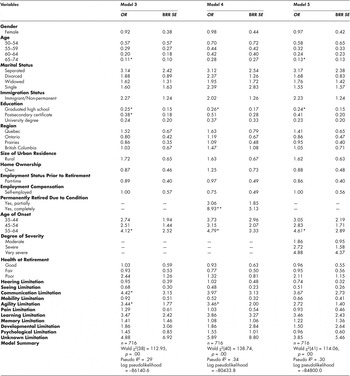
Table 3 presents a sensitivity analysis to test whether inclusion of the no-choice variable, the severity of disability measure, or both masked the health or disability limitations effects. This analysis reveals that while the odds of involuntary retirement increase for poor health when lack of choice is omitted from the model, they do not reach statistical significance (models 3 and 5). Models 3 and 4 show that the effects for communication and agility limitation reach or nearly reach statistical significance when severity of the disability is excluded from the model. However, the model summary statistics reveal that model 2 is the best fitting model.
Sensitivity analysis of the multivariate logistic regression and involuntary retirement by socio-demographic, socioeconomic, and health characteristics of persons with disabilities, ages 45–74a

a Reference Categories are male, ages 45–49, married, non-immigrant, less than high school, Atlantic province, urban, rental/band housing, employed full-time, employee (i.e. earning wages, salary and commission), did not retire due to condition, age of onset 0-34), mild severity, excellent/very good health at time of retirement, and no specific limitation.
* p < .05; ** p < .01;
Source: Statistics Canada, 2006 Participation and Activity Limitations Survey
Discussion
Of Canadians who retire, 27 per cent retire involuntarily (Schellenberg & Silver, Reference Schellenberg and Silver2004), and illness or disability is the number one reason for involuntary retirement in Canada (Statistics Canada, 1997). The analysis of the 2006 PALS has shown that Canadians with a disability have a high rate of involuntary retirement. Of those who retired during the 2001–2006 period, 38 per cent retired involuntarily from the labour force. Their higher rate of involuntary retirement means that many persons with disabilities are prematurely excluded from the labour market. Data from PALS indicates that in 2006 an estimated 4.4 million Canadians – one out of every seven in the population, or 14 per cent – reported having a disability (Statistics Canada, 2007). With the aging of the population, we can expect that many of these older adults with a disability will be excluded prematurely from the labour force in the future.
The analysis of the 2006 PALS revealed that the profile of persons with disabilities who had retired from the labour force between 2001 and 2006 is very heterogeneous in their socio-demographic, socioeconomic, and geographic characteristics. In line with Szinovacz and Davey’s (Reference Szinovacz and Davey2005) life course model of forced retirement, this study found that some groups of people with a disability are clearly at higher risk of involuntary retirement than are others, and they include persons with disabilities who are middle-aged, have lower levels of education, and are non-native-born Canadians. As discussed in the literature review, differences in socio-demographic characteristics, human capital characteristics, and regional effects may magnify the health or disability effects on employment outcomes of the disabled. The multivariate logistic analysis of the PALS data clearly revealed that the disability effects are very real. Involuntary retirement occurs when people with disabilities are no longer able to work rather than due to differences in socioeconomic characteristics.
This study contributes to knowledge through an analysis of the independent associations of health and disability factors on involuntary retirement for Canadians aged 45–74 with disabilities who retired during the five-year period from 2001 to 2006. Based on the review of the literature and our conceptual model of predictors of involuntary retirement, we hypothesized that health and disability have separate and independent effects on the perception of involuntary retirement. The analyses confirmed this hypothesis, demonstrating that the impact of health and disability characteristics should be considered separately in the study of retirement.
This study also verified the importance of distinguishing age of onset when investigating the labour market outcomes of persons with disabilities. Those who are disabled during childhood and those who are disabled later in life (after entering work) have different labour market experiences (Baldwin & Johnson, Reference Baldwin and Johnson2001). The logistic regression analyses showed that when other determinants are controlled for, the age of onset effect is greatest for those who are aged 55–64. The onset of disability in later life is most likely the trigger to an involuntary retirement. Employed persons born with a disability or who acquire it early in life are more likely to retire voluntarily. They may be more likely to have benefited from workplace accommodations and the use of technology.
As discussed in the literature review, the type of the disability differentially impacts labour market participation and outcomes; however, there is no research that considers the impact of the type of disability on involuntary retirement. Researchers found that when other factors were controlled for, persons with an agility disability were most at risk of involuntary retirement. Furthermore, communication and agility limitations were also found to have an effect on involuntary retirement. The likelihood of involuntary retirement also increased with the severity of disability or disabilities.
The life course perspective provides a conceptual model that can aid in the understanding of involuntary retirement. It incorporates human agency – in particular, individual choice – into our understanding of retirement’s voluntary nature (Moen, Reference Moen1996; Szinovacz & Davey, Reference Szinovacz and Davey2005). Retirement is voluntary when individuals perceive they have control over both the decision to retire and the timing of their retirement. Based on the review of the literature and our conceptual model of predictors of perceptions of involuntary retirement, we hypothesized that having no control over the decision to retire would be associated with the perception of involuntary retirement. This hypothesis was confirmed. The analysis revealed that persons with disabilities who had to permanently retire because of their condition were eight times more likely to retire involuntarily than those who did not have to retire because of their condition. For some, this was a partial explanation for involuntary retirement, but for many, it explained their withdrawal from the labour force.
The study’s findings are limited by a number of factors. First, the measure of involuntary retirement used in PALS did not allow us to ascertain why the respondent perceived their retirement to be involuntary. Second, the data were cross-sectional, and therefore we could not examine the causal impact of health, disability, and choice on involuntary retirement. Third, severity of disability and limitations were current measures of disability and might not have been indicative of disability at time of retirement. Disability may have gotten better or worse since the time of retirement. Fourth, there was no measure of the type of employment prior to retirement, nor of the type of chronic disease in the PALS data set. However, both factors may be important determinants of involuntary retirement. Despite these limitations, this analysis has provided useful information on the associations between health disability characteristics, and on an individual’s control over the retirement decision and type of retirement.
Conclusion and Policy Implications
Both policy solutions and workplace accommodations are necessary to keep persons with disabilities in the labour force so that they have choice over when and if they retire. It is not possible or even desirable for all persons with disabilities to continue to work if their condition does not allow it. However, given the negative impact that involuntary retirement has on economic status (Denton, Plenderleith, & Chowhan, Reference Denton, Plenderleith and Chowhan2013), the fact that many older adults desire to continue working (Morissette et al., Reference Morissette, Schellenberg and Silver2004), and the rise in the age of eligibility for old-age security benefits, consideration should be given to removing impediments and providing incentives for persons with disabilities to extend their working lives.
A recent analysis of the 2006 PALS data has shown that labour force participation rates are much lower for the disabled population (56%) compared to all Canadians aged 15 to 64 (80%) (Statistics Canada, 2008). Three quarters of the sub-population of persons with disabilities who retired recently did so before the age of 65. In particular, persons who acquired a disability between the ages of 55 and 64 have the highest risk of involuntary retirement. Given that the gap between their expected retirement date and the onset of their disability is shorter than the time for younger age groups, onset of a disability may be the trigger to forced retirement. The employer may be less willing to provide incentives or accommodations facilitating their continued employment, or the workers themselves may be less willing to continue working with a disability. Future research could focus more specifically on the retirement decision when the onset of disability occurs after the age of 55. Future research could address issues that would remove impediments and provide incentives for persons with disabilities to extend their working lives including (a) the use of technology; (b) the acceptance by employers and unions of greater flexibility of work days, work weeks, and work years; (c) changes in attitudes towards disabled people and their productive capabilities; and (d) the need to provide workplace accommodation to persons with disabilities.
In Canada, there is no national and comprehensive legislation such as in the United States to mandate accommodation. Instead, there is legislation to improve the employment prospects of persons with disabilities such as the Employment Assistance for People with Disabilities (EAPD) program, the “In Unison” agreements, and, more recently, the Multilateral Framework for Labour Market Agreements for Persons with Disabilities (Campolieti, Reference Campolieti2009). These programs provide assistance to persons with disabilities to help them prepare for the workforce as well as find secure work. Provincial workers compensation boards in Canada also have requirements that oblige some employers to provide reasonable accommodations to workers with work-related or occupational disabilities. Burkhauser, Butler, and Kim (Reference Burkhauser, Butler and Kim1995) found that in the United States, the receipt of accommodations could prolong employment.
Most recently, Campolieti (Reference Campolieti2009) used the 2001 PALS to consider labour market variations in accommodations provided and desired (such as modified duties, modified hours, human support, technical aids, specialized computer, communication aids, and other accommodations). Desires for accommodations were much higher among persons who had to change jobs or else leave the workforce than they were for those who did not have to change jobs, suggesting that support for workplaces to accommodate workers transitioning into new jobs would decrease the likelihood of involuntary retirement. Furthermore, women had a greater desire for accommodations that involved reduced hours than men. There is a need for research on strategies for improving the ability of persons with disabilities to remain in the workforce or to return to the workforce through workplace accommodation.