INTRODUCTION
Cognitive deficits are an important cause of functional impairment in Parkinson’s disease patients without dementia (PD), and may be apparent early in the disease process (Dubois & Pillon, Reference Dubois and Pillon1997; Levin & Katzen, Reference Levin and Katzen1995; Owen, Reference Owen2004; Pillon, Boller, Levy, & Dubois, Reference Pillon, Boller, Levy, Dubois, Boller and Cappa2001; Taylor & Saint-Cyr, Reference Taylor and Saint-Cyr1995; Zgaljardic, Borod, Foldi, & Mattis, Reference Zgaljardic, Borod, Foldi and Mattis2003). Decline in cognitive functioning is associated with caregiver distress (McKinlay, et al., Reference McKinlay, Grace, Dalrymple-Alford, Anderson, Fink and Roger2008a; Schrag, Jahanshahi, & Quinn, Reference Schrag, Jahanshahi and Quinn2000) and early rest home placement, and may also predict the onset of dementia (Jacobs et al., Reference Jacobs, Marder, Cote, Sano, Stern and Mayeuz1995; Janvin, Aarsland, & Larsen, Reference Janvin, Aarsland and Larsen2005; Woods & Troster, Reference Woods and Troster2003). Given the relative importance of cognitive impairments, there has been considerable interest in identifying a specific cognitive profile for patients with PD to inform appropriate intervention strategies.
The literature in the area of cognitive outcomes in PD is extensive and there are several comprehensive reviews on this topic (Caballol, Marti, & Tolosa, Reference Caballol, Marti and Tolosa2007; Levin & Katzen, Reference Levin and Katzen1995; Owen, Reference Owen2004; Pillon et al., Reference Pillon, Boller, Levy, Dubois, Boller and Cappa2001; Zgaljardic et al., Reference Zgaljardic, Borod, Foldi and Mattis2003). From this literature a general pattern of cognitive domains that are more likely to be impaired in patients with PD has been identified. These include visuoperception/visuospatial ability, speed of mental processing, memory, learning, and executive functions (including, planning, working memory, verbal fluency, and attention). Impairments in some areas of functioning, particularly executive functions, are evident even from the early stages of the disease and may predict the onset of dementia (Cooper, Sagar, Jordan, Harvey, & Sullivan, Reference Cooper, Sagar, Jordan, Harvey and Sullivan1991; Jacobs et al., Reference Jacobs, Marder, Cote, Sano, Stern and Mayeuz1995; Muslimovic, Post, Speelman, & Schmand, Reference Muslimovic, Post, Speelman and Schmand2005; Woods & Troster, Reference Woods and Troster2003).
Deficits in different subcomponents of executive functions have been consistently reported for patients with PD including planning, problem solving, working memory, verbal fluency, and set-shifting (Dimitrov, Grafman, Soares, & Clark, Reference Dimitrov, Grafman, Soares and Clark1999; Farina et al., Reference Farina, Gattellaro, Pomati, Magni, Perretti and Cannata2000; Muslimovic et al., Reference Muslimovic, Post, Speelman and Schmand2005; Tamaru, Reference Tamaru1997). Executive functioning refers to the ability to plan, initiate, and monitor goal-directed behavior, with the flexibility to update goals when presented with new information. Problems in this area are thought to reflect fronto-striatal disruption caused by dopamine denervation of the caudate nucleus (Cools, Stefanova, Barker, Robbins, & Owen, Reference Cools, Stefanova, Barker, Robbins and Owen2002; Marie et al., Reference Marie, Barre, Dupuy, Viader, Defer and Baron1999).
Given the neuropathology of PD, it has been suggested that the magnitude of any cognitive deficits will reflect the degree to which the task relies on the integrity of the frontal executive system (Taylor & Saint-Cyr, Reference Taylor and Saint-Cyr1995; Troster & Fields, Reference Troster and Fields1995), and support for this position is emerging. For example, Zamarian and colleagues (Reference Zamarian, Visani, Delazer, Seppi, Mair and Diem2006) examined the performance of 15 PD patients compared to 28 health, age, and education matched controls on measures of executive functioning and numerical ability. They found that PD patients performed worse than healthy controls, but that deficits in numerical ability were secondary to deficits in executive functions. Higginson and colleagues (Reference Higginson, King, Levine, Wheelock, Khamphay and Sigvardt2003) assessed 32 nondemented PD patients on different aspects of executive function, verbal memory tasks, and disease-related variables to predict performance on delayed recall. Results showed that working memory was the best predictor of verbal recall, accounting for almost 50% of the variance (Higginson et al., Reference Higginson, King, Levine, Wheelock, Khamphay and Sigvardt2003). Bondi and colleagues (Reference Bondi, Kaszniak, Bayles and Vance1993) examined the performance of 19 PD patients compared to 19 healthy controls on measures of executive functioning, memory, and visuoperceptual/visuoconstructive skills. Patients showed evidence of deficits in all areas of cognition tested. However, impairments on tasks of learning and memory and visuoperceptual/visuoconstructive tasks were not significantly impaired when performance on executive function tasks were controlled for. Results from these studies support the idea that subcomponents of executive functions underlie deficits in other areas of cognitive functioning. However, as noted by Higginson and colleagues (Higginson et al., Reference Higginson, King, Levine, Wheelock, Khamphay and Sigvardt2003), there is still some uncertainty regarding the effect of executive deficits on other areas of cognitive functioning, such as visuoperceptual judgment, which requires further investigation.
There were two primary objectives in the present study. First, we planned to identify a pattern of deficits in executive functions and general cognitive deficits for PD patients without dementia using a comprehensive set of commonly used neuropsychological tests. Domains and tests were selected to be consistent with previous research on cognitive deficits in PD (e.g., Muslimovic et al., Reference Muslimovic, Post, Speelman and Schmand2005). Our second goal was to examine the relationship between different domains of executive function and other areas of more general cognitive function, including memory and visuoperceptual functioning.
METHODS
This study was part of a broader project examining cognitive, neuropsychiatric, and language outcomes for patients with PD, and received approval from the Upper South B Regional Ethics Committee. Assessments were carried out at the University of Canterbury over three testing sessions, each of three hours duration. Tests were presented in a fixed order with breaks taken as required. Written consent was obtained from all participants at the start of the first testing session, after the study had been explained. Additional information pertinent to the inclusion/exclusion criteria (see Table 1) was obtained from all participants using a semi-structured interview. Motor impairment was also assessed in PD patients.
Inclusion and exclusion criteria for Parkinson’s disease patients and controls

Participants
Parkinson’s disease group
Parkinson’s disease patients in the Canterbury region, identified at the time of this study and not diagnosed with dementia, were invited by letter to participate by two consulting neurologists who specialized in movement disorders. Participants were required to meet the inclusion/exclusion criteria outlined in Table 1. Of the 115 letters that were mailed, 6/115 (5.2%) of individuals with PD could not participate due to illness, 6/115 (5.2%) were deceased, 8/115 (6.9%) declined, 34/115 (29.6%) did not respond. Of the 61 patients that were tested, 21/115 (18.3%) did not meet the inclusion/exclusion criteria, leaving 40 participants with PD included in the analyses. All patients were tested while on anti-parkinsonian medication (24/40 of the patients were on L-dopa; 20/40 on anticholinergics; 19/40 on dopamine agonists; 14/40 on MAO-B Inhibitor, and 4/40 on COMT Inhibitor).
Control group
Forty healthy controls were recruited who were similar to the PD group in terms of age and premorbid intelligence. The control group was recruited from a number of sources, including a previously established database and advertisements at local clubs and businesses. All individuals in the control group were given a brief outline of the study on first phone contact, and, if willing to participate, were sent an information sheet. In addition to adequate or corrected hearing and vision and being between 50 to 80 years of age, the same exclusion criteria listed Table 1 also applied to the control group.
Measures
Demographic and clinical information
The National Adult Reading Test (NART) (Lezak, Reference Lezak1995) was used as a measure of premorbid IQ; the Beck Depression Inventory (BDI-II) was used to assess mood and consists of 21 items; each question was rated 0–3, with higher scores indicating greater intensity of symptoms (Beck, Steer, & Brown, Reference Beck, Steer and Brown1996). Current mental status was assessed using the Mini-Mental Status Exam (MMSE) (Folstein, Folstein, & McHugh, Reference Folstein, Folstein and McHugh1975) and the Dementia Rating Scale (DRS-II) (Jurica, Leitten, & Mattis, Reference Jurica, Leitten and Mattis2001). In addition to the Hoehn and Yahr (H & Y) (Hoehn & Yahr, Reference Hoehn and Yahr1967), the Unified Parkinson’s Disease Rating Scale-motor section (UPDRS) was used to assess the severity of motor symptoms (Fahn & Elton, Reference Fahn and Elton1987). A global measure of functional status was obtained using the Modified Schwab and England Activities of Daily Living Scale (S & E; on this scale 0% represents a vegetative state and 100% represents total independence). All the patients rated themselves as independent in daily activities, as rated by the S & E.
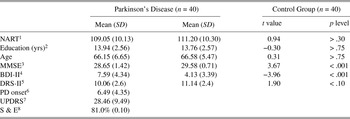
Comparisons between patients with PD and Controls are shown in Table 2. Although there were significant differences between the two groups in terms of current mental status (MMSE) and mood ratings, none of the participants showed any evidence of clinical depression or dementia, as assessed by a registered clinical psychologist using the Diagnostic and Statistical Manual–Fourth edition (DSM-IV) criteria. There were significantly more males in the PD group, PD 26/40 (65%) than in the Control group, 14/40 (35%), χ2 (df = 1) = 8.46, p < .01.
Clinical and demographic characterstics for Parkinson’s disease patients versus controls

Note
1National Adult Reading Test; 2Total number of years of formal education; 3Mini-Mental Status Exam; 4Beck Depression Inventory; 5Dementia Rating Scale-II; 6Number of years since diagnosis of Parkinson’s disease; 7Unified Parkinson’s Disease Rating Scale (motor score component); 8Modified Schwab and England Activities of Daily Living Scale.
Neuropsychological assessment
Neuropsychological assessment covered six cognitive domains: (1) executive function/planning; (2) problem solving; (3) working memory/attention; (4) speed of processing; (5) memory/learning; (6) visuospatial ability. Planning, problem solving, and working memory are considered to be subcomponents of executive function, and were measured separately to examine the different aspects of executive function that might be impaired (Salthouse, Reference Salthouse2005). Also included were measures of attention and speed of processing. Although not generally considered subcomponents of executive function, the integrity of these processes is directly linked with efficient processing of executive and general cognitive tasks.
All tests were commonly used neuropsychological measures and scored according to standard procedures. The majority of measures were from standardized batteries with age-adjusted norms, including: Wechsler Abbreviated Scale of Intelligence (WASI; Wechsler, Reference Wechsler1999; mean = 50, SD = 10), Delis Kaplan Executive Function System (D-KEFS; Delis, Kaplan, & Kramer, Reference Delis, Kaplan and Kramer2001), and the Wechsler Memory Scale-III (WMS-III Wechsler, Reference Wechsler1997), both with mean = 10, SD = 3. Norms were not available for the Behavioral Assessment of the Dysexecutive Syndrome (BADS; Wilson, Alderman, Burgess, Emslie, & Evan, Reference Wilson, Alderman, Burgess, Emslie and Evan1996), scores range from 0–4, Cambridge Neuropsychological Test Automated Battery (CANTAB), Reading Span task, and tests of visuospatial functioning. However, PD patients were comparable to Controls in terms age.
Executive function/planning skills. These skills were evaluated using the D-KEFS Verbal Fluency test (involving three subtests designed to measure speed and ease of verbal speech) and Color-Word Interference tests (involving two subtests that measure the ability to inhibit automatic verbal responses), and two of the Card Sorting subtests (free sorting and sorting recognition). Also included in this domain were the Intradimensional/Extradimensional Shift (ID/ED) from the CANTAB, which is conceptually similar to the Wisconsin Card Sorting tests and assesses the individuals’ ability to maintain and switch attention (number of stages completed, scores vary from 0–9), and the CLOX-I, which is an executive function task that requires goal selection, selective attention, and the self-monitoring (scores vary from 0–15, with lower scores indicating greater impairment) (Royall, Cordes, & Polk, Reference Royall, Cordes and Polk1998). Two measures of planning were used, the Key Search and Zoo Map from the BADS.
Problem solving. This was assessed using the D-KEFS, Tower Task (number of towers completed in the minimum number of moves, maximum score = 9). The D-KEFS Tower Task is an updated version of the Tower of Hanoi Task. Problem solving was also assessed using the Matrix Reasoning subtest from the WASI and the Stockings of Cambridge (SOCs) from the CANTAB (number of towers completed in the minimum number of moves, maximum score = 12). The SOCs is a computerized version of the Tower of London task.
Working memory/attention. This was assessed using letter number sequencing, Digits Forward and Reversed, from the WMS-III, Spatial Span (maximum sequences correctly recalled, 0–9) from the CANTAB, and the Daneman and Carpenter Reading Span test (Daneman & Carpenter, Reference Daneman and Carpenter1980) (scores range, 1–6).
Speed of processing. This was evaluated using word naming and color naming from the D-KEFS Color-Word interference test.
Memory/learning. This was assessed with the WMS-III, Paired Associates, and Logical Memory, immediate and delayed, and the Auditory Recall Index. The Rey Osterrieth Figure (ROF) recall after 3 and 30 minutes was also used as a measure of memory ability. All three parts of the ROF are rated the same (range 0–36, with higher scores indicating more accurate performance; Spreen & Strauss, Reference Spreen and Strauss1998).
Visuospatial/constructive skills. These skills were assessed using the Judgment of Line Orientation (JLO; Benton, Varney, & Hamsher, Reference Benton, Varney and Hamsher1978), which is a test of visuospatial ability. Scores reported for the JLO are the number of correct line pairs, with possible scores ranging from 0–30. Also included in this domain were the Rey Osterrieth Figure copy task and the CLOX-II, which is also a copying task. Both of these tasks tap into visuospatial/constructive skills. Scores for the CLOX-II vary from 0—15, with lower scores indicating greater impairment.
Data Analyses
Results for PD patients and controls were compared with t tests. To assess the magnitude of any differences between the two groups, effect sizes for cognitive impairments were generated using Cohen’s d. Because of the number of comparisons, we used, a .01 significance level rather than .05 to provide increased protection against Type 1 error, without unduly compromising power.
Pearson correlations were employed to assess the association between disease progression and cognitive outcomes. Pearson correlations were also used to assess the association between different measures of executive function, visuospatial ability, and memory/learning. Z scores were computed, using the control mean and standard deviation, so that comparisons could be made across tests. Multivariate analyses of covariance (MANCOVAs) were used to compare the difference between PD and control scores for a particular cognitive domain, while using other domains as covariates, and were considered significant at p < 0.05.
RESULTS
Comparison of PD vs. Control Group
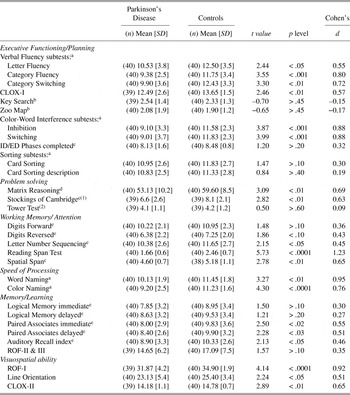
Results in Table 3 indicate that PD patients showed a variable pattern of deficits when compared to the Control group. Whereas consistent evidence of deficits was found on measures of speed of processing, individual t tests revealed deficits on only five of nine measures of executive function (Category Fluency, Category Switching, CLOX-I, and Stroop inhibition, and inhibition switching), two of the three measures of problem solving (Matrix reasoning and SOCs), two of the three measures of working memory (Reading Span Test and Spatial Span task), and two of the three measures of visuospatial ability (ROF copy and CLOX-II). There were no significant differences in terms of planning ability, attention, or memory.
Cognitive test outcomes for Parkinson’s disease patients versus controls

Note
(1)Number of towers completed in minimum moves; (2)Number of towers completed in minimum moves using the Tower task from the Delis Kaplan Executive Functioning System; aDelis Kaplan Executive Functioning System standardized scores; bBehavioural Assessment of the Dysexecutive Syndrome profile scores; cCambridge Neuropsychological Test Automated Battery; dWechsler Abbreviated Intelligence Scale standardized scores; eWechsler Memory Scale, 3rd edition, standardized score; ROF = Rey Osterrieth Figure test. Number of participants varied slightly for different measures for the following reasons: Due to motor impairments, one patient was not able to complete the Key Search, ROF, or CLOX. The Tower tasks. Due to error, one control was not administered the Tower Task and two controls were not administered the Spatial Span task.
The original analysis was rerun, excluding the two patients who had a H & Y of 4, so that the group consisted of only patients with mild to moderate motor impairments. Because results remained substantially the same and the pattern of deficits for the patients with PD compared to the Control group was unchanged, data for these subjects were included in the analyses reported here. Also, the observed pattern of deficits was identical, regardless of whether raw or age-adjusted scores were used.
Effect Sizes
Table 3 provides information in terms of effect sizes for measures with a significant finding. In the domain of executive function, effect sizes varied from medium to large (d = 0.57–0.88), with an average of 0.77. Significant effect sizes for problem solving (d = 0.63 and 0.69), working memory (d = 1.23 and 0.65) and speed of processing (d = 0.67, 0.95, and 0.76) were all large, with averages of 0.65, 0.94, and 0.79, respectively.
Correlations Between Cognitive Measures
Correlations between cognitive measures are shown in Table 4. All within-domain correlations were significantly positive for problem solving, working memory/attention, speed of vvvprocessing, memory and learning, and visuospatial ability, and for 8 of 10 cases for executive function. To further examine the relationship between each of the domains, scores for each of the measures in the matrix were transformed to z scores. These z scores were generated using the mean and standard deviation of the Control group. Overall scores were then produced separately for each of the five domains by averaging the z scores for measures that differentiated PD patients from the Control group (p < .01). Because of the high correlation between CLOX-I and CLOX-II, the CLOX-I was not included in the executive function domain. The sixth domain, memory/learning, was included in the matrix for the purpose of comparisons. Paired Associates I & II were combined and Logical Memory I & II were combined, giving a total of three measures that comprised the domain of memory/learning.
Correlation between measures of Executive Function, Problem Solving, Working Memory/Attention, Speed of Processing, Memory/Learning, and Visuospatial Ability for patients with Parkinson’s disease

Note
1Stockings of Cambridge; 2Rey Osterrieth Figure Test-copy; Bold-faced numbers indicate correlations of p < .01.
MANCOVA
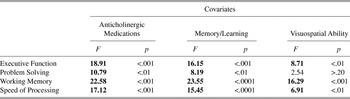
Multivariate analyses of covariance (MANCOVAs) were used to control for the effects of anticholinergic medication, memory/learning, and visuospatial ability, while assessing the difference between the PD group and the Control group on the domains of executive function, problem solving, working memory, and speed of processing. Results are shown in Table 5. Although the differences remained significant for executive function, working memory, and speed of processing (p < .01), deficits in problem solving were no longer significant after controlling for visuospatial ability. However, differences between the two groups remained significant (p < .01) for all domains, after controlling for memory/learning.
Comparison between patients with Parkinson’s disease and controls for the domains of Executive Function, Problem Solving, Working Memory, and Speed of Processing after controlling separately for the effects of Anticholinergic Medications, Memory/Learning, and Visuospatial Ability

Note
Bold-faced numbers indicate where there is a significant effect.
MANCOVAs were used separately to control for the effects of anticholinergic medication, executive function, problem solving, working memory, and speed of processing (Table 6). There were no significant differences between the PD and Control groups for the memory/learning domain. In terms of visuospatial ability, the PD group remained significantly different from controls regardless of which covariate wasentered into the analysis.
Comparison between patients with Parkinson’s disease and controls for the domains of Memory/Learning and Visuospatial Ability after controlling separately for the effects of Anticholinergic Medications, Executive Function, Problem Solving, Working Memory, and Speed of Processing

Note
Bold-faced numbers indicate where there is a significant effect.
DISCUSSION
We found clear significant differences in performance between PD and Control groups across different subcomponents of executive functioning (working memory, problem solving, verbal fluency, inhibition) and on tests of speed of processing and visuospatial skills. However, the groups did not differ significantly on measures of planning, attention, and memory/learning. Of particular interest was the finding that PD patients did not show deficits for all subcomponents of executive functioning; instead, there was evidence of variable performance. Our finding of a pattern of impaired and spared function is consistent with previous studies (Marinus et al., Reference Marinus, Visser, Verwey, Verhey, Middelkoop and Stiggelbout2003; Muslimovic, et al., Reference Muslimovic, Post, Speelman and Schmand2005; Uekermann et al., Reference Uekermann, Daum, Bielawski, Muhlack, Peters and Przuntek2004; Weintraub & Stern, Reference Weintraub and Stern2005) and points to a need for specificity when assessing executive dysfunction in PD. We also examined the relationship between anticholinergic medication use and subcomponents of executive functioning and visuospatial ability and memory/learning, and found evidence that deficits in speed of processing and visuospatial ability were independent of aspects of executive function. Moreover, we found that problem-solving deficits were only evident for tasks with a high visuospatial content, and were no longer significant when visuospatial skills were controlled for. The addition of anticholinergic medication use as a covariate did not significantly change the relationship found for the different subcomponents of executive function, visuospatial ability, or memory and learning, for PD versus controls.
The profile of executive function, speed of processing, and visuospatial deficits reported here is similar to other recent research regarding cognitive outcomes for PD patients, regardless of disease severity. For example, two recent studies, one examining outcomes for newly-diagnosed patients and the other for advanced PD (Muslimovic et al., Reference Muslimovic, Post, Speelman and Schmand2005; Woods & Troster, Reference Woods and Troster2003), reported a similar range of executive, speed of processing, and visuospatial deficits to those found here, even though the present study was based on a sample of patients that varied widely in terms of disease severity and duration. Indeed, it has been suggested that deficits in executive function, speed of processing, and visuospatial ability appear to constitute the core deficits for PD. By contrast, deficits in general memory, planning, and attention are much more variable and depend on the methodology of the study and inclusion criteria.
One of our most notable findings was that deficits in speed of processing and visuospatial ability were independent of executive function, and that problem solving was not impaired when visuospatial ability was controlled for. Deficits in visuospatial function have previously been identified in PD patients without dementia (Waterfall & Crowe, Reference Waterfall and Crowe1995). However, results for visuospatial deficits have been inconsistent, and the exact cause of these deficits remains unresolved. Whereas some researchers have argued that visuospatial deficits in PD are associated with fronto-striatal circuits and reflect executive functioning impairment (Bondi, Kaszniak, Bayles, & Vance, Reference Bondi, Kaszniak, Bayles and Vance1993), others have noted that PD is associated with visuospatial and problem-solving deficits independent of executive functions (Cronin-Golomb & Braun, Reference Cronin-Golomb and Braun1997), suggesting a different pathoanatomy. In the present study, PD patients showed visuospatial deficits that were independent of executive function deficits. Moreover, we found that visuospatial deficits could account for deficits in problem-solving ability. Both these findings provide evidence for cognitive deficits unrelated to a fronto-striatal deterioration. Our results are consistent with recent reviews on the neuroanatomy of PD. These reviews have suggested that attributing the complex cognitive decline associated with PD entirely to depletion of dopamine in the basal ganglia, and subsequent deterioration of fronto-striatal circuits, is an oversimplification. Instead, disease progression is more likely to be characterized by depletion of a range of neurotransmitter systems (Bohnen & Albin, Reference Bohnen and Albin2009; Bohnen et al., Reference Bohnen, Kaufer, Hendrickson, Ivanco, Lopresti and Constantine2006; Braak & Braak, Reference Braak and Braak2000; Cools, Reference Cools2006; Owen, Reference Owen2004). For example, recent imaging literature has found an association between the cholinergic system and executive deficits (Bohnen et al., Reference Bohnen, Kaufer, Hendrickson, Ivanco, Lopresti and Constantine2006) and posterior metabolic changes with multiple mild cognitive impairments (Huang et al., Reference Huang, Mattis, Perrine, Brown, Dhawan and Eidelberg2008). Moreover, these changes have been suggested as occurring early in the disease process (Bohnen & Albin, Reference Bohnen and Albin2009).
The majority of patients in this study were in the mild to moderate range in terms of disease symptoms. However, two of our patients had more severe motor problems. Despite this, correlations revealed few associations between cognitive performance and disease duration or motor symptoms. Furthermore, motor symptoms and disease duration have been reported by a number of groups as an unreliable means of identifying patients who have cognitive problems (Aarsland, Ballard, Larsen, & McKeith, Reference Aarsland, Ballard, Larsen and McKeith2001; Graham & Sagar, Reference Graham and Sagar1999; Janvin, Aarsland, Larsen, & Hugdahl, Reference Janvin, Aarsland, Larsen and Hugdahl2003; Lewis et al., Reference Lewis, Foltynie, Blackwell, Robbins, Owen and Barker2005; Muslimovic et al., Reference Muslimovic, Post, Speelman and Schmand2005).
One of the strengths of this study is that a range of measures was used to identify the profile of impaired and spared executive functions. Although there is considerable debate regarding which tests are most appropriate to measure each of the different cognitive domains (Taylor & Saint-Cyr, Reference Taylor and Saint-Cyr1995), our selection of tests and domains was theoretically motivated and based on previous research to allow comparisons (Muslimovic et al., Reference Muslimovic, Post, Speelman and Schmand2005). One limitation of our study was that not all measures could be corrected for age and education. However, the impact of this was minimized by ensuring that the PD group was similar to the Control group in terms of age and education. Another limitation of the study was an increased likelihood of Type 1 error due to the relatively large number of comparisons that were made. However, we attempted to compensate for this by using a more stringent test of significance (p < .01).
A number of issues were raised by this study that may warrant further consideration. First, deficits in executive function in PD have often been assessed as though this were a unitary process, without consideration to different subcomponents (Salthouse, Reference Salthouse2005). Furthermore, much of what we know regarding deficits in the subcomponents of executive function has come from studies that have examined single aspects of this skill with different groups of individuals. Very few studies have examined the constellation of executive function deficits within a single group of subjects. Second, in this study, not all measures within a domain showed impairment. For example, patients showed no deficit on the D-KEFS Tower of Hanoi, but did show deficits on the CANTAB SOCs, a computerized version of the Tower of London. However, there is growing evidence that although these two tasks are often used interchangeably, they tap into different skills (McKinlay et al., Reference McKinlay, Grace, Kaller, Dalrymple-Alford, Anderson and Fink2009; McKinlay et al., Reference McKinlay, Kaller, Grace, Dalrymple-Alford, Anderson and Fink2008b; Welsh, Revilla, Strongin, & Kepler, Reference Welsh, Revilla, Strongin and Kepler2000). As pointed out by Riedel and colleagues (Reference Riedel, Klotsche, Spottke, Deuschl, Forstl and Henn2008), estimates of cognitive impairment within-domain are largely dependent on the measure used to assess them. The heterogeneity of tasks employed, the varying levels of complexity, the processing demands of the different tasks (Brown & Marsden, Reference Brown and Marsden1990), and way in which different cognitive skills are operationalized (Taylor & Saint-Cyr, Reference Taylor and Saint-Cyr1995), have all been suggested as contributing to controversy regarding the cognitive impairments associated with PD.
Identifying the profile of cognitive deficits specific to PD is important as it provides information to clinicians regarding which measures are most appropriate to identify patients who may be experiencing cognitive decline. Information regarding such individuals can be used by clinicians to target intervention strategies. For example, recent research has demonstrated that cognitive training is able to improve executive functioning for PD patients (Sammer, Reuter, Hullmann, Kaps, & Vaitl, Reference Sammer, Reuter, Hullmann, Kaps and Vaitl2006) and is also effective in reinforcing cognitive strategies designed to compensate for declines in functioning (Sinforiani, Banchier, Zucchella, Pacchetti, & Sandrini, Reference Sinforiani, Banchier, Zucchella, Pacchetti and Sandrini2004). Information regarding intact skills is also useful because it may provide an opportunity to develop interventions that take advantage of those aspects of cognitive functioning that have been spared (Witt et al., Reference Witt, Daniels, Daniel, Schmitt-Eliassen, Volkmann and Deuschl2006). Given the effectiveness of cognitive interventions for PD patients in early stages of cognitive decline, future research should focus on developing guidelines for clinicians regarding tests that are most sensitive to identify patients who may benefit from these therapeutic interventions.
ACKNOWLEDGMENTS
We are grateful to Doctors Tim Anderson and John Fink for the referral of patients with a confirmed diagnosis of Parkinson’s disease and assistance with the interpretation and administration of the UPDRS. Audrey McKinlay was sponsored by a scholarship from the Foundation for Research Science and Technology, New Zealand, and by a Claude McCarthy Fellowship. This research was also sponsored by funding from the Canterbury Medical Research Foundation. No author has any conflict of interest.