INTRODUCTION
Synergy is the interaction or cooperation of two or more actions to produce a combined effect greater than the sum of their individual effects. Taking advantage of synergies among development and conservation objectives can potentially improve the overall cost-effectiveness of resources, reduce actual and potential conflicts among efforts, and avoid duplication of costs and efforts that would be incurred through individual implementation of each objective (CBD [Convention on Biological Diversity] 2004). However, while the potential for synergies is frequently invoked, it is seldom assessed.
Payment for environmental services (PES) is a market-based approach to conservation financing based on the twin principles that those who benefit from environmental services (such as users of clean water) should pay for them, and that those who contribute to generating these services (such as upstream land users) should be compensated for providing them (Wunder Reference Wunder2005; Pagiola & Platais Reference Pagiola and Platais2007; Engel et al. Reference Engel, Pagiola and Wunder2008). There are two basic kinds of PES programmes (Pagiola & Platais Reference Pagiola and Platais2007; Engel et al. Reference Engel, Pagiola and Wunder2008): user-financed PES programmes, in which service providers are paid by service users, and government-financed PES programmes, in which providers are paid by a third party, typically a government.
In addition to improving provision of environmental services, PES has also been thought to have the potential to help reach other objectives. To be effective, PES programmes need to be targeted to landholders who are in a position to deliver the desired services. To the extent that payment recipients are poor, however, the approach can potentially contribute to poverty reduction by providing them additional income (Pagiola et al. Reference Pagiola, Arcenas and Platais2005). Hopes that PES could contribute to poverty reduction have been particularly high, many assuming that payments would go mostly to poor land users, and thus contribute to poverty reduction (Kerr Reference Kerr2002; Landell-Mills & Porras Reference Landell-Mills and Porras2002; Grieg-Gran et al. Reference Grieg-Gran, Porras and Wunder2005; Pagiola et al. Reference Pagiola, Arcenas and Platais2005; Wunder Reference Wunder2005; Ravnborg et al. Reference Ravnborg, Damsgaard and Raben2007). Beyond individual case studies, however, the quantitative empirical basis for assessing results remains quite limited (Engel et al. Reference Engel, Pagiola and Wunder2008). This positive impact of PES on poverty reduction, however, does not always happen automatically, even when many potential service providers are poor. Poor landholders often face greater obstacles to participation in a PES programme than better off applicants. They may lack land titles (a requirement for participation in many government-financed programmes), may not have the technical or financial means of implementing the PES-supported land use practices, or may find the application process daunting. This invites collaboration between PES programmes and poverty reduction programmes. By assisting poor service providers to participate, poverty-focused agencies can help channel additional income to poor landholders, well beyond their own resources. At the same time, by removing obstacles to participation by the poor, they can help the PES programme achieve its objectives.
Although PES programmes are typically targeted to single services, most often to preserving water services, there have also been hopes that they would generate other services, such as conserving biodiversity. For example, Turpie et al. (Reference Turpie, Marais and Blignaut2008) argued that water can be an ‘umbrella service’ whose conservation through PES would also bring substantial biodiversity benefits. Here, too, there have been few assessments of the extent of possible synergies.
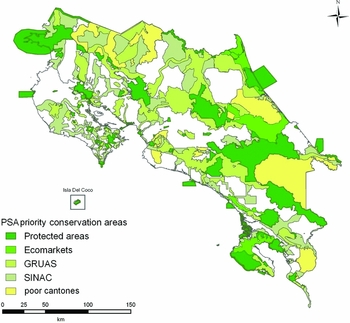
Costa Rica provides an excellent opportunity to assess the potential for synergies in PES programmes. Costa Rica is one of the 20 most biodiverse countries in the world (INBio [Instituto Nacional de Biodiversidad] 2008), and established a nationwide PES programme Pagos por Servicios Ambientales (PSA) in 1997, the first such programme in a developing country (Pagiola Reference Pagiola2008). The PSA programme is operated by the Fondo National de Financiamiento Forestal (FONAFIFO, National Fund for Forest Financing). The programme's primary focus has been on forest conservation, which accounts for about 95% of the enrolled area (Pagiola Reference Pagiola2008). Although the PSA programme nominally tries to generate four services (biodiversity, carbon, water and scenic beauty), it has hitherto been targeted primarily based on biodiversity criteria. Tattenbach et al. (Reference Tattenbach, Obando and Rodríguez2006) found that only 35% of the area under forest conservation contracts was in watersheds with downstream surface water users. Eligibility for enrolment is based on location in priority conservation areas (PCAs) defined primarily based on biodiversity criteria (Pagiola Reference Pagiola2008). The PCAs cover 3.4 million ha of land, including over 813 000 ha of declared protected land areas and almost 2 million ha of biodiversity corridors (Fig. 1). The latter were developed under three conservation programmes (World Bank 2000): the World Bank-GEF Ecomarkets project (227 000 ha), the GRUAS report on conservation gaps in Costa Rica (886 000 ha), and the Sistema Nacional de Areas de Conservacion (SINAC, National System of Conservation Areas) (824 000 ha). In 2005, 636 000 ha of ‘poor cantones’ were added to the PCAs, covering less developed areas that are not already included in the biodiversity conservation priority areas, a tacit admission that targeting purely based on biodiversity had failed to reach many poor landholders. The poor cantones are defined according to an index of social development (discussed in detail below).
The PSA programme's priority conservation areas in Costa Rica, based on data obtained from FONAFIFO. PSA = Pago por Servicios Ambientales (payments for environmental services), SINAC = Sistema Nacional de Areas de Conservacion (national system of conservation areas). GRUAS = GRUAS report on conservation gaps in Costa Rica.

The PSA programme's potential for poverty alleviation has been stressed from the beginning (Ortiz Malavasi et al. Reference Ortiz Malavasi, Sage Mora and Borge Carvajal2003; Porras et al. Reference Porras, Miranda, Salas, Platais and Pagiola2012). However, several empirical studies have found that many PSA programme participants are not poor. Miranda et al. (Reference Miranda, Porras and Moreno2003) found that most participants in the Virilla watershed were wealthy and derived their incomes from non-farm sources. Similarly, Zbinden and Lee (Reference Zbinden and Lee2005) found that 75% of conservation contracts in Huetar Norte were received by relatively wealthy landowners who derive their main income from off-farm activities. The relatively low participation rate of poor landholders has been blamed partly on obstacles preventing their participations (such as lack of land titles) and partly on the high costs of entering the programme (which include preparing a land management plan as well as a variety of administrative costs such as securing cadastral plans of the farm). These obstacles have led several other parties to seek to ease the application of smallholders to the PSA programme, thus achieving synergies between their own poverty reduction objectives and the environmental objectives of the PSA programme.
Although the PCAs offer a good coverage of the country's biodiversity-sensitive land area, funding available for conservation payments has been limited (FONAFIFO 2007). The PSA programme is financed primarily by an earmarked portion of fuel tax revenues, which provides about US$ 12–13 million a year, and to a smaller extent by voluntary agreements with individual water users who are paying to conserve their watersheds (generating about US$ 0.5 million a year). International donors have also provided financing at various times. Although their contributions have at times accounted for almost half of spending, they have always been of limited duration. The recent institution of a new conservation fee that will be dedicated to watershed conservation within the water tariff framework marks a major expansion of the programme's regular budget (Pagiola & Zhang Reference Pagiola, Zhang, Platais and Pagiola2012). The PSA programme will receive 25% of the total annual water tariff revenue collected from all water concessions. Once it is fully implemented in 2012, the tariff is projected to provide about US$ 5 million (US$ 1 ≈ CRC 491) annually to the PSA programme. This new source of funding, hereafter called watershed conservation funding (WCF), will increase total PSA funding by over 40%, and funding specifically targeted to watershed conservation by a factor of almost ten (Pagiola & Zhang Reference Pagiola, Zhang, Platais and Pagiola2012). The decree establishing the water tariff specifies that revenues must be used to benefit water users in watersheds within which they are generated. The WCF is thus location-specific and varies in amount across watersheds. The influx of geographically targeted WCF is expected to interact with the existing PSA financing and generate opportunities for synergies among various conservation and socioeconomic objectives, thus offering an interesting case study.
Costa Rica has made considerable progress in increasing income, reducing poverty and improving social indicators (World Bank 2007a, b). However, poverty remains widespread in rural areas. Compared to other countries in the region, Costa Rica has relatively low levels of poverty and inequality, and performs well in health and access to basic services. Its infant and child mortality rates are significantly lower, and its average life expectancy is substantially higher. Only 9% of the population falls below the international US$ 2 per day per person purchasing power parity poverty lines, compared to 25% in Latin America, while only 2% fall below the US$ 1 extreme poverty line, compared to 10% regionally. Despite this achievement, the country still faces a number of important challenges, such as stagnating progress in reducing poverty, income inequality, and distinct geographic differences in the incidence and concentration of poverty.
Conditions concerning the potential for synergies
We summarize the conditions concerning the potential for synergies in the implementation of PES programmes as three feasibility conditions: (1) spatial feasibility, (2) economic and financial feasibility, and (3) ecological feasibility.
The most obvious condition for synergies between PES and other objectives is that of spatial feasibility. Put simply, are the areas that are important for service generation also important for other issues, such as poverty reduction? PES programmes are payments for specific land uses, and they are targeted to areas that generate the desired services. PES programmes seeking to improve water services, for example, are targeted to watersheds that supply water users, and sometimes to specific critical areas within these watersheds, while PES programmes seeking to improve biodiversity conservation are targeted to areas of biological importance such as protected areas or biological corridors. Programmes seeking to sequester carbon are the least spatially restricted, but even they have restrictions; for example programmes seeking to sell emissions reductions under the clean development mechanism (CDM) can only be implemented in areas that were deforested prior to 1990. Efforts outside the areas able to generate the desired services would not result in any improvements in the desired services, and so have no potential for synergies. The potential for synergies only exists, therefore, to the extent that other objectives overlap spatially with the PES programme's objectives.
Spatial correlation between PES and poverty has often been implicitly assumed, and this assumption has been the major reason for the expectation that PES can contribute to poverty reduction (Pagiola et al. Reference Pagiola, Arcenas and Platais2005, Reference Pagiola, Rios and Arcenas2008a). However, empirical studies have shown mixed results (Nelson & Chomitz Reference Nelson and Chomitz2007; Pagiola et al. Reference Pagiola, Zhang and Colom2008b, Reference Pagiola, Zhang and Colom2010). Watersheds in Guatemala and Honduras where substantial active deforestation was occurring on steep slopes tended to have the highest concentration of poverty (Nelson & Chomitz Reference Nelson and Chomitz2007), but watersheds that are most important for water service generation do not necessarily have high levels of poverty (Pagiola et al. Reference Pagiola, Zhang and Colom2008b).
Spatial correlation between different services has also been implicitly assumed. Among the few studies that have examined this issue in detail, Pagiola et al. (Reference Pagiola, Zhang and Colom2010) found that about a quarter of all biodiversity conservation priority areas in highland Guatemala had potential for benefiting from payments targeted at water services. In that case, PES could make a meaningful contribution to biodiversity conservation, but it would be far from solving the problem.
Economic and financial feasibility concerns whether it is economically justifiable and financially viable for the parties to pursue synergies in implementing PES. The economic feasibility condition implies that the involved parties as a whole should be better off. In user-financed PES programmes, service buyers are only likely to collaborate for synergies if such collaboration leaves them at least as well off (taking into account both the benefits they receive from PES and the cost of implementing it). In government-financed programmes, there may be greater willingness to accept a reduction of environmental benefits and/or an increase in costs if this contributes to other social goals (Wunder et al. Reference Wunder, Pagiola and Engel2008). Because both PES and other objectives (such as poverty reduction) often involve benefits that are difficult to quantify (especially in comparable terms), it is often difficult to assess whether this condition holds. The related condition of financial feasibility is often easier to assess. Service buyers are unlikely to support efforts to achieve synergies if they result in higher financial costs of implementation, taking into account both payments and transaction costs. Government-financed PES programmes, in particular, often have a strict budget constraint as their funding levels are decided exogenously.
Ecological feasibility applies when achieving synergies requires generating multiple environmental services. A PES programme focusing on water services could also contribute to biodiversity conservation if the land uses that generate water service can also generate biodiversity benefits. Like spatial feasibility, ecological feasibility is often presumed. Forests, in particular, are often thought to provide multiple services as a matter of course. However, generalization of the relationship between forests and ecological feasibility should be examined case by case as certain services such as biodiversity requires much more than the presence of trees (Pagiola et al. Reference Pagiola, Zhang and Colom2010). Among others the composition, distribution, and interconnections of species are all important factors in forming habitats of diverse biological species (Pagiola et al. Reference Pagiola, Zhang and Colom2010). In some cases, it is possible to improve the ecological feasibility by adopting land use practices recognized to be capable of providing all desired services, which are likely to be more expensive than the service-specific land uses and can potentially compromise the economic and financial feasibility of the collaboration. Likewise, the links between forests and water services are far less clear than is commonly assumed (Bruijnzeel Reference Bruijnzeel2004; Calder Reference Calder1999; Chomitz & Kumari Reference Chomitz and Kumari1998).
Here, we use data from Costa Rica to examine the potential for synergies in the country's PES programme. Our primary aim is to assess the potential for synergies between the watershed conservation efforts that will be made with the new financing targeted at water services and socioeconomic objectives. We also examine the potential for synergies between watershed and biodiversity conservation objectives. We first offer a simple framework for assessing the potential for synergies in PES programmes by examining the spatial correlations among priority areas targeted for specific objectives and assessing the availability of funding for achieving the objectives. We then apply the framework to an empirical analysis of the PSA programme in Costa Rica. We use geo-referenced data to examine to what extent watersheds targeted by the programme WCF are spatially correlated with (1) areas of interest for social development, and (2) priority areas for biodiversity conservation. In this paper we focus primarily on spatial and on financial feasibility. Both are essential conditions for synergies in spatially targeted programmes such as PES programmes. If the objectives being sought cannot be achieved at the same location, there is no possibility of synergies between them. Likewise, without sufficient resources, little can happen. The issue of ecological feasibility is largely beyond the scope of this paper, as it is likely to depend heavily on location-specific conditions.
METHODS
Framework for assessing the potential for synergies
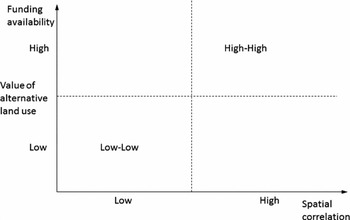
We developed a simple framework for assessing the potential for synergies in PES implementation that compares the availability of conservation funding for payments and the spatial correlation between the areas targeted for service provision and the areas that are important for other objectives, such as poverty reduction (Fig. 2). We focused on PES programmes that seek to address water services to illustrate the framework. The availability of funding typically depends on the willingness to pay of service users, if the programme is user-financed, or on government funding decision or funding rules, if it is government-financed (Pagiola & Platais Reference Pagiola and Platais2007; Engel et al. Reference Engel, Pagiola and Wunder2008). For user-financed programmes, the availability of funding reflects the demand (and value) of the services, which may not hold for government-financed programmes. Funding availability is considered relatively high (or low) if the offered payment is above (or below) the value of alternative land uses.
Framework for assessing the potential for synergies in PES programmes.

Spatial correlation measures the degree to which geographic areas targeted for different purposes overlap with each other. The quantification of spatial correlation requires the individual objectives to be clearly defined. For example, for the objective of poverty reduction, is it the incidence of poverty (poverty rate) or the concentration of poverty (number of the poor) that is the most relevant to the objective? These distinctions are often associated with different spatial distributions of thematic areas, resulting in different measurements of spatial correlation.
Under this framework, the potential for synergies between environmental service provision and poverty reduction is considered high when spatial correlation and funding availability are both high (the upper-right quadrant in Fig. 2). The potential for synergies is limited elsewhere. Areas that are important for service generation have limited poverty (low spatial correlation; the two quadrants to the left of Fig. 2), thus regardless of how much conservation funding is available in these areas, the PES programme will provide few poverty reduction benefits. When funding for PES is low, despite the presence of poverty in the targeted conservation areas, the potential for PES to contribute to poverty reduction will be limited, as few or no payments will be made (lower right quadrant of Fig. 2).
Data
We applied the assessment framework to an empirical analysis of the PSA programme in Costa Rica to explore the potential for synergies between the environmental conservation objectives and the social development objective, in light of the introduction of the new WCF through the PSA programme. Our analysis used three sets of geo-referenced data: (1) the existing PSA programme's PCAs, which are primarily determined based on biodiversity importance, (2) the watersheds targeted for water service provision, and the amount of WCF that will be generated in each of these watersheds, and (3) the level of social development at the watershed level. We describe each of the datasets and our data analysis approaches below.
We used a 1:50 000 map of water concessions (Fallas Reference Fallas2006) based on data on water concessions from the Ministry of Environment's Water Department, which covers 11 233 water use concessions (64% for surface sources and 36% for wells). It included the coordinates of the location from which water was to be abstracted, the total volume abstracted and the nature of the use. Each concession was mapped onto a watershed. The amounts paid by each concession were computed based on the concession amount and the tariff rate for each type of water user, using the rates that will be in force once the tariff is fully phased in. For example, domestic water supply systems will pay US$ 0.003 m−3 (CRC 1.46 m−3), while agro-industrial users will pay US$ 0.005 m−3 (CRC 2.64 m−3). We then computed the total water tariff revenue in each watershed by aggregating payments from all concessions in that watershed; a quarter of the total water tariff revenue is intended to be designated as WCF, channelled through the PSA programme and used specifically for watershed conservation.
The availability of geo-referenced data on welfare levels was the greatest obstacle to our analysis. The most detailed data source, the Encuesta de Hogares de Propósitos Múltiples (EHPM, Multipurpose Household Survey) of Costa Rica provides data only at the level of the 81 cantones, a spatial scale that is much larger than the watershed scale at which the WCF will be allocated. The only available geo-referenced data on welfare at a sufficient level of detail is the Índice de Desarrollo Social (IDS, Index of Social Development).
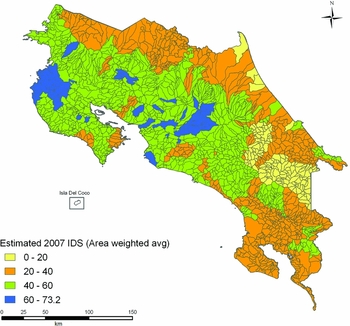
The IDS is an official measure of welfare that is estimated at the level of 470 districts. The IDS, prepared by the Ministerio de Planificación Nacional y Política Económica (MIDEPLAN, the Ministry of National Planning and Economic Policy), is a summary indicator that measures the heterogeneous distribution of progress in social development across geographic areas (MIDEPLAN 2001). The construction of the recent 2007 index is based on 11 equally weighted variables covering economic, social participation, health, and education dimensions, using variable such as under-five child mortality, coverage of potable water, and school dropout rates (MIDEPLAN 2007). As the index represents relative, as opposed to absolute, levels of social development measured by a package of variables, the value of IDS ranges from zero (least developed) to 100 (most developed). About 16% of the districts (74 districts) have IDS scores of less than 40, a practical rule-of-thumb cut-off level for an administrative unit to be considered poor. A spatial autocorrelation test shows strong evidence of a clustered pattern in the distribution of the 2007 district-level IDS scores (Moran's I index = 0.34) that can be roughly described as a series of concentric rings, with districts located further away from the centre of the country (the Greater San José Metropolitan Area) tending to have lower development levels. In particular, districts near the Nicaragua border and in the Huetar Atlantica region in the north, near the Panama border in the west, and in the Brunca region in the south tend to fall into the lowest two quintiles of IDS scores.
To allow comparison, the district-level IDS data must be mapped at a spatial scale that is consistent with that of the payment scheme (i.e. the watershed). To do this, we estimated an area-weighted average IDS score for each watershed from the IDS scores of the districts that intersect with it, weighted by the proportion of the watershed area that each district accounts for (Fig. 3). This procedure implicitly assumes that the population of each district is uniformly distributed, and that each person in each district has the average welfare level. While these are clearly not very satisfactory assumptions, no better approach is possible with the available data.
Distribution of 2007 IDS (Índice de Desarrollo Social, index of social development) scores in Costa Rica at the watershed level, estimated using data obtained from MIDEPLAN (2007).

We refer to watersheds that are expected to receive WCF payments as ‘WCF watersheds’. To assess the spatial correlation among watershed conservation, social development, and biodiversity conservation, we classified the total inland area into four groups: (1) ‘non-overlapping watersheds’ (WCF watersheds located outside the PCAs), (2) ‘overlapping PCAs’ (WCF watersheds that overlap with the PCAs), (3) ‘non-overlapping PCAs’ (PCAs that are located outside the WCF watersheds), and (4) areas outside both the WCF watersheds and the PCAs that are not eligible for any conservation payments.
RESULTS
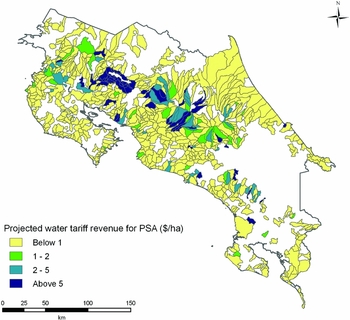
A total of 766 watersheds, covering almost 3 million ha (about 56% of total land territory), were expected to receive WCF payments (Fig. 4). A spatial autocorrelation test found that the amount of the WCF was distributed randomly in space; the pattern was neither clustered nor dispersed among watersheds (Moran's I index = 0).
Projected annual flow of watershed conservation funding in Costa Rica, based on data from Fallas (Reference Fallas2006). PSA = Pago por Servicios Ambientales (payments for environmental services). Water tariff revenues in US$ ha−1.

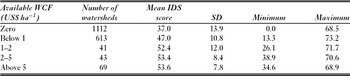
Despite the size of the WCF, funding available per hectare remained low (under US$ 5 ha−1 yr−1) in most WCF watersheds; 613 watersheds had only US$ 1 ha−1 yr−1 and only 69 watersheds had > US$ 5 ha−1 yr−1. In only one watershed (of about 1000 ha) would the WCF alone be sufficient to pay for the conservation of the entire watershed area at the current payment rate of US$ 64 ha−1 yr−1.
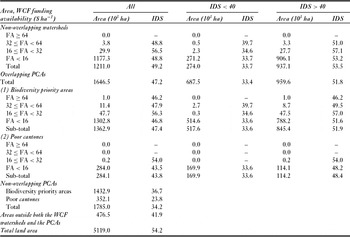
The non-overlapping watersheds occupied over 1.2 million ha, or 23.7% of the total inland area (Table 1). The WCF would be the only source of conservation financing in these areas, as they are not eligible for the existing PSA programme. None of the non-overlapping watersheds generated US$ 64 ha−1 yr−1. At the payment rate of US$ 32 ha−1 yr−1, the WCF could cover about 4000 ha, while at US$ 16 ha−1 yr−1, it could cover about 34 000 ha (about 3% of the area of non-overlapping watersheds). The overlapping PCAs occupied about 1.6 million ha, with the bulk of this (1.3 million ha) in biodiversity priority conservation areas. Here, too, most watersheds generated less than US$ 16 ha−1 yr−1.
Categorization of areas, by water conservation funding (WCF) and social development level. IDS = Índice de Desarrollo Social (Index of Social Development), PCA = priority conservation area, non-overlapping watersheds = WCF watersheds located outside PCAs, overlapping PCAs = WCF watersheds that overlap with PCAs, non-overlapping PCAs = PCAs located outside WCF watersheds, FA = funding availability.

Synergies between watershed conservation and social development
Overall, we found a positive but weak correlation between the estimated IDS scores and the per hectare availability of the WCF across watersheds (correlation coefficient = 0.15). Areas with no WCF had the lowest average levels of social development (IDS = 37). Among the WCF watersheds, those with WCF levels below US$ 1 ha−1 yr−1 had significantly lower estimated IDS scores than watersheds with higher levels of funding (Table 2). Even so, there were almost 1 million ha in the WCF watersheds that had IDS scores <40 (Table 1). However, almost all these areas had relatively low levels of WCF (<US$ 16 ha−1 yr−1), resulting in either payments that were too low to induce participation (or, if accepted, to have a meaningful impact on welfare), or only a small fraction of their area to be enrolled. About 71% of the area of the WCF watersheds with IDS <40 was in overlapping PCAs, where payments for watershed services and for biodiversity could potentially be combined.
Index of social development (IDS) score by level of the watershed conservation funding (WCF) derived from our own estimates. SD = standard deviation.

Synergies between watershed and biodiversity conservation
Over 1.6 million ha of land was classified as overlapping PCAs, accounting for about 48% of the total area of the PCAs and 58% of the area of the WCF watersheds. Of the overlapping PCAs area, nearly 1.4 million ha, or 83%, were biodiversity conservation priority areas (268 000 ha in protected areas and 1.1 million ha in biological corridors). Land users in these areas were eligible for both the WCF and the PSA programme budget. On average, WCF availability in the overlapping PCAs is slightly higher than in the non-overlapping watersheds. Over half of the PCAs do not coincide with the WCF watersheds. These non-overlapping PCAs include over 1.4 million ha of biodiversity priority conservation areas. In these areas, there is no potential for synergies with watershed payments.
Overall potential for synergies
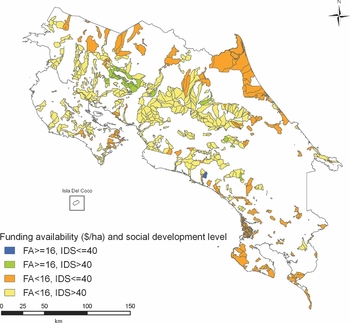
Using the framework (Fig. 2), we explored the potential synergies between the three objectives of protecting water services, conserving biodiversity and reducing social development gaps, taking into account the availability of the WCF. WCF watersheds located in biodiversity conservation priority areas were ranked by WCF availability and IDS scores (Fig. 5). The bulk of these areas were located in the northern part of the country, although some were also found along the south-western coast. These watersheds covered about 1.3 million ha. Of these, 518 000 ha had an IDS score of < 40. These 518 000 ha are the areas in which there is spatial feasibility for synergies among the three objectives. At first glance, this is a not inconsiderable, as the area accounts for 10% of the country's land area. However, the bulk of this area (515 000 ha) has < US$ 16 ha−1 yr−1 of WCF financing. Financing availability is thus likely to hinder the realization of the potential for synergies.
Areas in Costa Rica that lie within biodiversity conservation priority areas with watershed conservation funding, ranked by the availability of funding from the watershed conservation funding and by social development level. FA = funding availability (US$ ha−1), IDS = Índice de Desarrollo Social (index of social development).

DISCUSSION
In watersheds that receive the WCF and overlap with existing PCAs, the actual availability of conservation funding depends on how the WCF is combined with funds from the PSA programme budget. Variations in the number of water users, the volume they use, and the nature of use (which affects the tariff rate paid) resulted in large variations in the availability of funds across watersheds (Pagiola et al. Reference Pagiola, Platais, Ducassi, Zhang, Platais and Pagiola2012). Specifically, the WCF may be used to (1) substitute for the regular PSA funds, which would then be re-allocated elsewhere (this has been FONAFIFO's usual practice in watersheds where conservation covered by funding agreements with individual water users); (2) complement the regular funds, with payments to land users being shared among funding sources; and (3) add to the regular funds, allowing higher payments to be offered.
Our results imply that the potential for watershed payments alone to induce substantial social development impacts is likely to be limited; the areas to which the bulk of watershed payments are targeted are simply not the poorest areas. In addition, where watershed payments and low social development coincide, available funding is too limited to have a significant impact, except in combination with other funding.
Once the water tariff is fully implemented, the regular PSA budget should be about US$ 17 million annually (c. US$ 12 million from the fuel tax and almost US$ 5 million from the water tariff). At the current payment rate of US$ 64 ha−1 yr−1, this would allow conservation of about 265 000 ha. As there are a total of about 518 000 ha in overlapping PCAs that are located in both WCF watersheds and biodiversity priority conservation areas and have an IDS score of < 40, FONAFIFO could, in principle, maximize synergies across watershed, biodiversity and social development objectives by using all available funding in these 518 000 ha. In practice, such an optimal allocation is impossible, as the WCF must be spent by law in the watersheds in which it is generated. Thus, the WCF generated in non-overlapping watersheds must be spent there, and not in the overlapping PCAs. Likewise, some of the WCF generated inside overlapping PCAs must be spent in areas that are not priority biodiversity conservation areas, and some must be spent in areas with high levels of social development. The only watershed to generate sufficient funding to be fully conserved at current payment rates has an IDS score of 46.2. Of the total WCF, only about 7% is available for spending in areas where synergies across the three objectives are maximized. It would certainly make sense, however, for FONAFIFO to target its non-WCF regular budget of US$ 12 million to these 518 000 ha. Using this funding in non-overlapping PCAs would also potentially have a significant welfare impact, as these areas have a low IDS score (34.2), but doing so would forego the potential to have an impact on water services.
Several important caveats must be raised. First, our discussion focuses on spatial feasibility and on financial feasibility. These are essential conditions for synergies to be possible, but they are not the only ones. Ecological feasibility is also required: the land uses that provide one service must also provide the other. In the case of Costa Rica's PSA programme, ecological feasibility between watershed and biodiversity conservation objectives is unlikely to be a problem. Preserving existing ecosystems is likely to have the greatest positive impact on biodiversity (Pagiola et al. Reference Pagiola, Zhang and Colom2010) and this is precisely the PSA programme's primary focus. That the PSA programme will help deliver watershed services is less obvious. As noted above, the links between forest cover and water services are complex, and the PSA programme's almost exclusive focus on forest conservation is unlikely to be the most appropriate in every watershed.
Second, our analysis of potential poverty impacts focused on the average level of social development in areas that receive payments. However, unless everyone participates, the actual impact of Costa Rica's PSA programme on poverty will obviously depend on who receives payments. Even in an area with relatively high levels of social development, the poverty impact of PSA could be high if participants are disproportionately poor. Conversely, even in an area with low overall levels of social development, the poverty impact of PSA could be limited if only better-off households participate. Unfortunately, the limited available evidence on this topic is mixed at best. As noted above, several case studies have found that many PSA participants tend to be better off (Miranda et al. Reference Miranda, Porras and Moreno2003; Zbinden & Lee Reference Zbinden and Lee2005). However, these studies date from the initial stages of the PSA programme. Since then, concerted efforts have been made to encourage and support the participation of poorer landholders, notably through two projects financed by the World Bank and the GEF. No assessment has been made of how effective these efforts have been.
CONCLUSIONS
Synergies among projects that address specific social and environmental objectives can potentially improve the efficiency and effectiveness of resource allocation. Hopes that PES could generate such synergies have been particularly high. In this paper, we examined the potential for such synergies in the case of the new watershed conservation funding that Costa Rica's PSA programme is receiving. As with most funding streams for PES, this new funding stream has restrictions on how and where it can be spent. As a result, the potential for synergies depends on the extent to which the areas of interest for the different objectives overlap (spatial feasibility), on the amount of funding available (financial feasibility), and on the extent to which land use practices can provide multiple services (ecological feasibility).
We found significant spatial correlation among the areas targeted for watershed conservation, biodiversity conservation and poverty reduction. Spatial correlation is by no means perfect, and should certainly not be assumed to exist everywhere. Indeed, one important lesson from our results is that areas where such correlation exists must be deliberately sought out, however neither are such areas rare; in our case study, they covered as much as 10% of the country's land area.
Despite the spatial overlap, the potential for synergies is limited, primarily because of limited financial feasibility. Although US$ 5 million of watershed conservation funding will be available, this amount is distributed over a wide area, resulting in low available funding per hectare in most watersheds. The watersheds with the highest funding are not necessarily those with the highest potential for synergies with other objectives. In our case study, the watershed with the highest funding on a per hectare basis was also important for biodiversity conservation, but was not particularly poor. Although these restrictions seem harsh, the rule that water tariff revenues must be spent in the watersheds where they are generated is not an arbitrary one: it is intended to ensure that funding is highest where the value of water services is highest.
Our results show that the potential for significant synergies from the use of the new watershed conservation funding alone is limited. However, they also show that there are many areas containing potential for synergies. Ultimately, the biggest benefits would come, not from use of the watershed conservation funding per se, but from improved use of the programme's existing funding, which is not as spatially restricted. Over 3 million ha are eligible to receive payments from the regular budget, including 0.6 million ha that have high poverty rates but are of little biodiversity interest, and 1.8 million ha that are of no interest for water services. Within this area, contracts are issued on a first-come, first-served basis (Pagiola Reference Pagiola2008). By re-targeting this funding to the 0.5 million ha that provide both water and biodiversity services, and are located in areas of low social development, much higher benefits could be generated. Faced with a similar situation, Mexico introduced a points system to prioritize applications to its PES programme (Muñoz-Piña et al. Reference Muñoz-Piña, Rivera, Cisneros and García2011).
In addition to the synergies explored in this paper, additional synergies could be generated with carbon sequestration. Carbon sequestration has been an important objective of the PSA programme since its inception and, indeed, much of the programme's funding is derived from a fuel tax. However, the programme has not to date used carbon sequestration as an explicit targeting criterion, except on a very small scale. The potential for significant additional financing from new international programme of Reducing Emissions from Deforestation and Forest Degradation (REDD; URL http://www.un-redd.org/) is likely to change this. Like water conservation funding, REDD funding would be spatially targeted, in this case to areas at high risk of deforestation or degradation, so similar analyses to those conducted in this paper would be relevant. At present, however, these areas have not yet been identified.
We emphasize that this paper focuses on the potential for synergies, not the actual achievement of synergies, which requires a lot more than the spatial and financial feasibilities that are the focus of the current empirical analysis. Synergies cannot be achieved where there is no spatial and financial feasibility. However, neither are they guaranteed where spatial and financial feasibility exist.
ACKNOWLEDGEMENTS
We thank J.O.S. Batalla of MIDEPLAN and Jorge Fallas for their kind assistance in data collection. We thank two anonymous reviewers and the Editor in Chief for constructive comments. We are also grateful for the excellent editing services that Gillian Wilson provided. Any errors remain the responsibility of authors. The views in this paper are the authors' own, and do not necessarily reflect those of IFPRI and the World Bank.