

Revisiting the concept of issue salience: from fragmentation to integration
Far from being a static attribute of public issues, salience captures the dynamic interplay through which parties, citizens, and media negotiate the boundaries of political attention. Despite its centrality in political and communication research, the concept of issue salience has evolved through parallel and often disconnected traditions. Each field – party competition, media studies, and public opinion – has tended to privilege one causal direction, depicting salience either as a top-down process of elite emphasis, a bottom-up expression of citizen priorities, or a communicative outcome of media visibility. As a result, most research has approached salience through unidirectional or dyadic models of influence – typically focusing on one link at a time, such as party–voters (Carmines and Stimson, Reference Carmines and Stimson1980; Budge and Farlie, Reference Budge and Farlie1983; Bélanger and Meguid, Reference Bélanger and Meguid2008), media–party (Walgrave and Van Aelst, Reference Walgrave and Van Aelst2006; Green-Pedersen and Stubager, Reference Green-Pedersen and Stubager2010; Hopmann et al., Reference Hopmann, Elmelund-præstekær, Albæk, Vliegenthart and de Vreese2012), media–public (McCombs and Shaw, Reference McCombs and Shaw1972; Soroka, Reference Soroka2002; Vliegenthart and Walgrave, Reference Vliegenthart and Walgrave2011), or public–policy (Wlezien, Reference Wlezien1995; Soroka and Wlezien, Reference Soroka and Wlezien2010). Yet, as classic works on agenda control have shown, the very definition of what enters or exits the political agenda reflects a deeper contest over visibility and power, echoing Schattschneider's (Reference Schattschneider1960) idea of the agenda as a site of political struggle. In this sense, foundational contributions on agenda denial (Cobb and Ross, Reference Cobb and Ross1997) and non-decision making (Bachrach and Baratz, Reference Bachrach and Baratz1962) remain crucial for identifying how issues are prioritized or excluded. On one side, political scientists have largely conceptualized salience as an instrument of strategic competition (Budge and Farlie, Reference Budge and Farlie1983; Petrocik, Reference Petrocik1996), while communication research has focused on media-driven agenda-setting (McCombs and Shaw, Reference McCombs and Shaw1972), and public opinion scholars have analyzed it as an indicator of perceived importance or problem pressure (Wlezien, Reference Wlezien2005; Jennings and Wlezien, Reference Jennings and Wlezien2015). These perspectives, though complementary, rarely intersect empirically or conceptually.
The lack of integration is not merely terminological but conceptual: similar words describe distinct objects of study. For instance, different research traditions have approached salience through distinct lenses: issue emphasis in party research, issue importance versus problem status in public opinion studies, and issue visibility (or media attention) in communication research. This polysemy has generated analytical ambiguities and limited comparability across spheres. Moreover, despite growing relevance to cross-domain interactions, research still offers limited insight into how attention circulates among these arenas and how feedback processes sustain or erode institutional and public focus. Consequently, existing comparative works on cross-sphere linkages remain exceptions rather than the rule (Baumgartner and Jones, Reference Baumgartner and Jones2005; Barberá et al., Reference Barberá, Casas, Nagler, Egan, Bonneau, Jost and Tucker2019; Wlezien and Soroka, Reference Wlezien and Soroka2024). In turn, while the notion that salience “travels” between citizens, parties, and media is widely acknowledged, the processes through which it does so have seldom been theorized systematically.
At the same time, recent scholarship has made important advances in refining both the conceptual and empirical treatment of issue salience. For example, Moniz and Wlezien (Reference Moniz and Wlezien2020) distinguish between personal, media, and political salience, clarifying the difference between perceived importance and observable attention while identifying tensions between conceptual definitions and measurement strategies. Agenda-setting research, in turn, has increasingly adopted the issue as a “tracer liquid” of political dynamics, analyzing how attention moves across systemic, institutional, and decision agendas (Green-Pedersen and Walgrave, Reference Green-Pedersen and Walgrave2014; Zahariadis, Reference Zahariadis, Zahariadis and Taylor2025). Other contributions have questioned strict zero-sum assumptions, demonstrating that agenda change may involve issue substitution or volume expansion rather than simple displacement (Ennser-Jedenastik et al., Reference Ennser-Jedenastik, Haselmayer, Huber and Scharrer2022). These reconceptualization approaches share an important insight: issues can be used to trace patterns of responsiveness and inter-arena transmission. They have substantially clarified how attention moves across public, media, and political arenas and how agenda change can be observed empirically. What remains less systematically theorized, however, is how these arenas become mutually constitutive in shaping the very conditions under which an issue attains collective standing.
This article addresses these limitations by developing a unified perspective on issue salience that makes the three agendas analytically comparable and theorizes the relational conditions under which their interdependence produces salience, within a single system of reciprocal collective prioritization. The contribution is mainly theoretical: it specifies a common definitional core and a framework that explains how salience emerges and circulates through flows of supply, demand, and mediation. By clarifying the conceptual foundations of salience, this approach also opens the way for empirical strategies capable of capturing dynamic cross-sphere alignment and misalignment, a dimension increasingly central to the study of democratic responsiveness.
The paper proceeds as follows: the next section revisits how the literature has conceptualized salience and delineates the core definitional dimensions necessary for comparative analysis. The section “From disciplinary diversity to conceptual integration: toward a definitional synthesis” develops a conceptual synthesis that clarifies the shared foundations of salience across spheres. The section “From concept to measurement challenges” integrates these conceptual advances into a discussion of the methodological implications of measuring salience in different agendas. The section “A triadic framework of salience dynamics” presents the core of the paper by introducing the triadic framework of salience formation. The section “Future research directions” outlines key research directions, while the section “Conclusions” concludes.
Defining issue salience in the literature
A first step toward integration requires revisiting how the literature itself has defined salience, clarifying its conceptual core. A review of classical and contemporary research reveals that the ambiguity surrounding issue salience stems from its hybrid and “floating” nature (Giuliani, Reference Giuliani, Capano and Giuliani1996: 368), oscillating between individual perception, strategic communication, and collective visibility. Over time, the term has been used to describe at least three overlapping phenomena: (1) the perceived importance of issues to citizens; (2) the emphasis parties assign to issues in political competition; and (3) the prominence of issues within media coverage. Each of these definitional strands emerged within distinct disciplinary traditions – public opinion research, party competition theory, and communication studies – that developed largely in parallel. Understanding their respective logics is essential to reconstructing a shared conceptual core.
Public opinion research
In public opinion studies, salience typically refers to the importance citizens attribute to specific issues relative to others competing for attention. Classic works defined it as the degree to which an issue “matters” to the public (Key, Reference Key1961; Carmines and Stimson, Reference Carmines and Stimson1980), often operationalized through the most important problem (MIP) question or similar indicators of issue priority. Later refinements show that salience cannot be reduced to perceived importance alone: it involves the intensity and breadth of concern and the recognition of an issue as a problem (Wlezien, Reference Wlezien2005), the distinction between problem status and issue attention (Bromley-Trujillo and Poe, Reference Bromley-Trujillo and Poe2020), the differentiation between individual and societal importance (Paul and Fitzgerald, Reference Paul and Fitzgerald2021), and the separation of evaluative preference from cognitive relevance (Hatton, Reference Hatton2017), thereby framing salience as a politically consequential allocation of attention within citizens’ cognitive agendas. As Downs (Reference Downs1972) illustrated through the issue-attention cycle, such prioritization fluctuates over time, underscoring the dynamic and context-dependent character of public salience.
Party competition studies
In the literature on party competition, the meaning of salience shifts from importance to strategic emphasis. Following Budge and Farlie's (Reference Budge and Farlie1983) distinction between position and salience strategies, Petrocik's (Reference Petrocik1996) theory of issue ownership, and Riker's (Reference Riker1986) notion of heresthetic – the strategic manipulation of issue dimensions – parties are understood to compete not only through policy positions but also through the selective emphasis of issues. Salience here is the outcome of selective attention and prioritization within political communication. By choosing which issues to highlight, parties seek to shape the agenda in ways that mobilize their constituencies and neutralize their opponents.
Empirical research confirms that managing issue emphasis is as central to competition as position-taking (Sigelman and Buell, Reference Sigelman and Buell2004) and that convergence in policy positions often coexists with differentiation in framing and salience (Kaplan et al., Reference Kaplan, Park and Ridout2006). Subsequent work conceptualizes salience within a dynamic system of issue competition shaped by electoral incentives, media interactions, and public responsiveness (Green-Pedersen, Reference Green-Pedersen2007).Footnote 1 Related approaches show that parties prioritize issues according to their electoral yield (De Sio and Weber, Reference De Sio and Weber2014) and emphasize themes where they hold reputational or competence advantages (Budge, Reference Budge2001; Van der Brug, Reference Van der Brug2004; Wagner and Meyer, Reference Wagner and Meyer2014). Recent contributions further argue that salience-based differentiation enhances partisan decidability and voters’ perception of meaningful choice (Gunderson, Reference Gunderson2024).
Party salience also bears institutional consequences. The issues that parties systematically emphasize in opposition or government shape the prioritization of themes in parliamentary debate and, when in office, the distribution of attention across policy agendas and decision-making venues (Baumgartner and Jones, Reference Baumgartner and Jones2005; Green-Pedersen, Reference Green-Pedersen2007; Bevan and Jennings, Reference Bevan and Jennings2014). These effects remain mediated by procedural constraints, coalition dynamics, and venue-specific frictions, so that party salience shapes policymaking without determining it mechanically.
Thus, in the partisan domain, salience is an attribute of issues as articulated by political actors, grounded in agenda control and strategic behavior.
Media and political communication studies
Within communication research, salience concerns the visibility and prominence of issues in the media agenda and, more broadly, in mediated public arenas. Originating from McCombs and Shaw's (Reference McCombs and Shaw1972) seminal study of agenda-setting, and further elaborated through the framing and priming traditions (Iyengar and Kinder, Reference Iyengar and Kinder1987; Entman, Reference Entman1993), media salience refers to the amount and placement of coverage that an issue receives within professional news organizations, which in turn affects public perceptions of its importance. Recent contributions have increasingly challenged this classical top-down model of persuasion (Jacobs and Shapiro, Reference Jacobs and Shapiro2001; Zaller, Reference Zaller2003; McGregor, Reference McGregor2020), suggesting that media not only shape but also reflect public opinion (Wlezien and Soroka, Reference Wlezien and Soroka2024). Research on reverse or public-driven agenda-setting shows that shifts in public concern can precede and influence media and legislative agendas (Kertzer and Zeitzoff, Reference Kertzer and Zeitzoff2017; Barberá et al., Reference Barberá, Casas, Nagler, Egan, Bonneau, Jost and Tucker2019), supporting a bidirectional understanding of influence. Similar dynamics characterize media–party interactions, where journalistic visibility both mirrors and reshapes political priorities (Vliegenthart and Walgrave, Reference Vliegenthart and Walgrave2011). These reciprocal processes are amplified within the hybrid media system (Chadwick, Reference Chadwick2017; Langer and Gruber, Reference Langer and Gruber2021), in which legacy media, digital platforms, and direct political communication interact. Evidence suggests that traditional media, party communication, and politicians’ social media mutually predict one another over time (Gilardi et al., Reference Gilardi, Gessler, Kubli and Müller2022), producing networked amplification that combines vertical and horizontal attention flows (Maniou and Bantimaroudis, Reference Maniou and Bantimaroudis2021). At the same time, platform-based visibility and algorithmic curation increasingly structure which issues gain prominence (Napoli, Reference Napoli2014), redistributing gatekeeping across institutional and computational actors.
Cross-national research further shows that patterns of media salience are shaped by structural differences in media systems and journalistic autonomy (Curran, Reference Curran2012; Hallin and Mancini, Reference Hallin and Mancini2017). From this perspective, salience represents a communicative property of issues within a competitive attention economy, shaped by editorial routines, news values, and audience dynamics. It captures what becomes visible and how persistently it remains so (Budge and Farlie, Reference Budge and Farlie1983; Zaller, Reference Zaller1992), within the mediated public sphere. Yet visibility is selective: saturation of certain topics may crowd out alternative voices (Morlino and Sorice, Reference Morlino and Sorice2021), contributing to agenda denial and non-decision-making (Bachrach and Baratz, Reference Bachrach and Baratz1962; Cobb and Ross, Reference Cobb and Ross1997).
From disciplinary diversity to conceptual integration: toward a definitional synthesis
Despite their differences, the three traditions converge on a common intuition: issue salience expresses the relative importance of topics within bounded agendas. Whether conceived as citizens’ perceptions, party strategies, or media visibility, salience concerns how democratic systems allocate limited attention. What varies is the analytical lens: public opinion research treats salience as an individual property (Jennings and Wlezien, Reference Jennings and Wlezien2015), party competition theory as a strategic resource (Green-Pedersen, Reference Green-Pedersen2007), and communication studies as a communicative outcome (Weaver, Reference Weaver1991). These perspectives typically adopt a sequential view of causality, in which salience moves linearly from one actor to another. Although feedback is empirically acknowledged, it is rarely theorized as part of an integrated system of attention. Recent empirical studies have indeed begun to document multidirectional interactions across policy, media, and public agendas. For instance, Lee et al. (Reference Lee, Lee and Kim2026) show systematic correlations among institutional communication, media coverage, and public attention in a networked information environment. Yet such contributions treat salience as directly observable patterns of attention, leaving its conceptual status largely unspecified. This limitation indicates the need for a conceptual integration of the three traditions. Integrating these perspectives requires a shift from studying who influences whom to analyzing how attention itself circulates. Instead of privileging one-directional logic – top-down or bottom-up – the challenge is to understand how citizens, parties, and media coproduce the visibility and importance of issues through reciprocal adjustments (Soroka and Wlezien, Reference Soroka and Wlezien2010; Green-Pedersen and Mortensen, Reference Green-Pedersen and Mortensen2015). While agenda-setting scholarship has convincingly used issue salience as a tracer to map influence patterns within political systems (Green-Pedersen and Walgrave, Reference Green-Pedersen and Walgrave2014; Zahariadis, Reference Zahariadis, Zahariadis and Taylor2025), our argument moves beyond influence detection to conceptualize salience as a relational and emergent property of hybrid communicative environments. In doing so, we theorize it as the outcome of ongoing, multidirectional circulation across institutional, media, and citizen arenas, where visibility is coproduced and continuously reconfigured. This shift entails treating salience as more than a mere indicator of agenda power.
A first step in this direction is, as often with foundational concepts, to return to the classics, where we already find crucial dimensions of salience and its dynamics. Following Sartori's (Reference Sartori1970) distinction between intensity and extension, an issue becomes salient when it combines high subjective concern with broad societal diffusion – when it is “very important to many.” Salience, therefore, implies more than awareness: it reflects collective prioritization within a limited attention space. This interpretation also aligns with Stone's (Reference Stone1989) notion of causal stories, according to which issues gain salience not because of their objective properties but because they are framed as politically actionable.
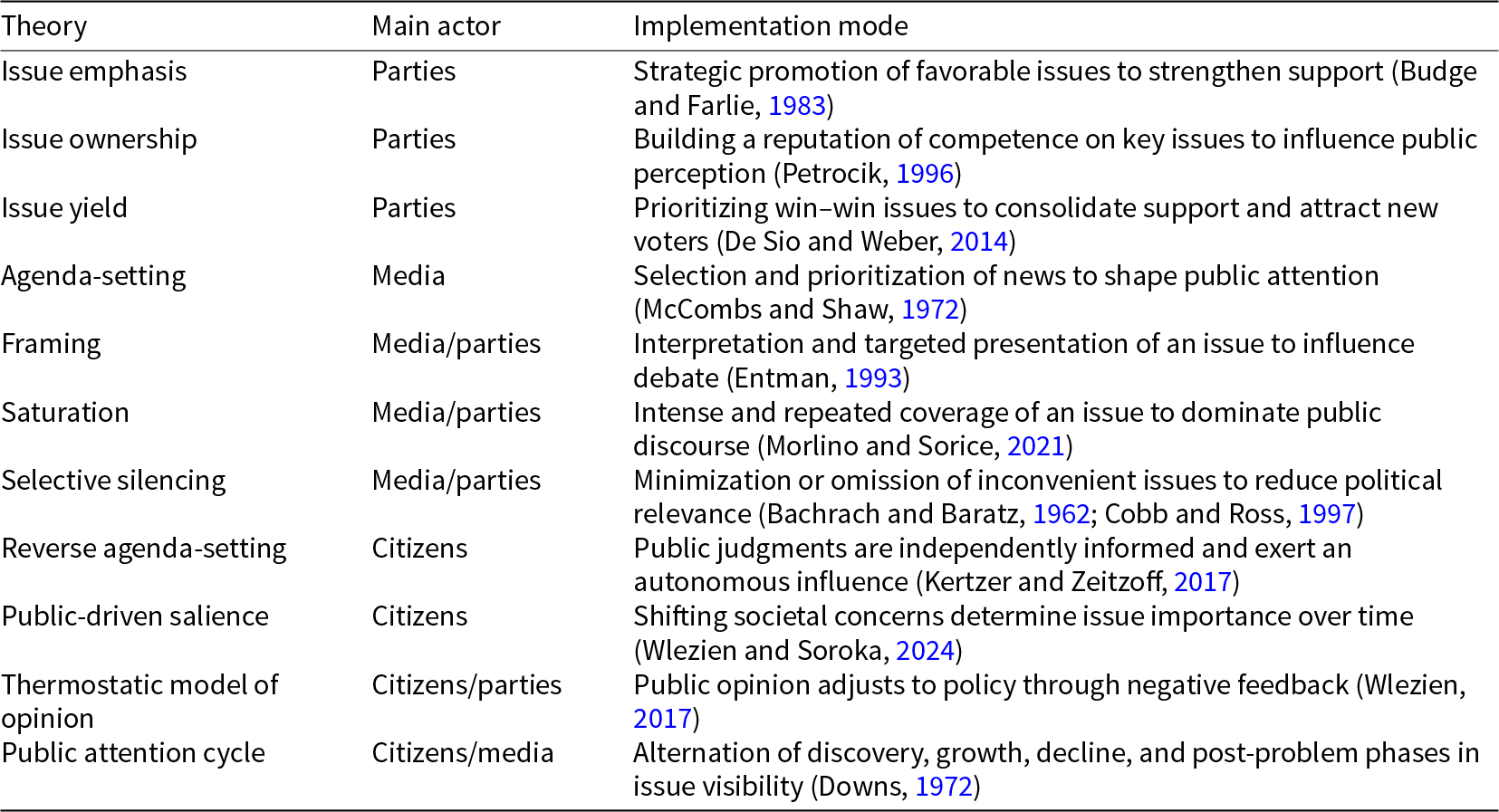
Table 1 organizes the main theoretical traditions according to the mechanisms through which salience is produced, stabilized, or transformed across public, media, and political arenas. The selection follows two criteria: approaches are included if they (a) explicitly specify a mechanism of salience attribution and (b) apply to at least one of the three spheres under analysis. The list is not exhaustive but representative of the dominant logics identified in the literature reviewed in the section “Defining issue salience in the literature”. Models centered on short-term campaign dynamics – such as “riding-the-wave” frameworks (Ansolabehere and Iyengar, Reference Ansolabehere and Iyengar1994; Klüver and Sagarzazu, Reference Klüver and Sagarzazu2016) – are treated as empirical manifestations of broader logics of strategic emphasis rather than as distinct theoretical categories. Responsiveness, similarly, is not listed as a separate entry: it operates as a cross-sphere relational outcome – the degree to which one sphere adjusts its attention in response to another – and therefore appears throughout the framework as a property of the interactions among the mechanisms listed, rather than a mechanism in its own right (on salience as an indicator of rhetorical responsiveness, see footnote 1). The aim is to isolate the core logics of salience formation while keeping the conceptual architecture parsimonious.
Classical theoretical approaches to issue salience

Table 1 Long description
The table lists eleven classical approaches to explaining why some political issues become more prominent, organized by theory, main actor, and implementation mode. Party-centered theories include issue emphasis, issue ownership, and issue yield, all describing how parties promote favorable topics, build competence reputations, or prioritize broadly appealing issues to gain or consolidate support. Media-centered approaches include agenda-setting, which prioritizes news to steer public attention, and framing, which shapes interpretation through targeted presentation. Several theories treat media and parties jointly, including saturation through repeated coverage and selective silencing through minimizing or omitting inconvenient issues. Citizen-centered approaches include reverse agenda-setting, where public judgments form independently and influence politics, and public-driven salience, where changing societal concerns shift issue importance over time. Mixed citizen and party dynamics appear in the thermostatic model, where public opinion reacts against policy direction through negative feedback. A mixed citizen and media account is the public attention cycle, describing phases from discovery to decline in issue visibility. The entries summarize conceptual mechanisms and cite exemplar authors rather than providing quantitative evidence or effect sizes.
Source: Author's elaboration.
Building on this literature, issue salience can be conceptualized as a multidimensional construct comprising both perceptual and structural components:
• Problem status – is the issue perceived as unresolved or urgent?
• Importance – does it matter to individuals or to society?
• Intensity – how strongly does it matter?
• Extension – to how many does it matter?
These dimensions help in explaining why salience is inherently dynamic – subject to amplification, decay, and transformation as citizens, parties, and media compete to define what counts as politically relevant. In this sense, the point is not that multidirectionality has been ignored, but that it has rarely been made an explicit and organizing principle. Making it explicit means recognizing salience as a relational property. Salience is therefore interpreted as a shared attribute of issues across citizens, parties, and media. It reflects the degree of attention and priority assigned within political, media, and public arenas, while the mechanisms of attribution – how importance is assigned, amplified, or neglected – vary across spheres.
Citizens attribute salience through cognitive and affective prioritization, expressing which issues they regard as most pressing for society. Parties attribute salience through strategic emphasis, selecting which issues to highlight or downplay in order to mobilize support. The media attribute salience through visibility, deciding which issues occupy central space in the news agenda. In each case, attention is a scarce resource that actors distribute selectively, making salience a positional property of issues within limited and competitive agendas.
By conceptualizing salience as an issue-level attribute rather than an actor-level disposition, we gain analytical comparability: the same construct – relative importance – can be measured through distinct yet parallel indicators across spheres. This cross-sphere perspective provides the conceptual foundation for a triadic model of how attention is allocated, negotiated, and redistributed between citizens, parties, and media.
To operationalize this unified concept, it is essential to distinguish the core characteristics of salience from its determinants. The former defines what salience is; the latter explains why some issues become salient, while others remain marginal.
Consequently, the features problem status, importance, intensity, extension, describing the internal structure of salience – how strongly and how widely issues are prioritized – are observable within each sphere, even if measured differently (see next section). By contrast, contextual determinants, such as perceived governability, moral or emotional charge, elite contestation, operate across spheres, shaping the rise or decline of salience without altering its conceptual definition. For instance, ungovernable issues (because of their technical or strategic complexity) may fade despite persistent problem pressure (Morlino and Sorice, Reference Morlino and Sorice2021), strong normative framings can rapidly broaden attention (Stone, Reference Stone1989), and partisan conflict often amplifies visibility and polarizes focus (Bélanger and Meguid, Reference Bélanger and Meguid2008).
At this point, issue salience can be approached as a latent relational property emerging from the interaction among citizens, parties, and media. It does not appear directly in any single indicator. Public concern, party emphasis, and media visibility, therefore, refer to the same underlying structure of collective attention while capturing different observable manifestations of it. This conceptual clarification enables us to move from definitional foundations to a shared operational understanding of salience, which the next section sets out.
From concept to measurement challenges
Building on the conceptual synthesis developed in the previous section, this part considers the implications of defining salience as a shared and dynamic attribute of issues. The main challenge lies in measuring a phenomenon that fluctuates as collective attention shifts, making its empirical observation intrinsically unstable, as documented in research on issue-attention cycles and punctuated agenda dynamics (Downs, Reference Downs1972; Baumgartner and Jones, Reference Baumgartner and Jones2005). By outlining these challenges, this section motivates the need for a broader analytical perspective, which the section “A triadic framework of salience dynamics” will introduce through the triadic framework of issue salience formation.
Working definition
Issue salience is the relative importance of a political issue within systems of collective attention (Budge and Farlie, Reference Budge and Farlie1983; Green-Pedersen, Reference Green-Pedersen2007). It expresses how strongly and how widely an issue is prioritized in public debate, political competition, and media communication. While its measurement can vary across spheres and methodological strategies, its conceptual core remains the same: salience is an attribute of issues, shaped by contextual determinants but analytically distinct from them (Sartori, Reference Sartori1970). This shared foundation allows the three spheres to be treated as distinct mechanisms of salience attribution rather than as separate domains of analysis. Citizens, parties, and media thus participate in the same process of attention formation, each operating under different incentives and constraints but contributing jointly to the overall configuration of issue prominence in democratic life.
Theoretical implications
Defining salience as a cross-sphere attribute has direct consequences for how we model its formation. If citizens, parties, and media each allocate attention according to distinct logics (Strömbäck, Reference Strömbäck2008; Soroka and Wlezien, Reference Soroka and Wlezien2010), salience cannot be reduced to a single direction of influence. It emerges instead from a network of reciprocal attributions in which every sphere acts simultaneously as a source and a recipient of attention.
Traditional models – whether focusing on media-public (McCombs and Shaw, Reference McCombs and Shaw1972) or party-voter linkages (Petrocik, Reference Petrocik1996) – have conceptualized salience as a dyadic process, where one actor sets the agenda, and another responds. Although scholars have increasingly acknowledged feedback dynamics between agendas, these contributions often remain confined within disciplinary boundaries or focus on bilateral interactions. Yet citizens do not merely react to elite or media cues; they also shape issue prioritization through mobilization, social media discourse, and opinion feedback (Barberá et al., Reference Barberá, Casas, Nagler, Egan, Bonneau, Jost and Tucker2019). Parties, for their part, monitor public concerns and media trends to adjust their emphases accordingly, while journalists interpret and translate both political and societal signals into news narratives that, in turn, re-enter and reshape the cycle of attention.
Viewing these interactions through a triadic lens captures the complexity of contemporary issue dynamics. Empirical research has increasingly pointed to such multidirectional dynamics across public, media, and political arenas, even when examined within bilateral frameworks (e.g. Barberá et al., Reference Barberá, Casas, Nagler, Egan, Bonneau, Jost and Tucker2019; Gilardi et al., Reference Gilardi, Gessler, Kubli and Müller2022). Each sphere performs different yet interdependent functions:
• Supply: generating issue attention and proposing frames of relevance;
• Demand: expressing expectations or pressures that call for greater visibility;
• Mediation: transmitting, amplifying, or reframing issues across spheres.
These are not fixed roles but mutable positions within a continuous feedback process. At certain times, citizens may supply salience through collective mobilization, while parties or media respond; at others, political or journalistic agendas drive attention, eliciting public reaction. What matters is not the direction but the configuration of interactions determining which issues become central, peripheral, or contested in democratic debate.
This approach thus moves beyond classical agenda-setting (McCombs and Shaw, Reference McCombs and Shaw1972; Green-Pedersen and Walgrave, Reference Green-Pedersen and Walgrave2014) by conceptualizing salience as a triadic feedback system, where citizens, parties, and media continuously adjust their emphases in response to one another. It allows for asymmetries – since not all spheres possess equal resources or visibility – yet highlights the interdependence of attention dynamics across the three spheres.
From this perspective, capturing salience empirically requires translating these interactive dynamics into comparable indicators across agendas.
The measurement of issue salience has long posed significant challenges to political science (Epstein and Segal, Reference Epstein and Segal2000) because salience is both conceptually flexible and empirically multifaceted. Public salience is most commonly measured through survey-based indicators such as the MIP question, increasingly complemented by behavioral and digital trace data (Mellon, Reference Mellon2014; Barberá et al., Reference Barberá, Casas, Nagler, Egan, Bonneau, Jost and Tucker2019). Party salience is traditionally operationalized through manifesto-based indicators, though recent approaches integrate multiple communication channels to capture issue emphasis across arenas (Helbling and Tresch, Reference Helbling and Tresch2011; Ivanusch, Reference Ivanusch2025). Media salience is inferred from frequency and placement of issue coverage (Kiousis, Reference Kiousis2004), with digital platforms and automated content analysis increasingly expanding the range of available indicators (Soroka and Wlezien, Reference Soroka and Wlezien2019). However, if salience is defined as the relative importance of issues within systems of collective attention, as assumed here, then measurement must reflect how citizens, parties, and media express and prioritize attention, while preserving comparability across these spheres. This implies that measurement is never neutral: how we define salience determines how we observe it (Sartori, Reference Sartori1970; Boudon and Filleule, Reference Boudon and Filleule2005 [2002]). A detailed discussion of measurement strategies across public, party, and media spheres is provided in Supplementary Appendix A, which forms an integral part of the article.
In addition, salience is inherently zero-sum: attention devoted to some issues limits the space available for others. For this reason, the prominence of a single issue should be interpreted in relation to how attention is distributed across the full set of issues – that is, whether agendas are concentrated on a narrow set of topics or more evenly dispersed, as captured by measures of agenda diversity (Boydstun et al., Reference Boydstun, Bevan and Thomas2014a). This reinforces that salience indicators must be read as relative rather than absolute measures of importance.
Ultimately, the methodological challenges of measuring issue salience reflect its conceptual complexity. Salience is a relational configuration of attention shaped by cognitive, communicative, and informational cues. Capturing it empirically demands methodological pluralism, sensitivity to context, and explicit alignment between conceptual definition and operational strategy. By focusing on salience as a shared attribute of issues, we create the conditions to analyze how collective attention evolves within democratic systems and how it links, or fails to link, citizens’ concerns, party strategies, and media agendas. In this view, the degree of alignment across these spheres would offer the most realistic indication of when an issue is considered salient.
These premises are essential for the next step: understanding how salience actually forms and circulates across citizens, parties, and media. The following section develops this dynamic perspective by introducing the triadic framework at the core of the article's theoretical contribution.
A triadic framework of salience dynamics
The conceptual and operational groundwork laid so far leads to the core contribution of this article: a systematic framework that explains how issue salience is coproduced across citizens, parties, and media. Building on the shared definition and measurement principles established in the previous sections, this part develops a dynamic and triadic perspective on salience formation. By theorizing how supply, demand, and mediation interact across spheres, the framework not only integrates previously fragmented approaches but also opens new opportunities for comparative research on attention and democratic responsiveness.
The triadic framework proposed here conceptualizes issue salience as the product of continuous interactions among citizens, parties, and media, understood as distinct but interdependent spheres of attention allocation. Each sphere performs three possible functions – supply, demand, and mediation – that alternate over time and across issues. Salience emerges not from unilateral influence but from the reciprocal adjustments that occur when these functions overlap.
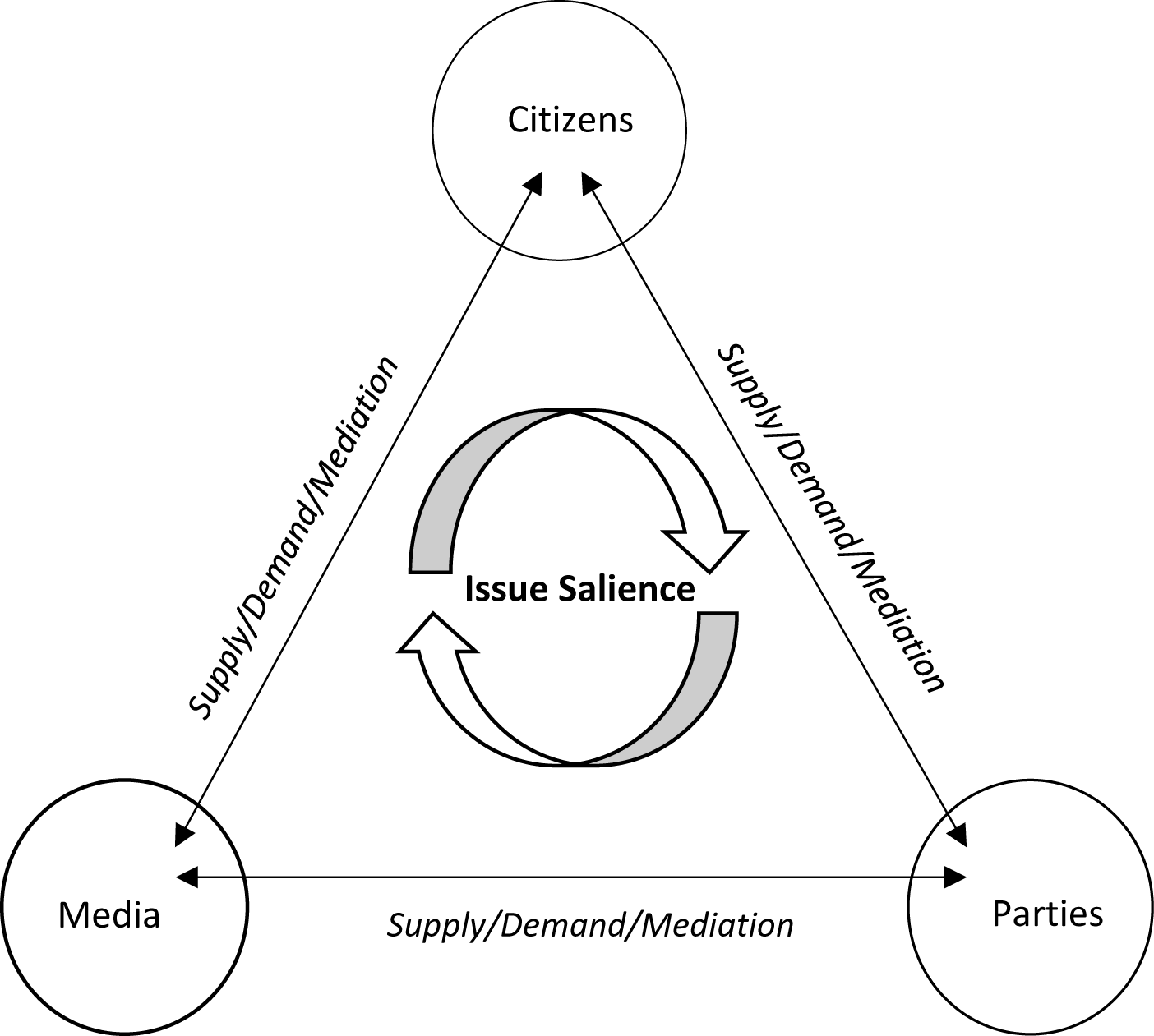
Figure 1 summarizes this configuration. The three spheres are represented as nodes of a triangle connected by double-headed arrows, indicating reciprocal flows of attention. Each connection corresponds to a function – supply, demand, or mediation – through which issue salience circulates across spheres rather than originating within one of them.
The triadic framework of issue salience.
Note: Citizens, parties, and media form a triangular system of reciprocal attention flows (double-headed arrows), with salience represented at the center as a recursive dynamic. The different circle thicknesses indicate asymmetries in communicative power among spheres, while each connection combines supply, demand, and mediation functions.

Supply refers to the capacity of a sphere to generate attention for an issue by introducing or amplifying it in public debate. Parties supply salience through campaign emphasis and policy framing; media through agenda-setting and news selection; citizens through mobilization, petitions, or online activism.
Demand captures pressures for attention – instances in which actors call upon others to address or prioritize an issue. Public concern, protest, or survey feedback represents demand toward parties and media; journalistic questioning or investigative exposure constitutes demand directed at political institutions.
Mediation designates the transmission and transformation of issue attention between spheres. Media translate political and societal signals into communicative visibility; parties react to public priorities by reframing them into policy proposals; citizens reinterpret media and political cues through everyday conversation or online discussion.
Salience here is not generated within isolated spheres but coproduced through reciprocal flows of attention. The model allows for asymmetries – since each actor possesses distinct resources and incentives – yet it underscores that the visibility and prioritization of issues depend on mutual responsiveness. When supply, demand, and mediation align, salience converges across spheres, reinforcing agenda coherence and perceived representational quality. Conversely, when these functions diverge, attention becomes fragmented, creating misalignments that can weaken democratic responsiveness. Moreover, these functions are not mutually exclusive: any sphere can act as supplier, demander, or mediator depending on contextual incentives and the phase of the attention cycle. Salience thus results from a dynamic equilibrium of attention flows, where changes in one sphere trigger adjustments in the others.
Because the three spheres possess unequal resources and visibility, interactions are rarely symmetrical. Media outlets often act as central mediators, filtering both political and civic demands; parties control institutional access and strategic framing; citizens vary in organizational capacity and communicative reach. Yet none of these spheres fully determines the agenda. The system operates through feedback loops, in which attention circulates recursively and can invert direction. For instance, sustained public concern about climate change may pressure parties to adopt new priorities (demand), prompting intensified coverage (mediation) and further reinforcing public salience (supply) (Alvarez and Morrier, Reference Alvarez and Morrier2024). Conversely, excessive exposure to a theme can generate saturation effects, whereby attention declines despite persistent problem severity (Baumgartner and Jones, Reference Baumgartner and Jones2024). These recursive mechanisms highlight that salience is both responsive and self-correcting: issues rise and fall according to how actors perceive and respond to each other's signals.
This framework implies that measuring salience comparatively requires identifying how these functions manifest within each sphere and across time. Rather than treating citizens, parties, and media as separate units, analysis should focus on patterns of alignment and misalignment in their issue hierarchies. When the three spheres converge on the same issues, salience alignment fosters responsiveness and perceived legitimacy; when they diverge, gaps emerge that may erode democratic satisfaction (Reher, Reference Reher2015).
The triadic model, therefore, links descriptive analysis of attention with normative questions of responsiveness. By tracing who defines what matters, whose priorities prevail, and how mutual adaptation occurs, it captures the communicative foundations of democratic representation in the age of hybrid media systems. For analytical clarity, a typology of recurrent triadic configurations illustrating these interaction patterns is provided in Supplementary Appendix B (see Table A1).
Future research directions
The triadic framework proposed here opens several promising directions for future research on the dynamics of issue salience and democratic responsiveness. Developing these avenues requires designs that observe salience both within and across political, media, and public spheres, under varying institutional and communicative conditions.
A first task concerns integrated research designs that combine multiple data sources within unified analytical frameworks. The growing availability of public opinion surveys (e.g. Eurobarometer; European Election Study), policy and media agenda datasets (e.g. Comparative Agendas Project), party issue-emphasis datasets (e.g. Manifesto Project Database; Chapel Hill Expert Survey), and digital trace datasets (e.g. GDELT) enables researchers to map the co-evolution of agendas with increasing precision. Some studies already compare agenda dyads – for instance, media–public or media–political influence – but seldom all three spheres simultaneously (Barberá et al., Reference Barberá, Casas, Nagler, Egan, Bonneau, Jost and Tucker2019; Wlezien and Soroka, Reference Wlezien and Soroka2024). Such designs would allow scholars to address questions that remain largely unexplored: Under what institutional configurations do spheres converge rapidly? Which issues are more likely to generate alignment across arenas? How does cross-sphere inequality of visibility shape political responsiveness? An integrated design would not simply juxtapose these data sources but model them within a common temporal and conceptual framework, allowing researchers to observe whether shifts in public priorities precede, follow, or co-evolve with party and media agendas. For example, combining monthly public opinion data with manifesto emphases and media issue frequencies would make it possible to detect delayed responsiveness, asymmetric amplification, or agenda inertia across spheres. More broadly, the framework implies a different empirical object. Public, party, and media indicators should not be treated as interchangeable measures of a single variable, but as temporally related components of a shared process. Empirical analyses can therefore focus on how agendas interact – for instance, whether media visibility precedes public prioritization or whether public concern triggers strategic emphasis by parties. The relevant outcome is not the level of salience within each sphere, but the configuration of their mutual adjustment. Under this perspective, salience emerges as a systemic property of cross-sphere alignment, not a property attributable to any single agenda.
Longitudinal and cross-national analyses can then examine how institutional contexts – such as electoral incentives, media pluralism, and partisan competition – shape the strength and symmetry of these attention flows.
A second priority involves the study of feedback loops and patterns of temporal sequencing. Because salience circulates, scholars should move beyond static correlations and examine the triggers and pacing of attention shifts, as agenda-setting research has begun to show through reciprocal influence models (Walgrave and Van Aelst, Reference Walgrave and Van Aelst2006). Advanced time-series approaches – including vector autoregression to track how changes in one sphere predict changes in others, Granger causality tests to assess temporal ordering, and dynamic network models to map shifting influence patterns – can help identify which actors initiate or amplify attention shifts. Such approaches would allow scholars to distinguish between short-term reactive loops and longer-term structural alignment, identifying whether democratic systems are characterized by episodic responsiveness or by sustained attention convergence. This distinction is crucial for assessing whether alignment reflects genuine representational responsiveness or merely transient agenda shocks.
Equally important is the analysis of attenuation processes – saturation, issue fatigue, and agenda denial – which remain under-theorized despite their centrality in managing scarce collective attention (Bevan and Jennings, Reference Bevan and Jennings2014). Tracking both amplification and decline phases would improve our understanding of how democracies prioritize problems over time.
Finally, the triadic framework has direct normative implications. By analyzing when alignment supports informed choice, pluralism and legitimacy, and when divergence instead reflects marginalization or power asymmetries, scholars can better evaluate the quality of the political system as a whole, building on evidence linking priority congruence to satisfaction with democracy (Reher, Reference Reher2015; Zucaro, Reference Zucaro2026). Comparative evidence could clarify whether concentrated media ownership, polarized party systems, or unequal communicative capacities distort attention structures – for example, granting disproportionate prominence to certain actors or suppressing others. These investigations connect salience research to broader debates on representation (Bevan and Jennings, Reference Bevan and Jennings2014), informational power, and communicative equality.
Beyond descriptive alignment, the triadic framework enables a differentiated evaluation of democratic quality. Persistent misalignment across spheres may signal distortions in communicative equality, agenda exclusion, or representational failure. Conversely, rapid convergence may reflect responsiveness but also vulnerability to media-driven volatility. The framework thus invites scholars to move beyond measuring congruence toward assessing the structure and stability of how attention is distributed as a core dimension of representative democracy. In this view, salience becomes both an outcome of political communication and an early-warning indicator of democratic imbalance. For instance, the evolving salience of climate change – where public concern has often preceded partisan emphasis and uneven media attention – offers a revealing testbed for assessing how cross-sphere alignment (or its absence) shapes responsiveness and perceived democratic quality (Zucaro, Reference Zucaro2026).
In this sense, the triadic perspective reorients salience research toward the systemic configuration of attention. It invites research designs that capture co-evolution and reciprocal adjustment across arenas, modeling attention as circulation within an interconnected process and evaluating democratic quality through patterns of symmetry and durability in attention allocation.
Conclusions
This paper has revisited the concept of issue salience through a triadic lens that integrates citizens, parties, and media within a single model of interaction. In doing so, it sought to clarify a notion that, despite its centrality in political and communication research, has remained conceptually fragmented and often confined within disciplinary boundaries. The proposed definition treats salience as an attribute of issues – a property reflecting how strongly and how widely topics are prioritized across public, political, and media agendas. This common denominator allows for analytical comparability while respecting the distinct logics through which each sphere allocates attention.
Building on this definition, the paper advanced a triadic framework in which salience emerges from reciprocal processes of supply, demand, and mediation. An issue becomes salient not simply when it receives attention within one arena, but when attention is mutually reinforced across arenas and recognized as collectively relevant. For this reason, the model moves beyond a linear view of influence and depicts a network of feedback loops in which each sphere alternates between generating, transmitting, and responding to attention. The integration of these roles reveals salience as a dynamic process of reciprocal attention and feedback: a mechanism through which democracies continuously negotiate what deserves collective concern. The framework contributes to the literature in three main respects.
First, it provides a unifying conceptual core, bridging traditions that have separately analyzed public opinion, party competition, and media agendas.
Second, it offers a comparative analytical template for examining alignment and misalignment among spheres, enabling cross-temporal and cross-national assessments of attention dynamics.
Third, it re-centers salience within normative debates on representation, suggesting that attention distribution functions as a diagnostic indicator of democratic vitality. While the framework purposefully concentrates on political salience within the triangular relationship between citizens, parties, and media, in terms of limitations, it does not capture other forms of attention allocation – such as personal or social salience – nor the autonomous role of civil society actors beyond their mediated presence. These boundaries are intentional and clarify that the triadic model targets collective, publicly visible issue attention rather than private or organizational concerns.
Future research should test and refine this framework through integrated data and dynamic designs, tracing how issue attention travels and transforms across contexts. The triadic perspective also invites reflection on the power asymmetries that shape collective visibility – who has the capacity to make issues matter, and whose priorities are neglected. By linking the study of salience to the broader question of communicative equality, this approach reconnects empirical analysis with the normative foundations of democracy.
In this sense, the “sound of salience” is more than a wordplay: it denotes the resonance of democratic communication itself; the rhythm through which citizens, parties, and media articulate, amplify, and contest what matters in the public sphere.
Funding
This research received no specific grant from any public or private funding agency.
Supplementary material
The supplementary material for this article can be found at https://doi.org/10.1017/ipo.2026.10093.
Competing interests
The author declares none.


 Open access

