1. Introduction
Learning can happen in various contexts. A distinction is often made between formal learning and informal learning. Characteristics of both types of learning have been discussed at length and several researchers have tried to define them (Marsick & Watkins, Reference Marsick and Watkins2001; Malcolm, Hodkinson & Colley, Reference Malcolm, Hodkinson and Colley2003; Eshach, Reference Eshach2007; Rogoff, Callanan, Gutiérrez & Erickson, Reference Rogoff, Callanan, Gutiérrez and Erickson2016).
Malcolm et al. (Reference Malcolm, Hodkinson and Colley2003) distinguished four aspects determining the formality of learning: process, location/setting, purpose, and content. Formal learning is structured by a teacher who presents and explains the learning content in a systematic way, and assesses mastery of the learning content afterwards. Informal learning on the other hand arises from everyday activities. In this type of learning, people learn from peers. This means that the learning content is undefined because it arises from the social context and it is therefore not assessed. The location and setting refer to the fact that formal teaching takes place in a formal setting (usually a classroom), at pre-set times and following a set curriculum. Informal learning happens as a by-product of other activities, so that time and place of learning are determined by these activities. Thirdly, the purpose of both types of learning is different. In formal learning the prime purpose of the activity is the learning itself, whereas in informal contexts learning is an unintended outcome. Furthermore, in informal learning situations the learning is learner-initiated as opposed to formal learning, which is steered by a person or an organisation with authority (e.g., a teacher, the government). Finally, the content of what is learned is often different: formal teaching leads to explicit knowledge while informal contexts tend to foster more tacit skills.
The modalities of English language learning in Flanders (and in quite a few other European countries) are illustrative of the distinction between formal and informal learning. On the one hand, English courses are part of the school curriculum in many non-English-speaking countries. On the other hand, today's omnipresence of the English language provides non-English speakers with many opportunities to pick up aspects of the language without any form of explicit teaching or assessment. English is used in many authentic contexts and integrated in many people's daily activities, such as listening to music, watching subtitled television programs, using the internet or social media, or gaming. These exposures do not come with a fixed curriculum, explicit grammar instruction, and formal assessment. People are simply exposed to English through activities where language learning is not the purpose.
In the present study we examine English language learning in informal, out-of-school contexts by focusing on the knowledge of English in non-English children prior to English classroom instruction. First, we describe the previous studies into informal language learning: in particular, studies investigating language learning from out-of-school exposure. Then, we report the aims of the study, the methods and the results. We end with a discussion of the findings.
2. The need for exposure
There is good evidence that formal class teaching is not enough to become proficient in a language. For this, formal teaching must be supplemented with informal learning in everyday settings (Bybee & Hopper, Reference Bybee and Hopper2001; Ellis, Reference Ellis2002; Ellis & Wulff, Reference Ellis, Wulff, VanPatten and Williams2014). This is true for native speakers (L1 speakers) as much as for people acquiring English as a second language (L2). For example, an average 18-year-old English L1 speaker knows 42 thousand uninflected words (lemmas) coming from 12 thousand word families (Brysbaert, Stevens, Mandera & Keuleers, Reference Brysbaert, Stevens, Mandera and Keuleers2016), meaning that they must have learned about seven new lemmas per day of their life. This learning rate is next to impossible on the basis of formal education alone. In addition, people who speak more than one language know thousands of extra words (Keuleers, Stevens, Mandera & Brysbaert, Reference Keuleers, Stevens, Mandera and Brysbaert2015; Laufer & Ravenhorst-Kalovski, Reference Laufer and Ravenhorst-Kalovski2010). These again are unlikely to come exclusively from formal learning.
To examine informal learning, researchers have looked at how exposure to the language provides learning opportunities. A term often used in this context is incidental language learning, defined as ‘the “picking up” of words and structures simply by engaging in a variety of communicative activities… during which the learner's attention is focused on the meaning rather than on the form of the language’ (Hulstijn, Reference Hulstijn, Doughty and Long2003; p. 349). Elgort, Brysbaert, Stevens, and Van Assche (Reference Elgort, Brysbaert, Stevens and Van Assche2018), however, argued that contextual language learning may be a better term, because incidental learning suggests that it occurs by chance, as a result of an unrelated activity, and is often taken to mean the opposite of deliberate (with intention). As we have seen above, the opposition deliberate versus accidental is not the only distinction between formal and informal learning. For that reason, Elgort et al. (Reference Elgort, Brysbaert, Stevens and Van Assche2018) proposed to use the intentionality-agnostic term contextual word (or language) learning, which we will do in this article as well.
Nagy, Herman, and Anderson (Reference Nagy, Herman and Anderson1985) were among the first to experimentally show the existence of contextual vocabulary learning. They asked 13-year-olds (eighth grade students) to read one of two texts of 1,000 words. Each text contained 15 difficult words (i.e., 30 in total). After the reading, the participants were asked for the meaning of the 30 target words. The children could give the meaning of 10% more words from the text they had read than from the other text. In a subsequent meta-analysis, Swanborn and de Glopper (Reference Swanborn and de Glopper1999) confirmed that some 15% of new words encountered in L1 reading give rise to partial or full knowledge immediately after reading.
Contextual vocabulary learning has also widely been investigated in the learning of L2. Investigators have looked at the effects of reading, listening, reading-while-listening and reading and/or listening with visual support on L2 acquisition (Brown, Waring & Donkaewbua, Reference Brown, Waring and Donkaewbua2008; Elgort et al., Reference Elgort, Brysbaert, Stevens and Van Assche2018; Gullberg, Roberts & Dimroth, Reference Gullberg, Roberts and Dimroth2012; Horst, Reference Horst2005; Horst, Cobb & Meara, Reference Horst, Cobb and Meara1998; Pellicer-Sánchez & Schmitt, Reference Pellicer- Sánchez and Schmitt2010; Vidal, Reference Vidal2011; Bisson, Van Heuven, Conklin & Tunney, Reference Bisson, van Heuven, Conklin and Tunney2014; Webb, Newton & Chang, Reference Webb, Newton and Chang2013). Overall, findings show the importance of frequency of occurrence (with contextual language learning typically taking place after 8 or more occurrences when reading a text) and the type of input (where it was found that multimodal input – combining, for example, reading and listening or listening and visual support – leads to larger learning gains).
More recently, researchers have begun to show an interest in contextual language learning in informal learning contexts, mainly through out-of-school exposure to different media. Some of these studies are discussed in the next section.
3. Language learning from out-of-school exposure
3.1. Types of exposure
Studies looking into the effects of out-of-school exposure on language learning have looked at different types of exposure: reading, watching television (with and without subtitles), listening to music, gaming, and use of social media.
Much research has been devoted to the importance of reading in language acquisition. Researchers agree that reading contributes to contextual word learning (see Ford-Connors & Paratore, Reference Ford-Connors and Paratore2015, for a review of the evidence). However, it is also becoming clear that this type of input is very limited when it comes to children learning a new language in informal settings (see below).
Other studies have looked at learning words from watching films. Two studies by d'Ydewalle and Van de Poel (Reference d'Ydewalle and Van de Poel1999) and Koolstra and Beentjes (Reference Koolstra and Beentjes1999) showed that children can learn vocabulary through watching a short, subtitled movie. In a more recent study by Peters and Webb (Reference Peters and Webb2018), adults were shown a single full-length television program and again contextual learning of vocabulary occurred. These studies prove that new vocabulary can be acquired in a foreign language by watching television in that language (with or without subtitles in the mother tongue). This is particularly relevant for countries like Belgium and the Netherlands, where nearly all non-native television programs are subtitled rather than dubbed, as soon as they are meant for children older than 8–10 years.
Ryu (Reference Ryu2013) states that playing computer games can lead to language learning in different ways. Learners can pick up words and phrases from the game through repeated exposure to this language during gaming. Furthermore, when playing massively multiplayer online games (MMOGs), learners unwittingly practice the language through interaction with native or more fluent peers as they often use (audio)chat functions with players who are on their team to discuss their gaming strategies and approach (Ryu, Reference Ryu2013; Peterson, Reference Peterson2010). These collaborative and repeated practices can lead to language learning. The opportunities for social interaction and authentic communication (e.g., via audiochat) were also reported as being beneficial for language learning in a study by Rama, Black, van Es & Warschauer (Reference Rama, Black, van Es and Warschauer2012). Social media provide similar conditions for language learning as they provide ample opportunities for interaction in the social network and users can all actively and creatively engage with the content (e.g., through tagging and commenting) (Zourou, Reference Zourou2012).
3.2. Previous research investigating language learning from out-of-school exposure
Muñoz (Reference Muñoz2011) conducted a study with university students in Spain, which focused on the effect of input in L2 learning. Input was measured in terms of the cumulative amount of hours since the start of instruction but also the time spent in an immersion situation and informal contact with the language (through watching television and films, writing e-mails in English, reading extended texts and other types of exposure) were measured. Correlation analyses revealed that both exposure through immersion (r = .34) and informal language contact (r = .25) were better predictors for the participants’ level of English proficiency than the starting age of instruction (r = .04), thus illustrating the importance of linguistically rich contact with native speakers.
Another study (González Fernández & Schmitt, Reference González Fernández and Schmitt2015), conducted with adult Spanish learners of English, also investigated the relationship between knowledge of certain collocations and learners’ engagement with English through different media (reading, watching films, television, video, listening to music, social networking) and found significant positive correlations between nearly all types of exposure (except for listening) and the results on a collocation test.
A study by Peters (Reference Peters2018) with two groups of Dutch-speaking teenagers (ages 15–16 and age 19) which investigated the effect of out-of-school exposure (through listening to music, watching television and movies with and without subtitles, computer games, books, magazines and the internet) on learners’ vocabulary knowledge also showed that a larger amount of the variance was explained by out-of-school exposure (13%) than by length of instruction (7%), again illustrating the impact of out-of-school exposure.
Kuppens (Reference Kuppens2010) looked into the effects of exposure through different media on children's L2 acquisition. She investigated the effects of different types of media exposure on children's translation skills (English-Dutch, Dutch-English) before the start of formal English instruction. Although the scope of this study is limited because it used a test that only looked at children's knowledge of a few (8 English and 8 Dutch) very common expressions (e.g., I love you, Watch out!), it is often cited for being the first to reveal that children benefit from watching subtitled English television programs and movies. The scores on the English-Dutch translation test were also positively related to the time children spent on gaming.
Lefever (Reference Lefever2010) measured English proficiency in Icelandic eight-year-olds before the start of English instruction in school. The study consisted of four parts: three tests of English skills and interviews with the parents of high performing children. The first language test involved reading skills and made use of four reading exercises based on a Cambridge test for young learners. The second test involved conversation skills and was run on a random selection of 51 of the original 182 children. Each child had an individual interview with an experimenter in which they described drawings of familiar scenes and answered questions. In the third test, listening skills were measured. A group of 175 children were asked to listen to four sets of instructions and questions and to respond to them. The children in Lefever's (Reference Lefever2010) study were able to answer 50% of the questions in the reading comprehension and 68% of the questions in the listening test. With respect to oral conversation, half of the tested children could understand simple English but could not use it to communicate effectively. One quarter could take part in a simple conversation with occasional prompting by the researcher, and another quarter could respond without code-switching and little prompting was needed. Their responses showed examples of advanced syntax and grammar use.
Interviews with the parents of 10 children from the last group indicated that about half of the parents regularly used English at home. All parents said their children watched English programs on television, DVDs or films. Most of this material was neither subtitled nor dubbed in Icelandic. Nearly all children were active users of computer games in English. In contrast, the parents reported that traditional print materials in English were not widely used, although parents of three children said their children read football magazines or cartoons in English. Lastly, all parents said their children listened to songs in English on the radio, television or via the computer, for example on YouTube. One of the children had also learned English songs in the school choir. Regretfully, the amount of exposure to different media was not measured in the study.
Finally, the influence of exposure to a foreign language on children's listening and reading abilities was investigated by Lindgren and Muñoz (Reference Lindgren and Muñoz2013), as a substudy of the ELLiE project, which investigated the effects of an early start in foreign language education in seven European countries. Watching television and films in the foreign language explained most of the variance in test results, listening to music with lyrics in the foreign language and playing computer games were also significant predictors but less so than watching television or films. The children in this study, however, already received L2 classroom instruction, making it impossible to distinguish between formal and informal language learning. The same is true for other studies showing positive effects of gaming on children's English L2 learning (Sylvén & Sundqvist, Reference Sylvén and Sundqvist2012; Jensen, Reference Jensen2017).
The studies discussed above have shown that contextual language learning from out-of-school exposure takes place but only a few studies have been conducted that have investigated the English L2 knowledge in children before the start of classroom instruction. In the present study L2 learning prior to instruction is examined, since this gives us the most reliable information about the extent of contextual L2 learning in informal settings. With the current research design we have tried to improve earlier studies investigating language learning through out-of-school exposure by testing a larger, more representative group of children and by using a larger apparatus of tests (cf. section 6.2. Instruments and procedure).
4. Educational and cultural context of the present study
The children in this study all attend primary school in Flanders, the northern half of Belgium. The language of instruction in all the schools is Dutch. As Belgium has three official languages (Dutch, French and German) of which Dutch and French are the two most spoken languages, it has been decided by decree that in Flanders the first foreign language to be taught in schools is French, which starts at the age of 10 (grade 5 of primary school).
Formal instruction in English only starts in the first or second year of secondary school when children are 12 or 13 years old. This is in sharp contrast with most other European countries where English lessons start at age 10 at the latest, but often much earlier and sometimes as early as age four (Enever, Reference Enever2011).
As in many other countries, English is omnipresent in the daily lives of children in Flanders mainly – but not exclusively – through contact with English media (music, television, gaming…). Children hear a lot of English music. There is a broad range of English television programs children can watch and these programs are subtitled rather than dubbed. There is also exposure through social media such as Snapchat and Instagram and watching videos online via YouTube and other media. From a study by Mediaraven and Linc (2016) we know that nine- to twelve-year-old Flemish children nearly all (98.2%) have access to a computer at home. Two thirds of the children have their own computer, 40% have their own smartphone and 18% have their own tablet. They mainly use these devices for gaming but also for watching films, clips and using social media.
5. Aims and research questions
The first aim of this study is to shed light on the extent of learning gains under informal language learning conditions, in a context where there are a lot of opportunities to engage in out-of-school exposure to the foreign language without classroom (or other formal) instruction. In order to establish the extent of informal language learning, the children's receptive vocabulary size and language proficiency were measured (listening skills, speaking skills, reading and writing skills). The second aim of the study is to look into the effects of different types of input on the children's informal language acquisition.
The two research questions of this study thus are:
(1) What level of English proficiency can children obtain from out-of-school exposure without formal teaching?
(2) Which types of L2 input have an effect on children's informal learning of English?
The hypotheses assume that, in line with earlier research by Lefever (Reference Lefever2010) and Kuppens (Reference Kuppens2010), children will pick up English from out-of-school exposure even prior to any kind of formal instruction.
Based on findings in previous studies investigating the role of out-of-school exposure on language learning (see section 3), we expect the degree of language exposure to be a significant predictor of the test results. As we anticipate a lot of variation in the amount of exposure to L2, we also expect a broad range of results in the children.
As for the type of L2 input, we think that text reading is unlikely to be an important source of information for primary school children acquiring English as L2, in line with the studies of Kuppens (Reference Kuppens2010) and Lefever (Reference Lefever2010). Furthermore, research into contextual language learning suggests that multimodal input leads to larger gains in L2 acquisition than unimodal input (Bisson et al., Reference Bisson, van Heuven, Conklin and Tunney2014; d’ Ydewalle & Van de Poel, Reference d'Ydewalle and Van de Poel1999; Koolstra & Beentjes, Reference Koolstra and Beentjes1999; Webb & Chang, Reference Webb and Chang2017). We therefore hypothesize that contact with speakers of English (Muñoz, Reference Muñoz2011), watching television (Kuppens, Reference Kuppens2010; Lindgren & Muñoz, Reference Lindgren and Muñoz2013), gaming (Sylvén & Sundqvist, Reference Sylvén and Sundqvist2012; Jensen, Reference Jensen2017), and use of social media (González Fernández & Schmitt, Reference González Fernández and Schmitt2015) will be important predictors of contextual language learning. Whether listening to English music is going to be a contributing factor is hard to predict, given that it is unimodal and has proven to be less beneficial for informal language learning than other types of input (Vidal, Reference Vidal2011; Lindgren & Muñoz, Reference Lindgren and Muñoz2013).
6. Method: participants, instruments, procedure
6.1. Participants
The children who participated in the study were in the last year of primary school at the time of data collection (i.e., they were 10-12 years old). The study started with 867 children from 38 primary schools (50 class groups) in Flanders. Dutch is the language of instruction in all 38 schools. The schools were selected through a stratified random sampling method, ensuring geographical diversity and diversity of different school typesFootnote 1. The aim was to test intact classes.
Of the children who took part, 36 reported they spoke English at home with at least one of their parents. Another 51 children reported they had already followed formal English lessons. All these children were left out of the analyses, resulting in 780 participants (402 boys and 378 girls). Of these, 567 children only spoke Dutch at home, 207 children spoke at least one other language at home, 6 children did not report which languages they spoke at home.
6.2. Instruments and procedure
English assessments: language skills and receptive vocabulary
Four language skills were tested: listening comprehension, reading comprehension, writing, and speaking. They were measured with the Cambridge English Test for Young Learners – Flyers, which is the most advanced test of the Cambridge English Tests for Young Learners suite. This test, which was designed for EFL-learners between seven and twelve years old, measures learners’ language skills at an A2-level (Common European Framework of Reference for Languages). A learner at an A2-level is defined as a basic user of a foreign language. This means they can understand sentences and frequently used expressions related to areas of most immediate relevance, and can communicate in simple and routine tasks requiring a simple and direct exchange of information on familiar and routine matters, and they can describe in simple terms aspects of their background, immediate environment and matters in areas of immediate need (Council of Europe, 2001, p. 24). This level corresponds to the level expected from Flemish children at the end of the second year of secondary school, after one/two years of formal education (2–4 hours per week). We used the test as published (Cambridge English Language Assessment, 2014). The test itself was not adapted but the instructions were provided in English and in Dutch. This was done because the children had not had any English lessons before and we wanted to make sure that the instructions were clear for all participants.
The listening test consisted of five tasks which each consisted of five items. In task one the participants saw a drawing of a children's party and were asked to connect a child in the picture with the correct name based on the dialogue they heard. In task two the participants were asked to listen for specific information and fill in the correct word in a police report. In task three, a drawing of a piece of furniture had to be connected with the room in which it belonged, based on a dialogue. In task four, five questions were asked and participants had to respond by choosing one of three drawings. In task five the participants had to follow the instructions given by the speaker in order to colour, draw and write things in a drawing.
Reading and writing were tested together. The reading and writing test consisted of seven tasks. In task one, the participants were given ten definitions which they had to link with the correct word. In task two, children had to assess whether statements about a drawing were correct or incorrect. In task three, they had to complete a dialogue by choosing the correct answers to the questions asked. Task four was a gap-filling exercise. The participants had to complete a story by filling in the correct word in the gap. They could choose a word from a list. In task five, participants had to read a text and answer questions about the text. Task six was again a gap-fill. Participants had to complete ten sentences with the correct word that they could choose from three alternatives. The last task was a gap-fill where no choices were provided. Participants had to complete the sentences with a word they thought suitable in the context. Both tests (listening and reading/writing) were administered in the classroom.
The last part of the Cambridge English Test for Young Learners was an oral test. This test consisted of four tasks. The first task was about identifying the differences in two similar drawings. The examiner made a statement about the drawing and the testee reacted by saying how his/her drawing was different. The second activity was an information gap activity. Both the examiner and the speaker asked questions and gave answers. The third task was a storytelling task. The speaker told a story about buying a new television based on five pictures. The examiner described the first picture and the speaker continued. The last task was a short interview about the learner's family and personal interests. The oral test was administered individually. To score it, a rubric was developed based on the criteria laid out in the teachers' manual provided with the Flyers test. The criteria used to assess the children's oral proficiency in English were grammar (1), vocabulary (2), pronunciation (3) and interactive communication (4). For each criterion children were given a score between 0 and 5. Examples of tasks for the different skills test can be found in Appendix 1.
The children's receptive vocabulary size was tested with the Peabody Picture Vocabulary Test 4 (PPVT-4), form A (Dunn & Dunn, Reference Dunn and Dunn2007). In this test, children listened to a recording of a word while they were shown four drawings, from which they had to choose the drawing that corresponded to the meaning of the word. The first 120 items were tested (10 sets of 12 items). The test was administered in the classroom. By using a recording it was ensured that all children heard the words pronounced in the same manner. They were allowed to listen to the recording twice if necessary.
In order to make sure the language tests were suited for this audience, we conducted a pilot study with 30 children (De Wilde & Eyckmans, Reference De Wilde and Eyckmans2017). The results of the pilot study showed that some of the children managed to get high scores on the tests. Since the children had not received any type of formal instruction, some children also had very low scores, which we had expected. To avoid ceiling effects in the PPVT-4, we added a set of 12 items to the 108 items we had tested in the pilot study. The new items were the starting items for 12-year old English L1 children.
The data were collected by 19 examiners who all had received a training before the test and who followed a protocol on how to run the tests. Depending on the group size, the tests took one to two days per class as the speaking test was administered individually. The children first did the PPVT, then the listening test and after a short break they took the reading and writing test. After that, each pupil's speaking skills were tested individually. The receptive vocabulary test, the listening test and the reading and writing test were first corrected by the examiners (who were provided with a key) and were corrected a second time by the researchers to minimize rating errors. Two raters corrected the speaking tests (24 speaking tests were corrected by both raters, interrater reliability: r = 0.89).
Questionnaires
The parents and children filled in a questionnaire that was developed on the basis of language background questionnaires of Early Language and Intercultural Acquisition Studies (ELIAS; Kersten, Rohde, Schelletter & Steinen, Reference Kersten, Rohde, Schelletter and Steinen2010) and Early Language Learning in Europe (ELLiE; Enever, Reference Enever2011). It was designed together with the help of teachers’ and policy makers’ input and tested during a pilot study (De Wilde & Eyckmans, Reference De Wilde and Eyckmans2017). These questionnaires serve to gather information about exposure to English through different media, contact with speakers of English, use of English, attitude towards English, children's and parents’ language background and parents’ educational level and current job. A number of questions address different types of exposure to the language: watching English spoken television without subtitles, watching English spoken television with English subtitles, watching English spoken television with subtitles in the home language, reading in English, listening to English music, gaming in English, use of social media in English and having contact with English-speaking people. The choice for the different criteria was guided by results on the effects of media exposure found in earlier research (cf. section 4). Use of social media in English was added to the list of media-related activities as children also engage in activities such as using social media and watching broadcasts online (which is more social than watching television in the traditional manner as there are often more possibilities to interact with online content e.g., by leaving comments). The parental questionnaire was filled in before the tests. The children's questionnaire (Appendix 2) was given to the participants the same day they took the vocabulary, listening and reading and writing tests. It was completed in Dutch, the language of instruction in all schools. In the questionnaire the participants were asked to indicate their daily exposure to English media as this is easier for 11-year-olds than indicating weekly or monthly exposure. Children who indicated they had different viewing, listening, reading or gaming habits on different days were asked to indicate how much time they spent on the activity on average.
7. Results
7.1. Results for the different language tests
As mentioned in 6.2 all children took four language tests: a listening test, a speaking test, a reading and writing test and a receptive vocabulary test.
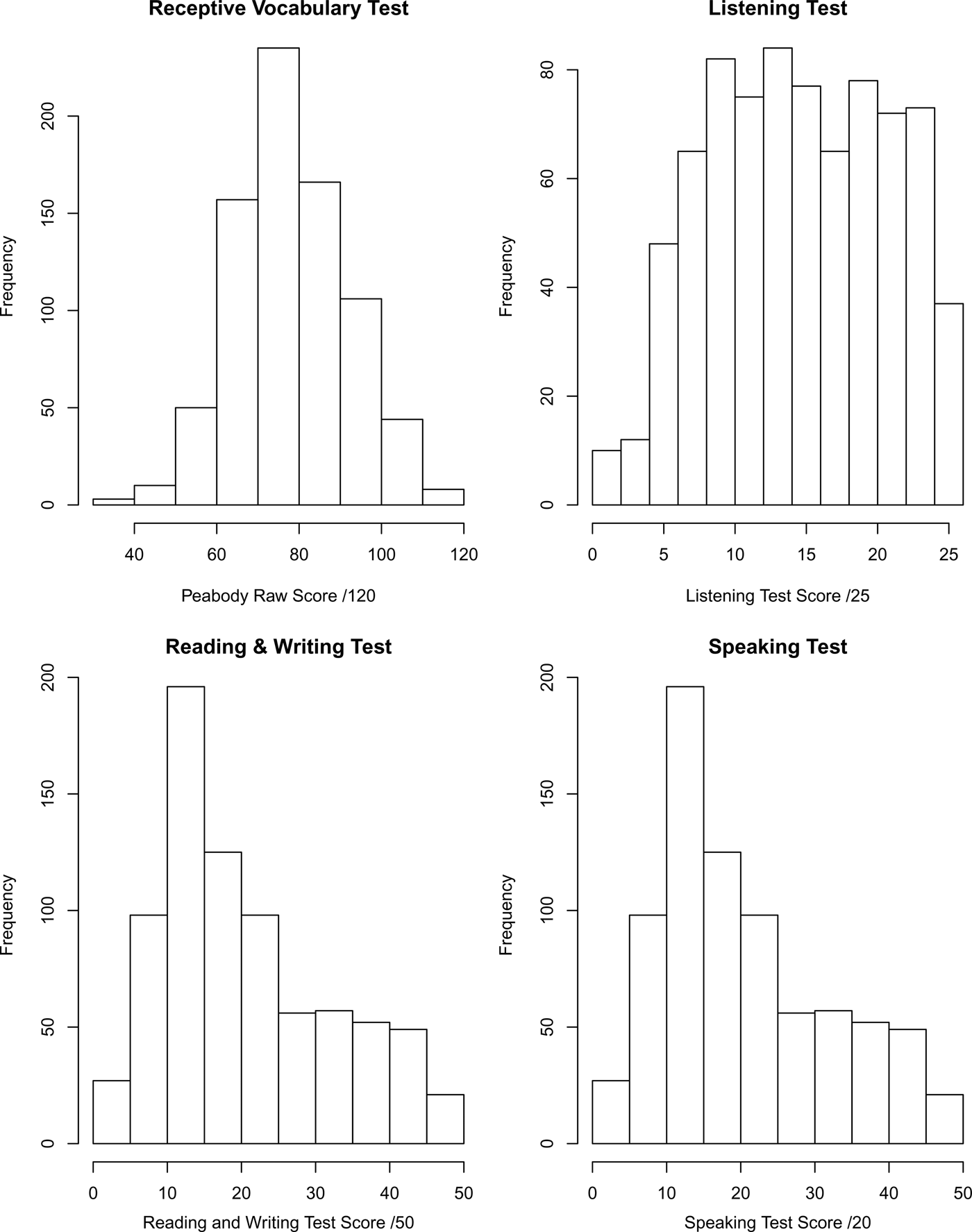
The mean score for the listening test is 15/25 (n = 779). There is a broad range of test scores with the minimum score being 0/25 and a maximum score of 25/25 (figure 1, median: 15/25, SD: 6.1). A quarter of the children have a score of 20/25 or higher which means that a quarter of the children obtain an A2-level for listening (CEFR) before the start of formal English instruction.
Distribution of the results for the different language tests.

The mean score for the reading and writing test is 21/50 (n = 779). Again, there is a broad range in test results with scores ranging between 0/50 and 50/50 (figure 1, median: 18/50, SD: 11.5). The mean score is lower than for the listening test but nevertheless 10% of the children obtain an A2-level for English before the start of formal English instruction (score 40/50 or higher).
The speaking test results demonstrate a mean score of 7/20 (n = 767) and results range widely between the minimum score (0/20) and the maximum score (20/20) (figure 1). The median is 5/20 and the standard deviation is 6. Although the mean as well as the median point to the challenging nature of this task for the children, a considerable number of children (14%) obtained a score of 16/20 or more which indicates an A2-level for speaking and 5% of the children received full marks.
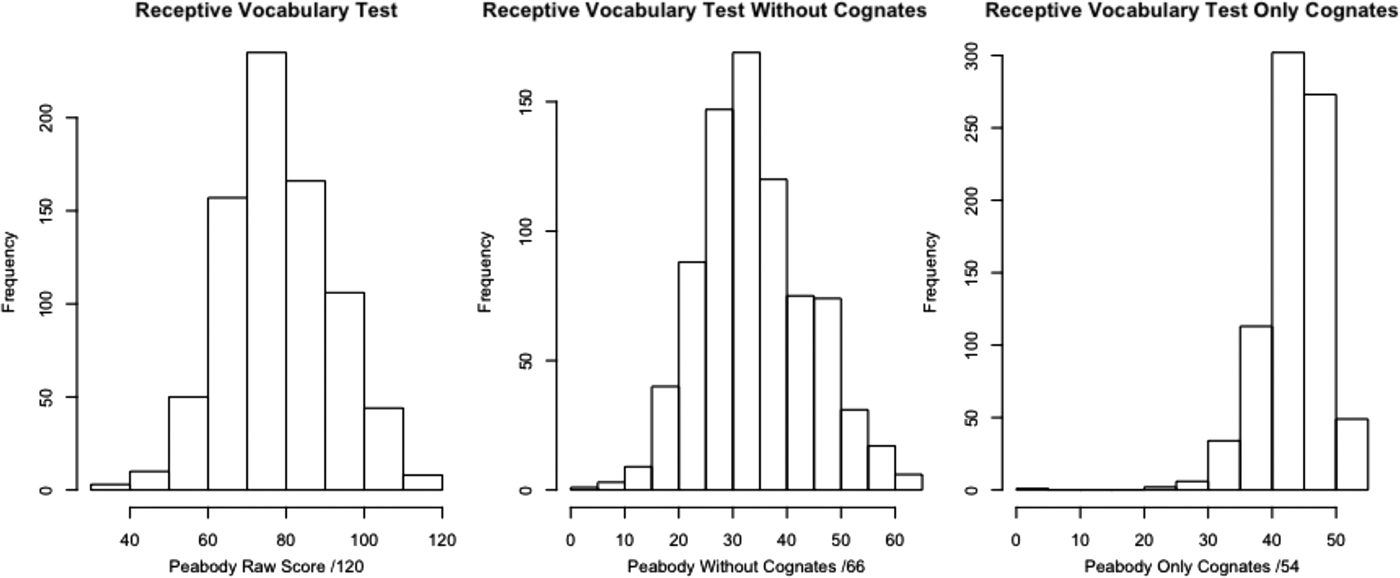
Finally, the children took a receptive vocabulary test (PPVT-4). The mean score is 78/120 which is also the median. Standard deviation is 13.9, the minimum score is 31/120 and the maximum score is 116/120 (figure 1), again showing a broad range in test scores. To interpret these results, it is important to know that 45% of the picture names in English were Dutch (near-)cognates (based on normalized Levenshtein distance > 0.50; Schepens, Dijkstra & Grootjen, Reference Schepens, Dijkstra and Grootjen2012). These cognates might be relatively easy to recognise for children whose L1 (or language of instruction) is Dutch. When the items are split, we indeed see higher scores for the English words that are Dutch cognates (M = 44/54, range 0-54), than for the English words that are non-cognates (M = 34/66, range 0-66) (figure 2).
Distribution of the results for the vocabulary test (raw score /120, without cognates /66, only cognates /54).

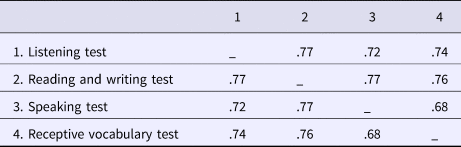
The correlation matrix in Table 1 shows that there are strong correlations between the results on the different language tests. This suggests that the various tests largely measure the same underlying construct(s). The language tests all had high reliabilities: listening test (α = .86), reading and writing test (α = .89), receptive vocabulary test (α = .91) and speaking test (interrater reliability: r = 0.89).
Summary of correlations (Pearson's r) for scores on the different language tests.

A principal components analysis with orthogonal components was conducted on the results of the four language tests (using the principal() function in R). The KMO verified the sampling adequacy for the analysis (overall MSA: .85, MSA for individual items > .82). The correlation matrix (Table 1) and Bartlett's test of sphericity (p < .001) indicate that correlations are large enough for principal components analysis. Analysis indicated that the first component already explained 80% of the variance (the factor loadings are .88 for the receptive vocabulary test and the speaking test, .90 for the listening test and .92 for the reading and writing test). This component captures overall language proficiency. There was a second component capturing the difference between perception and production, explaining 8% of the variance, but, as this component did not correlate with any of the variables discussed below, it is no longer taken into consideration.
7.2. Exposure to English
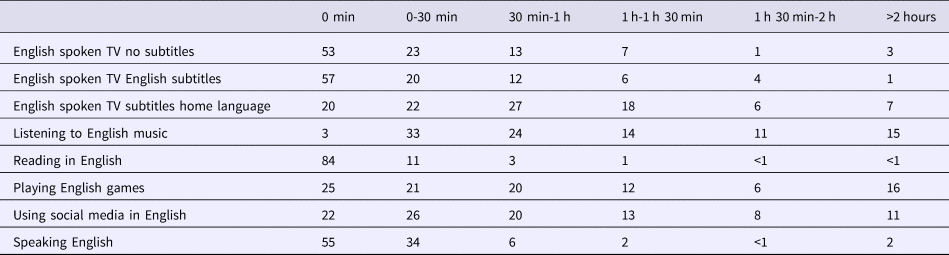
In the questionnaires children and parents were asked how long the children are exposed to the English language each day. Table 2 shows the children's answers. Only the children's answers are reported, as over 100 parents did not return the questionnaire and sometimes the children also filled in the parents’ questionnaire, which makes the data from the parents’ questionnaires less reliable than the data from the children's questionnaires – the children's questionnaires were all administered in the classroom in the presence of an examiner.
Percentage frequency for exposure to English per day.

It is clear from the table that nearly all children (97%) listen to English music on a daily basis. This does not come as a surprise, as a lot of the music played on Flemish radio stations is English music. So, even children who do not deliberately look for opportunities to listen to English music will hear a lot of English songs when tuning in to any radio station, especially radio stations aimed at a younger audience.
Other types of exposure activities to English are: watching English television with subtitles in the home language (80% of the children do this on a daily basis,), gaming in English (75% of the children do this on a daily basis), and use of social media in English (78% of the children do this on a daily basis). Popular games are Minecraft (sandbox game), Grand Theft Auto (action-adventure game), Fifa (football simulation game), which are each played by more than 100 children. Clash of Clans/Clash Royale (strategy game) and Call of Duty (shooter) are played by more than 50 children. All these games can be played both in single-player and multiplayer mode. Popular social media are YouTube (used by more than 300 children), Instagram, Snapchat, Facebook (used by 100–200 children) and Musical.ly (app for video creation and live broadcasting), which is used by more than 50 children.
Less frequent activities are watching English spoken television without subtitles and watching English spoken television with English subtitles (between 40 and 50% of the children say they do these activities on a daily basis). The least popular medium is print: 16% of the children read in English on a daily basis but only 5% read English books, comics or magazines for more than 30 minutes and only one child reported to read English for more than 2 hours daily. Overall, this overview shows that many children are exposed to English each day through different types of media.
A large number of children report having come in contact with speakers of English. It has not been specified whether these speakers are native speakers or not, but it can be assumed that many of these contacts are with non-native speakers: as these contacts take place on holidays, during gaming etc. When asked about their contacts with English-speaking people, 46% of the children reported they sometimes encounter people who speak English, 27% of the children sometimes meet English-speaking people at home, 43% when they are on holiday and 28% mention they encounter English-speaking people elsewhere.
We also asked the children how often they speak English. A staggering 45% of the children claim they speak English every day (cf. Table 3). 34% of the children mention they speak English between 0 and 30 minutes every day. 57 children report they speak English during gaming and when using social media. Other children speak English with friends and siblings (176 children) or even when talking to themselves (17 children).
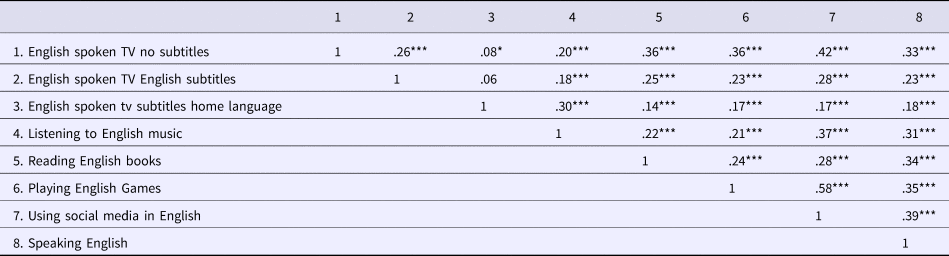
Summary of correlations (Pearson's r) between the different types of exposure.
***p < .001, **p < .01, *p < .05
Some children mention their speaking activities are limited to sometimes using English words when speaking Dutch (e.g., using English swear words). 11% of the children speak English for more than 30 minutes every day and 2% of the children report they speak English more than two hours each day.
Table 3 shows the correlations between the different types of exposure. There is only one correlation higher than .50, namely the correlation between gaming and using social media in English (r = .58). A principal component analysis confirmed that the variables measure divergent aspects of language exposure and that no further gain was achieved by trying to group them in components.
7.3. Which exposure variables affect contextual language learning?
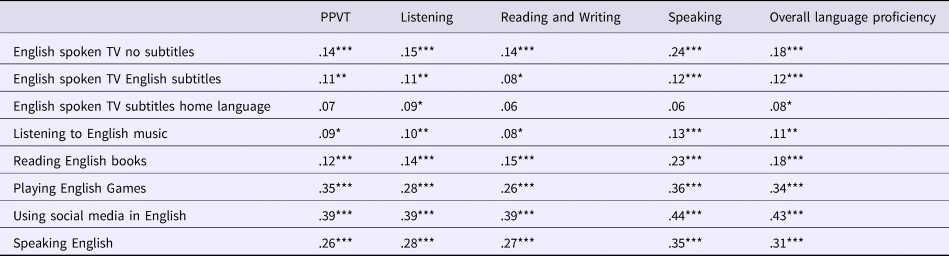
In order to analyse the effects of the different types of exposure to English on the children's English language skills, a correlation matrix between exposure types and the different measures for language ability and the principal component (overall language proficiency) was constructed (Table 4).
Summary of correlations (Pearson's r) between the different types of exposure to English and the measures for language ability.

***p < .001, **p < .01, *p < .05
We then ran multiple linear regression analyses for the different language tests and overall language proficiency. The data concerning the different types of exposure were treated as interval data (‘I don't do this’ = 0, ‘0–30 minutes’ = 1… ‘more than two hours’ = 5). The assumptions for regression analysis are met. There is no multicollinearity between the independent variables: VIFs are all lower than 2. Durbin-Watson tests show there is no autocorrelation. There is normality of the residuals.
Exposure effects on receptive vocabulary, listening, reading and writing and speaking skills
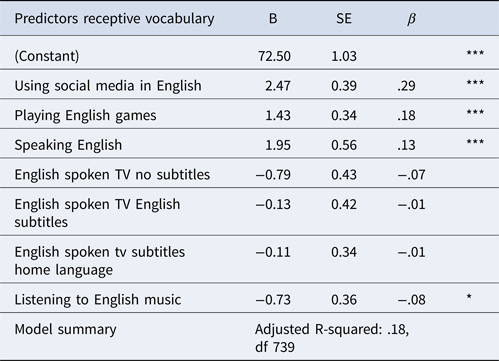
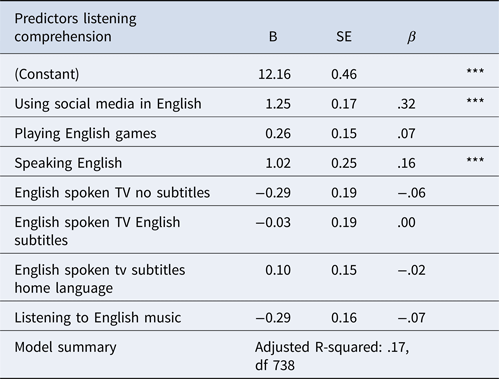
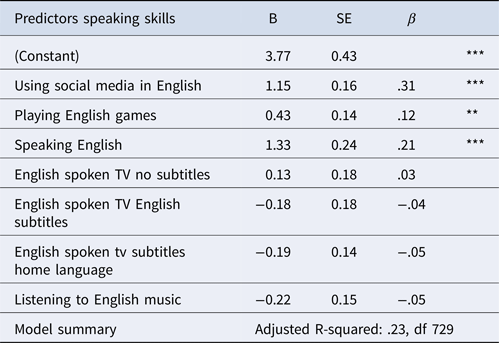
Tables 5a–5d show the results of the regression analyses with the four tests as dependent variables. Results show that using social media in English and speaking English are significant predictors at <.001 level for all dependent variables. Gaming also seems beneficial for the development of children's receptive vocabulary (p < 0.001) and speaking skills (p < .01). The amount of time children listen to English music is significant for receptive vocabulary and reading comprehension and writing (p < .05) but the relationship is negative: spending more time listening to English music is associated with overall lower language proficiency when the other variables are controlled for. All in all, exposure explains 18% of the variance in receptive vocabulary, 17% of the variance for listening comprehension, 16% of the variance for reading comprehension and writing and 23% of the variance for speaking.
Results of the regression model for receptive vocabulary (n = 747).

***p < .001, **p < .01, *p < .05
Results of the regression model for listening comprehension (n = 746).

***p < .001, **p < .01, *p < .05
Results of the regression model for reading comprehension and writing (n = 747).

***p < .001, **p < .01, *p < .05
Results of the regression model for speaking (n = 737).

***p < .001, **p < .01, *p < .05
Exposure effects on overall language proficiency
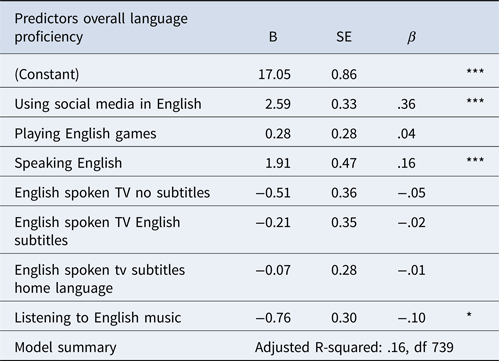
Table 6 shows the results of the regression analysis with overall language proficiency as dependent variable. Results show that using social media and speaking English are highly significant predictors for overall language proficiency (p < .001). Gaming also seems beneficial for the development of children's overall language proficiency (p < .01). The amount of time children listen to English music is also significant (p < .05) but the relationship is negative: spending more time listening to English music is associated with overall lower language proficiency when the other variables are controlled for. All in all, exposure explains 22% of the variance in overall language proficiency. This is in line with the results for the separate tests.
Results of the regression model for overall language proficiency (n = 734).

***p < .001, **p < .01, *p < .05
8. Discussion
The present study was designed to examine how much English primary school children acquire in informal settings and which factors affect the degree of informal learning. As this study intends to measure language learning prior to instruction, our study has similarities with the studies by Lefever (Reference Lefever2010) and Kuppens (Reference Kuppens2010), which we aimed to improve in three ways. First, care was taken to ensure a fully representative sample of children. Second, established tests were used, allowing replication and interpretation of the results across contexts. Finally, the input factors were surveyed systematically in order to identify the factors that influence the degree of informal L2 acquisition.
Prior to any form of classroom instruction, 10 to 25% of the children (depending on the skill) can communicate in L2 English at an A2-level (CEFR) at the end of primary school. This means the children can communicate in simple and routine tasks requiring a simple and direct exchange of information on familiar and routine matters (Council of Europe, 2001). The mean score for the receptive vocabulary test was 65% (53% when cognates were left out of the test), attesting to the degree of vocabulary that can be acquired when children are exposed repeatedly to a language, through activities that do not focus on language learning but on the negotiation of meaning (e.g., while playing a game).
A variable that undoubtedly plays an important role (although it was not thoroughly investigated here) is the attitude towards the language. English is seen as a high-status language by the participants in our study (733 participants answered that they think English is a fun language; only 27 claimed not to like English), which probably means that they enjoy engaging in (digital) interactions in English. Myers-Scotton (Reference Myers-Scotton2006) observed that L2 learning is more prevalent in social groups that perceive other groups as better, in terms of economic and cultural achievements. Indeed, one of the complaints in Belgian education is that students are more motivated to learn English than one of the other national languages (Housen, Jannsens & Pierrard, Reference Housen, Janssens and Pierrard2001).
At the same time, our findings show the high divergence in the scores obtained, a finding that was also present in Lefever (Reference Lefever2010). About a quarter of the students did not pick up much English (yet). In future research it will be interesting to see to what extent formal education decreases this divergence. As indicated above, the knowledge of the best performing children aligned with the knowledge expected after one to two years of school education.
A considerable part of the differences in test results could be explained by the amount of exposure the children had received (exposure to the language explained 22% of the variability in the children's overall proficiency scores). Other variables likely to be involved are individual differences in intelligence and language aptitude (Paradis, Reference Paradis2011; Sun, Steinkrauss, Tendeiro & De Bot, Reference Sun, Steinkrauss, Tendeiro and De Bot2016; Unsworth, Persson, Prins & De Bot, Reference Unsworth, Persson, Prins and De Bot2014), which unfortunately could not be addressed in the present study.
Interestingly, of the different types of English L2 input available to primary school children, the two most regularly investigated in studies on contextual learning in a formal context did not turn out to be the most important. These are reading L2 books and watching subtitled television programs. Although both variables are positively correlated with L2 knowledge, the correlations are much lower than those of three other variables. The three most important types of input for children's language proficiency were: use of social media in English, gaming in English, and speaking English. These three types of exposure offer ample opportunities for social interaction and authentic communication in contrast with watching television, listening to music, and reading, which are far less interactive. Apparently, passive perception of a language is less effective than active use of the language, a finding in line with the testing effect and the production effect in memory research (Rowland, Reference Rowland2014; MacLeod, Gopie, Hourihan, Neary & Ozubko, Reference MacLeod, Gopie, Hourihan, Neary and Ozubko2010). The fact that gaming is a predictor for overall language proficiency but less so than speaking English and using social media in English is not surprising, as gaming can be interactive or not depending on the type of game and whether the gamer plays multiplayer or single player games in online or offline modes. Further research should look into children's gaming habits in more detail in order to have a clearer view on the differences between gamers and how these might influence language learning. A qualitative investigation into children's out-of-school English-speaking habits would also be useful, as children in this study report being able to speak English frequently among peers but we did not explore this in depth.
Our findings are important given the research gaps identified by Elgort (Reference Elgort2018) in a recent review article of technology-mediated L2 vocabulary learning studies. Elgort (Reference Elgort2018) reported that the majority of papers were in-class studies. Only a few looked at independent activities, either incidental (like playing games) or deliberate (using online learning environments, such as Duolingo). One of the key recommendations in the study is that research into technology-mediated vocabulary development should also address language learning through digital gaming environments and social media tools in order to provide more insight into technology-mediated language learning outside the classroom. Our study addresses this gap by examining language learning through digital media in out-of-class contexts.
On the basis of the regression analysis of overall language proficiency, listening to English music seems to have a negative influence on children's contextual language learning, when the effects of the other variables are partialled out. This is in line with the finding that productive and multimodal types of input are more effective. The fact that the negative effect is significant is probably due to the nature of the input. Listening or even singing along to a song does not necessarily lead to understanding and learning the language. Furthermore, it takes away time from other activities that are more effective. At the same time, even though the variable is significant, it only explains some 1% of the variation.
Another interesting finding of our study is that the various tests for language skills all largely measured the same proficiency component. This is in line with earlier research showing a clear link between vocabulary knowledge and performance in all four language skills (Milton, Reference Milton, Bardel, Lindqvist and Laufer2013). It is also in line with the finding that various vocabulary tests measure the same skill (Mainz, Shao, Brysbaert & Meyer, Reference Mainz, Shao, Brysbaert and Meyer2017). It confirms the importance of vocabulary in language learning, especially at early levels (starting from absolute beginners). Even though some skills (e.g., listening comprehension) are clearly more developed than others, the PCA reveals that all the skills are linked and measure a broader, underlying component: overall language ability. This suggests that in further research into contextual language learning the number of language tests could be reduced, which could leave more time for the investigation of other interesting variables such as aptitude, intelligence and motivation.
9. Conclusion
The present study shows that in a society where English is perceived as the lingua franca and where there are a lot of opportunities to engage in activities in which learners are exposed to the English language, informal language learning takes place and can lead to large language gains. Just like previous studies, the current study also reveals that there is a lot of variation in the amount of contextual language learning between learners, and further research should pay more attention to internal learner differences such as language aptitude, intelligence and learning motivation in order to try and explain more variance between learners.
The findings concerning the types of exposure that support contextual language learning point to possibilities for interaction and authentic communication as the most important characteristics of input modes. Future experimental research should explore the opportunities of different kinds of interactive, multimodal input for contextual language learning and the role of language production for L2 development both in formal and informal learning contexts.
Author ORCIDs
Vanessa De Wilde, http://orcid.org/0000-0003-3005-9620
Acknowledgements
The data collection was funded by Artevelde University College Ghent in the context of the PWO-project False Beginners. We thank G. De Meyer, P. O'Neill, our students and colleagues for help with testing. We thank the schools, the teachers, the pupils and their parents for participating in the project.
Appendix 1: Example tasks for the various parts of the proficiency test.
1.

A multiple-choice question from part 4 of the Cambridge English Test for Young Learners: Flyers (listening test)
2.

An example from the gap-fill-exercise in part 7 of the Cambridge English Test for Young Learners : Flyers (reading and writing test)
3.
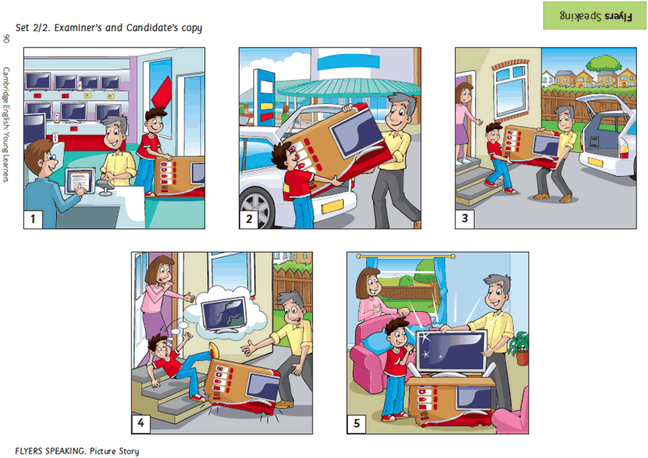
The storytelling exercise in the Cambridge English Test for Young Learners: Flyers (speaking test)
Appendix 2: Children's questionnaire
School: ________________________
Class : ______ Number : _____
Name : ________________________
Date of birth : ___________
I am ________________ years old
How much contact do you have with the English language?
1. Tick the box. How many hours/minutes do you do the activities in the list per day:

– Which games do you play? How often do you play these games?
– Youtube/social media: what do you watch? Which social media do you use (e.g. Snapchat, Instagram,…)?


2. Do you have any contact with people who speak English? Yes / No
If yes, where, when, with whom?
a. On holiday? Yes / No How often? _________________________
b. At home? Yes / No How often? ________________________
c. In other situations? Yes / No How often? __________________________
3. Do you sometimes speak English? Yes / No
If yes, where, when, with whom? _________________________________________________
4. Do you think English is a fun language? Yes / No
5. Do you sometimes look for opportunities to speak English? Yes / No
If yes, where, when, with whom? If no, why not?
________________________________________________________________________
General information:
1. Which language do you usually speak with your mother? ______________________
Which language do you usually speak with your father? _____________________
Which language do you usually speak with your brothers/sisters?_________________
Which language do you usually speak with your friends? _____________________
2. I am a □ boy.
□ girl.
3. I have ____ brothers and ____ sisters: they are ____________________ years old.