INTRODUCTION
The identification of deep-sea ‘essential habitats’ is currently a major focus of European Community research programmes with the aim of furthering the conservation and management of benthic biodiversity (Salomon, Reference Salomon2009). In this context, faunistic surveys in cold seeps, mud volcanoes, seamounts and canyons as ‘hot spots’ for local biodiversity are of strategic relevance in the global context (Orejas et al., Reference Orejas, Gori, Lo Iacono, Puig, Gili and Dale2009; Fabri et al., Reference Fabri, Pedel and Beuck2014; Angeletti et al., Reference Angeletti, Mecho, Doya, Micallef, Huvenne, Georgiopoulou and Taviani2015). In this scenario, in situ video observations of Mediterranean deep-sea fauna are still much reduced in comparison to those conducted to date in other oceans (Cunha de Jesus & Cancela da Fonseca, Reference Cunha de Jesus and Cancela da Fonseca1999; Stein et al., Reference Stein, Felley and Vecchione2005; Buhl-Mortensen & Buhl-Mortensen, Reference Buhl-Mortensen and Buhl-Mortensen2008). Nevertheless, the deep Mediterranean Sea hosts a complex collection of geologically and ecologically relevant environments that can vary across the short geographic scale of a few kilometres, hence resulting in a potentially highly variable faunal composition (Cartes et al., Reference Cartes, Maynou, Fanelli, Romano, Mamouridis and Papiol2009; Orejas et al., Reference Orejas, Gori, Lo Iacono, Puig, Gili and Dale2009; Papiol et al., Reference Papiol, Cartes, Fanelli and Maynou2012; Fanelli et al., Reference Fanelli, Cartes, Papiol and López-Pérez2013; Mecho et al., Reference Mecho, Aguzzi, Company, Canals, Lastras and Turon2014) that remains, to date, largely unknown in several areas, including the north-western (NW, hereafter) Mediterranean Sea (Danovaro et al., Reference Danovaro, Company, Corinaldesi, D'Onghia, Galil, Gambi, Gooday, Lampadariou, Luna, Morigi, Olu, Polymenakou, Ramirez-Llodra, Sabbatini, Sardà, Sibuet and Tselepides2010).
Three distinctive geomorphological structures mostly occur in the NW basin: canyons, seamounts and open slopes. Large submarine canyons, deep incisions in the continental margin, occur just a few miles off the coastline in close proximity to each other. Canyons concentrate and then funnel downward all sediment, including organic particles (Puig et al., Reference Puig, Ogston, Mullenbach, Nittrouer and Sternberg2003; Canals et al., Reference Canals, Puig, de Madron, Heussner, Palanques and Fabres2006; Company et al., Reference Company, Ramirez-Llodra, Sardà, Puig, Canals, Calafat, Palanques, Solé, Sánchez-Vidal, Martín, Aguzzi, Lastras, Tecchio, Koenig, Fernandez de Arcaya, Mechó and Fernández2012), hence affecting the local current regimes (Flexas et al., Reference Flexas, Boyer, Espino, Puigdefàbregas, Rubio and Company2008; Bahamon et al., Reference Bahamon, Aguzzi, Bernardello, Ahumada-Sempoal, Puigdefabregas, Cateura, Muñoz, Velásquez and Cruzado2011). Their biodiversity has been the object of intense research in the past two decades in various oceans (Company et al., Reference Company, Puig, Sardà, Palanques, Latasa and Scharek2008; McClain & Barry, Reference McClain and Barry2010; Duffy et al., Reference Duffy, Lundsten, Kuhnz and Paull2014). Seamounts, defined as topographic structures that rise above the surrounding seafloor, also occur in the Mediterranean basin (Acosta et al., Reference Acosta, Canals, López-Martínez, Muñoz, Herranz, Urgeles, Palomo and Casamor2003). Typically, their morphology is characterized by an exposed hard substratum that makes them ideal spots for sessile filter-feeder fauna (Koslow, Reference Koslow1997; Samadi et al., Reference Samadi, Bottan, Macpherson, Forges and Boisselier2006; Howell et al., Reference Howell, Mowles and Foggo2010). Finally, a third type of structure is represented by muddy landslides which occur on continental shelves and slopes, resulting in mud plains with several outcrops (Camerlenghi et al., Reference Camerlenghi, Urgeles, Fantoni and Mosher2010).
A broad knowledge of species distribution and biodiversity within these various different geomorphologies is still poor for the NW Mediterranean, with some areas (e.g. certain canyons or, in general, the slopes) more studied than others, relative to the commercial trawl fisheries. In these areas, scientific surveys have been conducted in an attempt to achieve faunal data for the integrated management of exploited stocks (Abelló et al., Reference Abelló, Carbonell and Torres2002; De Mol et al., Reference De Mol, Huvenne and Canals2008; Bahamon et al., Reference Bahamon, Sarda and Aguzzi2009). In general, one should bear in mind that most NW Mediterranean areas are presently threatened by a highly diversified typology of anthropogenic impacts. These are not only related to the commercial fishery itself (e.g. trawling as well as lost or discarded gears and longlines: Martín et al., Reference Martín, Puig, Palanques, Masqué and García-Orellana2008; Ramirez-Llodra et al., Reference Ramirez-Llodra, Company, Sardà and Rotllant2010; Puig et al., Reference Puig, Canals, Company, Martín, Amblas, Lastras and Palanques2012), but also from the accumulation of litter (Galgani et al., Reference Galgani, Souplet and Cadiou1996; Hess et al., Reference Hess, Ribic and Vining1999; Ramirez-Llodra et al., Reference Ramirez-Llodra, De Mol, Company, Coll and Sardà2013), whose decomposition acts on the metabolism of species and on the dynamics of the resulting trophic webs (Koenig et al., Reference Koenig, Fernández and Solé2012, Reference Koenig, Fernández, Company, Huertas and Solé2013a, b). For all these reasons, anthropogenic impacts on deep-sea ecosystems are presently a source of concern for both the science community and policymakers everywhere (Miyake et al., Reference Miyake, Shibata, Furushima, Omori, Guo, Yoshie, Fujii, Handoh, Isobe and Tanabe2011; Ramirez-Llodra et al., Reference Ramirez-Llodra, Tyler, Baker, Bergstad, Clark, Escobar, Levin, Menot, Rowden, Smith and Van Dover2011; Woodall et al., Reference Woodall, Robinson, Rogers, Narayanaswamy and Paterson2015).
ROV video-imaging surveys have increased worldwide in recent years as an efficient survey methodology, delivering key faunistic data on species composition, ethology and overall anthropic impacts (Galgani et al., Reference Galgani, Leaute and Moguedet2000; Miyake et al., Reference Miyake, Shibata, Furushima, Omori, Guo, Yoshie, Fujii, Handoh, Isobe and Tanabe2011; Ramirez-Llodra et al., Reference Ramirez-Llodra, Tyler, Baker, Bergstad, Clark, Escobar, Levin, Menot, Rowden, Smith and Van Dover2011; Fabri et al., Reference Fabri, Pedel and Beuck2014; Mecho et al., Reference Mecho, Aguzzi, Company, Canals, Lastras and Turon2014), in an ecologically more ethical manner (i.e. with no damage to the explored environments, unlike trawling). In this context, the objective of the present study is to describe, by means of ROV imagery, the megabenthic communities of various deep-sea geomorphological areas within the NW Mediterranean. Fauna from one canyon, two seamounts and two landslides were observed and quantitatively described. In addition, we quantified anthropogenic impact within each area, reporting at the same time relevant ethological observations, as an important ecological by-product of this exploration.
MATERIALS AND METHODS
Data collection
The ROV ‘Max Rover II’ of the Hellenic Centre of Marine Research (HCMR) was used to conduct visual observations during the research cruise EUROLEON, which was conducted in October 2007 on Mediterranean Spanish waters aboard the RV ‘BIO Hespérides’. The ROV was equipped with two wide-angle colour CCD cameras with a resolution of 3.2 Mpixel, 1Gb, offering a frontal and a lateral view, plus a third with a macro-zoom. Lighting was provided by 2 × 100 W HID lights and 4 × 150 W quartz lights. The ROV speed and height above the seabed during filming operations were ~1.2 knots and 1.5–2.0 m, respectively. The resolution was constant along transects. The limit of detection depended on the ROV distance to the bottom. In some cases, the presence of mud clouds could result in a diminution of the limit detection.
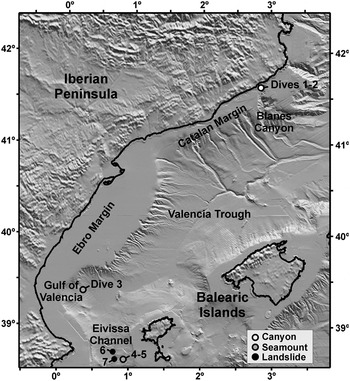
Seven transects (hereafter termed ‘dives’) were conducted for a total of 14.5 km surveyed (equivalent to a total of 30 h of video; Table 1). Three different NW Mediterranean distinct geomorphological zones were inspected (Figure 1): the continental margin off Blanes, the Gulf of Valencia, and the Eivissa Channel (also known as Ibiza Channel). In particular, dives occurred as follows (see Table 1): dives 1 (41°38′N – 02°52′E) and 2 (41°39′N – 02°53′E) at the head of the Blanes canyon; dive 3 on an unreported seamount in the Gulf of Valencia (39°30′N – 00°17′E); and dives 4–7 in the Eivissa Channel. In particular, for this latter area, two dives (4 and 5; 38°39′N – 00°55′E) were conducted along a small flat-topped seamount, and the other two (dives 6 and 7; 38°41′N – 00°50′E) were performed close to the escarpments of two large submarine landslides (named Jersi and Ana; Lastras et al., Reference Lastras, Canals, Urgeles, Hughes-Clarke and Acosta2004; Berndt et al., Reference Berndt, Costa, Canals, Camerlenghi, De Mol and Saunders2012; Lafuerza et al., Reference Lafuerza, Sultan, Canals, Lastras, Cattaneo, Frigola, Costa and Berndt2012).
NW Mediterranean area where ROV dives were conducted. Blanes canyon head in the Catalan continental margin, seamounts in the Gulf of Valencia and Eivissa Channel plus the landslides in the Eivissa Channel.

Depth range (m) and surveyed seafloor (km) of the seven ROV dives conducted in different geomorphological deep-sea zones of the NW Mediterranean.

Typologies of observed substrate: CoR, coral rubble; Mud; Sand and Rock.
Data processing and analysis
All video footages considered for animal taxonomic identification and counting were obtained with the frontal camera and inspected in a time-lapse mode (i.e. at 50% of acquisition rate). Video analysis was conducted using the software application Intervideo WinDVD 9.0 (Windows). All observed organisms larger than 5 cm were identified as faunistic entries (i.e. smaller animals were not visible), being classified to the lowest taxonomic level as possible. For a more precise taxonomic determination, digital frames were extracted after video partitioning. Classification was accomplished by the use of current taxonomic guides for the Mediterranean (Zariquiey, Reference Zariquiey1968; Riedl, Reference Riedl1983; Mercader et al., Reference Mercader, Lloris and Rucabado2001).
Data on faunal composition were annotated according to their timing of occurrence in the video footage (hence allowing correlation with ROV navigation data for a precise geographic positioning) along with concomitant annotations on the substrate type, classified as mud, rock, sand, and coral rubble, as well as on anthropogenic artefacts.
Data analyses were carried out considering faunal entries grouped within classes, to avoid those classification mistakes that may occur in ROV studies when attempting a more precise classification when no concomitant sampled specimens are available for comparison. Faunistic comparisons among different substrate types and depth ranges were carried out by grouping class entries by 100 m of ROV navigation track distance. Then, faunal data were compared across different geomorphologies. The same analysis was performed for anthropogenic impact.
Although all our statistical analyses were performed with class-level data (see below), for a better visualization of faunistic spatial trends, the numbers of individuals were plotted each 100 m according to the five most frequently observed phyla (Porifera, Cnidaria, Echinodermata, Brachiopoda and Chordata) and subphyla (i.e. Crustacea) and represented along the dive in the Appendix section. Finally, behavioural observations were reported and classified when occurring in videos more than twice (Stoner et al., Reference Stoner, Ryer, Parker, Auster and Wakefield2008).
Statistical methods
The level of similarity of class sampling composition among 100 m splits within a dive and among dives in the same or different geomorphological areas was assessed using the Non-metric Multidimensional Scaling (NMDS) method (Minchin, Reference Minchin1987). The function metaMDS in the ‘vegan’ library in R (Oksanen et al., Reference Oksanen, Blanchet, Kindt, Legendre, Minchin, O'Hara, Simpson, Solymos, Henry, Stevens and Wagner2013) was used to find both non-parametric relationships and Bray–Curtis dissimilarities between classes. To fit the area parameters (gradients of depth, type of substrate and anthropogenic impact) to taxa ordination, two functions in the vegan library were used. The function ‘envfit’, based on permutation tests, allowed fitting centroids of the levels of the factor variables ‘sediment type’ and ‘study area’ into the ordination of the taxa. The variable ‘anthropogenic impact’ was not significant. Therefore, it was not plotted onto the taxa ordination. Finally, the function ‘ordisurf’, based on thinplate splines (Wood, Reference Wood2003) with cross-validation selection of smoothness (Marra & Wood, Reference Marra and Wood2011), allowed fitting smooth surfaces for the continuous variable ‘depth’ onto the taxa ordination using restricted maximum likelihood (REML) as smoothing parameter estimation method.
RESULTS
General remarks
We observed a total of 4534 individuals, considered different faunistic entries (Table 2) in the various geomorphological areas surveyed (i.e. canyon, seamount and landslide) (see Figure 1). A comprehensive list of these entries, classified to the species level (when possible), is provided in Appendix 1. The fauna belonging to the classes Actinopterygii, Malacostraca and Anthozoa were the most abundant, representing 24%, 20% and 14% of all observations, respectively (see Figure 2). The class Demospongiae was less abundant (12%), with an occurrence similar to those of Rhynchonellata (11%) and Scyphozoa (9%). The abundance of all other remaining invertebrate classes was less than 3% each.
Percentage per class of total faunistic observations.

Number of individuals by class observed at each geomorphological area.

NMDS results showed the presence of a significant effect of depth on species ordination, taking all the inspected areas both together and within each area (see Figure 3). Area and sediment type were significantly related to the class ordination only when areas were considered together (Table 3; see Case 1). No significant effect of anthropogenic factors was found. When we considered all the classes in the three areas taken together (see Figure 3A), we observed that Asteroidea, Echinoidea and Holothuroidea were associated with shallower sandy areas, whereas Ophiuroidea, Crinoidea and Cephalopoda occurred primarily in deeper zones on muddy flat slopes.
Spatial ordination of class composition and abundances related to depth (m; grey curves), and sediment types, for (A) all the habitats together; (B) Canyon; (C) Seamount; (D) Landslide.

Summary of statistical validations for the connections between taxa ordination and environmental variables.

Data type determined methods for calculating P-values (permutations test and restricted maximum likelihood – REML).
*indicates significant (P ≤ 0.05) values.
Canyon head
A total of 792 faunistic observations were made on the western flank of the Blanes canyon head (see Table 2 and Figure 1). Both dives were similar in setting, with the exception of the southern dive 2, which crossed an area with a steeper slope in its deepest section. Two types of substrates were observed: a muddy area in the deepest part and a sandy area with strong tanathocenosis (i.e. assemblages of dead shells within the sediment), this latter on the shallower part of both dives 1 and 2. Globally, the class Anthozoa was the most reported in the Blanes Canyon head, with 31% of the total observations (Figure 4). This group also had the highest number of individuals per group (i.e. the Anthozoan Pennatula spp. with 158 observations, see Appendix 1). Class Malacostraca represented 26% of the total observations, most of them corresponding to the infraorder Brachyura (i.e. crabs). Malacostraca was followed by Actinopterygii (20%) and Rhynconellata (7%), with all the remaining classes representing less than 5% each.
Percentage of faunal observations at each geomorphological zone studied: (A) Canyon; (B) Seamount; (C) Landslides.

On the western flank of the Blanes canyon head, we could distinguish three different faunistic distributions (Appendix 2) coinciding with depth and slope changes. The deepest part surveyed (450–250 m) showed a low number of observations and a high number of classes. In general, canyon dives showed a two-step slope change at 250–300 m and 150 m depths. The deeper areas with steep muddy slopes were dominated by crustaceans. From 150 to 60 m depth, the seafloor is relatively flat and was dominated by the phyla Cnidaria (class Anthozoa, mostly Pennatula spp.) and Echinodermata, primarily the class Asteroidea, with the species Anseropoda placenta (Pennant, 1777), and the Holothuroidea, with Parastichopus regalis (Cuvier, 1817).
A NMDS analysis of the observations from the canyon revealed a significant effect of depth on class ordination (see Table 3, Case 2) but not of sediment typology and anthropogenic impact. At the faunistic level, there is a highly similar group composed by Actinopterygii, Malacostraca, Anthozoa and Elasmobranchii. This group of taxa is dissimilar to Demospongiae, Hydrozoa, Gastropoda and Thaliacea (see Figure 3B).
Seamount
Two seamount dives were analysed (see Figure 1), one in the Gulf of Valencia and the other in the Eivissa Channel (see Table 1). The first seamount presented a conical morphology surrounded by a muddy plain. A total of 10 h of images were recorded at this site. The second seamount, in the Eivissa Channel was surveyed separately on its eastern flank and on its flat top. The results are described separately below for each seamount, and a general analysis is then presented for both seamounts.
The Gulf of Valencia seamount rises from a depth of 800 m (Appendix 3). Its top is at 450 m. It was characterized by two types of substrates: a rocky area constituted by steep slopes combined with rocky substrata (from 450 to 600 m depth) and a large muddy plain surrounding the rocky area, from 600 to 800 m depth. A significantly denser concentration of benthic fauna was observed in the shallowest rocky areas (Appendix 3A), in contrast with a drastic diminution of that fauna toward the deepest muddy zones (Appendix 3B). The seamount presented two well-separated faunistic distributions, which were related to these substrates and depth. The rocky substratum was located on the flank of the seamount (Appendix 3A) and presented a fauna composed basically of benthic species of the classes Demospongiae (31% of the total observations within the rocky area), Anthozoa (25%, benthic species such as corals, anemones and gorgonians) and Brachiopoda (28%). The second substratum, the muddy plain surrounding the rocky area (Appendix 3B), was dominated by crustaceans of the class Malacostraca (33% of the total observations), the class Actinopterygii (32%) and Anthozoa (mostly deep-sea anemones of the genus Cerianthus, 22%). In the case of the muddy plain, the distribution of the benthic communities was patchy along the dive and was related to subtle changes of slope and substrate (Appendix 3B).
On the Eivissa Channel seamount (see Figure 1), two areas were studied: the upper slope (flank) and the flat top (Appendix 4). At its bottom, we observed a flat area mainly composed of mud with boulders (Appendix 4A). This area was dominated by motile fauna such as classes Malacostraca (24% of the total flank observations) and Actinopterygii (22%), but included also sessile fauna (24%, as benthic cnidarians on cobbles). Moving upwards, the flank was constituted by rocky outcrops dominated by the benthic classes Demospongiae (14%) and Rhynchonellata (8%).
Dive no. 5, over the flat top of the Eivissa Channel seamount encompassed only one substratum type, a bioclastic sand with sparse rocky outcrops (Appendix 4B). This transect covered the shallowest parts (196–250 m depth) of the surveyed area, and it was dominated by motile fauna, including Actinopterygii (48%), class Scyphozoa (26%, mainly Pelagia noctiluca (Forsskål, 1775)) and Holothuria (14%, one species, Holothuria (Holothuria) tubulosa Gmelin, 1791). The large number of fish schools observed over the rocky areas of the top of the seamount was noteworthy.
A total of 2290 faunistic observations were reported from both seamounts over a distance of 6.5 km (see Table 2). The most commonly observed groups were the benthic classes Demospongiae (24%) and Rhynchonellata (19%) (see Figure 4B). These groups were followed by Actinopterygii (16%) and Anthozoa (15%). The classes Malacostraca, Scyphozoa and Holothuroidea were less abundant in the seamount dives, representing 16%, 8% and 2%, respectively of the total observations.
The NMDS analysis conducted in the seamount showed that the factors depth and sediment were significantly affecting the distribution of the classes (see Table 3, Case 3). Classes Holothuroidea, Polychaeta and Thaliacea were associated with shallower sandy areas, while Rhynchonellata and Demospongia were associated with medium depths and rocky areas. In contrast, Crinoidea, Gastropoda and Ophiuroidea showed a preference for deeper muddy areas (see Figure 3C).
Submarine landslide
Two submarine landslides (Jersi and Ana) were surveyed in the Eivissa Channel (see Figures 1 and Table 1). The landslide scars were made up by consolidated sediments and, in the Jersi, even rocky pebbles and coral rubble were observed. The depositional areas were instead composed of mud, similar in gross morphology to the undisturbed upslope area (i.e. above the scars). As for the seamount, the results are described first separately for each landslide and then in general terms (including both landslides).
When we considered the landslides separately, we found Jersi dominated by the classes Malacostraca (60% of the total observations of this landslide) and Actinopterygii (19%). None of the other groups exceeded 8% in this landslide. We observed an increase of crustaceans on the scar area in front of the depositional area. Nonetheless, this landslide presented a generally constant faunal composition along all its surveyed area (Appendix 5A).
The substratum along the Ana landslide was mostly mud (Appendix 5B). The sediment along the scar appeared more consolidated. Actinopterygii (44% of the total observations of this landslide) dominated that area, followed by the classes Malacostraca (24%), Scyphozoa (19%) and Ophiuroidea (10%). The latter class was more abundant here than on the mud plain.
Considering both landslides together, the most representative groups were the classes Actinopterygii and Malacostraca, representing 40% and 32% of the total observations, respectively (see Figure 4C), followed by Scyphozoa and Ophiuroidea (respectively 14% and 9%). The other classes represented 5% of all the observations.
The different faunal groups identified fit well with the topographic features recognized on the bathymetry (see Appendix 5A, B). Landslide scars, deposits and undisturbed seafloor had different phyla compositions and abundances. The most observed fauna in the scars were the crustaceans of the class Malacostraca. Pelagic cnidarians (order Coronatae) and fishes dominated the landslide deposits. Finally, crustaceans and ophiurans (brittle stars) dominated the undisturbed seafloor upslope of the landslides. These observations were supported by an NMDS analysis. In the landslide area (see Figure 3D), this analysis indicated that depth significantly influenced class composition (see also Table 3). In contrast, both the substrate type and anthropogenic impact did not influence the detected faunal distributions.
Anthropogenic impact
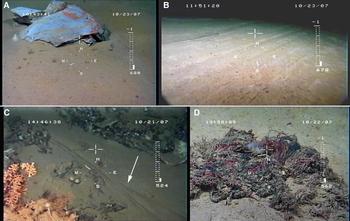
A noticeable level of anthropogenic impact was observed in all studied zones, with 158 recorded artificial objects of various types detected. These items included plastic bags, cans and bottles (see Figure 5A). Trawl marks were also consistently observed (see Figure 5B). Finally, lost or discarded fishing gears were also detected, including longlines (see Figure 5C) and the remains of hauling fishing nets (see Figure 5D).
Different types of anthropogenic impact observed. (A) Litter; (B) Trawl marks; (C) Longlines; (D) Fishing net.

Overall, litter was the most abundant observation (39%), followed by trawl marks (30%) and longlines (28%), with lost or discarded nets being less abundant (3%) (Figure 6A). In the canyon head, plastic bags and bottles represented 79% of the total observations, whereas longlines represented only 14%. A minority of the observations (7%) were related to trawl marks. No fishing nets were detected (see Figure 6B). On the seamounts and their surrounding areas, 58% of the anthropogenic impact referred to the presence of longlines, with a significant amount of other litter (22%), trawl marks (16%), and only 4% of discarded fishing nets (see Figure 6C). On the landslides, ~ half (45%) of the total anthropogenic observations were represented by trawl marks and other litter (44%), with longlines (9%) and fishing nets (3%) less representative (see Figure 6D).
Percentage of total anthropogenic impact observed in the study and in each area. (A) Total anthropogenic impact detected in all areas; (B) Canyon; (C) Seamount; (D) Landslide.

Behavioural observations of identified species
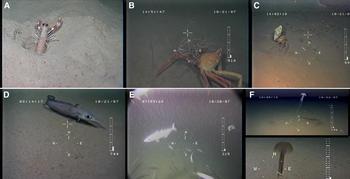
Several behavioural observations were made for motile fauna during the ROV surveys. Within the class Malacostraca, individuals of the family Galatheoidea were observed to maintain their positions, extending forward their claws as the ROV approached, suggesting the performance of territorial and aggressive defence behaviour. Burrowing behaviour was observed in an isolated individual of Norway lobster (Nephrops norvegicus, Linnaeus, 1758) at 670 m depth (see Figure 7A). This animal showed motile activity in relationship to the patrolling of different burrow entrances, entering and exiting from them. Another behaviour displayed by Malacostraca was related to camouflage. This was observed in six individuals of the crab Paromola cuvieri (Risso, 1816), which were carrying white plastic bags and other artefacts on their carapace (see Figure 7B, C).
Behavioural observations. (A) Territorial behaviour, in the Norway lobster, Nephrops norvegicus; (B-C) Camouflage behaviour from Paromola cuvieri; (D) The Macrourid Trachyrincus scabrus (Rafinesque, 1810), just before ROV evasion; (E) Schooling Trachurus sp.; (F) Pelagia noctiluca close to the bottom.

Fish behaviour was also noted in relationship to their reactions to the approaching ROV. Evasion was typically observed in individuals of the family Macrouridae (see Figure 7D), while other fishes (i.e. order Scorpaeniformes) did not show alterations in their behaviour. Schooling behaviour was reported for Trachurus sp. (Linnaeus, 1758), Pagellus bogaraveo (Brünnich, 1768), Capros aper (Linnaeus, 1758) and Lepidopus caudatus (Euphrasen, 1788) (see Figure 7E).
Finally, a peculiar observation was reported in relation to jellyfishes, mostly Pelagia noctiluca (Forsskål, 1775) and specimens from the order Coronatae, which were observed swimming a few centimetres over the seabed. In particular, small groups of P. noctiluca were observed touching the seafloor over the top of the flat seamount in the Eivissa Channel (see Figure 7F).
DISCUSSION
We conducted ROV video-observations of the benthic communities inhabiting a group of diverse geomorphological areas in the NW Mediterranean Sea for which poor faunistic information is to date available. Classes’ composition was mostly related to canyon, seamount and landslide in a site-specific manner. Anyway, depth was the principal parameter that shaped the zonation in our faunistic observations as already reported for other Mediterranean areas (D'Onghia et al., Reference D'Onghia, Mastrototaro, Matarrese, Politou and Mytilineou2003). This parameter constrained the presence of some species at certain locations, in a fashion that appeared to be independent of the different geomorphological character of the surveyed area and the type of substrate. For example, some shallow-water species, i.e. the anthozoan Pennatula rubra (Ellis, 1761), the asteroid Anseropoda placenta (Pennant, 1777), and the holothurian Parastichopus regalis (Cuvier, 1817), were never observed in deeper areas, even when suitable substrata were available, confirming species distribution ranges as observed by trawling (Sardà et al., Reference Sardà, Cartes and Company1994; Moranta et al., Reference Moranta, Stefanescu, Massutí, Morales and Lloris1998; D'Onghia et al., Reference D'Onghia, Mastrototaro, Matarrese, Politou and Mytilineou2003). Similarly, deep-living and highly motile species such as shrimps of the genus Plesionika spp. or fishes belonging to the order Stomiiformes and those within the family Myctophidae were only observed below a depth threshold.
Substrate type also plays a strong role in driving species composition in different geomorphological areas within a certain geographic region. Recurrent species composition across geography is of importance for the establishment of canyons, open slope, seamount and landslides as valid seascape units (Longhurst, Reference Longhurst1998; Levin et al., Reference Levin, Sibuet, Gooday, Smith and Vanreusel2010). According to these considerations, we decided to discuss our results separately for each geomorphological zone.
Canyons
The majority of the observations in the Blanes canyon corresponded to sessile fauna such as anemones, sea pens and fans, or tubeworms. All these taxonomic groups are suspension feeders and are common in canyons of the Catalan margin (Ramirez-Llodra et al., Reference Ramirez-Llodra, Ballesteros, Company, Dantart and Sardà2008, Reference Ramirez-Llodra, Company, Sardà and Rotllant2010; Company et al., Reference Company, Ramirez-Llodra, Sardà, Puig, Canals, Calafat, Palanques, Solé, Sánchez-Vidal, Martín, Aguzzi, Lastras, Tecchio, Koenig, Fernandez de Arcaya, Mechó and Fernández2012). A variable topography and physical characteristics has profound effects on the community structure within the canyon itself and in the surrounding slope areas (Genin Reference Genin2004; Tecchio et al., Reference Tecchio, Ramirez-Llodra, Sardà and Company2011, Reference Tecchio, Ramirez-Llodra, Aguzzi, Sanchez-Vidal, Flexas, Sardà and Company2013; Company et al., Reference Company, Ramirez-Llodra, Sardà, Puig, Canals, Calafat, Palanques, Solé, Sánchez-Vidal, Martín, Aguzzi, Lastras, Tecchio, Koenig, Fernandez de Arcaya, Mechó and Fernández2012; Papiol et al., Reference Papiol, Cartes, Fanelli and Maynou2012; Fanelli et al., Reference Fanelli, Cartes, Papiol and López-Pérez2013). In the specific case of Blanes canyon, an internal downstreaming flux of sediment takes place at a rate three times higher than on the surrounding open slope (Zúñiga et al., Reference Zúñiga, Flexas, Sanchez-Vidal, Coenjaerts, Calafat, Jordà, García-Orellana, Puigdefàbregas, Canals, Espino, Sardà and Company2009).
Seamounts
Faunistic differences between the Gulf of Valencia and the Eivissa Channel seamounts were observed. These differences are related to their topographic characteristics and depth, in turn influencing substrate types, local hydrography, and, most likely, food availability. The seamount of Valencia, with its conical shape, presented a sponge's community and a hard coral fauna, related to the abundance of hard substrate. On the other hand, the flat and shallower (195–250 m) topped seamount in the Eivissa Channel presented a dominance of motile fauna such as crustaceans and fishes, most likely associated with the shallow depth and the bioclastic sand.
Landslides
On the Eivissa Channel, two small submarine landslides and pockmarks were reported (Lastras et al., Reference Lastras, Canals, Urgeles, Hughes-Clarke and Acosta2004). We considered them to be mud plains or slopes with escarpments because they were too old in geological time to presently still affect the community colonization (Lastras et al., Reference Lastras, Canals, Urgeles, Hughes-Clarke and Acosta2004). Crustaceans and fishes dominated the faunal assemblages of both landslides, corroborating the preference of motile fauna for these types of geomorphologies. In fact, our results agree with those proposed by previous studies employing different sampling strategies (e.g. otter and Agassiz trawls) in these areas, highlighting these groups as the most abundant in terms of biomass (Stefanescu et al., Reference Stefanescu, Lloris and Rucabado1993; Sardà et al., Reference Sardà, Cartes and Company1994; Abelló et al., Reference Abelló, Carbonell and Torres2002). Moreover, a high proportion of predators (fishes and cephalopods) were observed in both areas.
Anthropogenic impact
The Mediterranean Sea has been a human thoroughfare since pre-history time and hosts some of the most ancient coastal settlements along its coastlines, which are currently densely populated (Longhurst, Reference Longhurst2007). As a result, it has been affected by all types of anthropogenic impacts for a longer time than other seas (Ramirez-Llodra et al., Reference Ramirez-Llodra, De Mol, Company, Coll and Sardà2013). Here, we observed noticeable levels of human impact, not only in relation to commercial fishery activity, but also to littering. We noticed several trawl marks as a proxy of intensive and repetitive fishing activity on canyon walls between 400–700 m. That activity produces a resuspension of sediment, which is mobilized towards deep areas with a potential significant impact on deep-sea communities (Palanques et al., Reference Palanques, Martín, Puig, Guillén, Company and Sardà2006; Martín et al., Reference Martín, Puig, Palanques, Masqué and García-Orellana2008). The continuous trawling over the seafloor on the Catalan slope has had a ploughing effect on the seafloor, resulting in a change of the seabed geomorphology and characteristics (Puig et al., Reference Puig, Canals, Company, Martín, Amblas, Lastras and Palanques2012).
Recent studies in this region reported biodiversity and community composition differences between fished and non-fished areas, with a decrease of sessile species in impacted zones (Ramirez-Llodra et al., Reference Ramirez-Llodra, Ballesteros, Company, Dantart and Sardà2008, Reference Ramirez-Llodra, Company, Sardà and Rotllant2010). Flat-topped sea hills and seamounts may present a modified faunal composition in relation to a previous undisturbed status (Clark et al., Reference Clark, Rowden, Schlacher, Williams, Consalvey, Stocks, Rogers, O'Hara, White, Shank and Hall-Spencer2010), primarily caused by the impact of commercial fishing activity (Pham et al., Reference Pham, Ramirez-Llodra, Alt, Amaro, Bergmann, Canals, Company, Davies, Duineveld, Galgani, Howell, Huvenne, Isidro, Jones, Lastras, Morato, Gomes-Pereira, Purser, Stewart, Tojeira, Tubau, Van Rooij and Tyler2014). In the present case, trawl marks were also observed at the top of the flat seamount. In our study area, we observed evidence of different fishing activities on both seamounts (not quantified here). There was a large amount of lost longlines (targeting fishes) tangled on the rocky substrate of the Gulf of Valencia seamount, while the flat-topped Eivissa Channel seamount presented a higher abundance of trawl marks (targeting mostly decapod crustaceans such as the red shrimp, Aristeus antennatus (Risso, 1816) (García Rodríguez & Esteban, Reference García Rodríguez and Esteban2008)).
Floating litter was observed in the Eivissa Channel landslides. Plastic bags accumulated in depressions such as pockmarks. This floating litter was also observed in Blanes canyon, where currents usually transport them from shallower to deeper areas. The impact of marine litter on deep-sea habitats is being addressed by several international initiatives (Galgani et al., Reference Galgani, Leaute and Moguedet2000; Ramirez-Llodra et al., Reference Ramirez-Llodra, Tyler, Baker, Bergstad, Clark, Escobar, Levin, Menot, Rowden, Smith and Van Dover2011, Reference Ramirez-Llodra, De Mol, Company, Coll and Sardà2013; Pham et al., Reference Pham, Ramirez-Llodra, Alt, Amaro, Bergmann, Canals, Company, Davies, Duineveld, Galgani, Howell, Huvenne, Isidro, Jones, Lastras, Morato, Gomes-Pereira, Purser, Stewart, Tojeira, Tubau, Van Rooij and Tyler2014). These studies provide a distribution of marine litter and its potential effects on the habitat and fauna, such as suffocation, physical damage to fragile sessile fauna (e.g. sponges, cold water corals) or the ingestion of microplastics in the NW Mediterranean Sea. Other studies have addressed the chemical contamination on deep-water fauna (Rotllant et al., Reference Rotllant, Abad, Sardà, Ábalos, Company and Rivera2006; Koenig et al., Reference Koenig, Fernández, Company, Huertas and Solé2013a, Reference Koenig, Huertas and Fernándezb) and sediments (Abi-Ghanem et al., Reference Abi-Ghanem, Nakhlé, Khalaf and Cossa2011). The presence of lost or discarded fishing nets is also often observed (Vertino et al., Reference Vertino, Savini, Rosso, Di Geronimo, Mastrototaro, Sanfilippo, Gay and Etiope2010; Ramirez-Llodra et al., Reference Ramirez-Llodra, De Mol, Company, Coll and Sardà2013), resulting in ghost fishing for long time periods.
Behavioural observations
In this study, schooling behaviour of fishes was observed near seamounts, as reported in similar studies in other oceans (Clark, Reference Clark1999). Conversely, on the muddy open slope, isolated individuals were usually detected. The reaction of fishes to the ROV approach varied depending on the species. As a first instance, all avoidance reactions could have been generated by a combination of strong illumination from lamps, water displacement around the ROV and vehicle-generated noise. In relation to the absence of behavioural reaction detected in some species at ROV approach (i.e. Polyprion americanus; Atlantic wreckfish), some questions arise about the ecological value of that passivity (Herring et al., Reference Herring, Gaten and Shelton1999). Behavioural observations for fishes are becoming abundant as ROV studies increase, since species are well visible, often being the focus of these surveys (Trenkel et al., Reference Trenkel, Francis, Lorance, Mahévas, Rochet and Tracey2004; Davis & Chakrabarty, Reference Davis and Chakrabarty2011; Ayma et al., Reference Ayma, Aguzzi, Canals, Lastras, Bahamón, Mecho and Company2016). Several studies in the Atlantic ocean compared trawl data with ROV video-surveys to evaluate biases produced by both sampling methods (Lorance & Trenkel, Reference Lorance and Trenkel2006). These studies showed that fish reaction and response to both ROV lighting and net approach generates a different bias-dependent effect on observations. In our case, the ROV does not seem to be perceived as a potential threatening stimulus by some species.
We observed four individuals of Paromola cuvieri as carrying human artefacts, as already reported in other areas (Braga-Henriques et al., Reference Braga-Henriques, Carreiro-Silva, Tempera, Porteiro, Jakobsen, Jakobsen, Albuquerque and Serrão Santos2011). This behaviour in the Mediterranean populations could be the result of the availability of litter in deep-sea areas. Plastic bag camouflage reported for the genus Paromola can be considered as a common behavioural trait for several other species of crabs (Bedini et al., Reference Bedini, Canali and Bedini2003), although they usually use gorgonians as camouflage (Wicksten, Reference Wicksten1985).
We observed seabed aggregation of the pelagic jellyfish Pelagia noctiluca according to previous findings (Cartes et al., Reference Cartes, Fanelli, Lopez-Perez and Lebrato2013). This species is known to have nycthemeral (alternated water column day and night) migrations (Franqueville, Reference Franqueville1970), and individuals were observed near the bottom on the top of seamounts, probably in relation to those movements (Boehlert, Reference Boehlert1988). The presence of P. noctiluca in the benthic boundary layer indicates that this species, previously classified as fully pelagic, has instead a benthopelagic life habit (i.e. animals enter contact with the seabed sediment once over the 24-h cycle; sensu Aguzzi & Company, Reference Aguzzi, Company, Costa, Matabos, Azzurro, Manuel, Menesatti, Sardà, Canals, Delory, Cline, Favali, Juniper, Furushima, Fujiwara, Chiesa, Marotta, Bahamon and Priede2010). Another interpretation could be that our observations were the result of some mass deposition of dead jellyfishes, probably resulting from some sort of schooling on the water column, which could be, potentially, a common behaviour in these animals (Billett et al., Reference Billett, Bett, Jacobs, Rouse and Wigham2006).
The different targeted environments showed faunal composition according to substrate, depth and topography. This aspect justifies a seascape approach in further ecosystem studies within north-western Mediterranean deep-sea areas. Several canyons, seamounts and landslides with the same characteristics could be classified as seascape units because they share similar compositions and distributions of taxonomic groups. This would allow faunistic predictions in other presently unexplored but similar western Mediterranean areas.
SUPPLEMENTARY MATERIAL
The supplementary material for this article can be found at https://doi.org/10.1017/S0025315417000431
ACKNOWLEDGEMENTS
We thank the Officers and crew of ‘BIO Hespérides’ and the ROV ‘Max Rover’ technical team from HCMR. Dr K. Ballesteros helped with faunal observations. Finally, we would like to thank C. Rivera-Rondón for discussions held regarding data structure and analysis smoothening the way to successful data processing. Jacopo Aguzzi is Theme Leader of the ‘Life in the North-East Pacific’ for the NEPTUNE network (Ocean Network Canada-ONC).