During 2017, climate and weather disasters devastated nearly every continent. Reference Galvin1 Flooding in Texas and the devastation in the Virgin Islands brought about comparisons to Hurricane Katrina, which was the costliest and most catastrophic weather-related disaster in US history. 2 Post-Katrina researchers offered a glimpse of the psychological problems that can occur after the staggering losses experienced by survivors. Reference Weisler, Barbee and Townsend3-Reference Abramson, Stehling-Ariza and Garfield5 For example, 74% of a sample of 102 studies of weather-related, technological, or violent disasters, identified specific psychological outcomes including post-traumatic stress, depression, anxiety, major depressive disorder, generalized anxiety disorder, panic disorder, post-traumatic stress disorder, and other psychiatric problems. Reference Norris, Friedman and Watson6 These findings are consistent with previous research regarding adverse effects of mental health after disasters occur. Reference Norris, Friedman and Watson6,Reference Galea, Nandi and Vlahov7
People in need of mental health care, however, do not always choose to seek out that care. Therefore, although effective treatments for mental illness exist, many individuals remain untreated. Reference Kohn8 Those who do seek help tend to do so outside of professional services, such as from clergy and Internet or social networks. Reference Thornicroft9,Reference Wang, Lane and Olfson10 Those with mental illness, a stigmatized disease, were significantly more likely to have used the Internet for health information, to have communicated with clinicians about their condition by means of the Internet, and to have used health-care services based on information found on the Internet, than those with nonstigmatized conditions. Reference Berger, Wagner and Baker11-Reference Van Ameringen, Mancini and Simpson13
Being that weather-related disasters will continue to occur; it is both beneficial and necessary to know what psychological problems may occur and understand the health-care patterns and information-seeking behaviors of survivors. The Health Belief Model (HBM), which originally attempted to explain the conditions under which a person will engage in individual health behaviors, offers a framework for understanding the way in which people approach health care. Reference Rosenstock14-Reference Henshaw and Freedman-Doan16 The HBM has also been a major theoretical focus of understanding the Internet’s use for health information-seeking behavior. Reference Ahadzadeh, Sharif and Ong17 The Internet has offered individuals who are aware of and concerned about their wellness the ability to be proactive in managing their health through seeking, exchanging, and communicating health-related information by means of online platforms. Reference Ahadzadeh, Sharif and Ong17 The HBM offers that this type of awareness increases the amount of health-related information people obtain from media sources. Reference Moorman and Matulich18
Although components of the HBM have considerable empirical support, this model has limitations for explaining health-care use among individuals with mental illness. Reference Hahm, Speliotis and Bachman19 For example, HBM excludes of the role that fear and stigma have on health care behaviors. Reference Eraker, Kirscht and Becker20 The social stigma associated with mental illness may be an important factor reducing help-seeking. Reference Clement, Schauman and Graham21 Fear is related to stigma in that people with mental illness are afraid that social stigma will cause significant personal challenges and social isolation. Reference Eraker, Kirscht and Becker20
Future disaster responses require timely provision of services to address the barriers faced by survivors. Reference Wang, Gruber and Powers22,Reference Madrid and Grant23 Addressing barriers is necessary because restoring individuals to a predisaster level of functioning is essential to community resilience and recovery and future disaster preparedness. Reference Rosenstock15 Understanding what keeps people from seeking mental health services will help health-care professionals design interventions and education programs to reduce barriers and encourage greater access for the underserved. Reference Henshaw and Freedman-Doan16
This study builds on the HBM by including the variables of fear and stigma in the study design. The objective of the study was to better understand the barriers and facilitators of health-care and health information-seeking behaviors of individuals who have experienced weather-related disasters with regard to mental illness.
METHODS
Study Design and Participants
Participants were recruited through social media, neighborhood message boards, and word of mouth. Residents of Texas, Louisiana, and Florida who had experienced weather-related disasters within the past 15 years were the focus of recruitment efforts. Study participants completed a self-report questionnaire by means of Qualtrics. The estimated time to complete the questionnaire was 15 min and was carried out during a 4-wk period in November 2017.
A total of 211 individuals agreed to participate in the survey after reading a consent form approved by the participating university’s institutional review board. Of those who agreed to participate, 14 said they had not experienced any weather-related disasters and were removed from analysis. Another 27 had experienced a weather-related disaster but did not provide any data beyond this question; they were also removed from the analysis. The final sample size was N = 170.
Measures
Individual Factors
Demographic data included gender, race, age, and education attainment. Economic data included requests for household income, and information regarding health insurance coverage. Questions that gave focus to environmental concerns were based on the experiences participants have had with weather-related disasters. The first section addressed if and how participants were affected by the flooding and hurricanes that effected the Gulf Coast during the past 15 years. The second section asked questions as to whether participants experienced distress and/or problems following the hurricanes that effected the Gulf Coast during the 2017 hurricane season. Responses measured the frequency with which they experienced symptoms of distress during the previous month (1 – Every day; 3 – Once a week; 5 – Less than once a month). This concept was measured by means of 11 items and averaged to create the “Depression Scale” index (α = .88). Example items include: Feeling down, depressed, or hopeless; Little interest or pleasure in doing things; and Feeling tired or having little energy.
Psychosocial Factors
The psychosocial variables addressed in the survey were developed from previous studies. Reference Hahm, Speliotis and Bachman19,Reference Eraker, Kirscht and Becker20 Participants were asked to read the questions, which addressed the possible reasons that they may or may not choose to seek out professional help when they experience symptoms of mental distress. Responses were based on the degree to which they agreed or disagreed with each statement. Answers ranged from 1 – Strongly disagree to 5 – Strongly agree. The barriers and facilitators encountered when seeking health care were measured by means of 5 items. Reliability analysis revealed that 4 of the 5 items should be averaged to create the “Barriers and facilitators” scale (M = 3.11, SD = .01, α = .60). Example items include: I have had previous bad experiences with health services (reverse-coded); It is difficult to take time off of work to go to the doctor (reverse-coded); and It is easy to get necessary health care, tests, or treatment when I need it. The fifth item, “Others encouraged me to seek mental health help” was not included in the scale. However, this item was included in a regression analysis to identify if any specific barriers predicted seeking mental health help.
The next set of questions refer specifically to fear and stigma associated with being treated for mental illness. Reference Clement, Brohan and Jeffery24,Reference Kantor, Knefel and Lueger-Schuster25 The variable was measured with 5 items. The items were averaged to create the “Fear and Stigma” scale (M = 3.43, SD = 1.10, α = .87). Example items included: It is embarrassing to ask for help when I am experiencing mental health issues; I am worried about what my friends or family might say if I were diagnosed with a mental illness; and I am concerned that if I see a doctor about my mental health, the information I share will not be kept confidential.
Health-care Use Behaviors
Participant health-care use behaviors were addressed in 2 sections: nonmedical and medical. Nonmedical information seeking was measured by asking participants whether they had consulted sources other than medical professionals about their mental health over the past month. 26 Examples include social networks, newspapers, and the Internet. They were then asked to agree with a statement addressing how much they trust the information received about health or medical topics from those sources on a 5-point Likert scale (1 – Strongly disagree to 5 – Strongly agree). They were also asked to agree or disagree with statements addressing how much they trust the information received about health or medical topics from those social networks on a 5-point Likert scale (1 – Strongly disagree to 5 – Strongly agree). This information was measured by means of 11 items that were averaged to create the “Non-Medical Professional Trust” index (α = .84).
The experience participants had when seeking information from nonmedical professionals was measured by means of 3 items, also provided by the National Cancer Institute. 27 Items asked how much participants agreed or disagreed with statements regarding the sources you’ve consulted regarding your mental health over the past month. The items stated: It took a lot of effort to get the information you needed; You were concerned about the quality of the information; and The information you found was hard to understand.
Questions addressing health-care seeking in the medical sector (the main outcome of interest for this study) inquired about the participant’s last encounter with a medical professional about symptoms of mental illness. 27 Participants were asked to respond yes or no to the following questions, “Have you ever visited a medical professional about symptoms of mental illness?” A medical professional was defined as a primary care physician, physician’s assistant, nurse, etc. If the participant had not seen a medical professional about their symptoms, they were asked to respond with a short answer as to why this was the case.
Data Analysis
Data showed a positive correlation between information seeking and seeing a health-care professional, r = .252, n = 136, P = 0.003. With this finding in mind, an analysis of covariance (ANCOVA) was used to examine visiting a medical professional for mental health problems as a function of information seeking, controlling for the highest level of education attained.
To gain a greater understanding of the facilitators and barriers to seeking mental health care for individuals who have experienced weather-related disasters, a multiple linear regression was first conducted using the scales for barriers and facilitators, information seeking, and fear and stigma. The analysis that followed included the individual factors that were used to create the scales for fear and stigma, and barriers. To identify the specific barriers or facilitators that predict individuals seeking professional mental health care, a multiple linear regression analysis was conducted to examine which factors, outside of information seeking, are most prevalent when individuals do not seek mental health care. Before running the analysis, the variables were checked for multicollinearity, and the data were checked for univariate and multivariate outliers. No multicollinearity was found, the Mahalanobis Distance test showed no multivariate outliers, and Z-scores for the variables were examined showing no univariate outliers.
RESULTS
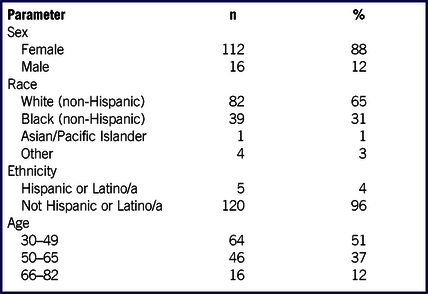
The average age of participants in the sample was 50.45 (SD = 12.88) (Table 1). Most participants were female (n = 112; 88%) and White (n = 82; 65%). Approximately a third of the participants (n = 39; 31%) were Black, and 4% were Hispanic. Participants responded to the frequency with which they experienced 11 symptoms associated with anxiety and depression. Sixty-six percent of participants reported a high frequency of depression and/or anxiety symptoms. Only 11% reported having no symptoms. The frequency with which other participants experienced symptoms varied. For example, when asked how often they feel down, depressed, or hopeless, 26.4% felt this way every day or several times a week, 6.5% responded once a week, 29.7% responded 1-3 times a month, and 37.4% responded less than once a month. Nearly half of the participants (47.1%) responded that they have trouble falling asleep every day or several times a week. Additionally, 44.1% said they felt tired or had little energy every day or several times a week, and 41.3% reported either having a poor appetite or overeating every day or several times a week.
Characteristics of Participant Sample

Health-Care–Seeking and Health Information-Seeking Behaviors
Of the total participants, 39% had visited a medical professional about symptoms of mental illness, while 61% had not seen a medical professional. Of those participants who visited a medical professional about their mental health, all of them also sought information from nonmedical sources. The most frequently consulted nonmedical sources were friends or family (52%) and the Internet (26%). Very few participants (20%) agreed or strongly agreed that it took them a lot of effort to get the information they needed. Even fewer (6%) agreed or strongly agreed that the information was difficult to understand. However, 40% said they were concerned about the quality of information found when seeking information from nonmedical sources.
Relationship Between Information Seeking and Seeing a Health-Care Professional
We first separated participants into 3 groups to better understand their information-seeking behaviors. Collapsing a variable into a smaller number of useful categories makes the scale more comprehensible. Reference Pollock28 If a participant consulted no nonmedical sources, they were labeled as having no information-seeking behavior (42%). If they consulted 1-2 sources, they were labeled as having low information-seeking behavior (41%). If they consulted 3-6 sources, they were labeled as having high information-seeking behaviors (17%). Those groups were then subjected to an ANCOVA analysis to test the relationship between information seeking and seeing a health-care professional and to test any group differences. This analysis revealed a significant effect for the level of information seeking, F(2,123) = 5.47, P < 0.005, partial η 2 = .08. Participants with high levels of information seeking were significantly more likely to visit a medical provider than those who had not sought nonmedical information at all (P < 0.05). There were no differences between those with low and high information seeking.
Barriers or Facilitators as Predictors of Seeking Professional Mental Health Care
We conducted a multiple linear regression analysis to further assess predictors of seeking professional mental health services. The model included variables pertaining to depression symptoms, information seeking, barriers and facilitators, and fear and stigma. The regression analysis showed a significant effect of the variables in the model predicting whether a participant was likely to seek professional mental health care, Adjusted R 2 = .08, F(4,119) = 2.93, P < 0.05. The model showed that higher information seeking was the only significant predictor of visiting a medical professional (β = .27; P < 0.05). Neither depression (P = 0.19), medical barriers and facilitators (P = 0.52), nor fear and stigma (P = 0.19) were related to visiting a medical professional. Thus, they had no detrimental contribution to visiting a medical professional.
A subsequent multiple linear regression analysis was conducted to examine which barriers and facilitators are most relevant to mental health-care help seeking. The variables in the model accounted for a significant portion of the variance in whether a participant is likely to seek professional health care, Adjusted R 2 = .06, F(5,120) = 2.72, P < 0.05. When the participant had a previous bad experience, they were less likely to seek medical care (β = -.21; P < 0.01), and the more others encouraged them to seek professional care, the more likely they would be to see a doctor (β = .20; P < 0.05).
We conducted a similar analysis with the individual items for stigma. The analysis showed that fear and stigma did not account for a significant portion of the variance in whether a participant sought professional care for their mental health, Adjusted R 2 = .03, F(5,117) = 1.20, P = 0.32. Participants who said they were concerned that the information they shared would not be kept confidential were less likely to seek mental health care (β = -.19; P = 0.08).
DISCUSSION
Nearly 66% of participants reported a high frequency of depression and/or anxiety symptoms, yet roughly 43% saw a medical professional. Of those participants who visited a medical professional about their mental health, 76% also sought information from nonmedical sources. These findings support previous research noting the continued need to understand what factors keep people from seeking mental health services. Wang et al. Reference Wang, Gruber and Powers22 found that an estimated 31% of respondents in their study of Katrina survivors had evidence of a mood or anxiety disorder, but only 32% of that group used any mental health services since the disaster, including those with serious disorders. The results also support previous research in showing that information seeking is an important factor in whether individuals choose to see a doctor. Seeking medical care for mental health reasons appeared to be strongly correlated with other forms of information seeking.
Across their 2 studies, Vogel et al. Reference Vogel, Wade and Wester29 found that those who sought mental health services were prompted to do so by others at least 74% of the time. They also found that those who sought services knew someone else who had sought help nearly 95% of the time. Like the findings of Vogel et al., Reference Vogel, Wade and Wester29 the most frequently consulted source by participants of this study was friends and family. Participants of this study consulted friends and family nearly 30% more than they did the Internet. It is apparent that friends and family are a more sought out source than the Internet. This may be due to trust or source credibility, or challenges with the use of technology. Whatever the reason, it is apparent that having others offer encouragement to seek help increases the chances that someone in need will see a doctor.
In many areas of health communication research, patient-provider communication has been the topic of review. This study’s results are consistent with previous findings that note the importance of positive patient-provider communication. Having a bad experience with a doctor was likely to discourage participants from seeking health care. It is necessary for medical professionals to be aware of the interaction they have with patients. Negative interactions, including poor communication, could affect health-care–seeking behaviors in the future.
Participants were surveyed for their fears and possible perception that receiving help for mental health would be stigmatizing. Although anticipated to be a barrier, fear and stigma were not significantly related to seeking professional help. Jennings et al. Reference Jennings, Cheung and Brit30 note that the relationship between help-seeking and stigma is complex. They found that, when individuals perceive that others would view them negatively for seeking treatment for mental health issues, they may endorse similar stigmatizing beliefs toward themselves, leading them to attempt handling problems on their own instead of seeking professional treatment.
Even though fear and stigma did not significantly predict whether an individual would seek mental health care, it does not necessarily follow that those variables would not be of benefit as an addition to the HBM. Being that the relationship between help-seeking and stigma is not easily understood, adding the contextual element of weather-related disasters may make a difference in health-seeking outcomes. Further exploration of fear and stigma as barriers to mental health care in a general context may be of benefit.
The current study has several limitations. First, most participants were women over the age of 30. Although limited, older participants have a greater potential for carrying heavier social, biological, and economic burdens. Older individuals also have more autonomy than those of a younger age in where and from whom they seek information. Second, the sample of participants was composed mainly of residents of Louisiana. Gulf Coast residents who had most recently experienced a weather-related disaster, such as those in Houston, Texas, may not have been able to participate in the study. A sample of participants who included more residents of Florida and Houston may have offered a greater breadth of information about people who experienced disasters, but residents of southern Louisiana offer the perspective of surviving many weather-related disasters, including floods and hurricanes.
Additionally, a potential bias exists due to time. There was a 15-year time span between Hurricane Katrina and when this study was conducted. Research shows that information recall is affected by the emotional content of an experience, as well as emotions and emotional goals experienced at the time of autobiographical retrieval. Reference Holland and Kensinger31 Thus, beyond time, people may not want that memory to be activated and may not want to share their experiences with others, even in an anonymous context. This may in part explain why several individuals entered the study but did not complete some of the items on the survey. Nevertheless, individuals who experienced prior weather-related disasters are at risk for mental health issues; more research is needed on their long-term information and communication needs and their experiences with the healthcare system.
CONCLUSIONS
Many of the findings in this study supported previous research, reinforcing the idea that communication can be both a barrier and a facilitator to health care. Positive communication and strong support systems have the potential to mitigate the reluctance people have in seeking help for mental health problems. Although it is discouraging that few people seek professional care, it is promising that participants were not avoiding care due to fear of being stigmatized. This offers opportunities for avenues of future research that focus on the possibility of weather-related disasters mitigating fear of stigmatization. It would also be of interest to find whether the negative connotations that have persisted about mental illness are declining, leading the way for more people to receive the treatment they need.
Fear and stigma were not barriers to seeking mental health care, showing that weather-related disasters may mitigate fear of stigmatization, leading the way for more people to receive the treatment they need. Less opposition to mental health care by survivors of weather-related disasters offers greater opportunity for mental health professionals to treat the numerous psychological problems survivors experience. Although not everyone seeks out care, providing necessary information may make headway to mental health care where it is greatly needed.
Mental health-care providers should identify sources that survivors use after a weather-related disaster and ensure that information about symptoms of depression and anxiety, as well as where to receive help is made available through those sources. For example, the Internet offers a variety of opportunities to dispense information regarding mental health and resources available. Such information can be offered on the numerous government websites regarding planning and recovery. eHealth technology offers the opportunity to develop more clinic-based resources online. Additionally, providers should be prepared to make themselves available as a source of information at shelters and information centers. As technology sometimes fails in the midst of a disaster, being able to offer information in person is a valuable tool.
Acknowledgments
The data reported in this article are original, have not been published elsewhere, and are not under consideration for publication elsewhere.
Conflict of Interest Statement
The authors declare no conflict of interest.