This project began as a journey from theory to practice. What would a democratic agenda setting mechanism for direct democracy look like? More specifically, could the ancient Athenian idea of a deliberating microcosm, chosen by random sampling, be used to set the agenda for direct democracy in a big American state like California? Could it be piloted to reveal the strengths and challenges that might face an actual institutional design? Could the ideal of “deliberative democracy” be made practical? These daunting questions led us from theory to practice. We report here on what we learned.
The past two decades have witnessed a surge of interest in “deliberative democracy” in both political theory and empirical work.Footnote 1 While there is now a large literature, we can think of the core idea of deliberative democracy as reason-based public will formation. Put more simply, it is that the “will of the people” has been arrived at by some process in which people weigh competing reasons under good conditions for considering them.Footnote 2 The good conditions may include mutual respect, listening as well as talking, access to good information, and opportunity for extended dialogue, among other things.Footnote 3 While the basic idea may seem only common sense, it situates itself uneasily within some democratic theory and the most common forms of democratic practice.
On the side of theory, Schumpeterian competitive democracy, “the competitive struggle for the people’s vote,” does not provide many occasions or incentives for mass deliberation. Joseph Schumpeter himself treated any reliance on the “will of the people” as chimerical.Footnote 4 Parties compete to win, by whatever means. If they can be more successful by manipulating or misleading the public with their campaign tactics, so be it.Footnote 5
On the side of practice, office holders have little opportunity to deliberate, independent of electoral considerations, in the era of the “permanent campaign.” Party discipline further limits their flexibility. At the mass level, people have little opportunity or incentive to deliberate policy issues in any detail. These problems do not inhibit Schumpeterian competitive democracy but do frustrate aspirations for deliberation.
Direct democratic practices like the initiative and referendum help relatively little. Large sums of money are typically spent for campaign advertising, focus-group tested messaging, and mobilization to support ballot propositions. Effective campaigns often focus on side issues or highly misleading or contentious factual claims, or the motives of the donors on one side or the other. There are well-meaning public service efforts to inform voters (official voter pamphlets, non-partisan voter guides, online voter advice applications), but few citizens spend much time consulting them. Instead, many citizens rely as best they can on party-based cues and endorsements.Footnote 6 Ballot propositions would seem to be a difficult area where high quality citizen deliberation might find a useful entry point.Footnote 7
Yet entry points for deliberation may be possible. They need to be carefully selected and then piloted to help envisage new institutions. Agenda setting for ballot propositions is an especially problematic area of current practice, but also, we think ripe for possible deliberative reform. That is our focus in what follows.
Agenda Setting and the Initiative Process
Scholars have long noted the extraordinary power over the policy agenda that the initiative process grants to proponents, and have lamented its consequences for the democratic process. Indeed, the canonical formal model of agenda control—Thomas Romer and Howard Rosenthal’s “setter” model, which has been applied to a wide range of political institutions—was motivated by the example of direct democracy.Footnote 8 Romer and Rosenthal observed how much power was wielded by those who wrote local or state referendums, grounding their model in the example of school funding measures on Oregon ballots. They showed that because a proposition’s author is able to make a take-it-or-leave-it offer to voters, the author can force the public to pass measures much closer to its own ideal policy than to the preferences of the median voter. In their review of the literature on the initiative process, Shaun Bowler and Todd Donovan note that this system grants the agenda setter control over precisely what the details of a law will be, in a way that is quite different from the normal give-and-take of representative democracy.Footnote 9
This concern over the power wielded by initiative proponents is compounded by the process through which they earn agenda control: gathering signatures to qualify an initiative, almost always with the help of paid signature gatherers. And because their use is nearly as old as the initiative process itself, states have attempted to prohibit the practice of paying signature gatherers since 1913–1914, when Ohio, South Dakota, and Washington first banned it. Yet the United States Supreme Court overturned such bans in 1988, creating a system in which agenda power can effectively be purchased in initiative contests.
This has left scholars to lament that “what was once a valuable agenda-setting mechanism for citizens has increasingly become a tool of professional special interest groups.”Footnote 10 Focusing on the primacy of money in setting the agenda for direct democracy, Elizabeth Garrett writes that “the link between money and ballot access is stronger than the connection between wealth and electoral outcomes in direct democracy. Individuals and groups with substantial financial resources can buy their way onto the ballot.”Footnote 11
The Initiative in California
While the initiative is currently employed in 24 American states, it is an especially prominent and recurrent aspect of governance in our largest state, California. California also has more than a century of experience with the initiative since it was launched in the Progressive era in 1911, as a way of returning democracy to the people and of curbing the influence of big money and corruption. Billionaires are now notable as individual agenda setters in California initiatives. Companies and unions have given comparable amounts in the past, but recently individual donors have put measures on the ballot and financed their campaigns almost single handedly with contributions of many millions of dollars.Footnote 12 Given the prominence of well-financed interest groups and of billionaire individual donors funding proposals nearly in their entirety, it is hard to conclude that the initiative has either allowed the people to effectively set the agenda or has curbed the influence of big money in politics.Footnote 13
A petition with signatures was supposed to empower ordinary citizens to set the agenda by determining what the rest of the electorate would vote on. Ideally, the signature-gathering process would serve an educative function as volunteers and civic groups discussed the reasons for proposals with petition signers.Footnote 14 But the task of collecting millions of signatures has given effective control of the agenda to those who can pay for the signature collection.Footnote 15
Within democratic theory, agenda setting is a long unresolved problem. Robert Dahl, for example, proposes “final control of the agenda by the demos” as one of the necessary conditions for democracy (and presumably for direct democracy). But he is not clear how the demos (the electorate) is supposed to exert final control.Footnote 16 If outsiders determine the agenda then the demos has clearly lost final control. But if a self-selected subset of the people takes over and lets the people only decide questions of their choosing then the people have also lost control of the agenda.Footnote 17 In theory, the petition process gives everyone an equal opportunity to propose a topic and get the requisite signatures and in that way set an agenda, at least for initiatives. But in actual fact, in a large-scale state, isolated citizens and even non-profit civic groups cannot put something on the agenda without the addition of very substantial resources. The equal opportunity is formal and symbolic, while effective final control is exercised by those who can finance the signature gatherers.
The Deliberating Microcosm
There is, however, venerable historical precedent for an approach to deliberative agenda setting for direct democracy. Use of a randomly selected microcosm that deliberates on the substance of proposals goes back to the earliest democratic practices in ancient Athens. It is a variation of that idea that we explore here in an application to California. It empowers a random sample of the people themselves, not their representatives, and it has long been used for agenda setting.
In ancient Athens the randomly selected Council of 500 met for a year and set the agenda for proposals to be voted on by citizens in the Assembly. The Council was one of several deliberating microcosms that made important public decisions—the citizens juries, legislative commissions (called nomethetai), and the graphe paranomon (a deliberating group that would hear the case that a proposal in the Assembly was illegal). All were similarly constituted. All of these institutions added a thoughtful and representative element to the work of the Assembly, Athens’s institution of direct democracy.Footnote 18 The Council did it through agenda setting. The nomethetai and the graphe paronomon worked after, rather than before, the votes in the Assembly. By the fourth century no proposal passed by the Assembly could become law without approval of the nomethetai, the legislative commissions chosen by random sampling that would hear the case for and against a proposed law and then vote. This institution seems to have been added to cure the dangers of orators mobilizing crowds in the Assembly to support unwise proposals—a danger which resonates with modern critics of direct democracy. It was a “democratic brake to slow down the machine” and “to protect against the possible ill effects of snap votes” in the Assembly.Footnote 19 The graphe paronomon is thought to have provided another incentive for deliberation in the Assembly in that if one made what was later thought to be an irresponsible (“illegal”) proposal one could be prosecuted.Footnote 20
Recent times have seen the creation of a variety of deliberative “mini-publics”—varying in how the participants are selected, the number of participants, the data collected on them, the institutional design for discussion, the decision rules, whether or not the process is moderated, and the product of the discussions (a vote by some decision rule, a consensus, or individual confidential responses to a questionnaire that are then aggregated).Footnote 21 Citizens juries, citizens assemblies and other mini-publics have produced a prominent literature.Footnote 22
The clearest example for agenda setting is the Citizens Assemblies in British Columbia, Ontario, and elsewhere. These Assemblies, based on a mandate from the legislature, were empowered to deliberate about a proposal for electoral reform and then to put that proposal on the ballot. While the agenda of electoral reform was decided by the legislature and provincial government, the specific nature of the proposal was decided by the Citizens Assemblies. The method of choosing the members allowed a great deal of self-selection, undermining claims of random selection. Although 23,000 voters were sent letters of invitation, only a very non-random 964 showed up at the selection meetings, where 158 of them were randomly selected. Despite this defect, the Citizens Assemblies’ deliberations were impressive, emulating the Athenian Council in having citizens determine the agenda for policy making. The deliberations were lengthy, and the participants clearly engaged.Footnote 23 They broke new ground in the modern era.Footnote 24
Other mini-publics evaluate proposals after they go on the ballot. The “Citizens Initiative Review” (CIR) in Oregon engages a small sample (of, say, 24 voters) in evaluating proposals and making those evaluations available to voters before the election.Footnote 25 This too has sampling issues. With such small samples, sampling error could easily reverse any recommendations.Footnote 26 In any case, our interest here is in entry points further upstream, using a deliberative microcosm as an agenda setter.
Piloting a Design for Deliberative Agenda Setting in California
In June 2011, a statewide sample of registered voters was convened to deliberate in depth about the problems facing the state for a project called What’s Next California (WNC). They considered 30 proposals from a broad coalition of reform groups, vetted by an extensive advisory group.
The fundamental idea of the project was to set an agenda for possible reforms that could be put before the voters or the legislature. Both decision venues were in play because before any civic group undertakes the extraordinary effort and expense of taking an issue to the ballot, it is reasonable to try and see if the legislature may act on it instead. What proposals would the voters of California support (or which would they not support) on the basis of actually discussing competing arguments for and against those proposals and after getting good information about them? That was the unprecedented question put before a credible sample of the entire state gathered in 2011 to deliberate for a weekend.
The key expectations for the project are tied to our aspiration to pilot deliberative agenda setting by a representative microcosm of the voters: First, that the project would be successful in recruiting a random sample of the voters, large enough that its representativeness and changes in opinion could be evaluated statistically. Second, that there would be significant knowledge gains. Third, that there would be significant changes in support for many of the policy options. Fourth that we could identify coherent reasons for that support after deliberation.
The idea is to model reason-based public will formation in setting the agenda for new legislation and ballot measures. The representativeness is key to answering the hypothetical—what would the people think, under transparently good conditions for thinking about these issues? The design of the project offers one particular account of what might count as good conditions (balanced briefing materials, small group discussions with trained moderators, plenary sessions with competing experts). Other mini-public designs offer different accounts of the appropriate conditions.Footnote 27 The project aspired to vet proposals, and not to create them from scratch. Our reasoning is that since potential ballot propositions comprise the agenda, those propositions would need proponents. Hence the eventual aspiration is an institution that vets proposals from potential proponents and deliberates in a representative and thoughtful way about them. In some way yet to be specified, the proposals with support either go to the ballot or get considered by the legislature.
What Happened?
A random sample of registered voters from throughout the state was recruited to travel to Torrance for the weekend.Footnote 28 Out of 527 initial interviews conducted by telephone polling, there were 439 acceptances to attend, with 412 showing up for the weekend of deliberation, travelling from throughout the state. The 412 were compared to a separate sample of 300 registered voters who were never invited to Torrance but who took the same questionnaire. The 300 in the comparison group were weighted to reflect the population of registered voters. In both samples there were up to ten call backs to reach those initially drawn in the sample. Participants were paid an honorarium for the weekend participation plus all travel expenses and hotel accommodations.Footnote 29
There were no significant differences between the 412 participants and the 300 in the control group in gender, age, education, employment status, ethnicity, political party or political ideology. There were, however, small differences in income and religious attendance and some significant differences in attitudes toward some specific policy proposals. To ensure that any differences in specific policy attitudes did not affect our results, we conducted a further matching analysis to establish weightings for the participant sample and then reanalyzed the changes in attitudes. The results remained substantially unchanged as detailed in separate analyses published online.Footnote 30 Hence, we report the unweighted results for the participants here.
The weekend discussions focused on specific reform proposals in four areas: the structure of the legislature, the initiative process, state-local reform, and taxes. The weekend alternated small group discussions with trained moderators and plenary sessions in which questions agreed upon in the small groups were posed to panels of competing experts. The agenda went from Friday evening through Sunday afternoon.
To assess knowledge, participants were asked a series of eight knowledge questions before and after deliberation. As in other Deliberative Polls, they provided evidence of strong knowledge gains.Footnote 31 Overall correct answers to the eight questions increased significantly by 18 points. The specific knowledge questions and the knowledge gains are available in table 1 of the online appendix.
Regression: Lengthening Assembly terms

There were thirty specific policy proposals divided into the four topics. They are a varied list composed by the advisory group, representing different perspectives for possible change in four key policy areas: the initiative process, the legislature, state/local relations, and taxation (tax and spend). The briefing document included not only a narrative but a separate page for each proposal with a clear summary and with pros and cons in tabular form. All the results for the 30 proposals, before and after deliberation, are shown in the online appendix. Twenty-one of the thirty proposals changed significantly. In what follows we will identify a couple of proposals of special interest in order to illustrate the public’s reasoning. Then we will turn to some that were notable for impact, either on legislation or by going to the ballot.
Vetting thirty specific policy proposals is a daunting task for a weekend. The briefing document was more than 100 pages in length. Critics of deliberative democracy have questioned whether ordinary citizens, even highly educated ones in advanced developed countries, are capable of a reason-based, critically reflective deliberation on complex policy questions.Footnote 32 If we succeeded in recruiting a good sample, it would be no more educated and no more knowledgeable about politics and policy than the average level of ordinary citizens. Could they deliberate on such complex issues? What indications can we get from the quantitative and qualitative data available that they weighed competing arguments in coming to considered judgments?
Inside the Deliberations: A First Look
With thirty widely-varying reform proposals, it was not possible to include tailor-made explanatory variables, close to the substance of the topic of each particular proposal—except in a few cases. Going into this agenda-setting exercise, it was also difficult to anticipate which proposals would be of most interest, either to the public or to potential proponents of ballot measures. So the decision to tailor some explanatory variables for certain proposals was a fairly arbitrary one. Nevertheless, it has been revealing. When available, they shed light on the reasoning supporting the considered judgments post deliberation.
We are particularly interested in looking at explanatory variables that can be interpreted as identifying considerations “inside the heads” of the participants, rather than merely causal factors that may be more in the background. Our interest is in understanding the substance of the deliberations and the factors that weigh with the public when they consider competing arguments. With this aim in mind, we can look at some proposals where we seem to have some relevant explanatory variables with the appropriate causal proximity. We can also conjoin quantitative analyses with the dialogue we have from the transcriptions of the small group discussions. Such excerpts give a sense of the competing arguments the citizens were posing to each other for consideration.
To illustrate the process, consider two of the proposals—for lengthening the terms in the legislature, and for making the legislature part time with part-time pay. Either would constitute a big change in the governance of the state.
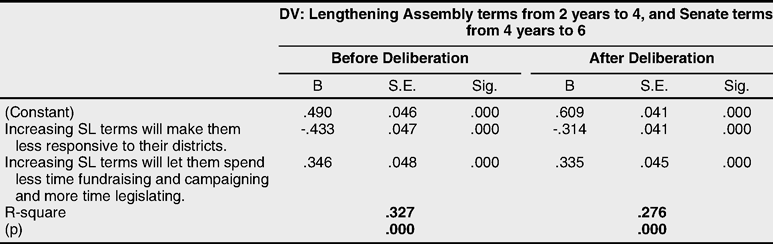
Support for lengthening terms in the State Legislature from two years to four years in the Assembly and from four to six years in the State Senate rose from 33 percent on first contact, to 45 percent on arrival (time 2) to 80 percent by the end of the weekend deliberations. Table 1 shows a linear regression estimated with OLS, connecting two empirical premises with opposition or support for this proposal both before and after the deliberations.Footnote 33 An argument against this proposal was that “increasing state legislative terms will make them less responsive to their districts.” Both before and after deliberation agreement with this argument weighs against the proposal for lengthening the legislative terms. In both cases the sign is negative and the relation is significant. Alternatively, the argument that “increasing state legislative terms will let them spend less time campaigning and fund raising and more time legislating” weighs in favor of the proposal. Both before and after deliberation the sign is positive and the relation is significant.
The transcripts from the small group discussions give plausibility to this picture. Consider these excerpts from various participants in the discussion considering this reform:
“I think we need to expect from them that they have a long term—that they don’t get into office, like they do now, with a two year term and the first item of business is how can I get re-elected?”
“I think it’s really a good idea if they don’t have to run every two years. Because every two years they’re out there handing out their hands. You have to be influenced by who you get your money from.”
Longer terms might also give legislators the freedom from campaigning that might allow them to come to some agreements without immediate reprisals:
“If people aren’t worrying about being re-elected in six months, maybe they’ll compromise more and get the budget passed. But it’s like if I cave on this, I won’t get elected and people will remember because the election is coming up . . . Maybe a longer term will get people more likely to stay at the table and compromise and get something done.”
The proposal for a part time legislature with part-time pay represented very different, more populist sensibilities. It initially polled high. The Los Angeles Times heralded its own survey at the time of the project: “It is time to bump law-making down to a part-time profession in California, according to an overwhelming number of respondents in a new poll.” The survey found that 65 percent favored “moving the state’s full time Legislature to part-time status with part-time pay.”Footnote 34
While there was substantial support in polling at the time, what would the people think about the proposal if they really considered its implications? WNC only asked this on arrival, after participants had presumably already begun deliberating in anticipation of the event and in light of the balanced briefing materials which were sent to them to facilitate preparation.Footnote 35 On arrival the proposal had 45 percent support. However, by the end of the deliberations, support had dropped to 27 percent (the mean response had dropped from .505 to .353).Footnote 36 Do the regressions shed any light on this drop?
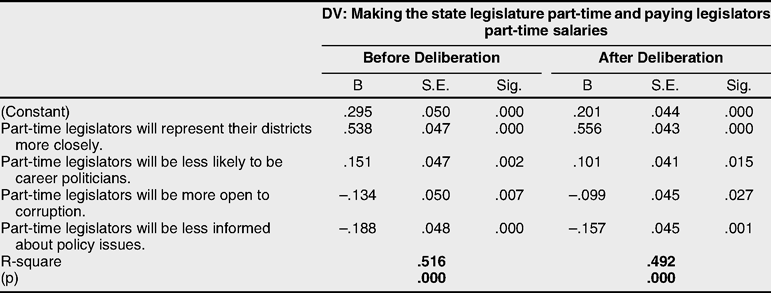
Table 2 depicts regressions before and after deliberation for four considerations that might weigh in favor or against the proposal for “making the state legislature part-time and paying legislators part-time salaries.” An argument in favor is that “part-time legislators will represent their districts more closely.” Both before and after deliberation this argument has a positive sign and the results are significant. A second argument in favor, in the current political environment, is that “part-time legislators will be less likely to be career politicians.” Again, this argument has a positive sign, both before and after deliberation, and the results are significant.
Regression: Part-time legislature

Table 2 also shows results for two arguments against the proposal. “Part-time legislators will be more open to corruption” has a negative sign, weighing against the proposal, both before and after deliberation and the results are significant. Also, “part-time legislators will be less informed about policy issues” also has a negative sign, both before and after deliberation and the results are again significant.
The transcripts show a mix of considerations on both sides as the participants weighed advantages and disadvantages. The argument in favor was that they could get closer to their districts if they were part time. Perhaps they could use technology and also save money:
“You benefit two ways: one, you’re spending more time at your district and you’re actually involved with your area; two, you’re reducing the cost of the travel. And that’s a lot of money right there. I mean they have to kinda keep up with technology in a sense.”
“When I’m saying part-time is get them out of Sacramento. Let them be home. They could do their job on the internet.”
On the other hand with the common perception that the legislature was not functioning well and that the state had big problems, there was a greater sense that the state might get an even less effective legislature if it were part-time:
“I don’t want somebody part-time handling the decisions that’s gonna affect my life during the long term.”
“I feel very uncomfortable with taking work part-time because I feel . . . how much more part-time are they gonna be doing if you gave him that title already. Now, they’re gonna be doing even less work.”
Perhaps the drop in support over the course of deliberation for this proposal—an idea touted not only in the press but soon promoted by a presidential candidate as a solution to the problems of the U.S. Congress and presumably other states than TexasFootnote 37—provides a caution for taking the polling of the moment as an agenda setter for constitutional change, whether state or national.
The picture that emerges, buttressed by other regressions and transcript excerpts in the online report,Footnote 38 is the public thoughtfully weighing competing reasons for each policy option and coming to their individual considered judgments. Those judgments, by design, were not collective or shared decisions, but as in other Deliberative Polls, collected in confidential questionnaires—allowing study of change at the individual level. This strategy also protects each deliberator from the social pressure of consensus-seeking as in a jury verdict. The process allows us to see what individual deliberators really think on reflection. And the collective result is what the microcosm really thinks on reflection. In most cases, these judgments are significantly different from what they thought before deliberation.
After What’s Next: Initiative Reform
The Deliberative Poll was mounted by a broad coalition of civic groups reflecting different perspectives.Footnote 39 Whether or not the results would have any impact on any of them was an open question. As it happened there were two notable areas of impact. First, when the groups California Common Cause, the California Business Roundtable, and California Calls convened a working group with an even broader coalition of organizations to consider possible initiative reforms, the results of the Deliberative Poll (DP) were an ingredient in these deliberations. Those results provided cautions on some ideas and fueled enthusiasm for others. Cautions focused on the “indirect initiative” that would allow the legislature in some way to second guess or revise the vote of the public. Four distinct versions of this idea all did poorly, especially after deliberation.Footnote 40 These ideas had been prominently advocated as a solution to the problem of potentially irresponsible proposals in the initiative processFootnote 41 but the DP results buttressed conventional polling in showing that the public had little appetite for them—even after they discussed them in depth.
The initiative reform efforts culminated in SB1253, a bill introduced by State Senate President Pro Tem Darrell Steinberg which has passed the legislature and has been signed into law. That bill does not include the indirect initiative but it does include some other elements that had strong support in the DP after deliberation. Of course, many considerations led to the construction of the bill, but it is worth noting the strong support expressed in the DP for two crucial elements—a system of public review permitting improvement of proposals by the proponents and greater transparency of funding for initiatives. The DP showed strong support for “creating a formal review process to allow an initiative’s proponents to amend an initiative following public input.” Support rose significantly with deliberation from 59 percent to 76 percent (.609 to .692). The bill includes a period of public comment on the internet to address perceived errors in the drafting or unintended consequences of the proposal and the opportunity for the proponents to amend. One of the DP proposals was “publishing the top five contributors for and against each ballot measure in the ballot pamphlet.” Support for this proposal rose significantly from 82 percent to 91 percent (.815 to .885).Footnote 42 The bill directs the Secretary of State to list the top 10 contributors for and against, not in the ballot pamphlet but on the internet in an accessible format. This was adopted as a more practical method of informing the public with up-to-date information, because state ballot pamphlets must be printed long before most contributions are made to initiative campaigns. Given the current difficulty of finding this information, this proposal seems to speak to the same concern as the proposal in the DP.Footnote 43
The DP can be considered one of many factors that helped set the agenda for initiative reform but it is notable that a key approach that the DP results discouraged, the so-called indirect initiative, was dropped and some key elements that fared well in the deliberations were included. We need establish no more than that the results were known and part of the extensive discussionsFootnote 44 to see the possibilities for the DP as an agenda setter. It is a potential test bed for the considered judgments of the public in major legislative efforts. While this example is suggestive, it provides a glimpse of democratic possibilities.
Proposition 31
The initial idea of What’s Next California was to set an agenda, not only for proposals that might be considered by the legislature, but also for proposals that could be taken to the voters. Taking this last step posed difficult challenges, both because of the cost of signature collection and the contentious nature of initiative campaigns in California. The realization of our initial idea was imperfect. Proposition 31, which made it to the ballot in November 2012, included a number of elements that were considered in the DP in June 2011. The proponent was the lead sponsor for the DP, the non-partisan civic organization California Forward. We can identify six elements of the DP that were in the proposition. But the proposal was complex and included other elements not considered by the public in its deliberations. One of those elements, a proposal for so-called “community strategic action plans” proved controversial with environmental groups and labor unions and led to the proposal being opposed by the Democratic Party. In a heavily Democratic state, the proposal was defeated 60.5 percent to 39.5 percent.
Nevertheless, to examine the potential role of the DP as an agenda setter for the initiative, it is worth tracking the support for the six elements that were actually in the citizen deliberations, to see how support for those elements fared in the election. We do this with follow-up surveys.
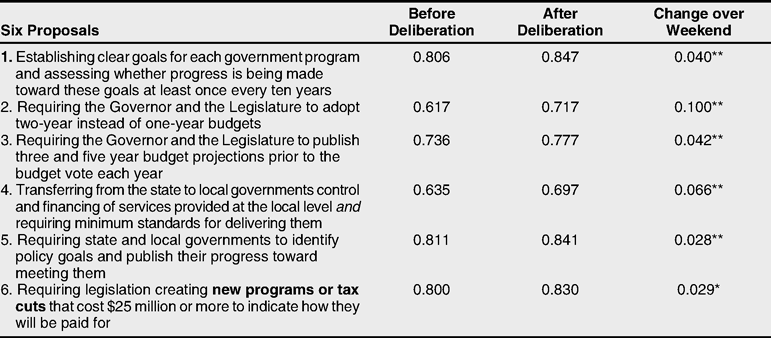
The six proposals that were part of Proposition 31 are pictured in table 3. They all relate to budgetary transparency and accountability. All have strong support both before and after deliberation and they all increase significantly. They establish clear goals for government programs with assessments of progress toward achieving those goals, two-year budgets to facilitate planning, three- and five-year budget projections, transfers from the state to local government of control and financing of services with minimum standards for delivering them, establishing policy goals for state and local government with progress assessed in achieving those goals, and PAYGO “requiring legislation creating new programs or tax cuts that cost 25 million or more to indicate how they will be paid for.”
Elements of Proposition 31

Proposition 31 was regarded as “very, very complicated,”Footnote 45 a problem made worse by rather complex ballot language finalized by the Attorney General’s office. While it was endorsed by prominent newspapers such as the San Francisco Chronicle and the San Jose Mercury News, the opposition proved decisive. The nearly three million dollars required to get on the ballot also exhausted the resources available to the public interest coalition so there was little if anything left for a campaign.
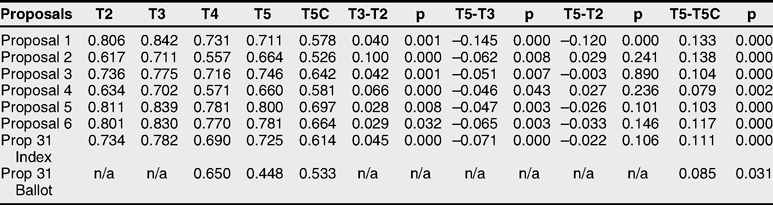
The component proposals in Proposition 31 that can be traced back to WNC continued to achieve strong support. Table 4 pictures all six components, plus an index for the six components (which we have labeled Prop 31 Index) and the actual ballot language for the entire Prop 31 (which we have called “Prop 31 Ballot”).Footnote 46 The table begins with T2 (before deliberation) since the six elements were not asked at T1 (the initial phone survey) but only on arrival at T2. T3 is the conclusion of the Deliberative weekend. T4 is a follow-up survey with a separate sample of the public in June 2012. T5 was a follow up at the time of the election both with our original sample of deliberators and a separate post-test only control group.
Support for Proposition 31 components and ballot measure

Notes: T2 is before deliberation, upon arrival of Deliberative Poll.
T3 is after deliberation, upon departure.
T4 is a survey that used the same questions as the other survey time points, but the sample is independent of the other time points. It is a survey of the public and not the deliberators.
T5 is a follow-up survey for Deliberative Polling participants.
T5C is a survey conducted at the same time as T5 with an independent sample of the public, a control group.
Prop 31 Index is a survey question that combines all of the individual Proposals 1-6, using the language that appeared on the Deliberative Poll.
Prop Ballot 31 is a survey question that covers the same substance, but uses the language of the actual ballot proposition summary that appeared on the June 2012 ballot in California.
For the deliberators, the gains from T2 to T3 were significant for all the individual propositions and for the index as a whole. The ballot language was not yet formulated so there is no measure. T4 is a separate sample of the public, not the deliberators, and shows that in June before the election, about a year after the DP, all the proposals and the index overall had substantial support. The actual ballot language also had support but less so in that separate sample.
By the conclusion of the campaign, the deliberators, in a follow-up survey at election time, registered a strong .725 for the Prop 31 index, significantly less than at T3 but still very high. Crucially, the Prop 31 Index also had a .614 level of support with the separate control group at T5 (election time). While the difference between treatment and control was significant at election time, this shows that the propositions generated from the deliberations had a credible chance of passing muster from the voters who had not deliberated—if they had been put to them clearly and without being packaged with other elements. The ambiguous Prop 31 language polled at only .533 with the control group indicating more likely trouble for it at the polls at T5.
Of course the tendency of voters to employ heuristics such as party endorsements was undoubtedly an added factor in the actual election, apart from the substance. Nevertheless the enduring support for the substance, when clearly expressed, signals the possibility of deliberative agenda setting. It is worth noting that not only was there little in the way of resources for any campaign in favor of Prop 31, the connection to What’s Next California was not part of the campaign. Virtually all voters had no idea that the public’s deliberations had helped to generate a proposition. If this origin had been a part of the campaign, it might have provided an alternative heuristic to assist with the credibility of the proposal. Voters want to know where a proposition comes from. If it comes from the people, that could be a credible electoral advantage. If, in addition, the factors weighing in the deliberations, the actual substance of the arguments, had been employed to provide levers of responsible advocacy, the campaign might well have done better.
Conclusion: Toward New Institutions?
Consider the California Deliberative Poll as a pilot for an institution that could empower the public to help set the agenda for the initiative. How would it work? Several problems have to be solved. It has to be non-partisan and scientifically credible yet also connected enough to the political fray that the selected proposals have actual proponents to advocate them to the electorate at election time. It needs to live up to the same sorts of criteria that we have used to evaluate WNC. It needs to be representative of voters in both attitudes and demographics. It needs to be large enough in scale that its claims to representativeness and its results are meaningful statistically. If there are briefing materials or sources of information for the deliberations, they need to be balanced, and deliberators must be given an appropriate opportunity to interact and seek further information. And lastly, the proposal or proposals selected in the deliberative process have to be followed up with something on the ballot appropriately connected to the deliberations and advocated at election time. Voters around the state should have an opportunity to consider the same reasoning that led the microcosm to support the proposal.
To fix ideas, imagine this scenario. A random sample of voters, about the size of WNC, is convened every two years to consider possible proposals to go on the ballot. Where do these proposals come from? Groups that wish to be proponents of initiatives develop proposals and satisfy a low threshold of signatures, low enough that civic groups could satisfy them with reasonable effort but without necessitating paid signature gathering. The reason for the (low, rather than onerous) signature threshold is that there has to be some way of distinguishing serious from frivolous proposals. If a proposal is selected by the microcosm it then qualifies without the burden of the full signature collection. Saving the expense of most of the signature collection is an incentive for groups to submit their proposals to this process. A second incentive is that they can identify their proposal as endorsed by a representative and informed microcosm of the people. Once voters become familiar with the process, such an endorsement could be very valuable. We know that a prime question voters ask about any initiative is—who supports it and why?Footnote 47 Endorsements are a key heuristic or informational short cut influencing support or opposition to ballot propositions.Footnote 48 In this case, the answer is that a proposal got on the ballot partly because a random sample of the people thought it was a good idea after they really thought about it in depth. As that idea catches on, so that less of the history needs explaining, it is likely to become more effective and valuable as a property of referendum campaigns, increasing the incentives for groups that could act as proponents to seek the thoughtful and representative endorsement of the people.
We can imagine that the entire process would be supervised by a non-partisan commission or advisory group. Several key functions would need to be fulfilled. The briefing materials for and against each proposal would need to be scrutinized for balance and accuracy. Perhaps proponents could provide the case for, potential opponents the case against, but all have to pass scrutiny from a balanced advisory committee appointed by the commission to have final say. Perhaps proponents and opponents would each have a right to reply. If there are no opponents, then some could be appointed to serve that role for this preparatory stage. At the deliberations, there would be a list of experts who could respond to questions in the plenary sessions and these again would be scrutinized by the advisory committee. These are all functions that have been accomplished at past Deliberative Polls, even on highly controversial issues.
How could the design ensure a connection between the people’s deliberations and what went on the ballot? The people would deliberate in choosing between developed proposals. We might imagine a small window for the proponents to improve their proposals in light of the deliberations with the opportunity for a follow up confirming vote from the microcosm if the proposal changed. There are two aims at this stage—identify the preferred proposals and get the best version of them in light of the deliberations. Obviously, there are many variations and details but this scenario sketches an approach that builds directly on the What’s Next California pilot.
We can imagine such a process as an alternative route to the ballot, not the sole route. The idea would be to provide a supply of at least some public interest propositions that the people would find meaningful. If such a design proved successful it could be expanded. Perhaps it might begin with the selection of one proposal each cycle. Then the number could be increased and perhaps more than one microcosm could be convened if the number of proposals became large. Given the extraordinary expenditures on campaigning for proposals once on the ballot, it seems appropriate to imagine relatively modest expenditures for the crucial agenda setting process. Like Oregon’s Citizens Initiative Review process, it might even begin with foundation funding and move to government funding after a track record of successful implementation.
What’s Next California showed that it is practical to convene a microcosm of the state’s voters to consider propositions in a balanced and thoughtful way. The microcosm satisfied our expectations: it was representative in attitudes and demographics, it gained knowledge, it evaluated a number of proposals, produced many significant changes on the basis of identifiable reasons. Some of its conclusions even fed into the legislative and the initiative process. It showed that a deliberating microcosm could provide a possible institutional design for setting the agenda for initiatives.
The initiative process is supposed to be the people’s process. But the agenda-setting function has been captured by those who can afford it. Why not recapture it for the people, using this ancient device? The key would be institutionalization and follow up, not only to put the people’s choice before the entire electorate but to make the reasoning available as a basis for choice. That would add a truly deliberative element to mass direct democracy and fulfill many of the initial aspirations of the initiative to empower the people to engage in thoughtful self-government.
Supplementary Materials
Online appendix (Tables A1, A2)
What's Next California, Report: Summary Results
What's Next California, Report: Overview
What's Next California, Report: Regressions
Do File
Replication Dataset