INTRODUCTION
Cleaner organisms are ecologically important on coral reefs, in that they remove parasites and potentially enhance the healing of surface wounds on client fish (Foster, Reference Foster1985; reviewed in Côté, Reference Côté2000). Cleaner fish, primarily wrasses and gobies, have received the most attention from researchers, but a variety of shrimps also appear to function as fish cleaners (Becker & Grutter, Reference Becker and Grutter2004). Much of the information on cleaner shrimps is based on anecdotal observations (Limbaugh et al., Reference Limbaugh, Pederson and Chace1961; Mahnken, Reference Mahnken1972), and whether they actually serve as effective cleaners of fish has been a topic of debate (Bunkley-Williams & Williams, Reference Bunkley-Williams and Williams1998; Spotte, Reference Spotte1998; Côté, Reference Côté2000).
Several recent studies demonstrate that cleaner shrimps can be effective in removing parasites from clients and also clean similar clients as do cleaner fish. Experiments performed under laboratory conditions have shown that two temperate species of Palaemon shrimps significantly reduce parasite loads on client plaice (Östlund-Nilsson et al., Reference Östlund-Nilsson, Becker and Nilsson2005), Ancylomenes holthuisi (Bruce) reduces parasite loads on surgeonfish by 74.5% within two days (Becker & Grutter, Reference Becker and Grutter2004) and A. pedersoni (Chace) removes 100% of juvenile cymothoid isopods from fish clients (Bunkley-Williams & Williams, Reference Bunkley-Williams and Williams1998). Experiments performed in macrocosms further revealed that A. pedersoni significantly reduce the abundance and size of monogenean parasites on fish (McCammon et al., Reference McCammon, Sikkel and Nemeth2010), and field observations in St Croix indicated that these shrimp also appear to clean a similar diversity of client fish in the Caribbean as do cleaning gobies Elacatinus evelynae (Böhlke & Robins) (Johnson & Ruben, Reference Johnson and Ruben1988). On Red Sea coral reefs, niche overlap of client fish occurs between A. longicarpus (Bruce & Svoboda, Reference Bruce and Svoboda1983) and obligate cleaner wrasses Labroides dimidiatus (Valenciennes) (Chapuis & Bshary, Reference Chapuis and Bshary2009).
Conversely, some shrimps that initially were classified as cleaners recently have been shown to exert no significant impact on the abundance of certain fish parasites. Bunkley-Williams & Williams (Reference Bunkley-Williams and Williams1998) determined that the shrimps Lysmata grabhami (Gordon), Stenopus scutellanus Rankin and S. hispidus (Olivier) do not remove juvenile cymothoid isopods from clients; S. hispidus also has no significant effect on monogenean parasites (McCammon et al., Reference McCammon, Sikkel and Nemeth2010). Additionally, Periclimenes yucatanicus (Ives) has been described previously as an obligate cleaner (Limbaugh et al., Reference Limbaugh, Pederson and Chace1961), but extensive field observations have failed to detect fish cleaning by members of this shrimp species (Gwaltney & Brooks, Reference Gwaltney and Brooks1994; L.K. Huebner, personal observations), and they have no significant effect on monogenean parasites in a macrocosm setting (McCammon et al., Reference McCammon, Sikkel and Nemeth2010). Further, Wicksten (Reference Wicksten2009) documented that at least one species of Lysmata shrimps, which clean larger fish, will kill and eat smaller fish. These studies demonstrate that quantitative field observations combined with experimental laboratory and macrocosm studies are needed to definitively classify shrimps as cleaners, especially as obligate cleaners.
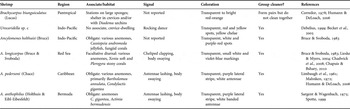
Proven cleaner shrimps on coral reefs vary widely among species in aspects of their biology (Table 1). In contrast to obligate cleaner fish, which perform ‘dances’ and have convergent blue and/or yellow striped body patterns (Potts, Reference Potts1973; Cheney et al., Reference Cheney, Grutter, Blomberg and Marshall2009), cleaner shrimps display neither convergent coloration nor stereotypical guild behaviours toward client fish (Becker et al., Reference Becker, Curtis and Grutter2005; Chapuis & Bshary, Reference Chapuis and Bshary2010). Cleaner shrimps also vary in their microhabitat preferences: some are crevice dwellers, while many are either facultative or obligate associates of sessile invertebrates, especially sea anemones and corals (Table 1). These cnidarian hosts serve as the centre of the shrimps' cleaning station and can also be posing stimuli for clients (Wicksten, Reference Wicksten1995a; Huebner & Chadwick, submitted). Interestingly, cnidarian-associated cleaner shrimp in the genus Ancylomenes (formerly within Periclimenes; Okuno & Bruce, Reference Okuno and Bruce2010) all display some variation of transparent bodies with white and/or purple markings, which may serve as signals to clients of this congeneric group of cleaners. This pattern, as well as other similarities and differences among cleaner shrimps in terms of their microhabitat use, behavioural signals, and group cleaning behaviours (Table 1), highlight a need for further investigation into evolutionary and ecological patterns in this group.
Information on the six species of cleaner shrimps on coral reefs that have been examined quantitatively in terms of parasite removal ability and/or interactions with clients in the field. Note that Ancylomenes anthophilus may be a junior synonym of A. pedersoni (Wicksten, Reference Wicksten1995b; Spotte, Reference Spotte1999).

Here we present field observations of interactions between client fish and Pederson cleaner shrimp A. pedersoni at cleaning stations on corkscrew sea anemones Bartholomea annulata (LeSueur) in St Thomas, US Virgin Islands. We identify client fish to family level, and quantify the rates and durations of cleans. We also report various behaviours observed among client fish, as well as include an examination of the effect of shrimp group size on cleaning rates and durations. Finally, we discuss the potential implications of our results for understanding the ecology and evolution of shrimp cleaning symbioses on coral reefs.
MATERIALS AND METHODS
We performed this study at two coral reef sites in St Thomas, US Virgin Islands: Brewers Bay (BB, ~6 m depth, 18°20′N 64°58′W) and Flat Cay (FC, ~7–9 m depth, 18°19′N 64°59′W; site details in Nelsen, Reference Nelsen2008). Observations were conducted over about one week at FC in March 2009 only, and at BB in March, July and November 2009, and February 2010. We focused on BB after the initial sampling period, because these reefs are closer to shore, logistically easier to access for dawn observations, and also support a higher abundance of the anemone Bartholomea annulata and symbiotic cleaner shrimp Ancylomenes pedersoni than do reefs at FC (Nelsen, Reference Nelsen2008).
Prior to cleaning observations during each sampling period, we conducted an initial census to identify and map all B. annulata in our study areas that each hosted at least one A. pedersoni (hereafter termed a cleaning station). We randomly selected a subset of these cleaning stations for observations; the sample size for each field period was determined by the duration of that period and the number of divers available to make observations (N = 15 stations at FC in March 2009, and 17, 16, 22, and 7 stations at BB in March, July and November 2009, and February 2010, respectively; N = 77 stations total). Different stations were selected for observation during each of the four field periods.
We conducted cleaning observations in the morning, beginning just after sunrise at ~06:30 and concluding by 08:30, to coincide with the dawn peak in cleaning activity at these shallow reef sites (e.g. Sikkel et al., Reference Sikkel, Schaumburg and Mathenia2006). Divers observed each cleaning station for 20 minutes from a distance of ~1.5 m or more (20 minutes × 77 stations = 25.67 hours of observation total on A. pedersoni stations). Observations began 2–3 minutes after the diver remained stationary on the sea floor, to allow fish to acclimate to diver presence and resume their normal activities. The following data were recorded for each station observed: number of cleaner shrimp at the station, number and identity (to at least family level) of fish clients cleaned, duration (in seconds) of each clean, and client behaviours and interactions. A clean was defined as A. pedersoni contact with a fish client body. Because neither the number of A. pedersoni per station nor the number or duration of cleans varied among the four sample periods (Kruskal–Wallis tests: H3 = 1.736, 6.689, and 6.298, P = 0.629, 0.098, and 0.083, respectively), the data were pooled analyses. All data were analysed using SYSTAT 13.
RESULTS
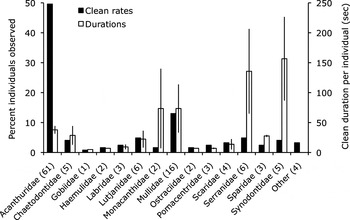
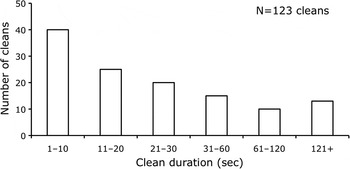
We observed reef fish belonging to at least 14 families to participate in 123 cleans at 77 Ancylomenes pedersoni cleaning stations total during our four field periods (four clients were not identified to family level; Figure 1). Though not during our 20 minutes observation periods, we did observe members of Gerreidae (mojarras) and Holocentridae (squirrelfish) during incidental observations at A. pedersoni stations during fieldwork for this study; thus A. pedersoni clean members of at least 16 fish families at our sites in St Thomas. Acanthurids (surgeonfish) accounted for nearly 50% of fish cleaned; the second most common clients were mullids (goatfish) accounting for 13% of observed cleans. Members of all other families comprised less than 5% each of observed cleans. Despite being the most common clients, acanthurids did not receive the lengthiest cleans (Figure 1). Serranids (groupers) and synodontids (lizardfish) received the longest cleans on average (>120 seconds), while monacanthids (filefish) and mullids had moderately lengthy cleans, averaging 74 seconds. However, variability in the duration of cleans within each of these four families was high. Clean durations ranged from a few seconds up to 11 minutes, but most cleans lasted <20 seconds (Figure 2).
Variation among client fish families in the number of individuals cleaned and duration of cleans (
 ± SE) at Ancylomenes pedersoni shrimp cleaning stations. Error bars represent variation among individual fish within each family; individuals were not identified to species. The number of individuals observed in each fish family is included in parentheses; a total of 123 cleans were observed. ‘Other’ includes fish that were not identified to family level, but were observed being cleaned; because they were not identified, we did not include durations for these cleans.

Variation in clean durations on client fish by Ancylomenes pedersoni shrimp.

In some cases, after shrimps finished a clean and returned to their host anemones, we observed fish to remain posing at stations, possibly attempting to incite another cleaning bout. Similarly, some fish swam away from stations after the shrimp finished cleaning, but travelled only a few metres or less, and then returned to the same cleaning station. This occasionally resulted in another clean. Also, some fish lingered near stations (<1 m) for several minutes, up to the entire 20 minutes observation period, despite spending little of this time being cleaned.
We observed several types of interactions among fish that approached the cleaning stations. Some fish abandoned clean-seeking behaviour at a station that was already occupied, while others chased away clients that were in the process of receiving cleans. In addition, some clients interrupted their own clean to chase away incoming clients, then returned to the shrimp to continue the clean. These interactions were both inter- and intraspecific: surgeonfish Acanthurus spp. chased other Acanthurus spp., as well as goatfish and tobacco fish Serranus tabacarius (Cuvier), away from cleaning stations. In one such instance, an individual of S. tabacarius waited ~1 m from a cleaning station until the surgeonfish departed, then proceeded to pose at the station. One ocean surgeonfish A. bahianus Castelnau lingered <0.5 m from a station, and chased all visiting clients from the cleaning station for the duration of the 20 minutes observation, despite spending only 11 seconds being cleaned at the station. Damselfish whose territories overlapped with cleaning stations occasionally chased clients away from stations, consistent with observations of damselfish near cleaning goby stations (Arnal & Côté, Reference Arnal and Côté1998).
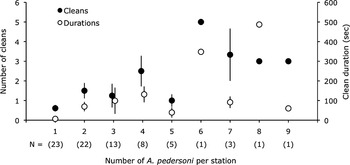
The number (simple linear regression (SLR): F1,75 = 7.094, P = 0.009, R2 = 0.086) and total duration (SLR: F1,75 = 7.775, P = 0.007, R2 = 0.082) of cleans per station significantly increased with the number of A. pedersoni at that station (Figure 3). However, the duration of individual cleans did not vary significantly with the number of shrimp cleaning at that station (F1,121 = 0.273, P = 0.602, R2 = 0.002); thus more shrimp engaged in a clean does not necessarily result in a shorter clean. One station contained only three shrimp, but 15 cleans occurred there: a large school of surgeonfish visited this station and remained together around the station as members of the school rotated to receive cleans. This station was excluded from these analyses as an outlier. In almost all cleans (97.6%, N = 123 cleans), all of the A. pedersoni present engaged in the clean, while in only three cleans a subset of the shrimp at the station participated.
Number and duration of all cleans (
 ± SE) during 20 minutes observation periods at Bartholomea annulata anemone cleaning stations with the number of Ancylomenes pedersoni cleaner shrimp per station. Error bars represent variation among stations (i.e. shrimp social groups). Sample sizes of stations observed with each number of shrimp are shown in parentheses. These relationships are significant (P < 0.01) in linear regression analyses.

DISCUSSION
Individuals of A. pedersoni cleaned a wide diversity of fish in St Thomas, US Virgin Islands, including fish in families heretofore unreported to be clients of A. pedersoni: Gerreidae, Gobiidae (gobies) and Ostraciidae (boxfish). If we combine our observations with those of other studies (Limbaugh et al., Reference Limbaugh, Pederson and Chace1961; Mahnken, Reference Mahnken1972; Criales, Reference Criales1979; Johnson & Ruben, Reference Johnson and Ruben1988; Wicksten, Reference Wicksten1995a, Reference Wicksten1998), A. pedersoni is known to clean fish in 22 families: the 16 reported here (Figure 1) in addition to Aulostomidae (trumpetfish), Balistidae (triggerfish), Bothidae (left-eye flounders), Muraenidae (moray eels), Pomacanthidae (angelfish) and Tetraodontidae (puffer fish). This large diversity of clients is likely because A. pedersoni are effective removers of fish parasites (Bunkley-Williams & Williams, Reference Bunkley-Williams and Williams1998; McCammon et al., Reference McCammon, Sikkel and Nemeth2010).
The relative frequencies of client families at our stations differed somewhat from those observed at other localities in the Caribbean. In Bonaire, serranids (~40%) and scarids (parrotfish, ~20%) comprised the majority of clients in 13 families (Wicksten, Reference Wicksten1995a), while our most common clients, acanthurids and mullids, represented the third and fourth most common client groups there. In St Croix, fish in only five families were observed at A. pedersoni stations (listed in descending frequency): Pomacentridae (damselfish), Serranidae, Scaridae, Holocentridae and Labridae (wrasses; Johnson & Ruben, Reference Johnson and Ruben1988). These differences may reflect variation in the relative abundances of client fish among reef sites in the Caribbean, or regional variation in cleaner preferences by clients. Due to time constraints, we were not able to quantify relative fish abundances at our field sites, or to estimate the diversity of fish that visited goby stations. However, data from other studies indicate that A. pedersoni clean an assemblage of fish clients that overlaps considerably, but not completely, with that of cleaner gobies: fish belonging to 16 of the 22 client families reported here (excepting Balistidae, Bothidae, Gerreidae, Gobiidae, Monacanthidae and Muraenidae) have been observed visiting cleaner gobies (Johnson & Ruben, Reference Johnson and Ruben1988; Arnal & Côté, Reference Arnal and Côté1998; Côté et al., Reference Côté, Arnal and Reynolds1998). However, members of Carangidae (jacks) and Sphyraenidae (barracudas) have been observed at goby stations and not at A. pedersoni stations (Johnson & Ruben, Reference Johnson and Ruben1988).
The large observed variation in the duration of individual cleans, particularly among fish in families with the longest clean durations overall, likely relates in part to client body size. We did not estimate the lengths of fish clients in our study, and clean durations did not correlate significantly with the maximum known sizes of client fish that we observed in each family. However, members of the four fish families with the lengthiest cleans—Monacanthidae, Mullidae, Serranidae and Synodontidae—achieve some of the largest body sizes of the fish observed at these cleaning stations (Humann & DeLoach, Reference Humann and DeLoach2006). Large fish generally have more parasites (Grutter, Reference Grutter1995), and higher parasite load has been shown to affect cleaning behaviour in some cleaner shrimps (Becker & Grutter, Reference Becker and Grutter2005). Thus, these shrimps likely spend more time cleaning large clients because of increased parasite foraging success, as do cleaner wrasse Labroides dimidiatus (Grutter, Reference Grutter1995; Bansemer et al., Reference Bansemer, Grutter and Poulin2002; Bshary & Grutter, Reference Bshary and Grutter2002). As we only observed one fish to wait for a cleaning station, the presence of waiting fish did not appear to impact cleaning duration in our study. Finally, individual clean durations did not decrease with an increasing number of clients at a station; thus, clean durations, at least in the time span of our observations, appeared to be independent of the number of cleans that a group of shrimp performed. Overall, the durations of cleans observed in this study are similar to those observed by Johnson & Ruben (Reference Johnson and Ruben1988) for several Caribbean cleaners (both fish and shrimp) in nearby St Croix, US Virgin Islands.
The variation in cleans per station (and durations thereof) that we observed when the shrimp occurred in large groups may be due to the small numbers of anemones that hosted >4 A. pedersoni (Figure 3). It is not clear why so few anemones contained large groups of shrimp: if the shrimp engage in more cleans when they are part of a large group, why do most of them occur in small groups? It may be that social interactions among the shrimp (Mahnken, Reference Mahnken1972), or other dynamics of sea anemone host choice, have a stronger influence on shrimp group size than optimizing their potential number of cleans. Also, these shrimp may not be limited by clients at our study sites and need not optimize cleans by forming large groups. More research is needed on the factors that influence cleaner shrimp social group size on sea anemones.
Client fish may visit stations that host more shrimp because there are more cleaners to inspect their body surface area. It is also possible that shrimp in groups regulate each other's clean quality by minimizing cheating in cooperative cleans, as do cleaner wrasse L. dimidiatus that clean in pairs (Bshary et al., Reference Bshary, Grutter, Willener and Leimar2008). We infrequently observed jolts by client fish, but did not observe client fish to leave or ‘punish’ A. pedersoni after a jolt, suggesting either little to no cheating by these cleaner shrimp and a lack of partner control by the client fish in this system. Though some cleaner shrimp may have a cheating–control system with their clients (Chapuis & Bshary, Reference Chapuis and Bshary2009), A. pedersoni may enjoy a system without punishment, suggesting more similarity to the symbiosis of Caribbean cleaner gobies with clients than to that of the Indo-Pacific cleaner wrasse L. dimidiatus (Soares et al., Reference Soares, Côté, Cardoso and Bshary2008).
This study adds to the information available on cleaner shrimp interactions with client fish in a natural field setting. Ancylomenes pedersoni participate in multi-level symbiotic systems, both with client fish and their parasites, and with sea anemones and their other associated symbionts (endosymbiotic microalgae and other crustaceans; Huebner & Chadwick, submitted). The dynamics of how these organisms interact with one another, as well as possible intraspecific interactions among individuals of A. pedersoni, suggest a level of complexity in this cleaning system that does not occur with other cleaners that do not form large group sizes on symbiotic hosts. The patterns described here thus provide a foundation for future inquiry into the mechanisms that drive these several types of cleaner shrimp associations: among shrimp that share anemones, between shrimp and client fish, and among the clients themselves. Because cleaner shrimp symbioses are less well understood than those of cleaner fish, these aspects of cleaner shrimp biology likely will be fruitful areas for future research.
ACKNOWLEDGEMENTS
We thank the University of the Virgin Islands (UVI) for the use of their facilities. S. Ratchford at UVI provided insight and field support, and A. Isbell, K. Morrow, and B. and J. Titus contributed valuable field assistance. We thank P. Sikkel, C. Johnston, S. Woodard and three anonymous referees for helpful advice on the manuscript. Funding was provided by a NOAA Puerto Rico SeaGrant (N.E.C., grant number R–101–1–08). This is contribution No. 85 of the Auburn University Marine Biology Program.