Chaetodontids live close to the substrate and feed diurnally (Zekeria, Reference Zekeria2003). These fish can consume a wide range of prey, and depending on the use of food sources, five feeding categories of butterflyfish are listed (Roberts & Ormond, Reference Roberts and Ormond1992): obligate hard coral feeders; feeders on sessile and sedentary invertebrates; feeders on motile benthic invertebrates; generalist omnivores; and planktivores. The majority of the butterflyfish belong to the first two dietary categories.
Chaetodon striatus Linnaeus, 1758 occurs in the tropical Western Atlantic, ranging north from Massachusetts to southern Brazil, including St Paul's Rocks, inhabiting various reef habitats at shallow depths to 20 m (Kuiter, Reference Kuiter2002). It lives associated with the substrate and feeds on anthozoans, polychaetes, crustacean and molluscs' eggs (Randall, Reference Randall1967; Pitts, Reference Pitts1991). Although episodes of feeding activity in the water column are scarce, a group of C. striatus was recorded foraging on plankton at Abrolhos reefs (Sazima & Sazima, Reference Sazima and Sazima2001).
The scyphomedusa Chrysaora lactea Eschscholtz, 1829 is considered widespread and is one of the most common and most widely distributed scyphozoans on the Brazilian coast (Migotto et al., Reference Migotto, Marques, Morandini and Silveira2002), but little information exists on its biology (Morandini et al., Reference Morandini, Silveira and Cornelius2006). Herein we report the first record of the feeding behaviour of a butterflyfish on the jellyfish C. lactea.
The present study was carried out at Prainha beach, Arraial do Cabo, Rio de Janeiro State (22°57′S–42°00′W), a subtropical region on the Brazilian south-eastern coast. The study site is characterized by rocky shores covered by granite boulders, with a sand bottom and the incidence of rock rubbles at some sites. The benthic cover in mid-depths to bottom is mostly represented by the zoanthid Palythoa caribeorum, whereas some scattered colonies of the firecoral Millepora alcicornis and macroalgae mats are also found. At shallow depths (~2 m) urchins and turf algae are dominant.
Observations were made during free dives, in January 2009. The maximum depth was of 6 m, with 10 m of water visibility. The feeding activity was photographed and video-recorded between 10h00 and 13h00. We have used the focal animal methodology recording all occurrences (Altmann, Reference Altmann1974). Total length (TL) was visually estimated and recorded on plastic sheets.
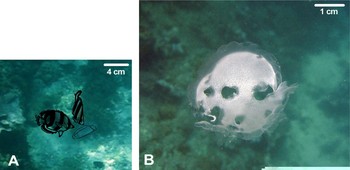
The opportunistic predation on C. lactea (4 cm of umbrella diameter) occurred when two pairs of C. striatus (6 cm TL) foraged on the rocky bottom. At a certain point of the feeding activity, one pair moved up to the water column and simultaneously preyed on the jellyfish (Figure 1A). After nibbling it for a while, one individual from the couple left and the other continued feeding for few seconds, following its partner afterwards. Tissue damage on portions of the umbrella and the velarium was estimated as 15% of the total body area of the jellyfish (Figure 1B).
(A) A pair of butterflyfish (Chaetodon striatus) nibbling on the jellyfish; (B) tissue damage of the jellyfish after the event.

Fish are the best documented group of jellyfish predators (Arai, Reference Arai2005), but most feeding on pelagic coelenterates have a broad diet (Purcell & Arai, Reference Purcell and Arai2001), unlikely chaetodontids. Another report of predation on C. lactea was made recently in Santa Catarina, southern Brazil (Bonaldo et al., Reference Bonaldo, Krajewski and Sazima2004) and involved the filefish Stephanolepis hispidus Linnaeus, 1766. Jellyfish are well recognized predators in food webs, but as food items they are often overlooked for the easy digestibility of their tissue (Arai, Reference Arai2005). As many fish feed on such prey, it is expected to be an important accessory item for generalist and opportunistic predators.
Moreover, C. striatus is known to feed on the zoanthids Palythoa carybaeorum Duchassaing & Michelotti, 1860 and P. variabilis Duchassaing & Michelotti, 1860 (Bonaldo et al., Reference Bonaldo, Krajewski and Sazima2005), which produce the most poisonous marine toxin known (Moore & Scheuer, Reference Moore and Scheuer1971). The palytoxin seems not to affect the banded butterflyfish, as in other marine animals (e.g. the hawksbill turtle Eretmochelys imbricata) (Stampar et al., Reference Stampar, Silva and Luiz2007) which makes them liable to feed on other toxic coelenterates.
The family Chaetodontidae comprises many specialized fish species (e.g. corallivorous fish), but some of them have generalized diets. The record presented herein can be a result of the higher abundance of the food source (during jellyfish blooms), becoming a constant and relatively easy prey to catch. Opportunistic feeding on a temporarily available item is reported for several fish (Lowe-McConnell, Reference Lowe-McConnell1987), mainly generalist species, thus indicating that these occasional items benefit those with some level of feeding plasticity.
ACKNOWLEDGEMENTS
We thank Sérgio N. Stampar for jellyfish identification, Carlos E.L. Ferreira for field support and two anonymous referees for revising this manuscript. This project was supported by the PADI Project Aware and CNPq scholarship granted for L. Chaves and CAPES scholarship granted for J.L. Feitosa and P.H. Pereira