1. INTRODUCTION
In 1958, a civil servant noted in a policy document that asylum requests were ‘unpleasant events’.Footnote 1 This characterisation of the Dutch asylum procedure is unexpected. When most asylum seekers came from communist countries, it is perhaps surprising that the ‘enemies of our enemies’,Footnote 2 or heroes of anti-communism, were not welcomed more enthusiastically. Many authors depicted the Cold War as a golden era of asylum policy, in which the difference between good and bad was clear-cut and true asylum seekers were welcomed.Footnote 3 This article, however, shows that, despite so many things working to their advantage, asylum applicants in the 1950s and 1960s were not necessarily easily accepted and asks the question ‘Why was their acceptance problematic?’ The article focuses on the political decision-making process and on the reasoning of people involved in this process. In this article, the word ‘asylum seeker’ is used for those who had applied for asylum, but whose applications had not yet been approved or rejected. Refugees were asylum seekers who were granted refugee status after they had passed through an asylum procedure. Refugees were legally almost in the same position as Dutch citizens: they were entitled to social benefits and scholarships, they could apply for refugee passports and it was virtually impossible to deport them. The legal position of economic migrants was less favourable. Their residence permits were extended, as long as they occupied a paid position. If they lost their job, the Dutch authorities could deport them. During this period the Dutch authorities invited individuals from refugee camps elsewhere in Europe to come to the Netherlands. These individuals were referred to as ‘invited refugees’ and were granted refugee status before arrival and therefore did not have to go through an asylum procedure. The word ‘asylum seeker’ existed during the Cold War, but was seldom used; instead, individuals arriving to seek asylum were referred to as: ‘bona fide refugees’, ‘pretending refugees’ or ‘asylum requesters’.
The Cold War asylum seekers have so far been largely overlooked in the historical literature.Footnote 4 When scholars study this period they describe the sudden massive movements of refugees, such as the resettlement of displaced persons in the late 1940s, the thousands who fled during the Hungarian uprising in 1956 and the Prague spring in 1968. Roel Fernhout, a prominent Dutch lawyer, argued – without offering proof – that in the 1950s and 1960s, West European countries pursued generous policies regarding East European refugees.Footnote 5 This belief became a mantra in Western historiography: during the Cold War there was a generous refugee regime. In current public opinion and scholarly debate it is assumed that during the Cold War period generous admission policies prevailed. For example, Heinz Fassmann and Rainer Münz stated that whatever their individual motives were, the Cold War migrants were regarded as political refugees in the West.Footnote 6 People who escaped communist oppression were admitted because ‘living under communism was persecution enough’.Footnote 7 Peter Rose argued that in the period from 1952 to 1980 refugees were defined in American law ‘as people fleeing communism’.Footnote 8 Although many authors claim that the refugee policy of the Cold War period was clear and lenient there is almost no research on this period and no data seem to be available to back up these assertions. Virtually all studies go back only as far as the mid-1970s. An exception is the study of Catherine Wihtol de Wenden, who showed that until 1960 France received an average of 15,000 asylum applicants per year, of which only about 200 each year were refused refugee status.Footnote 9 This proved that it was easy for asylum seekers to get accepted as refugees. The practice in the Netherlands was, however, different, as we will see.
Asylum seekers from behind the Iron Curtain do seem to have had a favourable starting point on arrival in the West.Footnote 10 They were believed to have strong anti-communist attitudes and they came from countries with despised regimes.Footnote 11 Those who ‘escaped’ communism proved, by their flight to the West, the inherent superiority of liberal democracy over communism.Footnote 12 These ‘defenders of democracy’ were seen as heroes and this image was strengthened by reports of their often long and difficult journeys to the West. Furthermore, they came at a time of economic growth and an increased demand for labour.
This yearning for the good old days of the Cold War, when asylum was a simple issue of ‘good guys’ and ‘bad guys’, dominates the literature. It is frequently contrasted with current admission policies, when receiving societies and asylum seekers do not share a common enemy.Footnote 13 After the Cold War ended in 1989, offering refugee status to asylum seekers was no longer of strategic and ideological use.Footnote 14 The mood in the West is believed to have changed, with asylum regimes becoming more restrictive. The reason given for this change is that new categories of asylum seeker emerged.Footnote 15 Many came to Europe in order to escape civil wars, for example, and many came from more distant countries, where the ruling regimes were no longer clear-cut enemies. Their numbers also increased.
2. CHARACTER OF THE PERIOD
In the midst of the Cold War, The Netherlands was a close ally of the United States and was believed to be a fierce opponent of the Eastern bloc. The tensions of the Cold War influenced the outcome of asylum requests, because by accepting escapees from behind the Iron Curtain a political statement could be made: accepting ‘anti-communists’ was a way to embarrass communist states.Footnote 16
The warm welcome of the Hungarian refugees in 1956 was an element of this strategy. In 1956, Dutch authorities invited over 3,000 Hungarian refugees from German and Austrian refugee camps to enter the Netherlands. For decades the enthusiastic Dutch welcome of the Hungarians dominated the image of how the country dealt with refugees. Based on this, an unproblematic and generous attitude towards later Eastern European asylum seekers might have been expected. The Hungarian refugees of 1956 differed, however, from the Eastern European asylum seekers. The Hungarians were selected by the Dutch authorities from the refugee camps.Footnote 17 Their political antecedents were known and there was no need to be suspicious about their motives for flight.
The people who applied for refugee status during the Cold War did not always fit the stereotypical image of refugees portrayed in the media over many years. Since the end of the Second World War media coverage of refugees had drawn attention to the elderly and the children staying in German and Austrian refugee camps. Such so-called ‘displaced persons’ were portrayed as vulnerable, immobile, unadventurous, dependent and non-masculine. Over the years this became the image of a ‘true refugee’ who deserved help. The asylum seekers who applied for refugee status during the Cold War were, however, mostly single men who did not fit this stereotype.Footnote 18
3. LEGISLATIVE BACKGROUND
The 1849 Dutch Aliens Act formed the basis of Dutch asylum policy after the Second World War. This act, however, was regarded as ‘completely inadequate’ because it made no distinction between aliens and refugees.Footnote 19 Refugees have fled their home country because of persecution; aliens have left their home countries for non-persecution reasons. In the 1930s, the Dutch authorities introduced regulations to prevent Jewish refugees from entering the Netherlands. After the War, attempts to stop aliens at the border continued. Several Aliens' acts implementation guidelines were issued to prevent Eastern European aliens from settling.Footnote 20 When his client was deported, one lawyer claimed that the rights of aliens were based on circulars that functioned alongside, but sometimes contradicted, the 1849 Aliens Act.Footnote 21 A newspaper concluded that aliens were indeed poorly protected by arguing that the Ministry of Justice governed by royal decree and most of the time ignored parliament.Footnote 22 In the mid-1950s, parliamentarians tried to end this uncertainty and called for a separate Refugee Law. After ratification of the Refugee Convention in 1956, they felt the need to improve the legal status of asylum seekers and break the monopoly of the Ministry of Justice over asylum proceedings. In 1957, this pressure resulted in the introduction of the Refugee Decree. This decree set down that decisions reached in asylum cases by the minister of justice be in accordance with those of the minister of foreign affairs. The decree also offered rejected asylum seekers the possibility of lodging an appeal and specified the duties of the representative of the United Nations High Commissioner for Refugees (UNHCR).
In 1951, a number of countries signed the Geneva Convention relating to the status of refugees. This convention remains the basis of the international refugee regime today.Footnote 23 The convention defined a refugee as ‘any person who, owing to well-founded fear of being persecuted for reasons of race, religion, nationality, membership in a particular social group, or political opinion, is outside the country of his nationality and is unable or, owing to such fear, is unwilling to return to that country; or who, not having a nationality and being outside the country of his former habitual residence as a result of such events, is unable or, owing to such fear, is unwilling to return to it’.Footnote 24 Elements of this definition, especially ‘well-founded fear’ and ‘persecution’, were implemented in the Netherlands in the Cold War period, although the persecution ground was seldom addressed.
After arrival in the Netherlands, asylum seekers reported to the nearest police station where they lodged an asylum application and asked for a residence permit. In detention, they were interviewed by both the police and the intelligence service. Two reports – as well as a recommendation from the attorney general – were sent to the minister of justice.Footnote 25 The minister of justice had three options when he assessed the case of an asylum seeker. First, if the minister felt the need to check an asylum seeker's political or criminal record, he could send them to an internment camp.Footnote 26 In that case, the applicants had to sign a declaration stating that they agreed to this. Second, the minister could decide to accept the applicant without further research; this might occur, for example, if an applicant was recognised as a refugee by an international body, such as the UNHCR. Finally, the minister could reject asylum seekers because of acute credibility concerns, criminal antecedents or because they had stayed previously in another Western country, where they could have lodged an asylum application. In the latter case the Dutch authorities would deport them to the country in which they had stayed before reaching the Netherlands. Those with criminal records were released and told to leave the Netherlands within a certain period, but not sent home as repatriating Eastern Europeans was seen as problematic in view of the tensions of the Cold War.
Two examples, abstracted from a letter sent to the Luxembourgian Ministry of Justice, illustrate the importance of the travel route to the Netherlands.Footnote 27 During the interrogation of one Pole, it was discovered that the man was fluent in English. Inquiry with Interpol (the International Criminal Police Organisation) showed that, prior to his arrival in the Netherlands, the man had stayed in both Belgium and England, where he had committed several crimes. Without further justifications, the man was deported to Belgium. Another man claimed that he had travelled by boat from Genoa to Rotterdam. The police searched him and found a German book in his possession. The police brought the man to the German border. After he revealed the bookstore from which he had bought the book, he was passed on to the German authorities.
In 1958, a civil servant revealed the proceedings in a case of two Eastern European women discovered working in a Dutch factory without valid papers.Footnote 28 One course of action that was discussed was to keep the two in detention until they got fed up and left the country. This was expensive, and the two might return later. Because the two women had left Germany three months earlier, deportation to that country was a possibility. However, it was unlikely that the German authorities would acknowledge without any proof that the two women had previously stayed in their country. The civil servant complained that when the two women used ‘the magic word “asylum”’ his instructions stopped him from deporting them. He could not think of any reason to keep the two, but it was impossible to get rid of them, though in his view their asylum request was absolutely not genuine. His supervisor claimed that deporting them seemed impossible and advised that work permits should be issued so they could work as maids. This case shows that the option of ‘asylum’ was considered only after detention and deportation. The civil servant was at a loss how to deal with these two escapees from behind the Iron Curtain. The case was solved by giving the women work permits to work as maids, but not accept them as refugees. There was a shortage of domestic servants after the War and it was unlikely that the two women would be perceived as a threat to Dutch (male) workers.
4. SOURCES AND ACTORS
This article reports on research examining 36 individual case files of asylum seekers created by the Ministry of Justice out of the total of 221 asylum seekers who applied for asylum in the period from 1957 to 1964. In addition, a great deal of additional source material was used to reconstruct Dutch asylum policy and the associated debates. The 36 case files – some of which are 20 centimetres thick – contain jurisprudence, correspondence between different ministries, and letters from applicants, employers, parliamentarians, politicians, journalists and concerned Dutch citizens. All those who influenced, or tried to influence, the outcomes of asylum requests will be referred to as ‘actors’. The details contained in these files make it possible to study not only the arguments that actors used, but also the support networks available to asylum seekers. Asylum seekers are seen to profit from both credible claims and from strong connections in the country in which they sought asylum.Footnote 29 Earlier research shows that persons acting in support of refugees favoured individuals with certain backgrounds or skills over others. Talented, sensitive and skilled refugees could count on more support.Footnote 30
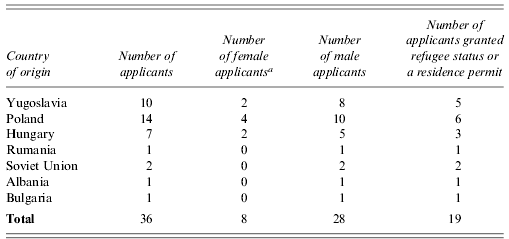
The final column in Table 1 shows that 19 of the 36 individuals whose cases were studied were admitted to the Netherlands. However, not all of them were granted refugee status. The minister of justice was able to issue a residence permit without acknowledging the applicant as a refugee.Footnote 31 For example, although denying that a woman qualified as a refugee, the minister offered her both a work and residence permit so that she could work as a nurse.Footnote 32Table 1 indicates that 17 individuals were rejected out of the 36 cases studied; all of them left the Netherlands. Nine individuals were rejected because they had stayed in a safe third country before their arrival in the Netherlands, four because they were regarded as unreliable, two because they were believed not to be at risk in their countries of origin and two because of criminal records.
Nationality of the asylum seekers included in the 36 case files, and the results of their applications
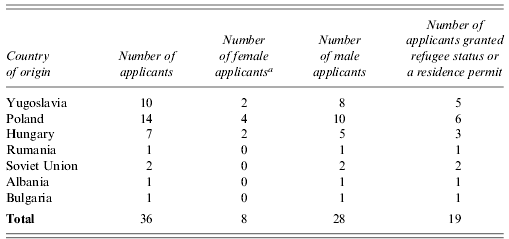
a All but one of the female applicants were admitted.
Few researchers have had access to the unique type of source used for this article, due to concerns over privacy. When they have had access, they have only used data from the interview on admission and the main interview to study travel routes or motives for the refugees' flight.Footnote 33 For the current research permission was gained to use the complete files. The research focus is not on the refugee claims, but on the arguments used by all those involved in the asylum procedure to explain why asylum seekers should be granted asylum or not.
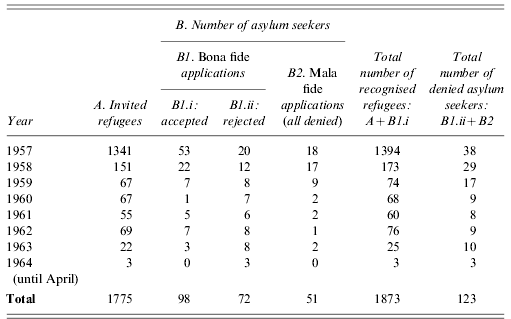
Not all asylum case files have been kept by the Dutch authorities, but the guidelines about archival storage are unclear. Corrie Berghuis and Marlou Schrover suggest that thicker and politically more interesting case files were more often preserved.Footnote 34 They claim that the files of those who were accepted or rejected without much discussion had a higher change of being destroyed. However, a number of straightforward cases remain. For the current research, files of those who were immediately accepted are less interesting because they contain only a letter stating that a person was a refugee because he or she fulfilled the criteria of the Refugee Convention. The case files of more controversial cases are precisely those useful for the present study as they indicate the arguments and discussions behind the decisions to either accept or reject an applicant. The outcomes of the 36 cases were slightly more positive than those for the whole caseload. Of the 36 cases studied, 19 (53 per cent) were offered asylum, while overall only 44 per cent of asylum seekers arriving in this period were granted asylum (see Table 2).
Number of asylum seekers and refugees in the Netherlands in the period 1957–1964
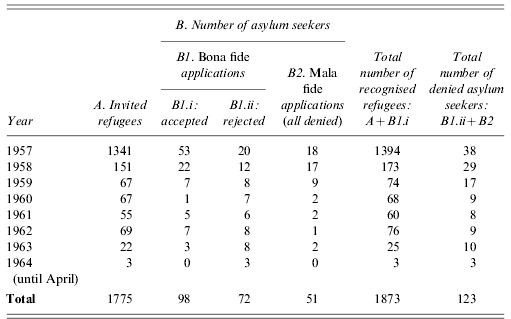
Source: The National Archive, The Netherlands, Archive of the Dutch Naturalisation and Immigration Service and its predecessors, 5.023.5027.357, Table prepared after questions were asked in parliament on 29 April 1964.
Most of the individuals who appear in the files as actors worked for the Ministries of Social Affairs, Foreign Affairs, Social Welfare, or Justice. The minister of social affairs guarded the interests of the Dutch labour market, and the minister of social welfare was watchful that asylum seekers did not become public charges. The minister of foreign affairs protected the international obligations of the Netherlands, and also guarded its good reputation. One official was pleased when he learned that in spite of the ‘extremely restrictive immigration policies’, considerable numbers of ‘spontaneous refugees’ had arrived. This showed the world that the Netherlands was helping to solve ‘the refugee problem’.Footnote 35
The representative in the Netherlands of the UNHCR played a central role in the Dutch asylum procedure. He issued mandate declarations to individuals and conducted eligibility assessments.Footnote 36 Such a declaration offered the bearer international protection by the UNHCR. The minister of justice had to approve the issue of such declarations, but in practice this was only a formality.Footnote 37 Mandate declarations were only issued after an applicant received a residence permit. The crucial first phase in the asylum procedure was undertaken by the Dutch authorities. One observer concluded that economic and political motivations influenced the outcome of a humanitarian issue.Footnote 38 The most influential refugee organisation in the Netherlands was the Dutch Federation of Refugee Aid (NFV), a coalition of twelve religious and secular non-profit organisations.
5. THE NUMBERS
Table 2 shows that of the 221 persons seeking asylum in the Netherlands between 1957 and 1964, 123 were rejected: an admission rate of 44 per cent, which meant that more asylum seekers were rejected than admitted. This contrasts with the image of a welcoming Dutch society portrayed by later authors. ‘Recognised refugees’ in Table 2 are all ‘invited refugees’ together with those asylum seekers who were granted refugee status. Among the total of 1,873 recognised refugees between 1957 and 1964, 1,278 were Hungarians, 194 Yugoslavs, 283 Poles, 28 Romanians, 48 Russians, and 42 from elsewhere. In Table 2, a distinction is made between the authorities' mala fide and bona fide application categories. Mala fide asylum seekers were immediately rejected and not admitted into the asylum procedure. They had often stayed in another country prior to their arrival in the Netherlands, or had criminal records. Bona fide asylum applications were considered by the Dutch authorities; they were not rejected outright.Footnote 39
During this period some visitors to the Netherlands decided not to return home after their visas expired and applied for asylum instead. In response, Dutch embassies were instructed not to issue visas too easily. After 18 Yugoslavs with visas applied for asylum within two years, for example, the Dutch ambassador to Yugoslavia was told to pay close attention to each visa application.Footnote 40 Other foreigners crossed the Dutch borders without permission. Some travelled directly from their countries of origin by boat; others came by land. Most of the asylum seekers were men. Fleeing and crossing the Iron Curtain was more difficult for women. Many – mainly Polish – asylum seekers were deserting sailors; all of them were male. The few women who applied for asylum were attempting to join relatives in the Netherlands.
6. METHOD
Frame analysis has been used to analyse the arguments contained in the letters and memoranda. Frame analysis is a method that is used to categorise large numbers of arguments, and is thus well suited to the current research. The grouping of arguments into vignettes or typologies is vital to frame analysis. ‘Frames’ are series of claims strung together in a more or less coherent way and are used to define and diagnose problems, present moral judgements and (sometimes) offer solutions.Footnote 41 Frames become visible via a combination of discourse analysis, which means making an inventory of words and phrases, and identifying clusters of arguments used in letters by the stakeholders. Recently, several authors have used this method to analyse the social construction of asylum seekers in media coverage and political debates.Footnote 42
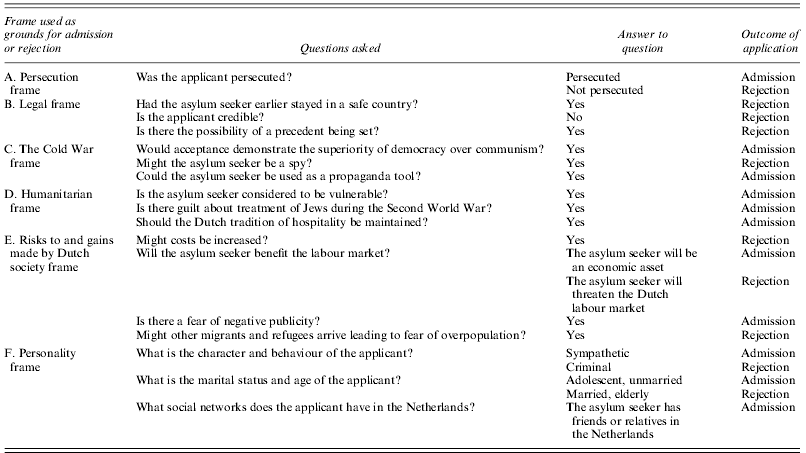
Having studied the 36 case files, 6 frames were distinguished: a ‘persecution’ frame, a ‘legal’ frame, a ‘Cold War’ frame, a ‘humanitarian’ frame, a ‘risks to and gains made by Dutch Society’ frame and a ‘personality’ frame. These six frames, outlined in Table 3, show how the actors defined the problem and how they constructed a solution. First, the ‘persecution’ frame deals with the question: ‘Was the applicant persecuted in his country of origin?’ Persecution was, as was mentioned above, a critical element of the Geneva Refugee Convention. We will see that decision makers automatically regarded asylum seekers' flight motives as political.
The 6 frames identified from the 36 case files

Second, the ‘legal’ frame deals with the question of whether it was legally possible to prevent an asylum seeker from being granted refugee status. The Ministry of Justice can be seen to have stressed the ‘safe third country’ principle. If, prior to their arrival in the Netherlands, applicants stayed in a country other than that from which they were fleeing, their applications were rejected because protection was available elsewhere. Those who travelled directly to the Netherlands were regarded as true refugees, while the others were called ‘adrift’.Footnote 43 The case files show that it became important to the authorities that asylum seekers who lied about their journey to the Netherlands were rejected. Finally, it can be shown that among civil servants the fear of creating a precedent was very strong.
Third, there is the ‘Cold War’ frame. The Cold War made it difficult to deport unsuccessful applicants from behind the Iron Curtain to their country of origin. Asylum seekers could, moreover, be used for political propaganda, although they could not be trusted because, in the Cold War context, some of them could be spies.Footnote 44 Fourth, there is the ‘humanitarian’ frame, which contains arguments reflecting humanitarian ideals within Dutch society. Vulnerable individuals, Dutch values dictated, should be offered protection. Actors referred to the old Christian tradition of offering sanctuary to political exiles. Furthermore, there was a feeling of guilt about having refused to let German Jews cross the Dutch border shortly before the Second World War. Those who favoured admission of East European asylum seekers portrayed them, like the Jews, as victims of a totalitarian regime.
The fifth frame is the ‘risks to and gains made by Dutch society’ frame. There was a strong belief at the time that the Netherlands was overpopulated.Footnote 45 More than a decade after the war, many Dutch citizens still had not been suitably rehoused. However, although the return of pre-war unemployment was feared, the Dutch economy in this period did grow. This meant that asylum seekers could find jobs easily and obtain a work permit, which was a requirement for obtaining refugee status. Finally, the personal characteristics of an asylum seeker could influence the approval or dismissal of their case. Sex, marital status, employment record and age influenced the outcome of asylum requests, and many actors focused on this ‘personality’ frame.
7. DISCUSSION OF THE ARGUMENTS USED WITHIN THE FIVE FRAMES
A. The persecution frame
To be accepted as a refugee, you needed to have a well-founded fear of persecution. In all 36 case files considered, the actors discussed if the applicant had been persecuted. Only a Rumanian and a Hungarian man mentioned that they were politically active in their countries of origin. None of the 36 asylum seekers ever stressed the atrocities of communist regimes, nor were they political activists, which is not very surprising because known opponents to a communist regime would not have been allowed to cross the Iron Curtain. They indicated that they left because of the general circumstances and emphasised the freedom in the Netherlands. The Hungarian woman G. said that the reasons she could not stay in Hungary were ‘obvious’ and that the interviewer ‘knew’ why she could not return.Footnote 46 Apparently, applicants expected the practices of communist states to be known and to be sufficient grounds for asylum to be granted. The Pole, S., a former marine, claimed that he could reveal important military secrets in exchange for refugee status. This was a tempting offer during the Cold War. The civil servant who assessed the case complained that the military secrets held by this man were outdated and if the man himself – who in his judgement had only economic motives – was not deported, every East European applicant would have to be accepted. His supervisor agreed, but was worried about the reaction of the media and parliamentarians if ‘this anti-communist’ was deported.Footnote 47 In the end, S. was not deported and was granted asylum.
In the early 1930s, the Hungarian woman G. – at that time a girl – stayed with a Dutch couple for some months to recover from the famine which had hit her home country. In 1961 she obtained a visa to visit her Dutch ‘step-parents’. Shortly after she arrived, the local police were informed of her refusal to return to Hungary, because she had relived ‘the pleasures of freedom’.Footnote 48 The Queen of the Netherlands – who was known to be an advocate of refugees – and a high-ranking official were contacted to explain why she was at risk in her communist country where personal liberties did not exist. Her application was rejected by the Dutch authorities, because there was an absence of persecution in her history and because Dutch society would not benefit from her presence. Judicial and economic reasons were thus combined to support her rejection. The UNHCR, however, argued that although she did not personally experience persecution, she lived under constant repression and could not handle this psychological pressure any longer; as a single woman, G. was particularly vulnerable. The minister of justice in turn responded that an objective fear of persecution, rather than a subjective fear, should be decisive. While he agreed that all non-communist citizens in communist states lived under pressure, it would be impossible to accept all of them. The minister was clearly afraid of creating a legal precedent and feared bad publicity and commotion if G. was deported to Hungary. In the end, G. was granted a permit to work as a maid. The UNHCR was told that she had not been accepted as a refugee, but had been admitted to the Netherlands on other grounds, which meant that her case could not be used as a precedent. In this case, the minister used the Refugee Convention to reject an application for asylum, thus employing the ‘persecution’ frame, but elements of the ‘risks and gains’ frame and ‘humanitarian’ frame are also visible.
In 1964 a Polish man, S., applied for asylum because he detested communism and refused to support the Communist Party.Footnote 49 While these were understandable flight motives during the Cold War, a civil servant typified this man as a ‘pseudo-refugee’, because he had never experienced persecution. The official listed three alternative courses of action. First, S. could be deported, particularly because his application was only known at the ministry. However, S. would then be denied the opportunity to lodge an appeal, which he legally had. The second alternative was to reject S. and allow a refugee organisation to support S. during the appeal process. The third option was to give in quietly and accept him as an asylum seeker. The civil servant preferred option two, because if another Pole were to arrive, he foresaw the same dilemma arising. However, if it were impossible to implement the deportation of S., he should be admitted, it was argued, because otherwise the impression would have been created that appealing resulted – irrespective of the outcome of the appeal – in admittance. The civil servant's supervisor and the minister of justice weighed the arguments and decided to give in quietly. In this case, the Refugee Convention was used, but in reality the solution which would avoid problems with similar applicants in the future was given preference.
B. The legal frame
Even if the motives of flight of the asylum seekers suggested that they should be granted refugee status, there were ways the Dutch authorities tried to exclude them. Of the 36 case files studied, 17 applicants were rejected, 9 of them because they had stayed in another country, such as Belgium or Germany, prior to their arrival. It was argued that they had already found protection and could be deported. It is surprising how well the information services functioned. The German authorities informed the Dutch that the Lithuanian S. was in fact the Pole J. who had stayed for nine years in Germany. He was expelled to Germany.Footnote 50 A civil servant stated that this case showed ‘again’ how carefully statements must be checked. In 1958, three Poles applied for asylum together. They claimed that they feared persecution because of their political opinions.Footnote 51 It was discovered that they had already applied unsuccessfully for asylum in Germany. Within a week of their arrival in the Netherlands, they were back in Germany.
The case of a Yugoslavian singer attracted credibility concerns arising from her travel route and to the way she – an untrained swimmer – claimed to have escaped from her country by swimming 18 kilometres across the sea. The notes of the police revealed feelings of sympathy because of the emotional and physical hardship she had allegedly experienced before she reached the Netherlands. After her arrival, the singer joined a Dutch family whom she had met when she toured previously with her Yugoslavian music group. This family offered her permanent shelter. This clearly eased the asylum decision, because state expenses were avoided. This outcome fits well into the ‘risks and gains’ frame. Somewhat bitter, an official called this ‘another resignation case’, because he did not have enough arguments to reject her.Footnote 52 Although it is hard to draw conclusions concerning the chances of success of women in the asylum procedure from this case, the fact that she was admitted in spite of credibility concerns, when others were declined, indicates that the few women who arrived were treated more leniently than their male counterparts, an issue discussed when considering the ‘humanitarian’ frame below.
The cases of J. and C., two Polish seamen, show how Dutch authorities dealt with credibility concerns. The men's problems, they claimed, had started on board a Polish state-owned ship, when they listened to an illegal radio broadcast about the removal of Nikita Khrushchev. Later, they openly criticised the Soviet leader. After they realised the broadcast had been fake, they deserted. They feared detention in Poland, because members of the Polish secret service had overheard their discussion. Their claims were doubted because in individual questioning sessions they gave differing names of the government officials aboard and differed on their date and place of desertion.Footnote 53 An official said that the two had insufficiently rehearsed their stories. The two were informed that their applications lacked credibility and should be withdrawn. In a follow-up interview, J. and C. blamed the contradictions on the nervousness of J., and the fact that C. was an uneducated peasant. The Polish interpreter – whom the police felt was objective – indicated that the men seemed reliable, and that the authorities should not easily dismiss their remarks.
A civil servant claimed that listening to illegal radio broadcasts and insulting political leaders indeed gave their claims a political twist, but also presented three similar cases of deserters that showed that requesting asylum had become ‘trendy’ among Polish seamen. His supervisor thought it harsh to deny them asylum, because the two had established an objective fear of persecution. He advised the minister of justice to reject their applications, however, because more seamen might arrive if it were this easy to obtain asylum. He added that it was impossible to admit the two without creating a precedent, because then every seaman could claim unverifiable problems with his supervisors. The minister of justice accorded the rejection of the Poles and added that their claims looked ‘artificial’. One week after they received their rejection letters, this was proven correct, because the two withdrew their applications and repatriated. The cases discussed above reveal the importance of elements of the Refugee Convention – mainly ‘persecution’ – and the existence of credibility concerns. The fear of creating a precedent, however, dominated decision makers' discussions.
C. The Cold War frame
The Cold War influenced the outcomes of asylum requests in a number of ways. First, a fear of communist spies may be seen coming through in the case files. Asylum seekers with suspect criminal or political records were sent to an internment camp for the duration of a thorough background investigation by the Dutch intelligence service.
Second, the Dutch authorities assumed that the economic conditions in Eastern European countries were backward. It was hardly a surprise to the civil servants that asylum seekers fled Yugoslavia, because economic conditions in the Netherlands were so much better. After a Yugoslav tasted the ‘improper vices of capitalism’, it was logical that he would refuse to return home.Footnote 54 According to one official, it was obvious that once a Pole experienced the favourable conditions in the Netherlands, he would prefer to lodge an asylum application there rather than return to Poland, where even the most skilled labourer could not achieve the same standard of living enjoyed in the Netherlands.Footnote 55 Authorities believed that capitalism was superior to communism. Even before a refugee claim was assessed, it was taken as a given that asylum seekers probably came to the Netherlands in order to benefit from the Dutch welfare state.
Third, the East and West used asylum seekers for political propaganda, but also to gain domestic support for Cold War policies.Footnote 56 Among the case files studied, the famous 1961 case of the Russian scientist Dr Alexei Golub and his wife Aleksejewa Aleksandrowna acts as an example.Footnote 57 Dr Golub and his wife had come to the Netherlands as part of a tourist group. On the last evening of their stay, Dr Golub applied for asylum, but his wife did not join him, because she feared losing contact with her parents. Once it became known that her husband had lodged an asylum application, officials of the Soviet embassy took her from her hotel to the residence of the ambassador. The following day, a group of Soviet officials brought her to the airport where Dutch officials sought to ask Mrs Aleksandrowna if she was truly returning voluntarily to her country. When the Soviets brought her to a room where she was supposed to meet the Dutch, an altercation began between Dutch police and Soviet officials. Soviet diplomats insisted that they should stay with her during the ‘interview’, but the Dutch police refused, because they wanted to speak to her alone. In the end the Soviets prevailed and accompanied Mrs Aleksandrowna to the airport office of Aeroflot.
Newspapers in Pakistan, France, Venezuela, New Zealand, the United States and East Africa reported the incident.Footnote 58 The Dutch authorities accused the Soviet diplomats of starting the fight and claimed that the Soviet ambassador had not controlled his staff, and even participated in the skirmish. The Soviets, for their part, claimed that the Dutch police used excessive violence against the diplomats, and added that the police tried to stop Mrs Aleksandrowna from voluntarily returning to her country. Dutch parliamentarians pushed for decisive retributions against the Soviet diplomats. As a result, two Soviet employees were declared personae non grata. When the news reached the Netherlands that the Dutch envoy in Moscow had been extradited, the Soviet ambassador himself was declared persona non grata in retaliation.Footnote 59
In an interview, Dr Golub explained that he had applied for asylum because he disagreed with the Soviet ideology and had too few opportunities for further research.Footnote 60 Within four days, an employee of the Ministry of the Foreign Affairs informed his supervisor that he ‘of course’ did not object to an ‘obviously positive decision’.Footnote 61 Dutch ministers were proud that the Netherlands could show the world what the right to asylum meant. The Soviets, however, stated that Dr Golub acted in a fit of insanity and wanted to ask him if he defected under false pretences. According to the Soviets, Dr Golub was depressed, mentally disturbed and incapable of making rational decisions. Mrs Aleksandrowna and a former teacher of Dr Golub sent letters to the Dutch authorities explaining that Golub had been misled and that it was criminal to use Dr Golub ‘as a toy in the Cold War’ and that although he would be reprimanded, he would be pardoned on his return to the USSR.Footnote 62 Mrs Aleksandrowna was told that the defection of her husband was completely voluntary and that if she wanted to visit the Netherlands, she could of course get a visa.Footnote 63 After Mrs Aleksandrowna arrived in Moscow she gave a press conference and appeared in newspapers. She spoke with disgust about the Dutch police, which she spoke of as headed by a ‘former SS-man’.Footnote 64
After Dr Golub was granted asylum, he received work in a laboratory. After six months, he suddenly approached the Soviet embassy and asked for, and obtained, permission to return home. The Dutch authorities were perplexed and disappointed. They doubted if his decision was voluntary. To them the idea that he would voluntarily agree to repatriate to a communist country was unimaginable. After a thorough investigation, the Dutch authorities concluded that the scientist had returned to his country because he was homesick and missed his wife. Also, they determined that he was disillusioned because he felt that his work in the laboratory was not appreciated. He had a high opinion of his own scientific accomplishments, but his Dutch colleagues were not convinced of his intellectual capacities. Shortly before he left, he had been interrogated by two Central Intelligence Agency (CIA) agents, which may have confirmed his suspicion that the West was only interested in him because he could reveal Soviet scientific secrets. Certainly, he refused to co-operate with the CIA and expressed disappointment with the Dutch authorities. The interrogation by the Americans may have been the final straw that made him decide to repatriate. When he arrived in Moscow and gave a press conference to 300 journalists, he explained that the West was only interested in him to obtain secrets. Dr Golub was sent to work in the Soviet labour camps for six years. When he was released, he was relegated to a lower work position than his education and experience merited.Footnote 65
Actors used the ‘Cold War’ frame in three different ways. First, some argued that refugees had escaped from ‘enemy’ countries and therefore they could be spies. Second, actors could comprehend why these refugees had fled their backward countries, where living conditions were less favourable. Finally, actors used asylum seekers as a tool of propaganda.
D. The humanitarian frame
In five of the studied files, humanitarian reasons proved decisive. The Netherlands has long been proud of its reputation for providing hospitality.Footnote 66 The issue of maintaining this reputation was important in the case of the Yugoslavian butcher I., who travelled for six days in the cold storage compartment of a train on his harrowing journey to the Netherlands. His horrifying story appeared in numerous newspapers.Footnote 67 When I. left the train, he had frostbite and was in poor physical condition, and this appears to have strengthened his asylum claim. The records show that an official argued that if I.'s foot did not have to be amputated, deportation to Germany was an option. If he lost his foot, however, he had to be accepted by the Netherlands, because otherwise deportation might lead to angry responses from the public and press.Footnote 68 The case was not straightforward, however, because I. had left his home country mainly for economic reasons and had never been persecuted in Yugoslavia. According to the minister of justice, I. only later became something of a persona non grata in his country both because of the spectacular way he had entered the Netherlands and because of his anti-communist statements to the Dutch media. I. lost five toes and spent two months recovering in a Dutch hospital. The ministry had to weigh the odds: I. had lost less than a complete foot, but might now suffer persecution on his return to Yugoslavia. Was the loss of five toes enough to make an appealing media case? The minister preferred that I. quietly disappeared into the Dutch labour market, so that negative publicity would be avoided. After a butcher was found who was willing to hire the man as an assistant, a work permit was issued. Compassion, compounded by a fear of public protest, was decisive in this case.
Some asylum seekers – mostly women – aroused pity. This could be the reason why the Ministry of Justice found it difficult to deport women. We saw above that the Dutch police felt sympathy for the untrained swimmer from Yugoslavia, and this influenced their recommendations on her case. The Hungarian woman L. refused to return to Hungary after she visited Dutch friends.Footnote 69 According to the police, her fierce refusal to return was more influenced by her husband's affair with his secretary than her fear of persecution by the Hungarian authorities. The police officer noted that during the interviews L. was very nervous and indicated that he felt sorry for her. Not unexpectedly, the minister of justice thought that her marital problems would not impede deportation to Hungary. The minister of justice came up with a surprising directive. The police had to tell L. to leave, but if she or her hosts caused a scene, the Ministry of Justice had to be contacted. This shows the great fear of public protest and a problematic deportation. The police indicated that she indeed became excited when she heard the news of her rejection, and refused to co-operate. The minister decided that it was not a good idea to deport her by force and offered her a temporary residence permit. The ‘humanitarian’ frame shows that arguments were often multifaceted. If civil servants felt sorry for an applicant, they often also had reason to fear bad publicity.
E. The risks to and gains made by Dutch society frame
Asylum seekers could be considered a threat to the Dutch society, but some were regarded as assets. Civil servants frequently referred to the Netherlands as being full.Footnote 70 In 1962, it was decided to invite a small number of Yugoslavians from refugee camps, but media attention had to be avoided, as reports on leniency might have encouraged others to try to gain admission. The Yugoslavs were all young, single, healthy and educated men. Their admission to the Netherlands was justified by stressing labour market shortage, although the Netherlands continued to stress in the international arena that, as it was already overcrowded, it could only host a small number of refugees.Footnote 71
The records show that civil servants believed that asylum seekers came to the Netherlands primarily for economic reasons. Local policemen's efforts to get rid of poor asylum seekers were applauded. A Polish couple who had visited a relative in the United Kingdom were stopped at the Dutch–German border because they did not have a valid German transit visa. The Germans sent them back to the Netherlands, where they applied for asylum.Footnote 72 The head of the local police went to the German embassy, where he succeeded in obtaining a German transit visa for them, and the next day the two were on their way to Germany. The minister of justice applauded this spontaneous initiative, all the more since the couple did not have friends or relatives in the Netherlands. If they had been admitted, the Dutch state would have been put to great expense in providing for them.
The asylum application of the Yugoslavian table tennis player P. was rejected because the minister felt that he was an unwanted economic migrant, for whom it was hard to find a job. A refugee support group offered P. a scholarship to enter a Dutch university, and the UNHCR pleaded in favour of P.'s recognition as a refugee. To convince the minister of justice that P. deserved refugee status, one official summarised the points in favour of accepting P.: there was the financial offer of the support group, the intervention by the UNHCR, his long stay in the Netherlands, and it was difficult to repatriate him because he did not have a passport.Footnote 73 The minister yielded to the arguments, despite the fact that he believed this man to be an economic migrant. The asylum procedure of another Yugoslav was similar. He was awarded refugee status as long as a Dutch private organisation took care of all the costs involved. The organisation had to prove that it was able to support the Yugoslav.Footnote 74
These examples illustrate the arguments that were used within the ‘risks to and gains made by Dutch society’ frame in deciding some Dutch asylum cases. These cases show the unwillingness of the authorities to spend state money on asylum seekers – which was also visible in the cases of the Hungarian G. and the Yugoslav singer – and the influence of private organisations. Above all, we again see the fear of adverse publicity. It should also be noted that although Dutch society was confronted by labour shortages, those arriving from East European countries were not unconditionally welcomed.
F. The personality frame
One policy document showed the outcomes of 19 asylum requests of Yugoslavs in the late 1950s. The cases were described briefly and revealed that the Dutch authorities attached great importance of having personal ties within the Netherlands.Footnote 75 Of the Yugoslavs, 10 were rejected and left the Netherlands, 8 were issued residence permits, and 1 woman married a Dutch man and thus legalised her stay. Only 2 men did not have any ties with the Netherlands, 6 of them had arrived to visit relatives, and 11 had come to visit friends and then asked for asylum. That so many of these Yugoslavs had contacts in the Netherlands is remarkable. Only one of them mentioned political activities in his country of origin. Ties with the Netherlands and economic aspects were thus more common than political claims. Another example is the case file of an elderly Hungarian woman who was allowed to remain with a relative because of humanitarian concerns.Footnote 76 Her advanced age and the fact that she did not have any relatives in Hungary were decisive factors. The authorities had no fears that she might bring relatives to join her in the Netherlands.
A strong example of the influence of one's social network is provided by the case of the Hungarian musician, K. This man fled from Hungary during the Hungarian revolt in 1956 and ended up in The Hague, where he worked as a viola player. The authorities refused his application for a work permit because he had ‘stolen’ the job of a Dutch violist.Footnote 77 Prince Bernhard – the husband of the Dutch queen – intervened on K.'s behalf. The prince and his two daughters, Beatrix and Irene, had met K. when he played the violin in a Viennese nightclub. The Dutch royals had been moved by K.'s performance, and the good manners he showed in accompanying the princesses to their car in the small hours of the night. The minister of justice, however, stood firm and sent the prince a note to explain that K. threatened the Dutch labour market. K.'s impresario, however, explained that the qualities of K. as a musician were unrivalled and that he was continuously booked. In fact, he had not stolen the job of any Dutch violist, but had created two jobs, since K. and two Dutch violists had formed a trio of international fame. The minister of justice yielded and renewed K.'s work permit. K. was not, however, granted refugee status. This case shows the benefit to asylum seekers of having an influential network. It also underscores the importance of the Dutch labour market in asylum decisions.
That special qualities improved applicants' chances was confirmed by the cases of the Polish women D. and Z., who had similar claims. They were both single practising Catholics and each had a social network in the Netherlands. They both claimed that their careers were stymied in Poland because they refused to become members of the Communistic Party.Footnote 78 Z. was a welder in a factory and had a sister who lived in the Netherlands. Her application was rejected, because she did not experience persecution in Poland. Furthermore, although there was a shortage of Dutch welders, Z. would have found it hard to find employment in the Netherlands, because welding was a male profession there. Her employability and her limited network were decisive. On the other hand, D., a cancer specialist, was admitted. She had done scientific research in various European countries before she arrived in the Netherlands. After her contract expired, she requested asylum. Her job was secured when her supervisor promised her a fixed contract. A civil servant regarded her asylum motives as weak and that she would not be in danger on returning to Poland. Deporting D. was not an option, though, because of her appointment, her long stay in the West and the commotion D.'s scientific friends were expected to make. These friends threatened to go to the media with the story that D. would be severely persecuted in Poland. The Dutch state official advised admitting her in appreciation of her work. Again, we see that the Ministry of Justice did not admit all anti-communists, but that fear of public uproar did result in the awarding of refugee status to some. It could be that among the 36 studied cases, the records of cases where a public dispute was involved were more often saved, because the file might be needed later to defend the decision reached by the Ministry of Justice.
Aversion to the lifestyle of an asylum seeker sometimes turned officials against applicants in the course of an assessment. The 29-year-old economist V. – ‘probably a communist’ interviewers felt – visited Belgium and then continued to the Netherlands where he requested asylum.Footnote 79 He arrived less than one year after he had married a 19-year-old Yugoslav girl. He left her for a divorced 35-year-old Dutch woman, whom he had met in a Yugoslavian dance hall. For unknown reasons, the Ministry of Justice decided not to deport V. immediately to Belgium. One official stated that V. was not a sympathetic character because he had abandoned his young wife so soon. Without further investigation, the minister of justice concluded that this man was not trustworthy. He was declared an unwanted alien and deported to Belgium. A few months later – after he obtained Belgium refugee status – he appeared at the Dutch border to visit the same woman. He was stopped because he was listed as an unwanted alien. After V. complained, he was allowed to cross the border, although he did not seem a ‘morally high-principled man and his girlfriend also seemed a bit easy-mannered’; however, the law made it impossible to refuse him since he carried a Belgian alien's passport.
Overall, we see that certain young skilled, or specialist, workers were accepted even if their claims were weak, because the Dutch economy needed their skills. Economic value trumped pity and reliability as arguments.
8. CONCLUSION
Several authors have created the impression that obtaining asylum during the Cold War was simple: asylum seekers were welcomed because they were the enemies of the enemy. The asylum procedures of the 1950s and 1960s are portrayed as unproblematic. These policies were believed to have changed only in the 1980s, when asylum seekers began arriving in larger numbers, no longer came primarily from communist countries and were no longer only men. According to this view, in the Cold War it was clear what persecution was, but later that definition grew murky. The change of nationality of the asylum seekers after the Cold War ended was to them an explanation of why lenient policies changed into restrictive policies. However, in the Netherlands between 1957 and 1967 more asylum seekers were rejected than accepted. The 36 case files analysed for this article showed that there was no dramatic change in asylum policy when the Cold War ended. It was never crystal clear who was a legitimate refugee, and despite lower numbers of asylum seekers in the Cold War period, admission was never simple.
How did Dutch authorities assess asylum seekers' applications in the Cold War period? Six frames were used to analyse the arguments that authorities and others used. The ‘persecution’ frame showed the influence of some elements of the Refugee Convention. This helped distinguish bogus refugees from political refugees, who had well-founded fears and had been persecuted. The ‘legal’ frame showed the way that the authorities excluded asylum seekers from a refugee status. We saw that the fear of setting a legal precedent was a decisive factor in their decision making, even though the number of asylum seekers was extremely low and flight out of communist countries was difficult. Within the ‘juridical’ frame, frequent reference was made to the ‘safe third country’ principle. Only applicants who travelled directly from their country to the Netherlands could be granted asylum. The Dutch authorities found (and still find) it difficult to deal with asylum seekers who travelled straight from their countries to the Netherlands, but whose appeals to the Refugee Convention were unsuccessful.
The ‘risks to and gains made by Dutch society’ frame and the ‘personality’ frame confirmed this. Individuals who were denied asylum were frequently admitted on other grounds, thus resolving cases without granting asylum. Actors threatened to inform the media if the Ministry of Justice tried to deport certain asylum seekers, with the result that some applicants received residence permits. Cases such as those of the Polish cancer specialist and the Hungarian violist showed the benefit to applicants of having a Dutch support network. The reluctance of the Dutch to spend money on asylum seekers was apparent in a case when asylum was only granted after a refugee aid organisation offered to pay for his university tuition. The documents studied showed that civil servants often believed that asylum seekers migrated to the Netherlands primarily to improve their economic position. It was believed that countless East Europeans were waiting to leave their underdeveloped countries to take advantage of the Dutch welfare system.
Within the ‘Cold War’ frame, the case of the defecting Soviet scientist and his wife, which was widely discussed in Western and Eastern media, shows how asylum played into political propaganda. Asylum seekers coming from behind the Iron Curtain were believed to be anti-communists and therefore enjoyed kneejerk support, but very few refugees admitted to anti-communist activities in their countries of origin. Most asylum seekers argued that they did not want to stay any longer in a communist country; however, in contrast to the oft-sung mantra of the ‘good old days of the Cold War’, the nationality of asylum seekers was not in itself enough to determine an applicant's successful admission.
Arguments that fall within the ‘humanitarian frame’ were not very prominent amongst the documents consulted covering the period from 1957 to 1967. The case of the Yugoslav butcher I. showed that compassion – together with official fear of bad publicity – resulted in a work permit. It seems that women benefited more often from this frame than men, because the Dutch authorities were reluctant to deport women. It is striking that three female asylum seekers – the cancer specialist, the betrayed wife and the Hungarian, G. – were all issued residence permits despite the fact that the minister of justice did not believe they had experienced persecution. It seems that the Dutch authorities felt that women could be exempted from parts of the definition of a refugee.
Why did the Cold War refugees, especially if they were believed to be fleeing the tyranny of communism, not receive the warm welcome that later authors believed they got? There were three reasons for this. First of all, the Dutch authorities walked a tightrope between being too lenient and too restrictive. If they were lenient they feared that many other refugees might arrive. If they were restrictive they feared criticism both from other countries and from groups within the Netherlands. Second, these were the heydays of the Cold War, and suspicions were rampant that asylum seekers were communist spies. Third, because of the Cold War, the deportation of asylum seekers was problematic, and since they could not be deported, stern rhetoric had to be used to ward off others. Asylum seekers who managed to reach the Netherlands were allowed to stay, if that could not be avoided, but often they were not granted refugee status. Later authors have emphasised the difference in treatment between the Cold War refugees and post-Cold War refugees without offering much proof that such a difference actually existed. It seems that they followed politicians who used this dichotomy to explain the later restrictive policy. In fact, the 36 case files discussed above indicate that policies were restrictive both during and after the Cold War.