


This volume reports on a multifaceted investigation of the Japanese construction known as the dative subject, in which the subject of a clause is marked by the particle ni.
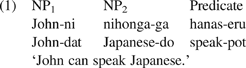
Such ni-marked NPs can occur alongside a second argument, as in (1) above, or as the sole argument, with predicates of psychological states, possession, potentiality, and necessity. As previous research on dative subjects had assumed a syntactic perspective on researcher-generated exemplars, the goal of Sadler's discourse-based study was to examine authentic use in various discourse contexts and at different historical points in order to develop a more comprehensive account of the phenomenon.
The first of three data sets for the investigation was comprised of 150 minutes of informal speech, recorded in private homes and restaurants in the US and Japan during the 1990s. Of 4,968 total clauses in the corpus, 1,149 were identified as potentially occurring with ni-marked NPs. Interestingly, Sadler found not a single instance of two argument NPs both being canonically marked with ni and ga, and only seven cases of just an initial NP being canonically marked. There was also a tendency for argument NPs not to be overtly expressed in conversation; 51.4% of the clauses had no lexicalized NP arguments, 42.9% had one, and only 5.7% had two. Still, even when the clauses without explicit arguments were eliminated, dative subjects remained exceedingly infrequent at 1.3%. This finding was in stark contrast with previous work, which had suggested that dative subjects were fully present in contemporary Japanese.
The second data set was derived from twelve contemporary Japanese novels, which were counterbalanced for first person versus third person narrative voice and for author gender. The analyses included 410 clauses randomly selected from each novel; of these 4,920 total clauses, 528 were identified as having predicates conducive to dative subjects. Here there were only five instances of canonical marking of two NPs, notwithstanding the greater tendency (20.4%) than in spoken language (5.7%) towards overt argument expression. Thus, while the classic dative subject construction was indeed evident in the written data set, it remained much less common than zero or noncanonical subject marking.
The final, diachronic component of the investigation was an analysis of thirty-one various literary texts dating from the 600s to the late 1900s. Each work from this collection was examined in its entirety and a total of 878 ni-marked NP1s were identified and ordered by year. The evolutionary path that emerged from this analysis revealed a direct link between dative subjects and locatives with ni, which the author concludes represent the particle's primordial function. The intermediate step was metonymic; from the 900s to the 1200s, ni-marked NPs referred to the residences of eminent individuals as a means of avoiding irreverent direct mention. Metonymic usage then dwindled and the form was used exclusively but relatively infrequently with human referents until the 1800s, when the contemporary usage of dative subjects flourished. This increase seen in writing is of course in contrast with the apparent nonuse of the form in contemporary speech, which lead Sadler to underscore the disparity between spoken and written language and to question the traditional reliance in linguistics on written data.


