Introduction
Methods for assessing the vulnerability of natural environments and communities have been much discussed; a value-loaded concept such as ‘vulnerability’ may be expected to reflect a bias towards a particular set or sets of ideals. However, coupled social and ecological models of vulnerable systems (for example see Turner et al. Reference Turner, Kasperson, Matson, McCarthy, Corell, Christensen, Eckley, Kasperson, Luers, Martello, Polsky, Pulsipher and Schiller2003; Vogel & O'Brien Reference Vogel and O'Brien2004; Walker et al. Reference Walker, Holling, Carpenter and Kinzig2004; Adger et al. Reference Adger, Hughes, Folke, Carpenter and Rockstrom2005) have moved towards resolving elements of conflict, whilst specific research communities (such as climate change) provide a broad-based platform from which commonalities of understanding and approaches can be nurtured.
Building on the emerging commonalities in vulnerability research, two broad-based concepts are often used to describe vulnerable systems. In the first instance is some idea of ‘harm’, such as exposure or susceptibility (Schiller et al. Reference Schiller, de Sherbinin, Hsieh and Pulsipher2001; McLean et al. Reference McLean, Tsyban, Burkett, Codignotto, Forbes, Mimura, Beamish, Ittekkot, McCarthy, Canziani, Leary, Dokken and White2001; Turner et al. Reference Turner, Kasperson, Matson, McCarthy, Corell, Christensen, Eckley, Kasperson, Luers, Martello, Polsky, Pulsipher and Schiller2003; Schröter et al. Reference Schröter, Metzger, Cramer and Leemans2004; Adger et al. Reference Adger, Hughes, Folke, Carpenter and Rockstrom2005; Nicholls & Hoozemans Reference Nicholls, Hoozemans and Schwartz2005). The concept of vulnerability encapsulates the idea of a negative trend in the behaviour or value of the system and some notion of impact is central to understanding the term. Alternatively, adaptation has also become a strong element of vulnerability analysis. This incorporates the idea of recovery from the effects of external forcing and the capacity of the system to absorb pressures towards change, such as adaptive capacity, resilience and coping capacity (Klein et al. Reference Klein, Nicholls, Ragoonaden, Capobianco, Aston and Buckley2001; Yohe & Tol Reference Yohe and Tol2002; Berkes et al. Reference Berkes, Colding and Folke2003; Smith et al. Reference Smith, Klein and Huq2003; Walker et al. Reference Walker, Holling, Carpenter and Kinzig2004; Adger et al. Reference Adger, Hughes, Folke, Carpenter and Rockstrom2005). A basic premise of managing vulnerable systems is that vulnerability can be reduced through decreasing the impact of external forcing on environmental systems and/or enhancing the adaptive capacity or resilience of communities or environments.
‘Vulnerability’ is most often considered an expression of the residual effects on a society or environment given a particular hazard event, namely impacts over and above the effects of adaptation to the hazard. The emphasis of this perspective is the end-state of a system, after a (or a series of) impact and response cycle(s) to a hazardous event. There is a measure of variability in approaches to understanding the relationships between the terms used in vulnerability analysis, such as resilience as a loose antonym of vulnerability, or vulnerability interchanged with the idea of ‘harm’ so that adaptation is a direct response to increased vulnerability rather than increased impact on the system (Buckle et al. Reference Buckle, Marsh and Smale2001; Cutter Reference Cutter2001; Vogel & O'Brien Reference Vogel and O'Brien2004). However, in all cases vulnerability assessment has focused on building an understanding of both present and future combinations of physical or socioeconomic attributes that define critical thresholds of impact and effective limits of adaptation responses (see for example Smith et al. Reference Smith, Klein and Huq2003; Walker & Meyers Reference Walker and Meyers2004; Groffman et al. Reference Groffman, Baron, Blett, Gold, Goodman, Gunderson, Levinson, Palmer, Paerl, Peterson, LeRoy Poff, Rejeski, Reynolds, Turner, Weathers and Wiens2006).
The goal of this paper is to encourage development of a clearer theoretical framework for a comprehensive systems approach to vulnerability analysis. This would better integrate threshold-driven vulnerability analysis with knowledge of the process-driven behaviour of environmental systems. The paper does not attempt to solve differences in specific approaches to the vulnerability term, nor does it seek to address the ambiguity that can surround the relationships between ‘vulnerability’, ‘risk’, ‘resilience’, ‘adaptation’ and other concepts which co-exist in the scientific literature, instead the focus is on a broad conceptualization of vulnerability analysis as a method for understanding the propensity of an environment to be impacted by a range of drivers with adverse effects. There has been an increasing groundswell of research emerging from interdisciplinary analyses of environmental problems, considering a range of external pressures and centring on more comprehensive systems approaches to understanding and managing environments. However, there has been relatively little theoretical discussion of the challenges, limitations and advances towards systems modelling that can be made via vulnerability analysis. I aim to review the concept of vulnerability from a systems perspective, highlight some clear lines of added-value in combining threshold analysis with a more concrete process-focus approach to vulnerability analysis and explore the usefulness of an assessment of system ‘functionality’ as a holistic tool for combining thresholds and processes in a truly multi-disciplinary manner.
I begin by examining limitations of threshold-focused vulnerability analysis with the basic argument that vulnerability analysis needs to have a more explicit focus on the process-based assessment of vulnerable systems. The challenge of adopting a more comprehensive systems approach may require shifts in how vulnerability is conceptualized, raising a second key argument that the vulnerability research area lacks a conceptual debate and subsequent conceptual framework for improving the systems approach to vulnerability analysis. A more concrete systems-based approach to vulnerability could add considerable value to vulnerability analysis as a tool for environmental management. I use the concept of system functionality as an example of an interdisciplinary and dynamic systems approach to understanding environmental behaviour. The concept is built on the framework of a dynamic web of functional states: assessing the ability of a system to maintain a range of functions through time. Functionality can provide a useful platform to explore processes and thresholds; this is discussed by way of an example in the context of coastal environments.
THRESHOLD-FOCUSED VULNERABILITY ANALYSIS AND EXPLORING SYSTEMS-BASED VULNERABILITY ANALYSIS
The importance of identifying critical thresholds of systems behaviour has been established within the climate change and wider vulnerability literature. This approach essentially builds on the General Systems Theory for understanding complex environments (see Wiener Reference Wiener1950; von Bertalanffy Reference von Bertalanffy1951; Boulding Reference Boulding1956) and subsequent development of systems thinking (for example, cybernetics) and application of systems thinking within existing disciplines (rewriting of geography from a systems point of view; Chorley & Kennedy Reference Chorley and Kennedy1971; Chapman Reference Chapman1977).
Systems thinking is founded on two pairs of ideas, those of emergence and hierarchy, and communication and control; both centre on the concept of organized complexity. The general model of organized complexity is that there exists a hierarchy of levels of organization, each more complex than the one below, a level being characterized by emergent properties which do not exist at the lower level. In any hierarchy of open systems, maintenance of the hierarchy will entail a set of processes in which there is communication of information for purposes of regulation or control (Checkland Reference Checkland1981).
Wiener (Reference Wiener1948, Reference Wiener1950) recognized the centrality of the process of self-regulation, or feedback, in system behaviour. Negative feedback processes act as a dampening mechanism against departures from the current state of a system, in other words, they reflect ‘self-balancing feedback’ (Wierner 1950). Self-regulation can be considered a stabilizing mechanism by which equilibrium is re-established, where equilibrium reflects a system state that is stable for a given range of external environmental pressures (Wright & Thom Reference Wright and Thom1977). Self-regulation is an important feature of systems behaviour for vulnerability analysis, characterizing the resilience or coping capacity of an environment.
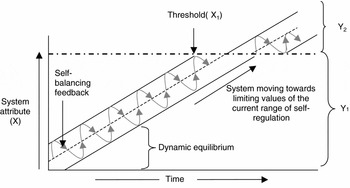
The stability of a system which is subjected to external forcing may shift through time, so that a dynamic equilibrium exists within the system (Schumm & Lichty Reference Schumm and Lichty1965). Under continued forcing, systems maintain a dynamic equilibrium until a threshold or thresholds are reached, after which change in the system performance may be experienced (Fig. 1). Threshold exceedance occurs when changing environmental inputs or changes in system characteristics drive the system towards limiting values that define the existing behaviour of the system. These limiting values define the operating range of self-regulation or the coping capacity or coping range of the system (Fig. 1). As a result, the limits of resilience (or the vulnerability of the system) can be characterized by the range of values that straddle the thresholds beyond which irreversible change occurs. The large proportion of vulnerability studies have focused on identifying the particular threshold values of vulnerable states of a range of environmental systems.
A simplified model of the relationship between threshold analysis, self- regulation within environmental systems and identifying vulnerable states of the environment. Where the stability of a system is changing through time, significant shifts in system behaviour (Y1 – Y2) can be related to thresholds of self-regulation (X1). In vulnerability analysis, these thresholds define limits of the coping ranges associated to a system attributes (x), reflecting the capacity to accommodation variations in system conditions and characteristics without producing significant impacts on system behaviour.

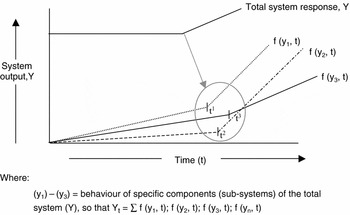
Linking the vulnerability of the system to characteristics which define thresholds of coping ranges is of critical importance. However, whilst thresholds are central to understanding vulnerability, a simple review of systems behaviour highlights that a comprehensive analysis of the thresholds which define vulnerable system states is a challenging task. Multiple temporal and spatially-defined thresholds exist within complex systems. The performance of a given system reflects the behaviour of specific components of the sub-system in question. It is a combination of relationships reflecting thresholds in behaviour in each of the sub-systems, which characterizes total system response (Fig. 2). However, there is a considerable complexity of thresholds within each of the physical, social and economic sub-systems which define integrated environmental change, so that the challenges of the complexity of thresholds exist at the range of scales from the social, geomorphic and ecological sub-systems to integrated behavioural change. The specific thresholds that identify a particular change in system performance can be difficult to identify.
An example of the complexity of thresholds defining the behaviour of a simple linear model system. Multiple temporal and spatially defined thresholds within the sub-systems characterize the behaviour of the total system response.

Added to this challenge of the multiplicity of thresholds are the complex feedback mechanisms which define changes in the behaviour of environments and communities. Complex systems, comprising dynamic sub-systems, reflect tightly coupled social, economic and geo-biological behaviour through space and time. Feedback mechanisms indicate clear but complex patterns of organization within a system and this non-linear interconnectedness of systems components can result in new structures and forms of behaviour emerging within the system (Wiener Reference Wiener1950). The complex multi-dimensional nature of systems results in considerable uncertainty in the nature of convergent behavioural patterns that may emerge within a system. Threshold exceedences are clearly dependent on complex non-linear and uncertain links between sub-systems across space and in time.
Such challenges raise an important issue with limited emphasis in current approaches to modelling and managing vulnerable environments. To achieve a greater understanding of the potential and direction of change in critical states or behaviour both now and in the future, vulnerability analysis should be focused on more specific ideas of the complexity of systems. In particular, it should assimilate an understanding of the processes which define the behaviour of the system with the current threshold-driven focus in vulnerability analysis. Threshold analysis is implicitly rooted in system processes; any given system state reflects a dynamically-stable process environment. However, there is often little explicit link in vulnerability analysis between the threshold values that define the coping range of a system and the range of dynamics (physical and social) that underpin the expression of system behaviour.
A fuller understanding of the interaction of physical (ecological, geomorphic and hydrological) and socioeconomic processes through space and time complements the current search for defining limits of system performance. It illuminates the interdependence between, and evolution of, critical thresholds in coping capacity within the system. However, it also provides a useful gauge of the true range of impacts of external forcing on complex systems. The social construction of risk, for example, means that humankind will often interpret a vulnerable environment when there is a threat to their socioeconomic position through either direct or indirect loss. Thus, it is ultimately human memory, which can be defined as the time taken for the socioeconomic system to adjust to an external forcing, which drives the impact that humans have on the environment. However, if memory within the physical system (the time taken for the ecological or geomorphological system to adjust to change and regain equilibrium) continually exceeds human memory, then society has no gauge as to the forcing impact or the ‘true’ vulnerability of the system. Increasing knowledge of the integrated system (i.e. the relationships and linkages between the spatial and temporal responses of the physical and social environment) is fundamental to understanding the behaviour of the system at any one point in time. There is a distinct possibility that owing to the lack of an explicit focus on the process behaviour, current management decisions on vulnerable environments may be damaging to the system in the long term (McFadden Reference McFadden2007).
The need for interdisciplinary research and for a more systems-orientated approach is becoming more widely acknowledged in vulnerability analysis, although this recognition can largely be associated to a particular range of research fields, for example, coupled socioeconomic and ecological modelling and the flood risk management community. The Foresight Flooding and Coastal Defence Project run by the UK Office of Science and Technology is an example of progress in this latter area (Evans et al. Reference Evans, Ashley, Hall, Penning-Rowsell, Saul, Sayers, Thorne and Watkinson2004a, Reference Evans, Ashley, Hall, Penning-Rowsell, Sayers, Thorne and Watkinsonb). Providing a long-term vision for the future of flood and coastal defence in the UK, the adoption of the Source-Pathway-Receptor-Consequence model enabled a simplified but whole flooding-system based approach to the analysis. Other research (for example Schroter et al. Reference Schröter, Polsky and Patt2005; Metzger & Schroter Reference Metzger and Schröter2006) has allowed quantitative spatial analysis of the human-environment system for vulnerability analysis, highlighting needs for integration including the knowledge base for vulnerability analysis, scales of response and multiple and interacting drivers of change. However, while progress is being made towards more comprehensive approaches, there has been relatively little theoretical discussion of the definition, aspirations towards and challenges to adopting a systems approach to ‘vulnerability’. Some examples of a theoretical review of the effectiveness of vulnerability analysis can be identified. Patt et al. (Reference Patt, Klein and Vega-Leinert2005) considered natural environments to reflect more complex systems than current vulnerability assessments can confidently model. However, a conceptual debate on the feasibility of increasing the capacity of vulnerability to reflect complex system behaviour is largely absent. This is central to exploring the degree to which important systems-based issues can be analysed in practical assessments of vulnerability analysis in environmental management. Theoretical discussions on systems thinking and systems applications have characterized the development of a wide range of disciplines (for example physical geography: Chorley & Kennedy Reference Chorley and Kennedy1971; Davis Reference Davis1972; engineering: Wymore Reference Wymore1976; ecology: Odum Reference Odum1983; Holling Reference Holling1987; and management science: Zannetos Reference Zannetos and Brans1984; Checkland & Casar Reference Checkland and Casar1986) and more recently the emergence of integrated and transdisciplinary science (for example research on resilience: Gunderson & Holling Reference Gunderson and Holling2002; Folke et al. Reference Folke, Hahn, Olsson and Norberg2005; Young et al. Reference Young, Berkhout, Gallopin, Janssen, Ostrom and Van Der Leeuw2006; Gotts Reference Gotts2007). Carrying this learning into the body of vulnerability science and testing the potential limits of systems thinking and application in vulnerability analysis should become a primary goal for scientists and other professionals involved in managing vulnerable environments.
Linking threshold analysis with a clear understanding of the interactions, differences and similarities between system processes that define coping ranges of the system, is apparently a simple conceptual development in vulnerability analysis. However, the challenge of adopting it is significant, and may require a fundamental shift in how vulnerability is conceptualized. Simplifying vulnerability in practical assessments for environmental management has frequently occurred at the cost of the essential complexity of environmental systems (McFadden & Green Reference McFadden and Green2007). For example, Patt et al. (Reference Patt, Klein and Vega-Leinert2005) concluded that narrowing the system from a complex adaptive entity to one that is relatively simple, can begin to increase confidence in statements on vulnerability assessment. However rather than simply deconstructing systems, the opportunities for enhancing vulnerability analysis to retain this complexity in approaches to understanding vulnerable environments should also be considered.
‘FUNCTIONALITY’: AN APPROACH FOR MOVING TOWARDS SYSTEMS-BASED VULNERABILITY ANALYSIS
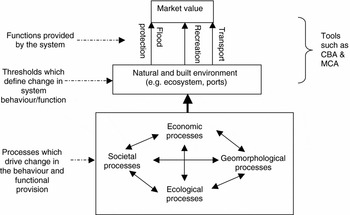
The idea that the natural system provides functions for human existence is not new, nor is the link between system functions and processes central to underpinning the value of environmental systems. The functional significance of the Earth's ecosystem, for example, is well established, implicit in the writings of Forbes (Reference Forbes1887) and Clements (Reference Clements1916) among others and a critical component of modelling and managing ecological resources. Yet, many management tools do not in practice realize the link between system deliverables and the sustainability of the structures and processes necessary to deliver goods and services. The functions provided by environmental systems are an explicit feature of generic tools such as cost-benefit analysis (CBA), which estimates economic value based on the direct and indirect use of the system, and multi-criteria analysis (MCA). However, such methods have no real focus on the structures and processes necessary to deliver goods and services (Fig. 3). For example, a wetland may be valued on the basis of a series of preferred services to society (such as bird habitat and storm protection). Such valuation is not specifically linked to the processes which create and maintain the wetland environment and subsequent functions that the system provides.
Decision-making tools such as cost-benefit analysis (CBA) and multi-criteria analysis (MCA) do not explicitly link process-defined behaviour with system output and functions.

System functionality is one example of a conceptual aid for increasing the effectiveness of process-based integration, providing a fulcrum around which an analysis of total environmental behaviour may be explored. The concept of system functionality introduces the idea of a dynamic web of functional states of an environment. The approach focuses on the sustainability of structures and processes; the dynamics that create and maintain the outputs that define system behaviour. It examines the temporal and spatial dimensions of these processes and links between the range of socioeconomic and physical processes across the total environment. The functionality of a system can be expressed as the persistence of a combined set of functions in relation to the variability of behaviour which defines the dynamic equilibrium of the system. Defining vulnerability in this context means that an environment can be considered vulnerable if its functions are easily threatened, and hence easily degraded such that its outputs are markedly lower. If vulnerability assessments were tied to a view of the environment as a comprehensive system in which a range of functions are overlain, this would provide a platform from which the dynamics of system processes and thresholds could be explored and translated into policy making for sustainable management. The key emphasis is towards integrating social, economic or physical based perspectives of change in the environment (including conceptual models and assessment tools) by examining the primary interactions, links and responses which define elements of change in the behaviour of the total system.
However, to increase the effectiveness of vulnerability analysis, this increased scientific knowledge-based analysis must also provide useful insights into the decisions that stakeholders must make within an environmental management process. Definitions of vulnerability are sought in order to help discussions as to what to do in the face of conflicting interests to reduce vulnerability. A complex environment is often an area of collision of interests as well as collision of processes, and definitions of vulnerability are often contested because they are a function of views of what the ideal environmental state should comprise. There are many actors involved in resource use and management, and different stakeholders generally have different preferences for the course of action to be adopted and often come to the choice with strongly held beliefs as to the nature of the course of action that should be adopted (Green & McFadden Reference Green and McFadden2007). The value of an approach to assessing vulnerability is consequently the degree to which it gives insight into the problem at hand. This gives an important focus for vulnerability analysis as a management tool. A useful definition of vulnerability is one that gives insights into what course of action must be chosen and carries sufficient shared meaning which enables stakeholders to communicate with each other (De Brujin et al. Reference De Brujin, Green, Johnson, McFadden, Begum, Hall and Stive2007).
A functionality approach to vulnerability analysis is a vehicle for enabling a social learning process regarding the functioning environment. A comprehensive framework would move beyond detailed assessment of scientific knowledge and experience of coastal behaviour to include insights from those stakeholders with an interest in coastal management, transforming the task of identifying system relationships defining environmental functionality into a more challenging undertaking. It also raises a series of questions regarding the relationship between scientists and other stakeholders (such as how do scientists incorporate or ‘validate’ stakeholder views on the important dimensions of environmental functioning and vice versa) and what is meant by ‘better’ decisions in terms of functioning systems (McFadden & Penning-Rowsell Reference McFadden, Penning-Rowsell and Forkiewicz2006). These questions may need to be addressed within a wider scientific conceptual debate on comprehensive systems approaches to vulnerability analysis. Vulnerability analysis that gives a comprehensive (stakeholder wide) view of the physical and social processes that define change in the behaviour of an environment affords particular insight into understanding ‘the environment’ and the choices for management that can be made. By exploring the dynamics of change and the realities of living in the context of a vulnerable environment, it moves towards providing a shared understanding of the system and this brings real practical value to those managing these environments.
Defining vulnerability in the context of a dynamic systems approach to understanding the environmental functionality promotes learning processes for vulnerability science, providing a framework for advancing scientific understanding of change in complex systems and a social learning experience deriving new insights into the problem at hand. Both elements of learning deliver a greater understanding of the potential for, and the direction of, change (both now and in the future) in the critical states or behaviour of the system. This is a useful and important component of understanding and managing vulnerable environments.
Exploring functionality: an example from coastal environments
Coastal regions are a primary example of a complex, multi-functional system with extensive conflicts of interest surrounding the use and management of resources. Many economic sectors and major urban areas are located within the coastal zone, and the coast also plays an important role in global transportation and the tourist industry. The network of beaches, wetlands and rocky coastlines provides a range of functions in both a socioeconomic and natural capacity. Sandy beaches are a buffer against wave attack to prevent flooding and land loss through erosion, as well as a recreational resource; coral reefs are effective coastal protection structures and sand dunes form natural bluffs and sand repositories from which sand may be extracted during storms without major shoreline retreat. Wetlands are highly productive systems providing, for example, waste assimilation, flood protection, nursery areas for fisheries and habitats for wildfowl (McLean et al. Reference McLean, Tsyban, Burkett, Codignotto, Forbes, Mimura, Beamish, Ittekkot, McCarthy, Canziani, Leary, Dokken and White2001).
A functionality framework for vulnerability analysis would initially focus on basic system processes that are critical for understanding the functioning of the environment. Any given system function or output can be associated with a range of processes which have a destabilizing effect and move the system towards the limits of the coping range of the functional state. In systems thinking, this positive feedback induces instability by reinforcing a modification in the performance or behaviour of the system. Likewise, processes can be identified which enhance the capacity of the system to self-regulate and so maintain the current system services and functions. Positive feedback reduces the differences between the actual and ‘desired’ behaviour of the system. Both sets of processes within a coastal environment relate to behaviour within the physical as well as social system. From a simple historical context for example, commercializing coastal towns and villages has led to increasing spending and the accumulation of wealth along stretches of the coast. Within the UK, such commercialization was largely a response to a 19th century demand on the coast to fulfil, in the first instance, a role in enhancing the health of Victorian city and town dwellers. This behavioural trend can be identified along much of the coast of England through the legacy of seaside resorts. However, such an economic and social process increased the susceptibility of many coastal systems, with conflicts between the relatively static human construct and a dynamic and flexible physical environment. Faced with natural processes of change, the emergence of coastal towns and villages was also frequently accompanied by hard coastline defences such as seawalls or gabions, which hold the physical line of the coast. The presence of hard sea-defences reflects further potential towards destabilization as the reflection of physical wave energy increases the potential for erosion and such defences cut off potential sediment supply to the coast. This means that the essential functional provision of the system (in this instance as a ‘desirable’ environment) becomes more easily threatened. The destabilizing effect reflects a combination of social processes (for example community advocacy for holding the line reflecting social constructions of the coast as a benign environment or at least one which should be controlled and maintained to allow physical as well as socioeconomic stability) and physical processes (for example the geomorphologic environment adjusting to changes in the energy balance at the coastline), each with different temporal and spatial dimensions of change.
Identifying the range of processes, and critically the scales and nature of interactions between the processes, that define functionality of a particular coastal system remains challenging. Significant needs still exist in improving process-based understanding of coastal vulnerability within the different scientific domains. Behind much coastal vulnerability analyses are human attitudes towards the use of coastal resources and human aspirations for their enhancement and development. Our basic understanding remains poor as to what drives what appear to be unwise patterns of human occupancy and use of coastal zones. This is social in nature and concerned with how people see their place in the world and what they expect of their environment in terms of risks and rewards. We know relatively little about the processes that inhibit or promote the adaptive capacity of individuals, agencies or indeed nations across the spectrum of scales. The environmental and engineering components of coastal vulnerability are widely researched; however questions such as how broad-scale coastal ecosystems respond to climate change and other drivers require particular attention (McFadden et al. Reference McFadden, Nicholls, Penning-Rowsell, McFadden, Nicholls and Penning-Rowsell2006).
Adopting a systems view of the functioning of coastal environments which includes both human and physical systems significantly increases the challenges. It includes the obvious differences in scales over which physical and social processes operate, as well as the challenges of nesting of impacts and responses within a system. However, a fundamental system-based question regarding total environmental functioning may also be the degree to which sub-system behaviours are indeed integrated. Is it possible to identify new models of converging (or emerging) processes and behaviour across the range of sub-systems, rather than focus the systems perspective on non-coupled or discipline-specific change, linked only through resource dependencies? For instance, there are sociological processes that define how a coastal community perceives its environment and physical processes that define the response of coastal wetlands within that environment to increasing sea-level rise. A functional perspective would move towards exploring the range of interactions which exist between these distinct elements and behaviours within the coastal environment, as well as the limits of integrated process thinking. A residual perception of landscape may exist from the visual arts articulation of landscape as sublime within the 18th and 19th century, a perception which has become inadequate as a framework within which to address contemporary challenges reflected through an increased pace of physical coastal change (S. Read, personal communication 2007). The interactions of these social and physical processes may promote both a decrease in the sense of social belonging and of place within the environment and an increased rate loss of physical environment, as the behaviour of social actors and their impact on the environment becomes increasingly detached.
Functionality provides a framework within which such key fundamental conceptual questions may be explored. However, a functionality-based analysis for coastal managers may begin by raising a series of simple questions such as, ‘why does a sandy beach appear in this particular system’ or ‘why is a high cultural value associated with this particular landscape’? The buffering capacity of a sandy beach, for example, can be related to processes that control the morphological and sediment structure of the system. Cultural heritage and social sensitivity to particular landscapes are often driving forces in defining the aesthetic value of coastal environments. The critical component of this analysis is to build on the process-function relationships by exploring the broad-scale interactions between the physical and human environments that impact the dynamics which create and maintain the various functions of the system (for example buffering against storm activity and recreation value). This would involve engaging in participatory practices to explore differences in understandings of the challenges and processes which define functioning coastal systems.
Developing this initial analysis by building a longer-term perspective of the functioning coastal system may allow opportunities for exploring the potential for harnessing change to enhance the functions provided by the system. A means of adapting such an approach into the coastal zone management (CZM) policy-making framework would be to ensure that the functionality of the system becomes part of a long-term vision of the coastal zone. Such a strategy creates a long-term future for the coast that would provide for natural processes, recreation, land use and development, in a visionary but recognizable manner (for example long-term shoreline evolution as modelled in the UK DEFRA FutureCoast project; Burgess et al. Reference Burgess, Jay and Hosking2002). Modelling the functions provided by the coast in the longer term would allow the processes underpinning vulnerability to be managed to either maintain or improve the functionality of the envisioned coast. The basic process-function model may also be linked to an assessment of the use values associated with the range of functions provided by the system. This would allow functional substitution to be examined; can the value of system be maintained or increased by substituting one function for another (such as using coastal wetland for wastewater recycling versus using the wetland for recreation) and what are the system-wide implications for subsequent change in the processes that produce the desired deliverables? Vulnerability analysis could become a powerful tool for preserving and adapting key functionalities of the system. Linking vulnerability to functionality embeds the concept in a framework on which more detailed models of integrated physical and socioeconomic behaviour may be developed.
Limitations to the use of vulnerability analysis as suggested within this discussion can be identified. The principles presented within this paper place strong emphasis on the need to understand the complexities of total system response to a wide range of drivers of change, the nature of interactions between all sub-systems and the process-based tendencies for change that are built on such relationships. In reality, this remains a difficult task. Functional systems may be temporally dynamic in physical form, within limited ranges at least, and indeed such constant change may be a form of necessary flexibility to maintain the structure and functional provision within the system. Recognizing the stable and unstable functional ranges provides a considerable challenge. There must also be synergy between the behavioural evolution of systems and the values which society attributes to functions and services provided by these systems in both the short and long term. Thus developments towards this approach require a clearer understanding of scenarios of social change and future demands on environmental systems. A further point is that vulnerability analysis must be seen as complementary to tools which assess the economic costs and benefits of decisions and management options. Despite such challenges, an important point emerges from this discussion. Vulnerability is a flexible and adaptable concept that should be more fully used as an aid to system understanding.
SYSTEM-BASED VULNERABILITY ANALYSIS ADDING VALUE FOR INTEGRATED ENVIRONMENTAL MANAGEMENT
Across the various facets of environmental management, ‘integration’ has emerged as the preferred international paradigm for achieving sustainable environmental development and conservation. For example, integrated flood risk management (IFRM) focuses on interdependencies and inter-relations between water and land management and the dynamic behaviours of the systems (Green Reference Green2004). It reflects a paradigm shift ‘from defensive action against hazards, to management of the risk’ and the necessity of a holistic approach which takes into account the whole river basin and multilateral cooperation and interdisciplinary planning for the whole catchment areas (United Nations Economic and Social Council 2000). IFRM is based on a good understanding of process drivers and not only sustains an appropriate standard of protection, but also ensures that all options for managing flood risk, such as managed re-alignment and zoning development, are maximized. IFRM involves cooperation and coordination across institutional and disciplinary boundaries, focusing on participatory and transparent approaches to decision-making and managing water and land across the catchment as a whole (APFM [Associated Programme on Flood Management] Technical Support Unit 2004).
The first sustained attempt at managing the coast was recognized in the 20th century with the development of the concept of CZM. It has evolved in the first instance from a ‘defence-response’ at the shoreline, through a realization of the degree of complexities within the natural environment and the need for flexible response strategies, to the recognition of the importance of interconnected opinions, values and beliefs filters which define societal perspectives of living at and managing the coast (de Groot & Orford Reference de Groot, Orford, Smith, Raper, Zerbini and Sanchez-Archilla2000). By the end of the 20th century, there was recognition that coastal resources could only be managed in the total context of the physical, economic and social environment. This led to the emergence of the concept of integrated CZM as the preferred governing framework for the coastal environment.
An examination of the evolution of integrated management indicates that ‘integration’ has two primary requisites: (1) a commonality of purpose and approach between all stakeholders (scientists, policy-makers, environmental managers and the public) and (2) a perspective by which the system is structured in an interdisciplinary way (McFadden Reference McFadden2007). A firmer system-based approach to vulnerability analysis is a useful tool for moving towards the realization of these requirements to achieve effective and meaningful integration in environmental management.
The first requisite highlighted above reflects the development of management strategies from an agreement building process which is defined by the range of relevant stakeholders. To achieve this, stakeholders (including especially local communities and managers) need to foster a longer-term vision of the environment against which to plan both the immediate and future management of the system. This may result in making difficult, but fundamental decisions in order to ensure the continuing long-term (physical, social and economic) goals for the region. Agreeing such goals would be a demanding and perhaps sometimes impossible process. Vulnerability analysis which is centred on the functioning of environmental systems can add to resolving this challenge, providing some basis for determining priorities in terms of what to do about which elements of the system. It bridges social and physical perspectives to provide a framework through which each of these interests can be expressed. Linking with the scientific community, stakeholders can move towards developing such a longer-term perspective of the functioning system, working towards desirable and ‘stable’ future states and ‘goals’ for the environment. By encouraging dialogue and an understanding of the total behaviour of the system, a comprehensive process-based vulnerability analysis can contribute to furthering real progress in the learning process through which new shared insights into decision-making can be made.
However, successful integration in environmental management must also be underpinned by knowledge of the integrated behaviour of the system in question. Integrated management must be underpinned by progress on scientific approaches and methods that contribute to understanding of the integrated nature of environmental behaviour. The wide ranges of spatial and temporal scales in both impact and adaptation suggest that by intervening within a system at any point in space or in time, human actions can have wide-ranging effects. Activities now can affect future thresholds of impact and adaptive or coping capacity. In reality, owing to past misguided intervention within environments, thresholds in system behaviour may already have been crossed that limit the capacity to achieve sustainable management (McFadden et al. Reference McFadden, Nicholls, Penning-Rowsell, McFadden, Nicholls and Penning-Rowsell2006). Embedding vulnerability analysis within a strong process-based framework provides a vehicle whereby the dynamics of system response can be explored, complementing existing methodologies for policy-making on environmental resources. An approach to vulnerability analysis which combines thresholds and processes in the functionality of a system is a useful tool towards achieving ‘true’ integration in environmental management.
Conclusions
Current expressions of vulnerability focus vulnerability analysis on thresholds and the actual impacts on a system over and above the effects of adaptation. A systems-based approach and functional perspective on systems behaviour add to this by allowing the possibility for exploring the potential vulnerability of the system. It examines processes which increase the likely impact of external forcing and those which enhance the ability of the system to mitigate or absorb impacts on the environment, with impact focused on a loss in the physical or socioeconomic functional value. Defined in two dimensions, i.e. (1) the critical thresholds which define the limits of behaviour and (2) the capacity of the system to maintain the behaviour, vulnerability analysis may afford the opportunity to explore and value processes in a manner that other tools such as CBA and MCA can not allow. By linking vulnerability to systems behaviour and functioning, vulnerability analysis could emerge as an important component of the decision-making framework for managing resources.
Criteria for vulnerability assessments are only as effective as the conceptual framework which underpins them. Consistent and significant improvements in vulnerability analysis depend on rigorous debate on the limitations and opportunities for improving the application of the concept to environmental management. The application of systems thinking and approaches to constructing vulnerability analyses need to be more fully explored and could make significant impact on the sustainable management of 21st century environments.