Several researchers have investigated the use of analogy and metaphor in design and design education. Both metaphors and analogies are of crucial importance for creativity (Holyoak & Thagard, Reference Holyoak and Thagard1996). Most studies investigated how designers use analogies in artificial settings (Casakin & Goldschmidt, Reference Casakin and Goldschmidt1999; Ball et al., Reference Ball, Ormerod and Morley2004; Bonnardel & Marmèche, Reference Bonnardel and Marmèche2004; Casakin, Reference Casakin2004, Reference Casakin2010; Ozkan & Dogan, Reference Ozkan and Dogan2013). Fewer studies have looked at analogies in real-world design situations (Christensen & Schunn, Reference Christensen and Schunn2007; Ball & Christensen, Reference Ball and Christensen2009; Kalogerakis et al., Reference Kalogerakis, Lüthje and Herstatt2010; Vattam et al., Reference Vattam, Helms and Goel2010). Even fewer studies have investigated the use of metaphors in design (Coyne et al., Reference Coyne, Snodgrass and Martin1994; Casakin, Reference Casakin2006; Hey et al., Reference Hey, Linsey, Agogino and Wood2008) and in the discourse about design (Caballero, Reference Caballero2003). The authors are not aware of any studies that investigated similes in design.
Kevin Dunbar called studies conducted in artificial settings “in vitro” and those in real-world settings “in vivo” (Dunbar, Reference Dunbar, Magnani, Nersessian and Thagard1999, Reference Dunbar, Gentner, Holyoak and Kokinov2001; Dunbar & Blanchette, Reference Dunbar and Blanchette2001). In vitro studies are conducted in artificial settings in which the researcher has control over certain features of the research environment. In vivo studies are those conducted in natural settings in which the researcher has seemingly no control over the way similarities are used. Dunbar (Reference Dunbar, Gentner, Holyoak and Kokinov2001) proposed that the artificial settings in which analogy studies were conducted could have had a detrimental impact on participants’ performance. In his research on the use of analogy in science (Dunbar, Reference Dunbar, Ward, Smith and Vaid1997, Reference Dunbar, Magnani, Nersessian and Thagard1999, Reference Dunbar2000) and politics (Blanchette & Dunbar, Reference Blanchette and Dunbar2001), he and his colleagues have shown that analogical reasoning in natural settings is pervasive and requires little effort. Research in metaphors has similarly highlighted the importance of studying metaphors within the larger and richer setting of the discursive context within which they are used, to understand their frequency of use and their full implications (see Caballero, Reference Caballero2003).
Our study investigated the use of similarity relations in the form of analogies, metaphors, and similes during a design review of undergraduate architectural design projects. Following the work of Dunbar and Blanchette (Dunbar, Reference Dunbar, Ward, Smith and Vaid1997, Reference Dunbar, Magnani, Nersessian and Thagard1999, Reference Dunbar2000; Blanchette & Dunbar, Reference Blanchette and Dunbar2001) and Lakoff and Johnson (Lakoff, Reference Lakoff and Ortony1993; Lakoff & Johnson, Reference Lakoff and Johnson1999; Johnson, Reference Johnson2013), we anticipated that many analogies and metaphors would be used during a design review. Dunbar and Blanchette (Dunbar, Reference Dunbar, Ward, Smith and Vaid1997, Reference Dunbar, Magnani, Nersessian and Thagard1999, Reference Dunbar2000; Blanchette & Dunbar, Reference Blanchette and Dunbar2001) suggest that when people are in a setting where they are naturally producing analogies, that is, in vivo settings, they are very comfortable using analogies. Lakoff (Reference Lakoff and Ortony1993) suggests that metaphor use is pervasive, automatic, and requires no effort. In this study, our first question was whether or not studying the use of analogy, metaphor, and similes in vivo design settings would indicate a frequent and spontaneous use of similarity relationships by students and reviewers, and if it did what type of similarity relations are used most frequently. Our second question was whether students and reviewers would differ in the type, range, frequency, goal, value judgment, and depth of similarity relationships they evoke.
We were also interested in the importance of the goal of the reasoner relative to other factors. Holyoak and Thagard's work highlights the primacy of goal in analogical reasoning (Holyoak, Reference Holyoak and Gordon1985; Holyoak & Thagard, Reference Holyoak and Thagard1989, Reference Holyoak and Thagard1997). We investigated whether goal could impact the source retrieval in similarity relationships, as shown in analogical reasoning in political discourse by Dunbar and Blanchette (Reference Dunbar and Blanchette2001) and in science by Dunbar (Reference Dunbar, Ward, Smith and Vaid1997, Reference Dunbar, Magnani, Nersessian and Thagard1999, Reference Dunbar2000). Our third question, consequently, investigated the relationship between goal and other factors—namely, type of similarity, expertise, range, frequency, value judgment, and depth, which are all found to be effective in using similarities.
The last specific issue we investigated relates to references to the human body and bodily experiences in similarity relationships evoked by reviewers and students. According to Lakoff and Johnson (Reference Lakoff and Johnson1999) our metaphoric understanding is closely linked to embodiment, that is, our bodily experiences. Lakoff and Johnson (Reference Lakoff and Johnson1999) suggest that metaphors based on bodily experiences are primary metaphors on which other complex metaphors are built. Holyoak and Thagard (Reference Holyoak and Thagard1996) claim that in analogical reasoning mapping is often supported by way of linking our mental representations of bodily understanding to unfamiliar systems of concepts. They describe personification as a way of using our bodily understanding so that unfamiliar non-human domains may be understood through knowledge about people. Our fourth and last question was whether embodiment was an important factor or not in evoking the similarities, especially metaphors, used in design reviews.
In a design review, students are expected to present their design projects while reviewers are expected to offer comments (see Murphy et al., Reference Murphy, Ivarsson and Lymer2012). Design reviews impose asymmetrical power relations and roles in which students are typically more submissive and reviewers are more dominant to the extent that they might take up two-thirds of the total review time (Goldschmidt et al., Reference Goldschmidt, Casakin, Avidan, Ronen, Adams and Siddiqui2014). Together with desk crits (Goldschmidt et al., Reference Goldschmidt, Hochman and Dafni2010), reviews constitute the major pedagogical tools in design education. In some respect, the design reviews at schools are precursors of design reviews in the professional design field, which are meetings during which major decisions are made collaboratively (Huet et al., Reference Huet, Culley, McMahon and Fortin2007). Design reviews provide a unique setting in which one could observe both explanatory and inspirational use of analogies, metaphors, and similes (for analogies, see Chou and Shu, Reference Chou and Shu2015). Furthermore, design reviews put both students and reviewers in a situation in which they cannot consult any outside source, forcing them to invoke primarily internal source analogs, that is, retrieval of sources from long-term memory (see Srinivasan et al., Reference Srinivasan, Chakrabarti and Lindemann2015).
Analogy, metaphor, and simile
During a design review, it is important to express ideas through different media as effectively as possible. Figurative language, in which meaning is conveyed non-literally through a variety of devices, offers a highly effective strategy (Gibbs, Reference Gibbs, Wilson and Keil1999). Three devices used in figurative language are analogy (Hofstadter, Reference Hofstadter, Gentner, Holyoak and Kokinov2001), metaphor, and simile (Gibbs, Reference Gibbs, Wilson and Keil1999). Each of these connotes a similarity relationship between a source and a target. In this study, an analogy is defined as an explicit similarity relation between two concepts, often formulated in the form of A : B :: C : D, according to which the relationship between A and B, that is, the source analog, is carried over to describe the relationship between C and D, that is, the target analog. An example of analogy from architecture would be Bream : Hat :: Eave : Roof (Bream is to hat as eave is to roof). A metaphor, often expressed in the form of A is B, is a similarity relationship according to which A is included within the category of B without an explicit statement about their similarity. The well-known statement from architectural design, “A house is a machine to live in” (Le Corbusier, 1986, p. 4), is an example of a metaphor. A simile, in contrast, is a relationship formulated as A is like B, by which similarity is advanced by way of comparison between A and B, such as “the familiar Shell and Gulf signs stand out like friendly beacons in a foreign land” (Venturi et al., Reference Venturi, Scott Brown and Izenour1977, p. 52).
According to Gentner (Reference Gentner, Bechtel, Graham and Balota1998), in analogical similarities, the systems of relations are carried across different domains. Analogies formulated in this way are called “simple analogies” (Gentner, Reference Gentner and Miall1982) or proportional analogies (Hofstadter, Reference Hofstadter, Gentner, Holyoak and Kokinov2001), defining only a limited set of analogies. Gentner (Reference Gentner and Miall1982) suggests that the definition of analogy could be extended to cover all non-literal similarity relationships, including metaphors and similes, wherein the source analog is not identical to, nor literally similar to, the target analog. A more nuanced definition of analogy is provided by Gentner and Markman (Reference Gentner and Markman1997), in which analogy and similarity are considered to exist along a continuum rather than be two distinct categories. The term analogy's wider definition denotes an umbrella category under which other forms of similarities, either categorization such as metaphors, or comparison such as similes, are also included. According to Hofstadter (Reference Hofstadter, Gentner, Holyoak and Kokinov2001), who considers analogies and metaphors to be closely related, analogy-making, going beyond the boundaries of proportional analogies underlies the process of categorization and constitutes the core of cognition.
Metaphor is a similarity relationship between two remote analogs ( Vosniadou & Ortony, Reference Vosniadou and Ortony1989; Holyoak & Thagard, Reference Holyoak and Thagard1996; Gentner & Bowdle, Reference Gentner and Bowdle2001; Holyoak, Reference Holyoak, Holyoak and Morrison2005) in which the similarity relationship is implicit (see Hey et al., Reference Hey, Linsey, Agogino and Wood2008), and reveals deeper relational and systems mappings (Bowdle & Gentner, Reference Bowdle and Gentner2005). Its interpretation requires a shared body of knowledge (Holyoak & Thagard, Reference Holyoak and Thagard1996). Holyoak and Thagard (Reference Holyoak and Thagard1996) suggest that the distinction between an analogy and a metaphor is more a matter of distance between the source and the target, that the more remote the source and the target the more their relationship is metaphorical. Furthermore, Holyoak and Thagard (Reference Holyoak and Thagard1996) indicate that in metaphors the relationship is often not directly suggested and the source domain is only implied indirectly. According to Gentner and her colleagues (Gentner, Reference Gentner and Miall1982; Gentner et al., Reference Gentner, Bowdle, Wolff, Boronat, Gentner, Holyoak and Kokinov2001) metaphors are expressive, non-literal similarity comparisons, and they could be considered a species of analogy (Gentner & Bowdle, Reference Gentner and Bowdle2001; Bowdle & Gentner, Reference Bowdle and Gentner2005). Caballero (Reference Caballero2003), studying architectural discourse, defines metaphors as all instances in which architectural elements are expressed via non-architectural entities, including conventional jargon such as “wing” or “skin’. While the use of analogy is more confined to explanatory–predictive situations, the use of metaphor includes both explanatory–predictive and expressive–effective situations (Gentner et al., Reference Gentner, Bowdle, Wolff, Boronat, Gentner, Holyoak and Kokinov2001).”
Gentner et al. (Reference Gentner, Bowdle, Wolff, Boronat, Gentner, Holyoak and Kokinov2001) state that metaphor differs from a simile in that it lacks any explicit comparison form, but they suggest that the term metaphor is used often to include similes as well. Notwithstanding the differences between metaphor and analogy, studies from cognitive science (Blanchette & Dunbar, Reference Blanchette and Dunbar2001; Gentner et al., Reference Gentner, Bowdle, Wolff, Boronat, Gentner, Holyoak and Kokinov2001) and design studies (Hey et al., Reference Hey, Linsey, Agogino and Wood2008) take similes as examples of analogies. The main issue of debate is more about how similes and metaphors are processed rather than how they are different (Berger, Reference Berger2013). Some, such as Ortony (Reference Ortony1979), have argued that metaphors invoke comparison, as do similes. Others, such as Glucksberg (Reference Glucksberg, Wilson and Keil1999), have proposed that metaphors are about category inclusion rather than comparison. A resolution is proposed by Gentner and Bowdle (Reference Gentner and Bowdle2001), who suggest that conventional metaphors are processed more like category inclusion statements, novel metaphors are processed more as comparisons, and that when a metaphor becomes more conventionalized its processing shifts from comparison to category inclusion.
Metaphors, similes, and analogies are different in form and in the way they are processed (see Margolis, Reference Margolis1957), but they are all related to establishing similarities between a source domain and a target domain. We propose that a more comprehensive account of the impact of similarity relationships in design can be achieved by looking into the significance of metaphors, similes, and analogies altogether, and not just proportional analogies, in which similarities are explicitly stated and the purpose is focused more on the explanatory power of the similarity.
Analogy, metaphor, and in vivo research setting
Most studies which have investigated similarity relationships in design have primarily focused on the use of analogies, fewer on metaphors, and almost none on similes. Most of these studies were conducted in artificial settings. In this section, we will explain the importance of studying similarity relationships in vivo settings. As most of the literature is related to analogies our review here will be unbalanced, reviewing predominantly the literature from analogical reasoning.
Beginning with the seminal work of Gick and Holyoak (Reference Gick and Holyoak1980), researchers have investigated why people have difficulty spontaneously identifying relevant source analogs and how this performance could be improved. Dunbar's contribution (Dunbar, Reference Dunbar, Ward, Smith and Vaid1997, Reference Dunbar, Magnani, Nersessian and Thagard1999, Reference Dunbar2000) to this line of work is that he demonstrated how people have relatively no problem using analogies in natural settings. There are two implications of Dunbar's work (Dunbar, Reference Dunbar, Ward, Smith and Vaid1997, Reference Dunbar, Magnani, Nersessian and Thagard1999, Reference Dunbar2000) and his work with colleagues (Blanchette & Dunbar, Reference Blanchette and Dunbar2001) for studies of analogy in design. The first relates to the in vivo versus in vitro research setting, and the second relates to differences in how expert and novice designers use an analogy. Most research in analogical reasoning has established that recognizing structural similarities between the source and target analogs requires expertise which comes with an interconnected body of domain knowledge. Researchers who have looked at expertise and the use of design analogies have done so in vitro settings. Results of these studies suggest that novices are not able to see structural similarities and are more likely to concentrate on superficial features of a source analog. Following Dunbar's work, however, the in vitro setting in which most of these studies were conducted might have obscured the relationship between expertise and the amount of similarity the designers evoked.
There are few in vivo studies investigating the use of analogies in design. These studies show that the use of analogy is common in design practice. Kalogerakis et al. (Reference Kalogerakis, Lüthje and Herstatt2010), for instance, indicate that analogies are commonly used in the design and engineering firms they studied and that in many instances experts used between-domain source analogs. In another in vivo study, Ball and Christensen (Reference Ball and Christensen2009) investigated the data from transcripts of two engineering design meetings and found that analogies were frequently used by designers. A third study, by Christensen and Schunn (Reference Christensen and Schunn2007), found that in an engineering company within-domain and between-domain analogies were used equally by designers.
In vivo studies on metaphors in design are not numerous either but support the claim that use of metaphor in design is pervasive for both students of design and design professionals. Caballero (Reference Caballero2003) showed that in building reviews published in architectural magazines metaphors are extensively used for both descriptions and evaluations. Coyne et al.s (Reference Coyne, Snodgrass and Martin1994) state that metaphors are of primary significance in fostering the hermeneutical thinking process and report how significant metaphors are in the design studio environment. Hey et al. (Reference Hey, Linsey, Agogino and Wood2008), in a review of design textbooks from four countries, showed the cross-cultural prevalence of similar metaphors in design education. Casakin (Reference Casakin2006), investigating the use of metaphors by students in a design studio environment, suggested that metaphors are more useful in the early, conceptual design in later phases of design.
In vitro studies of analogy in design, in contrast, do not provide much support for the pervasive use of spontaneous analogy. These studies have looked at differences between expert designers and novice designers (Ozkan & Dogan, Reference Ozkan and Dogan2013), under what circumstances designers use analogies spontaneously (Bonnardel, Reference Bonnardel2000; Dahl & Moreau, Reference Dahl and Moreau2002; Ball et al., Reference Ball, Ormerod and Morley2004; Bonnardel & Marmèche, Reference Bonnardel and Marmèche2004), and how one could encourage novice designers’ use of analogy through specific instructions (Casakin, Reference Casakin2004, Reference Casakin2010), through the timing of source analog display (Tseng et al., Reference Tseng, Moss, Cagan and Kotovsky2008), or through the way source analogs are presented (Linsey et al., Reference Linsey, Wood and Markman2008; Zahner et al., Reference Zahner, Nickerson, Tversky, Corter and Ma2010; Cardoso & Badke-Schaub, Reference Cardoso and Badke-Schaub2011).
In vitro studies of metaphors in design, in comparison, indicate the prevalence of metaphors in design. In an experimental study, Hey et al. (Reference Hey, Linsey, Agogino and Wood2008) compared the use of metaphors and analogies and found that metaphor is more influential in the problem-framing phase of design while the analogy is more influential when seeking solutions. Casakin (Reference Casakin2011), comparing first-year design students to fifth-year design students to investigate how they benefit from metaphor use, found that in the conceptual design phase the use of metaphors is very effective for both novice students and expert students, and in later phases metaphors are more helpful for experienced students. In another study, Casakin (Reference Casakin2017) found that architects were able to benefit from external textual stimuli in evoking metaphors in communicating and developing design ideas.
In this study, we investigated whether both novice and expert designers would spontaneously refer to similarity relationships, that is, analogy, metaphor, and simile, in vivo setting, whether or not they would differ, in what ways they might differ, whether novices and experts would see structural similarities, and what would be the impact of assumed goals and embodiment in their source retrieval.
Method
The data set consisted of the final review of a third-year undergraduate architectural design studio. The review lasted two full, successive days, starting roughly at 09:30 and ending at around 17:00 each day, with a one-and-a-half hour long breaks at midday.
Participants
The panel of reviewers, who were all practicing architects teaching design either full-time or part-time, consisted of 14 invited reviewers (four females, 10 males) and eight studio instructors (five females, three males). Reviewers’ professional experience ranged from eight years to 43 years (mean year of experience = 19.5 years; SD = 8.5). Four of the reviewers made very few comments; the other 10 reviewers made more contributions. Two of the reviewers participated for 2 days; the others participated 1 day or less. The instructors stayed as neutral as possible throughout the review to leave time and opportunity for the invited reviewers to make comments. Two of the design studio instructors are the authors of this study.
Thirty-four third-year architecture students presented at the review (n = 34; n = 17 female; and n = 17 male). A recording for one student could not be transcribed because of technical problems; the recording for this student was left out of the study.
Design task
The design task was a housing project for an urban regeneration zone in a city of 4 million inhabitants. In the project area and its surroundings, there were primarily squatter houses. These were being replaced by high-end housing projects. A metro station was within walking distance to the site. The building program specified 13,000 m2 of enclosed space, including 75 housing units (7500 m2 total), and social amenities (2000 m2 total) and outdoor facilities to be specified by the individual students, indoor parking (for 75 cars, 2000 m2 total), and outdoor facilities that would be programmed by individual students. Students were asked to design housing proposals that could contribute to the life of the city while providing the necessary privacy to the residents. Students were expected to question current, predominant housing schemes such as gated communities and those in which housing remains detached from the rest of the city.
Procedure
External reviewers received an advance invitation together with a description of the project topic, the site, and the architectural program. The review began with an introduction by the studio instructors summarizing the project topic, site, design challenge, topics covered during the semester, and format of the review. The format of the review was composed of students’ presentations followed by an open forum with back-and-forth exchange between reviewers and students, with no formal moderation as opposed to a review format during when students listen to the critiques without responding to them. Each review included an introductory presentation by the student, in which she/he explained her/his design decisions and described her/his project. Each presentation was followed by an interactive discussion between reviewers and student who was expected to respond to the reviewers’ comments and questions. There was no time limit for presentations, and instructors let the discussion evolve naturally with minimum intervention. When there were no more questions or comments one of the studio instructors concluded the review. The students and the panel were told that the review sessions would be video-recorded for academic research without any further detail. The total length of the recording was 9 h and 19 min. This included all of the students’ review time, without the preparation period for each student and the general introduction by the studio instructors. Students and reviewers verbally gave consent for recording at the beginning of both review days. A small camera (52.5 mm × 57 mm × 123.5 mm) was used for the recording, to ensure that the recording was as non-intrusive as possible. A teaching assistant in charge of recording remained seated at the end of the review panel facing the presenting student like the other reviewers. The review panel had at least 12 seated reviewers at all times and the camera was outside of both the presenting student's and reviewers’ cone of vision. The camera was mounted on a short, tabletop tripod and placed in front of the teaching assistant.
Coding
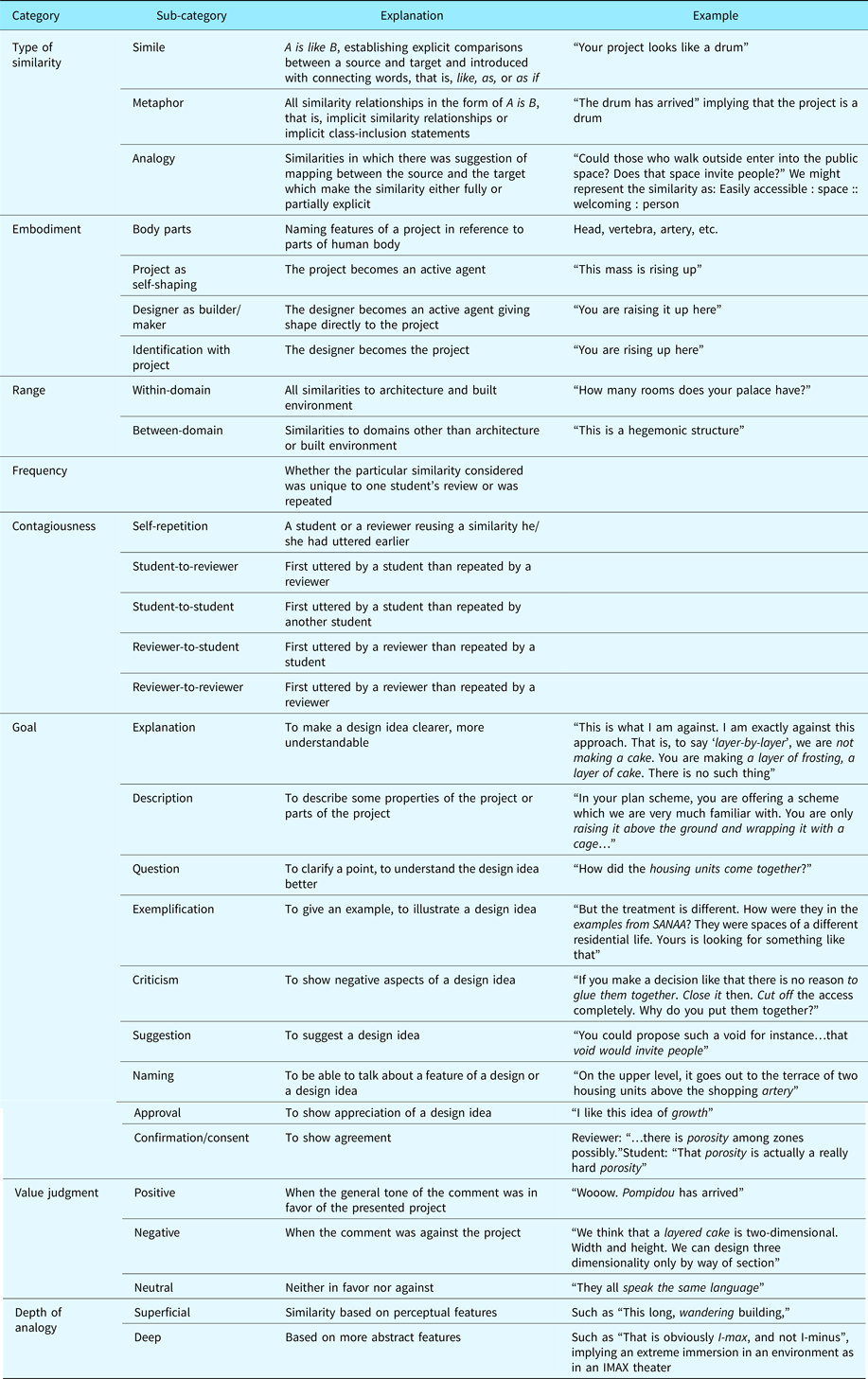
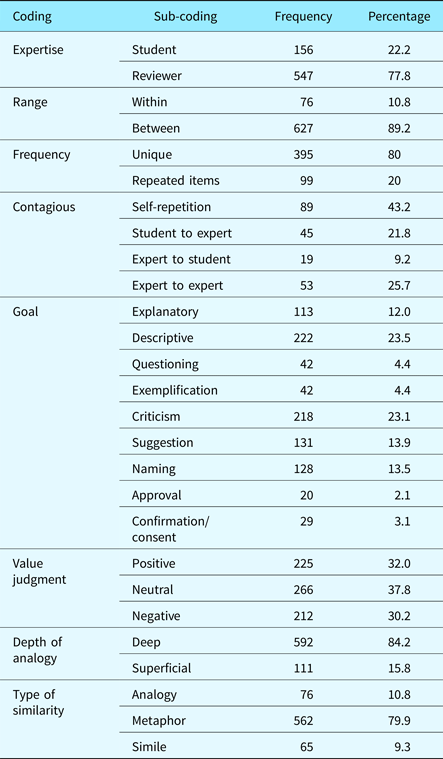
The recording was transcribed verbatim. In the first step of coding the three authors of the study identified each similarity. Only those which were considered to be similarities by all three authors were coded as similarity. In the second step, the authors coded the similarities in terms of the type of similarity, range, frequency, contagiousness, goal, value judgment, and depth of analogy (see Table 1). For this step, coding was conducted through discussions among the authors, and a simple majority was required for deciding the coding when there were disagreements. An independent coder who was given 10% of the data was asked to identify similarities within the data and code each similarity with the coding scheme given above. The independent coder, an architecture professor specialized in design studies, was given a detailed description of the coding categories together with transcriptions of three students’ reviews. We used the Delphi Method to determine the inter-rater agreement. In the first step after the second round of discussion, there was 66.67% agreement between the authors’ coding and that of the independent coder. In the second step, agreement on the type of similarities was determined using the Delphi Method. At the end of second round of discussions, there was 90.1% agreement.
Categories and sub-categories used for coding the reviews

Any statement which explicitly or implicitly indicated a similarity between two things, either in the form of A is like B, or A is B, or A : B :: C : D, was considered a similarity relationship. All similarity relationships in the form of A is like B, which established explicit comparisons between a source and target and which was introduced with connecting words, that is, like, as, or as if, were coded as similes (cf. Blanchette and Dunbar, Reference Blanchette and Dunbar2001; Hey et al., Reference Hey, Linsey, Agogino and Wood2008). We coded all similarity relationships in the form of A is B as metaphors (cf. Gentner and Bowdle, Reference Gentner and Bowdle2001; Bowdle and Gentner, Reference Bowdle and Gentner2005). Following Gibbs’ definition (Reference Gibbs, Wilson and Keil1999), we understand metaphors as implicit similarity relationships or implicit class-inclusion statements (Glucksberg, Reference Glucksberg, Wilson and Keil1999). In an implicit statement in the form of a metaphor, the similarity is implied yet becomes clearer in the context of the conversation. Similarity relationships were coded as analogies when there was some suggestion of mapping between the source and the target which make the similarity either fully or partially explicit. We considered partial, explicit mapping as a sufficient condition for deciding that a similarity was an analogy because within the natural flow of a design review it would not be realistic to expect fully explicit analogies. An explicit statement of similarity is one in which the analogy is further detailed in some respect, to explain the basis of the analogy.
The range category included two sub-categories. All similarities to architecture and built environment were considered within-domain, while all others were considered between-domain. Frequency refers to whether the particular similarity considered was unique to one student's review or was repeated. Repetitions were tallied. For the contagiousness category, each repeated similarity was coded as to whether it was a self-repetition, that is, a student or a reviewer reusing a similarity he/she had uttered earlier during the session, or a student-to-reviewer, student-to-student, reviewer-to-student, or reviewer-to-reviewer transfer.
For the goal category, we used nine sub-categories for coding. What was considered to be significant in this coding was the goal of the person making the similarity. This was determined based on the context of the similarity. The explanation category included those statements which were used in explaining a design idea, a design decision, or a design move, which is closer in meaning to what Gentner (Reference Gentner and Miall1982) calls explanatory analogies. Description comprised those statements which described the project or parts of the project and was closer to expressive analogies as they are defined by Gentner (Reference Gentner and Miall1982). Question consisted of question statements intended to clarify a point or better understand a design idea. Exemplification referred to statements which illustrated an idea with examples (see Stern, Reference Stern, Holyoak and Morrison2005). Criticism indicated a negative response to a design feature or design idea, whereas suggestion designated a way to solve a problem or to go about a design problem. Naming referred to statements that labeled a feature of a design or a project using a familiar, often evocative label. Approval suggested an appreciation of a design idea or move, and finally, confirmation and consent referred to an agreement with a previously stated idea, criticism, or suggestion.
We also coded the similarities according to whether they had a clear indication of the embodiment. This was an open coding which led to four major categories: body parts, project as a self-shaping agent, designer acting as a builder or maker, and identification of the designer with the project. In the last three, the similarity is established through the use of verbs, which is called predicative metaphor (Glucksberg, Reference Glucksberg, Wilson and Keil1999). The meaning of the verbs in such cases is figurative. Body parts is naming features of a project in reference to parts of human body. In project as a self-shaping agent, the project becomes an active agent. In designer as builder/maker the designer becomes an active agent giving shape directly to the project, like a sculptor giving shape to clay. In identification of the designer with the project, the designer becomes the project.
Following Blanchette and Dunbar (Reference Blanchette and Dunbar2000), we looked at the value judgment implied with each analogy – whether it had a positive, negative, or neutral tone. When the general tone of the comment was in favor of the presented project the analogy was coded as positive. When the comment was against the project, it was coded as negative, and if it was neither in favor nor against, it was coded as neutral. In the depth category, similarities were coded as superficial or deep, based on the level of similarity between the source and the target. When the similarity was based on perceptual features it was coded as superficial, and when it was based on more abstract features it was coded as deep.
Analysis
Analysis of the findings consists of both qualitative and quantitative analysis. The qualitative analysis presents the use of analogies, metaphors, and similes through illustrative examples from the reviews. The data from open-ended coding of statements of embodiment were analyzed through qualitative analysis. For the quantitative analysis, a Chi-square (χ 2) test was conducted between each pair of variables to determine significant relationships since all the variables in the study are categorical. When at least 20% of expected frequencies were less than five we conducted Fisher's exact test instead of the χ 2 test. A post hoc test comparing the standard residual values was conducted for each cell in the χ 2 cross-tabulation to the critical value (−1.96 and + 1.96), to determine the likely reasons of significance.
Qualitative analysis
We will review the qualitative data under the subheadings of metaphors, analogies, similes, the significance of goal in establishing similarities, and references to the embodiment in parallel to the research questions.
Metaphors
Reviewers and students used many similarities of different types but overwhelmingly used metaphors. We encountered examples in which buildings “break off”, “dismantle”, “speak”, “swim”, “kiss”, “have a dialog with”, and “walk away”. Sometimes architectural elements become “free,” as in “free walls, free people”, or the architecture is described as “having a language”, “being introverted”, “soulless”, or, as one reviewer stated, “Believe me, that courtyard would have been animated a lot more”. In one instance a student stated, “I needed to get higher in some places and lower in some other places”. Often, similarities were used to combine different concepts, as illustrated in the following examples: “crippled buildings”, “deaf walls”, “deaf surfaces”, “dead spaces”, “inviting space”, “spaces talking to each other”, “spaces embracing each other”, “spaces tied to each other”, “spaces looking at something”, “tying spaces together”. In these instances, metaphors enhance novel understanding, due to the juxtaposition of a source and a target domain, as introduced in the conceptual blending theory of metaphors (Fauconnier & Turner, Reference Fauconnier and Turner1998). In other instances metaphors give information about the quality and experience of spaces, such as “warm spaces”, “flowing spaces”, “ripped spaces”, or “spaces that embrace you”, by way of image-schemas in which one mental image is mapped onto another. Lakoff and Johnson (Reference Lakoff and Johnson1999) suggest that such image schemas facilitate automatic but rich inferences and are derived from bodily experiences.
In many cases metaphors enhanced and enriched the intended message and were further explained through a back-and-forth interaction. For instance, one student conceived of four different types of housing units based on their degree of exposure to public life, which he labeled “intersection’. He abbreviated “intersection” with an “I” and labeled his unit types “I-plus’, “I’, “I-visual’, and “I-minus’. Criticizing these unit types, reviewers questioned the nature of the “I-minus” unit type. One jokingly described it as being “totally asocial”, thus implicitly mapping the “minus” with “asocial” to make the similarity relationship more explicit. The student responded by describing how that unit type was the least connected with the public life because it was placed on a higher level, which further clarified the similarity. Another reviewer joined the discussion and called this unit type “IMAX’, using a second metaphor with a double meaning: first, describing a maximum interaction with its surroundings by extending and reversing the student's initial metaphor and, second, by referring to a type of movie theater which immerses the audience in the pictured scene. In this example, the reviewer's metaphor reversed the image-schema of student's initial metaphor. In the new image-schema advanced by the reviewer's metaphor the housing unit became an IMAX theater with heightened virtual sensory inputs in an isolated room.”
Similes
Within-domain sources were used significantly less when compared with between-domain sources by both reviewers and students. When within-domain sources were used they immediately invoked a specific positive example or negative example. At other times, within-domain, generic building types were mentioned in order to put the project into a particular category by way of similes. In one instance, after the student's introduction, a reviewer asked which building typology her project would belong to. Another reviewer answered that the project looked like “a factory” by using a simile. The student could not grasp the question and had a hard time placing her project into a category. The same reviewer changed his question by asking her what she would tell her friends she had designed. A third reviewer responded “a hospital”, while the first reviewer said “a prison”. Finally, the student said it is like a “business center”. All of these building types had pejorative connotations, and the student was thus led to question the quality of her project. This exchange shows also the fluidity between similarity in the form of categorization, as with metaphors, and in the form of comparison, as with similes. The similarity was first questioned by way of comparison, shifted into a categorization, and ended with another comparison. Later she was told that her project lacked critical features such as balconies, terraces and suitable window openings, features that one would normally associate with housing. She was told that because these were lacking in her project it either looked like a factory, a business center, or became a hospital, or a prison.
Analogies
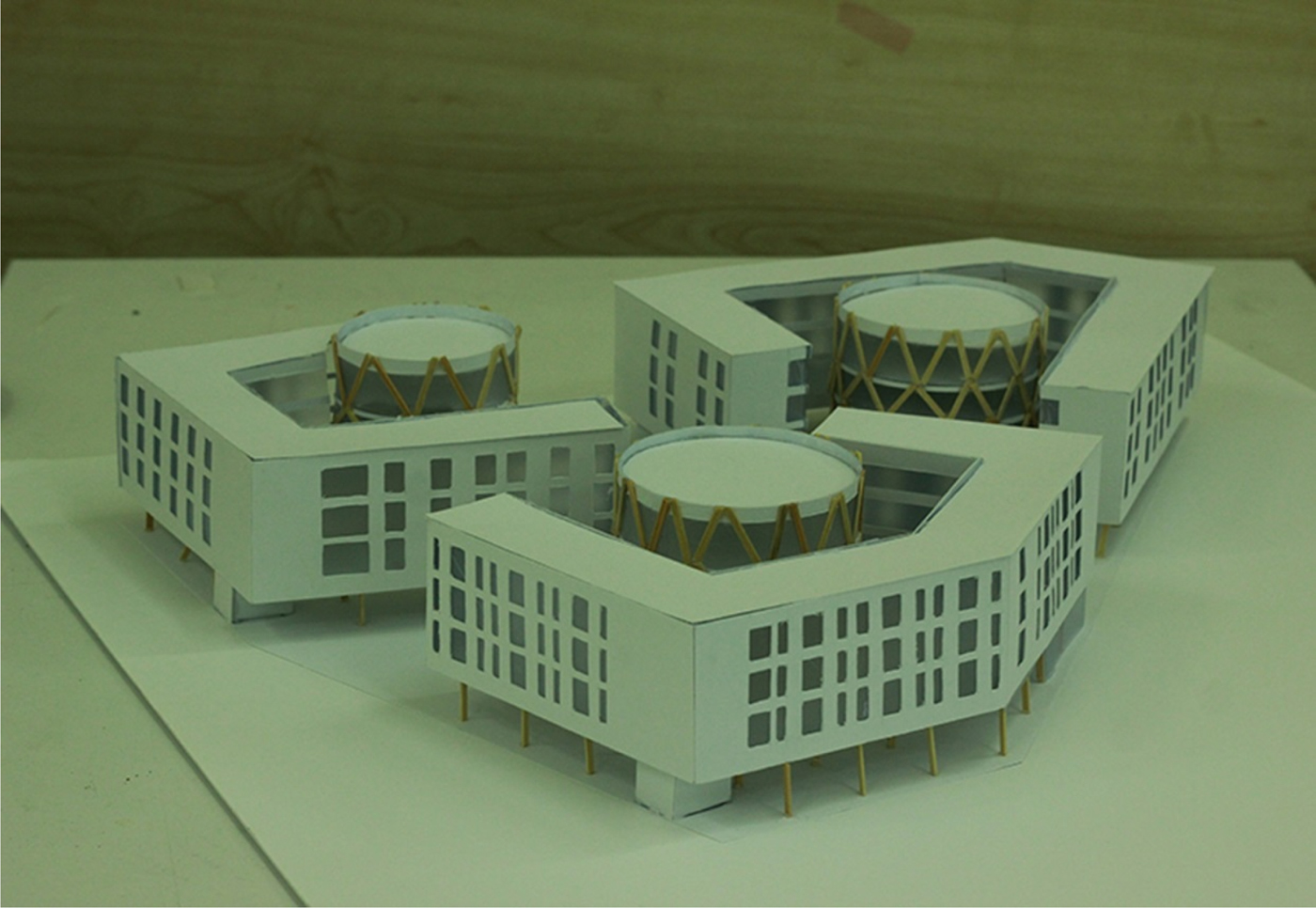
Often similarities were passed from reviewers to students, or the other way around, and set the tone of the review. Sometimes a negative similarity, such as a project “with deaf surfaces” (Fig. 1) or “drum” (Fig. 2), dominated the whole review and was repeated again and again or invoked aversion, even though it was used only once, as in the case of “tasteless spaces”. In one instance, a reviewer who was being critical led the discussion toward a negative analogy by questioning why the student's project was conceived in independent layers stacked on top of each other. The question was followed by an analogy that compared the sectional organization of the project to a layered cake. The layered cake analogy was repeated 11 times after its first utterance – seven times by the reviewer himself, two times by another reviewer, and once by the student herself. In total 29 similarities were used during that review; almost one-third was a repetition of that one analogy. The reviewer began the criticism as follows: “This is what I am against. I am exactly against this approach. That is, to say ‘layer-by-layer’, we are not making a cake. You are making a layer of frosting, a layer of cake. There is no such thing.” The reviewer is primarily critical of the lack of connections between different levels. He continued, “That is to say, we should not think with the layer-by-layer logic. You can put the program in this. Or the publicness. Whatever you put in. When you describe the project, however, ‘I made this on this layer, and I put this on the top layer’. This is exactly a cake recipe.” The student responded that she had separated the functions intentionally. The reviewer restated his criticism that he was against separation into horizontal layers and clarified the analogy by way of making the similarity more explicit. He suggested it would be possible to think of vertical layers instead. Moving his hands up and down, he asked “Why aren't we separating it like this?” The up and down movement explained what he meant. The student adopted the analogy but failed to see how vertical layers could improve her project. She simply stated that she had preferred to use horizontal layers. The reviewer repeated the cake analogy twice more. He finally added, “…this doesn't give you good sections, a good massing composition, because you are thinking in layers.” A second reviewer suggested that one could “mix up” things. The first reviewer agreed that mixing would bring richness to the section. He said that one could solve the problem layer-by-layer, but this would be a simplistic approach. He concluded with “This is why the cake example is given. Did I make myself clear?” The second reviewer then tried to explain that the cake analogy suggests two-dimensional schemes without spatial richness. In this instance, the analogy is made more and more explicit throughout the review to foster communication and understanding. There is some evidence that the cake analogy has become a part of architectural discourse across different cultures and is used negatively. Caballero (Reference Caballero2003) documents the use of a similar metaphor, namely “stacking the building blocks wedding cake-style”, as opposed to a more complex approach in which masses are “chamfered”, “pinched”, “skewed”, or “sloped”.
A student's rendering, showing surfaces with few openings that were called “deaf” by some reviewers.

A student's model showing cylindrical masses which were called “drums” by one reviewer.

Goal and value judgment
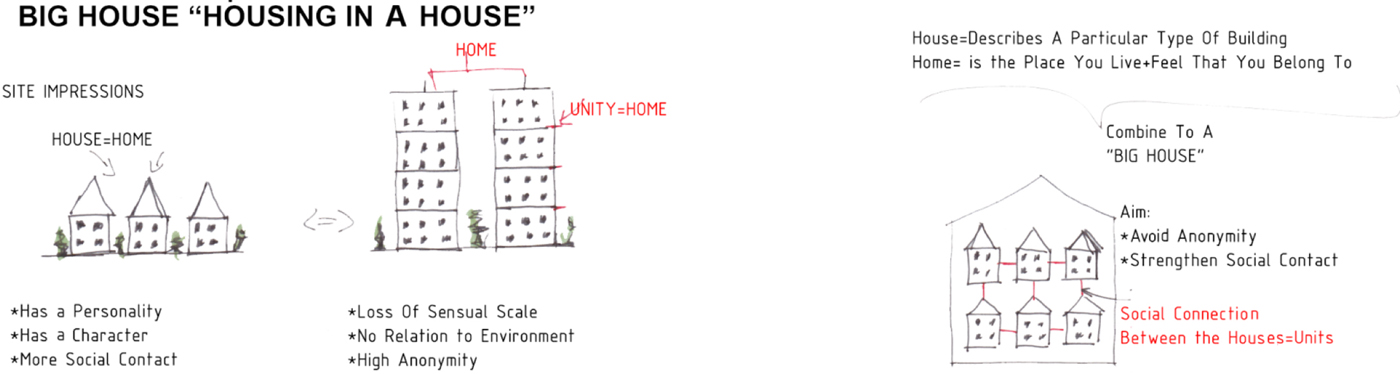
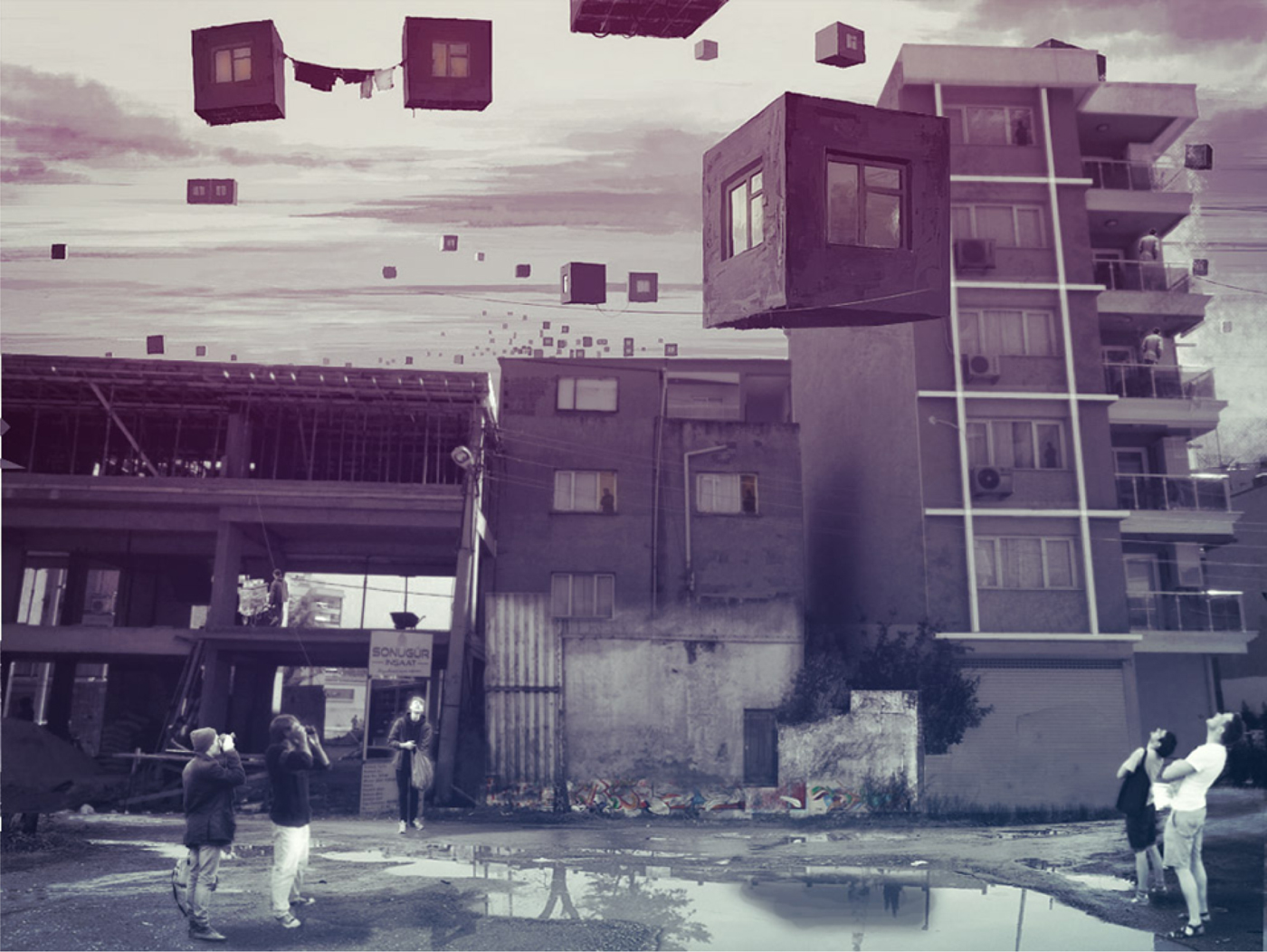
In cases where the design idea was based on a similarity, students presented the similarities, often in the form of analogies, while explaining their design rationale and design process. In these cases, the analogy acquires a double function – it is both innovative, that is, used as a starting point in the process, and explanatory. In one instance a student decided to design “a big house” (Fig. 3), intending to create the atmosphere of a single house, although it was a large housing project. During his review, he began to explain his design, both verbally and visually, in reference to this analogy describing how he imagined the conglomeration of units to be a big house. In another instance, a student based his design on criticism of “how people are jammed into boxes” in contemporary housing projects (Fig. 4). He proposed a scheme that would “unpack the box”. In his review, he presented a slide show illustrating how he saw the current condition, what problems it creates, and what he offered in response, using his “box” analogy.
A student's conceptual diagrams illustrating his idea of many houses within a single “big house”.

A student's college suggesting that people are jammed into boxes in new apartment buildings.

In some instances, the opening of a review was marked by a positive comment from a reviewer to show approval, which may have set the tone of the review. In one instance, a project which used an exoskeleton together with plug-in units was called “Pompidou,” referring to the Centre Pompidou in Paris (a pioneering project from the early seventies). This comment was made just as the model was placed in front of the panel before the student began his presentation. Sometimes, using a pejorative similarity directly indicated a criticism. In one such example, a student proposed a sunken plaza. One reviewer called the sunken plaza “a pit”, because it was not surrounded by adequate public functions. Another reviewer described it first as “a sink” and later as “a basement”.
Embodiment
In some instances, we observed that students and reviewers alike named features of projects using the names of body parts. In other instances, either the project became an active agent, the designer became an active agent, or the designer became the project. In the first instance, the project acquired attributes of a living creature, often human, such as “this [building mass] is rising up”. Masses or spaces were described as “flying”, or “biting”, implying a connection with adjacent spaces or spaces or program items “feed each other”, “kill”, or “animate” each other. In the second instance, the designer became someone who built the model or the building itself, such as “You are raising this mass above these legs”, and the student was encouraged to imagine him/herself making models or actually building the project on a site. In the third instance, the designer was identified with the building (“You are rising here”), or morphed into the project and enacted “movements” implied in the project with his/her body.
Quantitative analysis
We will summarize first the quantitative results under the headings of frequency of similarities, expertise, type of similarities, embodiment, and goal, followed by a discussion about each of these headings.
Results
Student presentations took approximately one-seventh of the total review time per student (mean length of student presentations = 2 min 32 s; SD = 1 min 34 s), while the open-forum took most of the review time (mean length of reviewers’ responses = 12 min 30 s; SD = 6 min 26 s). During the whole review, students on average talked less than one-third of the total time (mean percentage of word count spoken by students per review = 30.9; SD = 9.9), whereas the average percentage time per contributing reviewer was little more than one-tenth of the total time (mean percentage of word count spoken by one reviewer per review = 11.3; SD = 3.70). On average, about six reviewers contributed to each student's review (mean number of reviewers contributing per review = 6.6; SD = 1.93).
Frequency of similarities
There were in total 703 segments of similarity (M = 21 similarity segments per student review, SD = 11). 22.2% of all similarities (n = 156) were generated by students (M = 4.73 similarity segments per student session, SD = 4.88), and 77.8% (n = 547) were generated by reviewers (M = 2.62 similarity segments per student review, SD = 1.44). To calculate the average number of similarities per reviewer we divided the total number of similarities uttered by reviewers by the total number of reviewers who made a comment during each student's review session. The standard deviation for students is higher than the mean because there is a wide range in the number of similarities the students evoked. While three students out of 33 evoked no similarities and six students evoked only one, five students evoked more than 10 similarities. For students, there was one similarity within 173.6 words (SD = 141.7) on average while for reviewers the number was 96.0 words for every similarity (SD = 81.8), which suggests that reviewers were almost twice as likely to evoke similarities when compared with students.
80% of all similarities were in the form of metaphors (n = 562), while 11% were analogies (n = 76), and 9% similes (n = 65).
Expertise
Reviewers evoked 440 metaphors, 48 analogies, and 59 similarities in total, while students evoked 122 metaphors, 28 analogies, and six similarities. A similar distribution of analogies, metaphors, and similes is found both in students’ results (14% analogies, 82% metaphors, and 4% similes) and in reviewers’ results (7.2% analogies, 88.9% metaphors, and 3.85% similes).
Expertise has a significant relationship to frequency, value judgment, goal, and type of similarity. Students were more likely to use analogies (std. residual = 2.71) and less likely to use similes (std. residual = −2.22). Students were slightly more likely to repeat similarities (std. residual = 1.84), were more likely to be neutral (std. residual = 2.6), and less likely to be negative (std. residual = −3.8). Reviewers, on the other hand, were more likely to be negative in their comments (std. residual = 2.03).
Type of similarities
There is a significant relationship between the type of similarity and range in the whole group of participants [χ2 (2, N = 703) = 48.16, p = 0.0001, p < 0.05]. Analogies (std. residual = 2.72) and similes (std. residual = 5.27) were more likely to be within-domain similarities and less likely to be metaphors (std. residual = −2.79). When students’ and reviewers’ results were analyzed separately, we found significant relationships between type of similarity and range in students ((N = 159) p = 0.000017, Fisher's exact test) and reviewers [χ 2 (2, N = 543) = 30.04, p = 0.0001, p < 0.05]. Students’ within-domain similarities were more likely to be analogies (std. residual = 3.76) and similes (std. residual = 2.46) and less likely to be metaphors (std. residual = −2.28). Reviewers’ within-domain similarities were more likely to be similes (std. residual = 4.49).
There is a significant relationship between the type of similarity and value judgment as well [χ 2 (4, N = 703) = 55.33, p = 0.0001, p < 0.05], analogies were more likely to be positive (std. residual = 2.57) and less likely to be neutral (std. residual = −2.75), while similes were more likely to be negative (std. residual = 4.83) and less likely to be neutral (std. residual = −2.74). When students’ and reviewers’ results were analyzed separately, there is a significant relationship between type of similarity and value judgment in students ((N = 159) p = 0.00045, Fisher's exact test) and reviewers [χ 2 (4, N = 543) = 37.16, p = 0.0001, p < 0.05]. Students’ similes were more likely to be negative (std. residual = 2.29), and their analogies were more likely to be positive (std. residual = 2.03). Reviewers’ similes were more likely to be negative (std. residual = 3.89), and their analogies and similes were less likely to be neutral (std. residual = −2.34 and std. residual = −2.07, respectively).
We found a significant relationship between the type of similarity and depth of similarity [χ 2 (2, N = 703) = 28.87, p = 0.0001, p < 0.05]. Similes were more likely to have a superficial similarity (std. residual = 4.96) and less likely to have deep similarities (std. residual = −1.99). When students’ and reviewers’ results were analyzed separately, we found no significant relationship between students, but results indicate a significant relation among reviewers [χ 2 (2, N = 543) = 32.2, p = 0.0001, p < 0.05], in that reviewers’ similes were more likely to be superficial (std. residual = 4.81) and less likely to be deep (std. residual = −2.16).
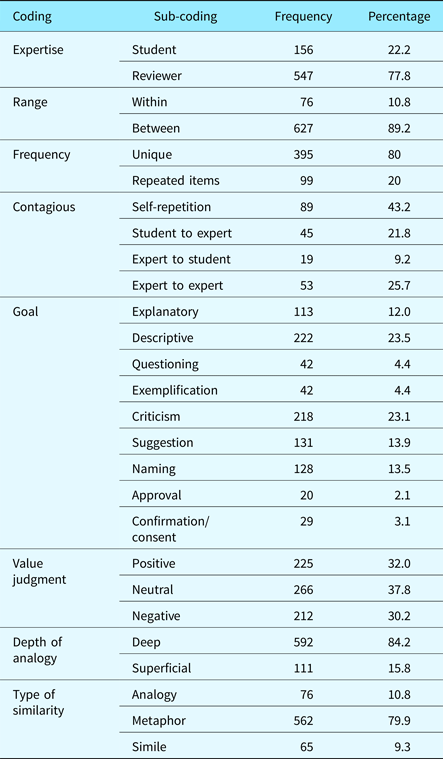
The rest of the results from the descriptive statistics are given below (Table 2). Table 2 gives the frequencies and percentages of each coding category.
The frequencies (the total count of cases for each category) and percentages of each coding category
Embodiment
We tallied similarities related to the embodiment. In total, there were 293 similarities (41.68% of all similarities) implying embodiment. There were 35 similarities to body parts (4.98%), 20 similarities in which the designer was identified with the project (2.84%), 137 similarities in which the project became a self-shaping agent (19.49%), and 101 similarities in which the designer was described as a builder/maker (14.37%). The vast majority of similarities evoking embodiment were metaphors (87.6%). Analogies (8.5%) and similes (3.9%) were rare. Two hundred and eight of all similarities evoking embodiment were uttered by reviewers; the count for students was 50.
Goal
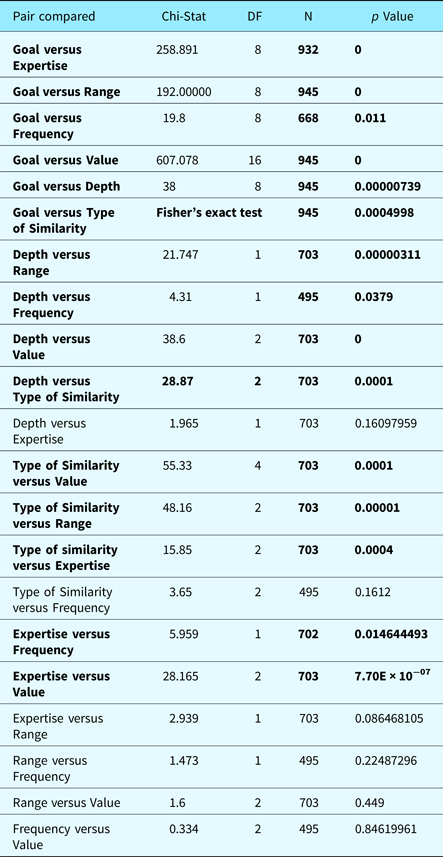
We tested each pair of variables using (χ 2) analyses (except the contagious variable, since it is a subset of frequency) to identify significant relationships (Table 3), but primarily to investigate the relative significance of goal in similarity making. 14 out of 21 χ 2 tests returned significant relationships. Goal has a significant relationship with each of the other six variables. Type of similarity and depth have a significant relationship with five variables. Expertise and value judgment have significant relation with four variables. Frequency and range variables have significant relationships with three variables. Here we summarize the results for the variable goal.
Chi-square analyses’ results of pairs of variables

The significant relationships are those that are bolded.
The goal variable has a significant relation to all of the other variables. The first significant relation is between expertise and goal, with results from reviewers and students almost diametrically opposed to each other. Reviewers were more likely to criticize (std. residual = 2.9), while students were less likely to criticize (std. residual = −5.73). Reviewers were more likely to make suggestions (std. residual = 2.57), and students were less likely to make suggestions (std. residual = −5.11). Reviewers were less likely to explain (std. residual = −5.15), while students were more likely to be explanatory (std. residual = 10.2). Furthermore, students were more likely to be confirmatory (std. residual = 4.2) and descriptive (std. residual = 2.04).
We found a significant relationship between goal and range. When the goal was exemplification less between-domain sources (std. residual = −5) and more within-domain sources (std. residual = 12) were used. When the goal was description participants were less likely to use within-domain sources (std. residual = −2.3).
There is a significant relationship between goal and frequency; however, a post hoc test comparing the standard residual values did not reveal any significant residual value to identify which one of the cells contributes most to the value.
With regard to the relationship between goal and value, when the goal was criticism participants were less likely to use neutral analogies (std. residual = −7.4) or positive analogies (std. residual = −5.6). When the goal was making suggestions more positive analogies (std. residual = 9.5) and less negative analogies (std. residual = −5.6) were used. When the goal was naming a feature of a project more neutral analogies (std. residual = 9.2) were used.
With regard to the relationship between goal and depth, we found that when participants were naming a feature of a design project they used more superficial analogies (std. residual = 2.7).
Finally, there is a significant relationship between goal and type of similarity. When the goal was explanation, analogies were more likely to be used (std. residual = 3.9); when the goal was exemplification, analogies (std. residual = 2.53) and similes (std. residual = 3.26) were more common and metaphors were less common (std. residual = −2.11). When the goal was suggestion and naming, similes were less likely to be used (std. residual = −2.0 and −3.33, respectively).
Discussion
We will discuss the findings in relation to the four research questions introduced in the introduction: the impact of studying similarities in vivo setting, the type of similarities used by reviewers and students, the significance of the goal variable in evoking similarities, and, finally, the role of embodiment in the similarities, especially metaphors, used during the review.
In vivo setting and expertise
We asked whether the natural setting in which participants were producing similarities could have an impact on their use of similarities. We found that both students and reviewers were using similarities, especially in the form of metaphors, frequently and without any effort. Reviewers, however, were using similarities twice more frequently than students looking at word counts per analogy. Hey et al. (Reference Hey, Linsey, Agogino and Wood2008) also found that students spontaneously use analogies and metaphors, while Caballero (Reference Caballero2003) identified many metaphors in architectural building reviews underlying the prevalence of metaphors in professional architectural practice.
In vivo design studies (Christensen & Schunn, Reference Christensen and Schunn2007; Ball & Christensen, Reference Ball and Christensen2009; Kalogerakis et al., Reference Kalogerakis, Lüthje and Herstatt2010) found that analogies are frequently used by experts. These studies investigated experts’ use of analogies in vivo setting, while novices’ use of analogies is primarily investigated only in vitro settings (Casakin & Goldschmidt, Reference Casakin and Goldschmidt1999; Ball et al., Reference Ball, Ormerod and Morley2004; Bonnardel & Marmèche, Reference Bonnardel and Marmèche2004; Casakin, Reference Casakin2004, Reference Casakin2010; Ozkan & Dogan, Reference Ozkan and Dogan2013). In our study, students were frequently using similarities, especially metaphors, between-domain source analogs, and focusing on structural similarities.
Students, in comparison to reviewers, were more prone to use analogies as they were trying to make sure that they were clearly explaining their design rationale, since analogies made relationships between a source and a target explicit, when compared with similes and metaphors (see Gentner et al., Reference Gentner, Bowdle, Wolff, Boronat, Gentner, Holyoak and Kokinov2001). The students were, however, not as likely to use similes.
There were no differences between students and reviewers considering the range and depth of similarities. Both reviewers and students retrieved primarily between-domain sources and used structural similarities rather than superficial similarities. One possible explanation could be that when people generate similarities on their own rather than receiving them they are more likely to retrieve deep similarities regardless of their level of expertise. Dunbar (Reference Dunbar, Gentner, Holyoak and Kokinov2001) highlights that research in analogy has repeatedly underlined the importance of structural similarities, while the research findings have shown again and again that “without extensive training, examples, or hints, people will be much more likely to use superficial features than deep structural features when using analogies” (p. 313). In natural settings, people tend to use analogies successfully and constantly without being prompted to do so (Dunbar & Blanchette, Reference Dunbar and Blanchette2001). This is what Dunbar (Reference Dunbar, Gentner, Holyoak and Kokinov2001) calls “analogical paradox” (p. 313), implying that when people have to generate analogies they tend to focus on structural features, whereas when they are trying to select analogies from a given number of potential source analogs superficial features tend to outweigh the selection process. Dunbar calls the former the generation paradigm and the latter the reception paradigm. In the generation paradigm, there is a joint interaction between retrieval and encoding. In our study, novice and expert participants alike naturally generated similarities and retrieved source analogs which were meaningful to themselves and to their audience.
Another explanation for no difference between experts and novices in attending structural versus superficial similarities is offered by Vosniadou (Reference Vosniadou, Vosniadou and Ortony1989), who states that what people look at in analogy is saliency, that is, the easily accessible similarities between a source and a target with regard to their knowledge base, rather than structural or superficial similarity. The natural conclusion is that novices and experts are equally able to focus on structural features while retrieving sources, as long as they are available and prioritized in participants’ mental representations. This does not imply that there are no differences between expert and novices, especially in terms of how analogies are adapted to new situations during the design process. The procedural knowledge acquired with expertise would result in significant differences in the way analogies are used in the design process (see Ozkan and Dogan, Reference Ozkan and Dogan2013) and increase in domain knowledge could lead to retrieval of more within-domain examples (see Dunbar, Reference Dunbar, Ward, Smith and Vaid1997). Similarly, Casakin (Reference Casakin2011) found that novice students had no difficulty in using metaphors in the conceptual phase of design, but in later stages of design, they were more challenged when they were required to not only retrieve source analogs but also do mapping, transfer, and adaptation of relevant features.
Type of similarity
Students and reviewers overwhelmingly used metaphors when evoking a similarity. As stated above, Casakin (Reference Casakin2011) did not observe any difficulty on the part of novice and expert students to benefit from metaphors. Our findings and Casakin's (Reference Casakin2011) could relate to the significance of primary metaphors for cognition in general. There were no hints, tweaking with representations, nor instructions to get participants to use similarities, nor were the participants discouraged from using similarities. Interestingly, most similarities were between-domain, which were also more likely to be implicit, that is, metaphors, while within-domain similarities were more explicit, that is, analogies. This could suggest that between-domain similarities were mainly derived from common conceptual domains which are constituted by primary metaphors, as suggested by Lakoff and Johnson (Reference Lakoff and Johnson1999), rather than by architectural knowledge. In both instances, the metaphors invoke image-schemas (see Lakoff, Reference Lakoff and Ortony1993) that are multi-modal mental representations. Image-schemas could be in the form of various modalities, such as verbal, visual, spatial, and auditory, rather than being only in one modality and they help designers make richer and multiple inferences automatically by referring to primary experiences.
In our study, students and reviewers both primarily used between-domain sources. In contrast, Dunbar (Reference Dunbar, Ward, Smith and Vaid1997) found that the range of analogies used by biologists differs according to their goals and that when scientists collaborate they use almost exclusively within-domain analogies, whereas when they explain new concepts to the general public they use more between-domain analogies because shared knowledge will help the public understand. One alternative explanation for our findings, consequently, could be that novices lacking enough domain-specific knowledge fall back on source analogs derived from general knowledge and thus retrieve more between-domain analogs. The experts in our study may have used more between-domain analogies because they were addressing an audience of lower expertise. Caballero (Reference Caballero2003) points out the necessity of a shared body of discipline-related knowledge in interpreting metaphors correctly. Students, who are not expert yet, may revert to between-domain analogies rooted in domain-general knowledge.
Students were more likely to use analogies, as they were in the position of persuading the reviewers and explaining their design rationale. Reviewers were more likely to use metaphors, suggesting that they were more interested in expressing their likes and dislikes. This agrees with the proposal that goals are of primary importance in analogical reasoning, which we will explain below.
One question that needs to be discussed is why both reviewers and students prefer to use metaphors over similes or analogies. Analogies, as defined in this study, require an explicit mapping between a source and a target which may not be always possible in the heated discussions of a review. The more interesting question is why metaphors are more common than similes. One potential answer is provided by the view which regards metaphors as direct category inclusion statements as opposed to comparisons such as similes (Glucksberg & Keysar, Reference Glucksberg and Keysar1990; Glucksberg, Reference Glucksberg, Wilson and Keil1999; Glucksberg & McGlone, Reference Glucksberg and McGlone2001). Direct categorization is less demanding in terms of the cognitive load it requires from the listener (Glucksberg & McGlone, Reference Glucksberg and McGlone2001). Glucksberg (Reference Glucksberg, Wilson and Keil1999) suggests that similes are more difficult to understand because they force listeners to identify the exact level of similarity between two categories, whereas with metaphors both the source and target are members of a common abstract category.
Metaphors used during the review were quick, without detail and without explicit mapping. Analogies were partially explicit and often became more explicit through a back-and-forth discussion. Their use, by both students and reviewers, was short but clear and was understandable by all parties. One indication that similarities were clear to the listeners was that they were contagious. They were repeated again and again, showing both confirmation and mutual understanding. In most cases, the similarities were between-domain and deep. Even in those cases when similarities were between-domain and deep they were easily understood without further clarification and explicit mappings. Further clarification and details may not have been necessary because of the rich context within which each review was conducted. Each similarity was linked to a specific feature or aspect of a design project as represented through verbal descriptions, drawings, and physical models. The rich set of representations in different formats provided abundant, complementary, and sometimes redundant information within the context. Participants pointed directly to features or aspect of a design project while they were using similarities. More interestingly, similarities were repeatedly accompanied by gestures that illustrated the intended meaning. It is possible that gestures were used to make the mapping explicit. Compared to verbal explanations, gestures are quicker (see Visser and Maher, Reference Visser and Maher2011), primary (and therefore easier to grasp), and they allow a more efficient communication.
Goal
One finding of the study is that the goal of the reasoner is the strongest indicator of the nature of similarities, that is, in terms of the producer of analogy, its range, frequency, emotional content, depth, and type. The primacy of goals in analogical reasoning is well established by Holyoak and Thagard (Holyoak, Reference Holyoak and Gordon1985; Holyoak & Thagard, Reference Holyoak and Thagard1989, Reference Holyoak and Thagard1997). In scientific reasoning, Dunbar (Reference Dunbar, Ward, Smith and Vaid1997) showed that scientists’ use of analogy changes in relation to goals.
In a design review, presenting students and their reviewers assume specific goals and positions in advance (see Webster, Reference Webster2007). Students were asked to explain their design schemes, justify their design decisions, and persuade the reviewers. Reviewers were experts expected to make suggestions and criticize or approve the quality of students’ works. In the study, students were more likely to be explanatory and confirmatory, avoiding any confrontation with the reviewers. Reviewers were more critical and made more suggestions, yet were less likely to be explanatory. This may be because reviewers wanted to express their positive or negative opinions as quickly as possible because there were multiple reviewers making comments on every project.
In our study, we found that when the goal was either to describe or make suggestions, between-domain sources were more likely to be used, whereas when the goal was exemplification, within-domain sources were more likely to be used. Christensen and Schunn (Reference Christensen and Schunn2007) found that explanatory analogies are more linked to between-domain sources, problem-solving is associated with both within-domain and between-domain sources, and problem identification is primarily associated with within-domain analogies. Ball and Christensen (Reference Ball and Christensen2009) found that in a brainstorming meeting in which designers are encouraged to aim for originality, between-domain source analogs were more likely to be used. One conclusion we derive from these studies is that the distance between source and target could be more a factor of the designer's specific goal at that particular moment. The study of Ozkan and Dogan (Reference Ozkan and Dogan2013) also provides results that support the underlying primacy of goals in the process of selecting a source analog.
During the design review, the roles of the participants impacted the emotional content of the similarities used. Students were generally more positive and reviewers were more negative. Blanchette and Dunbar (Reference Blanchette and Dunbar2001) found a similar relation between the goal of politicians and the emotional value of the analogies used, suggesting that politicians with a critical view tend to use negative analogies and those with a supportive view use positive analogies. Similarly, in our study, when the goal was criticism, negative similarities were more likely to be used, and when similarities accompanied suggestions the similarities were positive.
Embodiment
In agreement with Lakoff and Johnson (Reference Lakoff and Johnson1999), who suggest that abstract concepts are derivatives of primary metaphors, this study underlines the common and basic ability to benefit from similarities, especially metaphors. For instance, when we say we “grasp” an idea, the metaphor of grasping implies understanding through getting a hold of something. We acquire these primary metaphors through bodily experience, and the metaphors constitute the basis of our conceptual thinking (Lakoff & Johnson, Reference Lakoff and Johnson1999). Throughout the review, we saw both reviewers and students referring to bodily experience or using gestures to describe features of a project. In all of these examples, the understanding was facilitated through metaphors relating to bodily experiences, emphasizing the importance of embodiment in imagining and thinking about space. In instances when embodiment was evoked the metaphor helped simulate a design action, a building action, or a bodily action, as expressed through predicative metaphors. In her account of building reviews, Caballero (Reference Caballero2003) documents many biological metaphors that could be labeled BUILDINGS ARE LIVING ORGANISIMS. In her study, as in ours, there are many instances of metaphors that evoke human beings through personification, that highlight architecture's social dimension, or that use body parts. Similar to our findings, Caballero (Reference Caballero2003) identifies many instances in which buildings perform actions, such as “step’, “crouch’, “hug’, “meander’, and which she calls FORM IS MOTION metaphor.”
Analogy, imagery, and simulation are interactive in these examples, similar to creative model-based reasoning in science, as documented by Nersessian (Reference Nersessian2008). When the designer becomes an active agent she performs either acts related to building, designing, or using a space. In each of these instances designing becomes a simulative act during which the designer's actions are performative, as seen in comments such as “You could have wrapped all the housing units; whenever needed, you could have inflated the housing units towards the inside.” Sometimes these simulative acts were accompanied by gestures which perform actions, or by hand gestures drawing imaginary lines, to heighten the sense of enactment. Imaginary lines were sometimes drawn in the air or on models or drawings. Caballero (Reference Caballero2003) suggests that in examples in which the designer is acting as a builder or maker, the conceptual metaphor of BUILDINGS ARE MALLEABLE ENTITIES is instantiated, in that buildings are thought of as raw materials to be shaped.
Conclusion
The study shows the spontaneous and pervasive use of similarities, especially metaphors, in a review of projects in an undergraduate architectural studio. Similarities were effective in shaping the interaction and communication between students and reviewers. The results show that figurative devices, especially metaphors, are effective in thinking and communicating about space. In establishing similarities, the speaker highlights new ways of thinking about a design situation which is easily communicated to and shared with the listeners. From the design learning perspective, the use of similarities performs two simultaneous functions; they are both communicative devices as well as creative devices. Similarities enable students to communicate design intentions and in-turn to understand responses from design instructors. In addition, especially metaphors foster creativity by way of establishing novel connections between source and target domains.
Studying the use of similarities in such an in vivo setting was important to understand the nature and frequency of similarities used in such reviews. Similarities were common among students and reviewers and did not require lengthy explanations to be understood. The rich context of the design review provides abundant information, making lengthy explanations unnecessary. In most instances, the invoked similarities were metaphors derived from primary metaphors. This was one of the main reasons why they were frequent and easily understandable. Students and reviewers alike overwhelmingly used metaphors. Compared with the reviewers, students were more likely to use analogies and less likely to use similes.
The specific context of the review imposed particular roles on reviewers and students; this had a significant impact on the specific goals of both parties. Within the asymmetrical power structure of review sessions, students assumed a more passive, confirmatory, positive, and explanatory role, while reviewers assumed a more dominant, critical, negative, and suggestive role. The goal for students during a design review is foremost to persuade others of the success of their design scheme, while for reviewers it is to provide criticism and suggestions. The goal variable in the study is the most significant factor that determines the type of similarity used.
The assumed specific goals had a significant relation to expertise, range, value, depth, type, and frequency of the similarities used. When participants made suggestions and gave explanations their similarities were more likely to be deep and explicit. When they were naming features of a project they were more likely to be superficial and implicit. Most of the similarities used were between-domain and were in the form of metaphors; this supports those views which suggest that analogies and metaphors are common and are the basis of our conceptual and abstract thinking.
Finally, the study highlights the importance of embodiment in thinking about design and space. The embodied knowledge that students bring to their design education has a significant role in the kind of similarities they evoke and in the way they communicate with experts.
Our conclusions are limited to the particularities of an undergraduate architectural design studio review and can only provide partial insights into the use of similarities in the design process. We did not look into the creative implications of the analogies used. The review was not followed by further design work, so it was not possible to observe the impact of the similarities used during the reviews on the development of students’ projects. We can assume, however, that students and reviewers use similar design language during desk critiques throughout the course term and benefit from similar metaphors, analogies, and similes (see Coyne and Snodgrass, Reference Coyne and Snodgrass1991; Dogan, Reference Dogan2013). Furthermore, we did not conduct interviews with the reviewers and students after the review sessions to clarify their intentions. Such interviews might have provided further insight into the perceived goals of the participants and how they responded to specific similarities. Furthermore, the study is restricted to one school of architecture. It is possible that in other schools and in other cultures the use of similarity might be different and one may not find similar results (see Hey et al., Reference Hey, Linsey, Agogino and Wood2008).
In future studies, it would be possible to ask participants about their specific intentions and the content of their similarity. Another study could inquire into the relationship between asymmetrical relations in design reviews between students and reviewers by specifically asking students to be more active rather submissive during the reviews to see how and whether students’ and reviewers’ use of similarity would change. Students’ active involvement in the reviews could be encouraged, to see whether these asymmetrical relations would hold true and to see whether their use of similarity would change. The specific format of the review could have a strong impact on the results of this study. It would be possible to investigate the use of similarities in different review formats, such as closed reviews, in which students are not present, panel discussions, or exhibition reviews. It would also be possible to study their use in mid-term reviews and how the similarities that occur are pursued in the subsequent design process.
There are specific implications of the study for rethinking design reviews and the role of analogical reasoning and metaphors in design education. Given the pervasiveness and ease of the use of analogies, metaphors, and primarily distant analogies, instructors might take more advantage of the full potential of analogical reasoning and metaphors in design education. Beginning design education students come equipped with an ability to think through analogies and metaphors. The studio needs to build upon this primary ability in facilitating the creative design process and effective communication among the various actors. Design instructors should benefit from metaphors in expressing their ideas not just for purposes of enriching the design language but primarily to foster the design thinking. Analogies should be used to make similarities explicit and adaptable to new situations. Students, in turn, need to be encouraged to use metaphors and analogies to help them be creative while learning how to design and better communicate themselves. Others have proposed effective strategies of introducing analogical reasoning and metaphors in design education also. One strategy that provoked students to use metaphors was to ask them to inquire what their project wanted to be in reference to Louis I. Kahn's famous line (Dogan, Reference Dogan2013). Another could be to ask them to give a name to their projects. A more developed design teaching model is introduced by Coyne et al. (Reference Coyne, Snodgrass and Martin1994), who suggest that understanding and reflecting upon our metaphors could help students overcome their preconceptions especially when they are fixated while also getting familiar with a hermeneutical thinking style throughout the design process by way of highlighting inherent oppositions within metaphors. Finally, Casakin (Reference Casakin2011) had shown that novice and advanced students alike benefit from metaphors in the early stages of design, therefore, exposure to potentially useful sources in the early phases would help design learning. In the later phases of design, advanced students were more likely to benefit from metaphors (Casakin, Reference Casakin2011); therefore, helping students with understanding successful ways of identifying relevant similarities, transferring and adapting them to a new situation would be influential.
Acknowledgment
We would like to thank Virginia T. Couch, and the anonymous reviewers who made valuable contributions during different phases of this study.
Fehmi Dogan is an Associate Professor of Architecture at the Izmir Institute of Technology. He is interested in design cognition and design learning. For his doctoral thesis, he conducted archival case studies investigating the role of conceptual diagrams in the design process of master architects. Currently, he conducts research on design learning and the use of analogy by expert and novice designers. He has published in journals such as Journal of Architectural Education, Journal of Learning Sciences, Journal of Environmental Psychology, Design Journal, arq: Architectural Research Quarterly, and Design Studies.
Batuhan Taneri is a Research Assistant in the Department of Architecture at the Izmir Institute of Technology. He is interested in design learning and computational design. For his master thesis, he conducted a research investigating how architecture students” conceptions of design change throughout their education. Currently, he investigates pedagogical uses of computational formalisms in design education and their effects on design learning for his doctoral study.
Livanur Erbil Altintas is a Research Assistant and PhD student at the Izmir Institute of Technology. She is interested in design collaboration. For her master thesis, she conducted a research investigating the collaboration in architectural design teams entering a design competition with reference to convergent and divergent idea generation processes. For her PhD study, she is investigating the distribution of knowledge in the architectural design process among different experts.