Introduction
The Comprehensive Mental Health Action Plan of the World Health Organization recently emphasized that primary-care services constitute a core component of an effective suicide prevention strategy (WHO, 2013). Preventive initiatives to date have focused on better education and training for general practitioners (GPs) in identifying and managing depression and other mental illnesses (Rutz et al. Reference Rutz, von Knorring and Wålinder1989; Morriss et al. Reference Morriss, Gask, Webb, Dixon and Appleby2005), for three reasons. First, most people have been in recent contact with their GP shortly before dying by suicide (Luoma et al. Reference Luoma, Martin and Pearson2002; Pearson et al. Reference Pearson, Saini, Da Cruz, Miles, While, Swinson, Williams, Shaw, Appleby and Kapur2009). Second, mental illness is often managed in primary care (Reilly et al. Reference Reilly, Planner, Hann, Reeves, Nazareth and Lester2012); in the UK, three quarters of individuals are not in contact with specialist mental health services in the year preceding suicide (Appleby et al. Reference Appleby, Kapur, Shaw, Windfuhr, Williams, Hunt, While, Flynn, Roscoe, Rodway, Ibrahim and Tham2014), and psychotropic drugs are frequently prescribed by GPs (Ohayon & Lader, Reference Ohayon and Lader2002; Rubio-Valera et al. Reference Rubio-Valera, Fernández, Luciano, Hughes, Pinto-Meza, Moreno-Küstner, Palao, Haro and Serrano-Blanco2012). Third, suicide risk is elevated in the presence of virtually all forms of mental illness, including people with mild-moderate disorders who do not receive specialist services (Nock et al. Reference Nock, Borges, Bromet, Cha, Kessler and Lee2008). The frequency of GP consultations has also been shown to be higher in people with psychiatric history (Smits et al. Reference Smits, Brouwer, ter Riet and van Weert2014).
Although most individuals with mental illness consult with their GPs prior to suicide, little is known about the association between risk and patterns of clinical consultation, including patients who do not consult at all prior to suicide. Patients who do not engage proactively with their GPs consist of a mixed group of people, some of whom are perfectly healthy while others are socially disadvantaged with significant unmet health and psychosocial needs (Dryden et al. Reference Dryden, Williams, McCowan and Themessi-Huber2012) that could place them at elevated risk of suicide. Other clinical factors are also poorly understood in relation to suicide risk among primary-care patients, in particular patterns of psychotropic medication prescribing. Although prescribing multiple drug types can be appropriate for managing complex patients with serious mental illness, it was deemed to constitute ‘questionable practice’ among family doctors in a US Medicaid study (Park & Surles, Reference Park and Surles2004; Fontanella et al. Reference Fontanella, Bridge and Campo2009). Frequent consultation in primary care has also been linked with a greater number of psychotropic medication prescriptions (Smits et al. Reference Smits, Brouwer, ter Riet and van Weert2014). More evidence regarding the role of multiple psychotropic drug prescribing and clinical consultation patterns, in relation to other established determinants of suicide risk such as social deprivation (Rezaeian et al. Reference Rezaeian, Dunn, St Leger and Appleby2005; Congdon, Reference Congdon2012), is required to inform clinical practice and risk management in primary care.
We aimed to estimate relative risk of suicide associated with clinical consultation frequency and number of psychotropic medication types prescribed in the preceding year, and according to number of psychiatric diagnostic categories ever assigned. Our primary hypothesis was that risk would be elevated among patients who had consulted frequently and also among those with zero consultations. We also anticipated that the confounding effects of multiple psychiatric diagnoses, prescribing of multiple psychotropic medication types, and residential area-level deprivation would account for much of the observed variability in risk linked with differential patterns of clinical consultation frequency.
To our knowledge, this study is the first to examine these associations in a nationally representative primary-care cohort. In our nested case-control study it was neither appropriate nor feasible to try and infer which specific psychotropic medication types were most strongly linked with elevated suicide risk. Such an approach could result in serious misinterpretation, because observed elevated risk linked with certain prescribed medication types could merely reflect the nature and/or severity of the underlying psychopathology for which the drug was indicated in the first place – a specific form of residual confounding known as ‘confounding by indication’ (Didham et al. Reference Didham, McConnell, Blair and Reith2005). Instead, our purpose in examining multiple psychotropic drug types in the year preceding death by suicide was to delineate a particular subgroup of primary-care patients with severe and apparently intractable mental health problems, to assess whether this treatment-resistant group had elevated suicide risk, and then to examine the interrelationship between this measure and frequency of clinical consultation.
Materials and method
Data source
The UK-wide Clinical Practice Research Datalink (CPRD; http://www.cprd.com) is one of the world's largest population-based primary-care cohorts. The version that we analysed contained approximately 10.6 million complete patient records. Approximately 6.9% of the total UK population is included in the CPRD and these patients are broadly representative of the general population in terms of age, gender and ethnicity (Herrett et al. Reference Herrett, Gallagher, Bhaskaran, Forbes, Mathur, van Staa and Smeeth2015). The datalink routinely records all primary-care consultations, with detailed clinical Read coding for symptoms, diagnoses, referrals and laboratory test results (Chisholm, Reference Chisholm1990; HSCIC, 2015). During 2008 complete prospective and historic linkage to national mortality registration was implemented via the Office for National Statistics (ONS), England. Linkage of CPRD with these mortality data is only available for English practices that had consented to linkage. Such linkage covers three quarters of English CPRD practices and 58% of all UK CPRD practices (Herrett et al. Reference Herrett, Gallagher, Bhaskaran, Forbes, Mathur, van Staa and Smeeth2015).
Suicide case definition
In the UK, most unnatural deaths of undetermined cause are considered likely to have been suicides. To reduce false-negative misclassification our case definition included these open verdicts (Linsley et al. Reference Linsley, Schapira and Kelly2001). We delineated cases using International Classification of Disease version 10 (ICD-10) codes X60-84, Y10-34 (excluding Y33.9), Y87.0, Y87.2. Code Y33.9 was excluded because these are adjourned inquests in alleged homicide cases. Using this definition, we included all adult suicides during calendar years 2002–2011. Each deceased patient had at least one complete year of CPRD data that was deemed to be ‘up-to-standard’ for research purposes in the preceding year. This quality criterion was also applied in selecting matched living control patients.
Classification of exposures and covariates
Clinical consultation frequency
We used the CPRD variable ‘consultation type’, which contains 59 categories. A frequency count showed that just eight of these categories had been applied in 95.7% of all coding scenarios. Among these eight categories, we used ‘clinic’ (category 1) and ‘surgery consultation’ (category 9) to stringently delineate face-to-face clinical consultations during the year prior to suicide.
Psychotropic medication types
We categorized the number of psychotropic medication types prescribed to a patient by their GP in the year preceding suicide as follows: 0, 1, 2, 3, 4, ⩾5. The following ten standard British National Formulary (http://www.bnf.org/) chapter headings were used: first-generation antipsychotic drugs, second-generation antipsychotics, depot antipsychotics, lithium and other mood stabilizers, SSRI antidepressants, tricyclic antidepressants, other antidepressants, benzodiazepines, other anxiolytics and hypnotics, opioid analgesics. The list of Multilex product (FirstDataBank, 2014) codes that we applied to delineate these medication types can be downloaded from ‘ClinicalCodes.org’ at https://clinicalcodes.rss.mhs.man.ac.uk/ (Springate et al. Reference Springate, Kontopantelis, Ashcroft, Olier, Parisi, Chamapiwa and Reeves2014).
Psychiatric diagnoses
Using clinical Read codes these were classified as: schizophrenia-spectrum, bipolar disorder, depression, anxiety disorders, personality disorders, and eating disorders, according to diagnoses made at any point in a patient's clinical history. Code lists were compiled for each diagnostic category and were reviewed by two clinical experts for a previously conducted study (M. J. Carr et al. unpublished data). The coding lists can be accessed at ‘Clinical.Codes.org’ (https://clinicalcodes.rss.mhs.man.ac.uk/); a rationale for these coding decisions is given in Supplementary file 1.
Deprivation
Area-level deprivation scores were assigned to the patient's home address postcode. We applied the Index of Multiple Deprivation (IMD) at the Lower-layer Super Output Area (LSOA) level, which are small-area units in England with a population size ranging approximately between 1000 and 3000. The IMD encompasses the following deprivation domains: Income, Employment, Health and Disability, Barriers to Housing and Services, Crime, and Living Environment (McLennan et al. Reference McLennan, Barnes, Noble, Davies, Garratt and Dibben2011). Each patient's IMD score was routinely placed in a quintile (highest to lowest deprivation) according to the distribution of scores across all LSOAs nationally. Patients without a recorded postcode were assigned a missing data value, for fitting as a separate category in the multivariable models.
Referral to mental health services
We identified referrals during the year preceding suicide using two CPRD fields. First, the Family Health Services Authority (FHSA) field indicated the department to which the patient was referred. GPs are required to enter this information upon referral, and for our purposes ‘Psychiatry’ was the only relevant department. Second, we also utilized the National Health Service (NHS) speciality field. This contains more granular information, but completion by general practice staff is not compulsory when coding referrals. The NHS specialty classification included eight mental health codes: mental illness, child and adolescent psychiatry, forensic psychiatry, psychotherapy, old age psychiatry, clinical psychology, adult psychiatry, and community psychiatric nurse. We combined information from both the FHSA and NHS fields to construct a binary specialist mental health services referral indicator.
Study design and statistical analyses
The analyses were performed using Stata v. 13 (StataCorp., USA). Due to the rarity of suicide, we conducted a nested case-control study sampled from the whole cohort at risk (Clayton & Hills, Reference Clayton and Hills1993). Individuals aged ⩾16 years were included in the study. To maximize statistical power and precision each of the 2384 suicides was matched with up to 20 living controls (46 899 in total) by gender, age in years and registered practice. For 2235 (93.8%) of all suicide cases we were able to sample 20 matched controls; for all but 13 suicides (0.5%) we could sample at least 10 control patients, and each suicide case was matched to at least one control. To eliminate selection bias in the sampling of control patients they were selected at random from the risk-set pertaining to each case. Each control patient was known to be alive on the day that their matched case died, but they may have died from suicide or some other cause at a future date. Due to matching on practice, deprivation effects at practice-level were accounted for by design, and so our analysis of IMD quintiles pertained to residential area-level effects independent of those operating at the practice level.
From conditional logistic regression models we estimated relative risks as exposure odds ratios (ORs) that were adjusted inherently for age, gender and registered practice in the matched design. Multivariable conditional logistic regression models were fitted to adjust for the following additional confounders: prescribing of multiple psychotropic medication types, multiple psychiatric diagnostic categories assigned, and residential area-level IMD quintiles. Incidence density sampling for the nested case-control design meant that these ORs were interpretable as hazard ratios, as would be derived from a survival analysis of the full cohort (Clayton & Hills, Reference Clayton and Hills1993). Therefore throughout this paper we refer to OR values using the language of relative risk estimation.
Ethical standards
This study was based entirely on data extracted from the Clinical Practice Research Datalink (CPRD) obtained under licence from the UK Medicines and Healthcare products Regulatory Agency, although the interpretation and conclusions contained in this report are those of the authors alone. The study was approved by the Independent Scientific Advisory Committee (ISAC) for CPRD research (ref.: 12_031), having been scrutinized for its ethical and scientific soundness by that body.
Results
Demographics and clinical characteristics
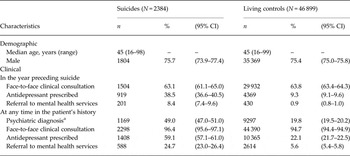
The median age of the case and control patients was 45 years, and three quarters were male (Table 1). Just less than a half of patients who died by suicide had ever received a mental illness diagnosis, according to the set of six major diagnostic groupings we examined, compared to almost a fifth of surviving control patients. Around two thirds of both case and control patients had at least one face-to-face clinical consultation in the preceding year (Table 1). Patients who died by suicide were far more likely than control patients to have been prescribed with antidepressants in the past year or at any prior time, and they were also much more likely to have been referred to mental health services.
Characteristics of suicide cases and their age, gender and practice-matched living controls

CI, Confidence interval.
a i.e. Any of the following six categories examined: schizophrenia spectrum disorders, bipolar disorder, depression, personality disorders, eating disorders, anxiety disorders.
Clinical consultation frequency
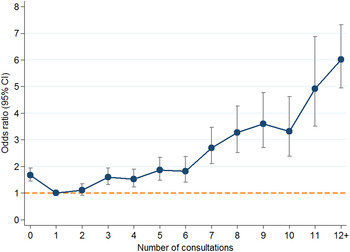
Initial descriptive analyses showed no discernible difference between case and control patients in their likelihood of having at least face-to-face clinical consultation in the year before suicide. We then stratified this crude binary variable by consultation frequency, which revealed marked differences between case and control patients (Fig. 1). A priori, we selected one consultation only in the previous year as the reference category, because we expected these patients to have the lowest suicide risk, and this is indeed what we observed. This group accounted for a considerably larger proportion of the living control patients than those who died by suicide (17.2% v.10.3%). The largest patient group in the distribution were those who had no consultations in the preceding year, over a third of both case and control patients, but these individuals had significantly elevated risk compared to the reference group. We observed an incremental upward gradient of rising risk with increasing consultation frequency compared to patients who consulted once in the preceding year. To demonstrate that the risk gradient continued upward beyond the ⩾12 cut-off, we conducted a more finely stratified analysis than is presented in Fig. 1. This revealed that those patients who consulted ⩾25 times were around 12 times more likely to die by suicide (n = 45 cases; OR 12.3, 95% confidence interval 8.5–17.8).
Odds ratios indicating relative risk of suicide according to frequency of clinical consultation in the year preceding suicide. The reference category for estimating these odds ratios is patients who consulted only once in the preceding year.

Psychiatric diagnoses
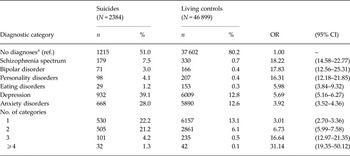
As indicated in Table 2, the greatest elevations in risk were observed in patients ever diagnosed with schizophrenia spectrum disorders, bipolar disorder and personality disorders; among patients diagnosed with depression, anxiety disorders and eating disorders, risk was somewhat lower than in those three groups, although it was nonetheless much higher than in patients without any of the six diagnostic categories. Risk also rose incrementally as the number of psychiatric diagnostic categories ever assigned to a patient increased.
Odds ratios indicating relative risk of suicide by specific psychiatric diagnostic category and by number of categories recorded

OR, Odds ratio; CI, confidence interval.
a The reference group for odds ratio estimation was patients without any of the six diagnostic categories listed in the table.
Psychotropic medication prescribing
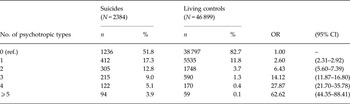
Stratified analyses by number of psychotropic medication types prescribed in the year prior to suicide revealed an extremely steep gradient of increasing risk (Table 3). Patients prescribed just one or two psychotropic medication types had elevated risk compared to patients who had received none, but the ORs for these groups were many times lower compared to those seen at the far end of the distribution.
Odds ratios indicating relative risk of suicide by number of psychotropic medication types prescribed in the preceding year

OR, Odds ratio; CI, confidence interval.
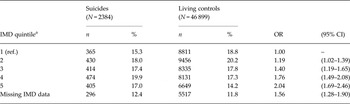
Socioeconomic status
We found a gradient in increasing suicide risk with rising levels of residential area-level deprivation, independent of practice-level deprivation effects (Table 4). Thus, risk was roughly double among patients living in the most deprived quintile versus the least. The risk elevation was incremental across each successive inter-quintile increase. For the sizable group of case and control patients with missing IMD scores, the OR also indicated raised risk.
Odds ratios indicating relative risk of suicide by residential area-level Index of Multiple Deprivation (IMD) quintile

OR, Odds ratio; CI, confidence interval.
a IMD quintiles from raw scores derived using patients’ residential postcodes, with practice-level deprivation adjusted for inherently in the matched design.
Referral to mental health services
As illustrated in Supplementary Fig. S1, we observed clear trends of increasing percentages of referral to specialist services with rising consultation frequency and number of psychotropic drug types prescribed in the year preceding suicide, and with the number of psychiatric diagnostic categories ever assigned. Nonetheless, more than three quarters of people who died by suicide in the higher-risk subgroups (i.e. ⩾12 consultations or ⩾3 psychotropic medication types prescribed in the year prior to suicide, or ⩾3 psychiatric categories ever assigned) were not referred.
Multivariable models
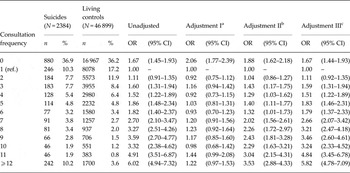
As with the unadjusted analyses presented in Fig. 1, again the reference category for OR calculation in these multivariable analyses was having just one consultation in the preceding year (Table 5). Adjustment for multiple psychotropic medication types almost entirely accounted for the strong unadjusted association observed between increasing consultation frequency and rising suicide risk. Cross-tabulation of these two variables revealed that 59.5% of patients dying by suicide who presented ⩾12 times in the preceding year had been prescribed with ⩾3 psychotropic medication types in that period. Adjustment for having multiple psychiatric diagnoses also strongly confounded the consultation frequency association, albeit to a lesser degree compared to the confounding effect of multiple psychotropic drug types. Adjustment for residential area-level deprivation made no material impact on the observed estimates.
Odds ratios indicating relative risk of suicide by frequency of clinical consultation adjusted for number of psychotropic medication types prescribed, number of psychiatric diagnostic categories assigned and residential area-level deprivation

OR, Odds ratio; CI, confidence interval.
a Multivariable Model I: adjusted for number of psychotropic medication types prescribed by a GP in the year preceding suicide.
b Multivariable Model II: adjusted for number of psychiatric diagnostic categories assigned.
c Multivariable Model III: adjusted for Index of Multiple Deprivation quintile (deprivation score assigned according to patient's home postcode); missing data fitted in the model as a separate category.
Discussion
Main findings
The findings from this nationally representative study of primary-care patients who died by suicide indicate that mental illness may to a degree be under-recognized and under-treated. Thus, we found that 51% of cases had none of six major psychiatric diagnostic groups ever recorded and, in the year before they died, 92% had not received a referral to mental health services. Suicide risk rose with increasing number of consultations although it was also higher among non-consulters, compared to patients who consulted with their GP only once in the preceding year. The strongest association observed was with multiple psychotropic drug types; patients prescribed four or five types had exceptionally elevated risk. Markedly raised risks were observed in patients diagnosed with schizophrenia spectrum disorders, bipolar disorder and personality disorders, and incremental risk elevations were also seen with increasing number of psychiatric diagnostic categories and with rising residential area-level deprivation. Multivariable modelling showed that prescribing of multiple psychotropic medications almost wholly accounted for the risk gradient linked with increasing consultation frequency.
Strengths and limitations
We examined a large nationally representative cohort of primary-care patients with complete linkage to cause-specific mortality records. The nested case-control design enabled examination of the determinants of suicide as a rare adverse event. Biases that seriously flaw many epidemiological studies were minimized. Information bias was precluded because the data were collected prospectively without knowledge of future outcome. Selection bias was also unlikely due to our robust method for sampling living control patients randomly from the whole cohort at risk via incidence density sampling. The CPRD provided high quality information pertaining to medication prescribed by GPs, because these data were downloaded directly from the IT system that issued each prescription. A limitation that affects numerous CPRD-based investigations is that the dataset typically lacks standardized measures of disease severity, and published CPRD-based studies of this type are therefore rare across all disease areas including physical illnesses (e.g. Peng & Jick, Reference Peng and Jick2004; de Vries et al. Reference de Vries, van Staa, Bracke, Cooper, Leufkens and Lammers2005). However, number of psychotropic medication types prescribed in the year preceding suicide and number of psychiatric diagnostic categories assigned served as proxy indices of illness severity, complexity, intractability and treatment resistance – phenomena that could not be measured directly using the clinical Read codes for disease symptoms and diagnoses available in the CPRD.
An important limitation of our study was potential misclassification of clinical consultation frequency. We defined face-to-face consultation stringently, and misclassification of this sort would tend to attenuate observed effect sizes due to non-differential distribution between case and control subjects (Copeland et al. Reference Copeland, Checkoway, McMichael and Holbrook1977). Thus, any resulting biases are likely to have been conservative ones that did not exaggerate associations or produce spurious false-positive results. We also conducted a sensitivity analysis using all eight of the consultation type categories that had been applied to characterize 95.7% of all CPRD consultations (as described in the Materials and method section). This revealed a similar pattern of association to what we observed in the primary analyses conducted using our preferred stringent definition. A second limitation concerns generalizability. Although the CPRD practices have been reported as being broadly representative of all practices nationally (García Rodríguez & Pérez Gutthann, Reference García Rodríguez and Pérez Gutthann1998; Herrett et al. Reference Herrett, Gallagher, Bhaskaran, Forbes, Mathur, van Staa and Smeeth2015), they do tend to have list sizes that are larger than average (Kontopantelis et al. Reference Kontopantelis, Springate, Reeves, Ashcroft, Valderas and Doran2014). Third, the CPRD includes only primary-care drug prescribing and contains no information on medication prescribed by specialist mental health services, and psychological therapy and other non-drug treatments are not recorded. Fourth, although practice-level deprivation was adjusted for inherently in the matched design, and we could explicitly model residential area-level deprivation, we had no individual patient-level measures of socioeconomic status. This could result in unknown degrees of ecological error and residual confounding. Fifth, the case-control dataset that was generated for this study did not include information on suicide method, and so we could not examine the determinants of intentional self-poisoning versus other methods. One final important omission was the primary reason for consultation. The clinical information that is held in the CPRD is too vast, detailed and complex to enable derivation of a simple categorical variable denoting this information such that it could be used meaningfully in these large datasets.
Comparison with existing evidence and interpretation
Our findings concur with those from previous studies showing that most individuals consult with their GP at least once prior to suicide (Cavanagh et al. Reference Cavanagh, Carson, Sharpe and Lawrie2003; Pearson et al. Reference Pearson, Saini, Da Cruz, Miles, While, Swinson, Williams, Shaw, Appleby and Kapur2009). The link between high-frequency consultation and suicide risk was reported from a previous UK investigation using the General Practice Research Database (now renamed the Clinical Practice Research Datalink). However, this small case-control study (Haste et al. Reference Haste, Charlton and Jenkins1998) had far fewer suicide cases than our study (N = 339 v. N = 2384). As well as being underpowered, GP-recorded cause of death data were examined without linkage to national mortality records. We also found that suicide risk is associated with a greater number of clinical consultations. Risk rose incrementally with increasing consultation frequency, and especially so with ⩾12 consultations, compared to those who saw their GP only once in the preceding year. Highly frequent consultation is therefore a marker for elevated suicide risk in primary-care patients. However, the proportion of patients considered to be high-frequency consulters, those who consulted their GP ⩾12 times, accounted for a small proportion (10.2%) of all suicide cases. It is therefore important for GPs to be aware of the elevated risk associated with multiple presentations that may not be considered high frequency. For example, OR values ranged between 1.60 and 4.98 for patients who consulted their GP between three and 11 times in the preceding year; i.e. less than once a month on average. These individuals constituted approximately a third of patients who died by suicide, a far greater proportion than the very-high-frequency consulters.
More than a third of people who died by suicide did not consult with their GP in the preceding year. Risk was elevated by 67% in this group compared to patients who consulted only once, and was similar to that of individuals who had consulted between three and five times. How can primary care prevent suicide in individuals who do not present to the service? This is clearly difficult and practices cannot feasibly assess suicidality risk for large numbers of patients who do not consult regularly, many of whom will be mentally and physically fit individuals. Only a small subgroup of patients among the non-consulters will have major psychosocial difficulties and be avoidant of seeking help for these problems. Conventional models of primary care may not be effective in meeting the needs of these individuals. For younger patients, dedicated services such as those provided by the voluntary sector or in less conventional settings, such as community centres or sports halls, and online supports (Lintvedt et al. Reference Lintvedt, Griffiths, Sørensen, Østvik, Wang, Eisemann and Waterloo2013), may offer a more realistic and acceptable approach to suicide prevention. An excellent example of such an approach is the ‘State of Mind’ initiative, which was established during 2011 in industrial towns across northern England via the sport of Rugby League. Its remit is to promote positive mental health and wellbeing, signpost individuals to where they can receive care and support in their local area, and raise awareness and provide education to communities with the ultimate goal of preventing suicide (http://www.stateofmindsport.org/.) A similar initiative in Australia, ‘Mates in Construction’, seeks to empower construction workers to address their psychosocial difficulties and reduce suicide risk in the industry through enhanced communication with supportive peers (http://www.matesinconstruction.org.au).
Psychotropic drug treatment is an effective method of managing mental illness and potentially reducing suicide risk (Wasserman et al. Reference Wasserman, Rihmer, Rujescu, Sarchiapone, Sokolowski, Titelman, Zalsman, Zemishlany and Carli2012; Gusmão et al. Reference Gusmão, Quintão, McDaid, Arensman, Van Audenhove, Coffey, Värnik, Värnik, Coyne and Hegerl2013). Complex prescribing is common practice in the treatment of some mental illnesses, for example bipolar disorder, and can have beneficial effects (Sachs et al. Reference Sachs, Peters, Sylvia and Grunze2014). As such, this association is likely to be a marker for greater illness severity, or clinical difficulty in achieving a benefit from first-line drug treatment, rather than a causal mechanism. However, it could also reflect the increased risk inherent with complex drug regimens such as drug interactions and non-adherence with treatment (De las Cuevas et al. Reference De las Cuevas, Penate and Sanz2014). There has been an increasing tendency towards complex prescribing, sometimes in the absence of evidence indicating improved patient outcomes (Mojtabai & Olfson, Reference Mojtabai and Olfson2010; Fleischhacker & Uchida, Reference Fleischhacker and Uchida2014). Irrespective of the mechanisms causing elevated suicide risk in association with the prescribing of multiple psychotropic medications, our findings could be used by GPs to inform their treatment and management plans. Just over half of patients who died by suicide did not receive any psychotropic medication in the preceding year, which may reflect under-diagnosis and potentially under-treatment of mental illness in primary care (Wright, Reference Wright1996).
Conclusion
This paper reports on primary-care risk factors for suicide in the year before death. This is an understudied yet important topic, because in many developed countries GPs are gatekeepers to secondary-care services. However, most research in these countries has focused instead on the roles played by emergency departments, inpatient and outpatient psychiatric services, and community mental health teams, in suicide risk monitoring and prevention. Our findings indicate that high-frequency consultation, prescribing of multiple psychotropic drug types, and the presence of multiple psychiatric diagnostic categories, are useful markers of elevated suicide risk in primary-care settings. Patients who present frequently with psychological distress, and particularly those who require multiple psychotropic medication prescribing in a short time-frame, should be monitored carefully and considered for referral to specialist services. Our understanding of pathways through primary and secondary healthcare services for people who die by suicide is currently incomplete, and is therefore a priority topic for further research.
Supplementary material
For supplementary material accompanying this paper visit http://dx.doi.org/10.1017/S0033291716001823.
Acknowledgements
The Mental Health Clinical Outcome Review Programme, delivered by National Confidential Inquiry into Suicide and Homicide by People with Mental Illness (NCISH), is commissioned by the Healthcare Quality Improvement Partnership (HQIP) on behalf of NHS England, NHS Wales, the Scottish Government Health and Social Care Directorate, the Northern Ireland Department of Health, Social Services and Public Safety (DHSSPS), the States of Guernsey and the States of Jersey. The funders had no role in the design and conduct of the study, the collection, management, analysis, and interpretation of the data, the preparation, review and approval of the manuscript, or the decision to submit the manuscript for publication.
Declaration of Interest
L.A. chairs the Suicide Prevention Advisory Group at the Department of Health (England), and he is a non-executive director for the Care Quality Commission. N.K. was chair of the NICE Guideline Development Group for longer term management of self-harm guidelines, and he is a member of the Suicide Prevention Advisory Group. All other authors declare no competing interests.