The relational bond formed between child and caregiver from infancy through toddlerhood is the base from which children develop an understanding of the self in relation to others (Bowlby, Reference Bowlby1973; Bretherton & Munholland, Reference Bretherton, Munholland, Cassidy and Shaver1999; Cassidy & Shaver, Reference Cassidy and Shaver2008). According to attachment theory, children's early relational experiences with their primary caregiver are internalized in the form of cognitive representations, or internal working models, which guide thoughts, feelings, and behavior in relation to the caregiver (Bowlby, Reference Bowlby1973; Bretherton & Munholland, Reference Bretherton, Munholland, Cassidy and Shaver2008). As children develop, these models become generalized to encompass views of the self, others, and the nature of relationships, thereby impacting children's relationships with peers and their mental health (Groh et al., Reference Groh, Pasco Fearon, Bakermans-Kranenburg, van IJzendoorn, Steele and Roisman2014). In general, children with secure attachments tend to develop working models of the caregiver as available, responsive, and accepting, and of the self as worthy of love, whereas those with insecure attachments develop working models of the caregiver as unavailable and unresponsive, and of the self as unworthy of love and attention (Bretherton, Reference Bretherton, Gunnar and Sroufe1991; Stams, Juffer, & van IJzendoorn, Reference Stams, Juffer and van IJzendoorn2002). Thus, children will process social information differently depending on the quality of the early attachment relationship experienced with the primary caregiver (Dykas & Cassidy, Reference Dykas and Cassidy2011; Seuss, Grossman, & Sroufe, Reference Seuss, Grossmann and Sroufe1992).
It has been well documented that insecurely attached children are less socially competent in their peer relationships than their secure counterparts (for meta-analyses, see Groh et al., Reference Groh, Pasco Fearon, Bakermans-Kranenburg, van IJzendoorn, Steele and Roisman2014; Pallini, Baiocco, Schneider, Madigan, & Atkinson, Reference Pallini, Baiocco, Schneider, Madigan and Atkinson2014). This is problematic given that the establishment and maintenance of peer relationships is a stage-salient task that becomes prominent in middle childhood and influences subsequent socioemotional development (Cicchetti, Reference Cicchetti1991; Parker & Asher, Reference Parker and Asher1987). Relationships with peers provide important opportunities for children to develop interpersonal skills, such as cooperation, gaining support, verbal communication, and dealing with conflict (Milteer, Ginsburg, & Mulligan, Reference Milteer, Ginsburg and Mulligan2012; Parker, Rubin, Erath, Wojslawowicz, & Buskirk, Reference Parker, Rubin, Erath, Wojslawowicz, Buskirk, Cicchetti and Cohen2006), whereas persistent difficulties in peer relationships can lead to clinically significant behavioral and affective disorders (La Greca & Lai, Reference La Greca, Lai, Ehrenreich-May and Chu2014). In particular, the literature suggests that poor peer adjustment in middle childhood and early adolescence is predictive of higher rates of future substance abuse, school dropout, criminality, and psychopathology (LaGreca & Lai, 2014; Parker & Asher, Reference Parker and Asher1987; Parker et al., Reference Parker, Rubin, Erath, Wojslawowicz, Buskirk, Cicchetti and Cohen2006).
Secure parent–child attachment therefore plays an important role in influencing children's internal working models of interpersonal relationships as they develop and begin interacting with peers. Parker et al. (Reference Parker, Rubin, Erath, Wojslawowicz, Buskirk, Cicchetti and Cohen2006) discussed three mechanisms by which this is thought to occur: (a) a secure attachment relationship with the primary caregiver promotes positive social expectations; children who have had positive experiences with a parent will also expect rewarding peer interactions; (b) children who have received responsive and empathic caregiving learn the fundamentals of social reciprocity; and (c) through a history of responsive care and autonomy support within the attachment relationship, children develop internal working models of the self as worthy and efficacious. This internal outlook is thought to be important to promoting characteristics that other children find attractive in a peer, including curiosity, enthusiasm, and positive affect.
In contrast, children with an insecure attachment to the primary caregiver come to expect less rewarding interactions with peers and tend to have a lower sense of self-worth and self-efficacy (Parker et al., Reference Parker, Rubin, Erath, Wojslawowicz, Buskirk, Cicchetti and Cohen2006; Stams et al., Reference Stams, Juffer and van IJzendoorn2002). As a result, they tend to experience higher levels of anxiety and/or anger in their interpersonal interactions, which often leads to withdrawal from or aggression toward peers (Parker et al., Reference Parker, Rubin, Erath, Wojslawowicz, Buskirk, Cicchetti and Cohen2006; Rose-Krasnor, Rubin, Booth, & Coplan, Reference Rose-Krasnor, Rubin, Booth and Coplan1996).
Children with insecure attachments in toddlerhood are more likely to experience peer rejection (Cassidy, Kirsh, Scolton, & Parke, Reference Cassidy, Kirsh, Scolton and Parke1996; Wood, Emerson, & Cowan, Reference Wood, Emmerson and Cowan2004) and victimization (Seibert & Kerns, Reference Seibert and Kerns2015; Troy & Sroufe, Reference Troy and Sroufe1987), and are also more likely to become victimizers themselves (Troy & Sroufe, Reference Troy and Sroufe1987). Similarly, insecurely attached preschoolers tend to engage in social interchanges that are less positive, more aggressive, and contain heightened negative affect (Booth, Rose-Krasnor, & Rubin, Reference Booth, Rose-Krasnor and Rubin1991; Rose-Krasnor et al., Reference Rose-Krasnor, Rubin, Booth and Coplan1996). Cassidy et al. (Reference Cassidy, Kirsh, Scolton and Parke1996) also found that insecurely attached children in kindergarten and first grade perceived the ambiguous intentions of their peers more negatively, supporting the proposition that negative internal working models of the caregiver are associated with negative representations of future relationships.
Studies examining the association between early attachment and peer relations in middle childhood have yielded similar results. Findings from a longitudinal investigation indicated that compared to infants with secure attachments, infants with an insecure attachment to their mother at 12 months of age were less competent at building close friendships by age 10 (Freitag, Belskey, Grossmann, Grossmann, & Scheuerer-Englisch, Reference Freitag, Belskey, Grossmann, Grossmann and Scheuerer-Englisch1996). A subsequent study of children followed from 15 months to ages 8–9 years indicated that participants who displayed insecure attachment patterns in infancy were less socially active, positive, and popular with peers, and displayed more social anxiety at school age than children with a history of secure attachment (Bohlin, Hagekull, & Rydell, Reference Bohlin, Hagekull and Rydell2000). Stams et al. (Reference Stams, Juffer and van IJzendoorn2002) followed a cohort of internationally adopted children placed before 6 months of age from infancy to age 7. The authors found that even after eliminating the influence of shared genetic factors between parents and children by design, infants with insecure attachments to their adoptive mother at 12 months of age demonstrated lower social competence and peer popularity at age 7.
Maternal Depression and Quality of Attachment in Offspring
Maternal depression impacts numerous aspects of the child-rearing environment. Children of depressed mothers are more vulnerable to a host of maladaptive outcomes, including lower cognitive functioning (Cicchetti, Rogosch, & Toth, Reference Cicchetti, Rogosch and Toth2000; Grace, Evindar, & Stewart, Reference Grace, Evindar and Stewart2003; Sohr-Preston & Scaramella, Reference Sohr-Preston and Scaramella2006), hypothalamus–pituitary–adrenal axis dysregulation (Dougherty, Tolep, Smith, & Rose, Reference Dougherty, Tolep, Smith and Rose2013; Laurent et al., Reference Laurent, Leve, Neiderhiser, Natsuaki, Shaw, Harold and Reiss2013), poor socioemotional adaptation (Maughan, Cicchetti, Toth, & Rogosch, Reference Maughan, Cicchetti, Toth and Rogosch2007; Murray et al., Reference Murray, Sinclair, Cooper, Ducoumau, Turner and Stein1999), and psychopathology (Goodman & Gotlib, Reference Goodman and Gotlib1999; Goodman et al., Reference Goodman, Rouse, Connell, Broth, Hall and Heyward2011). Depressed mothers are more disengaged with their children (Pelaez, Field, Pickens, & Hart, Reference Pelaez, Field, Pickens and Hart2008) and demonstrate decreased warmth, affective attunement, and empathic sensitivity to the child's needs (Goodman & Gotlib, Reference Goodman, Gotlib, Goodman and Gotlib2002; Hoffman, Crnic, & Baker, Reference Hoffman, Crnic and Baker2006; Lovejoy, Graczyk, O'Hare, & Neuman, Reference Lovejoy, Graczyk, O'Hare and Neuman2000). As theorized by Bowlby (Reference Bowlby1979, Reference Bowlby, Chess and Thomas1983), this psychological unavailability may prevent children from developing secure internal working models of caregivers.
A host of studies have indicated that offspring of depressed mothers are at increased risk for insecure attachment (Campbell et al., Reference Campbell, Brownell, Hungerford, Spieker, Mohan and Blessing2004; Goodman & Gotlib, Reference Goodman, Gotlib, Goodman and Gotlib2002; Lyons-Ruth, Connell, Grunebaum, & Botein, Reference Lyons-Ruth, Connel, Grunebaum and Botein1990; Martins & Gaffan, Reference Martins and Gaffan2000; Murray, Reference Murray1992; Radke-Yarrow, Cummings, Kuczynski, & Chapman, Reference Radke-Yarrow, Cummings, Kuczynski and Chapman1985; Teti, Gelfand, Messinger, & Isabella, Reference Teti, Gelfand, Messinger and Isabella1995). However, it is important to note that there has been heterogeneity within this body of research (see Wan & Green, Reference Wan and Green2009, for a review). Meta-analyses have generally pointed toward modest, rather than strong, associations between maternal depressive symptoms and quality of attachment (Atkinson et al., Reference Atkinson, Paglia, Coolbear, Niccols, Parker and Guger2000; van IJzendoorn, Schuengel, & Bakermans-Kranenburg, Reference van IJzendoorn, Schuengel and Bakermans-Kranenburg1999). Variability among findings may be related to sample characteristics. For example, in a meta-analysis of 15 studies, Atkinson et al. (Reference Atkinson, Paglia, Coolbear, Niccols, Parker and Guger2000) found that effect sizes were stronger in clinical samples (r = .27) and weaker in nonclinical samples (r = .09). This may be because mothers in clinical samples experience greater symptom severity and/or duration of symptoms (Campbell et al., Reference Campbell, Brownell, Hungerford, Spieker, Mohan and Blessing2004).
Alternatively, evidence has suggested that it may be the chronicity of depression, rather than the severity, that is most detrimental to attachment security. McMahon, Barnett, Kowalenko, and Tennant (Reference McMahon, Barnett, Kowalenko and Tennant2006) reported that persistent maternal depression, measured when children were 12 months of age, was significantly associated with attachment quality. They found that three-quarters of infants were classified as insecurely attached, whereas rates of insecurity in infants of briefly and never depressed mothers were statistically equivalent. Similarly, Campbell et al. (Reference Campbell, Brownell, Hungerford, Spieker, Mohan and Blessing2004) found that mothers who experienced intermittent or chronic symptoms of depression and who evidenced less sensitivity to their child's needs had offspring at greater risk for insecure attachment. Therefore, while children of depressed mothers are more vulnerable to attachment insecurity, not all will be adversely affected or respond in a similar manner.
Child–Parent Psychotherapy (CPP) for the Promotion of Offspring Attachment Security
Given the risk that maternal depression poses for offspring attachment security and subsequent social competence, interventions that target the early child–parent relationship may be useful for preventing maladaptive developmental trajectories. Relational interventions are of particular importance given that research has indicated that treating maternal depressive symptoms alone is not sufficient for preventing negative sequelae in offspring (Milgrom & Holt, Reference Milgrom and Holt2014; Nylen, Moran, Franklin, & O'Hara, Reference Nylen, Moran, Franklin and O'Hara2006; Tsivos, Calam, Sanders, & Wittkowski, Reference Tsivos, Calam, Sanders and Wittkowski2015). Evidence has supported the use of attachment-based interventions for improving outcomes among high-risk infants and children (for reviews, see Berlin, Zeanah, & Lieberman, Reference Berlin, Zeanah, Lieberman, Cassidy and Shaver2008; Juffer, Bakermans-Kranenburg, & van IJzendoorn, Reference Juffer, Bakermans-Kranenburg, van IJzendoorn, Holmes and Farnfield2014; Steele et al., Reference Steele, Steele, Bate, Knafo, Kinsey, Bonuck, Meisner and Murphy2014; Zeanah, Berlin, & Boris, Reference Zeanah, Berlin and Boris2011). CPP was the first evidenced-based treatment shown to increase rates of secure attachment specifically in offspring of depressed mothers (Cicchetti, Toth, & Rogosch, Reference Cicchetti, Toth and Rogosch1999; Toth, Rogosch, Manly, & Cicchetti, Reference Toth, Rogosch, Manly and Cicchetti2006). Subsequently, a home-visiting video-feedback program for depressed mothers and their infants has also been successful in promoting attachment security in offspring (van Doesum, Riksen-Walraven, Hosman, & Hoefnagels, Reference van Doesum, Riksen-Walraven, Hosman and Hoefnagels2008). To our knowledge, there are no other dyadic interventions to date that have led to improved attachment security in the young offspring of depressed mothers (Barlow, Bennett, Midgley, Larkin, & Wei, Reference Barlow, Bennett, Midgley, Larkin and Wei2015; Tsivos et al., Reference Tsivos, Calam, Sanders and Wittkowski2015).
CPP is an attachment theory-informed preventive intervention intended to optimize the quality of the parent–child relationship and foster secure attachment (Lieberman & Van Horn, Reference Lieberman and Van Horn2004). The intervention was derived from Fraiberg, Adelson, and Shapiro's (Reference Fraiberg, Adelson and Shapiro1975) “psychotherapy in the kitchen” model, which targeted mothers with histories of abuse and neglect. Through weekly sessions in a family's home, therapists strove to help mothers recognize how the “ghosts” from their own pasts were impacting their current relationships with their young children. Lieberman and Van Horn later built upon this model and its theoretical underpinnings to develop CPP (Lieberman, Reference Lieberman1992; Lieberman & Van Horn, Reference Lieberman and Van Horn2004, Reference Lieberman and Van Horn2008).
Cicchetti et al. (Reference Cicchetti, Toth and Rogosch1999) were the first to evaluate the efficacy of CPP for improving attachment security in children of depressed mothers. A preliminary sample of mothers with major depressive disorder and their toddlers (M age = 20.40 months) were randomly assigned to CPP (n = 27) or to a no treatment group (DC; n = 36) and compared to a control group (NC; n = 45) of women with no history of mental disorder. Toddler attachment was rated using the Attachment Q-set (AQS), which was completed by mothers. At baseline, offspring of depressed mothers evidenced significantly higher rates of insecure attachment than offspring of nondepressed mothers. However, postintervention follow-up assessments indicated that toddlers in the CPP condition had attained rates of secure attachment comparable to those of toddlers in the NC condition. In contrast, offspring in the DC condition continued to evidence higher rates of insecure attachment. Toth et al. (Reference Toth, Rogosch, Manly and Cicchetti2006) later reported on the efficacy of CPP in a larger sample of participants (CPP, n = 46; DC, n = 54; NC, n = 63), which included those from the previous investigation. Procedures remained the same, except that the Strange Situation Procedure (Ainsworth, Blehar, Water, & Wall, 1978), rather than the AQS, was utilized to assess toddler attachment. Findings replicated and extended those reported by Cicchetti et al. (Reference Cicchetti, Toth and Rogosch1999), indicating that when using the gold standard for assessing attachment, CPP remains effective for promoting secure attachment in offspring of depressed mothers.
The Current Investigation
Although it has been demonstrated that CPP is associated with numerous positive child outcomes immediately postintervention (Cicchetti, Rogosch, & Toth, Reference Cicchetti, Rogosch and Toth2006; Lieberman, Van Horn, & Gosh Ippen, Reference Liberman, Van Horn and Ghosh Ippen2005; Lieberman, Weston, & Pawl, Reference Lieberman, Weston and Pawl1991; Toth, Maughan, Manly, Spagnola, & Cicchetti, Reference Toth, Maughan, Manly, Spagnola and Cicchetti2002; Toth et al., Reference Toth, Rogosch, Manly and Cicchetti2006), as well as at 6- (Lieberman, Ghosh Ippen, & Van Horn, Reference Lieberman, Ghosh Ippen and Van Horn2006) and 12-months postintervention (Stronach, Toth, Rogosch, & Cicchetti, Reference Stronach, Toth, Rogosch and Cicchetti2013), no studies to date have examined the effects of CPP beyond 12 months following treatment completion. Furthermore, there have been no studies addressing the efficacy of an attachment-based intervention for promoting subsequent positive peer relations in children of depressed mothers. As a result of the paucity of research in these areas, the present investigation aims to evaluate the long-term efficacy of CPP for toddlers of depressed mothers for promoting positive peer relationships in middle childhood.
Hypotheses
The present investigation is guided by the hypothesis that postintervention attachment security (a) will predict more positive peer relationships at age 9, and (b) mediates the relationship between intervention status (CPP vs. DC) and peer outcomes among offspring of depressed mothers.
Method
Participants
Approval for the conduct of this research was obtained from the University of Rochester Institutional Review Board. After expressing interest in participating in the investigation, all mothers were approached individually by a research assistant and given the informed consent document to read and, if agreeable, to sign. Participants included a subset of mothers and their children (n = 87) who participated in a follow-up assessment of a randomized controlled trial evaluating the efficacy of CPP for toddlers of depressed mothers (see Cicchetti et al., Reference Cicchetti, Toth and Rogosch1999; Toth et al., Reference Toth, Rogosch, Manly and Cicchetti2006). Initial recruitment targeted mothers with a history of major depressive disorder (MDD) since giving birth to their child (n = 130). Maternal psychopathology was assessed via the Diagnostic Interview Schedule, Version III, Revised (DIS-III-R; Robins, Helzer, Cottler, & Goldring, Reference Robins, Helzer, Cottler and Goldring1988). Mothers who met criteria for bipolar disorder were excluded from participation; however, those with other comorbid Axis I disorders were retained. To minimize co-occurring risk factors that often accompany maternal depression, families were required to have at least a high school level education and could not be reliant on public assistance.
At baseline (Time 1 [T1]), depressed mothers (M age = 31.68 years, SD = 4.68) and toddlers (M age = 20.34 months, SD = 2.50) were randomized to either a depressed intervention condition (CPP; n = 66), in which dyads received CPP, or a depressed control condition in which no intervention was provided (DC; n = 64). Because CPP was not a treatment for maternal depression, all depressed mothers were permitted to seek services for their depression in the community if desired. With respect to the recency of MDD, 34.8% (CPP) and 43.8% (DC) of mothers met criteria for MDD within the past month, while 71.2% (CPP) and 78.1% (DC) met criteria within the past 6 months. In addition, for the majority of mothers, the onset of MDD was prior to their child's birth (CPP = 69.7%, DC = 71.9%). T1 assessments also revealed that comorbid Axis I disorders within the past year were common, with 59.1% of mothers in the CPP condition and 71.9% of mothers in the DC condition having at least one comorbid disorder. Across both groups, anxiety disorders (53.8%), bulimia (11.5%), and alcohol-related disorders (9.2%) were among the most prevalent comorbid diagnoses. Group contrasts on all of the aforementioned diagnostic variables were nonsignificant. Please see Toth et al. (Reference Toth, Rogosch, Manly and Cicchetti2006) for a more in-depth comparison of diagnostic variables between groups.
Procedure
T1 assessments were conducted over a series of home- and laboratory-based sessions. During an initial home-based session, mothers were administered a demographics interview, and maternal mental health was assessed using the DIS-III-R and the Beck Depression Inventory (BDI; Beck, Ward, Mendelson, Mock, & Erbaugh, Reference Beck, Ward, Mendelson, Mock and Erbaugh1961). In a subsequent laboratory-based session, mothers and toddlers participated in the Strange Situation paradigm (Ainsworth et al., Reference Ainsworth, Blehar, Waters and Wall1978) as a measure of toddler attachment security. Follow-up assessments were conducted when toddlers reached 36 months of age (Time 2 [T2]), and participants in the CPP condition had completed the preventive intervention. Mothers were again administered the DIS-III-R and BDI, as well as a demographics update; and during a laboratory-based session mother–toddler dyads completed the Strange Situation.
A final follow-up took place when children were between 8 and 11 years old (M age = 9.77 years, SD = 0.65). During a home-based session, mothers were administered the BDI—Second Edition (BDI-II; Beck, Steer, & Brown, Reference Beck, Steer and Brown1996), an updated version of the previously used BDI. In the present investigation, data from the BDI-II were used for the purpose of controlling for potential group differences in maternal depressive symptoms at the follow-up (Time 3 [T3]), and for performing group contrasts during participant retention analyses. At this time point, mothers also completed an updated demographics interview. Finally, children's teachers were delivered copies of the Teacher Checklist of Peer Relations (Coie & Dodge, Reference Coie and Dodge1988; Dodge & Somberg, Reference Dodge and Somberg1987), which they were asked to complete and return by mail.
Participant retention
From the original sample of 130 mother–child dyads, some participant attrition occurred by the time children reached 36 months of age. As a result of failing to complete all T2 assessments or moving out of the area, 8 dyads attrited from the CPP group and 8 from the DC group. In addition, 12 mothers assigned to the CPP condition either declined to participate in CPP or discontinued their participation early. Finally, the T2 Strange Situations could not be coded for 2 of the DC dyads due to equipment malfunction. As a result, group sizes for the cases who completed T2 assessments were as follows: CPP, n = 46; DC, n = 54. To assess for the possibility of differential attrition, group contrasts were performed using analyses of variance and chi-square (χ2) testing. No significant differences between completers (n = 100) and noncompleters (n = 30) due to completion status were found for baseline maternal depression scores, t (128) = 1.54, p = .13, d = 0.33, or for demographic characteristics, including maternal age, t (128) = –0.20, p = .84, d = 0.04, race, χ2 (4) = 5.09, p = .28, Cramer V = 0.20, educational level, t (128) = –0.82, p = .42, d = 0.17, marital status, χ2 (3) = 2.76, p = .43, Cramer V = 0.15, or annual family income, t (128) = –0.94, p = .35, d = 0.20.
Eighty-seven mothers completed T3 follow-up assessments when children were approximately 9 years of age. Participant attrition was primarily due to families moving out of the area. Again, group contrasts using analyses of variance and χ2 testing revealed no differences between completers (n = 87) and noncompleters (n = 13) with respect to group assignment, χ2 (1) = 0.34, p = .56, Cramer V = 0.06, baseline maternal depression scores, t = 0.01, p = .93, d = 0.03, or baseline maternal demographic characteristics, including age, t = 0.26, p = .61, d = 0.16, race, χ2 (3) = 1.11, p = .78, Cramer = 0.11, educational level, t = 0.04, p = .85, d = 0.05, marital status, χ2 (3) = 1.18, p = .76, Cramer = 0.11, or annual family income, t = 0.01, p = .91, d = 0.04. Teachers completed the TCPR for 76 children at T3. The teachers who did not participate worked in schools that were either out of area or did not permit research. The final sample included in analyses was therefore n = 76 (CPP = 37; DC = 39). Within this sample, 81.6% of mothers were married or living with a partner at follow-up, and the average annual family income was $64,829 (SD = $38,338).
Preventive intervention
CPP is an attachment-theory informed preventive intervention for young children ages 0 to 5 and their caregiver(s) (Lieberman & Van Horn, Reference Lieberman and Van Horn2004, Reference Lieberman and Van Horn2008). The intervention is based on the premise that caregivers who are unable to provide sensitive and responsive care are hindered by insecure internal working models of themselves and of the parent–child relationship that have resulted from negative experiences with their own caregiver(s). As such, the primary goals of the intervention are (a) to enhance the caregiver's capacity to respond in developmentally appropriate ways to the child's needs for nurturance, socialization, and protection; (b) to modify distorted or maladaptive perceptions that the caregiver or child may have about each other; (c) to restore the child's sense of safety and of trust in the caregiver as a secure base for meeting the child's basic needs; and (d) to promote the caregiver's ability to support the child's autonomy, while successfully balancing both her own needs and those of the child (Lieberman & Van Horn, Reference Lieberman and Van Horn2009; Toth, Michl, Guild, & Lieberman, Reference Toth, Michl, Guild, Lieberman, Steele and Steelein press). To achieve these goals, CPP focuses neither on the caregiver nor the child individually, but on the dyadic relationship between them.
In the present study, CPP was implemented at a research and clinical facility grounded in a developmental psychopathology framework. Sessions took place in weekly hour-long sessions over a period of approximately 12 to 18 months. Therapists working within a CPP framework strive to provide caregivers with developmental guidance while also maintaining a nondirective and nondidactic stance. Relevant processes within the caregiver–child relationship are therefore commented upon as they unfold. Interactions within the dyad are viewed as opportunities to explore the caregiver's internal representational world as it relates to her perceptions of and patterns of relating to her child. When necessary, the therapist also serves as a voice for the child, helping to build the caregiver's awareness of the child's efforts to communicate his or her emotions, needs, and fears. Furthermore, modeling of developmentally appropriate behavior occurs through the therapist's interactions with the child, enabling caregivers to begin to internalize more adaptive ways of relating to their offspring. The consistent support of the therapist is ultimately intended to provide caregivers with a corrective emotional experience that fosters more positive representations of the self and of the caregiver–child relationship.
In the current investigation, CPP was initiated following randomization to the CPP group and completion of baseline assessments. The intervention period averaged 58.19 weeks (SD = 10.00) in length and ranged from 42 to 79 weeks. Although sessions were scheduled weekly, the mean number of sessions conducted was 45.24 (SD = 11.16, range = 30–75), owing to cancellations and missed appointments. To ensure fidelity of the intervention, the implementation of CPP was monitored through weekly individual supervision, weekly group supervision and discussions of videotaped therapy sessions, and monthly monitoring of videotaped sessions for each case. In addition, an adherence checklist was used, and any deviations from the intervention standard were immediately addressed with the therapist's supervisor. The intervention was implemented by licensed master's level therapists.
Measures
DIS-III-R
The DIS-III-R (Robins et al., Reference Robins, Helzer, Cottler and Goldring1988) is a structured psychiatric interview designed to assess for Axis I disorders in accordance with the diagnostic criteria of the Diagnostic and Statistical Manual of Mental Disorders, Third Edition, Revised (DSM-III-R; American Psychiatric Association, 1987). The interview is organized into modules that probe for symptoms that fall into different categories of DSM-III-R Axis I disorders. Items are rated on a yes/no basis, and diagnoses are generated by computer algorithms, thereby precluding the need for interrater reliability. The DIS-III-R allows for 49 possible DSM-III-R diagnoses.
BDI
The BDI (Beck et al., Reference Beck, Ward, Mendelson, Mock and Erbaugh1961) is a widely used 21-item self-report measure that assesses for affective, cognitive, motivational, and physiological symptoms of depression. For each item, responders are asked to choose one of four self-evaluative statements that best represents their symptomatology over the past week. Items are rated on a 0 to 3 scale, with 3 indicating the most intense symptom severity. Cutoff scores for different levels of depression severity have been specified (0–9: none or minimal; 10–18: mild to moderate; 19–29: moderate to severe; and 30–63: severe; Beck, Steer, & Garbin, Reference Beck, Steer and Garbin1988). The BDI has been shown to correlate with psychiatric ratings of depression in both psychiatric and student samples (Beck et al., Reference Beck, Steer and Garbin1988). Test–retest reliabilities range from 0.48 to 0.86 among psychiatric patients and 0.60 to 0.83 among nonpsychiatric populations (Beck et al., Reference Beck, Steer and Garbin1988). For the present study, the BDI was used to measure the severity of maternal depressive symptoms at baseline and T2 follow-up. The updated BDI-II (described below) was used to measure depression severity at the T3 final follow-up. Internal consistencies for the present sample were 0.88 and 0.89 at T1 and T2, respectively.
BDI-II
In the present study, the BDI-II (Beck et al., Reference Beck, Steer and Brown1996) was utilized to assess and control for maternal depressive symptoms at T3, and also for the purpose of participant retention analyses. The BDI-II is a revision of the original BDI, and was developed in response to the DSM-IV's updated diagnostic criteria for depression. The scale retains the format and structure of the BDI and is also 21 items long. However, items involving changes in body image, hypochondria, and difficulty working were replaced. Furthermore, all but 3 items in the BDI-II were reworded, and items pertaining to sleep loss and loss of appetite were revised to include both increases and decreases in sleep and appetite. Cutoffs for depression severity were also revised (0–13: minimal; 14–19: mild; 20–28: moderate; 29–63: severe). A meta-analysis of 118 studies that reported psychometric properties of the BDI-II indicated test–retest reliabilities ranging from 0.73 to 0.96 across psychiatric, medical, and nonclinical samples (Wang & Gorenstein, Reference Wang and Gorenstein2013). The BDI-II also demonstrates strong convergent validity with other widely used measures of depression and anxiety (Wang & Gorenstein, Reference Wang and Gorenstein2013). T3 internal consistency for the present sample was 0.90.
Strange Situation Procedure
The Strange Situation (Ainsworth et al., Reference Ainsworth, Blehar, Waters and Wall1978) is a paradigm designed to observe attachment relationships between caregiver and child. During the procedure, the child is observed playing in a room, while the caregiver and a strange experimenter enter and leave the room at various intervals. The objective is to observe the child's behavior during separations and reunions with the caregiver as well as the child's response to being in the presence of a stranger. The child's behavioral patterns are then classified into one of four attachment styles: insecure-avoidant (A), secure (B), insecure-resistant (C), or disorganized (D). For the purposes of the present study, attachment types A, C, and D were collapsed into a single category representing insecure attachment.
Two trained raters who were unaware of diagnostic status and group assignment coded all videotaped sessions conducted at baseline. Interrater reliability was 90%. Over the course of coding, conferencing occurred for videos that were deemed by either coder to be ambiguous or complex (19% of sessions). The Ainsworth et al. (Reference Ainsworth, Blehar, Waters and Wall1978) criteria for attachment types A, B, and C were supplemented by a developmental systems approach for children ages 18 to 24 months (Schneider-Rosen, Braunwald, Carlson, & Cicchetti, Reference Schneider-Rosen, Braunwald, Carlson and Cicchetti1985). Type D classifications were determined using the Main and Solomon (Reference Main, Solomon, Greenberg, Cicchetti and Cummings1990) criteria.
Strange Situations conducted at T2 postintervention follow-up were coded using the same procedure outlined above. To serve as an additional check on reliability, a third blinded rater who had no previous involvement with the investigation coded 20% of all videos. Coder agreement was 94%. Given that children were 3 years old at T2, the MacArthur Preschool Attachment Classification System (Cassidy & Marvin, Reference Cassidy and Marvin1992) was used to classify attachment styles.
Teacher Checklist of Peer Relationships (TCPR)
The TCPR (Coie & Dodge, Reference Coie and Dodge1988; Dodge & Coie, Reference Dodge and Coie1987; Dodge & Somberg, Reference Dodge and Somberg1987) is an 18-item teacher-report measure with three subscales. Teachers are instructed to rate their student according to how well they believe the child relates to his or her peers as well as the extent of his or her prosocial behavior. The first two subscales, peer relations (6 items) and aggression (5 items), are rated on a 5-point Likert scale (1 = never true, 5 = almost always true). Sample items include “Other children like this child and seek him or her out for play” and “This child starts fights with peers.” The third subscale, teacher's assessment of children's social skills (7 items), is also rated on a 5-point Likert scale (1 = very poor and 5 = very well). Sample items include “accurately interpreting what a peer is trying to do” and “generating good quality solutions to interpersonal problems.” The TCPR has been shown to be highly correlated with the Child Behavior Checklist (r = .72; Dodge & Somberg, Reference Dodge and Somberg1987). More specifically, the teacher's assessment of children's social skills subscale has been shown to be associated with sociometric status of boys determined through peer nominations, with popular boys having higher mean scores, and rejected boys having lower mean scores (Coie & Dodge, Reference Coie and Dodge1988). In the present sample item 1 (“understanding others’ feelings”) on the teacher's assessment of children's social skills subscale demonstrated poor reliability (Cronbach α = 0.16). This item was therefore dropped from analyses. Internal consistency for the remaining 17 items comprising the full scale was strong (Cronbach α = 0.93). The three subscales also demonstrated strong internal consistency (peer relations α = 0.87; aggression α = 0.91; teacher's assessment of social skills α = 0.90). In the current investigation, each child's primary teacher completed the TCPR.
Results
Preliminary analyses
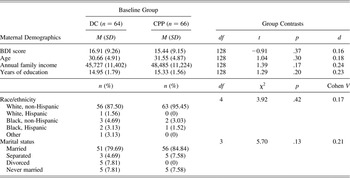
For descriptive purposes, maternal depression severity and demographic characteristics are presented in Table 1. Group contrasts indicated that, maternal demographics across conditions were comparable at baseline.
Baseline maternal depression severity, demographic characteristics, and group contrasts between the DC and CPP conditions

Note: Group contrasts were performed using t-tests and chi-square significance testing. DC, no treatment group; CPP, child–parent psychotherapy; BDI, Beck Depression Inventory.
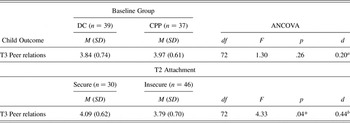
Analysis of covariance controlling for child gender and age at T3 indicated that the main effect of baseline group assignment on T3 peer relations was nonsignificant; however, a nontrivial effect size was found (CPP vs. DC); F (1, 72) = 1.30, p = .26, d = 0.20 (Table 2). Analysis of covariance was also used to compare T3 peer relationship means relative to postintervention attachment status (secure vs. insecure) among children in both groups. After controlling for child age and gender, findings indicated that among the children of depressed mothers, regardless of baseline group assignment, those who were securely attached at age 3 had significantly higher teacher ratings of peer relationship quality (M = 4.09, SD = 0.62) in middle childhood than those with insecure attachments (M = 3.79, SD = 0.70); F (1, 72) = 4.33, p = .04 (Table 2).
Main effects of baseline group assignment on T3 peer relations and of T2 attachment status on T3 peer relations
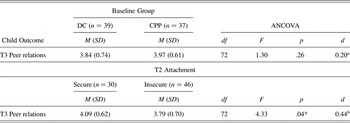
Note: Child age and gender were included as covariates in both analyses. T3, Time 3; T2, Time; DC, no treatment group; CPP, child–parent psychotherapy; ANCOVA, analysis of covariance.
a Small effect size.
b Small–medium effect size.
*p < .05.
Tests of mediation
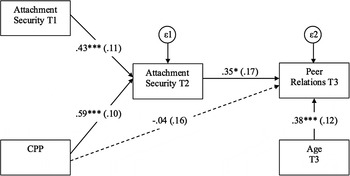
Our planned analyses focused on children from the CPP and DC groups for whom teachers had completed the TCPR at T3 (n = 80). In order to examine the longitudinal association between CPP, attachment security, and peer relations, a path analysis model was utilized within a structural equation modeling (SEM) framework (Kline, Reference Kline2005). Path analysis allows for the testing of multiple manifest variables within a longitudinal framework, can simultaneously account for multiple outcome variables, and specifies model fit. Baseline group assignment (DC = 0, CPP = 1) and baseline attachment security (0 = insecure, 1 = secure) served as exogenous predictors of postintervention attachment security, which was also a binary variable (0 = insecure, 1 = secure). In turn, baseline group assignment and postintervention attachment security were modeled to predict peer relationship quality in middle childhood. Child age at final follow-up was controlled for in this model (Figure 1). Child gender and maternal depressive symptoms (as measured by the BDI-II) at T2 and T3 were also modeled as covariates, but were not found to have significant unique effects on the dependent variables, and were therefore dropped from analyses.
Path model denoting standardized estimates of the direct and indirect pathways for the association between child–parent psychotherapy, attachment security, and peer relationships across time. Standard errors are in parentheses. To remain consistent with the weighted least squares mean- and variance-adjusted approach estimation technique, exogenous variables were left uncorrelated. Dashed pathways are nonsignificant. *p < .05. **p ≤ .01. ***p ≤ .001.

Path models were estimated via the weighted least squares mean- and variance-adjusted approach using Mplus, Version 7 statistical software (Muthén & Muthén, Reference Muthén and Muthén1998–2012). The weighted least squares mean- and variance-adjusted approach is a robust estimator, which does not assume normally distributed variables and is ideal for modeling categorical data. Model fit was assessed using four widely used indices: the χ2 goodness of fit test, the root mean square error of approximation (RMSEA), the comparative fit index (CFI), and the weighted root mean square residual (WRMR) or the standardized root mean square residual. A nonsignificant χ2 statistic, RMSEA values less than or equal to 0.06, CFI values greater than 0.95, WRMR values less than 1.0, and standardized root mean square residual values less than or equal to 0.07 were considered indicative of good model fit (Hu & Bentler, Reference Hu and Bentler1999; Yu & Muthén, Reference Yu and Muthén2002).
Our model evidenced good fit to the data, χ2 (2) = 0.31, ns; RMSEA = 0.00, CFI = 1.00, WRMR = 0.17. There was evidence of significant stability in attachment security over time (b = 0.43, SE = 0.11, p < .001), and consistent with previous published data using this sample (Toth et al., Reference Toth, Rogosch, Manly and Cicchetti2006), group assignment uniquely predicted postintervention attachment security after controlling for the effects of baseline attachment (b = 0.59, SE = 0.10, p < .001). Specifically, toddlers in the CPP group were more likely to demonstrate secure attachment styles at postintervention follow-up than toddlers in the DC group. As predicted, there was also a significant effect of postintervention (age 3) attachment security on peer relations in middle childhood (b = 0.35, SE = 0.17, p = .033), such that children who were more securely attached at age 3 were rated as having better peer relationships and interpersonal skills in middle childhood than those with insecure attachments (Figure 1). Finally, older children were rated by their teachers as having better peer relations (b = 0.38, SE = 0.12, p = .001).
To investigate whether attachment security at T2 significantly mediated the association between CPP and T3 peer relations, the distribution of the product of the coefficients method was employed with 95% asymmetric confidence intervals (RMediation; Tofighi & MacKinnon, Reference Tofighi and MacKinnon2011). The results indicated that the indirect effect was significant, 95% confidence interval = [0.01, 0.63].
Discussion
Preliminary analyses indicated that there was a small, though nonsignificant, effect of CPP on age 9 peer relations. Consistent with our hypothesis, CPP for toddlers of depressed mothers promoted attachment reorganization, and postintervention attachment security significantly mediated the nontrivial association between CPP and peer relationships in middle childhood. These findings support the supposition that by fostering a more adaptive relationship between child and primary caregiver, the child is more likely to follow a normative developmental trajectory and avoid the long-term negative sequelae associated with parental depression and insecure attachment. Through strengthening and repair of the attachment relationship with a depressed primary caregiver, CPP may be effective for promoting the development of healthy self-system processes (e.g., positive internal working models of self and other), which in turn, may enable children to more successfully navigate the developmental task of relating to peers in a positive manner.
Our findings are consistent with those from previous longitudinal investigations, which have indicated that children with histories of insecure attachment to their mother in toddlerhood are less effective at building close friendships (Freitag et al., Reference Freitag, Belskey, Grossmann, Grossmann and Scheuerer-Englisch1996), exhibit less positivity and popularity with peers, and are more socially anxious (Bohlin et al., Reference Bohlin, Hagekull and Rydell2000) in middle childhood than children with histories of secure attachment. Evidence suggests that attachment in elementary school children is associated with their internal working models of the self and other. For example, children with secure attachments (or secure base attachment scripts) in relation to their parent(s) tend to have higher self-esteem (Clark & Symons, Reference Clark and Symons2009; Psouni, Di Folco, & Zavattini, Reference Psouni, Di Folco and Zavattini2015) and also endorse more positive attributions of others (Cassidy et al., Reference Cassidy, Kirsh, Scolton and Parke1996; Clark & Symons, Reference Clark and Symons2009). Furthermore, children with implicit knowledge of secure base interactions with caregivers perceive themselves to be more appreciated and accepted by their peers and mothers, and also as more cognitively competent (Psouni et al., Reference Psouni, Di Folco and Zavattini2015).
In contrast, children who have not experienced their parent(s) as a secure base exhibit more negative working models of the self and of others (see Bretherton, Reference Bretherton, Gunnar and Sroufe1991; Cicchetti & Toth, Reference Cicchetti and Toth1998; Stams et al., Reference Stams, Juffer and van IJzendoorn2002), which impacts subsequent development by increasing the risk that they will later struggle to develop interpersonal skills that promote positive peer relationships (Edens, Cavell, & Hughes, Reference Edens, Cavell and Hughes1999). Adolescents with insecure attachment representations are less likely to seek and accept support from peers, more likely to worry about interpersonal rejection, and show higher incidences of hostile and negative affect in their interactions with an unfamiliar peer (Feeney, Cassidy, & Ramos-Marcuse, Reference Feeney, Cassidy and Ramos-Marcuse2008). Compared to adolescents with greater attachment security, adolescents with insecure attachment representations also experience more difficulty with support-giving behavior, evidencing more self-focus and less sensitivity/responsiveness in their discussions with a stranger (Feeney et al., Reference Feeney, Cassidy and Ramos-Marcuse2008).
Positive relationships with peers are of particular importance for children's socioemotional development. Numerous studies have found that peer rejection or victimization in childhood is associated with internalizing psychopathology. In a recent review, Platt, Kadosh, and Lau (Reference Platt, Kadosh and Lau2013) discuss evidence of a bidirectional relationship between peer rejection and depression, whereby each variable leads to increasing levels of the other over time. In addition, a longitudinal study that followed children from Grades 2 to 3 indicated that children rejected by their peers evidenced subsequent decreases in their social self-concept, which in turn predicted future symptoms of depression and anxiety (Spilt, van Lier, Leflot, Onghena, & Colpin, Reference Spilt, van Lier, Leflot, Onghena and Colpin2014). With respect to peer victimization, findings from a longitudinal investigation of children followed from Grades 4 through 12 indicated that low peer sociability was associated with peer victimization, and that highly victimized youth were at greater risk for internalizing psychopathology (Cillessen & Lansu, Reference Cillessen and Lansu2015). In particular, a meta-analytic review found small to medium effect sizes for the relationship between peer victimization and depression, loneliness, and anxiety in children and adolescents (Hawker & Boulton, Reference Hawker and Boulton2000).
Problematic peer relations have also been associated with externalizing behavior problems in childhood and adolescence (Hoza, Molina, Bukowski, & Sippola, Reference Hoza, Molina, Bukowski and Sippola1995; Laird, Jordan, Dodge, Pettit, & Bates, Reference Laird, Jordan, Dodge, Pettit and Bates2001; Morison & Masten, Reference Morrison and Masten1991; Sturaro, van Lier, Cuijpers, & Koot, Reference Sturaro, van Lier, Cuijpers and Koot2011; van Lier & Koot, Reference van Lier and Koot2010; Woodward & Fergusson, Reference Woodward and Fergusson1999). Evidence suggests that rejected youth may self-select into antisocial peer networks, which then encourage further antisocial behavior as well as friendships with deviant peers (Burt, Obradović, Long, & Masten, Reference Burt, Obradović, Long and Masten2008; Coie, Terry, Zakriski, & Lochman, Reference Coie, Terry, Zakriski, Lochman and McCord1995; Dishion, Patterson, Stoolmiller, & Skinner, Reference Dishion, Patterson, Stoolmiller and Skinner1991; Laird et al., Reference Laird, Jordan, Dodge, Pettit and Bates2001). Moreover, externalizing and antisocial behaviors are themselves predictive of peer victimization (Cillessen & Lansu, Reference Cillessen and Lansu2015), leading to a potentially negative cycle in which negative outcomes mutually amplify each other, resulting in increasing levels of maladaptation as a child develops.
In addition to emotional and psychological associations, peer relations have also been linked to academic achievement. Students who are well accepted by their peers tend to have higher grades (Flook, Repetti, & Ullman, Reference Flook, Repetti and Ullman2005; Ollendick, Weist, Borden, & Greene, Reference Ollendick, Weist, Borden and Greene1992; O'Neil, Welsh, Parke, Wang, & Strand, Reference O'Neil, Welsh, Parke, Wang and Strand1997), score higher on achievement tests (Buhs, Ladd, & Herald, Reference Buhs, Ladd and Herald2006; Diehl, Lemerise, Caverly, Ramsay, & Roberts, Reference Diehl, Lemerise, Caverly, Ramsay and Roberts1998; Kiuru et al., Reference Kiuru, Lerkkanen, Niemi, Poskiparta, Ahonen, Poikkeus and Nurmi2013; Ladd, Kochenderfer, & Coleman, Reference Ladd, Kochenderfer and Coleman1997), and are more likely to graduate (Risi, Gerhardstein, & Kistner, Reference Risi, Gerhardstein and Kistner2003) than less-accepted students. Similarly, a longitudinal investigation that followed Italian schoolchildren indicated that prosocial behavior (e.g., helpfulness, sharing, kindness, cooperativeness, and ability to console one's peers) toward peers among third graders was predictive of greater academic achievement in the eighth grade, even after controlling for initial variances in level of achievement (Caprara, Barbaranelli, Pastorelli, Bandura, & Zimbardo, Reference Caprara, Barbaranelli, Pastorelli, Bandura and Zimbardo2000).
In light of the significance of peer relations across multiple developmental domains, interventions that target children at risk for decreased social competence with peers are of paramount importance for facilitating healthy trajectories of socioemotional development. As a result of the impaired caregiving that offspring of depressed mothers receive, they are more vulnerable than offspring of nondepressed mothers to insecure attachment (Wan & Green, Reference Wan and Green2009) and relational difficulties with peers (Goodman, Brogan, Lynch, & Fielding, Reference Goodman, Brogan, Lynch and Fielding1993; Goodman & Gotlib, Reference Goodman, Gotlib, Goodman and Gotlib2002; Maughan et al., Reference Maughan, Cicchetti, Toth and Rogosch2007; Wang & Dix, Reference Wang and Dix2013); however, very few studies have assessed the effects of interventions for maternal depression on long-term child developmental outcomes (Tsivos et al., Reference Tsivos, Calam, Sanders and Wittkowski2015). Moreover, the majority of interventions for maternal depression target mother and child separately, utilize didactic psychoeducation groups, or simply do not involve the child (Tsivos et al., Reference Tsivos, Calam, Sanders and Wittkowski2015).
The evidence for interventions that target maternal depression alone has been mixed with respect to child outcomes. The Sequenced Alternatives to Relieve Depression study followed depressed mothers and their offspring (ages 7 to 17) over 3-month intervals for a period of 1 year while mothers received treatment for their depression (Pilowsky et al., Reference Pilowsky, Wickramaratne, Talati, Tang, Hughes, Garber and Malloy2008). Initially, all mothers were treated with citalopram. Participants who did not respond to the medication, or who were intolerant to citalopram, were offered alternative treatments, including other antidepressant medications, cognitive behavioral therapy, or a combination of treatments. Findings indicated that during the year following treatment initiation, both maternal depression severity and child psychiatric symptoms continued to decrease over time, and reduction in maternal depressive symptoms was significantly associated with reductions in child psychiatric symptoms (Pilowsky et al., Reference Pilowsky, Wickramaratne, Talati, Tang, Hughes, Garber and Malloy2008).
Two studies evaluating interpersonal psychotherapy for maternal depression also yielded positive results, demonstrating that the intervention was effective in increasing mothers’ positive involvement during interactions with their infants and toddlers (Beeber et al., Reference Beeber, Schwartz, Holditch-Davis, Canuso, Lewis and Hall2013; Clark, Tluczek, & Wenzel, Reference Clark, Tluczek and Wenzel2003). In contrast, Forman et al. (Reference Forman, O'Hara, Stuart, Gorman, Larsen and Coy2007) found that following interpersonal psychotherapy, treated depressed mothers still rated their children as lower in attachment security, higher in behavior problems, and more negative in temperament than nondepressed mothers. In another study, investigators evaluated the relative efficacies of nondirective counseling, cognitive behavioral therapy, and psychodynamic therapy, and found that all three treatments led to better infant emotional and behavioral ratings and more sensitive mother–infant interactions in the short term (Murray, Cooper, Wilson, & Romaniuk, Reference Murray, Cooper, Wilson and Romaniuk2003). However, none of the treatments had a significant impact on the security of infant–mother attachment, maternal management of early infant behavior problems, infant cognitive development, or any child outcome at 5 years of age. Although this has not been a comprehensive review of child outcomes following treatment of maternal depression (for a systematic review, see Tsivos et al., Reference Tsivos, Calam, Sanders and Wittkowski2015), the heterogeneity of findings within the literature suggests that treatment of mothers alone is not always sufficient for preventing psychopathology and maladaptive socioemotional development in offspring. Therefore, interventions targeting the mother–child relationship are of particular importance for improving child outcomes, and may be provided in conjunction with individual or group therapy for the caregiver.
Apart from CPP, dyadic interventions that have been evaluated for use with depressed mothers and their children have included mother–infant therapy group models (Clark, Tluczek, & Brown, Reference Clark, Tluczek and Brown2008; Jung, Short, Letourneau, & Andrews, Reference Jung, Short, Letourneau and Andrews2007), a home-visiting video-feedback intervention (van Doesum et al., Reference van Doesum, Riksen-Walraven, Hosman and Hoefnagels2008), psychoeducational groups (Gladstone, Forbes, Diehl, & Beardslee, Reference Gladstone, Forbes, Diehl and Beardslee2015), and baby massage (O'Higgins, Roberts St. James, & Clover, 2008; Onozawa, Glover, Adams, Modi, & Kumar, Reference Onozawa, Glover, Adams, Modi and Kumar2001). Among these studies, van Doesum et al. (Reference van Doesum, Riksen-Walraven, Hosman and Hoefnagels2008) were the only investigators to evaluate the efficacy of their home-visiting intervention on infant attachment security. Findings from a 6-month follow-up assessment indicated that infants in the intervention group had significantly higher scores for attachment security, as measured by the AQS, than those in the control group. However, no significant group differences were found at follow-up with respect to infant internalizing symptoms, externalizing symptoms, or levels of dysregulation (e.g., sleeping and eating difficulties; van Doesum et al., Reference van Doesum, Riksen-Walraven, Hosman and Hoefnagels2008). In another study, O'Higgins et al. (Reference O'Higgins, Roberts St. James and Glover2008) examined the effects of infant massage for improving mother–infant interaction quality. They found that at 1 year postintervention, mothers in the infant massage condition demonstrated significantly higher sensitivity toward their infants than mothers who had been randomized to an adult support group. However, these results were confounded by the fact that none of the depressed mothers showed impaired interactions with their infants at baseline.
The findings from the present study also showed that older children were rated by teachers as having better peer relations than younger children. These results are consistent with findings from a recent investigation in which older children evidenced higher average levels of social cooperation and social interaction than their younger peers (Gomes & Pereira, Reference Gomes and Pereira2014). Similarly, an investigation of Chinese schoolchildren demonstrated that older children endorsed higher levels of generalized trust in others, which was associated with higher levels of peer acceptance and better friendship quality (Xu, Tang, Jiang, & Ma, Reference Xu, Tang, Jiang and Ma2013). Taken together, these findings support the notion that children acquire more advanced social skills and cognitive beliefs as they develop, both of which may help to strengthen peer relations.
Future directions
The findings from the present investigation indicate that CPP is particularly promising for preventing long-term peer relational problems in offspring of depressed mothers. Future research is warranted to replicate these findings and to examine the potential effects of CPP on children's relationships with parents and teachers as well as their internal representations of self and other. There is also considerable need for additional research comparing the relative longitudinal efficacies of existing relational interventions for this population to determine the extent to which treatment outcomes are sustained. Given our findings that attachment security mediates the relationship between CPP and peer relations, the assessment of child–parent attachment in future investigations may contribute valuable knowledge to the existing body of research regarding the mechanisms through which preventive interventions are effective.
Limitations
Although the present investigation has many strengths, there were also a few limitations. First, the sample was restricted to middle-class mothers in an effort to minimize confounding risk factors that might have interfered with observing intervention effects. Other demographic characteristics were also somewhat homogenous, including the fact that the majority of mothers were Caucasian and had graduated from college. Therefore, our findings may not generalize to children and mothers of different racial and ethnic backgrounds, or to those from lower socioeconomic strata. However, previous research has shown CPP to be efficacious in fostering secure attachment in maltreated infants who were predominantly of minority race/ethnicity and low socioeconomic status (Cicchetti et al., Reference Cicchetti, Rogosch and Toth2006). In a sample of multiethnic preschoolers from diverse socioeconomic backgrounds, CPP also significantly reduced the prevalence of behavior problems (Lieberman et al., Reference Lieberman, Ghosh Ippen and Van Horn2006). Thus, these findings are promising with respect to CPP's potential to improve social functioning in more diverse populations.
Second, another limitation relates to mothers being free to seek other services for their depression if desired. As it would have been unethical to prevent depressed mothers from obtaining treatment, it is possible that additional services sought and/or use of psychotropic medication may have contributed to children's improved social functioning. However, given that additional services received would have focused on treating maternal depressive symptoms and not on the mother–child relationship, the likelihood of this possibility is diminished. In addition, contrasts revealed no significant differences between the CPP and DC groups with respect to services sought.
Third, the TCPR was the only measure used to assess the quality of children's peer relationships in middle childhood. Given that study participants were located in schools across multiple districts, it would have been difficult to obtain peer-report data for all participants, and many school districts have policies that restrict students from rating peers for research purposes. However, a strength of the TCPR is that it is a teacher-report measure and therefore avoids the biases associated with self- and parent-report measures.
Fourth, in this investigation CPP was compared against a nonintervention control condition rather than another active treatment. As a result, we cannot be certain that our findings are unique to an attachment theory informed intervention. Prior investigations conducted with maltreated children have evaluated the efficacy of CPP against another parenting intervention. Cicchetti et al. (Reference Cicchetti, Rogosch and Toth2006) evaluated the relative efficacy of CPP versus a psychoeducational parenting intervention and found that both were effective at promoting secure attachment in infants. However, a 1-year follow-up of the same sample indicated that maltreated children randomized to CPP had higher rates of secure and lower rates of disorganized attachment than children whose parents completed the psychoeducational parenting intervention (Stronach et al., Reference Stronach, Toth, Rogosch and Cicchetti2013). These findings are the first to demonstrate the superiority of CPP over alternative interventions for fostering sustained improvements in attachment security (Stronach et al., Reference Stronach, Toth, Rogosch and Cicchetti2013). Moreover, a similarly designed study with a different sample of maltreated toddlers found that when compared to a psychoeducational home-visiting intervention, only CPP was effective at fostering positive representations of the self and caregiver (Toth et al., Reference Toth, Maughan, Manly, Spagnola and Cicchetti2002).
Conclusions
To our knowledge, the present investigation is the longest longitudinal follow-up of a dyadic relational intervention for depressed mothers and their offspring to date. Our findings indicate that CPP fosters the reorganization of attachment security in toddlers of depressed mothers, and postintervention attachment organization significantly mediates the nontrivial association we observed between CPP and peer outcomes. Given the dearth of research examining the roll of attachment security following the implementation of relationally based preventive interventions for offspring of depressed mothers, there is considerable need for additional randomized controlled trials to compare the relative efficacies of existing treatment models for promoting secure attachment relationships. The current data provide compelling evidence for the use of CPP to foster adaptive developmental trajectories that are associated with greater relational competence with peers. Attachment appears to be a key factor in this process, supporting the use of interventions guided by attachment theory for targeting the early parent–child relationship in families at risk due to parental depression.