Early diagnosis, referral, and surgical intervention can significantly improve outcomes in children with congenital cardiac disease.1–3 In the developing world, however, intervention is often late or inadequate.4 Because socioeconomic factors may influence outcomes of healthcare,5, 6 we sought to explore the factors that affect access to cardiac surgical care for Guatemalan children with congenital cardiac disease. We used medical records from the Unidad de Cirugía Cardiovascular de Guatemala for children undergoing surgery during the calendar year 2002 to gather information regarding ethnic, socioeconomic, and geographic factors, as well as age at surgery, a proxy for access to care. Our objective was to identify factors that placed children at risk for delayed care in the developing world.
Methods
Subjects
Our subjects were children under the age of 18 years who received their first corrective surgery for congenital cardiac disease at La Unidad de Cirugía Cardiovascular de Guatemala in 2002. We excluded patients who were at least 18 years of age, had undergone previous palliative or corrective surgery for congenital cardiac lesions, or were not from Guatemala.
Data.
The paediatric division of La Unidad de Cirugía Cardiovascular de Guatemala, located in Guatemala's capital city, is a surgical centre dedicated solely to the repair of congenital cardiac lesions. It was established in 1997, and is the only centre of its kind in Guatemala. In 2002, it was the site of 4764 clinic visits, 2719 echocardiograms, 139 cardiac catheter procedures, and 202 cardiac operations.
We performed a retrospective review of medical records of patients operated upon in calendar year 2002 with respect to medical, demographic and socioeconomic information. Certain data was available only in patients who had applied for financial assistance. Permission was obtained from the Medical Director and the Committee of Teaching and Research at La Unidad de Cirugía Cardiovascular de Guatemala.
Surgical procedure.
Data regarding surgical procedure was obtained from the monthly log at La Unidad de Cirugía Cardiovascular de Guatemala. Information regarding type of surgery was corroborated with the medical record and operative note. In the case of discrepancy, operative notes were reviewed with a cardiac surgeon (AC).
Date of birth, gender, height and weight at time of surgery.
This data was obtained from the medical record.
Preoperative malnutrition, postoperative complications, and mortality.
This data was routinely coded in the medical record by a cardiologist or cardiac surgeon.
Religion.
Religion was recorded in the medical record as Catholic, Evangelical, or Other.
Ethnicity.
Data on ethnicity was obtained from the initial encounter form completed by a cardiologist or cardiac surgeon, who recorded ethnicity as Indigenous, Mestizo, or Other. Depending on the screening physician, this information had been obtained either by direct inquiry or by inference, as women and children in most Indigenous families wear traditional clothing. In general, Indigenous refers to Amerindian or predominantly Amerindian people, while Mestizo refers to mixed Amerindian-Spanish people or assimilated Amerindians, referred to in local Spanish as “Ladino.”
Region of residence and distance from surgical centre.
Addresses were obtained from the medical record and corresponded to one of Guatemala's twenty-two Departments. Distance from the surgical centre was defined as the length of the most direct road from the Department of residence to La Unidad de Cirugía Cardiovascular de Guatemala.
Urban versus rural residence.
Addresses considered rural were those within an aldea, caserio, finca, or other small community as specified by the Guatemalan census Bureau, regardless of distance from Guatemala City.
Years of parent education, household income, running water and electricity in home, family supports, intactness of family, and number of household members.
This data was available only for those families who required financial assistance from La Unidad de Cirugía Cardiovascular de Guatemala, and thus was not obtained in members receiving social security, whose surgical costs are covered in full by social security. Records were obtained from the Office of Social Work at La Unidad de Cirugía Cardiovascular de Guatemala, where this information is included in the routine intake. Years of parent education were recorded for the most educated parent. Family supports refers to help with money, childcare, transportation, or household duties from family living outside the home. Number of household members refers to all people living at home, excluding the patient. Intactness of family refers to whether or not both parents resided in the patient's home at the time of the intake.
Financial contribution.
Financial data was obtained from the medical record and coded as all, some, or no expenses paid from an outside source on behalf of the family. Sources of institutional support included the Aldo Castañeda Foundation, funded mainly by donations, as well as by grants and the Guatemalan government, Intervida, a partner organization to La Unidad de Cirugía Cardiovascular de Guatemala, church groups and missionaries, and in single instances El Plan Internacional, Project Ixim Acuala, Fundación Barcelo, and the Peace Corps.
Membership of social security.
This data was obtained from the medical record. In Guatemala, a family qualifies for social security, and thus for full coverage of the costs of surgery for congenital conditions, if the parent of the child is employed by the government, or employed by a participant in social security who employs greater than ten persons, and the employee has been working for a minimum of three months at the time of surgery.
Referral source.
Data on referral source was obtained from the medical record and recorded as public for all public hospitals, including La Unidad de Cirugía Cardiovascular de Guatemala, private for all private hospitals, including the Military Hospital and Liga del Corazón, or semiprivate for Social Security, Intervida, Aprofam, Nongovernmental Organizations, and doctors visiting from foreign countries.
Statistics.
All cases were stratified by an experienced pediatric cardiologist (JN) into one of three surgical classes based upon customary cardiovascular surgical practice in the United States of America. These were the neonatal period, as for those with transposition or critical aortic coarctation, in the first year of life, as for tetralogy of Fallot or ventricular septal defect, or after the first year of life, as for subaortic stenosis, or atrial septal defect. We placed 30 patients as requiring surgery as neonates, 110 needing surgery in the first year of life, and 38 subjects as needing surgery after the end of the first year of life.
The outcome we measured was age at surgery, adjusted for the surgical class. Because the variance and range of this variable differed for each surgical class, we used a square root transformation to stabilize the variance so that linear regression could be used. Dummy binary variables were created from surgical class in order that the regression could initially correct for surgical class. Because of difficulty in interpreting the coefficients of these regressions, for those variables that were significantly correlated with age at surgery within surgical class, a new binary variable was created, indicating whether an individual presented before or after the median of his or her surgical class, and we then performed logistic regression and calculated odds ratios.
The analysis proceeded in two stages. At first, we predicted the age at surgery from the variables that were collected on the full sample, then as a second step, the variables that were collected from the subset who applied for financial assistance, for whom more detailed data was available.
All analyses were performed using SPSS version 10.5.
Results
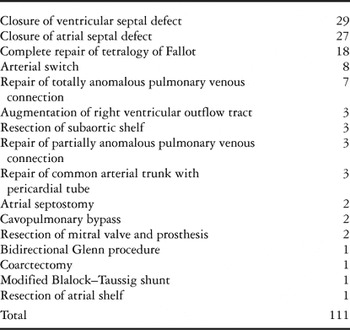
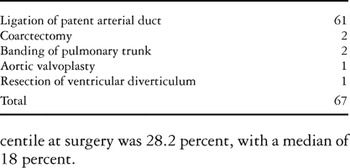
From among 202 patients undergoing cardiac surgical procedures at La Unidad de Cirugía Cardiovascular de Guatemala in 2002, nine were greater than 18 years, seven were not Guatemalan, and six had previous palliative or corrective cardiac surgery for congenital cardiac disease. In addition, two medical records were unavailable. The remaining 178 patients form our cohort for study. Of these, 111 underwent open procedures and 67 underwent closed procedures (Tables 1 and 2).
Table 1. Open cardiac repairs for Guatemalan patients 18 years or younger with congenital cardiac disease, La Unidad de Cirugía Cardiovascular de Guatemala, 2002.

Table 2. Closed cardiac repairs for Guatemalan patients eighteen years or younger with congenital heart disease, La Unidad de Cirugía Cardiovascular de Guatemala, 2002.

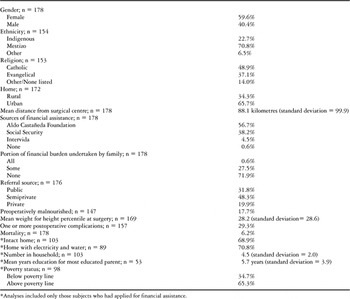
The majority of patients were from Mestizo families (70.8 percent), and lived in urban areas of Guatemala (65.7 percent) (Table 3). Children from 20 of the 22 Departments of Guatemala were represented in the sample studied. Alta Verapaz and Baja Verapaz were not represented. The majority of children (45.5 percent) were from Guatemala City, where La Unidad de Cirugía Cardiovascular de Guatemala is located.
Table 3. Characteristics of study population.

Most families received financial assistance from Fundación Aldo Castañeda (56.7 percent), and from Social Security (38.2 percent). The complete financial costs of surgery could be paid by only 0.6 percent of families, while 27.5 percent were able to make some contribution towards the cost.
Approximately 18 percent of patients were preoperatively malnourished. The mean weight for height centile at surgery was 28.2 percent, with a median of 18 percent.
Univariate predictors (Tables 4 and 5)
Table 4. Significant variables in prediction of age at surgery.*

Table 5. Significant variables in prediction of age at surgery.*

Geographic variables.
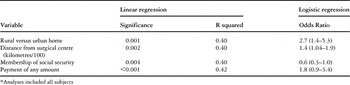
For each 100 kilometres of distance travelled, patients were 1.4 times more likely to be above the median age for their surgical class at the time of surgery (Odds Ratio 1.4; 95 percent Confidence Interval 1.04, 1.9; p equals 0.002). Rural versus urban residence was also a significant univariate predictor of age at surgery, with rural children approximately three times more likely to be above the median age for their surgical class at the time of surgery (Odds Ratio 2.7; 95 percent Confidence Interval 1.4, 5.3; p equals 0.001).
Socioeconomic state.
Data regarding family income were available for 98 of the 104 families who had applied for financial assistance. Mean income was 946.6 quetzales (approximately 118 United States dollars) per month, with 34.7 percent of families living below the poverty line (less than 486 quetzales per month). Among patients who applied for financial assistance, income and relationship to the poverty line were not significant univariate predictors for age at surgery.
Of the 178 children studied, 68 (38.2 percent) were from families with membership of social security, while 110 (61.8 percent) were not. Of note, patients were less likely to have social security if they were indigenous (p less than 0.001), or if they lived in rural areas (p less than 0.001). Individuals without social security also lived an average of 87 (plus or minus 14) kilometres farther away from the surgical centre than those who had it.
Patients with membership of social security, and thus full coverage of surgical expenses, were likely to be younger at surgery than their counterparts without membership (Odds Ratio 0.6; 95 percent Confidence Interval 0.3, 1.0; p equals 0.004). Children whose families had to pay any part of the hospital bill were 1.8 times more likely to be above the median age for their surgical class at the time of surgery (Odds Ratio 1.8; 95 percent Confidence Interval 0.9, 3.4; p less than 0.001).
Of the 104 children whose families applied for financial assistance, the 22 whose families cited additional help from outside organizations were almost 5 times more likely to be above median age for their surgical class at the time of surgery (Odds Ratio 4.7; 95 percent Confidence Interval 2.5, 15.2; p equals 0.001).
Data relating to education was available for 53 of the 104 families who had applied for financial assistance. Within this subgroup, years of education, using the most educated parent, was not a significant variable.
Referral data was available for 176 of the 178 patients studied. Referral from a public, semiprivate, or private source was not a significant predictor of age at surgery.
Family structure and support.
All data regarding family structure and support was available only for those patients whose families applied for financial assistance. Patients were from households of one to 11 people, themselves excluded. For each additional family member living in the home, children were 40 percent more likely to be above the median age for their surgical class at the time of surgery (Odds Ratio 1.4; 95 percent Confidence Interval 1.1, 1.7; p less than 0.001).
We found that 31 (29.8 percent) parents cited assistance from family living outside the home, while 73 (70.2 percent) stated that they had no such support. Age at surgery was not affected by family support from outside the home, or intactness of family as measured by the presence of two parents in the household.
Ethnicity, religion, and gender.
Age at surgery was not affected by ethnicity, religion, or gender.
Multivariable analyses
In models incorporating all 178 patients, stepwise linear regression showed that 42 percent of the variance in age at surgery could be attributed to rural as opposed to urban residence, and payment by the family of any part of the surgical costs (r squared equals 0.42). Rural patients whose families undertook any portion of the surgical expenses were older at the time of surgery than their urban counterparts and those who did not pay any amount.
In multivariable analyses in the subset of patients who had applied for financial assistance, stepwise linear regression showed that, in addition to the risk factors above, the number of household members was a significant predictor of age at surgery. The multivariable model including all three variables in this subgroup analysis explained 54 percent of the variance in age at surgery (r squared equals 0.54).
Discussion
Guatemala is a Central American country of 13 million inhabitants, three-fifths of whom are indigenous Mayan Indian. A report from the United Nations, published in 2000, found that only eight percent of the Mayan population had access to regular health care, especially in rural areas.6 This lack of access is reflected in the rate of infant mortality, which is estimated at 44.6 per 1000 live births,7 compared to the rate in the United States of America of 6.7 per 1000 live births.8 The Pediatric Division of La Unidad de Cirugía Cardiovascular de Guatemala, located in the capital city, is a surgical centre dedicated solely to the repair of congenital cardiac lesions. It was established in 1997, and is the only centre of its kind in Guatemala.
We found by univariate analyses that Guatemalan children with congenital cardiac disease presented significantly later for palliative or corrective surgery if they were from rural areas, did not have membership of social security, or paid any amount towards the cost of their surgery. Age at surgery was also positively correlated with the distance of the home of the patient from the surgical centre. For the subset of patients who applied for financial assistance, we found that children presented later for surgery if they required institutional support, or came from a household of larger size. In multivariable analyses, independent predictors of older age at surgery were rural as opposed to urban residence, and the inability of the family to make a financial contribution towards the cost of surgery. Within the subset of patients who had applied for financial assistance, independent predictors of later age at surgery were rural residence, additional help from outside organizations, and larger size of the household. Taken together, these three variables explained more than half of the variance in age at surgery.
Several authors have noted the underdiagnosis and treatment of congenital cardiac disease in the developing world. One group of Malaysian authors found that, with the exception of ligation of patent arterial ducts, access to surgical treatment was inadequate for all the children they studied with congenital cardiac disease. Reasons cited were lack of diagnostic equipment, trained personnel, and proper facilities for transport to centres providing tertiary care for confirmatory investigations or treatment.4
A Chilean group found that one-third of children less than one year of age who died of cardiac causes had never been evaluated by a cardiologist. To improve the care of Chilean children with congenital cardiac disease, they proposed more equitable care for those from poor or remote areas of the country, as well as a more comprehensive infrastructure for referral, and improved training of both primary paediatricians and cardiac specialists.2 This model has been shown to work in Cuba, where a national programme for paediatric heart disease was instituted in 1986, concomitant with the addition of a new Centre for Paediatric Cardiology to a large public hospital. In each of the 14 provinces, one doctor was identified as responsible for paediatric cardiac disease, and a system was established for referral from each province into the centre providing tertiary care. From the years 1987 to 1991, the rate of death due to congenital cardiac disease in children fell from 10.7 to 8.5 per 100,000.9
While Guatemala does not have a formal system of screening and referral for early detection and treatment of congenital cardiac disease, our study suggests that social security has the potential to fill this role by providing centres for healthcare in rural areas, and by covering the cost of surgery related to congenital cardiac defects. The role of social security in Guatemala may be comparable to that of healthcare insurance in the United States of America, where Perlstein et al.5 and Chang et al.1 found that the type of insurance significantly influenced age at referral and age at surgery, respectively. In our study, patients without social security who sought funding from other institutions presented significantly later than their peers, presumably because supports outside of social security take longer to obtain, and are often inadequate.
Patients from rural areas tended to present later than those from urban areas. Perlstein et al.,5 examining the patterns of referral for patients with congenital cardiac disease in Tucson, Arizona, also found that non-urban location of the home was a major risk factor for late referral. This finding may reflect a paucity of trained specialists in rural areas. In our sample, rural residence may also be a surrogate for socioeconomic and cultural disempowerment, as enumerated by the report from the United Nations published in 2000, which found that 73 percent of indigenous Guatemalans, and 72 percent of those living in rural areas, were “economically and socially excluded,” with limited access to basic services.6 While ethnicity alone was not a predictor for greater age at surgery, indigenous patients were less likely to have membership of social security.
Our data suggests that travel may be a major issue in access to surgical care, as distance from the surgical centre was a significant risk factor for later age at surgery. Contributing factors may be the cost and time involved in travel. Parents commuting from long distances would not be able to travel to the surgical centre each day, and might therefore need to pay for hotels in Guatemala City during the period of hospitalization of their child. Travel from a distance would also require time away from work or childcare. This effect may be compounded by the need to undertake several diagnostic visits prior to surgery.
Our study should be viewed in light of certain limitations. We chose age at surgery as a surrogate for access to care. Age at diagnosis, and age at referral for children with congenital cardiac disease, have been identified in previous studies as indicators of access to medical care,1, 10 and it follows that age at surgical intervention, an event that occurs further “downstream” in the process of care, might be subject to yet greater influence by non-medical variables related to access, such as ethnicity and socioeconomic state. This surrogate, however, necessarily excludes those children who never come to surgical attention, including those who die before they can be diagnosed.
The study was an exploratory analysis in which all data was not available for all patients. For example, detailed data regarding education of the parents, size of the household, and income of the family, was only available for those families who had applied for financial assistance, this being a group necessarily different from those who had social security or who were capable of paying. Because all data came from review of charts, an element of recording bias must be assumed. For instance, while only 18 percent of patients were recorded as malnourished, the true proportion of malnourished patients is probably greater.
Data from our study may not be generalizable to all developing countries. First, Guatemala is a mountainous country, with difficult terrain, making distance from the surgical centre perhaps more important than in other countries. Also, its indigenous people speak 23 languages, hindering communication with physicians even in the presence of a translator. And, because La Unidad de Cirugía Cardiovascular de Guatemala is directed by a paediatric cardiac surgeon (AC), who trained and practised for over two decades in the United States of America, its patients and four cardiac surgical residents have access to a level of expertise that may not be available to all fledgling programmes in the developing world.
In summary, we found that socioeconomic and cultural factors play a role in access to surgical care for Guatemalan children with congenital cardiac disease. Our findings suggest that the first steps in improving access might include broadening membership of social security. Access can also be improved by focusing outreach efforts on rural areas, or areas that are distant from the surgical centre.
Acknowledgement
Supported in part by the Kobren Fund.