INTRODUCTION
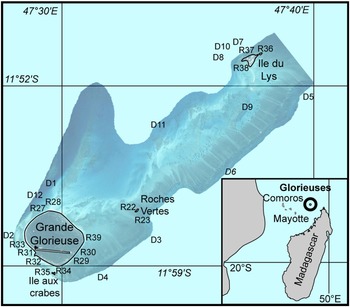
The Glorieuses Islands, with Europa, Bassas da Indian, Juan de Nova, and Tromelin belong to the Scattered Islands in the Indian Ocean administered by the French Terres Australes et Antarctiques Françaises (TAAF). It is a small archipelago, about 7 km2 in area, located at 11°35′S 47°18′E, 222 km from Nosy-Bé, in the north of Madagascar, and 253 km from Mayotte (Figure 1). Caceres (Reference Caceres2003) has given a detailed historical account of this archipelago including its discovery, political status, geomorphology and natural history.
Map of the Glorieuses Islands with indication of stations investigated during the BIORECIE 2 Expedition, including SCUBA dives (D1–12) and intertidal collection or snorkelling along the reef (R22–39). Adapted from ® Google Earth map at http://crustiesfroverseas.free.fr/pdf/Glorieuses-st-mbr.kmz.

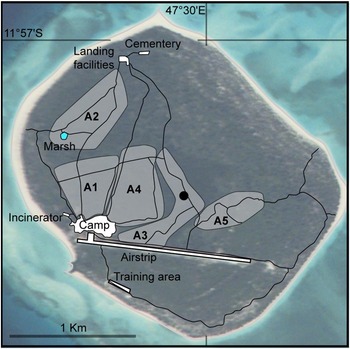
The archipelago is composed of two main islands. Grande Glorieuse, the largest, is sub-circular and has a maximum diameter of 2.3 km. Ile du Lys is much smaller and 0.6 km in length (Figure 1). These two islands are separated by 10 km of shallow reefs. There are also two groups of islets, the Ile aux Crabes, in the south of Grande Glorieuse, and the Roches Vertes, between the two main islands. A military detachment is stationed permanently on Grande Glorieuse and there is an airstrip for services supply and staff turnover. Grande Glorieuse is mostly occupied by a dense forest of coconut trees, crossed by a network of footpaths (Figure 2). There are neither rivers nor a lagoon but there is a small salty marsh that is flooded at high tide only. The sand beaches around the island are used as nesting grounds for sea turtles (Chelonia mydas). Ile du Lys is a rocky island with reduced vegetation coverage. It is colonized by seabirds (Anous stolidus and Sterna fuscata) so numerous during this study that it was difficult to explore the interior of the island. A central marshy depression, linked to the sea by a narrow passage in the north of the island, is flooded at high tide.
Map of Grande Glorieuse Island with indication of the terrestrial areas (A1–5) searched at night looking for the coconut crab (Birgus latro). The black spot in A3, 11°34.767′S 47°17.779′E, indicates the place where the crabs were observed.

The fauna and flora of the archipelago are protected by the TAAF. In Grande Glorieuse, with a permanent military detachment, the anthropogenic influence is strictly controlled, but illegal visits by foreign fishermen are still regularly noted at the Ile du Lys.
Terres Australes et Antarctiques Françaises is strongly committed to making the Scattered Islands a Marine Protected Area. To this end several studies have been undertaken in a research program called Biodiversité, ressources et conservation des récifs coralliens des Iles Eparses (BIORECIE, 2011–2013) which aims to update the inventories of the fauna and flora of these islands. The study presented herein is a part of this BIORECIE programme. It focuses on the results obtained for the Crustacea Decapoda during the BIORECIE 2 Expedition to the Glorieuses Islands, 5–17 December 2012. Field data are complemented by a review of the taxonomic studies for these islands, published between 1884 and 2006, with an updated list of the species presented for the Glorieuses Islands. A comparison is made with the results obtained in the Mozambique Channel for Europa Island after the BIORECIE 1 Expedition, 7–12 November 2011 (Poupin et al., Reference Poupin, Zubia, Gravier-Bonnet, Chabanet and Malay2013). Special attention is paid to the coconut (or robber) crab, Birgus latro (Linnaeus, Reference Linnaeus1767) as this is an endangered species very vulnerable to human predation. Its presence in the Glorieuse Islands is confirmed herein, for the first time since 1882, and its distribution in the western Indian Ocean (WIO) is updated based on recent observations made in the region between 2006 and 2013.
MATERIALS AND METHODS
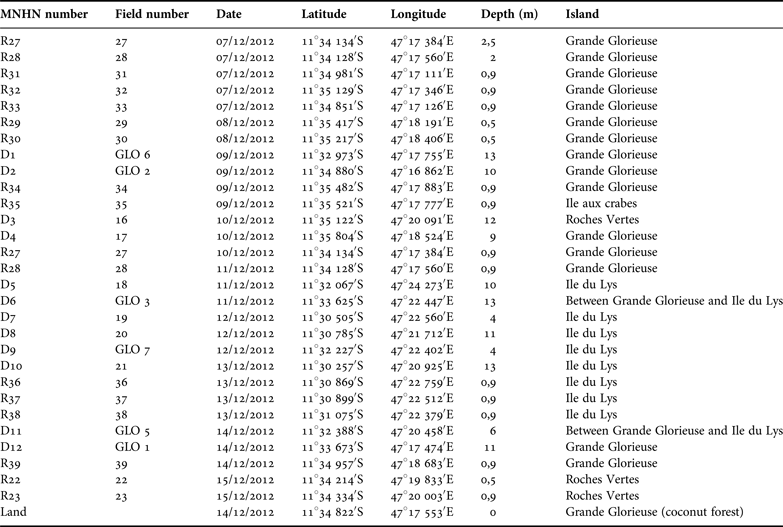
The Crustacea Decapoda were collected by hand at low tide, in the intertidal zone and by snorkelling in 1–2 m, in 15 reef stations (see Figure 1: R22–23 and R27–39) and Table 1. There were also 12 outer reef stations investigated by SCUBA diving (D1–12) ranging from 0.5–13 m in depth (Figure 1). Land Crustacea were investigated in Grande Glorieuse over eight nights, between 10 and 12 pm, in five areas identified on Figure 2 (A1–A5) with A2 visited twice and A3 visited three times. The Ile du Lys was also prospected during one night (9–12 pm, on 13 December). Crustacea samples were limited to species not identifiable in the field. Overall the collection represents 58 samples that are deposited and registered in the Muséum national d'Histoire naturelle, Paris (MNHN). Almost all the species have been photographed with their live coloration with photographs made available online by Legall & Poupin at http://crustiesfroverseas.free.fr/glorieuses.php.
Station data for the BIORECIE 2 Expedition in the Glorieuses Islands, 5–17 December 2012. MNHN number is the station number indicated on labels for the specimens that are deposited in the Muséum national d'Histoire naturelle, Paris.

Abbreviations used for this work are: coll., collected by; F, female; juv., juvenile; M, male; ov., ovigerous; spec./specs, specimen/s; st., Station.
RESULTS AND DISCUSSION
Historical overview
Before this study, 96 species of Decapoda were reported from the Glorieuses Islands. The oldest records are those of Coppinger (Reference Coppinger1884) and Miers (Reference Miers1884) after the visit of the British HMS ‘Alert’, in 1882. These authors report seven common species, including the coconut crab, Birgus latro (Linnaeus, Reference Linnaeus1767). Further crustacean collections were made much later, between 1958 and 1973, by French researchers, such as A. Crosnier, C. Jouannic and J. Millot, working at the ‘Institut Français de Recherche Scientifique pour le Développement en Coopération’ ORSTOM, Madagascar. Their collections appear sporadically in taxonomic reviews published afterward: Palaemonidae in Bruce (Reference Bruce1978); Galatheidae in Baba (Reference Baba1990), Porcellanidae in Haig (Reference Haig1966), Haig & Kropp (Reference Haig and Kropp1987); Dromiidae in Lewinsohn (Reference Lewinsohn1984); Dynomenidae in McLay (Reference McLay and Crosnier1999); Calappidae in Galil (Reference Galil and Crosnier1997); Carpiliidae, Eriphiidae, Oziidae and Pseudoziidae in Crosnier (Reference Crosnier and Serène1984); Parthenopidae in Tan & Ng (Reference Tan and Ng2007); Portunidae in Crosnier (Reference Crosnier1962, Reference Crosnier1975), Crosnier & Thomassin (Reference Crosnier and Thomassin1975); Trapeziidae in Castro (Reference Castro and Richer de Forges1997); Xanthidae in Serène (Reference Serène1984); and Grapsidae in Crosnier (Reference Crosnier1965).
In 1977 several deep stations of an expedition called BENTHEDI were investigated off the Glorieuses Islands between 30 and 3000+ m. Nine species of Decapoda have been found in the taxonomic literature as a result of this cruise: 1 Penaeidae in Crosnier (Reference Crosnier and Crosnier1991); 1 Sicyoniidae in Crosnier (Reference Crosnier1985); 1 Crangonidae in Komai (Reference Komai2008); 1 Scyllaridae in Holthuis (Reference Holthuis2002); 1 Diogenidae in Rahayu (Reference Rahayu2007); 2 Parapaguridae in Lemaitre (Reference Lemaitre2004a, Reference Lemaitre, Marshall and Richer de Forgesb); 1 Pylochelidae in McLaughlin & Lemaitre (Reference McLaughlin and Lemaitre2009); and 1 Dynomenidae in McLay (Reference McLay and Crosnier1999). A deep lobster is also reported by Chan & Yu (Reference Chan and Yu1995), 10 km off the Glorieuses Islands, collected in 1983 between 150 and 670 m during an unidentified sampling expedition.
In 2009, a collection of Crustacea was made at the Glorieuses Islands during an international programme called The Southwest Indian Ocean biodiversity hotspot: A biota-level study of diversification on land and sea (BIOTAS). From this campaign Poupin et al. (Reference Poupin, Bouchard, Dinhut, Cleva and Dumas2013a) have already identified 22 anomurans from Mayotte and the Glorieuses Islands. The rest of the BIOTAS collections, deposited in the University of La Réunion and the Florida Museum of Natural History, Gainesville, were not available for this study. However, the photographs taken during BIOTAS were obtained and carefully examined. Based on these, seven new records can be confidently added to the Glorieuses Islands fauna (indicated by ‘BIOTAS photograph[s]’ in the list of species in the Appendix).
Updated inventory, with geographical considerations
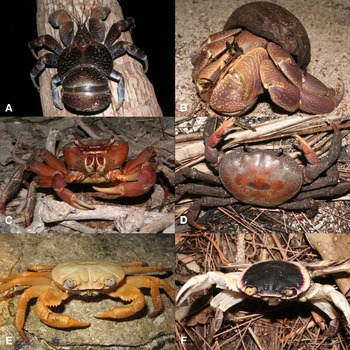
An updated list of the Crustacea Decapoda from the Glorieuses Islands is presented in the Appendix. The taxonomic classification follows De Grave et al. (Reference De Grave, Pentcheff, Ahyong, Chan, Crandall, Dworschak, Felder, Feldmann, Fransen, Goulding, Lemaitre, Low, Martin, Ng, Schweitzer, Tan, Tshudy and Wetzer2009) and the World Register of Marine Species, WoRMS at http://www.marinespecies.org. The list includes 96 records from the taxonomic literature plus 61 new records obtained during this study (in bold). In total, 99 species were recognized during the fieldwork. They can be recognized in the list by being associated with at least one station number (e.g. Station D3, R33) or by the mention of ‘LAND’, for terrestrial species. Fifty distinct species (58 samples) have been collected and deposited in the Muséum national d'Histoire naturelle, Paris, indicated by an MNHN registration number in the list (e.g. MNHN-IU-2013-7158). Species identified only from photographs taken during the BIOTAS 2009 Expedition are identified by ‘BIOTAS photographs’. The WIO indicates the species that are distributed in the western Indian Ocean only. Six terrestrial species are illustrated in colour in Figure 3, and colour photographs of almost all species are available online at http://crustiesfroverseas.free.fr/glorieuses.php.
Terrestrial Decapoda observed at night in the Glorieuses Islands: (A) Birgus latro (Linnaeus, Reference Linnaeus1767); (B) Coenobita brevimanus Dana, Reference Dana1852; (C) Cardisoma carnifex (Herbst, Reference Herbst1796); (D) Discoplax rotunda (Quoy & Gaimard, Reference Quoy and Gaimard1824); (E) Geograpsus crinipes (Dana, Reference Dana1851); (F) Geograpsus grayi (H. Milne Edwards, Reference Milne Edwards1853) (photographs by first author (A–D, F) and Patrick Durville (E)).

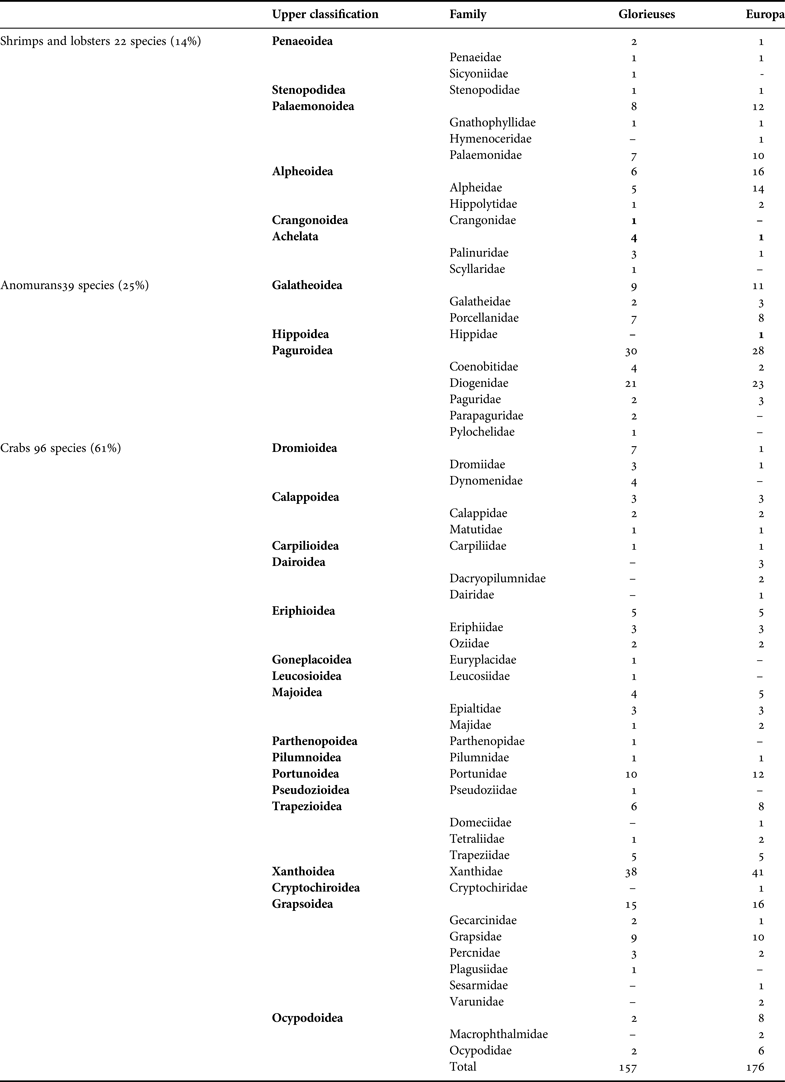
The number of species by family is summarized in Table 2. For comparison purposes results already obtained for Europa Island in the Mozambique Channel (Poupin et al., Reference Poupin, Zubia, Gravier-Bonnet, Chabanet and Malay2013b) are also indicated. Overall the two places appear to have a similar fauna. The few discrepancies observed in Table 2 (e.g. Alpheoidea, Dromioidea, etc.) are not considered significant and can be attributed to either chance, or differing sampling efforts. Also, deep water taxa, such as species of Parapaguridae and Pylochelidae, were not targeted around Europa while they were around the Glorieuses Islands. The single difference that seems to make sense in Table 2 is the absence in the Glorieuses Islands of crabs in the families Sesarmidae and Ocypodidae (genus Uca). These species depend on the mudflats and mangroves of Europa Island, but such habitats are absent around the Glorieuses Islands.
Biodiversity of Decapoda in the Glorieuses Islands expressed as number of species by families and upper classification. For comparative purposes (see text), the right column indicates the results obtained for Europa Island by Poupin et al. (Reference Poupin, Zubia, Gravier-Bonnet, Chabanet and Malay2013).

Most of the species found in the Glorieuses Islands are widespread in the Indo-West Pacific. Among the new records noted in this study, geographical ranges are noticeably extended for two species. Nursia mimetica Nobili, Reference Nobili1906 is a small leucosiid crab that was until recently known only from French Polynesia. Poupin (Reference Poupin2009) recorded it from La Réunion, and the additional specimen reported herein from the Glorieuses Islands confirms its presence in the WIO. The xanthid crab Paramedaeus octogesimus Ng & Clark, Reference Ng and Clark2002 was formerly known only from Hawaii and the Cocos (Keeling) Islands, but was recognized in the Marquesas Islands in 2012 (Legall & Poupin, at: http://crustiesfroverseas.free.fr/). The report in the present work marks a major range extension into the WIO. Seven species of the species listed herein are restricted to the WIO (identified by WIO in the Appendix): anomuran Areopaguristes abbreviatus (Dechancé, Reference Dechancé1963), Calcinus rosaceus Heller, Reference Heller1861, and Ciliopagurus tricolor Forest, Reference Forest and Crosnier1995; and crabs Eriphia smithii MacLeay, Reference MacLeay and Smith1838, Euxanthus rugosus Miers, Reference Miers1884, Liocarpilodes armiger (Nobili, Reference Nobili1905), and Grapsus fourmanoiri Crosnier, Reference Crosnier1965. A single species is only known from the Glorieuses archipelago, the portunid crab Thalamita pseudospinifera Crosnier, Reference Crosnier1975, and thus is potentially endemic.
Terrestrial species, with remarks on the coconut crab (Birgus latro)
Six terrestrial species (Figure 3) were found during nocturnal searches. Except for the coconut crab (see below), all of them are new records for the islands. Four species were observed in Grande Glorieuse, Birgus latro (Linnaeus, Reference Linnaeus1767), Coenobita brevimanus Dana, Reference Dana1852, Discoplax rotunda (Quoy & Gaimard, Reference Quoy and Gaimard1824), and Geograpsus grayi (H. Milne Edwards, Reference Milne Edwards1853), while Cardisoma carnifex (Herbst, Reference Herbst1796) and Geograpsus crinipes (Dana, Reference Dana1851) were observed only on the Ile du Lys. Although it is probable that the ubiquitous Geograpsus crinipes occurs also in Grande Glorieuse, it seems that the land crab Cardisoma carnifex has settled only in the small Ile du Lys where it takes advantage of the central marshy depression to dig its burrows. Many individuals were observed there at night, feeding on dead chicken, at the periphery of the seabird colonies.
The coconut crab, Birgus latro, has now been recollected from the Glorieuses Islands, for the first time, since the first observation and collection made at the Ile du Lys in 1882 during the voyage of the HMS ‘Alert’ (Coppinger, Reference Coppinger1884; Miers, Reference Miers1884), with an adult female deposited in the collections of the British Museum. Bouchard et al. (Reference Bouchard, Poupin, Cleva, Dumas and Dinhut2013) reported seeing the species from Glorieuses in 2011, but this record is based on photographs only. They also indicated its presence in Juan de Nova, Mozambique Channel, based on a personal communication by Jean Hivert. Both records are confirmed herein based on the field observations made at Grande Glorieuse during BIORECIE 2 and a new report made at Juan de Nova in March 2013, again shared by Jean Hivert (personal communication).
The coconut crab is not common in Grande Glorieuse. After eight nights of searching (10–12 pm), in five distinct areas (Figure 2), only four coconut crabs were found, including one ovigerous female. These were seen at a single site, near a small swamp, indicated by the black spot inside the A3 area (Figure 2, at 11°34.767′S 47°17.779′E). According to Jean Hivert (personal communication) the coconut crab is also rare in Juan de Nova where, despite several investigations undertaken during both night and day, it was observed at a single site in April 2011 (near ‘Maison Patureau’, about 9.00 pm, 17°03.119′S 42°43.380′E, 2 specimens) and at two different sites in 2013 (14 March, ‘Camp Séga to Faré’, 9.00 pm, 17°03.015′S 42°43.583′E, 1 specimen; 23 March, south of airstrip, 7.00 am, 17°03.390′S 42°43.043′E, 1 specimen). In comparison, near Zanzibar in Tanzania, Nordlund & Walther (Reference Nordlund and Walther2010) mentioned ‘without any doubt’ more than 280 adult coconut crabs in Chumbe Island, a private nature reserve. Nocturnal searches of the small Ile du Lys failed to find any coconut crab although the specimen collected in 1882 was from this island (Coppinger, Reference Coppinger1884; Miers, Reference Miers1884). As camps belonging to illegal fishermen were observed on the Ile du Lys during BIORECIE 2, it is probable that human predation on this small island is responsible for its disappearance there. On the contrary, the presence of a military detachment that prevents illegal fishing in the waters off Grande Glorieuse also provides good protection for the coconut crab on that island.
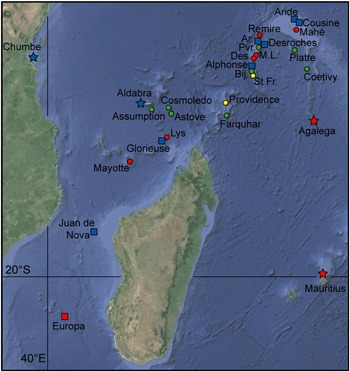
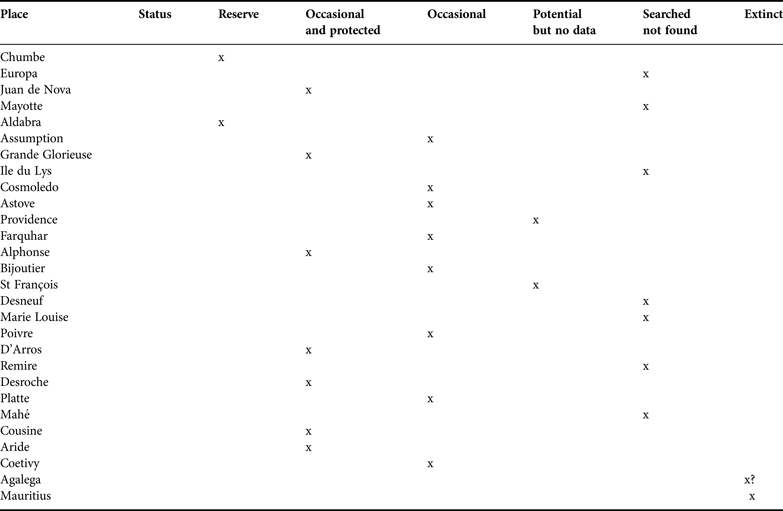
The coconut crab is an endangered species with populations declining throughout its geographical range, and as it is esteemed as food it is particularly vulnerable to human predation. Birgus latro was listed as globally vulnerable in 1981 under the International Union for Conservation of Nature (IUCN) Red List, and although this was downgraded in 1996 to the ‘data deficient’ category, this was not because populations were known to have recovered, but simply because it was recognized there was insufficient good data for decision making. Its geographical distribution in the Indo-West Pacific is shown in Drew et al. (Reference Drew, Harzsch, Stensmyr, Erland and Hansson2010, figure 1a, table A1). The results of the BIORECIE programme, complemented by investigations in the Seychelles by the Island Conservation Society (ICS), between 2006 and 2013, allow the distribution of this species in the WIO to be more precisely defined (Table 3; Figure 4). The western limit of distribution is Chumbe Island, a private nature reserve off Zanzibar, Tanzania, where the crab is abundant. Birgus latro has sometimes been reported from the African mainland (Reyne, Reference Reyne1939); however, it now appears to be extinct there (see Reay & Haig, Reference Reay and Haig1990; Nordlund & Walther, Reference Nordlund and Walther2010). Drew et al. (Reference Drew, Harzsch, Stensmyr, Erland and Hansson2010, table A1) presumed that despite no published records that the species still exists on the Mayotte and Comoros Islands; however, Bouchard et al. (Reference Bouchard, Poupin, Cleva, Dumas and Dinhut2013) did not find it on Mayotte in 2009, despite several inquiries and field investigations. It is therefore probable that Birgus latro is not present in Mayotte nor in the nearby Comoros (Grande Comore, Anjouan and Mohéli) and if they were ever present, then they have long-since been taken as food by the impoverished local human population. In the Scattered Islands visited during the BIORECIE programme the coconut crab was not found in Europa or in the Ile du Lys, but it is present in Juan de Nova and Grande Glorieuse. In the Seychelles, the coconut crab has been over-hunted for food on the granitic islands and inhabited outer islands. Inquiries made by the ICS (see also Bowler, Reference Bowler1999) indicate that the presence of Birgus latro has now been restricted to only the two inner islands, Cousine and Aride (2 specimens seen in 2006 and 1 specimen in 2007). In the Amirantes, it is occasionally observed on D'Arros, Desroches (Jupiter et al., Reference Jupiter, Adeline and Skerrett2013), Alphonse (Duhec, Reference Duhec2011), Bijoutier (1 specimen seen in 2012), and is regularly observed on Coetivy (3 specimens seen in 2010), Assumption, Cosmoledo, Astove, and Farquhar (confirmed in 2012). There is a high probability that they occur in small numbers on Providence and St François but this has not been confirmed. Only Aldabra Atoll, a UNESCO world heritage site, still supports an abundant population of coconut crabs estimated at more than one thousand individuals. In the Agalega Islands (Mauritius Republic) the coconut crab was reported by Haig (Reference Haig and Stoddart1984) but its presence can no longer be confirmed (M.K. Rossan, personal communication). As these are populated islands it may have now become extinct there because of human predation. The crab was reported from Mauritius in 1836 by Darwin (Reference Darwin and Eliot1909) in his narration of the voyage of the ‘Beagle’ but even then he noted that the species was declining. It is now considered extinct there. It is perhaps important to note that the very low incidence of Birgus latro on the islands of the WIO does not necessarily mean that there are still viable populations across most of this area. These animals are slow growing and known to live for at least 40–50 years. Such long-lived species, that most likely have only low and sporadic recruitment, are potentially at great survival risk, and need careful management. Islands such as Aldabra Atoll, where there are still significant populations, are thus crucial reservoirs for repopulating other suitable islands in the WIO.
Distribution of the coconut crab (Birgus latro) in the western Indian Ocean: data from BIORECIE program and ICS investigation, between 2006 and 2013. Blue stars, reserves; squares, effectively protected islands (blue, present; red, searched but not found); spots, non-protected islands (green, occasional; yellow, potential but no data; red, searched but not found); red stars, extinct; Ar., D'Arros; Bij., Bijoutier; Des., Desneuf; M.L., Marie Louise; Pvr, Poivre; St Fr., Saint François. Adapted from ® Google Earth map, available at http://crustiesfroverseas.free.fr/pdf/coconut-crab.kmz.

Distribution status of the coconut crab (Birgus latro) in the western Indian Ocean based on literature, data obtained during the BIORECIE program, and ICS investigation in the Seychelles between 2006 and 2013. ‘protected’, indicates islands that are inhabited by a permanent team that can prevent human predation. The islands are listed from west to east.

Europa Island (22°21′S) lying to the south of the Mozambique Channel would appear at first to be a suitable refuge for Birgus latro, especially as it is permanently protected from human predation by a French military detachment. However, it has never been reported from there and searches over several nights during the BIORECIE 1 Expedition proved to be in vain (Poupin et al., Reference Poupin, Zubia, Gravier-Bonnet, Chabanet and Malay2013b). The pelagic larval development at sea of the coconut crab takes 3–4 weeks (Reese & Kinzie, Reference Reese and Kinzie1968). As it is present in Juan de Nova, 640 km to the north of Europa, crabs on Juan de Nova would be a potential source of recruitment for Europa. In the Mozambique Channel the currents consist of mesoscale anticyclonic and cyclonic eddies (Heileman et al., Reference Heileman, Lutjeharms and Scott2009; Ridderinkhof et al., Reference Ridderinkhof, van der Werf, Ullgren, van Aken, van Leeuwen and de Ruijter2010). These eddies can be equally responsible for retaining larvae close to their source over extended periods of time, or conversely, promoting rapid southward drift along corridors formed by the succession of cyclonic and anticyclonic eddies (Hancke et al., Reference Hancke, Ternon and Roberts2011; J.F. Ternon, personal communication). The most likely explanation for the absence of Birgus latro on Europa Island is that the time taken for oceanic dispersal of larvae between Juan de Nova and Europa is probably far longer than the 4 week larval development phase, and thus recruitment so far south is not successful.
ACKNOWLEDGEMENTS
The programme BIORECIE is part of the projects that were selected through a tender ‘Iles Eparses’ led by the Centre National de la Recherche Scientifique, Institut Écologie et Environnement (CNRS-INEE) with financial support from the Institut National des Sciences de l'Univers (INSU), the Institut de Recherche pour le Développement (IRD), the Agence des Aires Marines Protégées (AAMP), the Fondation pour la Recherche sur la Biodiversité (FRB), and the TAAF, also co-funded by the foundation ‘Veolia Environnement’. Military stationed at the Glorieuses Islands provided accommodation, food, and help for travel across the Island and research at night for the coconut crab. All members of the sailboat ‘Antsiva’, chartered for the BIORECIE 2 Expedition, have greatly contributed to this study and we wish to address them our warmest thanks: SCUBA divers, Bigot Lionel, Durville Patrick, Fournier Martine, Magalon Hélène, Mattio Lydiane and Mulocheau Thierry; captain and crew of the ‘Antsiva’ boat, Tisné, Anne and Nicolas, Miradjy Saïd, and Tombo Raymond. Jean Hivert, a botanist from La Réunion who visits regularly the Scattered Islands for his research has shared very useful information on the presence of Birgus latro at Juan de Nova. The ICS staff, IDC (Island Development Company) staff and Seychelles residents, Jeanne Mortimer, Cyrus Dugasse, Dias Balette, Jean-Baptiste Toussaint, George Berrarie, and Michel Delorie have helped by providing valuable information for the distribution of the coconut crab in the Seychelles. Chantal Conand and the Chumbe natural reserve staff have drawn our attention to recent data for the coconut crab in this reserve. Jean-François Ternon (IRD) and Herman Ridderinkhof, physical oceanographers, have shared data and comments on the current system prevailing in the Mozambique Channel. Arthur Anker and Enrique Macpherson have helped to identify, respectively, the Alpheidae and the Galatheidae. In the Muséum national d'Histoire naturelle, MNHN, Paris, the help of Rachid Kebir, Anouchka Sato, and Paula Martin Lefèvre was greatly appreciated to properly label and register the crustacean samples deposited in this collection.
APPENDIX: LIST OF THE DECAPODA FROM THE GLORIEUSES ISLANDS
See main text for abbreviations used in this list. Species names in bold typeface are new records for the Glorieuses Islands.
-
Order DECAPODA Latreille, 1803
-
Suborder DENDROBRANCHIATA Spence Bate, 1888
-
Superfamily PENAEOIDEA Rafinesque, 1815
-
Family PENAEIDAE Rafinesque, 1815
-
Metapenaeopsis incisa Crosnier, Reference Crosnier and Crosnier1991
-
-
Family SICYONIIDAE Ortmann, 1898
-
Sicyonia fallax De Man, 1907
-
-
Suborder PLEOCYEMATA Burkenroad, 1963
-
Infraorder STENOPODIDEA Bate, 1888
-
Family STENOPODIDAE Claus, 1872
-
Stenopus hispidus (Olivier, 1811)—Station R33
-
-
Infraorder CARIDEA Dana, Reference Dana1852
-
Superfamily PALAEMONOIDEA Rafinesque, 1815
-
Family GNATHOPHYLLIDAE Dana, Reference Rahayu1852
-
Gnathophyllum americanum Guérin-Méneville, 1855—Station R35, 1 spec. MNHN-IU-2013-7158
-
-
Family PALAEMONIDAE Rafinesque, 1815
-
Cuapetes grandis (Stimpson, 1860)—Station R37, 1 spec. MNHN-IU-2013-7148
-
Cuapetes tenuipes (Borradaile, 1898)—Station D3, 1 spec. MNHN-IU-2013-7146
-
Exoclimenella maldivensis Duriš & Bruce, 1995—BIOTAS photographs
-
Harpiliopsis depressa (Stimpson, 1860)
-
Palaemonella crosnieri Bruce, Reference Bruce1978
-
Palaemonella tenuipes Dana, Reference Dana1852
-
Periclimenes imperator Bruce, 1967—BIOTAS photographs
-
-
Superfamily ALPHEOIDEA Rafinesque, 1815
-
Family ALPHEIDAE Rafinesque, 1815
-
Alpheus pacificus Dana, Reference Dana1852—Stations R22 & R30, 2 F ov. MNHN-IU-2013-7147, 1 F ov. R31, MNHN-IU-2013-7159
-
Alpheus roseodigitalis Nomura & Anker, 2005—Station R39, 3 specs MNHN-IU-2013-7160
-
Salmoneus brevirostris (Edmondson, 1930)
-
Synalpheus ? tumidomanus (Paul'son, 1875)—Station D3, 2 specs MNHN-IU-2013-7151
-
Synalpheus neptunus Dana, Reference Dana1852
-
-
Family HIPPOLYTIDAE Bate, 1888
-
Thor amboinensis (De Man, 1888)—Station D3, 1 spec. MNHN-IU-2013-7157
-
-
Superfamily CRANGONOIDEA Haworth, 1825
-
Family CRANGONIDEA Haworth, 1825
-
Parapontophilus abyssi (Smith, 1884)
-
-
Infraorder ACHELATA Scholtz & Richter, 1995
-
Family PALINURIDAE Latreille, 1802
-
Palinustus unicornutus Berry, 1979
-
Panulirus longipes (A. Milne-Edwards, 1868)—Station D11
-
Panulirus versicolor (Latreille, 1804)—Station R23
-
-
Family SCYLLARIDAE Latreille, 1825
-
Chelarctus cultrifer (Ortmann, 1897)
-
-
Infraorder ANOMURA MacLeay, Reference MacLeay and Smith1838
-
Superfamily GALATHEOIDEA Samouelle, 1819
-
Family GALATHEIDAE Samouelle, 1819
-
Galathea spinosorostris Dana, Reference Dana1852
-
Galathea tanegashimae Baba, 1969—Stations D3, 1 spec. MNHN-IU-2013-7316, R22, 1 spec., MNHN-IU-2013-7317, R39, 1 spec. MNHN-IU-2013-7318
-
-
Family PORCELLANIDAE Haworth, 1825
-
Petrolisthes borradailei Kropp, 1983—Stations R30, 7 specs MNHN-IU-2013-7343, R34, 7 specs MNHN-IU-2013-7342
-
Petrolisthes decacanthus Ortmann, 1897
-
Petrolisthes lamarckii (Leach, 1820)—Stations R30, 2 specs MNHN-IU-2013-7344, R34
-
Petrolisthes tomentosus (Dana, Reference Dana1852)
-
Pisidia delagoae (Barnard, 1955)
-
Polyonyx biunguiculatus (Dana, Reference Dana1852)
-
Polyonyx triunguiculatus Zehntner, 1894
-
-
Superfamily PAGUROIDEA Latreille, 1802
-
Family COENOBITIDAE Dana, Reference Dana1851
-
Birgus latro (Linnaeus, Reference Linnaeus1767)—Station ‘LAND’
-
Coenobita brevimanus Dana, Reference Dana1852—Station ‘LAND’
-
Coenobita perlatus H. Milne Edwards, 1837—Stations R29, 1 F juv. MNHN-IU-2013-7345, R37
-
Coenobita rugosus H. Milne Edwards, 1837—Stations R29, 1 F MNHN-IU-2013-7346, R32
-
-
Family DIOGENIDAE Ortmann, 1892
-
Aniculus retipes Lewinsohn, 1982
-
Areopaguristes abbreviatus (Dechancé, Reference Dechancé1963)—WIO
-
Calcinus elegans (H. Milne Edwards, 1836)—Stations R22 & R37
-
Calcinus laevimanus (Randall, 1840)—Stations R22, R32 & R34
-
Calcinus latens (Randall, 1840)—Stations D11, R22, R27, R28, R29, R33, R35 & R39
-
Calcinus morgani Rahayu & Forest, 1999
-
Calcinus pulcher Forest, 1958
-
Calcinus rosaceus Heller, 1861—Stations D3, D12 & R39—WIO
-
Calcinus seurati Forest, 1951—Station R37
-
Calcinus vachoni Forest, 1958
-
Ciliopagurus tricolor Forest, 1995—Station R33—WIO
-
Clibanarius englaucus Ball & Haig, 1972—Station R34, 5 specs MNHN-IU-2013-7347
-
Clibanarius eurysternus (Hilgendorf, 1879)—Station R22
-
Clibanarius virescens (Krauss, 1843)—Stations R30, 7 specs MNHN-IU-2013-7348, R34
-
Dardanus deformis (H. Milne Edwards, 1836)—Station R37
-
Dardanus gemmatus (H. Milne Edwards, 1836)—Station R31
-
Dardanus guttatus (Olivier, 1812)—Stations R30 & R39
-
Dardanus lagopodes (Forskål, 1775)—Stations D3, 1 F ov. MNHN-IU-2013-7349, D11, D12, R29, R31, R33 & R39
-
Dardanus megistos (Herbst, 1804)—Station R22
-
Dardanus scutellatus (H. Milne Edwards, 1848)—Stations D3 & D11
-
Pseudopaguristes laurentae (Morgan & Forest, 1991)
-
-
Family PAGURIDAE Latreille, 1802
-
Pagurixus carinimanus Komai & Osawa, 2006—Station D2, 3 specs MNHN-IU-2013-7352
-
Pagurixus haigae Komai & Osawa, 2007—Stations R22, 4 specs MNHN-IU-2013-7351, R39, 1 F ov., 1 spec. MNHN-IU-2013-7350
-
-
Family PARAPAGURIDAE Smith, 1882
-
Strobopagurus sibogae (de Saint Laurent, 1972)
-
Sympagurus dofleini (Balss, 1912)
-
-
Family PYLOCHELIDAE Bate, 1888
-
Trizocheles hoensonae McLaughlin & Lemaitre, Reference McLaughlin and Lemaitre2009
-
-
Infraorder BRACHYURA Linnaeus, 1758
-
Superfamily DROMIOIDEA De Haan, 1833
-
Family DROMIIDAE De Haan, 1833
-
Cryptodromia fallax (Latreille, in Milbert, 1812)
-
Cryptodromiopsis tridens Borradaile, 1903
-
Dromidiopsis tridentata Borradaile, 1903
-
-
Family DYNOMENIDAE Ortmann, 1892
-
Dynomene hispida (Latreille, in Milbert, 1812)—Station R39, 1 spec. MNHN-IU-2013-7326
-
Dynomene praedator A. Milne-Edwards, 1879
-
Hirsutodynomene spinosa (Rathbun, 1911)
-
Metadynomene crosnieri McLay, Reference McLay and Crosnier1999
-
-
Superfamily CALAPPOIDEA De Haan, 1833
-
Family CALAPPIDAE De Haan, 1833
-
Calappa gallus (Herbst, 1803)
-
Calappa hepatica (Linnaeus, 1758)
-
-
Family MATUTIDAE De Haan, 1835
-
Ashtoret lunaris (Forskål, 1775)—Stations R28 & R33, 1 F MHHN-IU-2013-7339
-
-
Superfamily CARPILIOIDEA Ortmann, 1893
-
Family CARPILIIDAE Ortmann, 1893
-
Carpilius convexus (Forskål, 1775)—Stations D3 & R22
-
-
Superfamily ERIPHIOIDEA MacLeay, Reference MacLeay and Smith1838
-
Family ERIPHIIDAE MacLeay, Reference MacLeay and Smith1838
-
Eriphia scabricula Dana, 1852—Stations R22, 1 M MNHN-IU-2013-7338, R37
-
Eriphia sebana (Shaw & Nodder, 1803)—Stations R22, R34 & R37
-
Eriphia smithii MacLeay, 1838—Station R37—WIO
-
-
Family OZIIDAE Dana, Reference Dana1851
-
Eupilumnus calmani (Balss, 1933)—Stations D3 & R39, 1 F MNHN-IU-2013-7340
-
Lydia annulipes (H. Milne Edwards, 1834)—Stations R22, R32 & R37
-
-
Superfamily GONEPLACOIDEA MacLeay, Reference MacLeay and Smith1838
-
Family EURYPLACIDAE Stimpson, 1871
-
Platyozius laevis (Borradaile, 1902)—BIOTAS photographs
-
-
Superfamily LEUCOSIOIDEA Samouelle, 1819
-
Family LEUCOSIIDAE Samouelle, 1819
-
Nursia mimetica Nobili, 1906—Station R22, 1 spec. MNHN-IU-2013-7315
-
-
Superfamily MAJOIDEA Samouelle, 1819
-
Family EPIALTIDAE MacLeay, Reference MacLeay and Smith1838
-
Menaethius orientalis (Sakai, 1969)—BIOTAS photographs
-
Perinia tumida Dana, Reference Dana1851—Station D3, 1 spec. MNHN-IU-2013-7330
-
Tylocarcinus styx (Herbst, 1803)—Station D2
-
-
Family MAJIDAE Samouelle, 1819
-
Pseudomicippe aff. varians Miers, 1879—Station R37, 1 F MNHN-IU-2013-7327
-
-
Superfamily PARTHENOPOIDEA MacLeay, Reference MacLeay and Smith1838
-
Family PARTHENOPIDAE MacLeay, Reference MacLeay and Smith1838
-
Daldorfia horrida (Linnaeus, 1758)—Station R37, 1 M MNHN-IU-2013-7341
-
-
Superfamily PILUMNOIDEA Samouelle, 1819
-
Family PILUMNIDAE Samouelle, 1819
-
Pilumnus ? longicornis Hilgendorf, 1878—Station R39, 1 spec. MNHN-IU-2013-7356
-
-
Superfamily PORTUNOIDEA Rafinesque, 1815
-
Family PORTUNIDAE Rafinesque, 1815
-
Charybdis annulata (Fabricius, 1798)—Station R30, 1 F ov. MNHN-IU-2013-7313
-
Charybdis obtusifrons Leene, 1937—Station D11
-
Cycloachelous granulatus (H. Milne Edwards, 1834)—BIOTAS photographs
-
Thalamita cooperi Borradaile, 1902
-
Thalamita foresti Crosnier, 1962—Station R30, 1 spec. MNHN-IU-2013-7312
-
Thalamita gloriensis Crosnier, Reference Crosnier1962
-
Thalamita picta Stimpson, 1858—Station R22, 1 spec. MNHN-IU-2013-7311, R33
-
Thalamita pseudospinifera Crosnier, Reference Crosnier1975
-
Thalamita sima H. Milne Edwards, 1834
-
Thalamitoides quadridens A. Milne-Edwards, 1869—BIOTAS photographs
-
-
Superfamily PSEUDOZIOIDEA Alcock, 1898
-
Family PSEUDOZIIDAE Alcock, 1898
-
Pseudozius caystrus (Adams & White, 1849)—Stations R30, 5 specs MNHN-IU-2013-7333, R34, 3 juv. MNHN-IU-2013-7334
-
-
Superfamily TRAPEZIOIDEA Miers, 1886
-
Family TETRALIIDAE Castro, Ng & Ahyong, 2004
-
Tetraloides nigrifrons (Dana, Reference Dana1852)
-
Family TRAPEZIIDAE Miers, 1886
-
Trapezia bidentata (Forskål, 1775)—Station D3
-
Trapezia cymodoce (Herbst, 1801)
-
Trapezia digitalis Latreille, 1828
-
Trapezia lutea Castro, 1997—Station R39, 1 M MNHN-IU-2013-7328
-
Trapezia rufopunctata (Herbst, 1799)—Station D3
-
-
Superfamily XANTHOIDEA MacLeay, Reference MacLeay and Smith1838
-
Family XANTHIDAE MacLeay, Reference MacLeay and Smith1838
-
Actaea polyacantha (Heller, Reference Heller1861)
-
Actaeodes hirsutissimus (Rüppell, 1830)—Station R39, 1 juv. MNHN-IU-2013-7359
-
Actaeodes tomentosus (H. Milne Edwards, 1834)
-
Atergatis floridus (Linnaeus, 1767)—Station R34, 1 juv. MNHN-IU-2013-7337
-
Atergatopsis signata (Adams & White, 1849)
-
Chlorodiella barbata (Borradaile, 1900)
-
Chlorodiella cytherea (Dana, Reference Dana 1852 )—Station R39, 1 juv. MNHN-IU-2013-7360
-
Chlorodiella laevissima (Dana, Reference Dana1852)—Stations D2 & R28
-
Cyclodius granulosus De Man, 1888—Station R33
-
Cyclodius nitidus (Dana, Reference Dana1852)
-
Cyclodius ungulatus (H. Milne Edwards, 1834)—Station R39, 1 F MNHN-IU-2013-7353
-
Etisus dentatus (Herbst, 1785)—Station R37
-
Euxanthus exsculptus (Herbst, 1790)—Station R33
-
Euxanthus rugosus Miers, 1884—WIO
-
Forestia depressa (White, 1848)
-
Kraussia rugulosa (Krauss, 1843)—Station R34, 7 specs MNHN-IU-2013-7331
-
Lachnopodus subacutus (Stimpson, 1858)
-
Leptodius nudipes (Dana, Reference Dana1852)
-
Leptodius sanguineus (H. Milne Edwards, 1834)—Station R34, 1 F, 1 juv. MNHN-IU-2013-7332
-
Liocarpilodes armiger (Nobili, Reference Nobili1905)—WIO
-
Liocarpilodes integerrimus (Dana, Reference Dana 1852 )—Station R39, 1 spec. MHNH-IU-2013-7314
-
Liomera bella (Dana, Reference Dana1852)
-
Liomera cinctimana (White, 1847)
-
Liomera rubra (A. Milne-Edwards, 1865)
-
Liomera rugata (H. Milne Edwards, 1834)
-
Lybia tessellata (Latreille, in Milbert, 1812)
-
Macromedaeus nudipes (A. Milne-Edwards, 1867)—Station R34
-
Neoxanthias impressus (Latreille, in Milbert, 1812)—BIOTAS photographs
-
Paractaea retusa (Nobili, Reference Nobili1905)
-
Paramedaeus octogesimus Ng & Clark, 2002—Station D3, 1 F ov. MNHN-IU-2013-7354
-
Paramedaeus simplex (A. Milne-Edwards, 1873)—Station R39, 1 juv. MNHN-IU-2013-7355
-
Pilodius areolatus (H. Milne Edwards, 1834)—Stations D11 & R27
-
Pilodius pugil Dana, 1852—Station R39, 2 juv. MNHN-IU-2013-7358
-
Pilodius scabriculus Dana, 1852
-
Pilodius spinipes (Heller, Reference Heller1861)—Station R39, 1 M MNHN-IU-2013-7357
-
Tweedieia laysani (Rathbun, 1906)—BIOTAS photographs
-
Zosimus aeneus (Linnaeus, 1758)
-
Zozymodes cavipes (Dana, Reference Dana1852)—Stations R30, 3 F MNHN-IU-2013-7335, R34, 2 M, 1 F MNHN-IU-2013-7336
-
-
Superfamily GRAPSOIDEA MacLeay, Reference MacLeay and Smith1838
-
Family GECARCINIDAE MacLeay, Reference MacLeay and Smith1838
-
Cardisoma carnifex (Herbst, 1796)—Station ‘LAND’
-
Discoplax rotunda (Quoy & Gaimard, Reference Quoy and Gaimard 1824 )—Station ‘LAND’
-
-
Family GRAPSIDAE MacLeay, Reference MacLeay and Smith1838
-
Geograpsus crinipes (Dana, Reference Dana 1851 )—Station ‘LAND’
-
Geograpsus grayi (H. Milne Edwards, Reference Milne Edwards 1853 )—Station ‘LAND’, 1 F MNHN-IU-2013-7321
-
Grapsus fourmanoiri Crosnier, 1965—Stations R22 & R34, 1 spec. MNHN-IU-2013-7319, 2 specs MHNH-IU-2013-7322, R37—WIO
-
Grapsus longitarsis Dana, 1851—Station R37
-
Grapsus tenuicrustatus (Herbst, 1783)—Stations R22, R30, R32, R34 & R37
-
Pachygrapsus minutus A. Milne-Edwards, 1873—Stations R22, R30 & R34, 7 specs MNHN-IU-2013-7323
-
Pachygrapsus planifrons De Man, 1888—Stations R22 & R34, 1 spec. MNHN-IU-2013-7324
-
Pachygrapsus plicatus (H. Milne Edwards, 1837)—Station R34, 2 specs MNHN-IU-2013-7325
-
Planes major (MacLeay, 1838)—Station D3 (drifting with a buoy)
-
-
Family PERCNIDAE Števcic, 2005
-
Percnon abbreviatum (Dana, Reference Dana1851)
-
Percnon guinotae Crosnier, Reference Crosnier1965
-
Percnon planissimum (Herbst, 1804)—Stations R22 & R31
-
Family PLAGUSIIDAE Dana, Reference Dana1851
-
Plagusia immaculata Lamarck, 1818—Station R22 (drifting on a buoy), 1 M, 1 F MNHN-IU-2013-7320
-
-
Superfamily OCYPODOIDEA Rafinesque, 1815
-
Family OCYPODIDAE Rafinesque, 1815
-
Ocypode ceratophthalmus (Pallas, 1772)—Station R31, 1 juv. MNHN-IU-2013-7329, Stations R32 & R37
-
Ocypode cordimanus Latreille, 1818—Station R27
-