INTRODUCTION
Artificial reefs are commonly used as a tool for fishery management (Caddy, Reference Caddy1999; Fabi et al., Reference Fabi, Luccarini, Psnfili, Solustri and Spagnolo2002), protection of marine areas from illegal fishing, and more recently for the preservation and rehabilitation of natural habitats (Boaventura et al., Reference Boaventura, Moura, Leitão, Carvalho, Cúrdia, Pereira, Fonseca, Santos and Monteiro2006). Artificial reefs are usually located on extensive sandy areas, isolated from natural rocky reefs, making them potential tools in the alteration of species abundance and distribution of the associated communities in the sediment around the reefs (Ambrose & Anderson, Reference Ambrose and Anderson1990).
The influence of artificial reef impacts may be relatively small or extend several hundred metres from the reef (Wilding & Sayer, Reference Wilding and Sayer2002) and the environment may be impacted in several ways, including leaching of toxic fractions from the construction material through the interaction of the structure with the local current regime (Pickering, Reference Pickering1996; Boaventura et al., Reference Boaventura, Moura, Leitão, Carvalho, Cúrdia, Pereira, Fonseca, Santos and Monteiro2006), modifying rates and processes of sedimentation, distribution and classification of grain size (Danovaro et al., Reference Danovaro, Gambi, Mazzola and Mirto2002), or even promoting alterations in the wave marks in the sediment (Davis et al., Reference Davis, Vanblaricom and Dayton1982). The physical presence of the reef structure and the water flux generated by waves and currents constantly remobilizes the nearby sediment, mainly in shallow areas (Reineck & Singh, Reference Reineck and Singh1973; Fritz & Moore, Reference Fritz and Moore1988). These modifications in the wave marks in the reef environment may promote alterations in the composition and abundance of benthic organisms, mainly those that live in the upper layers of the sediment, or at the sediment–water interface (Lorenzi, Reference Lorenzi2004). However, information on changes in the hydrodynamics induced by cement blocks is scarce (Ambrose & Anderson, Reference Ambrose and Anderson1990; Badalammenti & D'Anna, Reference Badalamenti and D'Anna1996; Danovaro et al., Reference Danovaro, Gambi, Mazzola and Mirto2002; Fabi et al., Reference Fabi, Luccarini, Psnfili, Solustri and Spagnolo2002).
Decreases in current speed at the reef perimeter are likely to allow the sedimentation of fine material including organic particles with a subsequent decrease in mean particle size and concomitant nutrient enrichment (Guiral et al., Reference Guiral, Gourbalt and Helleouet1995). A higher quantity of algae and other organic material such as faecal material and dead organisms associated with the reefs also occurs, and increases the organic matter in the sediment (Ambrose & Anderson, Reference Ambrose and Anderson1990).
Danovaro et al. (Reference Danovaro, Gambi, Mazzola and Mirto2002) described how artificial reefs could affect the adjacent infauna community: (a) by altering the hydrodynamic regime and physical characteristics of the substrate; (b) by modification of the distribution and/or composition of food resources; and (c) by alteration of the biological interactions among different parts of the food chain. One of these factors may prevail over the others or the different forces may act simultaneously, resulting in complex responses of the infauna.
The reefs are not self-sustainable since many predators that are associated with these environments use the reef structures mainly for shelter and depend on the adjacent unconsolidated sediment to obtain food (Parrish & Zimmerman, Reference Parrish and Zimmerman1977; Bray et al., Reference Bray, Miller and Gessey1981; Nelson et al., Reference Nelson, Navratil, Savercool and Vose1988; Hueckel et al., Reference Hueckel, Buckley and Benson1989; Frazer et al., Reference Frazer, Lindberg and Stanton1991; Posey & Ambrose, Reference Posey and Ambrose1994). The predation exerted by the ichthyofauna on the unconsolidated substrate community may form a trophic halo, reducing the occurrence of these preys close to the structures (Posey & Ambrose, Reference Posey and Ambrose1994; Barros et al., Reference Barros, Underwood and Lindergarth2001; Lorenzi & Borzone, Reference Lorenzi and Borzone2009). Ambrose & Anderson (Reference Ambrose and Anderson1990) suggest that physical parameters may influence the infauna abundance pattern more than predation, and reef distance was considered the principal factor influencing the community.
Studies of artificial reefs have almost exclusively centred on attraction and feeding ecology of fish (Osenberg et al., Reference Osenberg, Mary, Wilson and Lindberg2002; Relini et al., Reference Relini, Relini, Giovanni and Angelis2002a) and on the colonization of the reef modules by epifauna and reef fish (Badalamenti et al., Reference Badalamenti, Chemello, D'Anna, Henriquez Ramos and Riggio2002; Steimle et al., Reference Steimle, Foster, Kropp and Conlin2002; Boaventura et al., Reference Boaventura, Moura, Leitão, Carvalho, Cúrdia, Pereira, Fonseca, Santos and Monteiro2006). Knowledge on how benthic assemblages respond to increasing reef distance is restricted to few studies, mostly performed in the northern hemisphere (Danovaro et al., Reference Danovaro, Gambi, Mazzola and Mirto2002; Fabi et al., Reference Fabi, Luccarini, Psnfili, Solustri and Spagnolo2002; Steimle et al., Reference Steimle, Foster, Kropp and Conlin2002; Wilding & Sayer, Reference Wilding and Sayer2002; Wilding, Reference Wilding2006). In Brazil, the studies have followed the same tendency in the State of Ceará (Conceição et al., Reference Conceição, Marinho, Franklin, Lopes and Carpegiani2007) and in the north of the State of Rio de Janeiro (Zalmon & Gomes, Reference Zalmon and Gomes2003; Krohling et al., Reference Krohling, Brotto and Zalmon2006; Brotto & Zalmon, Reference Brotto and Zalmon2007; Krohling et al., Reference Krohling, Brotto and Zalmon2008; Santos et al., Reference Santos, Brotto and Zalmon2010). Two exceptions are the studies of Soares-Gomes et al. (Reference Soares-Gomes, Oliveira, Gabardo, Carreira and Fernandez2000) that characterized the meiofauna around an oil rig off Rio de Janeiro and Lorenzi (Reference Lorenzi2004) that characterized the infauna associated with an artificial reef employed in the south of Brazil.
The analysis of the influence of artificial marine reefs on the adjacent infauna, proposed here, is part of the research project ‘Artificial reef program on the northern coast of the State of Rio de Janeiro’ started in 1996. Here, we analyse the benthic assemblages in increasing distances from artificial reefs deployed along the north coast of Rio de Janeiro, south-eastern Brazil. Our purpose was to experimentally address whether soft benthic community structure was affected by increasing distance (0, 5, 25, 100 and 300 m) from the artificial reefs, and that this effect was linked to sediment particle size and the amount of organic carbon, as a function of proximity to the reef modules.
MATERIALS AND METHODS
Study area
The north coast of Rio de Janeiro (south-eastern Brazil) (Figure 1) is naturally lacking rocky or other hard substrates, and is covered by extensive sandy beaches with variable amounts of mud and calcareous nodules (i.e. rhodolites; Zalmon et al., Reference Zalmon, Novelli, Gomes and Faria2002). This area is located in a transitional zone between warm and oligotrophic waters of the Brazil Current from the north and cold, nutrient-rich upwelling of the South Atlantic Central Water from the south (Valentin & Monteiro-Ribas, Reference Valentin and Monteiro-Ribas1993). Primary productivity (chlorophyll-a) is low, Secchi depth does not exceed 4 m, and strong bottom currents are common (Krohling et al., Reference Krohling, Brotto and Zalmon2008). Although dominated by oligotrophic waters and homogeneous bottom relief, the north coast of Rio de Janeiro is often exploited by local inshore artisanal fishermen (Zalmon et al., Reference Zalmon, Novelli, Gomes and Faria2002).
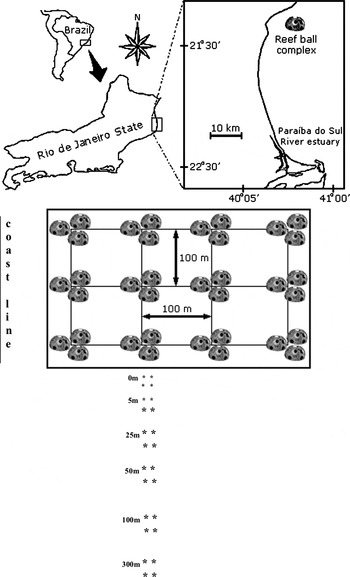
Geographical location of the north coast of Rio de Janeiro (south-eastern Brazil), where the reef complex was deployed (21°29S 41°00′W). The spatial arrangement of the reef ball replicates and sets, and the transect disposal with the six sampling distances (N = 4 sampling units/distance) are also shown.

Together with oceanic circulation, the north coast of Rio de Janeiro is also strongly influenced by weather and freshwater runoff. The outflow of the Paraíba do Sul River (the largest river in Rio de Janeiro State) is especially important during the rainy period (December to February), when a turbid (Secchi depth <0.5 m) and polyhaline (18–33 psu) estuarine plume spreads over 15 km north from the river mouth, covering most of the continental shelf up to ~10 km distant from the shore (Godoy et al., Reference Godoy, Almeida and Zalmon2002). This plume does not, however, reach the sea bottom during the rainy period, because the local trade winds lead to the intrusion of clearer and saline bottom waters. During the dry period (April to November), but mostly during winter, the intensity of south-west winds increases, stratification ceases and, consequently, water turbidity increases significantly near the bottom (Godoy et al., Reference Godoy, Almeida and Zalmon2002; Zalmon, personal observation).
EXPERIMENTAL DESIGN
Thirty-six prefabricated concrete reef balls® (~1.0 m3; 0.5 ton) were deployed in January 2002 on a flat and homogeneous bottom, 9 m deep, and 10 km offshore of the Guaxindiba Beach (21°29′S 41°00′W), northern Rio de Janeiro coast (Figure 1). Artificial reefs were arranged in sets (following the terminology proposed by Grove et al., 1991) of three reef balls (~0.5 m distance) and positioned 100 m apart from each other, in a 3 × 4 reef system configuration that covered ~60.000 m2 of sea bottom (Figure 1). The reef balls' location were marked using global positioning system (GPS).
The surrounding infauna near the artificial reefs was surveyed in November 2006 (end of the dry period) and February 2007 (end of the rainy period) at six distances from the reefs: 0, 5, 25, 50, 100 and 300 m, on the reef side parallel to the coastline, following the main current (Brazilian Current). At each sampling period, three of ten reef sets, located on the periphery of the reef system were selected and surveyed at each of the six distances (following a virtual transect, orthogonal to the reef set, starting at the edge of the reef system and located on the middle of the square reef). Four sediment samples were collected up to 10 cm deep and 2–3 m distant from each reef set with a PCV tube with 15 cm diameter. Three sediment samples from each distance of the reef ball structure system were processed for macrofaunal identification (mean values) and one for particle size and geochemical analysis for organic content and carbonate (absolute values). Each sediment sample for macrofaunal analysis was washed using seawater through a 0.5 mm mesh and then preserved in borax buffered 4% formaldehyde solution containing 0.2 g/l rose Bengal (Sigma). The macrofauna identification followed Rios (Reference Rios1994), Amaral & Nonato (Reference Amaral and Nonato1996) and Melo (Reference Melo1996).
The particle size analysis is described in Suguio (Reference Suguio1973) and the sediment was categorized according to Wentworth (Reference Wentworth1922). Carbonate analysis followed the method of Dean (Reference Dean1974) and organic content was processed with a CHNS/O Perkin Elmer (2400 serie II) Analyzer.
Data analyses
Richness and abundance were used as benthic community descriptors with increasing distances from the reef in both temporal surveys and evaluated by analyses of variance (ANOVAs). The sampling distances were considered as an orthogonal and fixed factor, while the surveys were an orthogonal and random factor. Log10 (X + 1) transformations were applied for variances homogeneity (Underwood, Reference Underwood, Resetarits and Bernardo1998).
Differences in the community composition between the treatments (dry × rainy periods and distances) were visualized using non-metric multidimensional scaling (MDS) based on the Bray–Curtis dissimilarity matrix. These analyses were performed with the statistical package PRIMER® (V.6). Permutational multivariate analyses of variance (PERMANOVAs) were applied for multivariate comparisons of the benthic community composition among the six experimental reef distances. The Bray–Curtis similarity distance was chosen as the basis for all PERMANOVAs and data were permutated 9999 times per analysis at an α-level of 0.05 (Manly, Reference Manly1997). When significant differences were found, pair-wise post-hoc comparisons were performed using 9999 permutations (see Anderson, Reference Anderson2005 for further details). Data were square root transformed for PERMANOVAs.
The fauna composition and the sediment variables related to both surveys and to increasing distances were analyzed using canonical correspondence analysis with CANOCO® (V4.5). The significance of the measured environmental variables was tested using Monte Carlo permutation tests (Ter Braak, Reference Ter Braak1986), and only those variables making a significant (P < 0.05) contribution to the species–environment ordination were included in the final analysis and the ordination diagram.
RESULTS
Sediment characterization
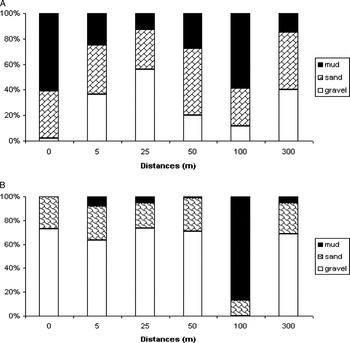
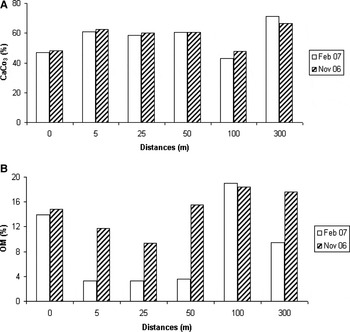
The sediments at the six distances were not visually distinct, predominating sand in November 2006 (Figure 2A) and gravel in February 2007 (Figure 2B). The particle size difference occurred mainly at the reef and at 100 m distance, with >60% of mud (Figure 2). On both surveys the carbonate percentages were similar at the reef and at 100 m distance with less than 50%, while at the other distances remained between 60 and 70% (Figure 3A). Organic content values were superior at the reef and at the higher distances 100 and 300 m, respectively (Figure 3B).
Percentage absolute values for the granulometric composition of the sediment measured at six sampling distances around the reef complex in November 2006 (A) and February 2007 (B).

Percentage absolute values for the geochemical variables carbonate (A) and organic matter (B) of the sediment measured at six sampling distances around the reef complex in November 2006 and February 2007.

BENTHIC COMMUNITY
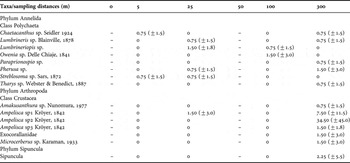
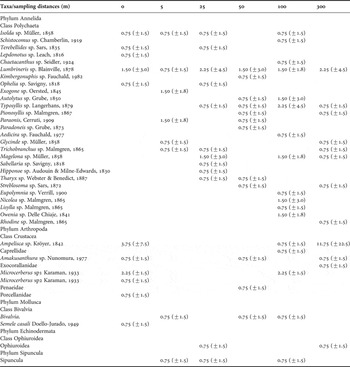
In November 2006 a total of 15 taxa and 219 individuals were collected, including 8 taxa and 48 individual of polychaetes, 6 taxa and 165 individuals of Crustacea and 1 taxon and 6 individuals of Sipuncula in four distances: 5, 25, 100 and 300 m (Table 1). At the reef (0 m) and at 50 m no organism was collected during this sampling survey. The highest number of taxa (N = 12), abundance (N = 180) and Shannon diversity (H′ = 0.7) was registered at the 300 m distance (Figure 4A, B, C). The amphipod Ampelisca spp. represented 70% of the total number of individuals at this distance during the November sampling survey. At 5 and 100 m we collected only two taxa of polychaetes and at 25 m, four taxa of polychaetes and one Crustacea (Table 1).
Mean and standard deviation (N = 3 samples) for richness, mean number of individuals and Shannon diversity (H′) at the six sampling distances in November 2006 and February 2007.

Benthic macrofauna recorded in November 2006 at the six sampling distances from the artificial reef on the north coast of Rio de Janeiro, south-eastern Brazil. Average number of individuals (±SD) at each distance (N = 3 sampling units/distance).

In the February survey we collected 39 taxa and 334 individuals. These included polychaetes (27 taxa and 66 individuals), Crustacea (8 taxa and 35 individuals), Bivalva (2 taxa and 4 individuals), Sipuncula (1 taxon and 3 individuals) and Ophiuroidea (1 taxon and 2 individuals) at all the six distances sampled (Table 2) The highest richness of taxa (N = 18) and diversity (H′ = 0.8) occurred at 100 m, followed by 300 m, where the highest number of individuals was found (N = 84) (Figure 4A, B, C). As in the previous sampling survey, the amphipod Ampelisca spp. predominated at 300 m, accounting for 55% of the individuals. In the reefs and at 300 m, the crustaceans were the main components (61%), while at the other distances polychaetes were responsible for 70% of the individuals (Table 2).
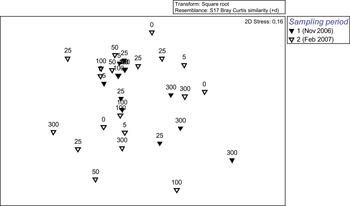
Non-metric multidimensional scaling of the benthic community at different sampling distances, considering the three sampling units at each distance of the reef ball structure system in November 2006 and February 2007.

Benthic macrofauna recorded in February 2007 at the six sampling distances from the artificial reef on the north coast of Rio de Janeiro, south-eastern Brazil. Average number of individuals (±SD) at each distance (N = 3 sampling units/distance).

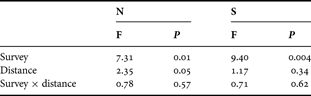
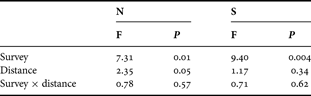
Benthic taxa richness and abundance varied significantly between surveys (P = 0.01) with higher values in the February 2007 samples (Table 3; Figure 4). Both numerical indicators changed similarly with reef distance, but more noticeably between 300 m and the other distance treatments for abundance (Figure 4). Also, ANOVA results revealed that abundance in the 300 m assemblage trended to be significantly higher (P = 0.05) than those at the closer sites. No significant sampling survey × reef-distance interaction was found (P > 0.05), and these results indicated that changes in benthic assemblages with reef distance were not affected by the survey or sampling distance.
Analysis of variance results. F and P values for sampling distance and survey variables related to abundance (N, number of individuals/0.018 m2) and richness (S, taxon richness/0.018 m2).
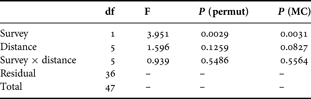
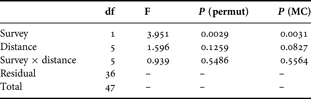
The MDS ordination indicated that macrobenthic assemblages, including all taxa in both surveys and at the six sampling distances, were very heterogeneous (Figure 5). Agreeing with the previous results, PERMANOVA also indicated significant differences (Table 4) in macrobenthic assemblages between surveys (F1,47 = 3.951, P = 0.0029) but not among sampling distances (F5, 47 = 1.596, P = 0.1259), in which none differed significantly from each other (PERMANOVAs pair-wise post-hoc tests; P > 0.05). No significant sampling survey × reef-distance interaction was found (P > 0.05).
Permutational multivariate analysis of variance results applied to a Bray–Curtis similarity matrix considering the sampling distances and surveys as a hierarchical factor.
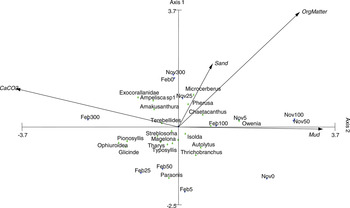
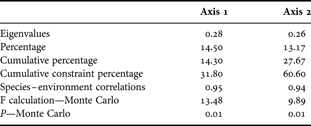
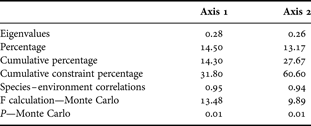
Two significant canonical axes were extracted in the canonical correspondence analysis (Table 5). The first one explained 15% of the species variation, of which 32% could be attributed to the sediment variables. The concentration of CaCO3 showed the highest correlation with the first axis and the disposition of the points in relation to the artificial reef revealed this effect at the 300 m distance in the February sampling survey. The highest abundances of Pionosyllis, Ophiuroidea and Glicinde contrasted with the low abundances at 0, 50 and 100 m distances from the reefs, both in November and February surveys (Figure 6). The second canonical axis was also significant, according to the Monte Carlo test, explaining 13% of the variance in the species abundance. The organic matter concentration in the sediment had the highest correlation with this axis (Figure 6). The samples disposition (distance from the reef) also showed this effect at the 300 m distance in the November sampling survey compared to the other distances in both surveys (November and February). Both axes had a gradient related to distance from the reefs. In November at 300 m there was an increase in the abundance of Microcerberus, Excorallanidae and Ampelisca sp. 1.
Canonical correspondence analysis including sampling distance (0, 5, 25, 50, 100 and 300 m from the reef), sediment variables (CaCo3, sand, mud and organic matter) and taxa in November 2006 (Nov) and February 2007 (Feb).

Eigenvalues, explanation percentages, species x axis correlation and Monte Carlo result for the canonical significance.
DISCUSSION
The sampling point located in the reef complex had more silt than the ones farther away, except for the 100 m sampling distance, indicating that reefs may have an influence on fine sediment deposition. Danovaro et al. (Reference Danovaro, Gambi, Mazzola and Mirto2002) showed that a direct consequence of the lower sandy fraction near reefs in the Adriatic Sea was a reduction in the current velocity around the reef modules. However, these authors did not observe this effect near Mediterranean reefs. In shallow waters in southern California, Davis et al. (Reference Davis, Vanblaricom and Dayton1982) found a perceptible physical effect only in small areas in the immediate vicinity of the reef structures, without measurable effects in the undulation patterns in the sediment, grain size and organic carbon. Langlois et al. (Reference Langlois, Anderson and Babcock2005; Reference Langlois, Anderson and Babcock2006) studied the effect of artificial reefs on the surrounding region at three sites in north-eastern New Zealand and also did not verify differences in the sediment around any of the study sites.
In contrast to the previously cited studies, Ambrose & Anderson (Reference Ambrose and Anderson1990), Posey & Ambrose (Reference Posey and Ambrose1994) and Barros et al. (Reference Barros, Underwood and Lindergarth2001) recorded a higher percentage of coarse sediment in areas near the reefs, while a higher fraction of fine sediment was found only in samples collected more than 10 m distant from the reef complexes. Barros et al. (Reference Barros, Underwood and Lindergarth2001) attributed this effect to the artificial reef structures that acted as a source of calcium carbonate for the closer sediment, due to the molluscs and crustaceans associated with the reefs. In artificial reefs deployed on the north coast of Rio de Janeiro, the epifauna of the modules is mainly composed of cnidarians such as arborescent hydrozoans and the Octocorallia Carijoa sp., while molluscs (Ostrea sp.) and crustaceans (Cirripedia) predominated in the initial stages of colonization (Zalmon & Gomes, Reference Zalmon and Gomes2003; Krohling et al., Reference Krohling, Brotto and Zalmon2006), justifying the absence of shells (the large fraction of the coarse sediments) and the lower percentage of CaCO3 in the surrounding areas of these reefs. Other organisms could contribute to higher percentage of CaCO3, like planktonic or benthic foraminifera, typically found in tropical warm waters, and their deposition could be related to a reduction in current velocities for example. However, the local current velocity is always >1.0 knot (Godoy et al., Reference Godoy, Almeida and Zalmon2002).
The concentration of carbonate and the grain size varied together, and sampling points with higher percentages of gravel (5, 25 and 300 m) also had higher percentages of carbonate, which suggest a biodetritic source. Also, the amount of organic matter was associated with the percentage of silt. Silty sediments generally had a higher organic matter content than sediments with coarser grain size, since organic matter tends to be associated with sediment deposition in slower moving water (Snelgrove & Butman, Reference Snelgrove and Butman1994). This effect might be related to the reef complex influence on the deposition of fine sediments with a subsequent increase in the concentration of organic matter. Fabi et al. (Reference Fabi, Luccarini, Psnfili, Solustri and Spagnolo2002) also verified that an artificial reef complex on a Mediterranean coast favoured the silt deposition (fine sediment) and the accumulation of organic matter within the reef area. Airoldi et al. (Reference Airoldi, Abbiati, Beck, Hawkins, Jonsson, Martin, Moschella, Sundelof, Thompson and Aberg2005) considered the artificial reef impacts on a local scale as the change in grain size and organic matter content, aside from the reduction in habitats in consolidated substrate. On a time scale, these authors evaluated that, in general, the grain size of the sediment decreased while the organic matter content increased.
The higher values of organic matter at the reef and at 100 and 300 m initially suggest that the influence area of the artificial reefs might surpass 300 m. The organic matter in the reefs may be derived from the remains of the organisms that grow on the experimental modules (Krohling et al., Reference Krohling, Brotto and Zalmon2006), faecal matter from the fish, principally juveniles, that use the reefs for shelter or feeding (Brotto et al., Reference Brotto, Krohling and Zalmon2006) or others that visit these structures and have a wider distribution (Zalmon et al., Reference Zalmon, Novelli, Gomes and Faria2002). The similarity of the infauna at the different sampling points suggests our hypothesis that the influence of the artificial reefs is rapidly ‘lost’, being dissipated due to strong marine currents at the site (Godoy et al., Reference Godoy, Almeida and Zalmon2002). Currents higher than 1.0 knot are commonly registered in the area during the year (Godoy et al., Reference Godoy, Almeida and Zalmon2002) and the size of the reef complex (300 × 200 m) suggests a reduced influence or impact of the experimental modules on the adjacent macrobenthic community.
Davis et al. (Reference Davis, Vanblaricom and Dayton1982) in southern California showed a very small influence of artificial reefs on the surrounding infauna, being present only in samples very close to the reef. These authors suggest that the macrofauna is less sensitive to effects associated with the reefs than the larger sessile epifauna, and the life history of the infauna (e.g. high larval recruitment frequency) allows a rapid recuperation of the areas impacted by the reef structures. Barros et al. (Reference Barros, Underwood and Lindergarth2001) and Langlois et al. (Reference Langlois, Anderson and Babcock2006) also did not verify an impact of reefs on the infauna either for total abundance or diversity of the communities at the distances sampled. The artificial reefs in this study were initially deployed on the north coast of Rio de Janeiro in 1996 and this is the first study concerning the local infauna and the results indicated an increasing tendency in the richness, abundance and diversity values along a distance gradient from 0 to 300 m, but without significant differences in the community composition. Common and abundant taxa, for example the polychaete Lumbrineris sp., occurred at all the distances, while other taxa predominated in the reefs and the farthest point, such as the amphipod crustacean Ampelisca spp.
Significant differences in taxon richness, abundance and macrobenthic assemblages between surveys with higher values in February 2007 suggest the influence of the Paraiba do Sul River (the largest river in Rio de Janeiro State). The outflow of this river with its associated organic nutrients is especially important during the rainy period (December to February), covering most of the continental shelf up to ~10 km distant from the shore (Godoy et al., Reference Godoy, Almeida and Zalmon2002; Souza et al., Reference Souza, Godoy, Godoy, Moreira, Carvalho, Salomão and Rezende2010).
Warwick & Clarke (Reference Warwick and Clarke1993) observed that the degree of variability among samples collected in impacted areas was higher than in less impacted areas. Significant differences in the community only between surveys reinforce the hypothesis of a large influence of the input from the Paraiba do Sul River, mainly in the rainy season of 2007 and a smaller influence of the experimental modules on the surrounding infauna. It is noteworthy that this seasonality on the river input could turn the environment extremely variable among years.
In a review of artificial reefs, Svane & Petersen (Reference Svane and Petersen2001) considered that their effect on the surrounding area was secondary, because most studies did not register measureable effects on wave patterns in the sediment, on organic matter, in the grain size or on the composition of the infauna. However, they considered that the artificial reefs affected the surrounding environment principally due to the attraction that the reefs had on the icthyofauna that came into the reefs to feed on the epifauna and/or the infauna or to hide. In other studies on the artificial reefs deployed on the north coast of Rio de Janeiro, Brotto et al. (Reference Brotto, Krohling and Zalmon2006) and Brotto & Zalmon (Reference Brotto and Zalmon2007) stressed the importance of biological interactions, such as predation of the macrofauna by fish attracted to the reef complex, as a structuring factor of the associated fish community.
In our reef complex, Santos et al. (Reference Santos, Brotto and Zalmon2010) verified that fish abundance and richness were significantly higher at distances up to 50 m from the reefs than distances of 300 m, and these authors concluded that the patterns found should be related to a halo of decreasing density of benthic prey items approaching the reef, as a result of a greater overlap of fish feeding grounds. Indeed, our abundance and richness infauna data showed lower values at <100 m reef distance in both surveys, although with no significant differences.
In their review, Snelgrove & Butman (Reference Snelgrove and Butman1994) observed that the relation between the infauna and the sediment is much more variable than traditionally proposed, without evidence that proves that parameters such as granulometry, organic matter content, and presence of microorganisms, food availability or bioturbation may, separately, determine the distribution of the infauna. Independent of the type of sediment, the composition in a specific site is not static, but is in dynamic equilibrium with the local conditions.
Compared to artificial reefs employed in Europe, the US and Japan, covering more than 20 hectares (Santos & Monteiro, Reference Santos and Monteiro1997; Furukawa, Reference Furukawa2000; Relini et al., Reference Relini, Relini, Torchia and Palandri2002b; Reed et al., Reference Reed, Schroeter, Huang, Anderson and Ambrose2006), the reef complex studied here can be considered to be small and essentially experimental. Along with the size, the environment of the region is characterized by strong hydrodynamic processes, such that the potential changes in the sediment, such as increase in organic matter content and subsequent enrichment of nutrients due in large degree to rapid colonization by fish and the epifauna, are rapidly diluted. The spatial variations in the sediment parameters monitored do not explain, by themselves, the distribution of the associated infauna, given the similarity in the community composition at the different sampling points, and reinforce the hypothesis of the major influence of the input from the Paraiba do Sul River.
However, we emphasize that the effects of employment of artificial reefs clearly depends on the type and size of the structure, the degree of isolation of the reefs, aside from the surrounding environment as attributes of the habitat that are capable of altering the structure and dynamics of the associated infauna.
ACKNOWLEDGEMENTS
We are grateful to MSc Bruno P. Masi for diving assistance. We thank the Brazilian agencies FAPERJ (grant number E26/152.540/2006) and CNPq (grant number 470396/2006-7).