Presenteeism is often defined as attending work while sick.Reference Aronsson, Gustafsson and Dallner 1 This definition does not assign any motives to presenteeism; it can reflect devotion to the job, fear of negative performance review, or an inability to afford time off.Reference Johns 2 Occupations in which higher rates of presenteeism occur include education and health care.Reference Aronsson, Gustafsson and Dallner 1 Healthcare professionals (HCPs) often feel irreplaceable, and as many as 80% may work while ill.Reference McKevitt, Morgan, Dundas and Holland 3 Of resident physicians surveyed in 2008–2009, 58% said they worked while sick and 33% did so more than once.Reference Jena, Baldwin, Daugherty, Meltzer and Arora 4
Consequences of presenteeism include lost productivity,Reference Aronsson, Gustafsson and Dallner 1 higher rate of occupational injuries,Reference Asfaw, Cryan and Rosa 5 higher rate of future sick leave,Reference Bergström, Bodin, Hagberg, Aronnson and Josephson 6 and in the case of a communicable disease, such as influenza, spread of infections to coworkers and/or patients. The latter point is particularly important in an inpatient setting; especially when caring for immunocompromised transplant recipients for whom influenza is associated with significant morbidity and mortality.Reference Kumar, Michaels and Morris 7 , Reference Reid, Huprikar and Patel 8
The objectives of this study were to identify the rate of influenza-like illness (ILI) among HCPs at a tertiary-care center during peak influenza activity, to identify the rate of presenteeism associated with ILI, and to determine whether the rate of presenteeism associated with ILI among HCPs who care for adult transplant recipients is different than that among those who care for other internal medicine patients.
METHODS
A 10-item, cross-sectional survey was deployed to 2 groups of physicians: (1) advanced practice providers (APPs), which includes nurse practitioners and physician assistants, and (2) hospital unit nurses. We administered the survey at 2 geographically distinct locations: (1) inpatient hospital units with adult transplant recipients and (2) inpatient hospital units with internal medicine patients. We did not include HCPs who worked in both transplant units and internal medicine units, or with both types of patients in a single unit. All participants were recruited by e-mail invitation. No identifiers linked respondents to their responses. The completion of the survey required ~2 minutes. Survey items are shown in Online Supplement 1. The study was approved by the institutional review board of the Cleveland Clinic (survey no. 15-1524).
A weekly influenza surveillance report published online by the Cuyahoga County Board of Health (http://www.ccbh.net/flu-weekly-reports) was used to determine local influenza activity. Once this trend report detected peak epidemic influenza activity, the survey was deployed via REDCap (Research Electronic Data Capture, Vanderbilt University, Nashville, TN),Reference Harris, Taylor, Thielke, Payne, Gonzalez and Conde 9 a secure, web-based application designed to collect survey data for research responses from patients, health professionals, and other research subjects. An e-mail invited the listed groups of employees to participate and explained the purpose of the study, risks, and confidentiality measures. A unique link to the survey was provided in the e-mail, allowing REDCap to send up to 2 additional weekly reminders to employees who did not complete the survey without compromising their anonymity. Survey responses were collected through REDCap. Upon completion of the survey, respondents were entered into a voluntary raffle to win a single $50 gift card or 1 of 2 $25 gift cards.
The survey asked questions regarding demographic data, symptoms of ILI, wearing a mask and time away from work.
Influenza-like illness was defined based on the Centers for Disease Control and Prevention criteriaReference Luckhaupt, Calvert, Li, Sweeney and Santibanez 10 as fever (>37.8°C) and cough and/or sore throat (in the absence of a known cause other than influenza). ILI B was defined as fever (>37.8°C) or cough or sore throat (in the absence of a known cause other than influenza). Based on their responses, participants were designated as having ILI or ILI B, which is less specific.
For the descriptive statistics, continuous measures were described as means, standard deviations, and percentiles, and categorical measures were summarized using frequencies and percentiles. The Pearson’s χ2 test or Fisher’s exact test was used to evaluate the association between categorical measures and HCPs group (HCPs for transplant recipients vs those for internal medicine patients). For the multivariate analyses, logistic regressions with backward model selection were performed. However, because we were interested in the association between work with transplant recipients and provider behavior, we retained work with transplant recipients in all the models. All tests were performed at the significance level of 0.05, and SAS 9.4 software (SAS Institute, Cary, NC) was used for all analyses.
RESULTS
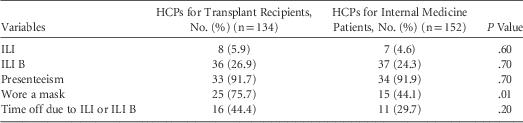
Peak epidemic local influenza activity in the 2015–2016 season began the week of March 6, 2016, through March 12, 2016, and was sustained through the week of March 20, 2016, through March 26, 2016. The survey was first distributed on March 30, 2016, with 2 subsequent reminders 1 week apart. Of 707 HCPs invited, 286 (40%) completed the survey. The response rate was higher for those who cared for internal medicine patients, compared to those who cared for transplant recipients (44% vs 37%; P=.04). Among the 286 responders, the median age was 35 years; 206 (72%) were female, 91 (31.8%) were physicians or APP, 137 (47.9%) were nursing staff, and 58 (20.2%) did not report their profession. Responder demographics were similar to those of all hospital employees (median age, 35 years; 67% female). Among the 286 respondents, 15 (5.2%) reported having ILI and 73 (25.5%) reported having ILI B in the preceding 2 weeks. In addition, 16 (5.6%) reported having had a fever, 65 (22.7%) reported having had a cough, and 46 (16.1%) reported having had a sore throat. Furthermore, 14 of 15 (93.3%) with ILI and 67 of 73 (91.7%) with ILI B went to work while ill. Of those who reported going to work while ill, 40 of 81 (49.4%) had worn a mask and 27 of 81 (33.3%) had taken some time off.
Table 1 compares the frequency of presenteeism and protective behaviors associated with ILI and ILI B among HCPs for transplant recipients to those among HCPs for internal medicine patients. Rates of ILI and ILI B, presenteeism, and time off due to ILI or ILI B were similar, but HCPs caring for transplant recipients were more likely to wear a mask when they experienced ILI or ILI B.
Comparing Outcomes of Presenteeism Associated With ILI and ILI B Among HCPs for Transplant Recipients to HCPs for Internal Medicine Patients

NOTE. ILI, influenza-like illness defined as fever (>37.8°C) and cough and/or sore throat (in the absence of a known cause other than influenza); ILI B, influenza-like illness defined as fever (>37.8°C), or cough, or sore throat (in the absence of a known cause other than influenza); HCPs, healthcare professionals.
In multivariate analyses, presenteeism was associated with female sex and age ≤40 years (Table 2). Wearing a mask while ill was significantly associated with caring for transplant recipients and female sex but not job title or age (Table 3). Nurses were >3 times as likely to take time off for ILI or ILI B as physicians or APPs. Even though HCPs who cared for transplant recipients were twice as likely to take time off for ILI or ILI B, the association did not reach statistical significance.
Multivariate Analysis for Risk of Presenteeism

NOTE. AOR, adjusted odds ratio; CI, confidence interval; HCPs, healthcare professionals.
Multivariate Analysis for Wearing a Mask and Taking Time Off With ILI or ILI B

NOTE. ILI, influenza-like illness defined as fever (>37.8°C) and cough and/or sore throat (in the absence of a known cause other than influenza); ILI B, influenza-like illness defined as fever (>37.8°C), or cough, or sore throat (in the absence of a known cause other than influenza); AOR, adjusted odds ratio; CI, confidence interval; HCPs, healthcare professionals; APPs, advanced practice providers.
DISCUSSION
In this anonymous survey at a single academic medical center, during influenza epidemic activity, 5% of HCPs experienced ILI, ~25% experienced ILI B, and 92% worked while ill, including those caring for transplant recipients. Although HCPs for transplant recipients who came to work with ILI or ILI B were twice as likely to wear a mask as those caring for general internal medicine patients, ~25% did not wear a mask, potentially exposing these immunocompromised patients to harmful infections. More than half of HCPs caring for transplant recipients, and ~65% of HCPs caring for internal medicine patients, worked continuously while ill with ILI or ILI B.
Female HCPs and HCPs ≤40 years are more likely to be caring for children at home, which might explain the higher presenteeism rate in these groups of HCPs, if they are saving their days off to care for their children when they are sick at home from school, or for vacation. Nevertheless, many HCPs who are >40 years old may have young children at home. Although they continued to work while ill with ILI or ILI B, female HCPs were 4 times more likely to wear a mask compared to male HCPs. Nurses were >3 times as likely to take time off for ILI or ILI B as physicians or APPs. Both the culture of nursing and the shift nature of the work may make it easier to call in sick because “float nurses” can be called in to cover their duties.
In contrast, physicians and APPs may mistakenly believe themselves to be irreplaceable, and the healthcare system may not accommodate illness in this HCP group. A previous study showed that although the majority of physicians and APP believe that working while sick puts patients at risk, most of them work while sick.Reference Szymczak, Smathers, Hoegg, Klieger, Coffin and Sammons 11 That study listed the following reasons for working while sick: not wanting to let colleagues down, staffing concerns, not wanting to let patients down, fear of ostracism by colleagues, concern about continuity of care, extreme difficulty finding coverage, a strong cultural norm to come to work unless remarkably ill, and ambiguity about what constitutes “too sick to work.” Employers should support physicians and APPs to overcome the reasons for working while sick by setting the expectation not to do that, and the expectation that colleagues will cover for each other in such instances.
Influenza has a significant negative impact on solid organ transplant recipients; causing pneumonia in 33%, requiring care in an intensive care unit (ICU) in 16%, and associated with death in 4%.Reference Kumar, Michaels and Morris 7 Similarly, in hematopoietic cell transplant (HSCT) recipients, 33% of patients with influenza develop pneumonia, 33% require care in an ICU, and 19% die within 30–60 days.Reference Reid, Huprikar and Patel 8 HCPs for transplant recipients may consider themselves uniquely qualified to care for these immunocompromised patients, which may explain why their presenteeism rate was equal to that of HCPs caring for internal medicine patients. HCPs of transplant recipients should also be especially aware of the dangers that ILI poses to their patients. A recent study showed that universal masking by all individuals in inpatient and outpatient HSCT facilities with direct patient contact, regardless of symptoms or season, reduced the incidence of respiratory viral infections in a unit by 60%.Reference Sung, Sung and Thomas 12 If cost analysis of universal masking shows favorable benefit, this would be an important additional infection prevention method, but reducing presenteeism remains essential to prevent spread of ILI; particularly to our most vulnerable immunocompromised transplant recipients.
Our study has several limitations. First, the response rate was 40%. Because we did not identify respondents, we cannot compare the characteristics of people who did or did not respond, but respondents’ demographics were similar to those of overall hospital employees, and the study sample was larger than is often obtained from surveys of physicians. In our hospital, inpatient hospital units that house transplant recipients are geographically separate from those that house internal medicine patients; although we cannot retrospectively ascertain that no transplant recipients were hospitalized in units that normally house internal medicine patients, or vice versa. Second, we did not confirm that respondents had influenza; 5.2% of respondents reported having ILI as defined by the Centers for Disease Control and Prevention,Reference Luckhaupt, Calvert, Li, Sweeney and Santibanez 10 which is consistent with a highly vaccinated population during an influenza epidemic.
In conclusion, presenteeism is very common among HCPs, including those who care for transplant recipients. Many HCPs who work with ILI do not wear a mask, and most do not take time off when ill. Nonpunitive systems should encourage HCPs to not work with ILI and to wear a mask to prevent spread of infection.
ACKNOWLEDGMENTS
Financial support: No financial support was provided relevant to this article.
Potential conflicts of interest: Sherif B. Mossad is the site principal investigator for multicenter studies funded by GlaxoSmithKline and Oxford Immunotec. Michael B. Rothberg has served as a consultant for ReVO Biologics. All other authors report no conflicts of interest relevant to this article.
SUPPLEMENTARY MATERIAL
To view supplementary material for this article, please visit https://doi.org/10.1017/ice.2017.91