1. Introduction
Bohmian mechanics is a quantum theory based on a primitive ontology of particles and two precise mathematical equations defining their dynamics. These are the Schrödinger equation

for the wave function, and the guiding equation

in which the wave function enters to determine a velocity field for N point particles with positions
 . On the fundamental level, there is only one wave function, the universal wave function, guiding the motion of all particles together. In many relevant situations, however, subsystems allow for an autonomous description in terms of an effective wave function determined by the universal wave function and the actual positions of particles outside the subsystem. It can then be shown that Born’s rule, applied to effective wave functions, describes the typical distribution of particle positions in an ensemble of identically prepared subsystems (Dürr, Goldstein, and Zanghì Reference Dürr, Goldstein and Zanghì2013, chap. 2). Born statistics, in other words, hold in quantum equilibrium.
With this result, the Bohmian theory reproduces the statistical predictions of standard quantum mechanics (whenever the latter are well defined). It does so by making correct statistical predictions about the outcome of measurement experiments as recorded in the spatial configuration of whatever plays the role of a “measurement device” (Dürr et al. Reference Dürr, Goldstein and Zanghì2013, chap. 3).
While Bohmians generally insist that the empirical content of the theory is exhausted by its predictions about particle motions, critics have questioned the empirical status of the particles, usually advocating for a priority of the wave function when it comes to relating the theory to observation (e.g., Bedard Reference Bedard1999; Zeh Reference Zeh1999; Brown and Wallace Reference Brown and Wallace2005; Gao Reference Gao2019b). On this basis, it has even been argued that Bohmian mechanics does not solve the quantum measurement problem (Stone Reference Stone1994; Gao Reference Gao2019a) or that it solves the measurement problem only by being a Many-Worlds theory in denial (Deutsch Reference Deutsch1996; see Valentini [Reference Valentini, Saunders, Barrett, Kent and Wallace2010] for a previous response). The misleading terminology of “hidden variables” has probably also done its part to stir the debate about just how hidden the Bohmian particles actually are.
I will argue that these criticisms are based on misconceptions of the Bohmian theory and the role of particles vis-à-vis wave functions in it. To the extent that valid questions have been raised—in particular about the empirical accessibility of particle positions—they are questions that can be answered. To this end, I first provide a brief review of the Bohmian description of the measurement process. Section 3 clarifies the status of particles and wave functions in Bohmian mechanics and address various worries about the empirical (in)accessibility of particle positions. In section 4, I (reluctantly) address the issue of conscious experience and why, assuming a functionalist theory of mind, mental states would be realized by particles rather than the wave function.
2. The Measurement Process in Bohmian Mechanics
A prototypical measurement in Bohmian mechanics is an interaction between a system S and a measurement device D resulting in one of several macroscopically discernible configurations of D (“pointer positions”) that are correlated with possible states of S. Schematically, the interaction between the measured system and measurement device is such that, under the Schrödinger evolution,

where the wave function Φ0 is concentrated on pointer configurations corresponding to the “ready state” of the measurement device, and Φi are concentrated on configurations indicating a particular measurement result (e.g., by a pointer pointing to a particular value on a scale, a point-like region of a detector screen being darkened, a detector clicking or not clicking). The Schrödinger time evolution is linear, so that a superposition

leads to

At this point, standard quantum mechanics is hit by the measurement problem (Maudlin Reference Maudlin1995a). In Bohmian mechanics, however, the system is described not only by the wave function but also by the actual spatial configuration
 of measured system and measurement device, given by the positions of their constituent particles. It thus has a well-defined configuration at all times, regardless of whether its wave function is in a superposition.
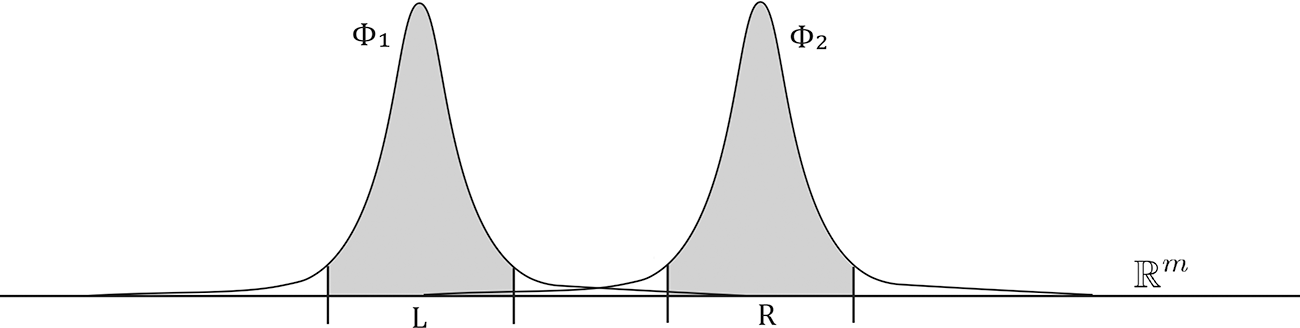
For illustrative purposes, we assume that Φ1 is concentrated on a region
 of the configuration space of D corresponding to pointer configurations pointing to the left, while Φ2 is concentrated on a region
 corresponding to pointer configurations pointing to the right. Obviously, the two regions are disjoint; that is,
 . By assumption, Φ1 and Φ2 are well localized in the respective regions (otherwise, the measurement device is no good), that is, almost zero outside (see fig. 1). In particular, we have


Pointer wave functions on configuration space.

Now, according to Bohmian mechanics, the probability of the pointer actually pointing to the left is

The final approximation follows from equation (5a) (together with the Cauchy-Schwarz inequality
 ). Similarly, the probability of the pointer pointing to the right is
 . If φ1 and φ2 are eigenstates of some quantum observable, |c 1|2 and |c 2|2 are the statistical predictions of standard quantum mechanics for an ideal measurement. (The better the pointer states Φ1 and Φ2 are localized in disjoint regions of configuration space, the closer the measurement is to “ideal.”)
Moreover, after the measurement (assuming it was not destructive), the measured system S will be guided by the wave function
 . If the pointer actually points left (let us say)—that is,
 —we have
 and hence (after normalization) the effective wave function φ1 describing the system S at the end of the measurement. In this way—which depends crucially on actual particle positions—Bohmian mechanics vindicates the postulate of textbook quantum mechanics that a measurement collapses the wave function of the measured system such that the previous outcome will be reproduced by a repeated measurement. It does not, however, vindicate the (bad) idea that the state φ1 or φ2 corresponds to some preexisting property of the system (“observable value”) that the measurement merely reveals (see, e.g., Lazarovici, Oldofredi, and Esfeld Reference Lazarovici, Oldofredi and Esfeld2018). Bohmian particles have a position and nothing else, while the physical content of the wave function is understood through its role for the dynamical and statistical description of the particles.
3. The Epistemic Status of Particles
Despite this central role of point particles in Bohmian mechanics (or maybe because of it) there has been much debate about their empirical status. Some authors have suggested that Bohmian mechanics includes—or should include—a postulate stating that measurement results are instantiated in particle positions or that observations “supervene” on particle positions (rather than the wave function) or something like that (see, e.g., Naaman-Marom, Erez, and Vaidman Reference Naaman-Marom, Erez and Vaidman2012). Such a postulate is neither helpful nor necessary, as I hope to clarify in this article. In fact, Bohmians generally insist (as did Bell Reference Bell2004, chap. 23) that it is a bad idea to include postulates about “observation” or “measurements” in any physical theory since those are much too vague and physically complex notions.
Other authors suggest that “measurement results” in Bohmian mechanics correspond first and foremost to certain wave functions, while the role of the particle configuration is merely to “pick out” one part of a (decoherent) superposition as the actual result. In particular, Brown and Wallace (Reference Brown and Wallace2005) claim to identify such a “Result Assumption” in the second part of Bohm (Reference Bohm1952).Footnote 1 I lack the historical competence to provide a thorough exegesis of Bohm’s original work. I believe that Brown and Wallace are reading too much into an innocuous statement, but I cannot rule out the possibility that Bohm had not yet appreciated the implications of his theory in full. What I can unequivocally say is that such a Result Assumption plays no role in the modern understanding of Bohmian mechanics (that has been further developed by Bell, and Dürr, Goldstein, and Zanghì, among others). Indeed, it would be a rather unproductive assumption to make since it leaves open the critical question of how and why and in what sense a particular wave function is supposed to correspond to a measurement result—or any concrete physical fact at all.
Unsurprisingly, though, this ψ-centric reading has resonated in particular with modern Everettians who are committed to the view that objects and events in physical space (like measurement devices indicating a measurement result) can be recovered by some sort of functional analysis in terms of internal degrees of freedom of the wave function or quantum state. This, however, is not how the Bohmian theory relates to the physical world, and there are legitimate questions as to whether the procedure “wave function functionalism” could succeed at all (see, e.g., Monton Reference Monton2006; Maudlin Reference Maudlin, Saunders, Barrett, Kent and Wallace2010; I express some of my own concerns in the course of this article).
Bohmian mechanics makes an ontological commitment to particles. They are the local beables (Bell Reference Bell2004, chap. 7) or primitive ontology (Allori et al. Reference Allori, Goldstein, Tumulka and Zanghì2014), what the theory postulates as the basic constituents of matter. The role of the wave function is first and foremost to determine the motion of particles and also (although this is a theorem rather than an additional postulate) to describe their statistical distributions. All our analyses of the theory are then consistent with the particles forming stable configurations that move and behave, qualitatively and quantitatively, like the tables, cats, measurement devices, and so on, that we observe in the world. This is why the theory is empirically adequate. In particular, the way in which the particle ontology solves the measurement problem is not just by picking out certain parts or branches of the wave function as “occupied” but by releasing the wave function from the undue burden of representing matter in the first place.
A point that Bohmians do repeatedly and emphatically insist on is that making correct predictions about the spatiotemporal configuration of matter—including pointer positions, display readings, or whatever else is used to “record” the outcome of “measurements”—is sufficient for the empirical adequacy of a physical theory (cf. Bell Reference Bell2004, 166). But this is a claim about physics in general, not an additional postulate about Bohmian measurements in particular.
As a nod to the neo-Everettians (and other wave function monists who try to develop a physical description out of the wave function only), it is worth pointing out that Bohmians are also “macro-object functionalists” (Lewis Reference Lewis2007) in the sense that functionalist arguments are relevant to locating macroscopic objects in particle trajectories. However, while I understand how things moving and interacting in physical space can be functionalized in terms of other things moving and interacting in physical space, it is unintelligible to me how things moving and interacting in physical space could be functionalized in terms of degrees of freedom of the wave function that (no matter how you want to think about it) are not things moving and interacting in physical space (cf. Maudlin Reference Maudlin, Saunders, Barrett, Kent and Wallace2010). I return to this issue in section 4.
3.1. Position Measurements
Some skeptics now say that this is all well and good, Bohmian mechanics may predict that particles can form cats, and tables, and measurement devices that have a definite configuration at all times, but there is no good reason to believe that when we look where a table is or whether the pointer points left or right, we will see them in the position that the theory predicts for their particle configuration. The intuition behind this worry seems to be that observations are physical interactions and that these interactions are first and foremost described by the Schrödinger equation for wave functions, which makes no reference to Bohmian particle positions. Hence, it may seem like observations are determined by the wave function after all, while the particles are somehow epiphenomenal.
This reasoning is not correct, but since an observation is indeed a physical interaction, the question here is ultimately a physical one, so let us see what the theory actually predicts. We recall the measurement procedure described in section 2 with the final wave function of system and apparatus given by the right-hand side of equation (4). Now we go one step further and consider a “measurement of the pointer position” by another system C (we assume that the measurement device D was perfectly isolated up to this point, so there is no environmental decoherence). We may think of an “observer” looking at the measurement device, resulting ultimately in a certain particle configuration of her brain, although I prefer a camera or some other system under no suspicion of consciousness (we return to the issue of conscious experience in sec. 4). In any case, the spatial resolution of such an observation could be finer than the spread of the “pointer states” Φi (thus corresponding to a Schrödinger evolution
 , where
 and the Ψj are the “record states” of C.) However, we will consider the simplest case in which the measurement interaction leads to a final wave function of the form

where Ψ1 is concentrated on a region ℒ of the configuration space of C corresponding to the camera recording a pointer pointing left, and Ψ2 is concentrated on a region ℛ corresponding to the camera recording a pointer pointing right.
So, what is the probability that the pointer actually points to the left (i.e.,
 ) while the camera records a pointer pointing right (i.e.,
 )? We find

since Φ2 is zero (or nearly so) on L, while Ψ1 is zero (or nearly so) on ℛ; hence, both Φ1Ψ1 and Φ2Ψ2 are just about zero on
 . Simply put: if you look where the pointer is, you will typically see the pointer where it is.
How does this result square with the argument that particle positions do not matter because interactions are described by the wave function and its Schrödinger evolution? Well, as I said, the argument is not correct (see also Maudlin Reference Maudlin1995b). It neglects the fact that in the interaction between the systems D and C, the particle configuration of D is essential to determining which part of the wave function guides the configuration of C. It is instructive to consider an intermediate stage of the measurement interaction

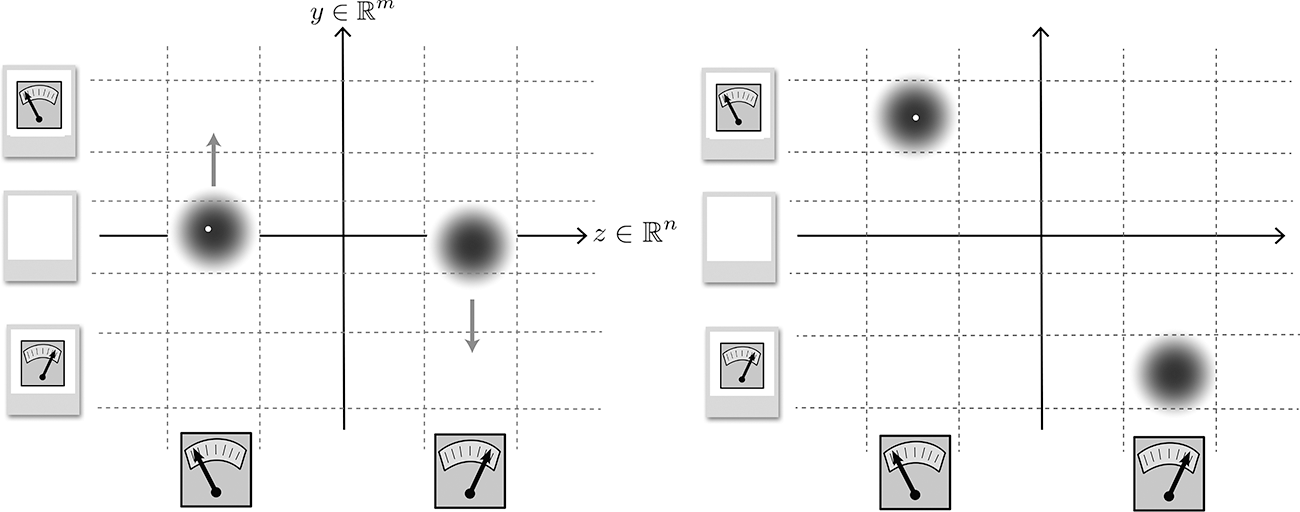
in which the wave packets Ψ⊲ and Ψ⊳ are just beginning to separate in the configuration space of C and propagate toward the regions ℒ and ℛ, respectively. In the full configuration space of
 , however, the entangled wave function
 is already well separated (decohered) along the y-coordinates (fig. 2). Now, according to the guiding equation (2), the velocity of the Z-variables is

Position measurement in configuration space. Dots indicate the actual configuration of the system.

Hence, if the pointer is actually left (i.e.,
 ), we have
 and thus
 , so that the configuration Z is effectively guided by the wave packet Ψ⊲ that moves toward ℒ (i.e., toward configurations in which the photography shows the pointer pointing left). Analogously, if the observed system is actually right (i.e.,
 ), the configuration Z is effectively guided by the wave packet Ψ⊳ that moves toward ℛ (configurations in which the photography shows the pointer pointing right). Hence, the idea that the particles are causally inert, an “idle wheel,” is clearly wrong. Indeed, it is misleading to say that interactions in Bohmian mechanics are described only by the wave function and the Schrödinger equation; the wave function rather mediates interactions between particles via the guiding law (2).
3.2. Atypical Outcomes
If we return to the probability estimate, equation (8), and suppose that the wave packets Φi or Ψi have long “tails,”
 may indeed not be exactly zero but only nearly so (as indicated by the ≈ sign). Hence, there would be a very small yet nonzero probability that the pointer configuration points to the left (at least for a short period of time), while the camera—or “observer”—sees a pointer pointing to the right. Realistically, this probability will be negligibly small, but the atypical outcome is still possible according to the theory. Would this mean that the Bohmian particle configuration Y does not correspond to the “real” pointer position? No, it means precisely what the theory says, namely, that there is an extremely small yet nonzero probability that the pointer points left, while the camera records a pointer pointing right.
And this should not be all that surprising upon reflection. Also according to electrodynamics, it is possible, yet extremely unlikely, that I see the moon to my right while it is actually to my left—because what I see is a very special fluctuation in the electromagnetic field. It is also possible, yet extremely unlikely, that I hold a thermometer (or my finger) in hot water but register a very low temperature because all the fast particles happen to stay away from it.
Atypicality can always undermine the reliability of observations; consequently, any inference from empirical evidence has to rely on the assumption that the evidence has not been produced by an atypical or very low probability event. This is an important insight about physics in general, not a mystery of Bohmian mechanics or quantum mechanics in particular.
3.3. “Position Measurements” That Do Not Measure Positions
There are also special measurement procedures in which the relevant “record states” Ψ1 and Ψ2 in equation (8) would have a big overlap in the configuration space of C. These include, in particular, so-called weak measurements but also interactions that lead, for instance, to a spin flip or the excitation of an atom, so that Ψ1 and Ψ2 are orthogonal in Hilbert space but not separated in configuration space. (This cannot be directly observed, but the “readout” that manifests in particle configurations can be delayed.) From the same equation, it is evident that such procedures will not reliably reveal the actual particle positions (Aharonov and Vaidman Reference Aharonov, Vaidman, Cushing, Fine and Goldstein1996; Naaman-Marom et al. Reference Naaman-Marom, Erez and Vaidman2012). There are even interferometer experiments, in which the naive reading of a detector is systematically wrong about the path of a particle, in which a spin flip (let us say) is always produced by a nonlocal effect rather than a Bohmian trajectory passing nearby (nevertheless, the measurement statistics are always correctly predicted by Bohmian mechanics). This has given rise to the catchy accusation that Bohmian mechanics predicts “surrealistic trajectories” (Englert et al. Reference Englert, Scully, Süssmann and Walther2014). In practice, decoherence prevents such situations for macroscopic systems (see Tastevin and Laloë [Reference Tastevin and Laloë2018] for quantitative results), but as Gisin (Reference Gisin2018) rightly points out, there is nothing in the Bohmian theory that makes it in principle impossible to perform such an experiment with elephants. This is supposed to sound bad. However, stars are even bigger than elephants, and general relativity, predicting the effect of gravitational lensing, tells us that they are not always where we see them (literally). As Einstein reminded the young Heisenberg (Reference Heisenberg2012, 80), it is always the physical theory that has to tell us what can be measured and how, that is, which physical events are correlated in a way that allows us to infer one from the other. Bohmian mechanics tells us that certain measurement procedures (which are much less trivial than just “looking”) are not reliable ways to detect the position of a particle or an elephant. Of course, concluding from this that we cannot trust observations of Bohmian particles in general is to commit a mistake similar to the American president’s when he says that “you literally can’t see” the F-35 stealth fighter.
Gisin (Reference Gisin2018) summarizes the situation correctly by saying that not all measurements that are called “position measurements” in standard quantum mechanics are actually position measurements in Bohmian mechanics.Footnote 2 Again, this is probably meant to sound bad (for Bohmian mechanics). But what, in fact, is the justification for calling these (or any) experimental procedures “position measurements” in standard quantum mechanics? Is it merely because their statistics can be described by some sort of “position operator”? This is not a physical account of why and how the detector events in question should be systematically correlated with the position of anything. Orthodox quantum mechanics is unable to provide such an account. In fact, it does not even contain localized objects with definite positions, leading to the more basic question regarding what “position measurements” are supposed to measure in the first place.
3.4. Absolute Uncertainty
An unfortunate source of confusion about the empirical status of particle positions in Bohmian mechanics is the theorem of absolute uncertainty (Dürr et al. Reference Dürr, Goldstein and Zanghì2013, chap. 2). This theorem states that if the effective (or conditional) wave function of a subsystem S is φ, an external observer cannot have more information about the particle configuration of that system than provided by the |φ|2-distribution. (“Information” here just refers to a correlation between the configuration of S and the configuration of some other system [e.g., a brain] that constitutes a “record.”) Lewis (Reference Lewis2007, 757) then objects that “this can’t be exactly right; the wavefunction, after all, doesn’t determine a unique result for a measurement. So Bohmians note that since an observer can know which wavepacket contains the particles, the lower bound on the accuracy with which the particle configuration can be known is actually the squared amplitude of the occupied wave packet. … There is a tension in the theory as just sketched; how can we know which packet contains the particles if the squared wavefunction amplitude constitutes a lower bound on the accuracy with which the particle configuration can be known?”
The theorem is exactly right (it is a theorem, after all). It just sets limits on our knowledge of a system’s particle configuration given its wave function. If and as long as the effective wave function of the measurement device is in a superposition, an observer cannot know which wave packet contains the particle configuration. How can we find out? Well, by looking at (interacting with) the measurement device. This will lead to an effective collapse of its wave function (in the sense explained in sec. 2) into an “occupied” wave packet consistent with that measurement result and the observer’s knowledge of it.Footnote 3 Notably, nothing here hinges on “observers” in the narrow sense of the word. In practice, interactions with the environment—be it only the surrounding air or photon field—will already collapse the apparatus wave function. We could then say that the environment contains information about the particle configuration, although not in a form that is humanly accessible.
To counter further misunderstandings, here are some things the theorem does not imply:
i) Absolute uncertainty does not prevent us from determining particle positions to arbitrary precision (keeping in mind that whatever procedure we use to localize the particles can also localize their wave function). Note that while one generally states the reverse implication, we could just as well say that our knowledge of the particle positions puts a limit on the spread of their wave function. To measure a trajectory is, evidently, just to measure the position at different times, although one then has to keep in mind that since the measurement procedure can change (effectively collapse) the effective wave function, it can also significantly change the trajectory, in particular for microscopic systems.
ii) Absolute uncertainty does not prevent us from inferring additional information about past trajectories or particle positions. For instance, in the double slit experiment (assuming a suitably symmetric setup) we know on theoretical grounds that particles hitting the screen above/below the symmetry axis have passed through the upper/lower slit (because Bohmian solution trajectories cannot cross).
iii) Absolute uncertainty sets a limit on our knowledge of a system’s particle configuration in terms of its wave function. It does not say that our knowledge of a system is limited to its wave function. Indeed, what we can know about wave functions is an entirely different question. It seems evident to me that our knowledge of the wave function is usually much more limited—and certainly much more indirect—than our knowledge of particle positions. In fact, to the extent that we can measure the wave function (by so-called protective measurements; see Aharonov and Vaidman Reference Aharonov and Vaidman1993), we infer it from position measurements.
For all these reasons, attempts to use absolute uncertainty in an argument for the empirical priority of wave functions over particles are unsuccessful.
4. Measurements and Conscious Experience
All that said, some authors insist that Bohmian mechanics runs into problems when the description of the measurement process ends not with the pointer of a measurement device (or maybe a photograph of the measurement device) but the brain and conscious experience of an observer (e.g., Gao Reference Gao2019b; see Oldofredi [Reference Oldofredi2019] for a good discussion). A priori, there are at least two reasons to be suspicious of such claims:
1. Most authors making them seem to misunderstand Bohmian mechanics already as applied to measurement devices.
2. From the point of view of the physical theory, there is no essential difference between a measurement device and a brain (or whatever physical system is supposed to be the supervenience base of conscious experience). The particle configuration of a brain records an observation in the same sense as the particle configuration of a measurement device or a photographic film does. Everything else falls under the mind-body problem, about which, I believe, quantum physics has nothing new to say (see also Loewer Reference Loewer, Smith and Jokic2003).
Of course, there is in general more to a “record” than a static particle configuration. It is also relevant how the system in question evolves and interacts, and this is determined by the wave function. Thus, to the extent that there is a legitimate debate here, it comes down to the following question (cf. Lewis Reference Lewis2007): If some functionalist theory of the mind is true, what makes it that mental states are functionally realized by the particles rather than the wave function which is also part of the Bohmian theory? This objection is particularly popular among Everettians, who use it to argue that Bohmian mechanics is a Many-Worlds theory in denial (see, esp., Deutsch Reference Deutsch1996; Brown and Wallace Reference Brown and Wallace2005). Bohmian mechanics agrees, after all, that the wave function of the universe never collapses, thus admitting all the branches that make up the Everettian multiverse.
The Bohmian response here is that the particles are the primitive ontology of the theory—the fundamental constituents of matter—while the wave function itself is understood through its dynamical or functional role for the motion of particles. To apply any kind of functionalism, it must be clear what the basic objects and properties are in terms of which the nonbasic objects and properties are functionalized. In the Bohmian theory, the basic terms are particle positions. In other words, it is a fundamental postulate of Bohmian mechanics that matter is made out of particles (and it is not a stretch to suppose that consciousness must be supervenient on, or grounded in, something material). This is not the same as postulating that we only and always observe particle positions; that is, it is an ontological commitment (which should be part of any fundamental theory) rather than an empirical or epistemic claim (which should be left to the analysis of the theory). If one wants to be metaphysically sophisticated, one can go on to elaborate a nomological interpretation of the wave function (see, e.g., Esfeld et al. Reference Esfeld, Lazarovici, Hubert and Dürr2014) and explain how the wave function comes in as part of the physical laws.
While I believe that this response is correct, I do not want to leave it at that since I doubt it will convince the critics. Instead, I want to point out that the case for the wave function being an equally good—or better—candidate for the supervenience base of conscious experience is a very weak one to begin with.
For starters, while there are good arguments for substrate independence in the philosophy of mind, in particular, the “fading/dancing qualia” of Chalmers (Reference Chalmers and Metzinger1995), I do not see how they would apply to particles and the wave function, even if the wave function were another physical entity. It may be possible to gradually replace a biological brain by a silicon brain while maintaining the functional organization, but what would it even mean to replace parts of a particle brain by wave functions?
Second, the objection against taking only particles as the physical correlates of conscious experience is, in more detail, that “if the functionalist assumption is correct, for consciousness to supervene on the Bohmian particles but not the wave function, the Bohmian particles must have some functional property that the wave function does not share. But the functional behaviour of the Bohmian particles is arguably identical to that of the branch of the wave function in which they reside” (Gao Reference Gao2019b, 306). This last assertion is also arguably false. For instance, Bohmian mechanics allows for the possibility that the universal wave function is stationary while all the change in the world comes from particle motions. Changing in time versus not changing in time is clearly a significant functional difference. I am not committing to a stationary wave function here; my point is that it cannot be a priori true that anything that can be functionalized in terms of particles can also be functionalized in terms of the wave function, even under a generous interpretation of functionalism.
On a more basic note, particles move relative to one another. The wave packets guiding their motion (to the extent that they are even separable) do not. They “live” in different dimensions of configuration space and hence do not even stand in distance relations to one another. Anything that allows for a functional definition in terms of matter in motion (this arguably includes brains, although the critical question is whether it includes “minds”) can, in principle, be realized by particles. It is not clear at all that it could also be realized by degrees of freedom in the wave function. The space-time state realism proposed by Wallace and Timpson (Reference Wallace and Timpson2010) for Everettian quantum mechanics (see also Wallace Reference Wallace2012) might fare better in this respect, but the more elaborate the Everettian functionalism becomes, technically and metaphysically, the less plausible the claim that this all comes out of the Schrödinger equation “for free” and is thus part of Bohmian mechanics, as well.
Finally, another version of the objection against particles as the physical correlates of conscious experience is that a conscious agent would then have precise knowledge of the particle configuration of her brain, which leads to worries about faster-than-light signaling as well as to the question of how the brain measures its own particle configuration (Stone Reference Stone1994). I do not see how this particular objection even gets off the ground. Knowledge realized in (or supervenient on) brain configurations is not knowledge about brain configurations.
In the upshot, to say that Bohmian mechanics cannot account for conscious experience (to the extent that it is physical) is to say that particles moving in accordance with the Bohmian laws cannot possibly be a “brain.” As far as I can tell, this claim has no basis in physics, neuroscience, or anywhere else. On the other hand, the idea that brains could be just as well located in the undulating wave function is based on a variety of physical and metaphysical assumptions that are not part of the Bohmian theory or questionable, in general. I am skeptical that physics can tell us why brain states are correlated with mental states, but I am convinced that physics must tell us what brains are made of. And the answer of Bohmian mechanics is clearly and unequivocally particles.
At the end of the day, the debate does not seem to be really about consciousness or deep metaphysics. The question that critics actually want to push is something like: “How does it follow from the equations of Bohmian mechanics that the tree in front of me is a configuration of particles rather than a pattern in the wave function?” To this, I respond that nothing physical follows from mathematics alone.Footnote 4 That is why the primitive ontology—the stuff that trees are made of (or maybe instantiated in)—is a basic and indispensable part of any fundamental physical theory. Nothing about the mathematics of classical mechanics implied that trees could not be patterns in the Hamiltonian flow on phase space, but physics has never been about locating trees in an abstract mathematical formalism; only the confusions about quantum mechanics lead to this business of “interpretation.” Instead, the scientific enterprise departs from our “manifest image of the world” (Sellars Reference Sellars and Colodny1962; see Maudlin [Reference Maudlin1997] for a discussion in the context of quantum ontology), our observation of trees, tables, cats, and so on, and the question of what these objects are made of on the most fundamental level. Once we have a hypothesis about the basic entities and the laws describing them, we are in the business of locating trees (and cats, and brains, and measurement devices) in the scientific image of the theory to see whether it matches the world that we experience. A theory with a clear primitive ontology can be wrong about what matter is or how it behaves, but it cannot be wrong about what it says that matter is. I guess I will have to leave it at that, after all.