Introduction
Recent research revealed that long-term plowing with heavy machinery can have adverse effects on soil physical, chemical and biological parametersReference Fuentes, Govaerts, De Leon, Hidalgoa, Dendoovend, Sayreb and Etcheversa1. Consequently, numerous methods for reduced, non-inversive tillage have been developed and it is estimated that worldwide about 7% of all arable land is now cultivated without any tillage at allReference Kassam, Friedrich, Shaxson and Pretty2. Long-term soil conservation management improved the quality of soils through enhancing the organic carbon fraction and biological statusReference Melero, López-Garrido, Madejón, Manuel Murillo, Vanderlinden, Ordóñez and Moreno3, Reference von Lützow, Leifeld, Kainz, Kögel-Knabner and Munch4. Soils with low organic matter are particularly responsive to conservation tillage, despite modest or no changes in the total standing stock of soil organic carbon within the rooting zoneReference Franzluebbers, Magdoffand and Weil5. Reduced tillage, which has been shown to decrease soil erosion and nitrogen (N) leachingReference Rasmussen6, provides a sink for carbon, mitigating the effect of agriculture on water quality and the greenhouse effectReference Ingram7. However, especially for many European farmers, plowing is a paradigm rooted in their cultural backgrounds and consequently in Europe reduced tillage is less adopted compared to other regions, such as the USA or AustraliaReference Lahmar8.
While in conventional agriculture the use of the moldboard plow is under discussion, mostly for economic reasons, in organic farming (OF) the main argument against the use of deep soil turning is the detrimental effect on soil ecologyReference De Souza Andrade, Colozzi-Filho, Balota, Hungria and García-Torres9. Reduced tillage is a viable option for European conventional agriculture due to the provision of efficient alternatives to control crop nutrition and weedsReference Tebrügge and Düring10–Reference den Putte, Govers, Diels, Gillijns and Demuzere12. However, in OF sustainable yields depend more strongly on particular field conditions, crop rotation and mechanical weed controlReference Mäder and Berner13. In Europe, conservation tillage is not widely used in OF, although the principles of OF support soil conservationReference Köpke14. Reservations against reduced tillage in OF stem from the fact that avoiding soil inversion will change the balance between crop demand and N supply from the soil, increasing the requirement for N input into the systemReference Malhi, Grant, Johnston and Gill15, Reference Vian, Peigne, Chaussod and Roger-Estrade16. In OF, nutrient supply is mainly dependent on the mineralization of soil organic matter by soil microorganisms or poorly soluble organic fertilizersReference Stockdale, Shepherd, Fortune and Cuttle17, Reference Zaller and Köpke18. Indeed, in conventional farming, where a deficit of soil nutrients can more easily be compensated by highly soluble mineral fertilizers, tillage intensity was unrelated to N supplyReference Rieger, Richner, Streit, Frossar and Liedgens19. Meanwhile, an increasing number of studies show that reduced tillage systems are also applicable under temperate OF conditionsReference Krauss, Berner, Burger, Wiemken, Niggli and Mäder20, Reference Sans, Berner, Armengot and Mäder21 even though problems, such as weed development, topsoil compaction and crop nutrient deficits, are likely to occur, especially during the early years of their adoptionReference Peignè, Ball, Roger-Estrade and David22. Experiments, as well as farmers’ experience, have shown that the practicability of reduced soil tillage in OF will depend on the crop grown, the preceding crop and the soil type, as well as climatic conditions in experimental yearsReference Gadermaier, Berner, Fließbach, Friedel and Mäder23, Reference Vakali, Zaller and Köpke24. As the organically farmed area in Europe steadily increased during the past decade and already covers >8 million hectares25, it is imperative to further investigate whether reduced tillage is an adequate alternative to traditional plowing.
The objectives of this study were to compare the effects of moldboard plowing (MP) with two reduced tillage systems (one shallowly inverting and one only loosening the soil) on: (i) soil nutrients; (ii) nutrient content of cereals and weeds; and (iii) cereal yield. We hypothesized that deep soil inversion of the MP would increase the availability and the vertical distribution of soil nutrients with consequences on enhanced nutrient content of the plants. Consequently, we expected higher yields in the plowed treatments, mainly because of a higher nutrient availability and a reduced uptake of nutrients by weeds.
Materials and Methods
Site conditions
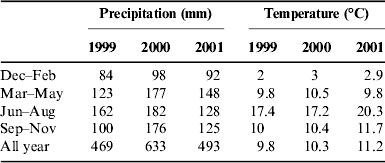
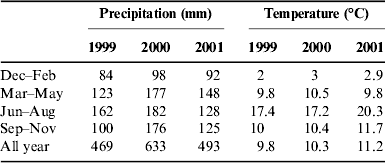
The present study was conducted within the long-term stockless OF procedures (Regulation EU 2092/91) project ‘Ecological Soil Management’ established in 1994 by the foundation Ökologie und Landbau (SOEL) in the South West of Germany in the district of Rheinhessen (49°49′23″N, 8°5′24″E). The experimental field was established on a farm that has been managed organically for more than 20 years and was plowed as a basic tillage treatment. Measurements included in this study cover the years 5–7 (1999–2001) after the establishment of the tillage treatments (1994). The soil type on this site is a clay loam (Calcaric Regosol, FAO) containing 50% silt, 38% clay, 12% sand; Corg=1.45% in the Ap-horizon, Ntot=0.17%, P2O5=20 mg 100 g−1 soil, K2O=43 mg 100 g−1 soil, pH (CaCl2)=7.5. Phosphorus (P) and potassium (K) were extracted using calcium acetate–lactate (CAL). The mean of 10 years annual precipitation at this site is 510 mm at an average annual air temperature of 9.3 °C (Deutscher Wetterdienst, Federal Ministry of Transport, Building and Urban Affairs, Berlin, Germany). Climatic conditions during the experimental years are shown in Table 1.
Sum of seasonal precipitation and average seasonal air temperature.
Tillage and crop management
We applied the following tillage systems on the field plots: (1) MP (Rabe Agrarsysteme GmbH & Co, Bad Essen, Germany), with soil inversion to 30 cm soil depth; (2) two-layer plow (TP, Gassner-Technik, Göggenhofen, Germany), with soil inversion to 15 cm and soil loosening to 30 cm depth; and (3) layer cultivator (LC, Kress & Co. GmbH, Vaihingen/Enz, Germany) combined with a barrel, loosening the soil up to 30 cm soil depth. TP and LC were considered as reduced tillage systems.
All tillage treatments were established within a five-course crop rotation: green fallow, winter wheat (Triticum aestivum L.), peas (Pisum sativum L.), winter rye (Secale cereale L.) and spring barley (Hordeum vulgare) L. The green fallow was cultivated as a main crop and consisted of Trifolium hybridum L., Medicago lupulina L., Trifolium repens L., Trifolium incarnatum L., Vicia villosa Roth, Fagopyrum esculentum Moench, Medicago sativa L., Phacelia tanacetifolia, Lolium perenne L. and Festuca rubra L. and was incorporated into the soil with a disc harrow and a cultivator. A catch crop consisting of Trifolium alexandrinum L., Trifolium resupinatum L., Sinapis alba L. and Vicia sativa L. was cultivated between wheat and peas and between rye and barley; it was winter killed and incorporated into the soil with a disc harrow at the beginning of spring (Table 2).
Type and timing of soil cultivation after each crop of the crop rotation and timing of harvest during the course of this experiment.

The five crops of the crop rotation were considered to be the main plots; so that all crops of the rotation were cultivated each year. The three tillage systems were considered the subplots (30 plots in total). The main plot size representing the crop was 39×100 m (separated by a 2-m buffer zone), allowing the use of commercial-sized farm equipment. In each main plot, three subplots (each 12×100 m2) were created for the three different tillage treatments. The experimental design was a split-plot with two replicates. All subplots were separated by a 1-m buffer zone, which was not cultivated. The crops rotated from one main plot to the other, but tillage treatments were retained in the subplots.
Tillage systems were implemented in late summer after cereal harvest only (i.e., during 3 of 5 years), after winter wheat and winter rye before sowing the catch crops, and after the spring barley before sowing the green fallow. The experimental plots were fertilized through green manure only; no additional fertilizers were applied. The crop rotation was typical for stockless organic agriculture in the region and followed the rules of crop rotations in Western EuropeReference Freyer26. It was arranged so that green manure, catch crop and green fallow should contribute to improve soil structure and stability (i.e., maximum 60% of the growing time cereal and at least 20% of the growing time legumes included in the crop rotation). A rotary harrow was used after the tillage treatments and before sowing the crops, except for the green fallow that was directly sown after the soil cultivation. The crops under investigation in the present study were winter rye (cv. Amilo, seeding density 190 kg ha−1) and spring barley (cv. Passadena, seeding density 200 kg ha−1, row distance of cereals=11.5 cm). Weed control was performed by harrowing the cereals once at the beginning of May. In the first experimental year, 1999, spring rye was sown (S. cereale cv. Petka, seeding density 230 kg ha−1) because of very wet weather conditions, which did not allow autumn sowing.
Soil nutrients
In three experimental years, soil sampling for the determination of humus, nitrate, P and K took place. In the experimental year 1999, soil sampling for all nutrients took place in May and in the experimental years 2000 and 2001 in February, before the seeding of the crop. Soil coring was made after the incorporation of the catch crop in the first 2 years. In the third year, because of rainy weather conditions, the incorporation of the catch crop was delayed; therefore the measurements were taken before the catch crop incorporation. In each plot eight cores (0–60 cm soil depth) were taken using a stainless steel soil corer (5 cm diameter). Soil cores were divided in the year 1999 into the soil depths of 0–30 and 30–60 cm and in the years 2000 and 2001 into the soil depths of 0–15, 15–30 and 30–60 cm and pooled within each plot. The samples for the nitrate measurements were immediately frozen to −18 °C, the samples for the other measurements were air dried and sieved to 2 mm. Organic carbon (Corg) was analyzed using a total analyzer (LECO-RC 412 analyzer, LECO Instrumente, Mönchengladbach, Germany); humus content was calculated by multiplying Corg by 1.72Reference Buckman and Brady27. Nitrate was measured in a continuous flow analyzerReference Skalar Analytical28 after extraction with potassium sulfate29. Phosphorus was measured photometrically and K with atom absorption after extraction with CAL (Skalar Analytical B.V., Breda, The Netherlands).
Shoot and weed parameters
The nutrient content of the cultivated crops and their associated weeds were quantified on dry weight content of the shoot mass harvested. Shoot dry mass was determined at three dates according to growth stages (GS)Reference Zadoks, Chang and Konzak30 for spring barley (year 1999: GS 31, 75, 92; year 2000/2001: 32, 75, 92) and for spring/winter rye (year 1999: GS 31, 75, 92; year 2000/2001: GS 30, 71, 92). At each date two areas of 1 m2 on each plot were cut slightly over the soil surface by hand, separated into cereals and weeds, and dried at 105 °C. The last date (GS 92) was, in each case, the harvest date, and shoot mass and grains were separated using an experimental threshing machine (Hege, Waldenburg, Germany). Grain yield was determined on the basis of 14% moisture. Dry plant material (dried at 105 °C) was ashed for P and K analysis at 250 °C and then 500 °C and was extracted with 20% HCl solution. The following analyses were conducted: total carbon (Ct) and total nitrogen (Nt) were analyzed with elementary analysis (LECO 1000, St. Joseph, Michigan, USA)29, Reference Falbe and Regitz31, P was analyzed photometrically and K with atom absorption regulation using a continuous flow analyzer (Skalar Analytical B.V., Breda, The Netherlands). All analyses were repeated twice and results of measurements with variation greater than 5% were repeated a third time.
Statistical analyses
Data on soil nitrate, humus, phosphate and K were tested separately for each crop by an overall split-plot ANOVA including the tillage system, year and depth as factors. Then for each individual year split-plot ANOVAs with tillage intensity (whole plot factor) and soil depth (sub-plot factor) were performed. These general models were followed by Tukey-HSD tests to determine the specific treatment effectsReference Zar32 within a distinct soil depth or GS. All analyses were performed using the general linear model procedure with custom models in SPSS (ver. 17.0.0, SPSS Inc., Chicago, Illinois).
Results
Soil nitrate, humus, phosphorus and potassium
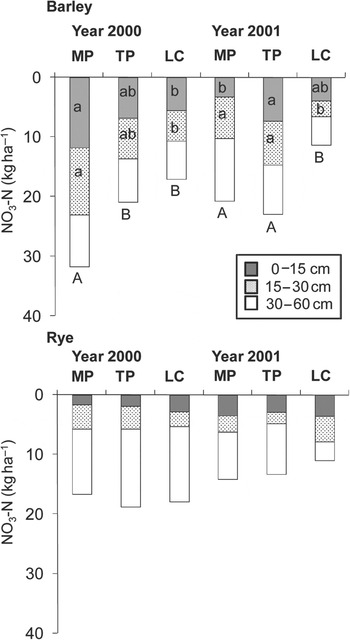
In 1999 soil nitrate content under barley and rye was measured in May, which resulted in nitrate values of max. 3 kg NO3-N ha−1, with no differences between tillage treatments. In 2000 and 2001, soil nitrate contents (0–60 cm soil depth) under barley were significantly affected by tillage treatments with lower values in plots tilled by LC compared to the MP (Table 3); in 2000 soil nitrate under the TP was also significantly lower than under the MP (Fig. 1). In 2000 52 and 86% more nitrate was present in the soil (soil depth 0–60 cm) under MP (31.7 kg NO3-N ha−1) than under TP or LC, respectively. In the following year, MP and TP showed similar nitrate contents (mean 21.7 kg NO3-N ha−1 for MP and TP) being about 92% higher than under LC. In 2000 and 2001, nitrate contents in the soil layers 0–15 and 15–30 cm were significantly affected by tillage treatments (Fig. 1). No tillage effect was observed on soil nitrate under rye; however, under rye soil nitrate was significantly different between soil depths (Table 3).
Mean NO3-N values in soil under organic spring barley and winter rye in plots treated with moldboard plow (MP), two-layer plow (TP) and layer cultivator (LC) (years 2000–2001). Different lower-case letters within a soil depth indicate significant tillage effects; capital letters denote tillage effects on total NO3-N (P<0.05, Tukey-HSD test). No significant tillage effects were detected for rye.

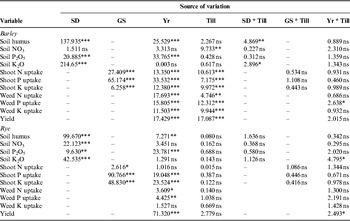
ANOVA results on soil humus (%), soil NO3, P2O5, K2O (all in mg 100 g soil−1), crop and weed N, P and K uptake, and crop yield (kg ha−1) in organic barley and rye cultivated with moldboard plow, two-layer plow and layer cultivator (Till) between years (Yr). Soil depth (SD) and plant growth stages (GS) and their interactions with tillage were included in the ANOVA models.

Significance levels: * P<0.05, ** P<0.01, *** P<0.001; ns, not significant.
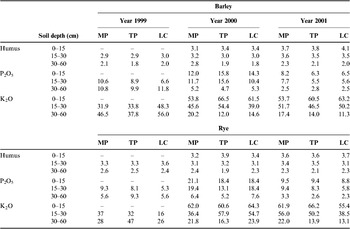
Humus, P2O5 and K2O content of soil under barley and rye were unaffected by tillage treatments, but humus and P2O5 were significantly affected by year under both crops (Table 3). Humus, P2O5 and K2O significantly decreased with soil depth under both crops (Tables 3 and 4). Interactions were observed under barley between soil depth and tillage for humus and K, and under rye between year and tillage for K2O (Table 3).
Humus (%), P2O5 (mg 100 g soil−1), K2O (mg 100 g soil−1) in soil under organic barley and rye in plots treated with moldboard plow (MP), two-layer plow (TP) and layer cultivator (LC) (years 1999–2001). According to ANOVAs no significant tillage effects within each soil depth were detected for these parameters. In 1999, samples were taken from 0 to 30 and 30 to 60 cm only.

Nutrient content of cereals—nitrogen, potassium and phosphorus content
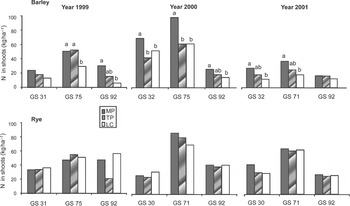
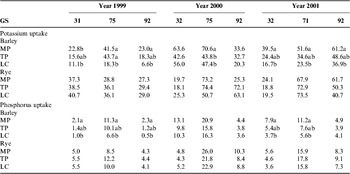
Content of N, P2O5 and K2O in barley shoots were significantly affected by GS, year and tillage treatments (Fig. 2, Table 3). In barley shoots, N was, in all 3 years, significantly higher under MP and lowest under the LC, with values under TP often in between (Fig. 2). Results of P2O5 and K2O content of barley were similar to those of N (Tables 3 and 5).
Mean nitrogen content at different growth stages (GS) of organic spring barley and winter rye in plots treated with moldboard plow (MP), two-layer plow (TP) and layer cultivator (LC) (years 1999–2001). Different letters within a soil depth indicate significant tillage effects (P<0.05, Tukey-HSD test). No significant tillage effects were detected for rye.

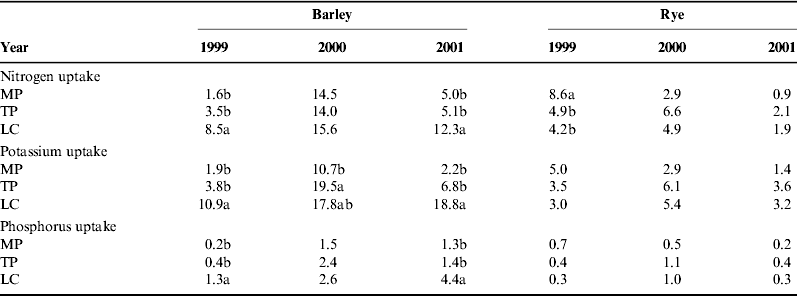
Potassium and phosphorus uptake (kg ha−1) of organic barley and rye at different growth stages (GS) in plots cultivated with moldboard plow (MP), two-layer plow (TP) and layer cultivator (LC) (years 1999–2001). Different letters after means denote significant tillage effects within GS; no significant differences were detected for rye (P<0.05, Tukey-HSD test).

In contrast to barley, the content of N, P2O5 and K2O of rye was not affected by tillage treatments. The parameter year influenced significantly the P2O5 and K2O contents of rye, and the parameter GS influenced all three examined nutrients (Fig. 2, Tables 3 and 5).
Nutrient content of weeds
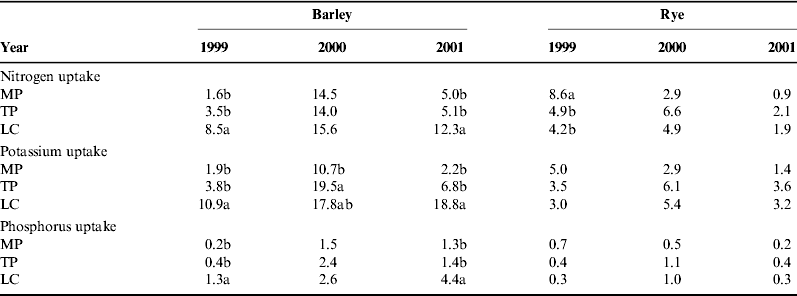
Weed N, P2O5 and K2O contents associated with barley were significantly affected by year and tillage, with higher values in the year 2000 and under the LC (Tables 3 and 6). Weed N and P2O5 contents associated with rye were significantly affected by year but not by tillage treatments (Tables 3 and 6).
Weed uptake of nitrogen, potassium and phosphorus (kg ha−1) summed over the growing season of organic barley and rye in plots treated with moldboard plow (MP), two-layer plow (TP) and layer cultivator (LC). Different letters after means denote significant tillage effects within a particular nutrient and year (P<0.05, Tukey-HSD test).
Grain yield
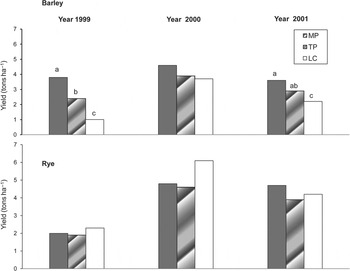
Across years the grain yield of barley was significantly affected by tillage treatments, with significantly higher values under MP than after the use of the reduced tillage systems; the lowest values were measured under LC. The opposite was found for rye, with across years 23 and 10% higher yields for LC than for TP and MP, respectively (Fig. 3). For both crops experimental year significantly influenced the yields, but only for rye was a significant interaction between year and tillage observed (Fig. 3, Table 3).
Mean yield of organic spring barley and winter rye in plots treated with moldboard plow (MP), two-layer plow (TP) and layer cultivator (LC) (years 1999–2001). Different letters indicate significant tillage effects (P<0.05, Tukey-HSD test).

Discussion
Soil nutrients
In organic cereal production, N is one of the key limiting factors responsible for irregular productivity and low qualityReference David, Jeuffroy, Henning and Meynard33. In our experiment, the differences in the crop responses to the different tillage systems are most likely not only due to crop-specific variations, but also the result of system-inherent differences in the timing of tillage treatments within the five-course crop rotation scheme. In our experiment, tillage was implemented shortly before the seeding of spring barley, while for winter rye it was implemented several months before the seeding. Consequently, our hypothesis that deep turning by MP would increase the availability of soil nutrients was confirmed only for soil nitrate under barley. This indicates that by turning the soil and incorporating harvest residues into the soil, mineralization processes are stimulated leading to higher soil nitrate contentsReference Sainju, Caesar-Tonthat, Lenssen, Evans and Kolberg34. A significant difference on soil nutrient contents between MP and TP was seen in the first year only, but not in the second year. This is most likely due to the different timing of the catch crop incorporation, which, in the first year took place before and in the second year after the measurement. Under the MP the catch crop residues could release more N, which also suggests that there could be a difference between the amounts of N that were captured from the catch crop. As several months passed between the tillage treatments and the cultivation of rye, tillage effects on soil nitrate were not apparent. Also the growth of rye during winter might have removed nitrate from the soil, thereby minimizing potential tillage effects. In other studies conducted at the same experimental site, reduced microbial activities were reported in the fields with MPReference Vakali, Zaller and Köpke24, Reference Emmerling35; however, the present data reveal that this did not seem to influence soil N contents. According to Stockfish et al.Reference Stockfish, Forstreuter and Ehlers36 and Moreno et al.Reference Moreno, Murillo, Pelegrin and Giron37 soil organic matter, and thus humus content, should be concentrated near the soil surface when inversion tillage was abandoned and LC was adopted. Our data showed that soil humus content was affected by tillage treatments only in certain soil layers, exhibiting an accumulation in the upper soil layers for TP and LC under barley (soil layer 0–30 cm MP: 73%, TP: 77%, LC: 79% of the total humus content, Table 4). This is also in accordance with the results of Gadermaier et al.Reference Gadermaier, Berner, Fließbach, Friedel and Mäder23. More obvious accumulation was not observed, probably due to the already relatively moderate humus contents of our soils, reflecting the success of OF strategies aiming at sustaining high humus contents with high soil biological activity through a well-balanced crop rotation designReference Zaller and Köpke18. Also the rather short duration of our experiment—starting 5 years before we took our samples—and tillage practices that were performed within the crop rotation only after the harvesting of the cereals could have led to these results. Soil nutrients under both cereals decreased with soil depth, suggesting that there were strong nutrient gradients in the soil with little correlation between individual soil layers. In contrast to other studiesReference Crozier38, we found no effects of tillage intensities on soil P2O5 and K2O, reflecting the weak mobility of these nutrients. It is important to note that we investigated tillage effects in a stockless OF system; it might well be that our tillage treatments will affect soil parameters differently in organic systems with other ways of fertilization or in conventional farming. The generally high soil P2O5 and K2O contents in our plots could be due to the high pH values and the dominant silt minerals in this soil type. Although the experimental year (high rainfall in 2000) influenced many of the examined parameters, a general lack of interactions between experimental year and tillage show that the tillage effects appear to be consistent even under varying climatic conditions.
Nutrient content of crops and weeds
As a consequence of higher soil N availability, we found higher N content in barley under the MP treatmentReference Chatskikh and Olesen39. These results were strengthened by the fact that according to Vakali et al. (2011)Reference Vakali, Zaller and Köpke24 weed competition in the MP treatment was less than in the LC treatment (averaged across GS 88 and 65% more weed shoot mass was measured at LC than at MP or TP, respectively). In the same experiment, root length density of barley was not significantly affected by tillage intensitiesReference Vakali, Zaller and Köpke24, so it is expected that higher N content in the soil would promote the growth of barley. Barley P2O5 and K2O content was significantly higher in the plow treatments, although the soil contents of these nutrients did not differ significantly. This can partly be explained by less nutrient uptake by weeds under the MP treatment.
Weed nutrient contents were often significantly lower under MP and TP than under LC, a fact that can be attributed to significantly more weed biomass produced under LC than under MP or TP. This was confirmed by our previous studyReference Vakali, Zaller and Köpke24 and is also in accordance with the results of Gruber and ClaupeinReference Gruber and Claupein40. The weed control aspect of basic tillage is one of the most important factors, which can limit the adoption of reduced tillage systemsReference Kouwenhoven, Perdok, Boer and Oomen41 as the soil cultivation has a larger effect on weed population than the nutrient availability in the soilReference McCloskey, Firbank, Watkinson and Webb42. Nevertheless, under temperate climate and OF conditions it appears that sufficient control of weeds and N availability could only be ensured by turning and mixing the soilReference Köpke43. The finding that under rye weed nutrient contents did not differ significantly between tillage treatments can be explained by the effect of peas as catch crops. Peas were incorporated into the soil using a disc harrow and a cultivator; hence, it can be expected that the remaining extensive rooting system of peas took up available soil nutrients.
Yield effects
Our findings of significantly higher productivity and yields in barley under MP and lowest under LC are in accordance with other studiesReference Berner, Hildermann, Fliessbach, Pfiffner, Niggli and Mäder44–Reference Schulz, Brock and Leithold46. No significant differences between tillage methods were measured for nutrient contents and yield of rye. However, the significant interaction between year and tillage indicates that yields of rye were differently affected by tillage treatments in different years. In the year with the most rainfall, we measured the highest rye yields under LC, whereas in the year with the average rainfall rye after MP showed the highest yields. All the above-mentioned results are in accordance with those of weed and crop biomass at the harvest stageReference Vakali, Zaller and Köpke24.
Conclusions
Our results showed that, according to our hypothesis, a reduction in soil tillage intensity can significantly influence soil N levels within the soil profile and, consequently, influence cereal and weed nutrient content and affect yields. These effects differed between crop species and were altered by the weather conditions of the experimental years. From the present study it can be concluded that MP is the optimum tillage method to produce high yields under OF conditions. However, it also has to be kept in mind that high soil nutrient contents under MP can lead to nitrate leaching from these systems with consequences for surface and groundwater bodies. A good compromise appeared to be the TP, which turned the upper soil layer while it only loosened deeper soil layers, resulting in a good soil structure and in better yields than the deeply loosening but not turning LC.
Acknowledgements
We are grateful to the technical staff of the Institute of Organic Agriculture, University of Bonn for assistance in the field and laboratory, to the Stiftung Ökologie und Landbau and especially to Dr Ulrich Hampl and Dr Christoph Emmerling for helping us with soil analysis.