New Orleans has long represented a linguistic oddity within the American South, demonstrating New York City English (NYCE) features such as raised bought, variable nonrhoticity, and a split short-a system, as well as a lack of participation in the broader Southern Vowel Shift (Carmichael, Reference Carmichael2014, Reference Carmichael2017; Carmichael & Becker, Reference Carmichael and Becker2018; Labov, Reference Labov2007). It is also the site of rapid demographic change following Hurricane Katrina in 2005. In this study, I examine the split short-a system within Greater New Orleans (GNO), providing the first comprehensive description based on a sample balanced for social factors. I then examine the effect of these social factors on short-a system type. The analysis considers data from 57 speakers from the linguistically conservative, white working-class New Orleans suburb of Chalmette, with three main aims. First, I assess the constraints identified in Labov's (Reference Labov2007) work on the GNO short-a system, which he developed based on Telsur data from 11 speakers for The Atlas of North American English (hereafter ANAE). My data, deriving from a larger pool of participants and representing a greater amount of recorded speech than the ANAE dataset, confirmed and clarified many of the constraints put forth by Labov, especially important for low frequency environments. My second goal was to examine whether this sample presented evidence of the change in progress toward a nasal system, as posited by Labov (Reference Labov2007). Because Chalmette is a linguistically conservative community that has retained traditional New Orleans English features longer than other areas around the city (Carmichael, Reference Carmichael2014; Dajko, Schoux Casey, & Carmichael, Reference Dajko, Schoux Casey and Carmichael2013; Mucciaccio, Reference Mucciaccio2009), the results in this community would be indicative of whether the change will achieve completion citywide, or whether it will simply come to differentiate different sectors of the population (suburb from city, or possibly working class from middle class). My data demonstrate that, even in Chalmette, there is a change in progress toward a nasal short-a system, which is nearly complete for the youngest generation of speakers. A final aim was to ascertain the effect of displacement following Hurricane Katrina and the resulting prominence of local place identity on language variation and change in a post-disaster context. Since Chalmette was particularly hard-hit by Katrina, it represents a crucial site for investigation of these questions. For this reason, I included in my analysis two measures of place: post-Katrina location status, which documented whether a participant had returned to their pre-Katrina home after the storm or relocated, and extra-local orientation, a multifaceted measure of each participant's orientation to their pre- and post-Katrina homes, developed based on ethnographic fieldwork in GNO. I found no significant effect of post-Katrina location status; however, there was a significant effect of extra-local orientation, with participants more externally oriented appearing to be earlier adopters of the nasal system. This patterning suggests that one's orientation to place plays a role in adoption of phonological systems. As a result, I echo calls that place orientation and place identity ought to be considered in research on the adoption of sound changes in contexts of speaker mobility (Carmichael, Reference Carmichael2017; Nycz, Reference Nycz2018).
PREVIOUS RESEARCH ON (Æ)
Short-a, or /æ/, has been the focus of a number of examinations in American English, with studies of split short-a systems, in particular, drawing interest, as these complex systems involve constraints across different levels of the grammar. In a split system, there is conditioning on the realization of /æ/ resulting in a distinctive distribution of /æ/ across environments; in a certain set of contexts (typically before nasals as well as certain voiced stops and fricatives, with specific lexical and syllabic exceptions), /æ/ is realized as tense (raised and fronted), and otherwise it is lax. Many dialect areas in the US with split systems are shifting toward the more widespread nasal pattern, in which /æ/ is tensed only before nasal consonants. A third type of short-a system found in the US is called a continuous system in light of its visual manifestation on a vowel plot: instead of two distinct clusters of pronunciations in tense and lax groups, as one would observe in a nasal or split system (albeit with different distributions), realizations appear in a “continuous smear” across the tense and lax regions of the vowel space for /æ/ (Labov, Ash, & Boberg, Reference Labov, Ash and Boberg2006:180–181).
Split systems have been argued to be present currently and/or historically in a number of locales, including Cincinnati, Ohio (Boberg & Strassel, Reference Boberg and Strassel2000), New Orleans (Labov, Reference Labov2007), the Hudson River Valley (Dinkin, Reference Dinkin2009), Columbus, Ohio (Durian, Reference Durian2012), and parts of New England (Johnson & Durian, Reference Johnson, Durian and Hickey2016), though they are most characteristic of the Mid-Atlantic region of the US, in particular the areas surrounding New York City (Becker, Reference Becker2010; Labov, Reference Labov2006[1966]), and Philadelphia (Labov, Reference Labov, Fasold and Schiffrin1989; Sneller, Reference Sneller2018), and to some extent the regions in between (Ash, Reference Ash2002). Labov (Reference Labov2007) has argued that the presence of split short-a systems outside of the mid-Atlantic represents a case of diffusion on the basis of the system's simplification in these regions. Durian (Reference Durian2012) and Johnson and Durian (Reference Johnson, Durian and Hickey2016) challenged this account, contending that the split system did not, in fact, diffuse from New York City. Instead, they proposed that it was simply more geographically widespread in the past, with speakers having shifted to a nasal system before adequate linguistic documentation of their system occurred. Their argument stems from the examination of dialect notes dating back to the late 1800s and early 1900s that describe split short-a systems in a variety of locales across the US, which led them to acoustically analyze archival data from Columbus and Eastern New England. In these datasets, they found evidence of continuous and “split-like” short-a systems, which they proposed suggests a previous shift away from split systems in these locales.
In the classic NYCE split system, /æ/ is tense before front nasals (/m/, /n/), voiced stops and affricates (/b/, /d/, /ɡ/, /dʒ/), and voiceless fricatives (/f/, /s/, /ʃ/, /θ/), and lax before all other sounds (Becker, Reference Becker2010:162). In addition, there are constraints excluding function words (e.g., am, had) and open syllables (e.g., planet, master) from this phonologically conditioned tensing pattern (see Labov [Reference Labov2007:354–355] for the full list of conditioning factors). Labov (Reference Labov2007) has noted that New Orleans English also displays a split system with remarkably similar phonological constraints to NYCE. Examining New Orleanians’ vowel plots collected as a part of the ANAE (Labov et al., Reference Labov, Ash and Boberg2006), Labov (Reference Labov2007:368) wrote, “[a]s in New York, New Orleans divides short-a into two distinct classes, with the tense vowel occurring before front nasals, voiced stops, and fricatives in closed syllables, and the lax vowel before voiceless stops and liquids.” Labov noted, thus, that one major difference between NYCE and NOE systems in terms of phonological constraints is that the New Orleans system has expanded tensing environments to include voiced fricatives. Labov found no evidence of the function word constraint in NOE, though he did find the open syllable constraint to be present, albeit inconsistently so. Some younger participants in his sample (b. 1952 and 1958) also featured nasal short-a systems, which Labov interpreted as evidence of a shift away from the split short-a system, toward a nasal system. While this limited dataset gives an idea about the short-a system types present more broadly in Greater New Orleans, it does not provide a complete description of all tensing environments nor does it demonstrate the range of variation for speakers across the region, leaving open questions about the short-a system in NOE.
The time depth and quality of linguistic data for NOE does not allow for many conclusions to be drawn as to the history and development of split and nasal short-a systems in the city. Reinecke (Reference Reinecke1951) examined passages read aloud by white schoolchildren (n = 42) and adults (n = 20), noting when a raised variant of /æ/ was produced. Although Reinecke lamented that he designed his reading passage before becoming aware of split short-a systems, and thus did not capture many key environments that would allow one to draw a conclusion about the New Orleans system, he did find instances of tensing in have, past, and antique in adults, and in these words as well as avenues, Latin, as, and fashioned in children (Reinecke, Reference Reinecke1951). Though tense and lax distinctions in reading passages do not always match those in conversational speech (Labov, Reference Labov, Fasold and Schiffrin1989), there are more inconsistencies here than might be reasonably expected due to speech condition alone. For example, Latin is not an environment in which one would expect tensing for a split system, and the children raise very seldomly in the word as, which would be expected to be a tensing category in terms of its phonetic environment. One could make the argument that this is an exception due to being a function word; however, the children do not apply that rule to have, which they robustly tense. Finally, avenues and fashioned represent open syllables, which should be lax if the open syllable constraint were observed. Thus, the evidence from Reinecke is unclear in terms of documenting the short-a system of New Orleans English. Rubrecht (Reference Rubrecht1971) analyzed speech from four New Orleanians, providing close transcriptions of their pronunciations of certain words. The transcriptions indicate that a 62-year-old black man featured raising in had (2) and understand, but not black, while a 27-year-old white man featured raising in crab, has, grass, band, half, mash, and basket, though in a second token of mash there was no raising. The other two New Orleanian participants (a 47-year-old white man and a 33-year-old white woman) did not feature any raised tokens. The words documented by Rubrecht provide better evidence for at least some speakers featuring split systems, since the environments in which he noted tensing are triggering environments (if we assume the phonological constraints proposed by Labov [Reference Labov2007], as well as a lack of function word constraint [tense has, had]). Thus, based on the evidence available, we can conclude that split systems were present in NOE in the early twentieth century, though we cannot confidently confirm whether the constraints matched the contemporary tensing environments documented in the ANAE.
METHODS
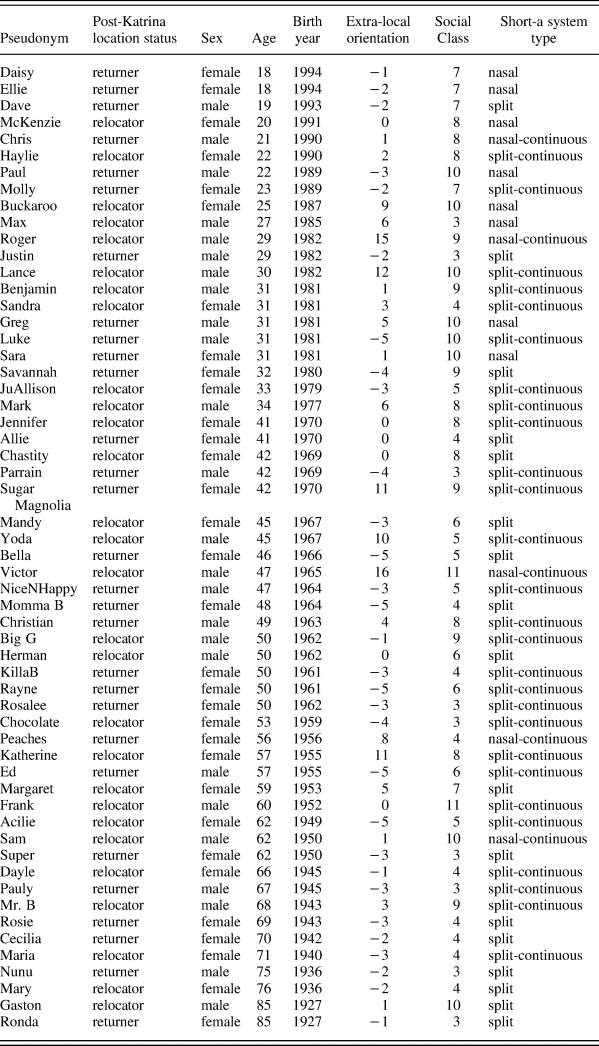
The data for this study was collected in 2012; 57 native English speakers who were born and raised in Greater New Orleans completed sociolinguistic interviews (Table A1 in the Appendix contains full participant information). The participants come from the white, working-class suburb of Chalmette and surrounding towns in St. Bernard Parish. This site was chosen because it has a reputation for retaining traditional New Orleans English features that have largely been abandoned in other parts of the city, such as raised bought, th-stopping, and rhoticization of oil as /ɝl/, which are locally enregistered as ‘Yat’ or ‘Chalmatian’ ways of speaking (Carmichael, Reference Carmichael2014; Dajko et al., Reference Dajko, Schoux Casey and Carmichael2013; Mucciaccio, Reference Mucciaccio2009). Given that Labov (Reference Labov2007) has presented data suggesting a shift toward a nasal system in New Orleans, as linguistically conservative GNO residents, these participants are both those most likely to feature a split short-a system and may be informative in terms of the advancement of this change in progress—if the shift toward a nasal system is underway even in this community, it is likely to become complete citywide. This community is also of interest because of the context of displacement and sudden demographic shifts following Hurricane Katrina. In 2005, due to a failure of the levee system, many parts of Greater New Orleans were submerged by floodwaters following Hurricane Katrina. A mandatory evacuation was ordered for the entire city, and, for months afterwards, residents were barred from entering the city, which was protected at all points of entry by the National Guard. Many residents spent a year or more away from their homes, and some permanently relocated. The low-lying suburb of Chalmette, and surrounding St. Bernard Parish in general, was hit particularly hard, with only half of the population returning after the storm (Lasley, Reference Lasley2012). Since participants experienced differing degrees of post-Katrina displacement, this dataset may also answer questions about language variation, speaker mobility, and place orientation.
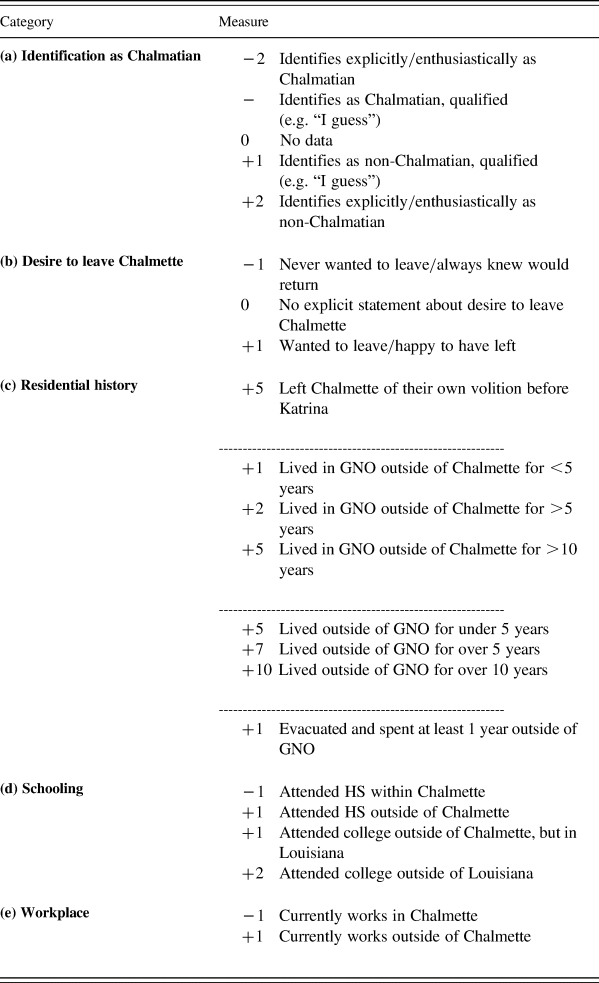
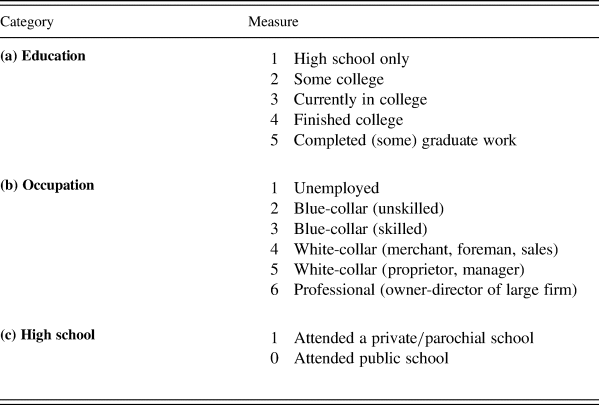
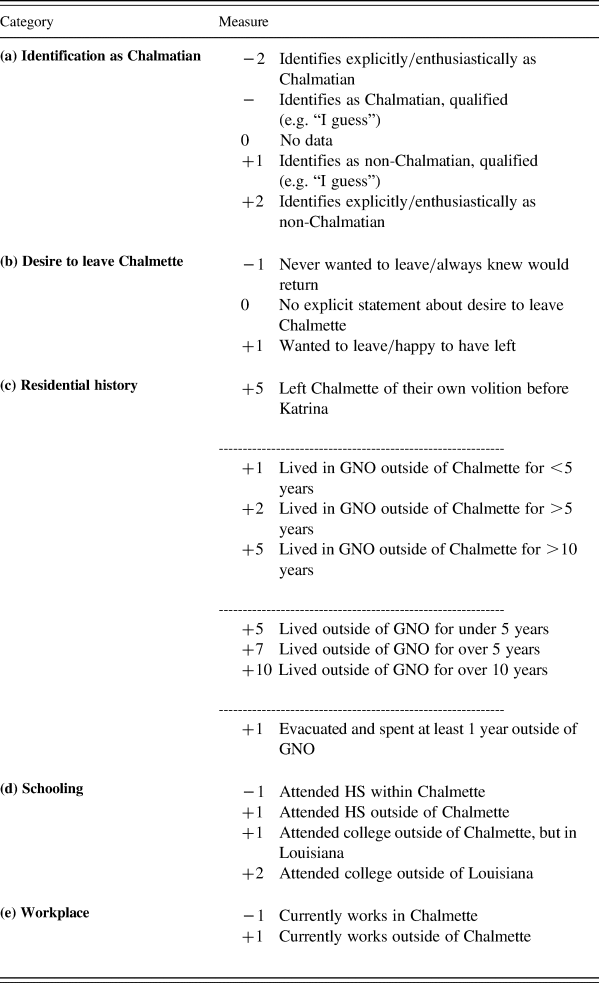
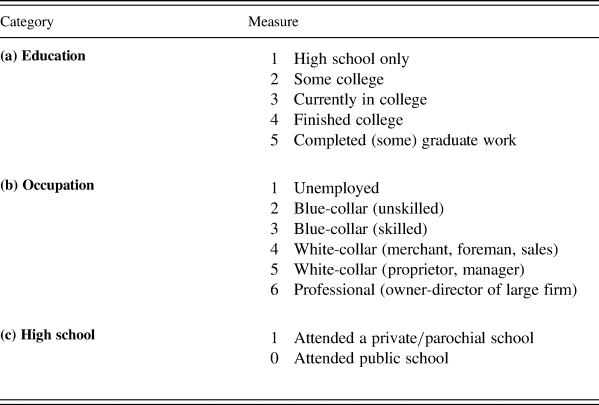
The sample was balanced according to age, with participants ranging from 18 to 85 (b. 1927–1994). All participants in this study identified as white, which is representative of the pre-Katrina demographic background of this area (88.3% white [US Census Bureau, 2000]). Although Chalmette is generally a working-class community, there were differences between participants in terms of the amount of education and types of occupations participants had. Those factors, as well as whether participants attended public or private high school (a locally salient class marker in GNO) were combined into a single measure of social class, which ranged from 1–12 (See Table A2 in the Appendix). The sample was balanced according to sex (all participants identified as either male [n = 25] or female [n = 32]) and also according to post-Katrina location status, a classification capturing whether participants returned to their pre-Katrina homes following the storm (n = 29) or relocated to other areas in GNO (n = 28). Because Chalmette is a linguistic enclave with high rates of locally enregistered traditional NOE features, movement to other areas of GNO with lower rates of these features creates a scenario where the arriving relocators’ speech is highly marked, thus introducing the possibility that the relocators would adapt to the linguistic norms of the broader region (or in contrast, emphasize the features that define them as different). Finally, in recognition of the fact that post-Katrina location status did not always seem to capture participants’ actual attachment to their pre- and post-Katrina homes, an ethnographically informed measure of orientation toward local norms and a locally-defined place-based identity was also calculated for each participant. This five-item measure was based on participants’ characterization of themselves as locals, their stated intention of whether they wished to stay or leave their community (regardless of whether they did in fact return or relocate), and their activities within the community versus in external locations, all of which represent key predictors for place identity and place attachment (McAndrew, Reference McAndrew1998; Lewicka, Reference Lewicka2008). The resulting measure was a numeric score ranging from −5 (very locally oriented) to 16 (very externally oriented). The calculation process for this extra-local orientation measure, referred to elsewhere (e.g., Carmichael, Reference Carmichael2017, Reference Carmichael2020) as extra-Chalmatian orientation, can be found in Table A3 in the Appendix. Interviews were audiorecorded in .wav format on a Zoom H4 handy recorder with a Shure SM10A unidirectional headset microphone. Interviews comprised conversational speech, a reading passage, and a word list. Interview speech of 15 to 45 minutes was transcribed for each speaker, representing the portion of the interview with the most free-flowing speech in narrative form. This sample of interview speech, along with the entire reading passage and word list, were force-aligned using the Penn Forced Aligner (Yuan & Liberman, Reference Yuan and Liberman2008) and hand-checked for any alignment errors. Measurements of F1 and F2 at the 50% point of each vowel token were extracted in Praat for the first 30 tokens of (æ) in the transcribed portion of each interview, as well as all tokens of (æ) from the reading passage and word list. Only the first three tokens of a given word were included in the analysis to avoid oversampling particular lexical items, resulting in a total of 1,717 tokens of (æ) from the word list (~30 per speaker), 3,349 tokens from the reading passage (~58 per speaker), and 1,732 tokens from interview speech (~30 per speaker), for a total of 6,798 tokens overall. All tokens were Lobanov (Reference Lobanov1971) normalized, and coded for following phonetic environment, syllable quality (open or closed), and word type (function or content word), in order to examine these factors as predictors of tensing.
SPLIT SHORT-A SYSTEMS IN NEW ORLEANS ENGLISH: LINGUISTIC CONSTRAINTS
One goal of this paper is to update and further flesh out Labov's (Reference Labov2007) description of the short-a system in GNO. Below, I identify the linguistic constraints on split short-a systems in my dataset. To accomplish this, I visually assessed the presence of phonological constraints, the open syllable constraint, and the function word constraint within short-a data plotted for each speaker in normalized F1/F2 space. In the figures below, tokens across key environments within the reading passage and word listFootnote 1 are presented in order to most clearly illustrate the patterns observed. In the sections that follow, I describe the overall trends across systems, but here I focus only on speakers with clearly split short-a systems (n = 17) in order to describe the constraints on tensing in the NOE split short-a system.
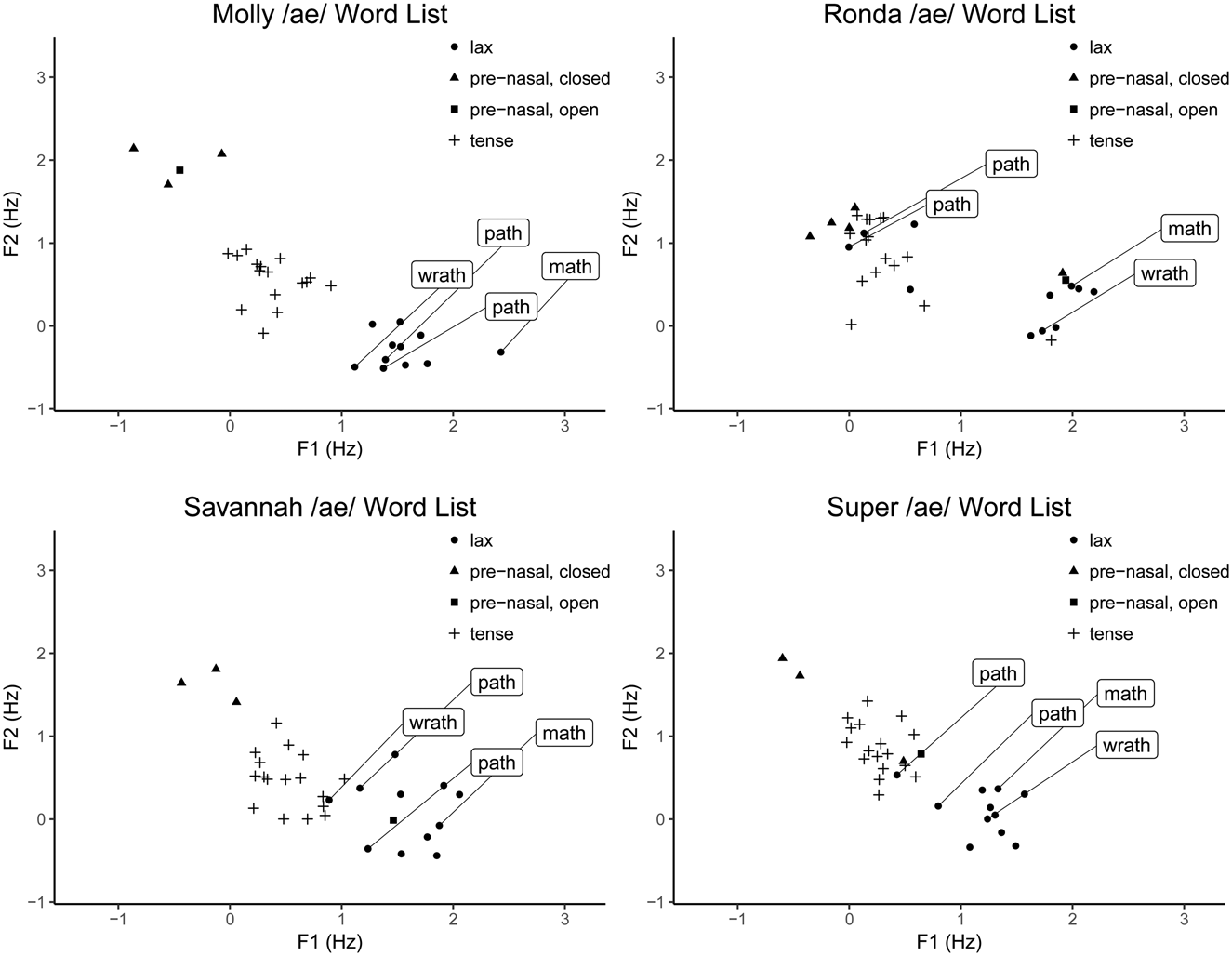
In terms of phonological constraints, visual inspection of vowel plots mostly corroborates Labov's (Reference Labov2007) description of the split short-a system in New Orleans, with front nasals, voiced stops, and both voiced and voiceless fricatives as tensing environments. Figure 1 presents examples of split systems in this dataset, with tokens coded as tense and lax according to Labov's description; plots also indicate prenasal, closed syllable (e.g., “can”) and prenasal, open syllable (e.g., “cannon”) contexts. While examination confirmed nearly all of Labov's tensing categories based on following phonetic environment, visual examination of vowel plots suggested that the voiceless fricative /θ/ might represent a lax environment, in contrast with Labov's characterization. This can be seen—albeit with some inconsistencies—in Figure 1, which presents short-a tokens from four representative split short-a system speakers’ reading passage and wordlist data. For Molly, “wrath,” “path,” and “math” __/θ/ are all clearly in the lax territory, leading one to believe that /θ/ is not a tensing trigger in NOE. However, Ronda features lax “wrath” and “math,” but tense “path.” For Ronda's pattern, if we assume effects of truncation (“math” as a truncation of “mathematics” and thus potentially subject to the open syllable constraint) and word frequency (“wrath” as low frequency in contrast with higher frequency “path”) are at play, we might conclude that __/θ/ is in fact a tensing environment. But then Super and Savannah demonstrate some tense realizations and some lax realizations across “wrath,” “path,” and “math,” further muddying the waters.
Realizations of /æθ/ for split system users Molly (female, 23, b. 1989), Ronda (female, 85, b. 1927), Savannah (female, 32, b. 1980), and Super (female, 62, b. 1950).

Thus, as a result of visual examination of vowel plots, I generally confirm Labov's (Reference Labov2007) claim of tensing before “front nasals, voiced stops, and fricatives in closed syllables” in the NOE split short-a system, with the caveat that there is unclear evidence for how to categorize __/θ/, and more data for this low frequency environment is needed to make claims about /θ/ as a tensing trigger.
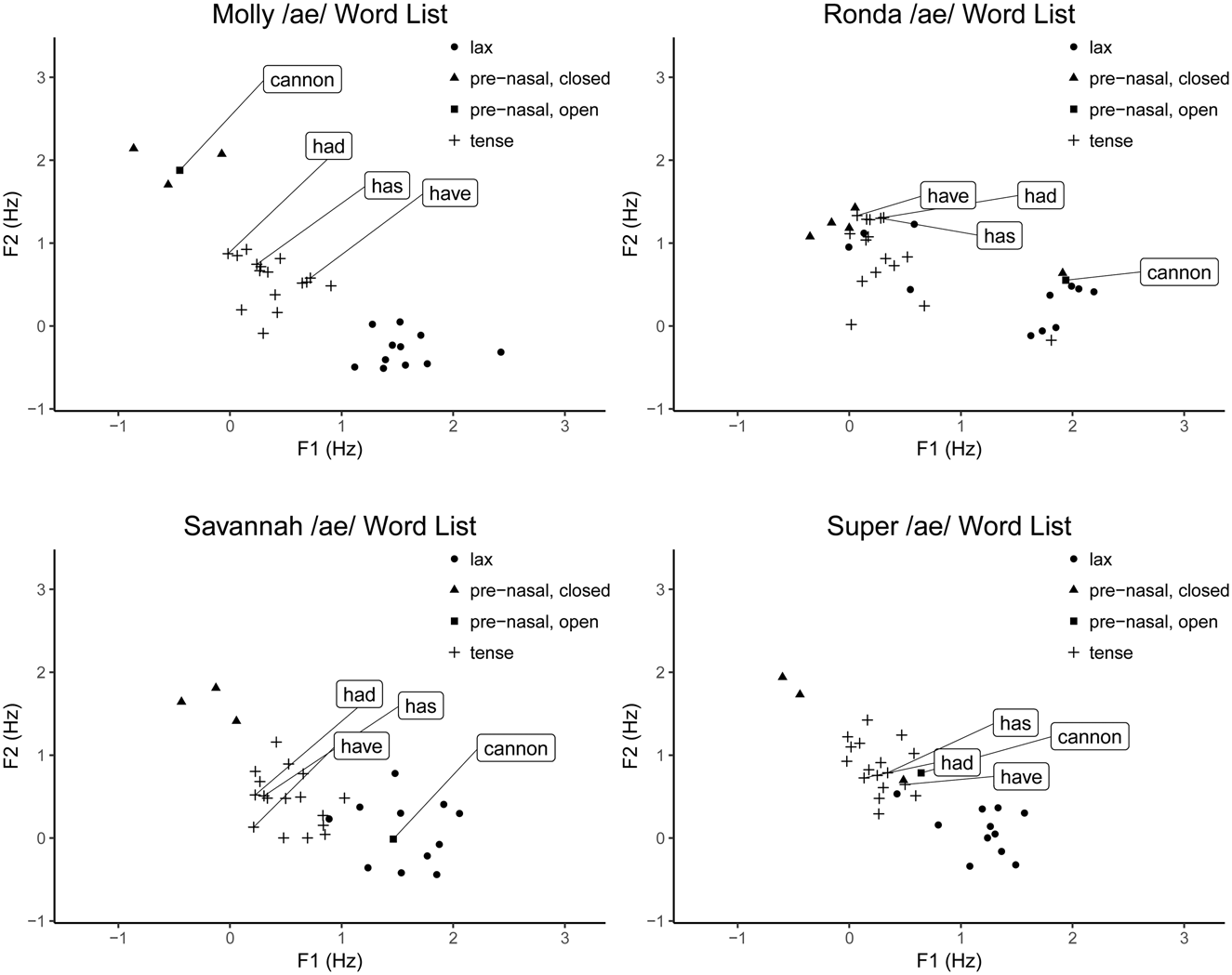
In addition to phonological constraints, Labov (Reference Labov2007) asserted that the open syllable constraint appeared to be active (though inconsistent) in the ANAE dataset for New Orleans English, while the function word constraint was absent. The open syllable constraint dictates that tensing is blocked in open syllables, even when /æ/ precedes a tensing environment as in the words “mammal” and “traffic.” The function word constraint blocks tensing in function words such as “has,” “have,” and “had,” which would be tensing environments based on purely phonological considerations (__/z/, __/v/, __/d/). Visual examination of vowel plots confirms Labov's description of these constraints, as Figure 2 demonstrates. Function words “has,” “have,” and “had” are tense across all participants, while prenasal, open syllable “cannon” is inconsistently lax across participants (lax for Savannah and Ronda; tense for Molly and Super).
Open syllable constraint (“cannon”) and function word constraint (“has,” “had,” “have”) realizations for split system users Molly (female, 23, b. 1989), Ronda (female, 85, b. 1927), Savannah (female, 32, b. 1980), and Super (female, 62, b. 1950).

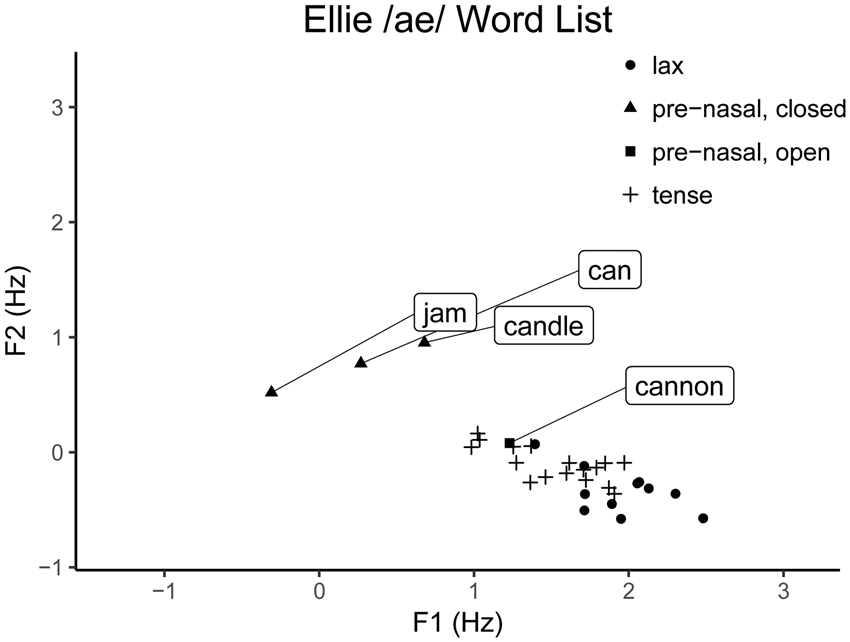
Of note, especially given that Labov (Reference Labov2007) described the open syllable constraint as “severely weakened,” is that even one speaker who clearly exhibited a nasal short-a system observed the open syllable constraint: Ellie (18, b. 1994, returner), shown in Figure 3 with lax “cannon” but tense “jam,” “can,” and “candle.”
Open syllable constraint in otherwise nasal short-a system: Ellie (female, 18, b. 1994).

And indeed, visual examination of vowel plots indicated that 63% (n = 36) of the speakers in my sample featured this constraint, across all short-a system types (n = 57). When examining only the speakers in my sample who feature split short-a systems (n = 17), 77% (n = 13) of participants adhered to this constraint. Thus, in this sample, we see evidence of a relatively robust open syllable constraint, but no function word constraint.
CLASSIFICATION OF SHORT-A SYSTEM TYPES
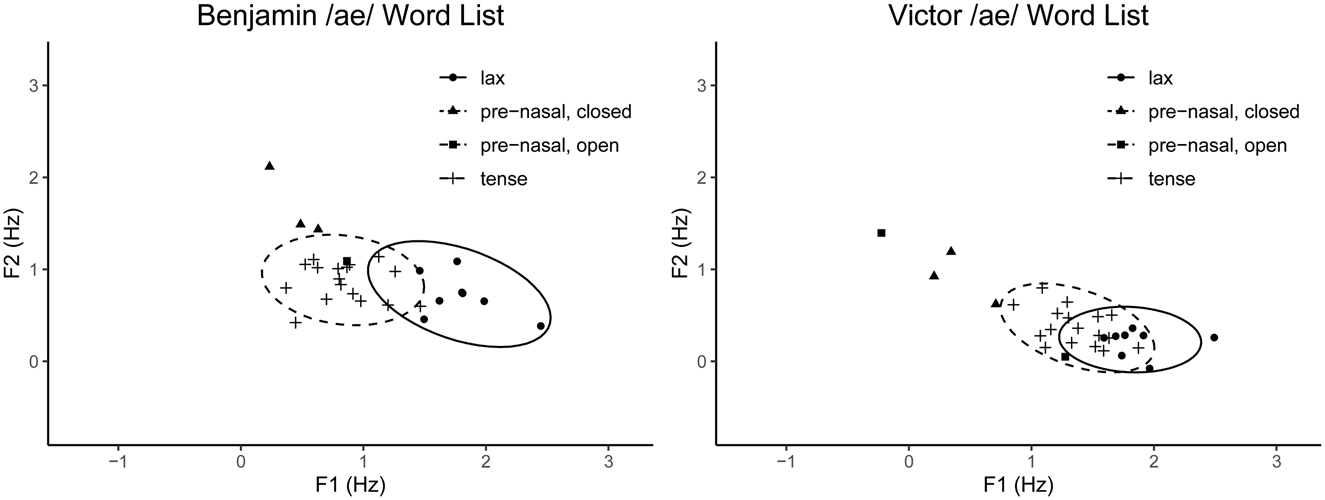
The data demonstrated clear examples of nasal and split short-a system types as well as examples of continuous systems. As a reminder, continuous systems are those with “the highest and frontest tokens of /æ/ occurring before nasals, but [with] no robust difference between prenasal and nonprenasal tokens of /æ/. In the continuous system, tokens occur in a more or less uninterrupted smear, from mid-front to high-mid-front position on down to low central position” (Labov et al., Reference Labov, Ash and Boberg2006). Figure 4 presents two examples of continuous systems from my data, with ellipses drawn around tense and lax tokens to demonstrate their distribution.
Continuous short-a systems; word list data (Benjamin, male, 31, b. 1981; Victor, male, 47, b. 1965).

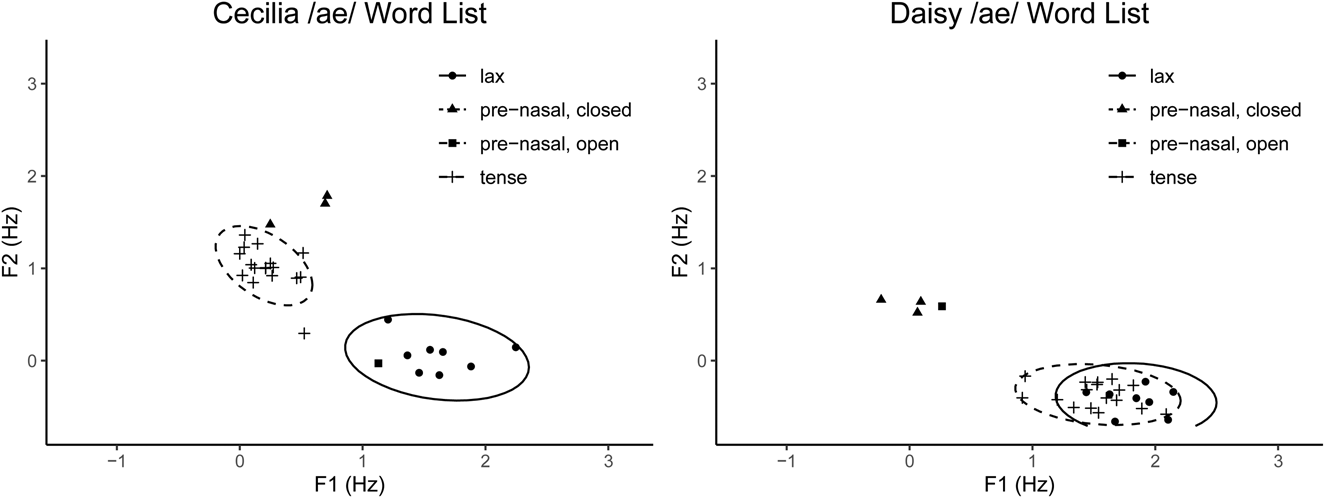
Contrast Figure 4 with Figure 5, which presents a clearly split system (left) and a clearly nasal system (right). Cecilia's split system features distinct ellipses for tense and lax tokens with no overlap. Daisy, in contrast, features strongly overlapping tense and lax tokens that are highly distinctive from prenasal tokens, both open and closed syllables.
Split (left) and nasal (right) short-a systems; word list data (Cecilia, female, 70, b. 1942; Daisy, female, 18, b. 1994).

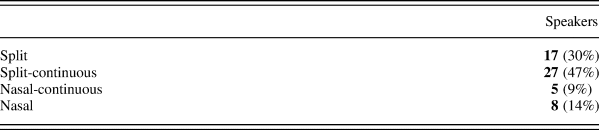
Note that, in the example plots provided in Figure 4, the two continuous system examples are actually quite different from each other in terms of the spread of tense and lax (æ) tokens, which we can see based on the way the ellipses pattern, in terms of overlap between tokens in these environments. Victor features most tense and lax (æ) tokens occurring in overlapping distribution, regardless of their classification into tense- or lax-triggering groups based on following environment, though not nearly as overlapping as Daisy's fully nasal system nor as distinguished from prenasal tokens. In contrast with Victor, Benjamin's tokens of (æ) more or less match up with the location of tense and lax (æ) one might expect for a split short-a system in New Orleans; however, the tokens appear in a continuous smear rather than in distinct and separate portions of the vowel space. To capture this distinction between a continuous system that looked more split and one that looked more nasal, speakers with continuous systems were divided into two groups: split-continuous and nasal-continuous. Thus, speakers in this study were separated into four short-a system groups: split, split-continuous, nasal-continuous, and nasal. As a check on my visual classification, I calculated for each speaker the Euclidean distance between their median normalized F1 and F2 for closed-syllable tokens preceding sounds that trigger tensing (e.g., __/z/, __/d/, __/b/) and those preceding sounds that do not trigger tensing (e.g., __/l/, __/t/, __/p/) in the split system, using all tokens across conditions except for those preceding nasal consonants, since presumably these would trigger tensing in both systems. My expectation was that speakers with split systems would show a greater Euclidean distance between tense and lax environments, while those with nasal systems would show a lower Euclidean distance, with continuous speakers in the middle (though split-continuous speakers would likely have higher Euclidean distance values than nasal-continuous speakers). Euclidean distance is a rough measure that captures only distance and not overlap (see Nycz and Hall-Lew [Reference Nycz and Hall-Lew2013] for some considerations about the distinction between the two), and thus does not represent the ideal measure for quantitative analysis of short-a system type. However, it does provide some qualitative insights about the level of distinction each speaker makes between tense and lax /æ/ tokens, which bolstered impressionistic categorization according to token overlap. I compared the ranking of speakers according to Euclidean distance and revisited my visual classification of speakers who seemed to pattern outside of the cline from split to nasal systems. Upon visual reinspection, I ultimately altered the classification of two speakers with split-continuous systems and one with a nasal system; these speakers were re-classified as featuring a nasal-continuous system. Table 1 reflects the final classification of speakers, based on the increased granularity that Euclidean distance measures offered in distinguishing between these transitional systems.
Short-a system totals

The numbers in Table 1 demonstrate that the majority (77%) of the speakers in this study featured split and split-continuous short-a systems, demonstrating the relative robustness of this short-a system type in Chalmette, despite its reported decline in the broader New Orleans region (Labov, Reference Labov2007).
SPLIT SHORT-A SYSTEMS IN NEW ORLEANS ENGLISH: SOCIAL PATTERNING
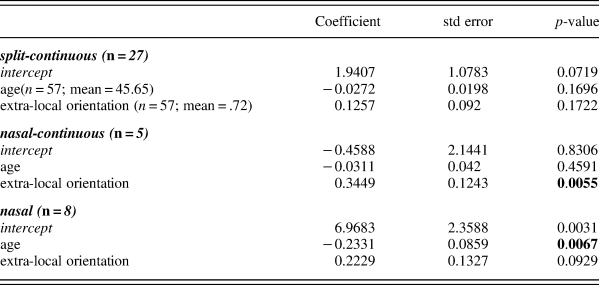
To examine the patterning of short-a system types according to social factors, I developed a multinomial logistic regression model with the fixed effects of age, class, sex, extra-local orientation, and post-Katrina location status, with the dependent variable of system type (split, split-continuous, nasal-continuous, and nasal). Multinomial regressions allow for nonbinary response variables, such as the four system types in this study. Table 2 presents the results of the best model for the data, which featured age and extra-local orientation as significant predictors. Because multinomial regression essentially generates multiple binary regressions, the model for each comparison of short-a system types (split-continuous, nasal-continuous, and nasal) against the reference point of split short-a system is presented separately in Table 2. Significant p-values are bolded.
Results of multinomial regression on short-a system types (n = 57; reference point: split system, n = 17)
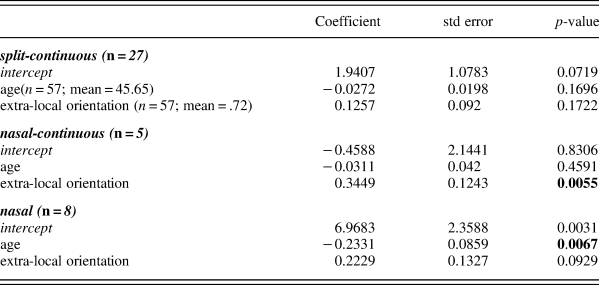
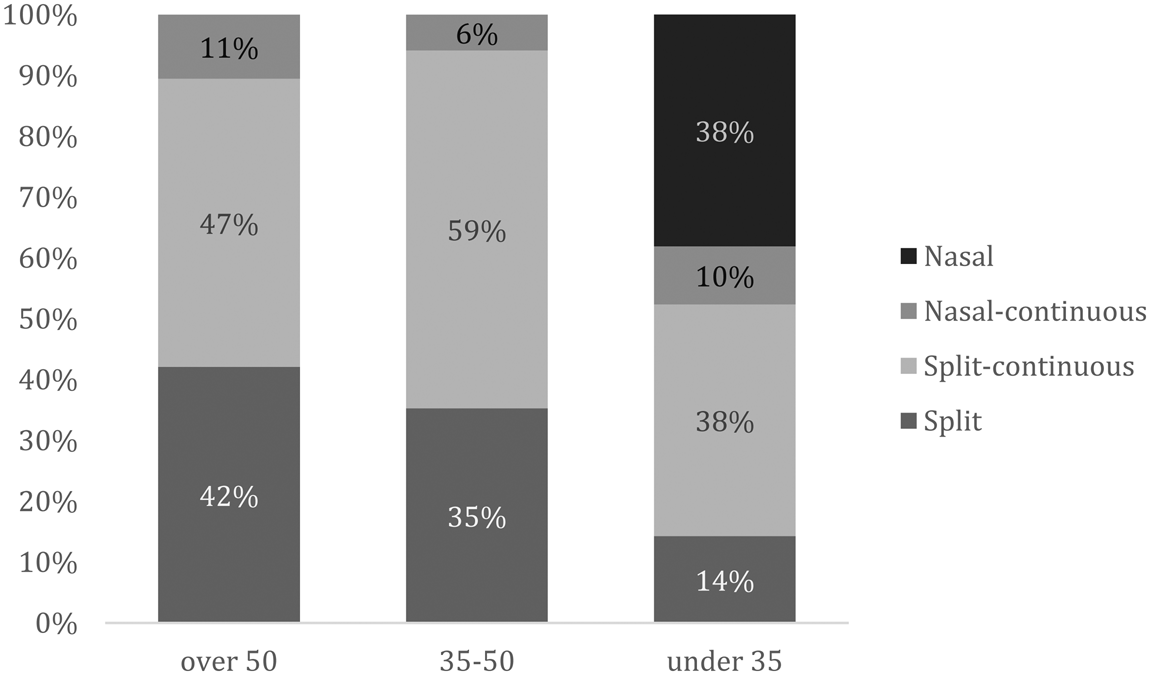
Social class, sex, and post-Katrina location status were not significant predictors of short-a system type. In contrast, age and extra-local orientation were significant predictors, with nasal systems more likely than split systems among younger speakers and nasal-continuousFootnote 2 systems more common than split systems among participants with higher extra-local orientation scores (those more oriented to places outside of Chalmette). Figure 6 provides a representation of trends across short-a systems for speakers in different age groups. Although age was treated as a continuous variable within statistical analyses, for visualization purposes Figure 6 organizes age by three age groups, evenly split across the sample: under 35 (b. 1977–1994; n = 21), 35–50 (b. 1961–1976; n = 17), and over 50 (b. 1960 or earlier; n = 19).
Short-a systems according to age: under 35 (b. 1977–1994; n = 21), 35–50 (b. 1961–1976; n = 17), and over 50 (b. 1960 or earlier; n = 19).

In Figure 6, we observe a steep decline in the presence of split short-a systems across age groups, from 42% split in the oldest generation to only 14% in the youngest. Notably, no speaker in this corpus that is 35 or older features a nasal system. In contrast, 38% of the youngest generation has a nasal short-a system. If both nasal-continuous and split-continuous systems are conceived of as intermediary systems between the split and nasal system, it is notable that over half of the speakers in the oldest and middle generations feature such intermediary systems, suggesting that the change away from the split system was already in progress even when the oldest speakers began acquiring English as children. The oldest speaker with a continuous system is Maria (female, 71, b. 1940), who has a split-continuous system.Footnote 3 The shift from the oldest generation to the middle generation is not a drastic one; however, for participants under the age of 35 we see the change in progress toward a nasal short-a system rapidly progressing. The oldest speakers in this corpus with nasal systems are Greg and Sarah, both 31 years old (b. 1981) at the time of data collection. If we compare these patterns with Labov's (Reference Labov2007) ANAE data, which notes New Orleanians born in 1952 and 1958 featuring nasal systems, we can conclude that Chalmette lags behind New Orleans proper in terms of the shift toward a nasal system, mirroring results with other features, such as variable nonrhoticity (Dajko et al., Reference Dajko, Schoux Casey and Carmichael2013).
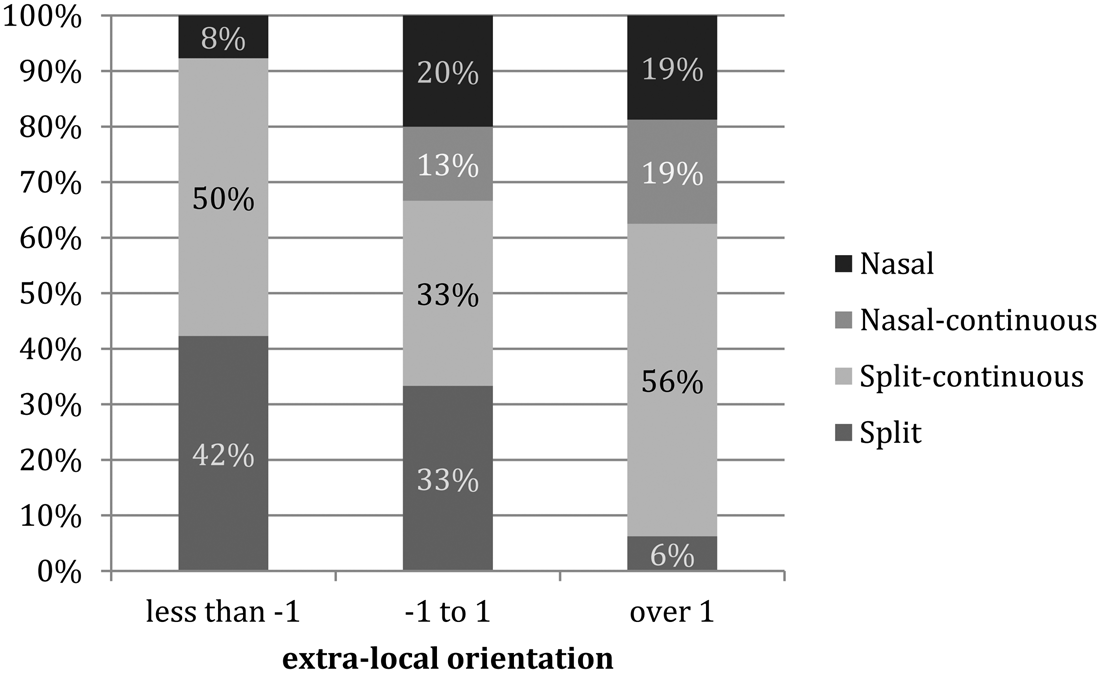
As Table 2 demonstrates, participants with higher extra-local orientation scores—those speakers who orient most to areas outside of Chalmette—are more likely to feature nasal-continuous systems than split systems. While this significant predictive power holds only across these two short-a system types, a model comparison revealed that adding extra-local orientation as a predictor resulted in a significant improvement over a model containing only age, suggesting that the effect is robust. Figure 7 presents the distribution of short-a system types according to extra-local orientation. As was the case with age, although extra-local orientation was treated as a continuous variable within the regression model, for the sake of demonstrating the differences across the continuum, in this figure I have grouped speakers into three ranges of extra-local orientation: less than −1 (n = 26), −1 to 1 (n = 15), and over 1 (n = 16). As a reminder, extra-local orientation scores ranged from −5 to 16 based on scoring for participants’ identification with Chalmatian identity and participation in social structures in Chalmette. Those with scores below −1 would be those most oriented toward a local, Chalmatian identity. Since an inwardly focused identity is the default in this insular community, nearly half of participants fall within this range. The remaining participants are evenly split between the middle of the range (−1 to 1, meaning that they had conflicting responses or lukewarm identification as Chalmatians) and toward the upper pole (over 1, which included the participants who were most outwardly oriented, including those who openly expressed distaste for Chalmette and overt avoidance of the locale and its residents—a particularly marked stance for individuals from Chalmette).
Short-a systems according to extra-local orientation: less than −1 (n = 26), −1 to 1 (n = 15), and over 1 (n = 16).

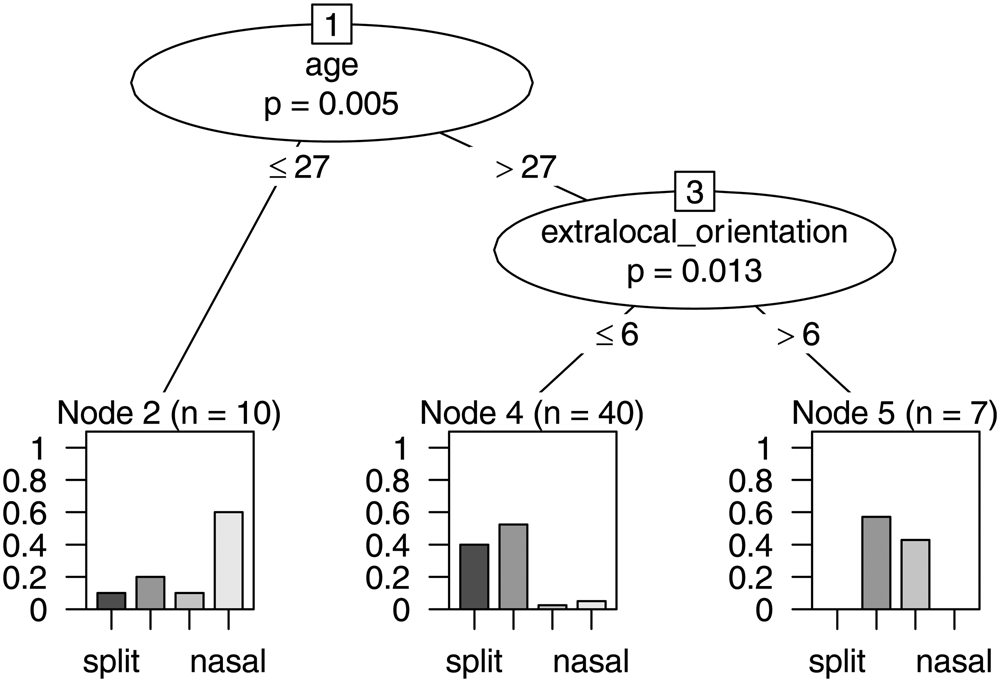
Figure 7 shows that speakers with an extra-local orientation score of less than −1—those who are the most oriented toward Chalmette—are also those most likely to feature a split short-a system, with 42% of participants featuring split systems. In contrast, only 6% of speakers with an extra-local orientation score over 1 (those most oriented away from Chalmette) feature a split short-a system. The two speakers with scores under −1 who featured nasal systems were Paul (male, 22, b. 1989) and Ellie (female, 18, b. 1994). Given that we observed younger participants featuring nasal short-a systems more frequently than older speakers, this suggests there may be a relationship between extra-local orientation scores and age for this variable. While adding an interaction between age and extra-local orientation does not significantly improve the model presented in Table 2, an inference tree generated for these data, shown in Figure 8, demonstrates that there does appear to be a connection between the factors of age and extra-local orientation, in that the latter factor best predicts short-a system for speakers over 27 years of age (b. 1986 or later).Footnote 4
Inference tree for short-a system types.

In Figure 8, we see that for participants aged 27 and younger (n = 10), extra-local orientation scores do not predict system type. This is likely because such an overwhelming proportion of younger speakers featured a nasal system, regardless of extra-local orientation. For participants over 27, in contrast, very few speakers featured nasal systems. Moreover, all of the speakers over 27 with a split system also had an extra-local orientation score less than or equal to six. As was apparent in the regression model, it is the nasal-continuous system that is most strongly predicted by orientation, with participants featuring higher extra-local orientation scores also most likely to have a nasal-continuous system. This inference tree demonstrates that, in particular, it is the participants over 27 who are driving this effect. As before, if we consider the nasal-continuous system as a transitional system on the path toward the nasal configuration, we can think of these participants as potentially leading this change in progress. Thus, it seems that for older generations of speakers, the externally oriented participants were most likely to be early adopters of a nasal-continuous system, while those most oriented to Chalmette tended to retain the conservative split short-a system.
SUMMARY AND DISCUSSION
The data presented in this study demonstrate that split, continuous, and nasal short-a system types are attested in current-day Greater New Orleans. I have shown that /æ/-tensing in New Orleans English is conditioned by following phonetic environment, with an active open syllable constraint, but no function word constraint, providing further evidence for Labov's (Reference Labov2007) description of the split short-a system in NOE. Despite the fact that many participants in this study featured a split or split-continuous short-a system, statistical analysis indicated that younger participants were more likely to feature nasal systems, confirming Labov's (Reference Labov2007) claim that a shift is in progress away from the split system toward adoption of a nasal system. This pattern mirrors such shifts taking place in NYC (Becker, Reference Becker2010) and Philadelphia (Sneller, Reference Sneller2018) and follows broader trends throughout the US in terms of adoption of a nasal short-a system. Another significant predictor of short-a system type was extra-local orientation, with speakers featuring a higher extra-local orientation score (those most oriented away from Chalmette) more likely to feature the transitional nasal-continuous system. An inference tree further revealed that this pattern was robust for participants over 27 (b. 1984 and earlier), in part because participants 27 and younger (b. 1985 and later) were highly likely to feature a nasal system, suggesting that the change in progress toward a nasal short-a system has progressed nearly to completion for this youngest group of speakers (thereby obscuring any impacts of extra-local orientation among them). Focusing on the speakers over 27, I interpreted the relationship between extra-local orientation and short-a system as indicating that participants that were more externally oriented to places outside of Chalmette were those leading the change toward a nasal system, by positing that the nasal-continuous system is a transitional “first step” toward adopting a nasal short-a system.
One of the principal questions in this study was centered on how displacement following Hurricane Katrina may have impacted linguistic features in GNO. The sample featured some participants who returned to Chalmette to rebuild after the storm and others who relocated elsewhere in GNO, where traditional New Orleans English features are less common. Participants who relocated explained to me that they were highly identifiable by their accents, which are stigmatized in other parts of GNO, providing an ideological motivation to adapt their speech to their new dialect area. Moreover, due to obligatory evacuation in the months following the storm, all participants—returners and relocators alike—spent some amount of time away from Chalmette, gaining exposure to different ways of speaking that could impact their phonological systems. Although it is not possible to state the direct impact of the storm using this dataset, it is crucial to note that relocation itself was not a significant predictor of short-a system type. That is to say, participants who relocated permanently were no more likely to feature a nasal short-a system than those who returned to Chalmette. Rather, all younger speakers, returners and relocators alike, were participating in the shift. The fact that some of the oldest speakers in the sample featured continuous systems suggests that the shift was underway before the storm,Footnote 5 though it is possible that the context of dialect contact following the storm accelerated these effects when considering the drastic shift toward a nasal system in the youngest group of speakers (who would have been school-aged at the time displacement occurred, and thus exposed to extra-local linguistic norms during adolescence, a stage in life which has been shown to be significant for impacting linguistic practices [Eckert, Reference Eckert, Finegan and Rickford2004]). And crucially, although post-Katrina location status was not a significant predictor of short-a system type, extra-local orientation did play a role, suggesting an aspect of place-based identity in short-a system type. However, many questions remain to be answered in order to properly interpret these results. For one: what is the status of short-a within other areas of GNO? Vowel data on New Orleans English remains sparse, thus it is challenging to situate this shift within the broader regional speech patterns. There is evidence that highly marked local features such as nonrhoticity appear in higher rates and are more ideologically associated with Chalmette in comparison to New Orleans proper (Carmichael, Reference Carmichael2014, Reference Carmichael2017; Dajko et al., Reference Dajko, Schoux Casey and Carmichael2013), but we know little about less salient vowel features like split short-a systems. This brings up the question of awareness. In Philadelphia, Sneller (Reference Sneller2018) used a matched guise test to demonstrate that split versus nasal systems in the city are above the level of conscious awareness and carry social meaning. This contrasts with Eckert and Labov's (Reference Eckert and Labov2017) suggestion that the abstract phonological organization of one's sound system—mergers, splits, and chain shifts—are not as readily available for the development of indexical social meaning as phonetic gestures are, due to the referential weight that a phonological system carries, and the frequent lack of awareness linked to such complex sound relationships. Some participants in the current study commented on the pronunciation of specific lexical items (e.g., had and has pronounced with raising was linked to “the Chalmette accent” by one speaker), but a broader awareness of the system was not evident in the interviews conducted. However, an experimental approach to the question would be ideal for assessing the level of awareness that Chalmatians—and other New Orleanians—have about this phonological variation, in order to determine the role of awareness in the shift toward a nasal system. These questions are especially pertinent given the findings on extra-local orientation reported on in this paper, since social salience has been proposed as a precondition to the indexical linking of linguistic features and the places they are found, and thus to the employment of these features as markers of place-based identity (Carmichael, Reference Carmichael2017; Nycz, Reference Nycz2018).
One of the central debates within studies of split short-a systems has been the origin of the split systems in the communities where it is found. While Labov (Reference Labov2007) asserted that the split short-a system diffused from New York City to locations as far-flung as Cincinnati, Albany, and New Orleans, Johnson and Durian (Reference Johnson, Durian and Hickey2016:292) proposed that the system “was original to much of American colonial settlement.” Labov (Reference Labov2007:357) drew attention to the fact that the short-a systems observed in these locales feature a “loss of structural detail” in comparison with NYCE's system. He suggested that this is because adult speakers who adopt split short-a systems as a result of contact with NYC speakers merely acquired the surface phonetic realizations (the phonological constraints), often lacking the deeper abstract structure (the grammatical and lexical constraints). The analyses presented in this paper confirm Labov's (Reference Labov2007) description of the NOE split short-a system, demonstrating robust phonological constraints but fewer grammatical/lexical constraints. Moreover, the split short-a system is not the only feature proposed to have diffused to New Orleans from NYCE. Carmichael and Becker (Reference Carmichael and Becker2018) completed a constraint ranking comparison for nonrhoticity and raised bought in contemporary data from New York and New Orleans, concluding that the constraints on nonrhoticity display a similar pattern to that of short-a: the system of (r) constraints in NOE was strikingly similar to that of NYCE, save for the effect of word type (lexical/function word). That is, the system featured strong commonalities but with a loss of structural complexity as would be expected in a situation of diffusion. The bought data presented a less clear pattern of similarity, which Carmichael and Becker concluded might suggest that this feature did not, in fact, diffuse from NYC and rather developed independently but is mentally “packaged” with nonrhoticity and split short-a as “New Yorky”-sounding features. The data presented in this paper, taken in tandem with other comparisons between New York and New Orleans, provides further support for Labov's (Reference Labov2007) diffusion claim in the case of New Orleans’ short-a system. In order to demonstrate that the split system did not diffuse from NYC, which is the simplest explanation for the striking similarities observed, one would need to examine archival linguistic data from New Orleans (and possibly surrounding areas) to determine the spread and time depth of the split system in the region and complete historical research into which settler populations may have brought such a system (since New Orleans features a very different settlement history from New England and the mid-Atlantic, as a predominantly Francophone city until the mid- to late-1800s).
Related to the question of the split system's origin in New Orleans is that of the nasal system's arrival to the city. As others (Ash, Reference Ash2002; Boberg & Strassel, Reference Boberg and Strassel2000; Labov et al., Reference Labov, Ash and Boberg2006) have pointed out, a nasal system is objectively a simpler system than a split short-a system, since the latter features phonological triggers that do not belong to a natural class as well as grammatical/lexical constraints. Having lost some of the grammatical complexity of the NYCE system when it diffused to New Orleans, the NOE version of the split system was arguably never phonemic (see Labov [Reference Labov1994] for an outline of the necessary conditions for making such an argument). But it is nevertheless more complex than the nasal system, so there could be some component of naturalness in shifting toward the nasal short-a system. The nasal system is also more common in the US on the whole, thus allowing speakers exposure to it on television and social media and also likely during their displacement following Hurricane Katrina. In other shifting communities, migrating populations to the region in question have been cited as the source of the nasal system (see Sneller [Reference Sneller2018] on Philadelphia). As mentioned, there is evidence that the nasal system had arrived in New Orleans before the storm, pointing to its potential appearance via migrant populations pre-Katrina, rather than it being a result of contact due to post-Katrina displacement. However, “Louisiana is one of the least diverse states when it comes to domestic migration—nearly 4 out of 5 residents were born in the state, a figure that hasn't changed much over the past century” (Aisch, Gebeloff, & Quealy, Reference Aisch2014). So the question arises of how a critical mass of nasal system users in this particularly nonmobile region would tip the scales. One potential hint comes from the significant effect of extra-local orientation in Chalmette; perhaps orientation toward these nonlocal standards could explain the shift. Again, further data on short-a systems within New Orleans proper, especially across different ethnic groups and from individuals with provenance from outside the city, is a necessary first step toward answering this question. The fact remains, however, that after Hurricane Katrina New Orleans lost over half of its population directly following the storm, though the most recent numbers put the city's population of New Orleans back at 80% of its pre-Katrina population (Plyer, Reference Plyer2016), numbers which reflect a large amount of newcomers. Thus, these shifting demographics will surely have an impact in years to come on the local dialect and may have already played some role in accelerating the changes among the youngest generations of New Orleanians.
A final question that this research bears on is what this shift means for language patterns in GNO, a dialect island within the South with a history of unexplainably Northern-sounding features. The results of this study, in combination with Labov's (Reference Labov2007) ANAE data on New Orleans proper, suggests that the future of NOE is likely as a dialect featuring a nasal short-a system, with the change possibly completed within a generation or two given the rapidity of the shift thus far, along with the concomitant loss of longstanding New Orleanians and influx of nonlocal residents post-Katrina. As is the case with Charleston, South Carolina, another major port city in the South that does not participate in the Southern vowel shift (Baranowski, Reference Baranowski2013), it appears that this change will keep New Orleans marginal to the rural South. Indeed, with the shift toward a nasal system, New Orleans jumps the South entirely to adopt Midland dialectal patterns, joining other Southern urban centers like Dallas, Houston, Atlanta, and Raleigh that have similarly demonstrated the effects of dialect leveling toward Midlands-esque features that distinguish them from rural, Southern vowel shifted areas of the South (Dodsworth & Kohn, Reference Dodsworth and Kohn2012; Koops, Reference Koops2014; Thomas, Reference Thomas1997; Tillery & Bailey, Reference Tillery, Bailey, Schneider, Burridge, Kortmann, Mesthrie and Upton2004). Combined with findings related to the decline in use of New Orleans’ other traditional linguistic features, such as nonrhoticity and raised bought (Carmichael, Reference Carmichael2014, Reference Carmichael2017; Schoux Casey, Reference Schoux Casey2016), we could say that New Orleans English is currently undergoing a “typological transition” (Boberg & Strassel, Reference Boberg and Strassel2000)—inasmuch as it has ever allowed for categorization in a given dialect group. That said, there remain some distinctive features of New Orleans English that differentiate it from “the third dialect” (Labov, Reference Labov and Eckert1991), such as the incipient introduction of Canadian raising of /aw/ (Carmichael, Reference Carmichael2014, Reference Carmichael2020), keeping New Orleans squarely in the realm of “odd” within the American English landscape, defying geographic and historical trends.
CONCLUSIONS
In this study, I have presented an analysis of the short-a systems present in New Orleans English as it is spoken in the linguistically conservative suburb of Chalmette. Across the 57 participants in this study, I noted split, continuous, and nasal systems. One of the aims of this analysis was to determine if Labov's (Reference Labov2007) description of the split short-a system in New Orleans was confirmed by my larger dataset of speakers. My data corroborated Labov's description of phonological constraints: front nasals, voiced stops, and fricatives all triggered tensing; the only caveat for Labov's initial classifications is that more data is required to confirm that /θ/ is a tensing trigger along with other voiceless fricatives. Also mirroring Labov's findings, my data demonstrated a relatively robust open syllable constraint and no function word constraint.
Statistical analysis revealed that age and extra-local orientation were significant predictors of short-a system type. NOE is undergoing a shift away from a split system toward the more common system type in the United States, a nasal short-a system. While post-Katrina location status was not a significant predictor of short-a system type, suggesting that relocation following Hurricane Katrina has not had a direct effect on speakers’ short-a system types, extra-local orientation did significantly predict short-a system types. Speakers with higher extra-local orientation scores—those who oriented the most to extra-local areas—were less likely to feature the traditional split short-a system than those who oriented more to Chalmette. This patterning suggests that place orientation is a crucial factor to consider in studies involving mobile speakers, or other contexts in which one's identity may become linked to place (e.g., voluntary relocation, involuntary displacement, gentrification, situations of extreme demographic shift, and so on).
Previous research on short-a centers on the identification of the system type, its origins, and what that means for the classification of the dialect in question (i.e., into which regional variety of American English does it fit?). The analysis above provides some answers for these questions in the case of New Orleans English. The analysis presented, considered in tandem with Carmichael and Becker's (Reference Carmichael and Becker2018) research on other features shared with NYCE, provides support for the idea that the NOE split short-a system diffused from New York to New Orleans (Labov, Reference Labov2007). While the source of the nasal system in New Orleans is less clear, its ascendancy is unambiguous, and at least in terms of this feature, New Orleans English appears to be drawing closer to Midlands patterns of speech in the United States. The coming generations—especially those speakers who were elementary school age, or not yet born, in 2005 when Hurricane Katrina forever changed the trajectory of the city—will prove especially interesting in terms of the future typological classification of the New Orleans dialect.
APPENDIX
Participant information

Metric for assessing social class
Metric for assessing extra-local orientation scores