In our minds, gaining the right to vote—and even initially, the right to sit at a lunch counter—was tied to the racially-based powerlessness of [rural and poor African Americans], and gaining these rights would, we thought and hoped, inevitably lead to improving their economic status. That it did not do so doesn't mean we didn't think it would.
—Julian Bond, former communications director of the Student Nonviolent Coordinating CommitteeFootnote 2INTRODUCTION
Given the conflation of race and poverty in the general perception, it may seem apparent that civil rights groups that are focused on racial equality would also advocate for the poor.Footnote 3 However, advocacy for the poor has never been the top priority of civil rights organizations. Existing literature on the activities and ideologies of civil rights groups argues that such organizations have functioned with a distinct middle-class bias since well before the 1960s civil rights movement (Goluboff Reference Goluboff2007; Reed Reference Reed1999; Marable Reference Marable1985). Additionally, all organizations face disincentives to represent the poor: such advocacy is expensive, politically unpopular, and often involves trade-offs with other issues that are more central to organizations' missions.
Nonetheless, because of the disproportionate effects of poverty on African Americans, civil rights groups may consider economic issues and issues of poverty to be inherently part of their mission. Such organizations have expressed concern with, and commitment to, issues that specifically affect the African American poor (Strolovitch Reference Strolovitch2007). Although they varied in their chosen tactics and strategies, groups such as the Student Nonviolent Coordinating Committee and the Southern Christian Leadership Conference were particularly concerned with African American economic freedom.Footnote 4 Organizations and activists struggled to balance their commitment to sometimes radical economic goals with the necessity of working toward civil rights goals that were palatable to White liberals and policy makers (Jackson Reference Jackson2007). For many activists and leaders, the goals of civil rights were inseparable from those of economic equity because activists on the frontlines were struggling to overcome both racial and economic oppression. As John Lewis, former chairman of the Student Nonviolent Coordinating Committee, explained:
People have said that the civil rights movement was a middle-class movement…. But, a lot of the people that made up the rank and file of that movement, the people that got arrested and went to jail, the people that participated in the marches, that stood in that immovable line, they were dirt poor.Footnote 5
Additionally, middle-class African Americans might have particular interests in addressing issues of economic inequality. Research demonstrates that middle- and upper-class African Americans, who largely compose the membership of civil rights organizations, do not consider their own interests to be far removed from those of the African American poor. Scholars have found that African American middle-class status may be fragile—African Americans have less wealth and income than middle-class Whites and contend with housing segregation and discrimination as do the African American poor (Pattillo-McCoy Reference Pattillo-McCoy1999; Oliver and Shapiro, Reference Oliver and Shapiro1995). Michael Dawson found that shared interests based on race lead middle-class African Americans to care more about issues affecting the poor than their class status would predict (Dawson Reference Dawson1994).
Dawson's (Reference Dawson1994) findings have spurred arguments about whether the emphasis on linked racial fate masks differences, and different interests, among African Americans. By assuming common interests based on race, the dominant interest is assumed to be “common” (Reed Reference Reed1999, p. 44). Although policy makers and organizational leaders evoke linked racial fate with claims to represent “all African Americans,” scholars have found that such claims are often accompanied by inactivity on behalf of nondominant subgroups. For example, Cathy Cohen (Reference Cohen1999) found that African American leadership largely neglected the disproportionate impact of HIV/AIDS on African Americans. Borrowing from her theory of primary and secondary marginalization, we could define organizational constituencies as either primary or secondary, based on their level of marginalization within, and outside of, the organization (Cohen Reference Cohen1999). Often, the definition of a group's primary constituency is noncontroversial; it would be difficult to argue that the NAACP was not founded to represent African Americans. However, such broad identities are often difficult to translate into organizational priorities. Therefore, primary constituencies often dominate organizational priorities, whereas secondary constituencies receive less attention, or are ignored altogether.
Additionally, advocacy that is considered to be relevant to an organization's overall constituency often carries implicit, and sometimes explicit, class biases. For example, civil rights organizations' relatively recent focus on affirmative action policies is interpreted by some scholars as the representation of middle-class interests to the neglect of low-income African Americans (Reed Reference Reed1999; Marable Reference Marable1985). In her Survey of National Economic and Social Justice Organizations, Dara Strolovitch (Reference Strolovitch2007) demonstrates that organizations claiming to represent “all African Americans” give disproportionate attention to issues affecting the wealthy and highly educated. She finds that civil rights organizations focus substantially more attention on affirmative action in higher education, an issue that affects an advantaged subgroup of their constituency, and less on welfare reform, an issue that affects a disadvantaged subgroup of their constituency (Strolovitch Reference Strolovitch2007, p. 121).
Therefore, whether civil rights organizations represent the poor is, in fact, an empirical question—such representation cannot be assumed. Examining civil rights organizations' advocacy on behalf of the poor sheds light on an important, yet largely unexamined, aspect of the organizations' histories, and illustrates how issues of class and race intersect in interest group priority setting.Footnote 6 Additionally, it provides a unique opportunity to further understand the internal decision-making process of organizations—how do interest groups choose their priorities? What factors might lead groups to advocate on behalf of marginalized subpopulations of their constituencies?
In this paper, I examine the Student Nonviolent Coordinating Committee's (SNCC) and the National Association Advancement of Colored People's (NAACP) activities leading up to, and concerning, the Economic Opportunity Act (EOA), the legislative component of President Johnson's War on Poverty.Footnote 7 It may seem that the NAACP and SNCC had one clear incentive to represent the poor during the War on Poverty: federal funding was available to organizations involved in antipoverty programming. However, neither the NAACP nor SNCC received federal War on Poverty funds during the mid-1960s, and both organizations were quite vocal about their refusal to do so. SNCC did not pursue federal funding because of its overall distrust of federal antipoverty programming. In 1965, the NAACP Board decided that the organization should not become a prime contractor of the federal antipoverty funding because such a commitment would compromise the organization's ability to protect the rights of African Americans from the federal government.Footnote 8 In fact, civil rights organizations faced particular disincentives to making antipoverty policy a priority during the War on Poverty.
During the early and mid-1960s, groups were quite narrowly focused on passing the Civil Rights Act and Voting Rights Act, legislation that was intended to fight racial discrimination. After the passage of the acts, groups debated whether the movement should focus on overseeing their implementation or should emphasize activities related to the goal of economic justice—a goal which many groups and leaders saw as inseparable from civil rights but which had taken a backseat to desegregation and nondiscrimination since the mid-1950s.Footnote 9 African Americans were not the primary recipients of public assistance—in 1960, 40% of welfare recipients were African American.Footnote 10 Additionally, neither the Johnson administration nor the national media initially considered the War on Poverty to be particularly relevant to African Americans. In its coverage of the first year of the EOA's implementation, the news media focused on rural poverty and the experience of poor Whites in the United States (Gilens Reference Gilens1999, p. 116). Therefore, civil rights organizations had a choice—they could choose to focus on the effective implementation of the Civil Rights Act and Voting Rights Acts, which would affect all African Americans. Or, they could choose to prioritize the War on Poverty, which would affect low-income Americans, many of whom were African American.
As donations to civil rights groups dropped after the passage of the acts, civil rights groups had little incentive to take on a politically unpopular priority that did not explicitly concern racial equality.Footnote 11 By the late 1960s, the NAACP had become less dependent on membership for revenue because of its increasing reliance on grants from the Ford and Rockefeller Foundations and the Carnegie Corporation.Footnote 12 However, during the early and mid-1960s, civil rights organizations, including the NAACP, relied heavily on membership contributions for revenue (Marger Reference Marger1984).Footnote 13 Therefore, declining membership numbers put organizations in precarious positions, and may have made a commitment to a costly goal, such as poverty alleviation, increasingly unattractive.
My findings indicate that despite such disincentives, both the NAACP and SNCC increased their antipoverty activities during the War on Poverty. Competition among organizations pushed groups to advocate on behalf of the poor. The NAACP became involved at the national and local levels, and worked to increase its relevance to the African American poor. SNCC focused on grassroots organizing to ensure that low-income African Americans were not disempowered by the federal government's antipoverty policy. Although SNCC had considered poverty alleviation to be critical to its mission since its founding, strategic considerations led the group to operationalize its ideological commitment.
In the next section, I present theoretical understandings of interest group decision making. Second, I explain my approach to establishing organizational priorities. I then establish the level of attention that both groups devoted to antipoverty policy during the War on Poverty. The NAACP and SNCC increased their attention to the needs of the poor during this period, but with varying tactics and goals. Next, I present my findings as to why both organizations shifted their priorities during the 1960s. As I demonstrate systematically in this paper, competition among civil rights organizations drove the NAACP and SNCC to commit attention to antipoverty issues and to focus attention to grassroots organizing concerning the War on Poverty. Differences in the organizations' structures mediated what form this attention would take.
A THEORETICAL UNDERSTANDING OF WHY AND HOW GROUPS SHIFT THEIR PRIORITIES
Pluralists argue that competition among organizations allows multiple voices to be heard within the U.S. political system—power is dispersed among groups of citizens with common preferences and no one group of elites holds disproportionate levels of power (Truman [1951] Reference Truman1960; Dahl Reference Dahl1961). Instead, groups and group leaders strive to attract members or ideological adherents. This creates competition among groups and ensures that all people have the opportunity to gain representation, because some group or group leader will always be seeking their support. Because pluralist theory emphasizes competition within the political system, scholars pay attention to what types of groups exist; how groups form and maintain themselves; and who, in terms of group interest, is represented in the U.S. political system. However, such research rarely examines the internal priority-setting processes within groups.Footnote 14 Indeed, usually organizational goals and priorities have already been determined at the point when scholars examine organizational behavior. Although few scholars have analyzed the internal decision-making processes of organizations, many have noted the importance of such analysis (Tierny, Reference Tierney, Crotty, Schwartz and Green1994; Baumgartner and Leech, Reference Baumgartner and Leech1998).
A group's internal response to external factors often determines its organizational priorities.Footnote 15 In their analysis of incentive systems, Peter Clark and James Wilson argue that an organization will face varying levels of competition from rival organizations based on the types of incentives it offers to its members (Clark and Wilson, Reference Clark and Wilson1961, pp. 157–161; Wilson [1973] Reference Wilson1995, p. 266). If several organizations are addressing the same set of issues, relations can be harmonious as long as organizations are not required to compete over membership.Footnote 16 This may be possible if each group carves out a unique role for itself concerning the issues, or approaches the same social problem with tactics differing from the other groups that share its constituency.Footnote 17 A group may also avoid competition by shifting its focus within its overall mission, or by focusing on a different aspect of its “identity” (Heaney Reference Heaney2004). However, within a group of organizations that arguably share a defined constituency, such as civil rights groups, perceived competition for membership may be inevitable, regardless of the various options for organizational focus and strategy.Footnote 18
Because of my reliance on archival research, this paper is able to assess whether groups respond to competition and also how they respond. First, I expect that if one organization begins to approach general goals from a new perspective, one that appeals to a broad base of membership, competition to maintain membership may require shifts in other organizations' goals and priorities toward those of the rival organization. To maintain its membership, political strength, and preeminence among organizations sharing its mission, or its identity, an organization will work to prevent the loss of its constituency, or potential constituency, to other organizations with similar missions.
Second, I expect that an organization's perceptions of, and responses to, competition, a factor that is external to an organization, will depend on the organization's structure. This research offers a unique opportunity to assess the interaction of internal and external factors on decision making, and makes it clear that such factors cannot be assessed in isolation. A national organization that controls the programming of its affiliates, such as the NAACP, will be influenced by activities at the local level. Even if its chapters have no power to name organizational priorities, the national office will be affected by the activities of other organizations in the field, such as SNCC, that are mobilizing people that both organizations consider to be part of their constituencies (Clark and Wilson, Reference Clark and Wilson1961; Wilson [1973] Reference Wilson1995; Gray and Lowery, Reference Gray and Lowery1996). For large organizations with autonomous affiliates, or for loosely federated organizations such as SNCC, local activities may determine national priorities because the national office seeks to retain relevance to local groups.Footnote 19 If the national office does not maintain a cooperative relationship with its local offices and organizers, then the local groups are able to pursue their own priorities without regard to the national office, stripping the national office of its purpose.
ESTABLISHING AND EXPLAINING PRIORITY SHIFTS: DATA AND METHODS
Establishing Shifts in Organizational Priorities
An examination of the NAACP and SNCC provides an opportunity to understand priority setting in two organizations with similar missions but with very different organizational structures and approaches to social change. Neither the NAACP nor SNCC considered poverty policy to be a top priority, although both considered economic justice to be highly relevant to their overall missions. While the NAACP had a long-established and highly organized bureaucracy, SNCC functioned with a very loose structure and an embedded suspicion of any type of bureaucracy. A comparison of decision making within the two groups is worthwhile because of their differing approaches to achieving similar overall goals.
Determining organizational priorities, and the reasons groups arrive at those priorities, is a challenging task. Organizations have various audiences and means for expressing their priorities, and sometimes do not decide on an explicit hierarchy of goals. Archival research provides a unique opportunity to determine organizational priorities, and to assess the dynamics leading to internal decision-making within organizations. I examine materials such as annual reports, annual convention resolutions, speeches and programs, internal memos, communications to membership, public speeches, and press releases.Footnote 20 Both public and internal documents contribute to my assessment of organizational priorities and decision making. For example, a program from an organization's national convention allows me to assess the amount of attention the group was devoting to antipoverty policy; minutes from the board meeting where the convention was planned provide an understanding of the factors that contributed to determining the theme of the convention.Footnote 21
Sometimes it is clear when an organization is prioritizing an issue—local affiliates are mobilized, organizational representatives make public speeches, and media attention is focused on the organization's activities. Such an impressive campaign on an issue gains publicity for the organization spearheading the effort, and can be quite beneficial for the group in the long term. In the short term, however, it is quite costly. Only an organization that not only is financially comfortable but also has a presence in multiple states or urban areas, access to media attention, and the ability to attract participants to public gatherings could conceive of such a campaign. Smaller organizations, or even large ones that do not wish to devote all of their resources to one issue, may prioritize advocacy on issues without embarking on an all-consuming campaign.Footnote 22
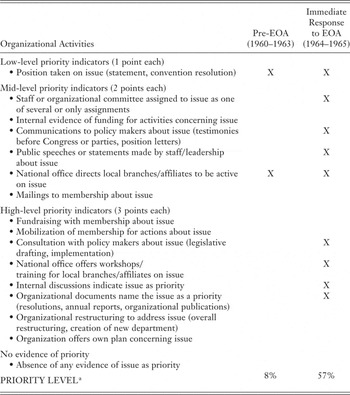
To determine shifts in organizational priorities, it is necessary to measure the level of priority each organization devoted to antipoverty policy during distinct time periods. Organizations engage in many different types of activities for many different reasons. Factors distinct to each organization, such as whether it generally relies on direct action tactics, mobilizes local organizations, or has local branches, affect how each organization prioritizes an issue. As Table 1 illustrates, I have included various types of activities at each level of priority.Footnote 23
Organizational Activities as Indicators of Priority

According to my scales of priority, indicators of an organization's high level of commitment to an issue include explicit statements of the issue as an organizational priority, internal structural changes aimed to make the organization's activities concerning the issue more effective, and activities that involve the mobilization of membership. These activities reflect an organizational commitment to the issue that is financial and that also involves membership. Without some evidence of membership involvement, an organization's commitment to an issue is not classified as a high priority. At a mid-level of commitment, a group has committed ongoing resources and staff to the issue, but has not reached out to membership through direct mobilization. Staff may lobby members of Congress on the policy and make public statements on the issue but will not activate membership to contribute funds for activities on the issue or to participate in demonstrations. If an issue is a low priority for an organization, the group may offer rhetoric either supporting or opposing a policy but will not commit any substantial organizational resources in terms of staff or funding, to the issue. For example, a staff member may attend a coalition meeting about a piece of legislation, but that will be the staff member's only activity concerning the legislation. Coalition activity itself might indicate various levels of organizational commitment to an issue. If an organization actively participates in a coalition, activities such as fundraising and membership mobilization indicate a high commitment to the issue, based on my priority scales. On the other hand, staff attendance at a coalition meeting requires minimal organizational resources.
This methodology allows me to present archival information in a standardized form, providing an understanding of fluctuations in attention to antipoverty policy, both across and within organizations. For each low-level priority indicator, a group receives one point; for each mid-level priority indicator, a group receives two points; and, for each high-level priority indicator, a group receives three points. I then determine the priority level based on the organization's antipoverty activities as a percentage of total possible activity points. Once fluctuations in priorities are documented, it is possible to examine why shifts in organizational attention to the poor occurred, and thus contribute to an understanding of organizational decision-making and to an awareness of how politically marginalized groups gain representation.
Assessing the Factors That Affect Priorities
To assess the influence of each variable examined, I assess the impact of each document based on its content, author, and intended audience. For example, a memo from a national field director to an executive director about the problems with expanding branch activity indicates that these problems existed and that the national office was responding to them. On the other hand, a similar letter from a branch officer to the national office does not indicate that the national office found such concerns to be pressing nor does it indicate that the national office was responding to them.
I evaluate the relationship between the independent variables and an organization's attention to welfare reform in two ways. First, I determine the role of the independent variables during a time that the organization is focusing on welfare reform. Often, an organization's shift in focus to antipoverty policy occurs after several months of internal discussions. Based on internal and external documents, membership numbers, budget numbers, branch numbers, and reorganization activities, I determine changes in the independent variables during the period before the planning of the antipoverty activities. While this method does not establish a causal relationship between changes in an organization's structure and its priorities, it does provide an understanding of the structure of the organization, and the organization's economic health as it embarked on a priority shift to represent the poor.
Second, in many cases, the content of resolutions, speeches, and internal memoranda divulges reasons for the organization's attention to the issue. For example, a memo from an executive director to his or her assistant stating that the organization must begin to focus on public assistance issues to attract the support of the masses indicates the importance of a group's constituency to an organization's priorities. In the quotation below, Roy Wilkins, then executive director of the NAACP, explains to branch leaders that the NAACP should increase its attention to the War on Poverty to maintain its preeminence within the civil rights movement:
As one of the Association's leaders, you will recognize at once that we are striking out in a new direction and launching a major new program area [the War on Poverty]. You will also, I believe, welcome it as an absolutely necessary move if the Association is to maintain its leadership in our movement.Footnote 24
Such documents, which present apparently causal reasoning, establish the relationships between the independent variables and the organization's attention to poverty, and help tell the story of the organizational changes and their effects on the organization's emphasis on welfare issues. However, simply because an organizational document gives a reason for a priority shift does not mean that other factors were not also relevant. I pay attention to organizational explanations for shifts in focus but also take into account factors such as whether the organization was financially healthy at the time or was facing a decline in membership.
CIVIL RIGHTS ORGANIZATIONS' PRIORITIES
Civil Rights Organizations' Decisions to Advocate on Behalf of the Poor
On August 20, 1964, Congress passed the Economic Opportunity Act (EOA), which established antipoverty policy as a priority of the Johnson administration. The purpose of the EOA was to alleviate poverty in urban and rural areas. The EOA was considered unique by policy makers, as well as advocacy groups, because of its emphasis on the involvement of the poor through Title II, which included the creation of the Office of Economic Opportunity (OEO), and the legislation's “maximum feasible participation” clause. The title's overall principle was that the poor should participate in the newly established local antipoverty agencies, known as the Community Action Programs (CAPs) (Axinn and Stern, Reference Axinn and Stern2001, p. 247). Although funded by the federal government, each CAP would be run by local agencies and nonprofit organizations, opening the door to possible interest group participation in the implementation of the EOA (Jackson Reference Jackson and Katz1993, p. 419).
Although literature on the activities and ideologies of civil rights groups has demonstrated a commitment to issues affecting the middle class, existing literature also points to groups' dedication to advocacy concerning economic issues (Jackson Reference Jackson2007, Reference Jackson and Katz1993; Piven and Cloward, Reference Piven and Cloward1977; Meier and Bracey, Reference Meier and Bracey1993).Footnote 25 Charles Hamilton and Dona Hamilton (Reference Hamilton and Hamilton1997) argue that civil rights groups have consistently operated with a “dual agenda,” focusing on both traditional civil rights issues as well as those concerning universal social policy:
Civil rights organizations have consistently emphasized three main points: (1) preference for a universal social welfare system that does not distinguish between social insurance and public assistance, (2) jobs for all in the regular labor market, and (3) federal hegemony over social welfare programs
(Hamilton and Hamilton, Reference Hamilton and Hamilton1997, p. 4).Because they focus on universal and contributory social welfare policy, Hamilton and Hamilton (Reference Hamilton and Hamilton1997) do not examine organizational representation of public assistance recipients—an important distinction when discussing responses to social welfare policy. Public assistance policies are unique in the realm of social welfare because of their political unattractiveness; they are neither publicly nor politically supported, and they are not based on contributions from eventual recipients. Additionally, it was not until the War on Poverty that welfare policy came to be viewed through a racial lens and associated with African Americans. Despite the inequitable nature of welfare disbursements, neither the policy makers nor the public viewed poverty policy as particularly affecting Blacks (Lieberman Reference Lieberman1998; Gilens Reference Gilens1999). In short, it was not at all obvious that the policy deserved a place on the race-centered agenda of civil rights organizations. Why then did these organizations decide to advocate on behalf of an unpopular group such as welfare recipients? Figure 1 summarizes the NAACP's and SNCC's attention to antipoverty policy during two periods—two years leading up to the EOA and two years during the passage and initial implementation of the act.
Organizational Attention to Antipoverty Policy

The NAACP's Attention to Antipoverty Policy during the 1960s
The NAACP was founded in 1910 to establish a permanent and lasting voice in the battle against lynchings, race riots, and unjust criminal prosecution of African Americans (Meier and Bracey, Reference Meier and Bracey1993, p. 8). By 1920, membership dues from African Americans supplied most of the organization's income. At the same time that Black membership was increasing, the NAACP was also performing outreach to sympathetic Whites (Kellogg Reference Kellogg1967, p. 134). The NAACP's goals during the period after its founding focused on securing liberty for African Americans through antilynching legislation, criminal defense in cases resulting from the race riots in cities during the early twentieth century, and equitable criminal representation in general.
Throughout its history, however, the NAACP has had a reputation for elitism and a lack of concern with the plight of low-income African American. By the mid-1950s, the organization addressed issues confronting African American workers primarily through policy advocacy and not litigation strategy, which became largely confined to cases involving nondiscrimination and desegregation (Frymer Reference Frymer2008; Goluboff Reference Goluboff2007). As Table 2 illustrates, the NAACP's attention to public assistance policies was scant until 1964 and 1965. Although the organization offered rhetoric concerning poverty during the early 1960s, it did not engage in activities that brought the issue to the attention of policy makers or its membership.
NAACP's Attention to Antipoverty Policy, 1960–1965

a Priority level determined by the organization's antipoverty activities as a percentage of total possible activity points. The NAACP activities during the early 1960s totaled three out of thirty-seven possible activity points, or an 8% priority score; NAACP activities during the War on Poverty totaled twenty-one out of thirty-seven possible activity points, or a 57% priority score.
During the War on Poverty, on the other hand, the NAACP devoted significant financial resources to the program, and mobilized its membership and branches to be active in its implementation. As poverty issues became increasingly important within the civil rights movement during the early 1960s, the NAACP struggled with whether and how it would address the interests of low-income African Americans. My measurements of priority reflect this change: the NAACP increased its involvement from 8% of possible antipoverty activity points in the early 1960s to 57% of possible activity points in 1964 and 1965.
Beginning in 1961, the board passed resolutions specifically addressing public welfare and the inequitable disbursement of welfare benefits between African Americans and Whites. In both 1961 and 1962, a convention resolution specifically addressed attempts by numerous states to deny benefits to eligible recipients based on residency requirements and to disparage the character of welfare recipients:
Throughout the country there is a growing campaign … to discredit the principle of humane and efficient public assistance to persons unable to maintain themselves. This has taken the form of efforts to malign newcomers by charging, without basis in fact, that they have deliberately migrated to urban areas in order to seek welfare and other public assistance…. We call on our branches and state conferences to investigate all instances of denial of public assistance where such denial is racially motivated and to take affirmative action through appropriate statements, protests and other means to insure that the rights of innocent children and all other necessitous persons are protected.Footnote 26
In 1962, the board passed a resolution linking economic and social factors to the reasons why a disproportionate number of African Americans were eligible to receive welfare benefits. It also supported a benefit provision for children with a father in the home. The NAACP framed the issue in terms of racial discrimination, and argued that it affected African Americans as a whole:
The high proportion of Negro families receiving such assistance in many communities is used to reflect discredit upon the race of these recipients … economic and social factors, such as continued higher levels of unemployment among Negroes, should be pointed up as contributing to this unfortunate situation…. Since gainful employment is too often denied the Negro male, [we urge that] there be a renewal of the temporary provision allowing assistance to dependent children even if an employable male is in the home, when the unemployment is through no fault of his own.Footnote 27
The national office itself was not active concerning welfare reform or welfare legislation during the early 1960s. Although directives concerning discrimination by state welfare agencies were issued to branches and resolutions stating the organization's positions were passed at conventions, there is no evidence that the national office played a role in the passage of President Kennedy's public assistance amendments of 1962.
As Table 2 illustrates, the NAACP increased its activities during 1964 and 1965 to a mid-level priority. In September 1964, at the first NAACP Board meeting after passage of the EOA, the board voted to appoint a special committee to study the Anti-Poverty Act: “As to the Anti-Poverty Act, we must devise ways of working on the community level…. We must study it and devise ways and means of getting in on the ground floor, on the local level.”Footnote 28 At the October 1964 board meeting, the newly formed special committee on EOA implementation reported that it was preparing a memorandum outlining the Anti-Poverty Act for the branches, indicating the most appropriate areas for NAACP involvement.Footnote 29 By this time, the national office had already received word that branches were “moving rapidly ahead to implement [EOA] programs” from the organization's regional offices.Footnote 30 The November issue of The Crisis, the NAACP's newsletter, named the implementation of the EOA as the organization's top priority and reported the branches' activities.Footnote 31 Shortly after the national office named the antipoverty legislation as its top priority, Herbert Hill, labor secretary and a member of the special committee, presented his proposal for NAACP involvement in the antipoverty programs: “[The Labor Secretary proposed that] the NAACP become the basic coordinating agency in the Negro community for initiating, negotiating, and operating programs developed under the authority of the Economic Opportunity Act of 1964.”Footnote 32
In 1965, the NAACP passed its most detailed and policy-based resolution concerning the organization's welfare-related activities:
The NAACP recognizes … the EOA as a great challenge to the American people and an equally great opportunity for the American Negro and all other minorities…. We believe the NAACP can make a significant contribution to the War on Poverty and urge our national officers, branches, and members to pursue constructive and aggressive courses of action.Footnote 33
Although national and local staff generally recognized the importance of placing immediate priority on the War on Poverty, some affiliates were ill equipped to make such a transition. In early 1965, Hill wrote to Roy Wilkins and explained that branches would require significant help from the national office to be able to participate in local antipoverty programs effectively: “Because the NAACP has traditionally eschewed social work approaches … there will be a reluctance as already indicated, on the part of government agencies to enter into contractual agreements with the NAACP.” Therefore, Hill stated that branches would need “extensive intervention” from the national office and that this help could not be limited to memos.Footnote 34 The board voted to create a manual for the branches to guide them in their participation in the antipoverty programs at the local level. Branches were to seek representation on local CAP planning boards and to demand representative participation of African Americans throughout the phases of the poverty program.Footnote 35 The organization's 1965 annual report highlighted the antipoverty activities of numerous branches and state conferences.Footnote 36
Between the early and mid-1960s, the NAACP's attention to antipoverty policy shifted from a low level to a midlevel. By 1965, the NAACP's activities reflected the organization's acknowledgement of the structural bases for poverty and a commitment to rely on the federal government to provide aid for those who were ineligible to receive contributory benefits. The national office mobilized its branches, met with policy makers, and named the War on Poverty as an organizational priority after the passage of the EOA. As the evidence in this section suggests, the national office was concerned that its branches have the appropriate tools to implement the War on Poverty and that the NAACP be highly relevant to the implementation of the EOA.
SNCC's Commitment to Antipoverty Policy during the 1960s
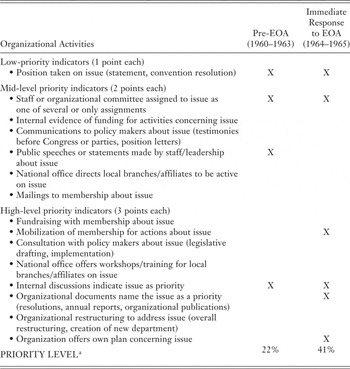
From its inception, SNCC prioritized the mobilization of African Americans living in poverty throughout the rural South as an important goal. This commitment eventually would extend to low-income African Americans living in northern cities. The War on Poverty and passage of the Equal Opportunity Act catalyzed SNCC to push for nondiscriminatory, and sometimes revolutionary, antipoverty policy. SNCC's priorities reflected the organization's consistent commitment to economic autonomy for African Americans. However, SNCC's antipoverty activities remained largely rhetorical until the mid-1960s. SNCC gave antipoverty policy a low priority during the early 1960s; the organization participated in 22% of possible antipoverty activities. In 1964 and 1965, SNCC participated in 41% of all possible antipoverty activities (see Table 3). SNCC never gave high priority to the federal government's antipoverty policy.
SNCC'S Attention to Antipoverty Policy, 1960–1965

a Priority level determined by the organization's antipoverty activities as a percentage of total possible activity points. SNCC activities during the early 1960s totaled eight out of thirty-seven possible activity points, or a 22% priority score; SNCC activities during the War on Poverty totaled fifteen out of thirty-seven possible activity points, or a 41% priority score.
At the end of 1963, SNCC's executive committee met to discuss the organization's future. The committee decided that socioeconomic issues should become the organization's top priority. SNCC was particularly concerned with urban areas of hard-core poverty, and the committee argued that if such poverty were to be addressed, it would have to be addressed “systematically and not sporadically.”Footnote 37 The staff decided that the organization's new focus required a rethinking of strategy—because poverty prevents people from participating in direct action activities, organizers would therefore need to use new tactics to organize poor people. To implement this type of organizing, the executive committee decided that further education of the staff about the causes of poverty was necessary. By the end of 1963, SNCC was committed to increasing its organizational resources to mobilize the rural poor.Footnote 38 However, this commitment was reflected in plans for staff education, and remained largely rhetorical until after the passage of the EOA in 1964.
SNCC increased its advocacy on behalf of the poor after the passage of the EOA because it believed that the War on Poverty was a disingenuous attempt to address fundamental economic inequality in the United States. SNCC's interpretation of the EOA is not surprising, particularly because of the implementation problems of the act, which often seemed to discriminate against poor Blacks, and because SNCC had long been unexcited about federal poverty programs. Even before the organization analyzed the War on Poverty programs specifically, SNCC was highly skeptical that they could ever be effective in alleviating poverty. In the New York Herald Tribune, chairman John Lewis stated: “Giveaway federal programs … the inadequate War on Poverty … all provide a mere Band-Aid for the gaping wound of economic injustice. The problems are so tremendous that individual civil rights organizations cannot handle them.”Footnote 39 This recognition of the inequities inherent in the U.S. political system caused SNCC to focus on local relief and organizing—staff and committee members repeatedly argued that overhauling the economic system was an impractical goal.Footnote 40 Throughout its history, and culminating in 1965 with the creation of the Poor People's Corporation, SNCC preferred a strategy of providing poor Blacks with the means to escape poverty and argued that aid programs fostered dependence on the federal government, which could not be trusted to provide adequate benefits on a nondiscriminatory basis.
At the Waveland Staff Retreat in 1964, three months after the passage of the EOA, SNCC staff discussed how to react to the War on Poverty. Responding to an executive committee directive issued in September, staff held a workshop on federal programs, with special emphasis on the poverty program; however, the staff present at the workshop decided that they did not have enough information, and that further research was needed before SNCC could establish its position on the War on Poverty.Footnote 41 The national office was asked to provide information about the poverty programs, and, as will be seen below, began to devote resources to providing SNCC staff with up-to-date information about the ramifications of the poverty legislation.Footnote 42
Perhaps most reflective of SNCC's critical view of the War on Poverty programs was its weekly internal publication in 1965, “Life with Lyndon.” “Life with Lyndon” provides a unique lens into SNCC's ideology concerning antipoverty policy, and makes clear that the organization was unsupportive of the War on Poverty programs because of its commitment to improving the economic position of the poor, not because of a lack of interest. Responding to the staff's request for additional information concerning the federal poverty programs, Jack Minnis, a research staffer, wrote detailed analyses of the War on Poverty grants and the players in the federal government, or “poverty warriors,” who were responsible for implementation. In the “Life with Lyndon” series, SNCC complained about the small percentage of funds allocated to poor people:
On January 17 Lyndon announced that $101 million of war-on-poverty money has been allocated. A total of $22,670, .02% of the allocations, actually went to poor people in the form of small business and farm loans. The balance, 99.98% went to poverty warriors themselves. A typical grant (no loans to the warriors—only the poor must repay) was the one to the Systems Development Corporation of Santa Monica, CA…. While Lyndon's head poverty-warrior, Sargent Shriver (he should know a lot about poverty—he was born to wealth and married even more) could only find $22,670 to put into the hands of poor people.Footnote 43
SNCC argued that the OEO should increase its disbursements to the poor instead of funding corporate projects. This theme was prevalent throughout the newsletters and was consistent with SNCC's ideological commitment to providing the poor with the tools to lift themselves out of poverty: “If Lyndon had decided to give the poverty money to the poor, instead of to his rich and near-rich friends, there would be … families who had a decent living in the US who hadn't had one before.”Footnote 44 In December 1965, SNCC was forced to stop producing the newsletter because of the high costs of researching, printing, and distributing it to the staff.Footnote 45
In addition to its newsletter, the national office organized protests against the slow implementation of War on Poverty programs at the national level. The Washington and national offices organized two days of protests in Washington, DC, to “break the poverty barrier” and to demand immediate implementation of War on Poverty programs. The organization indicated that the protests were “the first major unemployment demonstrations in the US in 10 years.”Footnote 46 SNCC also focused on poverty alleviation through local outreach to help residents receive the appropriate amount of welfare benefits.Footnote 47
Although the national office did coordinate a limited number of national-level activities, SNCC advocated that local organizations be at the forefront of the fight to gain improvements for poor people. In 1965, the national office prioritized a local antipoverty project, the Poor People's Corporation, which funded economic projects in Black communities in Mississippi.Footnote 48 The Corporation's founding conference was held at Tougaloo College in Tougaloo, MS, and included 300 participants. Jesse Morris, a SNCC field organizer, helped found the organization (Carson Reference Carson1995, p. 172). Upon its founding, the Corporation identified the failings of the War on Poverty as one impetus for its creation:
The poor are not being involved in the planning of the Community Action Programs … and … politicians are using the “War on Poverty” for patronage and other political purposes. In Mississippi, a new approach is being tried…. A Poor People's Corporation has been formed…. This corporation is responsible for providing technical assistance to low income groups that have been formed for self-help purposes and to provide financial and other resources to said groups.Footnote 49
Reflecting SNCC's commitment to the distribution of antipoverty funds to the poor themselves, the Corporation's entire budget was spent on antipoverty projects. The Corporation was staffed by three volunteers and one full-time worker, whose low wages were paid by SNCC.Footnote 50 The focus on providing funds to the poor, and not on maintaining the organization, reflected the antibureaucratic ideology of many SNCC staff. Additionally, it prevented the Corporation from the bureaucratic spending associated with the War on Poverty, of which SNCC was extremely critical.
SNCC's response to the War on Poverty reflects both its rhetorical and action-based commitment to self-empowerment among African Americans. The organization did not engage with the federal government in its implementation of EOA programs but rather served as a watchdog to be sure that poor African Americans were receiving the benefits that were due to them. Additionally, the group helped to organize local responses to poverty that would ideally allow the poor to develop a means for sustained income.
WHY THE SHIFT? EXPLAINING ORGANIZATIONAL DECISIONS TO SHIFT PRIORITIES
Case studies based on archival research raise concerns that perhaps the research is creating a story and, in this case, neglecting other factors that may have led organizations to advocate on behalf of the poor. My research includes assessments of factors based on existing literature about the various reasons interest groups represent particular issues, including relations between each organization and political parties and policy makers; trends in welfare receipt among African Americans; trends in poverty levels among African Americans and Whites; and changes to welfare legislation itself.Footnote 51 In this paper I focus on the factors that I find to most affect priority change in crowded issue niches: organizational structure and competition. Findings about the interaction between internal and external variables may be mitigated by concerns that a host of external factors may have an independent effect on decision making (March and Olsen, Reference March and Olsen1989). Perhaps President Kennedy's directives to his Council on Economic Advisers to design antipoverty policies, which would eventually be the foundation for the War on Poverty, led civil rights organizations to focus on antipoverty.Footnote 52 As I discuss above, although Kennedy's policy prescriptions undoubtedly focused national attention on poverty, neither policy makers nor civil rights organizations generally considered his directives to have particular racial implications (Lieberman Reference Lieberman1998; Gilens Reference Gilens1999). During the early 1960s, civil rights groups were concerned about poverty. As I demonstrate below, it took competition among the groups to turn that concern into active advocacy.
Another possibility is that civil rights organizations increased their attention to poverty policy as more of their constituents became affected by poverty or by welfare programming. However, my findings indicate that changes in welfare receipt and poverty rates among African Americans do not explain shifts in organizational priorities. During the early and mid-1960s, the poverty rate among African Americans declined as the level of AFDC receipt increased. Poverty rates among African Americans had been dropping since the 1950s, largely due to migration to northern cities, overall economic growth, inclusion in public assistance policies, and increased job opportunities. Trends in AFDC receipt during this period are tricky to interpret—the slight increase in the percentage of African American recipients in the late 1960s was due to the increasingly nondiscriminatory distribution of benefits, not to increases in the number of eligible recipients (Lieberman Reference Lieberman1998; Patterson Reference Patterson1994; Blank Reference Blank1997).
Perhaps groups advocated on behalf of the poor because of an existing ideological commitment to economic justice. As the research in this paper demonstrates, the NAACP's and SNCC's decisions to represent the poor were strategic—both groups were aware of their position among civil rights organizations when determining their priorities. Even for SNCC, a highly ideologically driven group, advocacy on behalf of the poor happened in part because of the group's acknowledgment of its effect on other civil rights organizations' priorities. The findings in this paper point to the importance of moving beyond ideology as an explanation for group priorities. In groups with multiple goals, structural and strategic considerations determined which commitments become organizational priorities.Footnote 53
Explaining Civil Rights Advocacy on Behalf of the Poor
The NAACP's and SNCC's responses to antipoverty policy varied a great deal—SNCC focused on fighting the unjust implementation and economically traditional foundation of the Economic Opportunity Act. On the other hand, the NAACP sought to work with the federal government to coordinate implementation at the local level. Both organizations increased their advocacy on behalf of the poor because of their perceived position among civil rights organizations.
Because of their common overall missions, the NAACP and SNCC shared an issue niche with other civil rights groups, such as the National Urban League (NUL), the Congress of Racial Equality (CORE), and the Southern Christian Leadership Conference (SCLC). The civil rights movement included campaigns for school desegregation, desegregation of public facilities and accommodations, and voting rights for African Americans, all of which were conducted by coalitions of organizations. These organizations often worked with varying strategies and focused on particular aspects of each campaign. Although working toward similar goals, the groups were often conflicted about the strategies used to achieve these goals and which groups would play prominent roles in each campaign (Zald and Garner, Reference Zald, Garner, Zald and McCarthy1987; Peake Reference Peake1987; Morris Reference Morris1984). Because each organization struggled to maintain its unique role within the movement, and its relevance to the movement, relations among groups affected organizational priorities. This research demonstrates that groups in crowded issue niches are especially attuned to the activities of other groups, and may therefore adjust their priorities accordingly.
For the NAACP, pressure came from competing organizations, such as SNCC, and led the national office to name antipoverty activities as a priority. Because the NAACP operated with a top-down, bureaucratic structure, the national office was not concerned with local offices' autonomy to determine their own priorities. SNCC perceived itself to be a radicalizing force among civil rights organizations and considered its own antipoverty activities to be critical to pushing the more traditional groups' priorities. SNCC's commitment to a decentralized structure and to local organizing determined how it implemented its antipoverty activities.
The NAACP's Protection of Its Preeminence among Civil Rights Organizations
The founding bylaws of the NAACP established the group as a highly centralized one whose activities would be implemented by its branches. Charles Flint Kellogg argues that “from the beginning, the Association was highly centralized and the national body maintained control over branches and membership” (Reference Kellogg1967, p. 119). The national office's authority to establish priorities does not indicate that there were no tensions between the national and local offices, or even that the local offices effectively responded to national priorities.Footnote 54 The national office, however, unquestionably recognized its authority over its branches, and consistently worked to enforce its priorities with local offices. This internal dynamic stands in marked contrast to other organizations, such as SNCC, that struggled with whether the national office had authority to determine local priorities. For the NAACP, priority setting at the national level applied to all organizational offices at the regional, state, and local levels.
As the civil rights movement picked up steam during the early 1960s, the NAACP increasingly worried about losing members to organizations such as SNCC and CORE, as well as losing the public's perception of the NAACP as the preeminent civil rights organization.Footnote 55 Such competition was not new for the NAACP. The organization had recently experienced what it considered to be threats to its primacy among civil right organizations by the National Negro Congress (NNC) and the Communist Party.Footnote 56 Eventually, the employment and economic activities of the NNC convinced the NAACP that it needed to shift its agenda in order to appeal to African Americans who were mobilized by the NNC (Bates Reference Bates1997).
Throughout its history, the NAACP had come under fire for catering to the interests of the middle and upper classes.Footnote 57 This reputation led the organization to be particularly concerned with maintaining its relevance as poverty became an increasingly important issue for civil rights organizations. Fears about the actions of new civil rights groups, such as SNCC, being formed in the early 1960s, were expressed by Gloster B. Current, director of branches, in a letter to L. Pearl Mitchell, a board member:
Today there are competitive organizations in the field…. They feel that if they can carve out a role for themselves and thus diminish the strength and agility of the larger civil rights organizations in the field, that they will be able to corner the civil rights market and take control of it.Footnote 58
The NAACP was quite concerned with the recruitment strategies of other civil rights groups. As the 1960s civil rights organizing intensified, and as the number of active civil rights organizations grew, the NAACP became increasingly concerned with its image as an elite, top-down organization. Newer, or newly radical, organizations appealed to low-income African Americans and emphasized the importance of their involvement in the civil rights struggle. In 1962, Roy Wilkins, executive secretary, reported to the board that CORE, SCLC, and SNCC “all were in full-fledged competition with the NAACP throughout all phases of the civil rights program.”Footnote 59
This competition from newer civil rights organizations had direct implications for the NAACP's strategies. Before a staff meeting in 1960, which would address the NAACP's image, John Morsell, assistant secretary, received memos from national staff concerning the direction the NAACP should take in relation to political action and the masses. Mildred Bond, life membership secretary, wrote to Morsell complaining that historically, the leadership and membership of the NAACP had been middle class. Numerically, the organization continued to grow, but this was because the middle class itself had grown. Bond stated that the staff should consider whether it was time to break away from only middle-class involvement.Footnote 60 Calvin D. Banks, field secretary, made an argument similar to Bond's, explicitly arguing for reaching a greater number of African Americans: “The talented tenth stigma must be erased. We must get closer to the masses. We must aim for a simplification of approaches which will increase awareness.”Footnote 61 Herbert Hill, director of labor, agreed, arguing that the organization needed to focus on attracting membership at the local level to increase mass membership.Footnote 62
In September 1964, after the board voted to focus on the implementation of the EOA, Wilkins wrote a memo to the branches explaining the board's decision. He instructed branches to immediately request representation on CAP boards to maintain the NAACP's visibility as the preeminent civil rights organization:
As one of the Association's leaders, you will recognize at once that we are striking out in a new direction and launching a major new program area. You will also, I believe, welcome it as an absolutely necessary move if the Association is to maintain its leadership in our movement.Footnote 63
Similarly, in its 1965 resolutions, the board indicated that the reason for its prioritization of the EOA was to maintain the organization's leadership in the civil rights movement:
NAACP branches can and should play an important role in mobilizing the Negro community in determining its representation in such local agencies [the Community Action Programs]. NAACP branches should be recognized as a primary source of those who represent the Negro community.Footnote 64
The NAACP's directives to branches, to represent individuals receiving public assistance on CAP boards, were driven by the organization's need to maintain its viability as a civil rights organization among all African Americans. Because African Americans continued to face disproportionate levels of poverty even after the passage of the Civil Rights Act, and other organizations, such as SNCC, continued to bring these disparities to light, a mainstream civil rights organization could not close its eyes to the needs of poor African Americans.
SNCC's Unique Commitment to Local Organizing and Radical Objectives
SNCC was founded in April 1960 to serve a unique purpose within the burgeoning civil rights movement. The committee would coordinate the growing student movement and local protest groups throughout the South. The conveners of the initial meeting, including Ella Baker of the SCLC, thought that there was a need for “an organization among organizations” to provide information and funds concerning student-protest activities.Footnote 65 From its inception, the organization was not to attempt to control the actions of local protest groups, or to step out of its coordinating role.Footnote 66
SNCC considered its commitment to decentralization to be distinctive among civil rights organizations. Because other groups had to work to build local chapters and to maintain themselves as organizations, SNCC staff argued that these groups were not able to take risks concerning their programs and priorities. SNCC, on the other hand, conceived of itself as a coordinating agency that did not function as a traditional interest group and therefore did not determine its priorities based on the concern of maintaining itself. SNCC did not build chapters at the local level; therefore, it could work to form “community movements” as opposed to “community organizations.”Footnote 67 Organizers were very aware that poverty prevented political and community participation. Because SNCC was committed to developing stable community and political organizations at the local level, it was particularly concerned with the implications of the high levels of poverty among African Americans, especially in the South.
Staff considered SNCC's commitment to local protest strategy to be one of its unique characteristics, as compared with other civil rights organizations that were focusing on more traditional forms of political activity.Footnote 68 The group's focus on the local level and local-level protest strategies was reflected in its organizing attempts. Through community building and mobilizing at the local level, SNCC argued that the Black masses would be able to gain political control. While activities at the national level were sometimes relevant, it was local-level organizing that would produce the leaders necessary to effect social change:
In order for the Negro to keep his political power, assuming he will have it and assuming he will get the vote, there must be grassroots political organization through housing projects, neighborhoods, housewife organizations, the churches, the social clubs, etc.Footnote 69
SNCC worked to distinguish itself from other civil rights organizations. At a 1962 meeting of the heads of civil rights organizations in New York, SNCC was forced to defend its unique approach to local organizing to other civil rights organizations. Roy Wilkins of the NAACP stated he believed that other organizations, namely SNCC, were attempting to push the NAACP out of the civil rights struggle. SNCC also came under attack from the National Urban League's executive secretary, Whitney Young, based on its lack of traditional organization. Young suggested that SNCC and CORE merge since SNCC did not serve a unique purpose. SNCC staff responded that the organization's commitment to local autonomy made it distinctive among other civil rights groups: “[SNCC is able to] establish clear identity with the local community by living in it to the point where [staff] is no longer outsiders.”Footnote 70 As this exchange demonstrates, SNCC was very aware of the need to establish a distinctive identity among civil rights organizations.
In addition to its unique commitment to local organizing, SNCC defined its role in the movement based on its militancy. After the heads of organizations meeting, the coordinating committee defined its intent in terms of possible competition with other civil rights groups: “Our intent is not to be on a competing basis with other groups, but to assist them where possible to fulfill their own objectives. This may mean stimulating them to direct action.”Footnote 71 After experiencing ideological disagreements with other civil rights organizations during the planning of the March on Washington in 1963, SNCC was encouraged by field organizer Eleanor Holmes to maintain its involvement with the Big 10 civil rights organizations after the march specifically for the purposes of radicalizing the other groups:
As the most militant of the civil rights organizations, SNCC has an obligation to keep its point of view alive in the Committee [of the Big 10 civil rights organizations] and to seek to move it in a more militant direction…. Even the Big 6 includes the far richer, far more influential, and far more conservative NAACP and Urban League…. SNCC should not abandon its radicalizing role at this juncture.Footnote 72
SNCC's oversight of the implementation of the War on Poverty was driven by its commitment to local activism and autonomy, and its awareness of its unique role within the civil rights movement. SNCC was critical of the War on Poverty, particularly because it did not provide enough autonomy for the poor themselves. The group's commitment to local organizing and its consistent support for economic programs that did not rely on federal aid were unique among civil rights groups. SNCC was aware of the importance of defining its own goals and positions within the broader civil rights issue niche. Similar to the NAACP, SNCC's perception of its place within the civil rights movement made the War on Poverty a priority for the organization; and its structure, one of local decentralization, contributed to its critical response to the program.
CONCLUSIONS
The NAACP and SNCC responded differently to competition from other civil rights organizations because of differences in each group's structure. The indirect result, however, was a convergence on poverty alleviation, which moved up the ladder of organizational priorities for both groups. Because it felt particularly vulnerable based on its historical preeminence, as well as recent threats to that preeminence, the NAACP responded to competition from other civil rights groups, and chose to activate its affiliates to participate in the implementation of antipoverty legislation. The organization's top-down decision-making structure allowed the national office to respond to competition from other civil rights groups, and to direct local affiliates in their antipoverty activities. The passage of the EOA, and its discriminatory implementation, incited SNCC, an organization suspicious of federal government policies and committed to local organizing, to speak out against the War on Poverty and to create its own local alternatives to the federal aid for the poor, such as the Poor People's Corporation. SNCC's conception of itself as a radicalizing force for existing civil rights organizations pushed its decision makers to remain critical of the American economic system, and to advocate for policies and programs that would usurp that system. This intended “radicalization” worked, and beginning in the early 1960s, the NAACP became heavily influenced by the activities of emerging civil rights organizations, including SNCC, and allowed other groups' platforms to determine its organizational priorities and strategies.
The findings in this paper are important because they point to the inadequacy of interest group research that does not examine the interaction among external and internal variables when studying organizational decision making. Based on the findings in this paper, future research must consider external factors, such as competition among organizations, and also pay particular attention to structural differences among groups within the same issue niche and the effect of these differences on the interests a group chooses to represent.
The research in this paper establishes and explains shifts in priorities within organizations. However, SNCC and the NAACP varied in their level of attention to the poor, and in the magnitude of their shifts in priorities (see Figure 1). What explains the differences in the magnitudes of the shifts in priority among civil rights organizations? A brief consideration of the groups might indicate that these differences could be explained by an organization's ongoing concern with the needs of the poor—SNCC, an organization with a founding commitment to poverty issues, experienced a less dramatic increase in advocacy activities during the War on Poverty than did the NAACP. However, the research in this paper demonstrates that differences in organizations' founding ideologies may not be enough to explain these differences. Future research is necessary to explore the factors that lead to differences in the levels of attention organizations devote to antipoverty issues.
Civil rights organizations' advocacy on behalf of the poor both confirms and complicates the pluralist understanding of the U.S. political system. As pluralism would predict, organizational competition did lead to increased representation on behalf of the poor. However, representing the poor is a taxing endeavor, both financially and organizationally. For organizations that are not embedded in a community, leaders must establish relationships and trust with community leaders before any mobilization can occur, and often before national representation can be effective.Footnote 73 Certainly, other goals, which are less expensive and have a higher possibility for success, are more attractive for interest groups to pursue. As scholars have documented extensively, it is difficult for the interests of the poor to be heard in Congress by parties, or by interest groups.Footnote 74
Despite these challenges to the representation of the poor, the findings in this paper offer a glimmer of hope for increasing the representation of marginalized interests within the U.S. political system. Competition within a group of organizations with similar missions may lead to increased advocacy on behalf of politically marginalized subgroups of the organizations' constituencies. As scholars have established, organizations work harder to advocate on behalf of their advantaged subgroups and primary constituencies (Strolovitch Reference Strolovitch2007; Cohen Reference Cohen1999). However, if one organization within a movement can be convinced of the interests of a politically alienated group, such as low-income African Americans, other organizations may follow suit, and representation may become increasingly democratic.