





Artifactification occurs when a museum recognizes an object’s significance to a historical narrative, facilitating a semiotic shift that transforms an object into an artifact, where it becomes a material depiction of history, identity, and people. This process effectively decides which histories are given visibility, concentrating immense social power in museums.
1. Theorizing Artifactification
Not all objects are artifacts, and differentiating between the two terms has sparked debate. For anthropologist Daniel Miller, the meanings of artifacts are entirely dependent on how “we order things and are ordered by things,” while Maurizia Boscagli’s Stuff Theory: Everyday Objects, Radical Materialism shows that an object or artifact is never in a permanent state of being.Footnote 1 She draws upon Bill Brown’s Thing Theory, which states that “the thing really names less an object than a particular subject-object relation.”Footnote 2 Thus, philosophers such as Amie L. Thomasson and psychologists such as Tania Zittoun conceive of artifacts as socially constructed, created by human intentionality.Footnote 3
While these thinkers agree on the ontological status of artifacts as socially constructed, they diverge on the question of power, who wields it, and where it comes from. In the 1970s, Czech museologist Zbynēk Stránský coined the term musealia to refer to “objects that are the heritage of humanity… that are chosen to document some event, person, time, or idea,” and the term musealization to describe “the processes by which an object becomes part of musealia.”Footnote 4 Donald Preziosi also correlates historical narrative, object, and museum. He sees museums as “semiotic instruments” that string together artifacts and ideologies to legitimize national identity, but exactly how an object becomes a historical artifact has never been fully theorized.Footnote 5
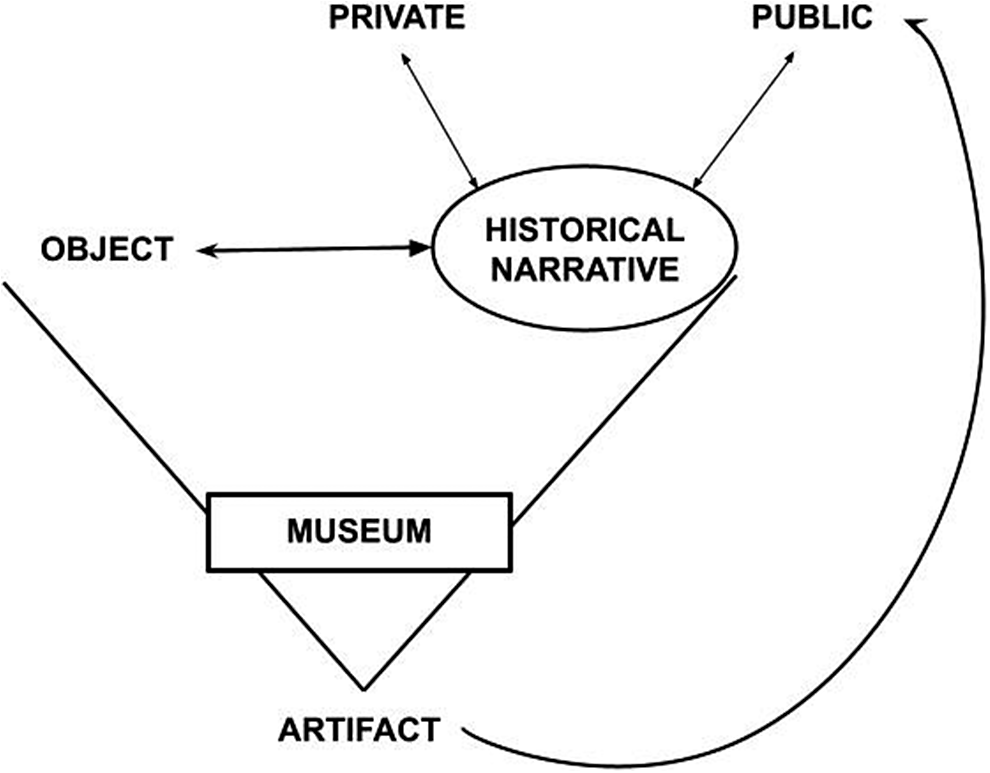
Artifactification is the non-linear process that illustrates a museum’s power and influence in transforming an object into a historical artifact (see Figure 1).Footnote 6 This process draws upon John Searle’s theory of Status Functions, which argues that statuses operate in society as they do because there is a collective agreement that accepts that particular status.Footnote 7 “All Status Functions are institutional facts,” he writes, and the rules of a particular institution are imparted upon the object in question.Footnote 8 In artifactification, it must be collectively agreed that an object is the materialization of the past, present, or future. To create such an agreement, museum institutions process these objects through acquisition and accessioning. All those involved in acquisition and accessioning are part of the artifactification process, which includes but is not limited to curators, educators, registrars, museum boards, independent scholars, community advisory groups, and even private collectors who loan their pieces to a museum. These roles collaborate within the confines of the museum’s policies, standards, and values to accept objects into the collection, thereby creating museum-worthy artifacts that are then governed by rules set by the museum institution and the museum community as a whole.
The Process of Artifactification

Artifactification begins with the recognition of an object’s significance to a historical narrative or vice versa. The historical narrative reconstructs a past, organizing and stylizing events, and it exists in two major spaces: public and private. The public historical narrative is the general knowledge that the public has about history and is most often consumed through institutions, such as school curricula, museums, and the media. The private historical narrative, on the other hand, is the lesser-known but no-less-important parts of history consumed through local means such as oral histories, heirlooms, and family education. These two spheres of historical narratives overlap and influence each other, but how histories are transmitted and received differentiates the two. Regardless, both the object and the historical narrative must exist to create an artifact. Most often, it is the public historical narrative that takes precedence, but more stories from the private historical narrative are indeed coming to light.
Historical narrative without material form, or vice versa, can mean that the public may not value a history as a specific individual might. Take the Parthenon Marbles. They were not taken by Lord Elgin because of any motivation to preserve history; he wanted to decorate his home.Footnote 9 The Marbles were seen for their aesthetic value more than their historical value. It was not until the British Museum acquired them from Elgin’s private collection in 1816 that they were given artifact status as materializations of a historical period.Footnote 10 The process of acquisition, on the part of both Parliament and the British Museum, meant that Elgin’s valuation of aesthetic worth of the Marbles was then replaced by the Museum’s recognition of historical value. The decorations of Elgin’s home are now representations of British imperial power and identity. In the present day, the Marbles have even become symbols of what universal museums should be. The object is subject to the institutional rules it finds itself in, which can affect the meaning, interpretations, and narratives around these artifacts.
It must be a museum making the connection between historical narrative and object for an artifact to be constructed, which is why Preziosi positions museum institutions as “uniquely powerful semiotic instruments for the creation, maintenance, and dissemination of meanings by fielding together and synthesizing objects, ideas, and beliefs.”Footnote 11 An individual can make the connection themselves, but that does not make an object into an artifact; it makes the object into an heirloom, a relic, or in the case of Elgin, a mantlepiece. The institutional recognition of an object’s relevance to a historical narrative is essential for artifactification. If a museum ceases to recognize that connection, then the artifact returns to being an object. In legitimate processes, this is most often seen through deaccessioning. This is not to say that communities must be told by museums what to think about their historical artifacts, but rather that museums tend to take on an authority position which allows them to shape these meanings.
Some will question whether museums are the only institution that can act as the driving force in artifactification. While there are plenty of institutions that function similarly to museums, they do not engage with semiotics, material culture, and narratives in the same interconnected manner. Libraries and archives, for example, are for reference and research, not to present certain narratives of history. Libraries and archives can and do provide museum-like displays, but unless those displays are curated to have a narrative that the institution supports, they do not have the same semiotic power as a museum. This is because museums present narratives, whether implicitly or explicitly. Curation, interpretation, and even accessioning are forms of storytelling. In choosing what to accession, the museum asserts authority in deciding what object has historical value to the narrative it is building.
Others may wonder if material culture within private collections could be given artifact status as the collection could present a particular kind of narrative. Per Searle’s theory of Status Functions, artifactification is a process of collective agreement. Within a private collection, there is only an individual agreement, by the private collector, that an object is significant and therefore should join the collection. Even if private collectors are made up of groups of people, including organizations, objects in private collections are not governed by the same institutional rules and standards as a public non-profit museum would be. In a museum, acquisitions and best practices are a collaborative effort with involvement from various teams and groups inside and outside the museum for the purpose of public education. Most importantly, museums are held in the public trust, and the public holds the institution accountable. Without the collective intentionality, material culture in private collections remains only as relics or antiques. Even if a deaccessioned artifact were to enter a private collection, it has been removed from the collective institutional system with the standards that could impart upon it an artifact status.
Consider the French Crown Jewels that were stolen from the Louvre in October 2025.Footnote 12 The museum had recognized the connection between the historical narrative of the French monarchy to these objects, thereby creating artifacts. Once those artifacts were removed from the collection, albeit forcefully, they returned to being objects. The chief executive of Art Recovery International, Chris Marinello, claims that it is most likely that the thieves would disassemble the jewels to sell.Footnote 13 If that is the case, the Crown Jewels are even less of an artifact. Broken down into its most basic components, the jewels have been taken out of the institutional system that values them as the material representation of French monarchical history and they have now been placed into a system that only values them by their monetary profit.
Museum-worthy artifacts, once vetted by the artifactification process, can then influence the historical narrative through exhibitions and educational resources, but artifact-status is not permanent. When artifacts go missing, public knowledge about certain historical events can be an insufficient representation of the past. In the case of the French Crown Jewels, the theft removed the status of artifact, but added to the narrative. The heist went viral across the internet, bringing more attention to the Louvre and the history of the jewels. On the other hand, the Parthenon Marbles continue to be displayed at the British Museum but are now at the center of repatriation claims. The controversy around the Marbles is perhaps more well-known than the actual intended historical use, again adding to the narrative of the artifacts.
2. Disrupted Artifactification in Chinese Canadian Material Culture
Not every artifact will receive the same sensationalism as the French Crown Jewels or the Parthenon Marbles. For more obscure histories, the related material culture is unlikely to be recognized as significant due to the unknown nature of these narratives. As a result, the artifactification process remains incomplete. This can cause the everyday people outside of institutions to struggle to see the connection between their own heirlooms and the historical narrative.
This is the exact circumstance that surviving family members of Chinese Canadian veterans found themselves in.Footnote 14 The families knew that their fathers brought back a significant number of war memorabilia from their time overseas, even “duffle bags full.”Footnote 15 Some veterans had donated their war paraphernalia to museums, but when the family returned to look for them, they were “missing” from the collections. There were also objects that never made it into museums and were subsequently “lost” over time. The missing material culture is not a one-time incident; it is a shared experience between these families.
The problem is not a lack of historical research about Chinese Canadians. There are a select number of historians and even museums dedicated to Chinese Canadian history. In his article, Timothy J. Stanley examines the structure of anti-Chinese sentiment in Canada by tracing the Head Tax and the Chinese Immigration Act of 1923, now known as the Chinese Exclusion Act.Footnote 16 Catherine Clement has done groundbreaking work with the Chinese Canadian Museum’s The Paper Trail to the 1923 Chinese Exclusion Act exhibit, showcasing the largest collection of Head Tax and C.I.45 Forms ever displayed, and later, with her book of the same name.Footnote 17 Marjorie Wong and Roy MacLaren were two major authors to write about Chinese Canadian contributions in the military during World War II. Despite having both the historical narrative and the objects brought back by veterans, Chinese Canadian military artifacts are consistently unaccounted for.
In 2017, Douglas Jung’s family agreed to loan his military jacket to a museum in Vancouver, Canada. This jacket is of great significance, as Jung is an incredibly important figure in Chinese Canadian history: he volunteered for a mission with the British Special Operations Executive (S.O.E.) in the Second World War, called Operation Oblivion, at just nineteen years old.Footnote 18 After the war, he became the first Chinese Canadian Member of Parliament and represent Canada at the United Nations.Footnote 19 The jacket was on display for two years before it was stolen from the display case in 2019.Footnote 20 The jacket has yet to be recovered as of 2026 and there has been little to no media attention to this matter. Although the jacket was a loan, and ownership remained with the family, the museum nevertheless had the responsibility to keep the artifact safe. Furthermore, the museum has a responsibility to the public as well, to take accountability and be transparent about the theft and the recovery process. Unlike the French Crown Jewels, the theft of Jung’s jacket disrupted the artifactification process, causing it to remain out of the historical narrative and public awareness.
When artifactification is disrupted, museums can face larger and harsher implications, especially regarding the relationship between institution and community. The theft of Jung’s jacket created a mistrust between the family and the museum. Jung’s son, Arthur Calderwood, was also asked to loan his father’s set of military medals, including his Order of Canada and Order of British Columbia, to the same museum.Footnote 21 Calderwood refused, due to the museum’s lack of security, saying, “I felt terrible at the time that I refused to loan my father’s decorations to the museum, but now, in retrospect, I feel lucky that I did not loan them as they too would have been stolen.”Footnote 22
At the same time, there were quite a number of objects that were never brought into a museum. Norman Low, another Operation Oblivion veteran, passed away shortly after returning to Canada from the war. His son Geoff Low explained that as time passed, people came in and out of his father’s workroom in their home where Norman’s military paraphernalia was kept.Footnote 23 As a result, these objects disappeared without anyone knowing what happened to them.Footnote 24 Since the historical narrative around Chinese Canadians was and is rather unfamiliar to everyday people, as Geoff put it, “some people don’t see the value in it because they just see it as old military stuff.”Footnote 25 Perhaps the Low heirlooms should have been donated to a museum. Whether these heirlooms would have been valued enough to make an impact on the historical narrative is another question. These objects very well could have suffered the same fate as Jung’s jacket. Regardless, the Low family heirlooms were never even allowed to begin the process of artifactification, as they were never recognized as having the potential to be artifacts.
The examples of missing Chinese Canadian material culture illustrate a pattern where museums and the general public do not recognize historically significant objects as prospective artifacts. Whether it is a weak connection between object and narrative or artifacts are lost before they can inform the narrative, it is ultimately the negligence of the modern Canadian museum that has perpetuated this pattern. Museums are not making nor are they sustaining the connection between Chinese Canadian historical narratives and objects. Therefore, the process of artifactification for these objects remains incomplete, causing a lack of material representation of Chinese Canadian history within museums. Without material representation, visitors may not recognize that their own possessions could be important to building and reshaping historical memory, which only continues a vicious cycle of historical amnesia.
This paper is not a prediction of what future museum collections may look like. It is a warning: when historically significant objects from communities are lost before they can impact historical understanding, the public historical narrative struggles to be anything more than what it is now. The narrative will continue to tighten like a noose, choking out any alternative history that does not adhere to what is already acceptable. It matters not if these objects are Chinese Canadian. The loss of history and material culture can happen to any community or diaspora. Museums must be cognizant of their own authority in creating and maintaining historical narratives, if the institution is to become more diverse and flexible in their storytelling. Diversifying museums, its staff, and the narratives it supports may just work to shift the authority to artifactify from institutions to communities, thereby amplifying those stories and voices unheard.
acknowledgements
Special thanks to Dr. Jeff Wilson, Helen Kwong, Malak Mobarak, and my family.
Author contribution
Conceptualization: E.C.D.; Formal analysis: E.C.D.; Investigation: E.C.D.; Methodology: E.C.D.; Visualization: E.C.D.; Writing - original draft: E.C.D.; Writing - review & editing: E.C.D.
Conflict of interests
The author declares no competing interests.

 Open access

