INTRODUCTION
The first information on the decapod fauna of Cyprus was given by Heller (Reference Heller1863) who reported six marine species. Later, Unger & Kotschy (Reference Unger and Kotschy1865), Plateau (Reference Plateau1884) and Adensamer (Reference Adensamer1898) raised this number to 11 species. After 1898, a number of publications (e.g. Fodera, 1961—according to Lewinsohn & Holthuis, Reference Lewinsohn and Holthuis1986; Demetropoulos & Neocleous, Reference Demetropoulos and Neocleous1969; Lewinsohn & Galil, Reference Lewinsohn and Galil1982) added new records and significantly raised the number of decapod species known from Cyprus. However, the first inventory of the marine decapods of Cyprus was given by Lewinsohn & Holthuis (Reference Lewinsohn and Holthuis1986), in which 113 were included. Later Hadjichristophorou et al. (Reference Hadjichristophorou, Argyrou, Demetropoulos and Bianchi1997) and Kocataş et al. (Reference Kocataş, Katağan and Benli2001) recorded the presence of 30 more species new to the decapod fauna of Cyprus, raising the total number to 143.
In 2007 Tzomos et al. published an updated list of the marine decapods of Cyprus consisting of 145 species (11 Dendrobranchiata, 33 Caridea, 5 Thalassinidea, 5 Palinura, 22 Anomura, 69 Brachyura), six of which are lessepsian immigrants. More recently Dogan et al. (Reference Dogan, Ozcan, Kirkim and Katagan2008) reported two more decapod species (1 Dendrobranchiata, 1 Thalassinidea) increasing the decapod species number for Cyprus to 147.
This study aims to provide new information on the decapod fauna of Cyprus.
MATERIALS AND METHODS
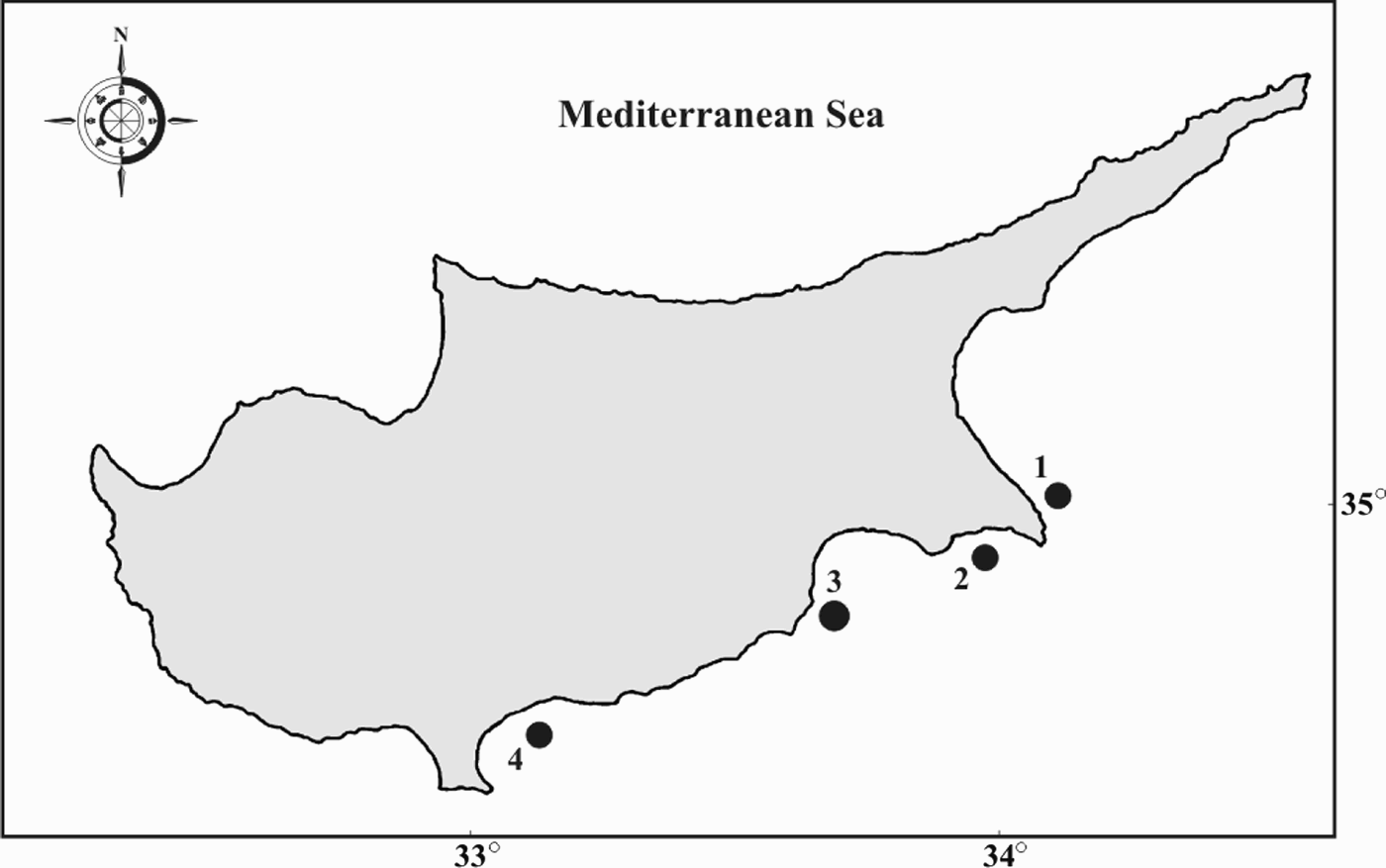
Samplings were carried out from 18 to 26 May 2004, at four stations, off the south-eastern coast of Cyprus (Figure 1) at depths from 50 to 134 m. The samples were collected with an otter trawl, from muddy substrata and maerl beds. Samples were deposited in the Museum of the Department of Zoology, Aristoteleio University of Thessaloniki (MDZAUT). The following abbreviation is used throughout the text: CL, carapace length.
Map of Cyprus indicating the location of the sampling stations.

SYSTEMATICS
The four decapod crustacean species (2 Caridea, 2 Brachyura) recorded for the first time from Cyprus are the following:
Parapandalus narval, Zariquiey Álvarez, Reference Zariquiey Álvarez1968, p. 111.
Parapandalus narval, Holthuis, Reference Holthuis, Fischer, Bauchot and Schneider1987a, pp. 245–247, 250, figure 4.
Plesionika narval, Chan & Crosnier, Reference Chan, Crosnier and Crosnier1991, pp. 443–447, figures 12a–c, 13a, 14a–c, 15a–e, 34–36.
MATERIAL EXAMINED
Sixteen ♀♀ (13 ovigerous), 12 ♂♂; Station 2; depth: 86–110 m; maerl beds; 20–22 May 2004; CLmax. ♀ = 26.5 mm, CLmax. ♂ = 17.0 mm. Two ♂♂; Station 3; depth: 60–95 m; maerl beds; 20 May 2004; CLmax. ♂ = 18.5 mm. Six ♀♀ (6 ovigerous), 4 ♂♂; Station 4; depth: 128–135 m; maerl beds; 24 May 2004; CLmax. ♀ = 17.5 mm, CLmax. ♂ = 16.0 mm.
A cosmopolitan species having a wide distribution at low latitudes. It has been known from various areas of the western Mediterranean (e.g. Zariquiey Álvarez, Reference Zariquiey Álvarez1968), the central Mediterranean (e.g. Heldt & Heldt, Reference Heldt and Heldt1954), the Adriatic Sea (e.g. Pesta, Reference Pesta1918 as Parapandalus narval; Števčić, Reference Števčić1990), from the Aegean Sea (e.g. Drensky, Reference Drensky1951), and from the Levantine Sea, off the coast of Israel (e.g. Galil, Reference Galil2004). Also known from the Eastern Atlantic, the Red Sea and the Indian and the Pacific Oceans (e.g. Garcia Raso, 1996; Li, Reference Li2006).
This species is reported for the first time from the coast of Cyprus.
Processa elegantula Nouvel & Holthuis, Reference Nouvel and Holthuis1957, pp. 8–10, 37–41, figures 174–204.
MATERIAL EXAMINED
Three ♀♀ (2 ovigerous); Station 2; depth: 86–99 m; muddy substratum; 21 May 2004; CLmax. = 11.5 mm.
An Atlanto-Mediterranean species, known in the western Mediterranean from various areas (e.g. Nouvel & Holthuis, Reference Nouvel and Holthuis1957), the central Mediterranean, off the coast of Tunisia (Ďuriš, Reference Ďuriš1996), the Aegean Sea (e.g. Holthuis & Gottlieb, Reference Holthuis and Gottlieb1958; Koukouras, Reference Koukouras1998), and the Levantine Basin along the south coast of Turkey (Kocataş, Reference Kocataş1981). Also known from the Eastern Atlantic Ocean, from the English Channel to Annobon Island (e.g. Nouvel & Holthuis, Reference Nouvel and Holthuis1957; Crosnier, Reference Crosnier1971; Dauvin & Vallet, Reference Dauvin and Vallet1997).
This species is also reported for the first time from the coast of Cyprus.
Macropipus tuberculatus, Zariquiey Álvarez, Reference Zariquiey Álvarez1968, pp. 367–369, 374, figures 119f, 122 g, 123c, 124d.
Macropipus tuberculatus, Holthuis, Reference Holthuis, Fischer, Bauchot and Schneider1987b, pp. 347–351, 358, figure 5.
MATERIAL EXAMINED
Ten ♀♀, 17 ♂♂; Station 3; depth: 73–90 m; muddy substratum; 18 May 2004; CLmax. ♀ = 25.5 mm, CLmax. ♂ = 29.7 mm.
An Atlanto-Mediterranean species, known from various areas of the western Mediterranean (e.g. Zariquiey Álvarez, Reference Zariquiey Álvarez1968; García Raso, Reference García Raso1996), the central Mediterranean (e.g. Schembri & Lanfranco, Reference Schembri and Lanfranco1984), the Adriatic Sea (e.g. Števčić, Reference Števčić1990), the Aegean Sea (e.g. Adensamer, Reference Adensamer1898; Koukouras et al., Reference Koukouras, Dounas, Türkay and Voultsiadou-Koukoura1992) and the Levantine Basin from the coast of Syria (Hasan et al., Reference Hasan, Zeini and Noël2008). Also known from the Eastern Atlantic Ocean, from West Nonvay to Morocco and the Azores (e.g. Milne-Edwards & Bouvier, Reference Milne-Edwards, Bouvier and Milne-Edwards1900; Christiansen, Reference Christiansen1969).
It is also the first record of this species from the coast of Cyprus.
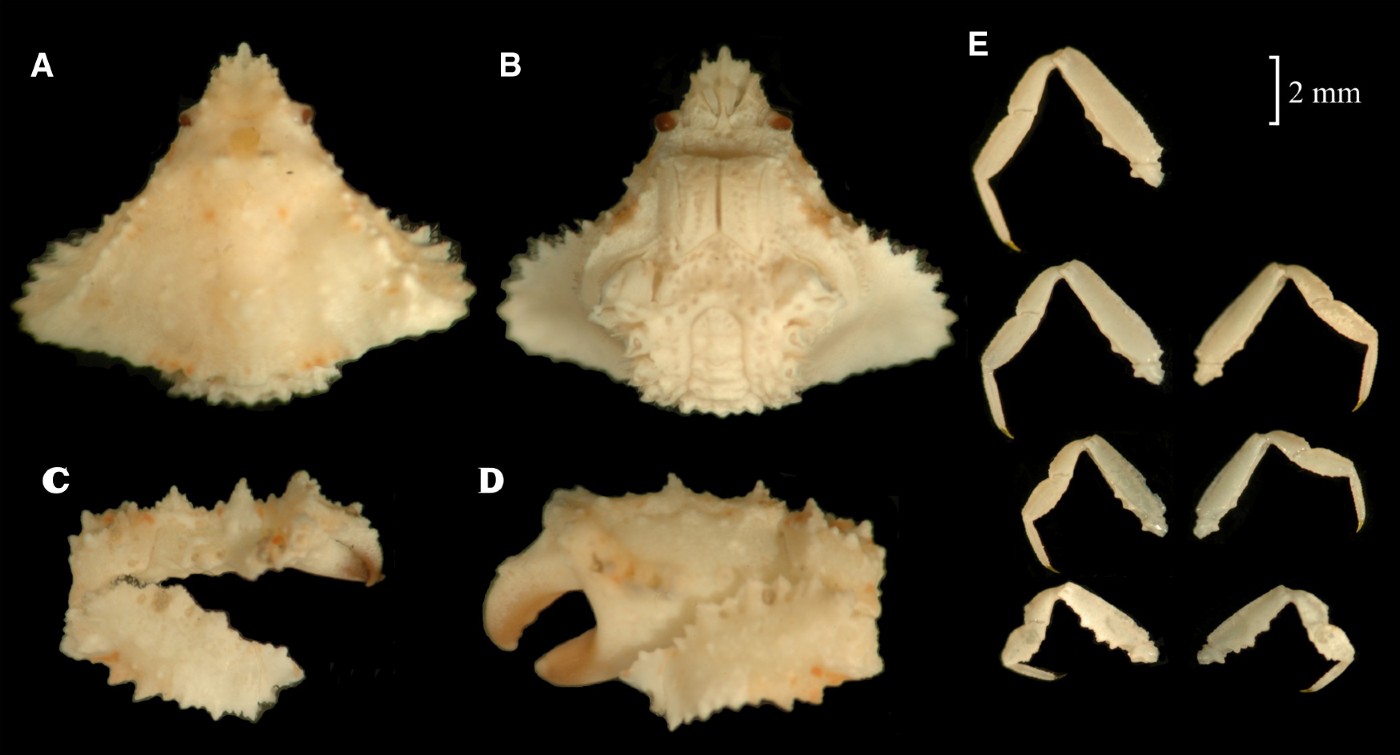
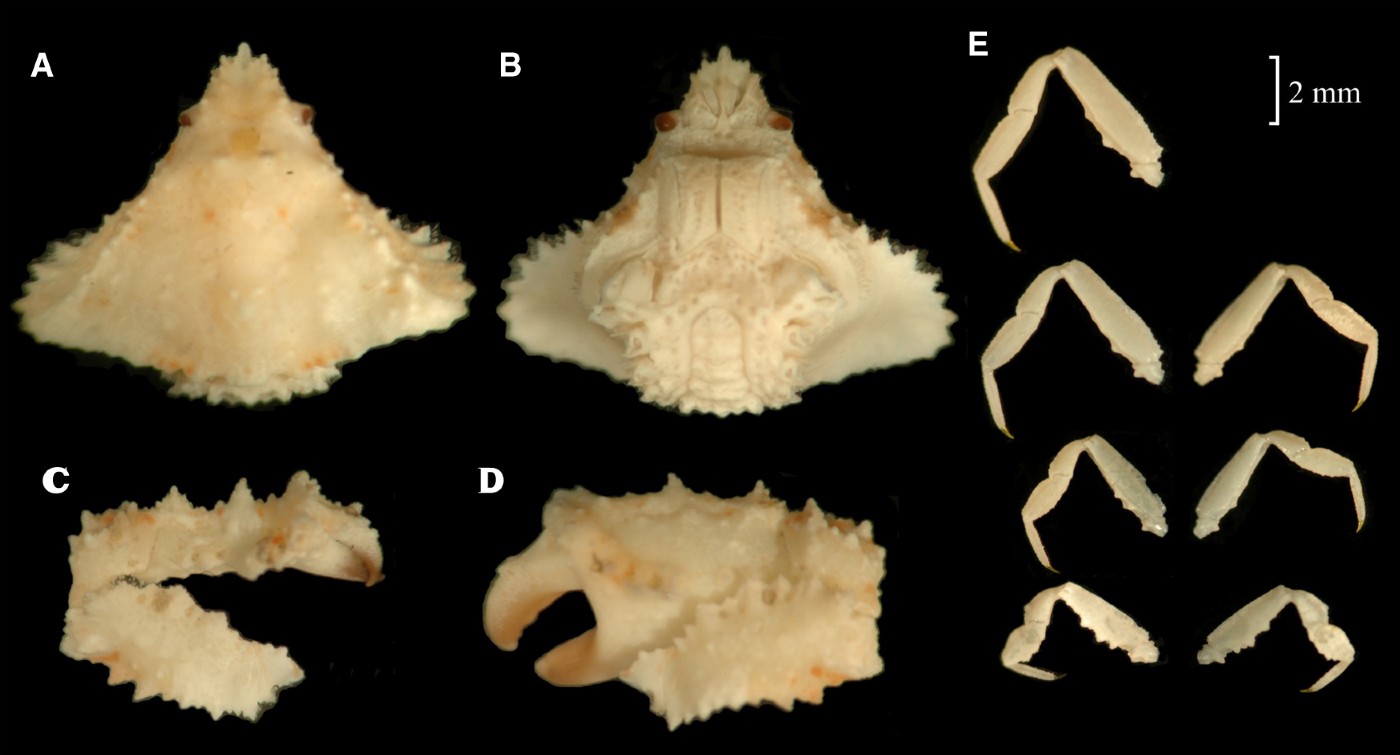
Parthenope expansa (Miers, 1879), male, 9.7 × 12.7 mm. (A) Dorsal view; (B) ventral view; (C) left first pereopod; (D) right first pereopod; (E) from top to bottom: left second pereopod, third, fourth and fifth pair of pereopods.
Parthenope expansa, Manning & Holthuis, Reference Manning and Holthuis1981, pp. 328–330, figure 84.
MATERIAL EXAMINED
One ♂; Station 1; depth: 68 m; maerl bed; 26 May 2004; CL = 9.7 mm.
A rare Atlanto-Mediterranean species. It has been known from the western Mediterranean (e.g. García Raso, Reference García Raso1996), the central Mediterranean, from the Gulf of Catania (Pastore, Reference Pastore1975), and the Aegean Sea (e.g. Adensamer, Reference Adensamer1898; Koukouras et al., Reference Koukouras, Dounas, Türkay and Voultsiadou-Koukoura1992). Also known from the south-eastern Atlantic Ocean, from the Gulf of Guinea to the Azores and Madeira (e.g. Milne-Edwards & Bouvier, Reference Milne-Edwards, Bouvier and Milne-Edwards1900; Monod, Reference Monod1956; Manning & Holthuis, Reference Manning and Holthuis1981).
This species is reported for the first time from the Levantine Basin and its discovery at the Cypriot coast significantly expands its known distribution in the Mediterranean.
Although the crab Parthenope expansa inhabits various kinds of substrata (gravel, sand, rock, coral, with calcareous and other algae) it is more commonly found in maerl beds (Pastore, Reference Pastore1975; Manning & Holthuis, Reference Manning and Holthuis1981).
The four species recorded increase the number of decapod species known from Cyprus to 151. In terms of species number, the decapod fauna of Cyprus is more impoverished in relation to the faunas of the other neighbouring areas of the Mediterranean (Holthuis & Gottlieb, Reference Holthuis and Gottlieb1958; Lewinsohn & Holthuis, Reference Lewinsohn and Holthuis1986; Tzomos et al., Reference Tzomos, Kirmitzoglou, Chartosia, Mavidis, Kitsos, Ateş, Özcan, Sezgin, Katağan, Kocataş and Koukouras2007). This should mainly be attributed to the geographical isolation of Cyprus and to the relatively reduced sampling effort that has been carried out in the area.
ACKNOWLEDGEMENTS
We are grateful to Professor Athanasios Koukouras (Department of Zoology, Aristoteleio University of Thessaloniki) for his encouragement during the preparation of the manuscript and for critical reading. We would also like to thank Dr Paul Clark (Department of Zoology, Natural History Museum of London) for his continuous help and for providing us with copies of hard-to-find papers. Finally, we are grateful to the two anonymous referees for their comments and suggestions.