Introduction
Delirium, an acute disturbance of cognitive and perceptual functions, is a frequent and costly disorder in elderly hospitalized patients (American Psychiatric Associatio, 1994; Cole, Reference Cole2004; Inouye, Reference Inouye2006). Its management involves treatment of the underlying medical condition, supportive measures and the use of psychotropic drugs (American Psychiatric Association, 1999; Canadian Coalition for Senior's Mental Health, 2006) Antipsychotic medications (APs) are commonly prescribed for agitation and psychosis in delirium (Carnes et al., Reference Carnes, Howell, Rosenberg, Francis, Hildebrand and Knuppel2003).
Recently data have emerged which raise concerns about the effect of APs on mortality in the elderly (Wang et al., Reference Wang2005; Schneeweiss et al., Reference Schneeweiss, Setoguchi, Brookbort, Darmuth and Wang2007) and especially in the elderly with dementia (Schneider et al., Reference Schneider, Dagerman and Insel2005; Gill et al., Reference Gill2007; Rochon et al., Reference Rochon2008), a group at high risk for developing delirium (Elie et al., Reference Elie, Cole, Primeau and Bellavance1998). The safety of delirium treatments using APs in the elderly has also been questioned (Gill, Reference Gill2006) and could be of concern in view of the comorbid acute medical disorder in delirious elderly hospitalized patients.
We are aware of no study to date that has examined the impact of APs on mortality in a sample of medical elderly hospitalized patients with delirium. The goal of this study is to assess the effect of APs on mortality in these patients.
Methods
Data were originally collected as part of a prospective (McCusker et al., Reference McCusker, Cole, Dendukuri, Han and Belzile2003) and a multidisciplinary care study (Cole et al., Reference Cole2002) of delirium in elderly medical inpatients. Both studies were conducted at St. Mary's Hospital in Montreal, a 400-bed, university-affiliated acute care hospital. Data were collected identically in both studies. Additional chart review to clarify medication exposure was done as needed for the purposes of the present study.
Delirium diagnosis
All patients aged 65 or more admitted to the five general medical units of St. Mary's Hospital between March 1996 and January 1999 were eligible for enrolment in the two studies. Exclusion criteria included: primary diagnosis of stroke, duration of stay on the intensive care or cardiac monitoring units of more than 48 hours, admission to the oncology service or inability to speak French or English. At admission and during the first week of hospitalization patients were screened by a research nurse who administered the Short Portable Mental Status Questionnaire (Pfeiffer, Reference Pfeiffer1975) and used the Confusion Assessment Method (Inouye et al., Reference Inouye, Van Dyck, Alessi, Balkin, Siegal and Horwitz1990) to identify potential cases of delirium. These potential cases were then diagnosed with delirium if they met DSM-IIIR criteria for probable or definite delirium (American Psychiatric Association, 1987). Both incident and prevalent cases of delirium were included in this study.
Demographic and clinical profile
At enrolment a demographic profile was obtained including age, sex, marital status and living arrangements before admission. Presence of dementia prior to admission was evaluated by administering the Informant Questionnaire on Cognitive Decline in the Elderly (IQCODE; Jorm, Reference Jorm1994) to a family member at some point during admission.
Initial severity of illness was assessed by the research nurse at time of diagnosis on a scale of 1 (minimal) to 9 (most severe) (Charlson et al., Reference Charlson, Sax, MacKenzie, Fields, Braham and Douglas1986) and with the acute physiology score from the Apache II (Knaus et al., Reference Knaus, Draper, Wagner and Zimmerman1985), which ranges from 1 to 21, a higher score indicating higher severity. Comorbidity at admission was assessed using the Charlson Comorbidity Index (Charlson et al., Reference Charlson, Pompei, Ales and MacKenzie1987), which takes into account the number and severity of comorbid conditions, a higher score indicating higher severity (range in our data is 0 to 12).
Delirium symptoms were assessed using the Delirium Index (DI; McCusker et al., Reference McCusker, Cole, Dendukuri and Belzile2004) within 24 hours of enrolment, then every other day for the first week, then weekly thereafter until discharge, death, or eight weeks of hospitalization. The DI measures the severity of delirium on a scale of 0 (no symptoms) to 21 (severe symptoms). The composite score is calculated from the sum of seven separate symptoms examined and scored out of 3 (0 = none, 1 = mild, 2 = moderate, 3-severe): altered attention, disorganized thinking, disorientation, disturbance in consciousness, disturbance in memory, perceptual disturbances and abnormalities of motor activity (hyper- or hypoactivity).
Since one of the two studies from which patients were recruited was a randomized controlled trial of the detection and management of delirium (Cole et al., Reference Cole2002), we identified whether patients were randomized to the treatment or usual care group. There was no specific prescribing protocol in the treatment arm of this trial, and whether patients were randomized to the treatment or usual care group had no effect on mortality.
Study design
A nested case-control analysis (Breslow and Day, Reference Breslow and Day1980) was conducted for the full cohort with delirium. By opposition to a standard case-control, the former cases and controls are sampled from a predefined source population with known sample size. This source population can be a group or cohort of subjects that is followed over time. Cases consisted of all patients who died in hospital within eight weeks of admission. Each of the cases (deaths) was matched to controls who were still alive on the same day post-admission, regardless of whether those “controls” went on to become cases themselves. For this reason, patients were often counted more than once (e.g. a patient who died on admission day three could be matched as a control to patients who died on days one and two). As a result, up to 100 controls were selected for each case from the study cohort (38 controls per case on average) using incidence density sampling (Lubin and Gail, Reference Lubin and Gail1984; Richardson, Reference Richardson2004), matched for severity of illness (2–5 = mild, 6–7 = moderate to severe, and 8–9 = moribund) and age group (65–80 years or above 80). The outcome was the case-control dummy variable (Breslow and Day, Reference Breslow and Day1980).
Antipsychotic exposure
Antipsychotic exposure was defined on the basis of chart review and coded as a binary variable. A patient was considered exposed (AP+) if he/she had either a regular and/or PRN (pro re nata – as needed) AP medication prescription and had actually received it in the five days prior to the matching date as indicated by nursing medication sheets. We excluded any patient who was receiving an antipsychotic prior to hospitalization.
Statistical analysis
Conditional logistic regression (Breslow and Day, Reference Breslow and Day1980) was used to assess the impact of exposure to AP on mortality with and without adjustment for other covariates. Covariates used for adjustment were Charlson comorbidity score and the acute physiology score. Odds ratios (OR) and 95% confidence intervals were calculated from the regression coefficients.
Results
A total of 326 patients with delirium were enrolled, of whom 111 received an AP at some point during hospitalization. Over 90% of these patients received either haloperidol (80%) or risperidone (10%). More patients in the treatment arm of the randomized controlled trial received APs (n = 49) than in the usual care group (n = 29) or follow-up study (n = 33). One-hundred-and-eighty-six patients received no APs. Twenty-nine patients had PRN orders but their drug administration data could not be retrieved and their exposure status remained unknown. Seven of these patients died. Of the 111 patients exposed to APs, 23 died (20.7%) whereas 32 of the 186 non-exposed patients died (17.2%). There were no statistically significant differences in physical illness indices between patients who received APs and those who did not.
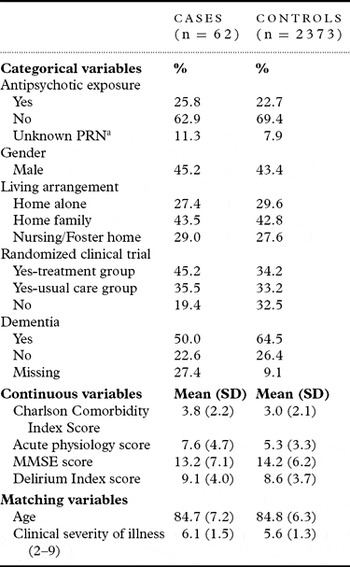
Table 1 shows the descriptive characteristics of the cases and controls. Mean age of the cases was 84.7 years. Over two-thirds lived at home and at least half suffered from dementia. More cases than controls had missing data on dementia (27.4% vs. 10.9%).
Characteristics of cases and controls

PRN = pro re nata (medication as needed); MMSE = Mini-mental State Examination.
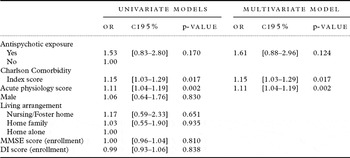
Table 2 shows the results of univariate and multivariate conditional logistic regression for in-hospital mortality. Exposure to APs showed a non-significant association with mortality in the univariate model (OR = 1.53, CI 0.83–2.80) and, as the primary variable, was entered into the multivariate model. Both acute physiology score (OR = 1.11, CI 1.04–1.19) and Charlson score (OR = 1.15, CI 1.03–1.29) were significantly associated with mortality in the univariate model and were thus entered into the multivariate model. Finally, we can see that the correlations between Charlson, Apache scales and AP exposure are very small (<0.15). This explains why the odds ratio from the univariate models are very similar to the multivariate model.
Univariate and multivariate conditional logistic regression model of in-hospital mortality

OR = odds ratio; MMSE = Mini-mental State Examination; DI = Delirium Index.
Results of the multivariate analysis (Table 2) were similar to the results of the univariate analysis. AP exposure was associated with an elevated risk of mortality that was not statistically significant (OR = 1.61, CI 0.88–2.96) while comorbidity (OR = 1.15, CI 1.03–1.29) and acute physiology scores (OR = 1.11, CI 1.04–1.19) were associated with an elevation of risk that was statistically significant. The large number of missing data precluded a full analysis of the impact of dementia on mortality. Nonetheless, a separate analysis with available data showed no impact of dementia on mortality (OR = 0.78, CI 0.39–1.53).
Discussion
Administration of AP medications to elderly medical inpatients with delirium was not associated with a statically significant increase in risk of mortality. This difference did not reach statistical significance as previously observed on larger and longer follow-up studies of non-delirious elderly patients exposed to APs (Wang et al., Reference Wang2005; Schneeweiss et al., Reference Schneeweiss, Setoguchi, Brookbort, Darmuth and Wang2007; Gill et al., Reference Gill2007). However, recent findings have shown that even a short exposure (less than 30 days) to APs can increase risk of mortality in patients with dementia (Rochon et al., Reference Rochon2008). Because of the small sample size (62 deaths and an average of 38 incidence-density matched controls per case), the power at the 0.05 level of significance for detecting an OR of 1.6 for the primary outcome was only 41%. In fact, to reach a power of at least 80% we would have needed a sample size of 180 cases.
The study has the following strengths. This is a large cohort of well-diagnosed elderly hospitalized patients with delirium who would represent a group likely to be prescribed an AP (Carnes et al., Reference Carnes, Howell, Rosenberg, Francis, Hildebrand and Knuppel2003). Reliable and valid instruments were used to assess important cofounders such as severity of illness and comorbidities.
At the same time, some study limitations should be noted. First, this is a secondary analysis of data from studies in which there was no medication protocol. Patients were not randomized with respect to AP exposure, leaving room for systematic bias as clinicians used only clinical judgment when deciding whether to prescribe these medications. Nonetheless, there was no difference in physical illness indices whether patients received APs or not. Second, because of the wide variations in timing and dose of AP administration, we were unable to examine dose-response associations. The only other study we are aware of that looked at the dose response relationship between AP exposure and mortality found no statistically significant relationship (Kryzhanovskaya et al., Reference Kryzhanovskaya2006). Third, we were unable to control for confounding by dementia because of the large number of missing data. However, sub-analysis for available diagnosis of dementia showed no impact on mortality. Finally, we were unable to control for administration of other psychotropic medications which could have contributed to delirium and/or mortality.
No other study examining the relationship between APs and mortality in the delirious elderly nor any medication for delirium that includes an unmedicated comparison group study has been published to our knowledge (Ryan, Reference Ryan2001; Gill, Reference Gill2006). Elderly delirious patients are more ill and possibly represent a higher risk group. Given that neither the safety nor efficacy of APs in delirium has been subjected to placebo-controlled trials, they should be prescribed with care and, when feasible, alternative non-pharmacological interventions should be considered. Larger controlled trials are needed to clarify the safety and efficacy of APs in the management of elderly patients with delirium.
Conflict of interest
None.
Description of authors' roles
Dr. Elie and Dr. Boss designed the study, supervised the data collection and wrote the paper. Dr. Cole and Dr. McCusker assisted with the study design and interpretation of the results. Mr. Belzile and Dr. Ciampi were responsible for carrying out the statistical analysis.
Acknowledgments
The authors are grateful to Mrs. Christine Gagné for her great assistance in the secretarial process. The study was funded by St. Mary's Hospital Internal Grant 04-32.