Introduction
India has an exceptionally high level of childhood stunting though prevalence fell from 48% in 2005–6 to 38% in 2015–16. Nevertheless, India still accounts for one-third of the global total (IIPS & ICF, 2017). India also has one of the world’s shortest adult populations – a reflection of historic poverty, malnutrition and disease – though heights have improved, more for men than women (Deaton, Reference Deaton2008). Growth failure from conception to two years of life is a strong determinant of adult height (Martorell et al., Reference Martorell, Khan and Schroeder1994; Victora et al., Reference Victora, de Onis, Hallal, Blossner and Shrimpton2010). Failure in human growth starts in utero, becomes prominent during the first year of life and continues until around two years of age (Victora et al., Reference Victora, de Onis, Hallal, Blossner and Shrimpton2010; Martorell & Zongrone, Reference Martorell and Zongrone2012). The proximate causes of growth failure include malnutrition, infections, particularly diarrhoeal disease, poor sanitation and adverse uterine conditions (Black et al., Reference Black, Allen, Bhutta, Caulfield, de Onis and Ezzati2008).
The intergenerational effect of short parental stature on stunting in offspring is well established. Much of the evidence concerns maternal height. In a multi-country analysis of data from low- and middle-income countries, a significant effect of maternal height on child stunting was found in 52 of 54 national surveys, after adjustment for a range of covariates including household wealth and parental education (Ozaltin et al., Reference Ozaltin, Hill and Subramanian2010). This link is usually regarded as a reflection of the intergenerational transmission of poverty (Grantham-McGregor, Reference Grantham-McGregor, Cheung, Cueto, Glewwe, Richter and Strupp2007; Martorell & Zongrone, Reference Martorell and Zongrone2012). One of the most potent risk factors for poverty is being born to poor parents (Martorell & Zongrone, Reference Martorell and Zongrone2012). Evidence also suggests a biological pathway. Women with short height have a reduced store of protein and energy, smaller reproductive organ sizes and limited room for fetal development, leading to low birth weight, which is closely related to childhood stunting (Duggleby & Jackson, Reference Duggleby and Jackson2001).
The Indian literature on links between parental height and child health outcomes, such as stunting, is sparse. Using data from round 3 of the National Family Health Survey (NFHS) conducted in 2005–6, Subramanian et al. (Reference Subramanian, Ackerson, Smith and John2009) found that a 1 cm increase in maternal height was associated with a decrease in relative risk for stunting of 0.97 after adjustment, and a similar but smaller effect of father’s height. In a related paper, small but equal associations between mothers’ and fathers’ body mass index (BMI) and childhood stunting were found, though a district-level analysis found women’s BMI to be strongly related to stunting (Subramanian et al., Reference Subramanian, Ackerson and Smith2010; Menon et al., Reference Menon, Headey, Avula and Nguyen2018). Rehman et al. (Reference Rehman, Gladstone, Verghese, Muliyil, Jaffar and Kang2009) also found an inverse relationship between maternal height and stunting in the urban slums of India. In a study on five countries including India, short maternal height was associated with child stunting. Mothers with height less than 150.1 cm were 3.2 times more likely to have stunted offspring compared with taller mothers (Addo et al., Reference Addo, Stein, Fall, Gigante, Guntupalli and Horta2013). Another multi-country study analysed the contribution of risk factors to stunting in children aged 2–3 years. For India, the major contributors were low birth weight and prematurity, unimproved sanitation, diarrhoeal disease, with a small contribution of 12% from mother’s height (Danaei et al., Reference Danaei, Andrews, Sudfeld, Fink, McCoy and Peet2016). However, this analysis fails to take into account that mother’s height is strongly related to birth weight.
This paper aims to add to this limited literature by assessing the relationship between parental height and childhood stunting using recent national survey data. The particular objectives were to examine the relative effects of maternal and paternal height; to compare their magnitude with the effects of socioeconomic influences; and to assess the extent to which educational and material success in life, as measured by maternal and paternal schooling and household wealth, moderates or mitigates the disadvantages associated with short stature.
Methods
Data source
Data for the study were taken from the fourth round of India’s National Family Health Survey (NFHS-4) conducted in 2015–16. The NFHS is India’s equivalent of the Demographic and Health Surveys (DHS). The NFHS provides representative data at the national, state and district levels on population and health indicators. Details of the design and methods have been published by International Institute for Population Sciences (IIPS) and ICF (IIPS & ICF, 2017).
Study population and sample size
The study population for the study included children aged 0–59 months born to mothers aged 15–49 years at the time of the survey and fathers aged 15–54 years. Of all 190,538 surviving under-five children, maternal heights were available for 190,084 while paternal heights were available for a representative sub-sample of 29,039. Data on height were missing for 6% of children and mothers and 12% of fathers. The analysis was based on those children for whom both parents’ heights were available, after excluding a small number of implausible values (n=28,975).
Outcome measure
Stunting was the outcome variable for the study. In the NFHS, trained investigators measured the child’s height with an adjustable measuring board calibrated in millimetres (IIPS & ICF, 2017). A child was considered stunted when the median score was more than 2 standard deviations under the World Health Organization-determined median scores (WHO, 2008). This binary outcome was preferred to the alternative of height as a continuous variable because of its familiarity and ease of interpretation.
Exposure
The height of the parents was also measured by trained investigators using an adjustable measuring board calibrated in millimetres (IIPS & ICF, 2017). In the absence of any objective standards for assessing adult height, maternal height was represented as a quintile with the following cut-off points: ≤147.0 cm (very short), 147.1–150.0 cm (short), 150.1–153.0 cm (average), 153.1–156.0 cm (tall) and >156.0 cm (very tall). The corresponding categories for paternal height were: ≤157.0 cm (very short), 157.1–161.0 cm (short), 161.1–165.0 cm (average), 165.1–169.0 cm (tall) and >169.0 cm (very tall).
Covariates
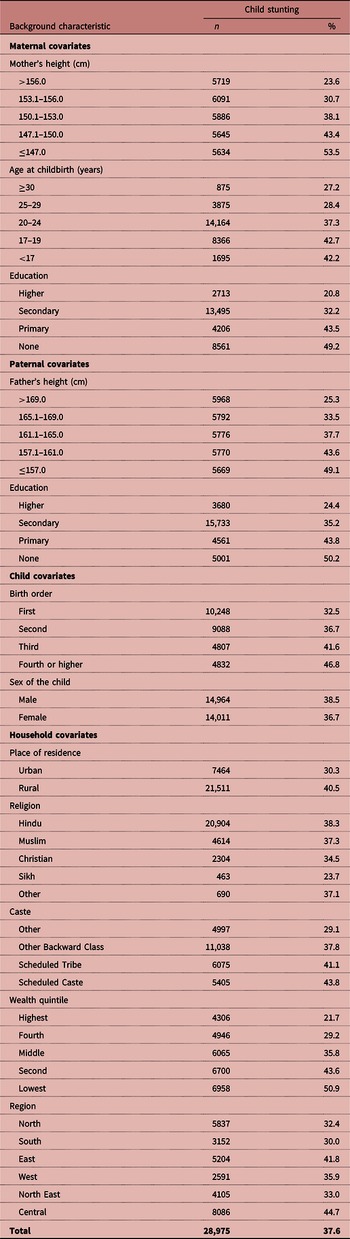
The covariates for the study were the education of both parents, household economic status represented as wealth quintiles (based on dwelling construction and household possessions), demographic factors (maternal age at childbirth, birth order and sex of the child), geographic factors (rural–urban and region of residence) and social factors (religion and caste based on the household head). The categorization of covariates is shown in Table 1. Parental education and household wealth were regarded as potential effect-modifiers and the other covariates as potential confounders.
Weighted frequency for child stunting (children aged 0–59 months) across maternal, paternal, child and household covariates, India 2015–16

Analysis
Following bivariate descriptive analysis, logistic regression was applied to identify the significant determinants of stunting in India. SPSS (version 20) was used to perform all the statistical analyses. Results from three models are presented: an unadjusted model; a model of maternal height, paternal height, education of both parents and household wealth; and a fully adjusted model that included all covariates. The logic for the selection of models was that education and household wealth represent success in life that may offset the disadvantages associated with short stature and thus may be regarded as moderators, whereas other covariates were considered as potential confounders. All results were weighted to take account of variations in sampling probabilities and standard errors took account of the clustered nature of the sample.
Results
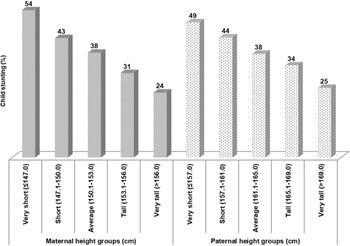
The relationship between maternal and paternal height was essentially linear (Figure 1). Across the five quintiles of maternal height, the percentage of children stunted rose from 24% among the very tall to 54% among the very short – a difference of 30 percentage points. The corresponding estimates for paternal height were 25% and 49% with a difference of 24 percentage points.
Child stunting by maternal and paternal height groups, India, 2015–16.

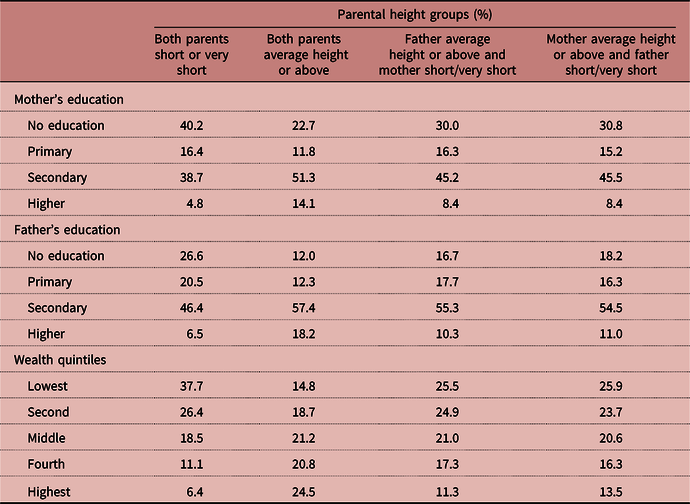
Table 2 confirms that the short parents were indeed deprived. Among couples where both parents were short or very short, 40% of wives received no schooling compared with 23% among the group where both spouses were of average or higher height. The corresponding figures for husband’s education were 27% versus 12%. Similarly, 38% of short or very short spouses were in the lowest wealth quintile compared with 15% of average or higher height spouses.
Deprivation in education and economic status by height group, India 2015–16

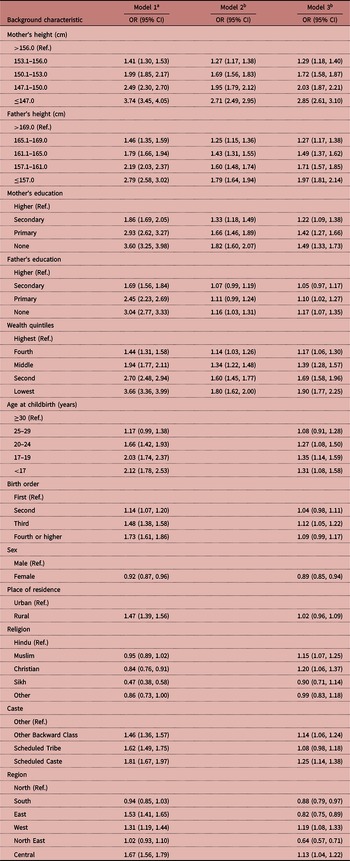
All the covariates were significantly associated with stunting, as indicated by the 95% confidence intervals (Model 1, Table 3). Parental education and household wealth were the sources of the most substantial variation. Whereas a little over 20% of children born to mothers or fathers with higher than secondary schooling were stunted, this proportion rose to about 50% for those whose parents had no schooling. The range of stunting was similar for household wealth quintiles – from 22% to 51%. Among the demographic variables, birth order showed a strong association with stunting. Maternal age at childbirth had a negative association with stunting, but the difference between girls and boys was very small. It may also be noted that stunting varied by region and caste.
Odds ratios for child stunting (children aged 0–59 months) across maternal and paternal height groups and household covariates, India 2015–16

a Unadjusted odds ratio.
b Adjusted odds ratio.
95% confidence interval is given in parentheses.
Ref.=reference category.
Table 3 shows the unadjusted odds ratios (ORs) for stunting for all covariates (Model 1), the adjusted odds ratios (aORs) after controlling for parental education and household wealth (Model 2), and the aORs adjusted for all covariates (Model 3). As explained above, the logic for the choice of models is that education and wealth are expected to mitigate the effects of maternal and paternal height on child stunting while the demographic, geographical and social factors are potential confounders. As the height of the mother decreases, the odds of child stunting increase. Compared with the children born to very tall women with height greater than 156 cm, children born to tall mothers were 1.4 times more likely to be stunted; those born to mothers with average height were twice more likely to be stunted; those born to short mothers were 2.5 more likely to be stunted and children with very short mothers of ≤147 cm height were 3.7 times more likely to be stunted. Similar to maternal height, there was an inverse relation between paternal height and child stunting.
In the second model, after including parental education and economic status, the adjusted odds of stunting by maternal and paternal height groups decreased, particularly for children with very short mothers, with a reduction in odds ratio from 3.74 to 2.71 compared with very tall mothers. Similarly, for father’s height, the adjustment for education and wealth made the most pronounced difference for very short fathers relative to very tall fathers – from an OR of 2.79 to an aOR of 1.79. When the additional covariates were added in Model 3, there were small and statistically insignificant increases in these adjusted odds ratios. Both maternal and paternal height remained strong determinants of child stunting. As indicated by the confidence intervals, maternal stature was more closely linked to stunting than paternal stature. The results clearly show that maternal height is the strongest predictor of stunting and that paternal height is as important as wealth, after adjustment for all other factors.
All other factors, except rural–urban residence, retained statistically significant associations with stunting in the fully adjusted model. The strongest association was with household wealth; the prevalence of stunting rose monotonically with decreasing wealth with an aOR of 1.90 for the poorest quintile relative to the richest. Though severely attenuated after adjustment, maternal education remained a strong predictor of stunting.
In contrast to the strong adjusted effects of maternal and paternal height, household wealth and maternal education, the adjusted effects of other factors were relatively small. The reduction of the effect of paternal education was pronounced. Of note is the appreciable association between stunting and maternal age at childbirth, with a one-third increase in the odds of stunting for children born to teenage mothers compared with those born to a mother aged 30 or more.
Discussion
The NFHS-4, with its huge sample size, provides an unusual opportunity to assess the associations between the height of both parents and childhood stunting. The study objectives were to establish the relative influences of maternal and paternal stature on stunting, to compare these influences with those of socioeconomic factors, and specifically to assess the degree to which educational and material success mitigates the influence of parental stature on stunting. Though the study confirmed that short parental stature was strongly associated with deprivation in terms of education and wealth, it is by no means an immutable determinant of fate. For instance, among families where both parents were classified as short or very short, close to half of mothers and fathers had received a secondary or higher education and 17% lived in households belonging to the top two wealth quintiles. To what extent can educational and economic success weaken the association between short parental stature and poor linear growth in children?
The results were emphatic. The unadjusted estimates showed the associations of stunting with maternal height, wealth and education to be similarly strong and only slightly less pronounced for paternal height. In the multivariate analysis, the odds of stunting by parental height reduced but maternal height emerged as the strongest predictor, with adjusted odds of 2.85 for very short mothers compared with the very tall. This relationship was essentially linear. This result is consistent with a multi-country study, which found an adjusted relative risk of 2.1 for stunting among offspring of mothers with a height of less than 145 cm compared with maternal heights of 160 cm or more (Ozaltin et al., Reference Ozaltin, Hill and Subramanian2010). Similar to these results, this study also found maternal height to be a stronger predictor of stunting than wealth or education.
The two other strong predictors of stunting were paternal height and wealth, with adjusted odds of close to 2.0 for the least advantaged quintile relative to the most advantaged. In comparison, associations between stunting and other factors were minor, with the partial exception of maternal education, which is well established as protective of child health and survival.
In countries with near-optimal disease and nutrition environments, adult stature is largely a reflection of genetic endowment. In India, environmental conditions are far from optimal and adult stature may be regarded as a proxy for disadvantage in utero and early life, though there will be a genetic and epigenetic contribution. The very strong association between mother’s height and poor linear growth of children is thus a reflection of the intergeneration transmission of disadvantage. The contribution of genetics in India is probably small. Even in rich countries, a pooled analysis of twin studies has shown that environmental factors account for most of the variance in children’s height, though this contribution declines with age, from 82% at 5 months to 56.5% at 5 years (Dubois et al., Reference Dubois, Kyvik, Girard, Tatone-Tokuda, Pérusse and Hjelmborg2012).
The relatively small attenuation of the maternal height effect after adjustment for education, wealth and other covariates is surprising. Yet, it is also consistent with international evidence. The multi-country study by Ozaltin et al. (Reference Ozaltin, Hill and Subramanian2010) found that the relative risk of stunting in children of the shortest relative to the tallest mothers fell only from 2.4 to 2.1 after adjustment for a similar range of covariates that were deployed in this study. One possible explanation is that the measure of wealth, based on possession of consumer durables and household amenities such as water supply and applied nationally, does not adequately capture income and certainly does not attempt to represent household diets. Moreover, household wealth may not translate into improved nutrition and health care for women, particularly in the patriarchal north of India. A second explanation is that more profound changes in the environment than represented by wealth quintiles, such as migration from South East Asia to the USA, are required to offset the poor intra-uterine anatomy associated with low maternal stature, leading to low birth weight and an elevated risk of stunting (Yip et al., Reference Yip, Scanlon and Trowbridge1992).
The association between paternal height and child stunting has been little studied and is not well understood. Much of the literature reviewed by Martorell and Zongrone (Reference Martorell and Zongrone2012) found fathers’ characteristics to be a relatively unimportant influence relative to those of the mother. For instance, the birth weight of mothers, but not of fathers, was found to be strongly correlated with the birth weight of offspring. Similarly, the growth of mothers in the first 20 months of life was associated with offspring height but not the growth of fathers. The present analysis confirms the finding of Subramanian et al. (Reference Subramanian, Ackerson, Smith and John2009) – that maternal stature in India is more strongly predictive of child stunting than father’s stature. Nevertheless, the paternal height–stunting association observed in the NFHS-4 data was very strong, and equal in magnitude to that of household wealth. This may reflect a purely genetic effect. However, there is some evidence that a father’s health and nutritional status may affect sperm quality, epigenetic status, DNA integrity and seminal fluid composition in ways that influence fetal growth and health of offspring (Fleming et al., Reference Fleming, Watkins, Velazquez, Mathers, Prentice and Stephenson2018). There is a possibility that these conditions are more prevalent in short than tall men.
What might be the implications of these results for policies to reduce the intergenerational transmission of disadvantage and accelerate the fall in childhood stunting? It is known from the World Health Organization Multicentre Growth Reference Study that, under near-optimal conditions, early growth in Indian children can match that in rich countries but it will take decades to achieve such conditions across the whole country (Garza et al., Reference Garza, Borghi, Onyango and de Onis2013). However, the decline in India’s fertility offers an exciting opportunity for improvement. A woman’s pre-conception health and nutrition is a crucially important determinant of fetal and child growth and health; interventions during pregnancy have limited impact (Onis & Branca, Reference de Onis and Branca2016; Stephenson et al., Reference Stephenson, Heslehurst, Hall, Schoenaker, Hutchinson and Cade2018). In India, poor pre-conception health of women, including low BMI, is common (Coffey, Reference Coffey2015). Pregnancy preparedness is key and is enabled by low fertility. A two-child norm is now established in India and this represents a quantity-to-quality shift; the smaller the number of children the greater is likely to be the desire to furnish them with the best possible health and schooling. Furthermore, very few couples attempt to delay their first pregnancy following marriage (Pandey & Singh, Reference Pandey and Singh2015). Thus newly married couples represent a priority population for educational interventions, with the central message that a flourishing baby requires a mother who is healthy and well-nourished at the time of conception. This message should be accompanied by information that teenage mothers are at elevated risk of experiencing poor growth in children. In addition, health workers, both facility- and community-based, need to be informed that short women are at enhanced risk of poor fetal and infant growth in their offspring and require a special focus.
In conclusion, this analysis shows that a mother’s height has a stronger association with childhood stunting in India than socioeconomic influences such as her education and household wealth. The influence of paternal height is also strong, equal in magnitude to household wealth, though less pronounced than that of maternal height. The limitation is that NFHS-4 data do not allow any progress in disentangling the complex interplay of environmental, genetic and epigenetic pathways of influence.
Acknowledgments
This work was undertaken with support from the Population Council through its project entitled Policy Research and Advocacy for Strategic Investment in Maternal, Newborn and Child Health in India, supported by the John D. and Catherine T. MacArthur Foundation (Grant No. 16-109245-0). The authors are thankful to Dr K. G. Santhya and A. J. Francis Zavier for their expertise, which greatly assisted the research.
Funding
The authors received no financial support for the research, authorship, and/or publication of this article.
Conflicts of Interest
The authors have no conflicts of interest to declare.
Ethical Approval
The protocol for NFHS-4 was approved by the International Institute for Population Sciences, Mumbai, and by ICF, who manage the Demographic and Health Survey program. We used anonymized public access data from this survey.