The franciscana, Pontoporia blainvillei (Gervais & D'Orbigny, 1844), and the boto-cinza, Sotalia guianensis (Van Bénéden, 1864) are vulnerable cetaceans along the western South Atlantic waters (IBAMA, 2001). They are sympatric along the south-eastern Brazilian coast (19ºS–25ºS) (Siciliano et al., Reference Siciliano, Moreno, Demari e Silva and Alves2006) and the study conducted by Di Beneditto et al. (Reference Di Beneditto, Ramos and Lima2001) compared their feeding habits in northern Rio de Janeiro State (21º18′S–22º25′S). The present note compares the diet of these dolphins considering the proximate-composition and caloric value of their preferred prey.
The feeding habits of the franciscana and the boto-cinza described in Di Beneditto & Ramos (2001) and Di Beneditto & Ramos (Reference Di Beneditto and Ramos2004), respectively, were used to select the prey species for the proximate-composition and calorimetric analysis. The fish Stellifer cf. rastrifer, Pellona harroweri, Anchoa filifera and Isopisthus parvippinnis are representative for the franciscana, while Trichiurus lepturus is the main fish species for the boto-cinza. The squids Loligo sanpaulensis and L. plei are important for both dolphin species.
During April and May 2007, the known prey specimens were collected along the northern Rio de Janeiro State coast. The whole fresh specimens were homogenized, forming a composed sample of each prey species, which was frozen and lyophilized. The water content and the dry mass, as well as the mineral matter were determined gravimetrically by desiccation at 105ºC and by incineration in an oven at 600ºC, respectively. The crude protein was obtained by the Kjeldahl method (Cunniff, Reference Cunniff1998) and the protein content by calculation of the Kjeldahl nitrogen × 6.25. The lipids were extracted using Folch et al.'s (Reference Folch, Lees and Stanley1957) method and its content was determined gravimetrically. The protein, lipid and mineral content values were expressed as dry mass percentage (%DM). The gross energy (GE) was determined using a bomb calorimeter and was expressed as kcal per kg DM−1. All samples were analysed in triplicate, except for GE. The statistical analyses were processed in the R-system 2.2.1 software (P value ≤ 0.05). The prey groups were compared by t-test and the GE values for each prey species by Chi-square test (Zar, Reference Zar1999).
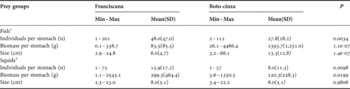
The total amount of ingested fish and squids by the two dolphins was previously described in Di Beneditto et al. (Reference Di Beneditto, Ramos and Lima2001). In the present study, these data were statistically analysed and revealed that the biomass recorded per stomach was significantly different, as well as the fish specimen number and size and squid specimen number (Table 1). The results indicated that fish are more important for the boto-cinza, while squids for franciscana.
Diet comparison between the franciscana and the boto-cinza by the t-test (modified from Di Beneditto et al., Reference Di Beneditto, Ramos and Lima2001).

1, all fish species consumed by the franciscana (N = 19) and the boto-cinza (N = 31); 2, all squid species consumed by the franciscana and the boto-cinza (N = 3); SD, standard deviation; Min, minimum; Max, maximum.
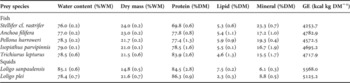
The water, protein, lipid, mineral and GE values are summarized in Table 2. All the fish species and the squid L. plei had similar mean water content values. However, the value for L. sanpaulensis was around 7% higher than that of other prey. The proximate-composition results indicated that protein was the largest fraction of the organic matter in all prey species, which contained a minor amount of lipids. The mineral matter values were 2.5 times greater in fish than in squids. In relation to the GE values, there was a significant difference considering all the species (χ2 = 220.5, P < 2.2e-16). Anchoa filifera, P. harroweri, I. parvipinnis and T. lepturus had equivalent values (χ2 = 4.9, P = 0.1814), while S. cf. rastrifer and the squids showed the lower and the higher values, respectively.
Water content, dry mass, proximate-composition (protein, lipid and mineral) and gross energy (GE) values for the main prey species of the franciscana and the boto-cinza. Mean (standard deviation).

The diet of these dolphins has been already described for other areas, where similar feeding habits were noted for the boto-cinza (e.g. Santos et al., Reference Santos, Rosso, Santos, Lucato and Bassoi2002) and the franciscana (e.g. Danilewicz et al., Reference Danilewicz, Rosas, Bastida, Marijo, Muelbert, Rodríguez, Lainson-Brito, Ruopollo, Ramos, Bassoi, Ott, Caon, Rocha, Catão-Dias and Secchi2002). According to these authors, the franciscana ingests small-size prey (up to 10 cm) and squids are very representative of its diet, while the boto-cinza is primarily piscivorous and presents greater plasticity regarding the prey size.
The main prey species of both dolphins are abundant all year round in northern Rio de Janeiro State (Di Beneditto et al., Reference Di Beneditto, Ramos and Lima2001). Regarding the franciscana, prey selectivity is mainly related to its oral apparatus and digestive tract (Brownell & Ness, Reference Brownell and Ness1970; Jefferson et al., Reference Jefferson, Leatherwood and Webber1993), which limit the size of the ingested preys. In turn, fish and squid species with higher water content are easier to be digested by the franciscana. These characteristics and the high water content in L. sanpaulensis can explain, at least in part, the great importance of this prey in the franciscana diet, which was previously reported by Di Beneditto & Ramos (2001).
A basic protein diet is expected in a carnivorous species, such as dolphins (Schmidt-Nielsen, Reference Schmidt-Nielsen1996). Differences in the prey species regarding proximate-composition and caloric content can be reflecting environmental conditions, preys body structure, ontogenetic and reproductive state, and also depend on region or season (Perez, Reference Perez1994; Kastelein et al., Reference Kastelein, Vaughan, Walton and Wiepkema2002). In general, the caloric intake from squids is lower than from fish (Cox et al., Reference Cox, Gaglione, Prowten and Noonan1996; Walker, Reference Walker1996). However, in Hawaiian waters the caloric content of fish, shrimps and squids consumed by Stenella frontalis did not show significant differences (Benoit-Bird, Reference Benoit-Bird2004). Perez (Reference Perez1994) did calorimetric measurements of Alaskan organisms ingested by marine mammals and detected that energy values can vary between the squid and fish species, without a specific trend.
The franciscana and the boto-cinza have marked differences in growth and reproductive parameters (Ramos et al., Reference Ramos, Di Beneditto and Lima2000). These authors verified that the former has higher growth rates, lower body dimensions, earlier sexual maturity attainment and shorter birth intervals than the latter. These features can conduct the franciscana to greater energetic needs, which could be related to its squid preference, once in the study area these organisms are providing higher energy content than the fish species.
This study presented the first comparative information about the proximate-composition and caloric value of the prey species consumed by these South American dolphins, providing baseline data for future bioenergetics and nutritional needs studies and improving the knowledge about their feeding ecology.
ACKNOWLEDGEMENTS
We thank the fishermen from Atafona harbour and the technician Silvana Ribeiro Gomes, who provided us with the dolphin's prey specimens. A.P.M. Di Beneditto was supported by CNPq (Proc. No. 305160/2006-0) and M.V. Vidal Jr. was supported by FAPERJ (Proc. No. E-26/152.612/2006). This is contribution number 104 from the Graduate Program of Ecology and Natural Resources/UENF.