the way to see mountains is to take a knapsack and a walking stick
John Ruskin, Works 26: 104Part I: Ruskin the Climber
Most readers either overlook or dismiss John Ruskin's climbs in the Alps as being insignificant compared to his avid interest in geology and mountain form. However, I want to suggest that Ruskin's climbing – his physical and kinetic relationship to the mountains – is essential to his understanding of them. His numerous and repeated ascents in the lower Alps were not always easy: in fact, they were often tough and sometimes dangerous. Through a few select examples, in the first part of the essay, I establish just how difficult many of these scrambles were so that I may proceed, in the body of the paper, to talk about how these strenuous experiences influenced his way of seeing the mountain landscape he admired, and how, in turn, they helped shape his concept of imperfect vision.
Ruskin and Skiddaw
Over forty years ago, while I was visiting the Lake District, I walked up Skiddaw for the first time. Young and careless, I resolved to reach its bare peak. I was not properly equipped: tennis shoes, a light nylon jacket, and no water. The day seemed fine until late afternoon when a storm suddenly blew in. Following cairns that marked the way, I obstinately persisted in reaching the scaly slate of Skiddaw's summit, but, once at the top, I could not find my way down, for I was caught in a dense fog. I saw enough of my surroundings, however, to realize that I was stuck on a narrow ledge; I feared that a miscalculated step would send me hurtling down the mountain's precipitous sides. I had no choice but to wait for the storm to pass. Luckily for me, within an hour, the figure of a hardy, experienced rambler gradually took shape through the mist and broke through the encircling clouds. He gave me water and escorted me down just before darkness fell.
This experience was the beginning of my love affair with Skiddaw. Ever since then I have periodically returned: sometimes the conditions have been clear; at other times, clouds have settled to obliterate the sweeping view. Once or twice the wind on top has been so strong that I have had to crawl along to prevent myself from being blown over by seventy-mile per hour blasts. The last time I ascended Skiddaw was the summer of 2005. So many people have now gone up and down its slopes that the paths have eroded, but still Skiddaw beckons me.
In some respects my repeated attraction to Skiddaw reminds me of John Ruskin's own enchantment with this “celebrated mountain” (Richardson and Ruskin, “A Tour to the Lakes in Cumberland” 27). Throughout his life, Ruskin felt the pull of Skiddaw. As a young boy he went up with his parents; and, in April, 1848, while on his honeymoon, he rode up with his wife, and in his late 40s he spoke triumphantly of his once more climbing along “the stately ridge towards the summit.” Pleased with the rapidity with which he reached the top, he bragged, “I think there may be some life in the old dog yet” (Works 36: 534).
Ruskin's repeated references to Skiddaw remind one that he was not only profoundly attracted to the mountain landscape but also lured by the actual physical motion and exertion of clambering over their crags and reaching their heights. As I have mentioned in the introduction, this aspect of Ruskin's kinetic relationship to mountains is not one that usually receives much notice. Critics tend to make little of Ruskin's physical accomplishments and, like one of his biographers, reduce his climbs either to “scrambles about the hills” or “to sketching expeditions” (Evans 101, 144). In particular, critics pay minimal attention to his notable feats in the Alps. More to the point, they refuse to see the link between his rigorous climbing and his way of seeing. First, though, I want to give some sense of just how physically demanding these climbs were.
The Thrill of Ascent
Although Ruskin readily admitted that he had “poor climbing powers” because he never learned the most advanced technical skills (Praeterita 334), he was a strong walker who could clamber over difficult places and endure long scrambles. His taste for such activity came from his boyhood travels with his family. The Ruskins' frequent trips to the Lake District and to the Continent when he was a young boy whetted his appetite for laborious climbs and precipitous ridges. Reading the earliest accounts of his family's ascents up Skiddaw, to the hills above Chamonix, and up to the top of Mt. Vesuvius, one senses the pleasure and satisfaction he experienced, even when there were difficulties.Footnote 1 It was not until Ruskin was in his twenties, however, that his mountain travel became more adventurous. Beginning in 1842, when Ruskin was twenty-three, Switzerland became a second home. For the next forty years or so, he was, with a few exceptions, to visit the Alps annually, either with his parents or alone, for months at a time.Footnote 2 Here he had more opportunities to clamber over dangerous terrain and ascend into higher regions.
The more serious climbing was initiated when, in 1844, Ruskin's father hired Joseph Marie Couttet as a guide for his son.Footnote 3 Fearful that his son's enthusiasm for collecting minerals and making sketches in the Alps might lead to trouble, he told Couttet that Ruskin should be “taken charge of . . . and not permitted in any ambitious attempts, or taken into any dangerous places” (Praeterita 299). That edict to be careful, however, was not always heeded. Under Couttet's guidance, Ruskin soon learned how to wield an alpenstock, braved many a peak or pass he might not otherwise have attempted, and climbed with a vigor that he had not thought possible. Between 1844 and 1849, when undertaking the bulk of his geological and mountain studies, Ruskin repeatedly went up what many people might consider to be challenging and lengthy climbs, though never, it should be emphasized, up to heights associated with the famous peaks of Mont Blanc (15,781 ft.) or the Matterhorn (14,780 ft.). Many of these summits, though, were over seven thousand feet (i.e., Mont Moro at 9,800 ft.) and a couple, at least, were over ten thousand. (One should remember that New England's Mt. Washington, which can be a hard and even dangerous climb, is only 6,288 ft.)
Although it is impossible to list all of Ruskin's numerous ascents, a selection is sufficient to portray their rigorous character. In June, 1844, for instance, Ruskin climbed “the Montanvert [6,267 ft.] beside a glacier all the way: a thorough scramble, clinging to bushes and swinging from trunks of trees in capital style.” On the following day, he describes “a difficult descent to the snow, and then a climb an hour or more, on steep inclined planes of snow, with formidable loose rocks interspersed.” He concluded his climb by clambering over a glacier covered with deep snow, “only one crevice appearing; but the slope was so steep” (Diaries 1: 283–84). Later in the month, he and Couttet were off at 8 a.m. “for the Montagne la Côte [8,494 ft.]. . . . We had a tremendous climb; nothing but mauvais pas from beginning to end, and a little too steep to be pleasant; makes the limbs ache.” A day later a restored and pleased Ruskin accomplished “a desperately stiff ascent of a ‘couloir’ – the hardest thing I have yet done for labour.” He attained “a point which I think higher than any I have yet reached” (Diaries 1: 289–90).
In July, 1844 the climbs continued and so did Ruskin's desire to go “as hard as [he] could” (Diaries 1: 295). For instance, he ascended Mont Buet – once referred to as the “Mont Blanc for Ladies” (SummitPost). He reached, for him, a record height of 10,157 ft. Ruskin's description of this ascent, written a day later in his diary, reflects his involvement in the climb for its own sake. Only peripherally does he attend to the painterly perspective offered by the early morning light and shadow gliding across the distant view of Mont Blanc. The going up Mont Buet was tough. He scrambled “up a slope of loose, black, ugly calcareous slate” and found his breath and strength “very much taxed.” Then he went up to the summit and discovered himself to be in a position “which I did not altogether like – a ledge of snow overhanging a cliff of three thousand feet down.” He complained of feeling a “great weakness in the middle of my thighs,” and not being able “to work hard enough to warm myself.” Once he began his descent, his courage failed when he was unexpectedly confronted by another long climb. Having managed this obstacle, he and Couttet temporarily lost their way, and consequently, “plunged down among heaps of slippery mud and slime.” After a “most uncomfortable hour of exhaustion and dread of fatigue-fever . . . things began to improve.” Ruskin closes his account with a rare excursion into the vernacular: “It was a desperate day – a regular choker” (Diaries 1: 307–08).
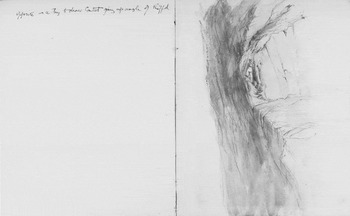
Back among the Alps in the summer of 1845, he continued these rigorous expeditions: for instance, buffeted by icy winds, he ascended places “about Buet-height, 10,000 ft” and later climbed to the top of the Riffelhorn (9,603 ft.), an ascent that is now considered to be moderately difficult and somewhat technical.Footnote 4 Throughout the subsequent decades and into the 1870s, Ruskin persisted in returning periodically to his higher climbs, at 7,000 ft. and above. He seems to have gone up to the Riffelhorn again, for on the inside of the back cover of a later diary, is an unpublished sketch that Ruskin dashed off of Couttet clinging to overhanging rocks of the “Riffel” (Figure 1). He also made a strenuous tour de Mont Blanc, and then climbed with his friend Richard Fall – on one expedition, they descended two thousand feet by means of a glissade (a rather daring and fast way down).Footnote 5 In his thirties and forties, among many other climbs, Ruskin repeatedly went up the Grand Salève (4,290 ft.), back up to Montanvert (6,267 ft.), and, in his late fifties ascended the Wengen Alp (6,160 ft.).
John Ruskin, “A try to draw? Coutet going up angle of Riffel,” drawing in “The Diary of John Ruskin, 1848–49.” Courtesy of the Ruskin Foundation.

There is no doubt that Ruskin took his climbing seriously. In 1847, when he was courting Effie Gray, he wrote her a humorous and self-conscious description of himself “coming down from the high snows.” Ruskin's words offer a rare picture of his climbing mode. In the letter, he wonders if she would care to see his “face burned, literally scarlet. . . . Then the costume: Fancy – first – me with a huge pair of dark blue – double glassed – spectacles. Over these – over the whole face, a green gauze veil – doubled, and fastened down in the waistcoat – Then a broad straw hat on the top of all – tied tight down with its flaps over the ears – by a handkerchief over the crown of it – tied under the chin! Many a hard days walk have I had – so accoutred – enough to frighten anything in the world but Alpine Sheep – whom nothing frightens” (James 65).
Eventually Ruskin gave up his residence in Switzerland. Sadly, his last trip to Switzerland, when Ruskin was sixty-nine, ended in physical and mental breakdown. He retreated to Brantwood where he could occasionally and more modestly walk up the hills of the Lake District. Memories of Switzerland remained, and Ruskin designed a zig-zaggy path on a steep slope in his garden that is said to represent Dante's Purgatorial Mount, but more convincingly, seems to abstract the numerous ascents of his previous years that brought him in physical proximity to the mountain landscape.
Part 2: Ruskin Sees
In this section I want to suggest that Ruskin's strenuous experiences not only influenced the way in which he regarded and represented the mountains he studied but also made him more aware of a disturbing chronic weakness in his eyes – an impediment that contributed to his thinking about the nature of interruption or obstruction, as well as about the privileges of imperfection.
Ruskin and the Art of the Climber
Ruskin's climbing could not help but influence the way in which he beheld the mountains he admired and studied. The relation of Ruskin as a traveler to the character of his perception has already caught the attention of critics such as Jay Fellows, Elizabeth K. Helsinger, and Lindsay Smith, who recognize that his eyes were those of an itinerant viewer (“to see is to travel” Smith 21). They suggest that, for him, seeing, reading, and traveling were partially interchangeable (Smith 20). Helsinger, in particular, speaks of Ruskin's “excursive sight” – a progressive mode of perception that follows the traveler's motions as he moves “leisurely” through a scene or a subject (Helsinger 13–14). In this manner, Ruskin is said to move from detail to detail and from view to view, through a gradual unfolding of the landscape. Helsinger's emphasis on the words “leisurely” and “gradual,” however, distorts the picture and softens the physical roughness and anxiety that often accompanied his rambles on the mountains.
As I hope I have proved, Ruskin was by no means exclusively a leisurely hill climber. To typify his efforts in this way almost runs the risk of linking him with the tourists he despised. Ruskin did see with the eyes of a traveler, but as one who, time after time, month after month, and year after year, scrambled, slid on treacherous slate, perched on precipitous ledges, swung on branches, exhausted himself, clambered over difficult spots, felt the brutal wind, and suffered either from the burning sun or altitude headaches. There was little relaxation in Ruskin's attempts to ascend as hard as he could. “Rigor,” not “leisure,” is the more appropriate word. Such a shift in vocabulary affects one's understanding concerning not only the character of his climbs but also the nature of his perception. Among the mountains, his was not necessarily an “excursive sight” but rather one that was tutored by loose footing, aching limbs, and, of course, exhilaration. Ruskin's remarks after making his way down from the upper glacier of Blaitière capture these more rugged encounters. He comments that the “direction and manner of progression” were “so awkward that I had no leisure for looking at the rocks” (Diaries 2: 430; italics mine).
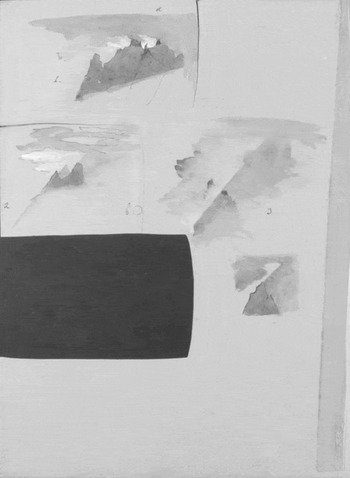
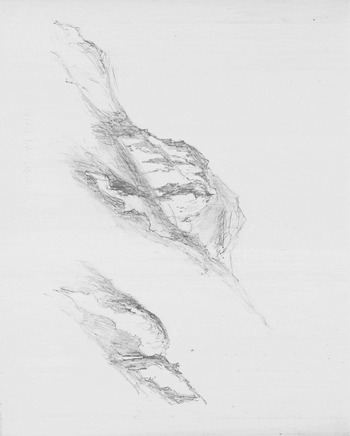
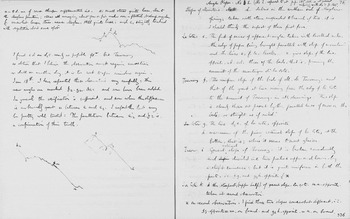
Ruskin's knowledge of the mountains reflects this more potent and bruised experience. His numerous on-the-spot study sketches of the peaks, the rocks, and the clouds, or what he preferred to call his “memoranda,” are executed at the utmost speed. They recognize the inescapable temporality that accompanies an ascent, and they acknowledge the roughness of the surroundings. Ruskin's quick brush strokes, rapid pencil lines, and washes reflect the strain of the instant. Fragments of summits, hasty studies of clouds, outlines of precipices, and cataracts fill his diaries. Blotches of daring color splashed on whatever paper is at hand seize a passing moment in which he penetrates the composition of a cloud formation, a rock, or a precipice. Nothing is gradual. Each image is unframed, for here there is no time to think of a boundary (Figures 2 and 3). He is, in his words, made “half mad” by his attempts to “fix one trait” of the “glorious skies” before they fly away (Diaries 2: March 1844).
“The Diary of John Ruskin, 1844.” Courtesy of the Ruskin Foundation.

“The Diary of John Ruskin, 1845.” Courtesy of the Ruskin Foundation.

In a sense, the study sketches Ruskin executed while climbing are as breathless as he was. Occasionally resting on a single detail, his drawings and watercolors follow and attempt to replicate the various foci of the eye's attention as it guides the body's ascent. They reflect the anxiety that emanates from there being no stable point of reference, and hurriedly catch a view or a particular just before it disappears. In a letter to his father, Ruskin describes such an experience when he talks about journeying over the Col de la Seigne to Courmayer, one of the most rugged parts of the Alps. He describes how, on the way, he quickly tried to capture a view of Mont Blanc before the mists would again obliterate its contours: “When we got up, the last cloud – except a small group on the Monts Combin and Velan far away – had melted; Mont Blanc and his whole company of hills were clear, and after again consulting my feelings and pulse, I unpacked my sketch-book, sat down under a stone, and made a memorandum which I do not intend to touch hereafter – as I fancy few artists can show a careful sketch in colour, made at 8000 feet above the sea when suffering under violent sore throat” (As quoted in Wildman n.p.).
Climbing a mountain, one maneuvers one's body through a landscape, parts of which are elusive and threaten to disappear. In The Elements of Drawing (1856–57), Ruskin speaks of this reality when he reminds his student readers that when drawing from nature: “The clouds will not wait while we copy their heaps or clefts; the shadows will escape from us as we try to shape them, each, in its stealthy minute march, still leaving light where its tremulous edge had rested that moment before, and involving in eclipse objects that had seemed safe from its influence” (Works 15: 90). He advises: “You must try therefore to help what memory you have, by sketching at the utmost possible speed the whole range of the clouds; marking, by any shorthand or symbolic work you can hit upon, the peculiar character of each” (Works 15: 129).
Within the context of such a fugitive landscape, Ruskin's rage to discover the “governing lines” of a mountain's form becomes pressing and understandable. Surrounded by a vista that does not hold still, and subjected to the elements that can turn upon one and wipe out a perspective, a person needs to identify some mark of orientation, some stability, in order to find the way and not slip into error. For Ruskin the answer was in tracing the defining lines that distinguish one mountain from another and that represent a mountain's particular shape. According to Ruskin, it was by seizing these leading or governing lines that “likeness and expression are given” (Works 15: 91) to a drawing – no matter what details escape the eye. These lines anchor a continuously moving world and help shield the observer, as both climber and painter, from its fluctuations.
Climbing and its Visual Consequences
Ruskin was well aware that his moving up among the mountains and grasping the boulders to get to the next step were essential to his way of seeing and knowing. Given his rage to see the particular and to get up as close as possible – to look down into – what he was describing, Ruskin had little choice but to move bodily among the rocks and passages of these crags or peaks. His aesthetic demanded it, no matter what the subject under his perusal, whether a tile on a floor or a geological specimen lodged just below a mountain crest. It is interesting to note that this impulse to see and “read” what was before him also prompted him to scramble over the roofs and climb up to measure the windows of Venice so that he might meticulously examine their ornamentation and structure. It is no accident that when he was studying Venetian architecture in preparation for writing The Stones of Venice, he had Couttet at his side, as if they were both still clambering among the Alps and determining the angles of their slopes. The orientation and the motivation were similar.
Ruskin's need to examine things closely, though often hurriedly, placed him in a position to think about the ways in which the movements of the body influence the ways in which one sees. Climbing was among the most explicit expressions of this link between seeing and doing. For instance, when Ruskin introduced Deucalion, his geological study, he made the significant point that “many and many such a day of foot and hand labour” have “been needed to build that book” (Works 26: 222). There could be no more telling phrase. Ruskin understood that the haptic and optic are not autonomous but work together. To touch, to observe, and to move one's feet over stones were all part of the act of seeing and comprehending. His connecting the visual moment to motion was affiliated with the ideas of a number of contemporary theorists, such as Alexander Bain. In The Senses and the Intellect (1855), Bain accorded a special place to the movement of the eye as it scans, treks a landscape, and from time to time rests upon a single point or a fraction of the field of view. In particular, Bain speaks about looking at a mountain, and about how the eye, just as the body, migrates, shifts from one perspective to another, rests occasionally on a single point or narrowly inspects the parts: “If I look at a mountain, there are many trains that I may be led into by taking this as a point to start from. By contiguity, I may pass to the other mountains of the chain, to valleys and villages beyond, to the mineral composition of the mass, to the botany, to the geological structure, to the historical events happening there” (562).
I don't want to develop or repeat what others, such as Jay Fellows, who in his The Failing Distance, and Lindsay Smith, in Victorian Photography, Painting and Poetry, have so acutely and carefully researched concerning optical theory in the nineteenth century. Rather, I want to suggest another way of regarding Ruskin's connection to the visual experience, by dwelling upon the ways in which his years of climbing in the Alps contributed to a pressing awareness of his own vulnerable vision and how this consciousness led him to a more complete understanding of the importance, and even the privilege, of imperfection.
The Vulnerable Eye
Among many subtle observations in his study of the nature of vision in the nineteenth century, Jonathan Crary suggests that from the beginning of that century there was a significant shift in people's notion of what an observer was and what constituted vision. No longer was the observer perceived as being shielded by a mechanical apparatus such as the camera obscura that guaranteed access to an objective or pre-given truth about the world and, hence, removed the observer from the site of the optical experience (“Modernizing Vision” 31). Crary proposes that, released from this prescriptive and rigid enclosure, the nineteenth-century observer experienced a new perceptual autonomy and, necessarily, had to contend with a direct viewing of the prospect – like Turner in his late work, who was compelled to confront “the dangerous brilliance of the sun” (Techniques 138) as well as manage a vista that is no longer fixed in a timeless order. With this alteration, there emerges an understanding that by extension the viewer's sensory organs and their activity not only are “lodged within the unstable physiology and temporality of the human body” (Techniques 70) but also are “inextricably mixed with whatever object they behold” (Techniques 72). The individual is no longer detached from any active relation to the exterior world. “The symbolic confines of the camera obscura have crumbled” (“Modernizing Vision” 35).
Although Crary's remarks about such a shift shed light upon Ruskin's attempts to modernize the idea of vision – a development that Crary explores fully (see Techniques 94), I want rather to isolate part of Crary's argument in order to illustrate the nature of Ruskin's work in the mountains. At the risk of oversimplifying Crary's discussion, I propose that his assertion that the nineteenth-century observer is seen to be no longer detached from an active relation to the exterior helps situate Ruskin's mountain studies. As I have noted, a majority of Ruskin's sketches bear the full brunt of the elements; they originate in “disagreeable windy bleak days” that spoil his drawing. (Diaries 1: 294). They are not the issue of a protected environment. With the exception of his occasional drawing through the window of his hostel, his memoranda reveal an observer who functions without an obstacle between him and the scene, even when he seeks shelter so he can draw more comfortably.Footnote 6 As we have seen through his climbing experiences and drawings done under difficult conditions, Ruskin was entirely willing to face the instability and temporality of what surrounded him. What is more, he exhibited an extraordinary sensitivity to the interaction of his own body and eyes with what lay directly before him. His practice suggests that Crary's model of the crumbling camera obscura and the consequent autonomy of the eye implied a new risk, exposure, and vulnerability for the vision and the person of the observer.
What needs to be noted is that when Ruskin immersed himself in a “real [mountain] landscape” (Works: 20: 185) and bared his body to the vagaries of the mountain terrain, he registered the consequences of this exposure, almost physically, in his eyes. That Ruskin would pay attention to the effect on his eyes is not surprising. As many critics and readers have often recognized, Ruskin was “eye-driven” (Rosenberg 4). He firmly believed that “the greatest thing a human soul ever does in the world is to see something.” He added, “Hundreds of people can talk for one who can think, but thousands can think for one who can see” (Works 5: 333). Throughout his life, he expressed his gratitude for occasionally having eyes strong enough to see the mountains clearly and not just stout limbs to carry him up the steep hillsides (Works 37: 409). Eyes were the source of knowledge, even, as I shall discuss, when they were flawed.
Tutored by the example of Saussure's close attention to the glaciers he was studying (Praeterita 79) as well as by his own proclivity for “rapturous and riveted observation” (Praeterita 50), Ruskin strongly maintained that one must work with one's own eyes.Footnote 7 Like Saussure who went to the Alps “only to look at them, and describe them as they were,” (Works 6: 476), one must not conform to the vision of others or become blinded by acquired notions of how things ought to appear. When Ruskin recalled his first attempts to describe mountain scenery, he admitted that “scarcely any single fact was rightly known by anybody, about either the snow or ice of the Alps.” He continued, “Chiefly the snows had been neglected: very few eyes had ever seen the higher snows near; no foot had trodden the greater number of Alpine summits; and I had to glean what I needed for my pictorial purposes as best I could, – and my best in this case was a blunder.” A page later, he confessed, “If I had only looked at the snow carefully, I should have seen that it wasn't anywhere as thick as it could stand or lie” (Works 26: 129–30).
Given the importance of sight, it is not surprising that Ruskin was acutely aware of its vulnerability. He understood that even the vision of the person who observes with the educated eye may suffer from imperfections. His diary entries frequently speak of his own frustration in not being able to get things right as well as his dissatisfaction in his inability to catch the sweep of a mountain curve. The eye cannot always be relied upon; it has its limitations. In Modern Painters, thinking of how difficult it is to determine the actual peak of the Matterhorn, he despairs “how little the eye is to be trusted for the verification of peaked outlines” (Works 6: 227); he notes how the pyramidal form of the aiguille, as seen from a certain point, is entirely deceptive, and worries that after a certain point, the eye is not cognizant of proportion. Sight is not always reliable; it can mislead and deceive.
The Vulnerable Eye and its Impediments
For Ruskin the quandary was that the eye could not only deceive the beholder but also, paradoxically, block or impede vision. Ruskin knew his own vision was literally vulnerable. Even when he was not climbing, there were times when he suffered from a weakness in his eyes affecting the clarity of his sight. Indeed, once when Ruskin was examining a painting by Tintoretto, Couttet noticed a little blue vein standing out beneath Ruskin's eye and put an end to their viewing for that day (Hunt 157). The anxiety remained with him through most of his adult life. In July 1869, for instance, he wrote to his mother to explain why he was staying longer in Venice than she hoped he would. He justified his decision by telling her that he must remain in order to complete his studies: “But I am fifty, and my sight may fail soon of its present power” (Works 36: 574). To understand this dilemma and to better comprehend the importance of this anxiety for his studies of the mountains and of Venice, it is necessary to trace the nature of interference, both in Ruskin's specific case and in principle.
Ruskin was aware that there were often interruptions to his vision that hindered and frustrated his attempts to observe as accurately as possible. This interference seemed to affect him most acutely when he was studying the mountain landscape, especially when his eyes were compromised by snow blindness or when drifting clouds obscured the panorama and aggravated the intrusions created by the motes that floated in his eyes. When Ruskin first started going to the Alps, he was having problems with his vision. His letters and diary entries from the months he was spending on the Continent offer a glimpse into his preoccupation with this predicament. In October 1841 he wrote, “Well, I think my eyes are very little worse since I was walking last year down that steep hill on the road to St Étienne – rough-work both for wheels and horses – and watching the motes in my eyes as they danced about the granite cliffs and over the chalkey road. They were very troublesome during that walk, and it has been a kind of date ever since – as the sketching at Nice” (Diaries 1: 217).Footnote 8 Two days later he interrupted his diary to remark that “I really think my eyes are so much better than they were that day at Valence. I remember when I was watching the distant mountains I could not get the circles out of my eyes at all – would interfere wherever I looked, vexed me very much” (Diaries 1: 218). He was frustrated by the small particles that floated in his eyes and compromised his efforts: “The things [the specks before his eyes] are large in my eyes today” (Diaries 1: 169).
A few months earlier, a worried Ruskin had written to a friend that “My sight caused me at first more anxiety than anything else, but as that is not, on the whole, worse, though much tried by glaring sun and a good deal of sketching, I do not trouble myself more about it” (Works 1: 390). Ruskin did, though, continue to trouble himself about his eyes: they became the subject of anxious correspondence between him and his father. In August 1841 John James advised his son not to read the Times or, at least, to dry the newspaper every morning before looking at it or have the valet read “choice subjects” from it out loud: “The Times is printed by steam & hurts the eyes” (Burd 2: 681). Worrying about the motes floating in his son's eyes, he also consulted a physician. From London, he wrote to Ruskin: “I was uneasy about your Eyes & went to Alexander [a doctor whose name appears in the father's accounts for 1842]. He says the danger to them would be high Living – no fear of this under Jephson [Ruskin's doctor at the Leamington Spa]. He says there is nothing to apprehend but that these [illegible] long in the Eyes establish themselves & never depart. Call on your coming to Town on Alexander” (Burd 2: 686).
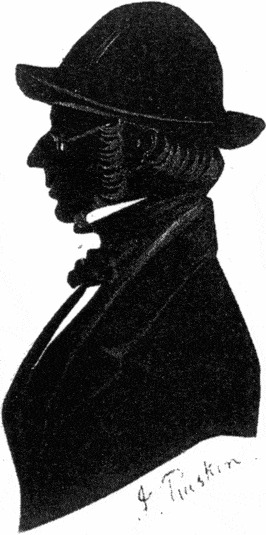
For the next two years Ruskin continued to fret about the intrusion of these specks in his eyes: Back in England, in May 1843, he complained, “If my eyes only would let me alone I should do capitally, but they don't get better” (Diaries 1: 246). And in Switzerland the next year, he protested that the motes interfered with his attempts to draw, a condition made worse by the glare of the Alpine snow: “My eyes were desperately bad too in an attempt to draw, and farther hurt by the immense quantities of snow” (Diaries 1: 279). To alleviate this snow blindness Ruskin had sunglasses made, not only for himself but also for his valet and guide – a practice he had actually already begun when he was a student at Oxford and wore tinted spectacles to protect his eyes from the sun (Figure 4). This practice earned him the nickname of “Giglamps.”Footnote 9
“John Ruskin, c. 1846, by an unknown silhouettist.” Reproduced in James S. Dearden, John Ruskin: A Life in Pictures (Sheffield: Sheffield Academic Press, 1999), 35. Courtesy of Continuum International Publishing Group.

Ruskin's concern about his vision might seem somewhat trivial to readers who think that suffering from motes in the eyes is not only a common but also a harmless and transient problem.Footnote 10 However, if one looks at current literature about “floaters,” optometrists and ophthalmologists are not as sanguine as, perhaps, the general public might think, for the phenomenon can bring about a loss of side vision and also have the effect of causing blurred and distorted sight. They are quick to suggest that any doctor who learns that a patient has multiple floaters should take the symptom seriously, for, as Dr. Joseph W. Sowka and Dr. Alan G. Kabat write, “flashes and floaters may indicate a serious, vision-threatening problem” and can indicate retinal related damage (72). In an article in the Review of Optometry, “How to Make Sense of Flashes and Floaters,” these doctors describe various symptoms and the likely causes for them. It is interesting to note that in one part of their article, they isolate a group of specific symptoms that the young Ruskin speaks of in his letters: the combination of the circles in his eyes, the multiple floaters that dance over his field of vision, some of them large, as well as decreased vision. This set of symptoms, they suggest, is “the typical cause of PVD [posterior vitreous detachment – the technical term for floater] in young patients” (italics mine) and is a condition that is “due to cystoid macular edema” (68).
The emphasis on “young” is important. Articles on the subject all suggest that floaters are usually associated with aging – for the fifty-five-year old and up. However, what is significant about Ruskin's problems is that they were already acute and consistent when he was in his twenties and thirties. The circumstance suggests retinal damage. It is little wonder that both Ruskin and his father took these troubles seriously; that Ruskin felt despondent about them, and spoke of the recurrence in terms of an evil “black serpent” (Bradley 169). Moreover, and much to the point, recent medical opinion suggests that they would have interfered with his sight not only for the reasons given above but also because these floaters and circles are “most noticeable in bright light,” and are “more obvious when looking at a light background like a white wall” (Eye Advisor 2007.2) – hence, Ruskin's particular difficulties in seeing within the context of the bright snow covering the mountain landscape or at the moment when the brilliant sun would strike his eyes as he looked up at the details ornamenting the buildings of Venice.
Motes in the Eyes and Clouds in the Skies
Without pressing the correspondence too far, I want to suggest that the motes floating before and impeding his field of vision have some relation to Ruskin's sense of the way clouds frequently obstructed, barred, and shadowed his view of the mountain peaks and precipices he was studying. I am certainly not implying that these troublesome motes were the reason why Ruskin paid so much attention to the clouds in the landscape. He was, obviously, indebted to a tradition of landscape painting and Romantic poetry that drew the eye and the artist's or poet's concentration to clouds. Indeed, Ruskin's careful study of clouds is obliged to Constable's watercolor studies (with annotations about the precise time and wind direction) that caught the fleeting nature of clouds, and, of course, is also beholden to Turner's work that renders the swirling clouds as an effectual part of a painting's composition. I am, rather, proposing that these motes sometimes contributed to the frustration he experienced when clouds obliterated a mountainous landscape so that he could not adequately catch a peak's governing lines and could not, for the moment, accurately measure the angle of a mountain's sides. In his diaries from his mountain climbing years, Ruskin occasionally hinted at a parallel between these motes and the interrupting clouds. For instance, as if externalizing these particles (these motes) that hampered his sight, Ruskin spoke of the clouds that enveloped him on his way up a mountain near Chamonix by summoning a vocabulary typically associated with descriptions of motes in the eyes: “The cloud was very thick and floated before the eyes in visible particles, like dust” (Diaries 2: 428; italics mine). A day later, because his view was still blocked by the clouds, Ruskin had to content himself with “watching the lines of pine” (Diaries 2: 429). In another entry, he noted that he was “waiting . . . constantly on account of clouds” (Diaries 2: 435). Like the circles and motes in his eyes, these clouds compromised his view of his intended subject. It is interesting to note here that Ruskin knew of the theory that particles of dust, referred to as motes in the air, helped to form the clouds, the rain, and snow on the mountains (see Works 37: 524–25). And, in addition, that these motes created the wonderful blue of the sky. Although he was well aware that there never could be “perfectly moteless air,” he did write, in 1885, to Professor Oliver Lodge, wondering whether such a pure condition could be possible – a query that reflects his lasting frustration with his compromised vision and his discomfort with the notion that such a beautiful color depended upon something as mundane as a speck of dust.
Clouds, of course, were not the only source of interference. Reading through Ruskin's descriptions and diary entries, one becomes increasingly aware of his observations concerning the cleavages, the shadows, and the horizontal strata that cut across and often hinder or obliterate a view of a mountain's curves and precipices as well as of its whole anatomy.
Angles and Daguerreotypes
Compensating for the imperfections of the eye and its susceptibility to deception, Ruskin spent a great deal of his time scrambling among the rocks measuring the angles at which the side of a mountain or a precipice slanted and stood in relation to others. He filled his diaries with extensive lists of these calculations and diagrammatic drawings. It is as if he were realizing his youthful resolve to “make himself master of trigonometry.” In an early letter to his father, he had bragged: “I'll measure em [the mountains], I'll know the height in feet inches and lines, of every crag in the united [sic] Kingdom, . . . see if I don't” (Burd 1: 280). Later, of course, a more mature Ruskin was to do just this in the Swiss and Italian Alps where, on the basis of what he measured, he drew abstract diagrams of mountain forms (Figure 5). His diaries from those years are packed with data and recorded moments when he stopped “to take the angle of the right hand precipice, which had for some half mile back shown its profile in the most magnificent way, overhanging in the blue sky” (Diaries 2: 422).
“The Diary of John Ruskin, 1848–49.” Courtesy of the Ruskin Foundation.

As part of this impulse to counteract his somewhat compromised sight and to get things right, Ruskin, beginning in the 1840s, also occasionally resorted to making Daguerreotypes to correct the details and proportions of his paintings or drawings – Ruskin claims to have made the first image of the Matterhorn as well as the aiguilles of Chamonix “ever drawn by the sun” (Birchell 8).Footnote 11 In 1845, Ruskin commented: “It [the daguerreotype] is a noble invention . . . and any one who has worked and blundered and stammered as I have done for four days, and then seen the things he has been trying to do so long in vain, done perfectly and faultlessly in half a minute, won't abuse it afterwards” (Rabb 119–25). Later in 1849, he spoke of it as being a corrective to the inadequacy of the eyes: “After this I drew at my beautiful place near Les Tines and worked hard for two hours, and did everything wrong; nearly the same in the evening, when I could not draw the aiguilles from my window, and got nervous and uncomfortable. I have this morning put all to rights from Daguerreotype” (Diaries 3: 394). The technique corrected deception: “For fear of being deceived . . . I dageurreotyped the Cervin from the edge of the little lake under the crag of the Riffelhorn” (Works 6: 287). As Smith points out in her study of the complex relationship between Victorian discourse and photography, Ruskin often turned to the photographic medium as an additional referent to counteract “perceptual aberration, for vision gone awry” (Smith 5). The daguerreotype called into question the concept of a faithful transcription of the external world as seen by the imperfect naked eye. For Ruskin it became a necessary appendage of travel, whether, as we have seen, in the mountains, or in Venice: “Daguerreotypes taken in this vivid sunlight are glorious things. It is very nearly the same thing as carrying off the palace itself” (Shapiro 220).
Ruskin, though, was not always so enamored of mechanical aids to vision. Ruskin's attitude toward the daguerreotype fluctuated “according to various aesthetic and social factors” (Smith 10) and, at moments, he rejected and adamantly distrusted its optical mediation. He developed an antipathy toward anything mechanical that replaced the direct engagement of the human eye – even with its imperfections. In 1881, he spoke of photographs as being “horrid things” (Rabb 110–15), and a decade earlier, when giving his lectures as Slade Professor of Art, he pleaded with his audience: “Go and look at the real landscape, and take care of it: do not think you can get the good of it in a black stain portable in a folio” (Works 20: 165). At this point, he had come to think of the photograph as a mechanistic substitute, rather as cast iron is an inferior replacement for sculpture.
The Vulnerable Landscape
Ruskin's acute consciousness of just how susceptible the eye is to weakness found an accomplice in the very mountains he explored. Through his climbing, he quickly learned that it is not only the body and the eye that are vulnerable but also the mountains themselves. The two reinforced each other and contributed to the general sense of a terrible fragility. These massive structures seem to be “everlasting,” but are destructible and brittle; they are continuously “perishing” (Works 6: 176). At one point, Ruskin speaks of the Alpine peaks standing on a plateau like “children set upon a table”; one fears for their falling (Works 6: 207). He is constantly remarking on the fragments that have slipped from or have been hurled by the forces of time from the summits, the avalanches, the watercourses, the sliding snow – the eternal decay – of the mountains: “Their form, as far as human vision can trace it, is one of eternal decay. No retrospection can raise them out of their ruins. . . . No eyes ever ‘saw its substance, yet being imperfect’; its history is a monotone of endurance and destruction: all that we can certainly know of it, is that it was once greater than it is now” (Works 6: 210). His sketches embody the violence of time that continues to sculpt the Alps. They catch the mountain's lines of fall, and reflect, as well, his submission to the imperfect eye.
Fragments, Omission, and the Nature of Seeing
Knowing that it was impossible to see purely (without impediment) or completely, Ruskin eventually came to understand that “nothing is ever seen perfectly, but only by fragments, and under various conditions of obscurity” (Works 15: 120), and that “WE NEVER SEE ANTHING CLEARLY” (Works 6: 75). The latter quotation from “Of Turnerian Mystery” is very much about Ruskin's more general belief that seeing is as much a spiritual act as a physical one; that to see completely is to reflect a knowledge of what lies beyond outward, visible details. To see completely is to possess imaginative insight into the mysterious infinity of things, a gift few artists have: one of these few was, of course, Turner. It is important to note, however, that embedded in the statement that “WE NEVER SEE ANYTHING CLEARLY” is the raw experience of physical sight which Ruskin uses, as a foundation, to explicate this principle. In an earlier version of the passage in “Of Turnerian Mystery,” Ruskin remarks:
Whatever we look at is full of mystery. Everything we look at, be it large or small, near or distant, has an infinite quantity of details still too small to be seen; and the only question is not how much mystery there is, but at what point the mystery begins. For instance, I suppose most people think they can see their own hand clearly. If they do, let them try to count the small furrows, or the lines of the light down which give its texture to the skin, and to trace the course of the fine veins through the shadows of the fingers. You suppose you see the ground under your feet clearly; but if you try to number its grains of dust, you will find that it is as full of confusion and difficulty as the distance; only the confusion on the horizon is of trees and houses, here, of pebbles and dust. (Works 6: 75–76)
It should be emphasized, however, that even though he could continue to wish to see “an infinity quantity of details” and hope for a “perfectly moteless” sky, this reality was not necessarily disheartening, for Ruskin also found pleasure in “seeing only part of things rather than the whole” (Works 6: 73): Frustration dissolves when he marvels at the summits that push through “the rolling clouds” (Diaries 1: 19) and are “bathed in light clouds” (Hayman 141). He is ecstatic when he sees the Dents de Morcles coming “through the solid distant flakes of cumulus clouds” (Diaries 2: 432), and exhilarated when, through a rent in the grey rain, he seizes a glimpse of the Bernese Alps burning “like hot coals” (ms diary 2 July 1866). In these instances there is no attempt on Ruskin's part either to unveil the mists and clouds or to rage against these exaggerated motes in the sky. Such a fragmented display enhances or reveals the nobility and the mystery of his subject.
Significantly, through these incomplete experiences, Ruskin came to understand that “What we call seeing a thing clearly, is only seeing enough of it to make out what it is” (Works 6: 76). Omission is part of seeing; it is a necessary part of the truth – a circumstance that he also recognized in Turner's representation of mountain scenery, when the painter would obliterate certain details in order to capture the veracity of the landscape. In Modern Painters, Ruskin comments that “every one of his [Turner's] compositions [is] evidently dictated by a delight in seeing only part of things rather than the whole, and in casting clouds and mist around them rather than unveiling them” (Works 6: 73).
Ruskin understood that the gatherings of clouds, rather than obscuring his sense of the mountain form, could also paradoxically reveal it. The clouds, clinging to each promontory, expose its outline. In another instance, Ruskin talks about a beautiful morning view of the mountains when the clouds, that had broken into fragments about the Chamonix aiguilles, showed “the whole form [of the crags] through” them, by means of a sort of transparent interruption: “the tops of the crags were all clear; freshly and deeply laden with snow, and dark against the pale morning blue; but each had, blowing from its peaks northward, a fringe of sunny cloud of intense brightness; that on the Charmoz was unbroken, and appeared like a glory” (Diaries 1: 287).
Ruskin realized that too much clarity was unnatural – that it is not possible to draw the whole of nature. To see too clearly is to absorb the viewer in the deadening effect of excess. The more intense the perception, the more things, which one normally would partly see, multiply and baffle the viewer. At one point, while looking at the aiguilles through a cloudless sky – when not a single atom of a cloud was to be found out by the most telescopic eye – he gave up all hope of analysis of the mountains' form. In despair, he “watched the inextricable confusion of the fractures” (Diaries 2: 433). Such seemingly unimpeded sight caught him in too much detail and confused his capacity to see the larger, more abstract pattern. The lack of interruption deterred his ability to find the law.
Ruskin's resistance to absolute clarity is linked to his antipathy to mechanical reproduction – such as the Daguerreotype discussed above. He understood that a mere transcript of a scene has little to do with art and its representation of emotion, impression, mystery, and memory. Ruskin was adamant that although it was important to have a scientific knowledge of a mountain and its anatomy, the act of investigating strata and structure by itself “reduces all mountain sublimity to mere detritus and wall building, so that one looks on a great mountain only as a ‘group of beds’” (Diaries 3: 416). The facts within a transcript do not make Art. There is, obviously, a difference between a topographical representation of a scene and an artistic one. In a topographical picture, “not a line is to be altered, not a stick nor stone removed, not a colour deepened, not a form improved”; it is merely a reflection of a place “in a mirror” (Works 4: 31).
Ruskin's two drawings of “The Pass of Faido” illustrate this principle. The first is simply a topographically correct drawing; the second is an on-the-spot sketch. In the first, all is unnaturally clear; the lines are clean and definitive. No shadow crosses the paper; no cloud blocks the view, no mote interferes. All is stationary, and what Ruskin would call “bad.” (“You will soon begin to understand under what a universal law of obscurity we live, and perceive that all distinct drawing must be bad drawing” [Works 4: 79].) The second sketch, based upon Turner's drawing, admits clouds, mists, patches of obscurity, and it replicates the violent force of the mountain's falling lines as well as the swirls and the toss of the crests in the raging water. Here the eye that understands the anatomy of the scene works with the imperfect, on-the-spot vision that must engage the mists and clouds as they move across the Pass and sculpt the motion of the moment. The topography is brought to life and allowed to admit the frail elements of human sight as well as the vulnerability of landscape itself.
Ruskin seems to have understood that one needs these clouds or exaggerated motes in the sky – these interferences – to function as elements of mediation. These obstacles lead to and leave room for mystery, and they summon memories of similar moments. (Ruskin always thought of Turner's paintings as being a collection of memories, especially those mountain scenes that recalled the mountain scenery of his youth in Yorkshire.) If Ruskin had not moved among the mountains, had not ascended through rough and dangerous territory, and had not exposed his body as well as his eyes to the elements, he would not have understood as thoroughly the necessity of leaving some things out, nor would he have appreciated as much the fragility of the mountains he clambered over and preserved with his fleeting sketches.
Conclusion: Venice and the Mountains
As I have already mentioned in passing, Ruskin's climbing in the Alps seems to have its corollary in his clambering over some of the grand buildings in Venice. In the 1840s and early 1850s, with tape measure in hand, daguerreotype equipment in tow, and with his plaster cast molds, he got himself into danger by recording their dimensions and by carefully studying their architectural details, no matter how high from the ground – awkward maneuvers that caused a stir among some spectators, who followed him around, watched, and then dusted off the powder from his clothes once he had descended.
This correlation between Ruskin's mountain climbing and his ascending ladders and scampering on the roofs of St. Mark's or the Ducal Palace extends significantly beyond the similarity in the physical exertion and skill. The parallel also suggests a corresponding viewpoint – that is to say, the observations Ruskin made while on his climbs in the Alps set a precedent for the way in which he compared, for instance, the tracery of French Gothic buildings to the winding paths and varied slopes in the Alps (Works 8: 89), and, a few months later, affected the way in which he approached Venice.
In the letters written to his father while he was living and studying in Venice from 1851 to 1852, Ruskin often registers his nostalgia for the Alps. Through these passages, one recognizes that even within the context of this splendid and engrossing city, Ruskin still continued to be moved by the “magnificent,” ennobling mountainous landscape he had either just left behind or was about to enter. The mountains are rarely out of view, physically or emotionally. With a painful pleasure, he looks upon the broad expanse of the Bernese Alps that border the horizon as he stands on “the low quay opposite Murano” (Bradley 182) and that, within the wider and deeper perspective, unite with the immediate and compelling sight of the architecture in the foreground. Sometimes the view of these mountains reminds Ruskin of his harder climbing days when he was more vigorous. At these moments his fear that his strength was declining bothers him, especially as he anticipates a trip to Switzerland with his parents: “I do not think I shall ever be able to be a strong climber on the hills – and without that power, the sight of them would sometimes be less pleasure than pain. . . . I do not intend to take any more hard climbs for several years – and when a man is 33, and likely to lie by for several years – it is very possible he many not care to scramble much more” (Bradley 144–45).
It is no accident, then, that, in The Stones of Venice (1851–53), among the passages from Volume I that he claimed to think most highly of are “the little bits about the Matterhorn” (Bradley 141). It is also not surprising that when he first introduced the great city to his reading public, Ruskin, with his excursive eye, positions both himself and his readers at a location from which the distant hills and mountains are visible – as if acknowledging their importance as overseers or guides of his work and his temperament. The Alps circle the horizon and, from afar, help direct his understanding of the structures that rise directly before him. He writes:
at what seemed its northern extremity, the hills of Arqua rose in a dark cluster of purple pyramids, balanced on the bright mirage of the lagoon; two or three smooth surges of inferior hill extended themselves about their roots, and beyond these, beginning with the craggy peaks above Vicenza, the chain of Alps girded the whole horizon to the north – a wall of jagged blue, here and there showing through its clefts a wilderness of misty precipices, fading far back into the recesses of Cadore, and itself rising and breaking away eastward, where the sun struck opposite upon its snow, into mighty fragments of peaked light, standing up behind the barred clouds of evening, one after another, countless, the crown of the Adrian Sea, until the eye turned back from pursuing them, to rest upon the nearer burning of the campaniles of Murano, and on the great city, where it magnified itself along the waves, as the quick silent pacing of the gondola drew nearer and nearer. (124–25)
The eye turns toward Venice after first gazing upon the Alps: the mountains looming on the horizon preface his sight and prefix his understanding of the city. The “chain of Alps,” with their jagged roughness and vulnerability, with their frailty as well as their power, heighten his sensibility to loss and fragmentation in Venice. The view of them intensifies his distress at seeing a once mighty city deteriorate, crumble, or fall prey to misdirected renovations. Consequently, as was his practice while climbing, he responds by hurriedly sketching as many of the remaining fragments as possible over two long winters – before they disappear or elude the eye. He was sketching from one side of the building while the restorers were wrecking the other side. These drawings of the buildings' details and remnants exude the same breathless quality as his mountain “memoranda” – a feature that disturbed Ruskin's father who complained to a friend that in Venice his son was “drawing perpetually . . . fragments of everything from a Cupola to a Cart-Wheel, but in such bits that it is to the common eye a mass of Hieroglyphics” (Works 8: xviii).
To repeat: the eye that looks at the Alps before it regards Venice discovers an analogue between the two landscapes. The geological specimens Ruskin has collected in Chamonix seem to be the very stones that compose the magnificent city and turn St Mark's into “one precious mineralogical cabinet” (31 July 1869 ms. letter to Mother); the sight of St Mark's “entangled among the rainclouds” becomes a “Venetian aiguille Dru [a peak in the Swiss Alps]” (Bradley 54); a fragment of a building in the Alps illustrates a principle of architectural structure (The Stones of Venice 51); the curve or movement of the glaciers he has followed among the Alps sympathizes with and allows Ruskin to mark the abstract lines of ornamentation; and the precipitous, frozen summits of the Alps furnish a vocabulary for describing the structure of roofs or details of windows: a roof is raised into “all manner of peaks, and points, and ridges” (The Stones of Venice 81).
But, most notable of all, the savageness of the mountains and his memories of his sojourns amid their rugged terrain allow him more fully to comprehend the nature of the Gothic. Here is where the Alps most significantly preface his work in Venice and his thoughts about the historical Gothic, especially that emanating from the North and based upon English and French examples. When describing the architecture of the North, Ruskin is conscious of the analogy, and notes that there is a fraternal relationship between the wild mountains and the Gothic edifices. He remarks on: “this wildness of thought, and roughness of work; this look of mountain brotherhood between the cathedral and the Alp, this magnificence of sturdy power, put forth only the more energetically because the fine finger-touch was chilled away by the frosty wind, and the eye dimmed by the moor-mist, or blinded by hail” (The Stones of Venice 164).
I want to suggest that Ruskin surveyed these structures from the perspective of a climber who had experienced the “roughness of work,” and who had suffered severe headaches in the high air – a memory that Ruskin recalls vividly in a February 1852 letter written to his father while working in Venice and worrying about his health and physical exhaustion (Bradley 168). He looked upon these buildings with the memory of his own vulnerable body: with recollections of his hands that during his climbs had fumbled in the frost, and of his sight that had been blinded by mist and sun. It is interesting to note that when Ruskin was still in the process of writing The Stones of Venice, the eye trouble that had often interfered with his mountain studies continued to frustrate his efforts. For instance, in a 24 April 1852 letter to his father, Ruskin complained again of the motes before his eyes: “I was drawing, in the morning, from a high subject at St Marks which made me raise my eyes and let them fall very often – and the black specks tormented me excessively, and I fancied there were more of them coming and was getting despondent about them” (Bradley 258–59). The same month, he worried that he could not look “long enough at anything to fix it in my mind – not even read an inscription of the front of Sta M. Formosa, for want of which” a chapter was difficult to complete (Bradley 253). Both are part of a larger and more universal sense, mentioned earlier, that it is never possible to experience a visual whole, that the act of seeing is necessarily partial and fragmented.
Although there are several other pressing concerns and sources that were of great importance to Ruskin in his vindication of the Gothic in his The Stones of Venice, his own vulnerable body and weak eyes also seem to have played a role in his defense of the workman's achievements, with its imperfections and irregularities. Indeed, Ruskin's condemnation of the English taste for mechanical perfection, his efforts to restore the moral and imaginative to the consciousness of English culture, and his understanding that imperfection is a value recognized and tolerated by Christianity, all assemble and shape his justification of the Gothic. His larger understanding that irregularity is a sign of life as well as a source of beauty, though, is also to some degree indebted to the physical experiences of climbing and living with the interferences chronically impeding his sight. As a result, when he speaks of the irregularities and imperfection in the achievement of the workmen who built the Gothic cathedrals, he is doing so partially within the context of his own vulnerable body, especially his eyes, dimmed by clouds, and interrupted by motes, wind, or shadows. While in the Alps, his blundering efforts to look directly at and represent what surrounded him allow him to empathize with and recognize the value in the workmen's prickly independence and their on-the-spot vision that result in the irregularities of Gothic ornamentation. Their flaws are also Ruskin's. And so is their refusal to mimic convention, their preference for “the true leaves,” and their ability to make fire as real as if it were bursting out of Hades' gate (The Stones of Venice 170).Footnote 12 His celebration of – his relief in seeing – the workmen's imperfections recalls his rejection of purely mechanical, enslaving renditions of mountain landscapes as well as his preference for a painting that admits error as well as its own limitation; he values most those works that are devoted not simply to accuracy but also to the individual imaginative soul that engages the mystery of what lies beyond the visual: “On the whole, very accurate workmanship is to be esteemed a bad sign; and if there is nothing remarkable about the building but its precision, it may be passed at once with contempt” (The Stones of Venice 189). In a 6 June 1852 letter to his father, Ruskin despite his devotion to accuracy and to getting things “perfectly right” admits: “But yet, I am happy to say that a fine drawing, made with feeling – is always worth a great many casts or daguerreotypes – and a first rate one . . . is worth any quantity of them. There is something in it besides the facts . . . a human soul” (Bradley 297).
I suggest that not only the rugged, irregular topography of the mountains themselves but also Ruskin's climbing and his sketching in the Alps did much to impress upon his consciousness the vulnerability of the eye, a circumstance that offered him yet another context for his celebration of the Gothic and his larger defense of irregularity. It seems that Ruskin climbed not only for the thrill of exertion and the rage to collect his geological specimens but also for a perspective that reveals more than a panorama – that also exposes, in spite of the accompanying annoyances and frustrations, the privilege of the imperfect vision, which opens up a space for the imagination and leads one into the spiritual mystery of the landscape.