I. INTRODUCTION
There is presently an extensive interest in reducing the numbers of antennas on communication spacecraft which demands to combine transmit and receive antennas operating at different frequency bands within one dual-band antenna. Reflector antennas are prevalent antenna technology and may operate over a very wide bandwidth. For dual-band antenna, it should be ensured that the reflector is efficiently illuminated by the feed horn across all bands. This requires the horn radiation pattern to exhibit a rotationally symmetric beam with appropriate beam width and a high degree of polarization purity, in this case, over two discrete frequency bands (3.68–3.70 and 5.865–5.915 GHz) of widely separated (bandwidth ratio 1:1.6). The feed should be compact to minimize central feed blockage to the beam reflected from the reflector antenna.
Several investigators [Reference Cowan1–Reference Granet and James7] have developed different types of dual-band horn for diverse applications. Cowan [Reference Cowan1] has developed dual-band circular feed horn with two peripheral chokes for front-fed reflectors having F/D ratios in the range 0.3–0.4 at 11.6/14.2 GHz. A corrugated horn at 11.79/17.69 GHz for offset Cassegrain antenna has been presented by Rao [Reference Rao2]. Grunert and Hazelwood [Reference Grunert and Hazelwood3] designed a wide-angle illumination dual-band feed horn for front-fed, symmetric- and offset-fed reflectors by combining Potter dual-mode horn step and scalar rings. Deguchi et al. [Reference Deguchi, Goto, Tsuji and Shigesawit4] proposed a dual-band serpentine-profiled horn as primary feeds for reflector antennas at 8.6/11.15 GHz. Sotoudeh et al. [Reference Sotoudeh, Kildal, Ingvarson and Skobelev5] introduced a dual-band partly corrugated hard horn consisting of a smooth-walled horn with an attached longitudinally corrugated outer section with abrupt transition between two sections for cluster-fed reflector to obtain multiple beams. Chan and Rao [Reference Chan and Rao6] investigated a dual-band multi-sloped horn at 19.3/29.2 GHz operating with only TE1n modes. Granet and James [Reference Granet and James7] examined a spline-profiled smooth-walled Horn for dual-band at 4/6 GHz for shaped Cassegrain antenna.
In this paper, a new compact dual-band axially corrugated profiled horn feed (DBCPH) is established to achieve aforesaid electrical as well as mechanical objective by a judicious combination of a sinusoid profiled (quasi-conical) section and two internal axial corrugations (internal short-circuited ring slots) section. The DBCPH feed offers simplification in its mechanical design; eases in manufacturing, and retains low weight and compactness which are important considerations for space applications. The DBCPH feed is intended for 0.8 m front-fed prime-focus reflector (focal length = 0.45 m) for satellite antenna application.
II. SYNTHESIS AND REALIZATION OF THE DBCPH
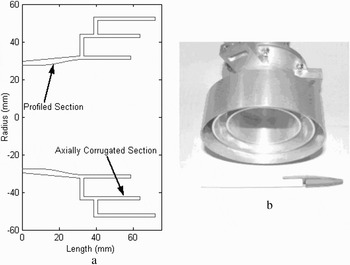
The DBPCH is fabricated by using aluminum alloy 6061T6 with the help of computerized numerically controlled turning machine. Synthesized geometry and photograph of the DBCPH is given in Fig. 1. It consists of two axial corrugations at aperture region, each for uplink and downlink frequency bands, followed by one sinusoidal profiled section at throat region. The profiled section acts as matching section and employed to guide the modes into axial corrugations section. Axially corrugated section controls flaring to the aperture and hence edge taper of the pattern. The input radius of the horn is selected so that only TE11 symmetric mode can propagate at the throat at both operating frequency bands. The aperture radius of the horn is chosen to give required beam width at both bands. The axial corrugations are chosen, so that the innermost and outermost slots are 0.4λ and about 0.25λ deep at the center frequency. The length of the feed is kept equal to the maximum allowable length by design constraint. A lower cross-polar level can be obtained by combining TE11 and TM11 modes in proper ratio and wider co-polar main beam can be produced with addition of appropriate amount of TE12 mode [Reference Sotoudeh, Kildal, Ingvarson and Skobelev5]. In DBCPH, the modes at the aperture are deliberately generated and controlled in a proper ratio of amplitude and phase at two separate uplink and downlink frequency bands utilizing both sections to get the required edge taper at reflector edge and simultaneously low cross-polar level at reflector edge in both bands.
DBCPH: (a) synthesized geometry and (b) photograph of the fabricated horn.

Sinusoid profile [Reference Granet8] has been used extensively, and this profile usually displays good pattern characteristics. Sine profile is given as

where r i, r o, and L are input radius, output radius, and length of the profiled section, respectively. Power of sine p can be smaller or greater than 1. Profiled section gives an additional degree of freedom for impedance control and mode generation to the axially corrugated horn. Different electrical performance objectives can be achieved mainly by optimizing parameters of the profiled section and axially corrugated section. The optimized value of p is 4.2 for DBCPH.
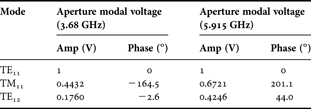
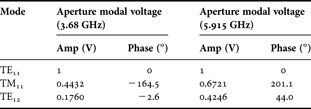
Radiation properties (edge taper, cross-polar level at reflector edge, return loss, etc.) in two discrete uplink and downlink frequency bands are optimized using mode-matching-based software (Mician μWave wizard). “Evolution” optimization technique is used to optimize dimensions of the corrugated section and parameters of the profiled section. At optimized dimensions, higher order modes arrive at the aperture of the horn in proper ratio of amplitude and phase to achieve the performance (given in Table 1).
Aperture modal content of DBCPH.
III. RESULT AND DISCUSSIONS
The return loss of the horn is measured using a vector network analyzer, and radiation pattern and gain is measured in anechoic chamber. Gain transfer method is used for gain measurement using a C-band standard gain horns (Scientific-Atlanta 12–2.60 and Microlab/FxR C638A).
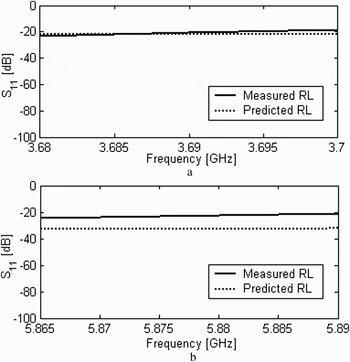
Figure 2 presents measured and predicted return loss of the DBCPH in two frequency bands. The return loss is better than 18.6 dB in both bands. The small deviation between measured and predicted results may be due to the manually optimized co-axial probes, used for excitation.
Predicted and measured return loss versus frequency of the DBCPH for (a) lower frequency band and (b) higher frequency band.

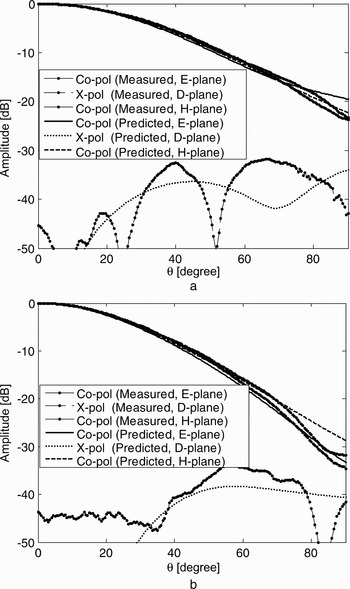
Figure 3 shows measured and predicted co-polar (in inter-cardinal planes) and cross-polar (in diagonal plane) radiation patterns of the DBCPH in two frequency bands.
Measured and predicted radiation patterns of the DBCPH for (a) lower frequency band (at 3.68 GHz) and (b) higher frequency band (at 5.915 GHz).

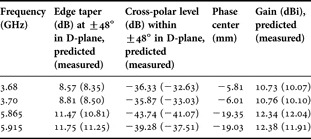
Measured and predicted performances such as edge taper and cross-polar level at half subtended angle (=48°), bore-sight gain, and phase center from the aperture of the DBCPH at edge frequencies of two bands are evaluated and listed in Table 2, which reveal that the DBCPH fulfills the requirements of edge taper at reflector edge (between 8 and 12 dB), return loss (better than 18.6 dB) and low cross-polar level at reflector edge (−32 dB) at both bands. Predicted radiation patterns and properties of the DBCPH are compared with corresponding measured results showing good agreement.
Comparison between measured and predicted performance of DBCPH.

IV. CONCLUSION
A new simplified design of DBCPH suitable for dual-band satellite communication antenna applications has been presented and important aspects in the design of DBCPH feed have been outlined. The characteristics of a fabricated model of the DBCPH have been given to demonstrate the advantages of the design concept. Excellent electrical performance (circularly symmetric beam, return loss >18.5 dB, cross-polar level <− 32 dB, adequate illumination, etc.) in both band and mechanical requirements (compactness, low weight, easy to fabricate, etc.) are achieved with DBCPH. The bandwidth of the horn sections used in this design is limited by the frequency-dependent phasing of different modes. However, wider bandwidth in each frequency band can be achieved by utilizing multiple corrugations in each frequency bands.
ACKNOWLEDGEMENT
The authors are thankful to Editor, IJMWT, reviewers, Dr. R. R. Navalgund, Director, SAC and Mr. A. S. Kiran Kumar, Associate Director, SAC for their supports and valuable suggestions. The fabrication and measurement related advice and contribution of Mr. B. N. Pandya, Mr. C. P. Patel, Mr. Rakesh Shah, Mr. Jidesh, Mr. H. S. Solanki, Mr. Indra Prakash and other colleagues is acknowledged.
 Ramesh Chandra Gupta (SIEEE’2006 to MIEEE’2008) was born in Sultanpur, Uttar Pradesh, India, in 1975. He received the B.E. degree in electronics engineering from Shivaji University, Kolhapur, India, in 2000, the M.E. degree in communication, control, and networking from Rajiv Gandhi Proudyogiki Vishwavidyalaya (University of Technology of Madhya Pradesh), Bhopal, India, in 2002, and the Ph.D. degree in electronics engineering (antenna engineering) from Banaras Hindu University (BHU), Varanasi, India, in 2006. From February 14, 2004 to December 04, 2006, he worked at the Department of Electronics Engineering, Institute of Technology, BHU, Varanasi, India as a Senior Research Fellow (SRF). His biography has published in several editions of Marquis Who's who, USA and International Biographical Centre (IBC), England. He is author of 15 journal papers and 8 conference papers. Dr. Gupta is currently working at Space Applications Centre (SAC), Indian Space Research Organisation (ISRO), Ahmedabad, India as a Scientist/Engineer-SD from January 1, 2009 with responsibility for projects concerned with design and manufacture of horn and feed systems for satellite communications. He has joined SAC, ISRO as a Scientist/Engineer-SC from December 16, 2006. He is also a project engineer for Indian Communication Spacecraft GSAT-10. He is the member of Institution of Electrical and Electronics Engineers (MIEEE), USA from 2008. Dr. Gupta is serving as a technical reviewer for several international journals including the IEEE Transactions on Antennas and Propagation, USA, IET Microwave, Antenna and Propagation, UK, and AEU Int. Jr. of Electronics & Communications, Germany. His current research interests include horn antennas for spacecraft payload.
 Jigar Pandya was born in India in 1974. He has done B.E. in electronics and telecommunications. He joined Space Applications Centre, Ahmedabad in 1998. He has more than 12 years experience in design and development of wide variety of passive waveguide feed components for space and ground segments. This includes various types of OMTs, filters, diplexers and horns for earth stations and space applications. He has published more than seven papers in various conferences proceedings and journals. Presently, he is working as Scientist/Engineer-SF at Satellite Communication Antenna Division, Antenna Systems Group, Space Applications Centre, ISRO, Ahmedabad, India. His current interest includes passive waveguide components for space-borne and ground antennas.
 Khagindra Kumar Sood was born in Sangrur, Punjab, India in 1967. He received his B.E. in electronics and electtrical Communication engineering from Thapar University, Patiala, Punjab, India in 1990. He received his M.E. in 1992 in electronics and communication engineering with specialization in microwave and radar engineering from Indian Institute of Technology-Roorkee (IIT-R) (erstwhile University of Roorkee), Roorkee, Uttaranchal, India. His post-graduate work encompassed a waveguide shunt-slot feed for a microstrip patch antenna and the development of a method-of-moments code for the problem analysis. Since 1992 he has been with the Antenna Systems Group at the Space Applications Centre (SAC) of the Indian Space Research Organization (ISRO) at Ahmedabad, Gujarat, India. Mr. Sood has also been a Guest Scientist at the German Aerospace Centre (DLR) at Oberpfaffenhofen, Bavaria, Germany over the period 1999–2000 where he worked on technologies for active terminal antennas at Ka- and V-bands. At ISRO, he has been involved with the design and development of antennas, feed systems, and associated passive components for spaceborne as well as ground-based applications. His key areas of interest are shaped reflectors, dual-gridded reflectors, multiple-beam antennas, unfurlable antennas, large Cassegrain earth-station antennas and feed horns, OMTs, etc. for these antennas. He has been Deputy Project Director, Communication Payload Antennas for important ISRO communication satellite projects. In this capacity, some of his notable contributions are segmented shaped reflector for enhanced inter-beam isolation for GSAT-4, unfurlable antenna for INSAT-4E and indigenous dual-gridded reflectors for INSAT-4G/GSAT-8. He has published some of his work in Electronics Letters and is an inventor/co-inventor in eight patent applications relating to antennas with high beam isolation, low cross-polarization, and multimode tracking antennas. He is currently the Head of the Satellite Communication Antennas Division within the Antenna Systems Group at SAC. He is responsible for the design and development of antenna systems related to satellite communications, satellite-based navigation, and satellite ground terminal antennas for various applications.
 Rajeev Jyoti received his M.Sc. physics (1984) and M. Tech. microwave electronics (1986) from Delhi University. Since 1987 he is involved in the development of antennas required for satellite communication in Space Applications Centre. Presently, he is Group Head of Antenna Systems Group, SAC, ISRO, India. He has more than 24 years experience in development of space borne and ground antennas in Space Applications Centre, Ahmedabad. He has contributed significantly in design, analysis, and development of microwave antennas namely gridded antenna, multiple beam antennas, and phased array antennas for INSAT/GSAT, RISAT, DMSAR projects. Mr. Rajeev Jyoti is Fellow Member of IETE India, Senior Member of IEEE, USA, and Chair of Joint Chapter of IEEE AP and MTT, Ahmedabad. He has published more than 50 papers in various conferences and referred journals. He has 12 patents to his credit. He was awarded UN ESA Long term fellowship in Antenna & Propagation at ESTEC/ESA Noordwijk.