Introduction
The NINCDS-ADRDA diagnostic criteria for Alzheimer's disease (AD) were published 25 years ago (McKhann et al., Reference McKhann, Drachman, Folstein, Katzman, Price and Stadlan1984) and remain widely used in clinical practice and in research settings. According to these criteria, a diagnosis of probable AD arises in the presence of established dementia accompanied by progressive cognitive deficits affecting memory and at least one other cognitive domain (e.g. language, executive functions), absence of delirium or disturbed consciousness and absence of other causative systemic brain processes. Unclear etiology, presence of deficits affecting a single cognitive domain, and presence of a systemic brain disease capable of producing dementia but not thought to be the cause of the dementia give rise to a diagnosis of possible AD.
Based on neuropathological confirmation, clinical diagnostic accuracy is variable, ranging between 0.75 and 0.95 (e.g. Lim et al., Reference Lim1999), the highest being observed in probable AD cases from specialist dementia clinics. Further, many autopsy series have shown that multiple brain pathologies are a common finding. In other words, a proportion of patients reaching clinical criteria for AD will include other pathological substrates of dementia, for example dementia with Lewy bodies (DLB) or vascular pathology (e.g. Lim et al., Reference Lim1999). In clinic settings, absence of neuropathology makes the NINCDS-ADRDA criteria de facto gold standard.
Since the publication of the clinical criteria for AD, a large body of knowledge has accumulated on the presentation of non-Alzheimer dementia. Vascular dementia and dementia with Lewy bodies (DLB) are the most common forms of dementia in older adults after AD. In dementia patients aged <65 years, frontotemporal dementia (FTD) is as common as AD (Ratnavalli et al., Reference Ratnavalli, Brayne, Dawson and Hodges2002). Together, these dementia types account for the vast majority of dementia cases. Consensus criteria for the clinical and pathological diagnosis of non-Alzheimer dementias have emerged in recent years as greater understanding of their mechanisms has accumulated (Román et al., Reference Román1993; McKeith et al., Reference McKeith1996; Reference McKeith2005; Neary et al., Reference Neary1998; McKhann et al., Reference McKhann, Albert, Grossman, Miller, Dickson and Trojanowski2001). Because the clinical diagnostic criteria for AD and non-AD dementia syndromes share some clinical features, a proportion of patients who meet clinical diagnostic criteria for AD will also meet clinical diagnostic criteria for a second dementia syndrome (or more).
To determine the frequency of non-AD dementia clinical diagnoses in AD, we examined a cohort of community-based patients reaching NINCDS-ADRDA diagnosis for probable or possible AD. This study aimed to assess the overlap of core clinical features used to establish a diagnosis of FTD and DLB in this AD sample, and to examine their underlying pathology. Because of their specific neuropathology and different disease progression, accurate antemortem diagnosis of these disorders is essential, each dementia type likely to require specific disease management and treatment interventions. The study sample represents an ideal AD cohort to assess the practical implementation of subsequently applying clinical diagnostic criteria for other dementia syndromes and to suggest alternative approaches to diagnosis in the presence of mixed clinical presentations.
Methods
Participants and methodology
The recruitment and examination procedures for cases evaluated in this prospective study have been published previously (Broe et al., Reference Broe1990; Henderson et al., Reference Henderson1992). Briefly, newly recognized cases of dementia were recruited through general practitioners over a 2.5-year period between March 1986 and October 1988. All 333 identified cases were assessed by a neurologist using patient and informant histories, comprehensive clinical examination and standardized assessment tools. In-depth cognitive assessment was carried out by a neuropsychologist and blood was sampled for hematological, biochemical and serological evaluation. A brain CT scan was performed in 60% of cases to exclude cerebral tumors and cerebrovascular disease. Cases were excluded if they were unable to speak English, lacked a suitable informant, or had evidence of other known neurodegenerative causes of dementia or non-degenerative brain disease on consensus review. In particular, none of the patients included in the study had received a diagnosis of Parkinson's disease from the neurologist or their physician, and none received L-dopa therapy. Of the 333 cases referred for evaluation, 170 received a diagnosis of AD according to the NINCDS-ADRDA criteria (probable AD = 83; possible AD = 87). Age of disease onset was estimated by the neurologist based on the clinical interview and informant history.
A retrospective chart review was performed by two neurologists with extensive experience in geriatric medicine (HC or GAB) using a checklist of signs and symptoms compiled from the consensus criteria for FTD (Neary et al., Reference Neary1998) and DLB (McKeith et al., Reference McKeith1996) to ascertain the number of cases meeting probable diagnosis for these two diseases. Cases meeting a clinical diagnosis of possible FTD or possible DLB were not included in this study because of limited pathological confirmation of these diagnostic categories.
Diagnosis ascertainment of probable FTD
Because all 170 cases had an insidious onset and gradual progression (core feature A), this core feature was not coded separately. Early decline in social interpersonal conduct (core feature B) and early impairment in regulation of personal conduct (core feature C) could not be distinguished from each other retrospectively. These two core features were therefore combined into one feature measuring impairment of social and/or personal conduct. Emotional blunting (core feature D) and loss of insight (core feature E) were established from the informant histories and the clinical examination. In addition to the three possible core features, presence of 15 supportive features was also ascertained (Neary et al., Reference Neary1998). FTD diagnostic criteria do not provide a hierarchical diagnostic certainty (i.e. probable, possible). As a conservative measure, cases were classified as probable FTD if they exhibited all four core signs plus one or more supportive features.
Diagnosis ascertainment of probable DLB
For the diagnosis of probable DLB, the presence of the core and supporting clinical features was considered (McKeith et al., Reference McKeith1996). Fluctuating cognition (core feature A) was established from the Neurology of Aging and Hachinski scores derived from informant histories (present or absent), as previously reported (Hohl et al., Reference Hohl, Tiraboschi, Hansen, Thal and Corey-Bloom2000). Episodic confused states that resembled delirium or transient periods of reduced or loss of consciousness were also included as part of this feature. Well-formed recurrent visual hallucinations (core feature B) were recorded when reported in the presence of the examiner or when reported by the caregiver. These hallucinations were mostly complex features relating to people, objects and landscapes. Finally, presence of parkinsonism (core feature C) was assessed from the Neurology of Aging. This feature was included if both bradykinesia and rigidity were present, as the degree of nigral degeneration has been shown to correlate directly with the number of extrapyramidal symptoms considered (Londos et al., Reference Londos, Passant, Gustafson and Brun2001). A diagnosis of probable DLB was established when two of the three core features were present in addition to the gradual progression. Testing for two of the suggestive features proposed in the recent revision of the DLB clinical criteria (REM sleep behavior disorder, low dopamine transporter uptake in basal ganglia) (McKeith et al., Reference McKeith2005) was not available.
Interrater reliability between neurologists (HC and GAB) for each core clinical feature of FTD and DLB was very high, despite the potential difficulty with retrospectively identifying the clinical features of DLB (McKeith et al., Reference McKeith, Perry and Perry1999). Agreement between raters was complete with the exception of fluctuating cognition (κ = 0.91); see also McKeith et al. (Reference McKeith, Perry and Perry1999). For cases of disagreement, this clinical feature was considered absent.
Postmortem confirmation
Postmortem examination was performed in accordance with the current neuropathological consensus criteria (Mirra et al., Reference Mirra1991; McKeith et al., Reference McKeith1996; Reference McKeith2005; National Institute on Aging and Reagan Institute, 1997; Harding and Halliday, Reference Harding and Halliday1998; McKhann et al., Reference McKhann, Albert, Grossman, Miller, Dickson and Trojanowski2001; Cairns et al., Reference Cairns2007). Postmortem data were available for 15 probable AD and 12 possible AD cases (16% of the sample). Postmortem investigation was performed using standardized protocols published previously (Halliday et al., Reference Halliday2002) as well as specific immunohistochemical markers for TDP-43 (Cairns et al., Reference Cairns2007), α-synuclein (McKeith et al., Reference McKeith2005), tau and Aβ (Shepherd et al., Reference Shepherd2004). Macroscopic and microscopic features were recorded to determine the presence of AD, DLB, frontotemporal lobar degeneration (FTLD) and vascular pathology. Presence of at least one microscopic pathological feature per field ×200 magnification in multiple regions was necessary for pathological diagnosis.
This study was approved by the South Eastern Sydney Area Health Service, the University of New South Wales, and Sydney South West Area Health Service human ethics committees.
Results
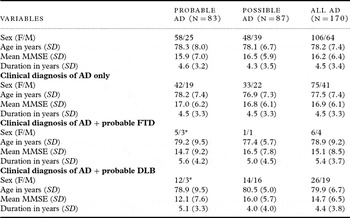
Mean symptom duration in this cohort of 170 AD cases was 4.4 years (SD = 3.4). Importantly, 62% of cases exhibited clinical features for 4 years or less. In this group, the mean symptom duration was 2 ± 1 years (Table 1). No significant differences were observed between possible AD and probable AD cases with respect to MMSE, disease duration, or age (all p > 0.05). Similarly, these variables did not differ significantly between cases with or without autopsy data. Age and disease duration in the AD cases who met clinical diagnostic criteria for a second dementia disorder did not differ from those who did not.
Demographic and Clinical Characteristics of Probable and Possible AD Cases

Note. *Including one case who met clinical diagnostic criteria for both probable FTD and probable DLB.
Prevalence of core clinical signs for FTD in AD cases
Apart from the core signs of insidious onset and gradual progression, which were observed in all cases, prevalence of the core clinical signs for FTD was as follows: disturbance in interpersonal or personal conduct: n = 39 (24%), insight: n = 21 (12%), and emotional blunting: n = 13 (7%). Prevalence of the core features was similar in probable and possible AD cases. Cases with or without a particular core feature did not differ in age, disease duration or MMSE score (all p > 0.05). Among the supportive clinical diagnostic features for FTD, the physical signs of primitive reflexes (81%) and akinesia, rigidity or tremor (78%) were most frequently encountered within this sample. The next most common features were the behavioral disorders of decline in personal hygiene and grooming (54%), perseverative and stereotyped behaviors (32%) and mental rigidity and inflexibility (30%). All other features occurred in fewer than 25% of cases. Mutism was not observed and echolalia and hyperorality were recorded in a single case only.
Prevalence of core clinical signs for DLB in AD cases
The prevalence of the core clinical features for DLB was as follows: spontaneous parkinsonism: n = 70 (41%), fluctuations in cognition: n = 61 (36%), and recurrent visual hallucinations: n = 29 (17%). Fluctuation in cognition was significantly more frequent in possible than in probable AD cases (41/87 vs 20/83; χ2 (1, 168) = 9.13, p = 0.003). In all instances, cases with or without a particular core feature did not differ in age or disease duration (all p > 0.05). MMSE scores, however, were significantly lower in cases diagnosed with fluctuating cognition (15.0 vs 17.1; t(159) = 2.00, p = 0.047) or visual hallucinations (13.3 vs 16.8; t(159) = 2.66, p = 0.008), but not with parkinsonism (15.6 vs 16.7; t(161) = 1.06, p > 0.20) than in those without these features.
Coexisting dementias in probable AD cases
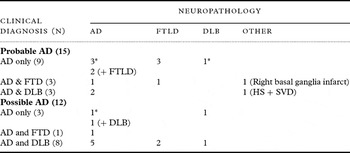
Twenty-three of the 83 probable AD cases (28%) met probable criteria for another dementia. Among these cases, eight (10%) met clinical criteria for probable FTD, and a further 15 (18%) met clinical criteria for probable DLB (Table 1). This included one case who met probable clinical diagnostic criteria for both FTD and DLB. The overlap between AD and FTD diagnoses was due primarily to the presence of impaired social and/or personal conduct, while overlap between AD and DLB diagnoses was due to the presence of parkinsonism early in the course of the disease. Of the 15 probable AD cases with autopsy data (Table 2), eight had pathologically confirmed AD. Six cases showed FTLD (five with Pick pathology and one with TDP-43 inclusions), two of these with coexisting AD pathology. Two cases exhibited cerebrovascular disease and one showed pathological DLB.
Neuropathology according to clinical diagnostic criteria classification

FTLD = frontotemporal lobar degeneration; HS = hippocampal sclerosis; SVD = small vessel disease; * = includes 1 case with TDP-43 positive inclusions.
Concordance between clinical and pathological diagnosis was variable. Of the nine cases diagnosed with probable AD only, only five cases exhibited AD pathology: two with co-existing Pick pathology and one with overlapping TDP-43 inclusions. Of the remaining four cases, three had Pick pathology and one had DLB pathology. Among the six cases fulfilling clinical diagnostic criteria for a second dementia syndrome, only three were found to have AD pathology and no case showed multiple pathologies (Table 2). Interestingly, the converse was also true: of the three cases meeting diagnosis for both probable AD and FTD, only one showed FTLD pathology only at autopsy, whereas none of the three cases meeting diagnostic criteria for both probable AD and DLB exhibited DLB pathology. Overall, this cohort with probable AD showed lower confirmation of pathological AD and pathological DLB than previous studies (e.g. Lim et al., Reference Lim1999), and a high prevalence of pathological FTLD.
Coexisting dementias in possible AD cases
Of the 87 possible AD cases, 32 (37%) met probable criteria for another dementia. Probable FTD was uncommon (n = 2) but probable DLB was very common in this setting (n = 30, Table 1). The considerable overlap between AD and DLB diagnoses was again due primarily to the presence of parkinsonism early in the course of the disease.
Eight of the 12 possible AD cases with autopsy data exhibited AD pathology. In six cases, AD was the sole pathology, one had additional TDP-43 inclusions and one had co-existing DLB pathology (Table 2). Of the four cases without AD pathology, two showed TDP-43 inclusions and two DLB pathology, consistent with these diseases’ clinical prevalence. Cerebral infarcts subsequent to recruitment occurred in six cases, contributing to early deaths. Among the possible AD cases meeting clinical criteria for a second dementia syndrome, concordance between clinical diagnosis and pathological findings was again variable. The single case that also met clinical criteria for FTD showed AD pathology. Of the eight cases meeting both possible AD and DLB clinical diagnosis, only one had DLB pathology, two cases had FTLD pathology and five cases showed AD pathology. No cases had multiple pathologies.
Discussion
In a sample of 170 well-characterized, clinically diagnosed AD cases enrolled prospectively, about one third of participants (n = 54) reached clinical criteria for a second clinical syndrome: either probable FTD or probable DLB. Consistent with previous community-based studies (Stevens et al., Reference Stevens, Livingston, Kitchen, Manela, Walker and Katona2002), many of these clinical AD cases had two neurodegenerative pathologies. Importantly, however, little clinical or pathological overlap existed between FTD and DLB, contrasting with their respective clinical overlap with AD. This finding indicates that concurrent DLB and FTLD pathology in AD cases is rare but that either disease will coexist with AD in a significant proportion of cases. This study confirms that the sensitivity and specificity of the NINCDS-ADRDA diagnostic criteria for AD remain suboptimal and underlines the importance of considering the presence of multiple conditions when establishing a diagnosis of AD.
Probable FTD in AD population
In this study, 10% of probable AD cases also met clinical criteria for probable FTD. Of the 15 probable AD cases coming to autopsy, six of these had FTLD pathology. Clinically indistinguishable from the other probable AD cases in this cohort, these cases are likely to have a similar pattern of brain dysfunction caused by a different pathological substrate. No possible AD cases had FTLD pathology. This finding is consistent with the approximately 10% of FTLD patients who have prominent memory deficits as their presenting feature (Graham et al., Reference Graham2005). The recent revision of the NINCDS-ADRDA criteria for AD, which aims to improve diagnostic accuracy and specificity, has highlighted this problem (Dubois et al., Reference Dubois2007). However, the recommendations to incorporate biomarkers in the diagnosis (e.g. evidence of medial temporal lobe atrophy, abnormal brain metabolism, abnormal CSF or presence of genetic mutation) in addition to the pattern and severity of clinical features, may resolve this issue only in part: genetic mutations remain relatively rare and will assist diagnosis in only a small number of cases (currently about 10%). In addition, medial temporal lobe atrophy is observed in non-AD dementia populations (Kril et al., Reference Kril, Macdonald, Patel, Png and Halliday2005). A temporal lobe distribution of FTLD pathology has been identified recently (Amador-Ortiz et al., Reference Amador-Ortiz2007) and may represent this clinical population. Repeat clinical examination supported by brain MRI, which is now available in many clinical settings, ought to become the approach of choice to clarify the clinical picture and improve diagnostic accuracy. MR has the advantage over CT scan to allow the acquisition of high-resolution images in the coronal plane, an orientation more appropriate to visualize brain structures of interest (e.g. hippocampus). With disease progression, the clinical profile and structural brain changes are likely to become increasingly different across patient populations.
Clinical diagnostic criteria for FTD will also require further refinement in order to increase diagnostic specificity. In the present study, decline in social interpersonal conduct and/or impairment of personal conduct were observed in almost a quarter of AD cases. The other core features of emotional blunting and impaired insight were less frequently encountered (8% and 12%, respectively). Retrospective studies of FTD series have found that the core clinical features considered necessary for a diagnosis of FTD were not evenly represented at presentation (Piguet et al., Reference Piguet, Hornberger, Shelley, Kipps and Hodges2009), and were also found in AD (e.g. impaired insight in 56% of AD patients)(Rosen et al., Reference Rosen2002). Supporting clinical features for FTD were also variably represented. In our sample, motor signs (akinesia, rigidity or tremor) and a disorder of social conduct were very common, unlike hyperorality, which was recorded in only one patient. The diagnostic value of many of these features remains to be established.
Probable DLB in AD population
Over a quarter of AD cases met clinical diagnostic criteria for probable DLB. The considerable overlap between these clinical disorders was due to the high prevalence of parkinsonism. Importantly, the parkinsonian signs were not considered of sufficient severity to support a clinical diagnosis of Parkinson's disease. While this finding may be surprising to clinicians, it is consistent with much of the literature (e.g. Funkenstein et al., Reference Funkenstein1993) which confirms that early signs of spontaneous parkinsonism are not uncommon in AD and can be observed with careful neurological examination. Previous studies involving patients from memory or movement disorder clinics have clearly shown that early spontaneous parkinsonism in AD is associated with the greatest rate of false-positive clinical diagnosis of DLB (Hohl et al., Reference Hohl, Tiraboschi, Hansen, Thal and Corey-Bloom2000; Lopez et al., Reference Lopez2002). Our data from a community population further highlight this problem and suggest that when cases fulfill clinical criteria for AD, the diagnostic criteria for DLB need to be modified with reduced weight given to the core feature of parkinsonism. Further, similar to AD cases also meeting clinical criteria for probable FTD, repeat assessment is again likely to improve diagnostic accuracy.
Neuropathology in probable and possible AD
Our results revealed a low autopsy confirmation of AD and a high rate of FTLD pathology. The rate of DLB pathology in cases with a clinical diagnosis of probable AD was also lower than previously reported. In addition, neuropathological concordance in cases meeting clinical diagnosis for a second dementia syndrome was also low. In this study, AD pathology was determined using the National Institute of Aging-Reagan Institute (NIA-Reagan) (1997) criteria. Unlike the CERAD criteria, which measure the density of cortical plaques (Mirra et al., Reference Mirra1991), the NIA-Reagan criteria not only assess the presence of neuritic plaques but also that of neurofibrillary tangles using Braak staging (Braak and Braak, Reference Braak and Braak1996), resulting in fewer cases with coincidental pathologies in appropriate brain regions. The application of these pathological criteria using type, anatomical region and threshold density of lesions most likely contributed to the lower confirmation of AD in this sample than that reported in previous studies.
Probable AD is meant to reflect greater likelihood of diagnostic accuracy than possible AD. This clinical diagnosis is also thought to exclude other major pathologies associated with dementia. In our cohort, probable AD cases which met clinical diagnostic criteria for a second dementia were as likely to have AD as non-AD pathology. Recent studies have demonstrated that a proportion of patients with a clinical diagnosis of AD will have FTLD, either in isolation (>10%; Graham et al., Reference Graham2005) or in association with AD pathology (>20% of cases with AD; Amador-Ortiz et al., Reference Amador-Ortiz2007). Unlike current pathological criteria for DLB and AD, the criteria for FTLD (Cairns et al., Reference Cairns2007) do not specify the minimum pathology necessary to meet diagnosis, although the severity of pathology is likely to be particularly relevant in cases with co-existing diseases. For the present study, we used similar semi-quantitative lesion densities to establish FTLD and DLB lesions. Without such grading, a greater number of AD cases would have been considered to have co-existing pathologies. Because pathological criteria for both syndromes are relatively new (latest for FTLD published in 2007 (Cairns et al., Reference Cairns2007), and for DLB published in 2005 (McKeith et al., Reference McKeith2005)), the value of this method of measuring lesion density needs prospective validation.
A diagnosis of possible AD, as the name implies, is less certain than that of probable AD. Our investigations, however, confirmed that AD pathology was as likely in cases of possible AD as in probable AD (see also Lopez et al., Reference Lopez2002). In addition, we showed that when a second pathological process was detected in possible AD cases, it was more likely to be Lewy body pathology than FTLD. Even in the presence of co-existing early spontaneous parkinsonism, as reported in many AD cases, a large proportion of this group is likely to show AD pathology predominantly, whether DLB pathology is present or not. To address this difficulty, the recent pathological criteria for DLB exclude cases with AD pathology (McKeith et al., Reference McKeith2005).
Strengths and limitations of the study
Clinically, participants in this study had typical AD and were enrolled using strict exclusion criteria to eliminate non-neurodegenerative conditions. This cohort was selected because of the absence of sampling bias in the recruitment, the relatively early referral for study after symptom onset, and the detailed clinical examinations and histories (Broe et al., Reference Broe1990; Henderson et al., Reference Henderson1992). The clinical tools used to ascertain the presence of FTD and DLB symptoms retrospectively were modified slightly to facilitate use and increase interrater reliability between the two experienced clinicians. These criteria captured the main core features diagnostic for FTD and DLB syndromes. Arguably, because participants’ recruitment preceded the widespread acceptance of non-AD dementia syndromes, the quality of the clinical information available used to establish FTD and DLB diagnoses may have been affected. It is therefore possible that our results underestimate the clinical overlap between AD and FTD, and between AD and DLB when using existing clinical criteria, rather than the opposite. This, however, does not change the pathological overlap.
Although the consent rate for autopsy was low, it is similar to other prospective studies of this type (e.g. 8% in DLB study; Lopez et al., Reference Lopez2002). The cases consenting to autopsy did not differ from the total sample in age, disease duration or MMSE score. The clear advantage of this study design is its close resemblance to a clinic population and its inclusion of cases with co-existing disease(s). In many autopsy studies, cases are selected with a single disease (e.g. AD, FTLD or DLB) and cases with multiple pathologies excluded. The presence of two or more diseases is an important yet undervalued consideration in clinical practice, especially in older individuals.
Conclusions
This study confirms that a significant proportion of AD cases identified using strict clinical diagnostic criteria will also meet clinical criteria for another dementia syndrome and will show non-AD pathology. While overlap between AD and DLB clinically has been previously reported, our results demonstrate that overlap between AD and FTD is also common. The suggestion by Lopez and colleagues (Reference Lopez2002) that the NINCDS-ADRDA criteria should be followed by the hierarchical use of other clinical criteria (DLB and/or FTD) for more accurate diagnosis has considerable merit. We suggest that improvement in diagnostic specificity will be achieved with repeated clinical examinations accompanied by MR T1-weighted brain images acquired in the coronal plane. These images will allow detailed examination of changes over time in regions of interest such as the medial temporal lobe and prefrontal cortex, which may be critical in differentiating AD from non-AD pathology. In recent years, attempts have been made to improve the clinical diagnosis of AD and FTD with mixed results (Mendez et al., Reference Mendez, Cherrier, Perryman, Pachana, Miller and Cummings1996). This evidence, along with our findings, demonstrates that the need to revisit clinical diagnostic criteria for the major dementia syndromes remains.
Conflict of interest
None.
Description of authors’ roles
O. Piguet was responsible for data analysis and for writing the manuscript. G. M. Halliday and J. J. Kril conducted the neuropathological investigations and assisted with manuscript revision. H. Creasey and G. A. Broe conducted the review of clinical cases and diagnosis allocation, and assisted with manuscript revision.
Acknowledgments
This work was supported by Australian National Health and Medical Research Council (NHMRC) project grants nos. 153843 and 301964. OP is an NHMRC Fellow (Clinical Career Development Award). GMH is a Principal Research Fellow of the NHMRC. Initial clinical interviews were performed in part by Dr Elizabeth McCusker and the authors acknowledge her contribution.