Introduction
Methicillin-resistant Staphylococcus aureus (MRSA) has been a persistent bacterial mutation present since methicillin was introduced in 1960. However, due to its increased prevalence in recent years, it is now a significant pathogen in nosocomial and community-acquired infections.Reference Vos and Verbrugh1 The morbidity and mortality associated with MRSA can be as high as 60 per cent,Reference Luzar, Coles, Faller, Slingeneyer, Dah and Briat2, Reference Kluytmans, van Belkum and Verbrugh3 due to the limited options for antimicrobial treatment.Reference Armstrong-Esther4
Staphylococcus aureus is the most commonly cultured organism from nasal swabs.Reference Williams5 Strangely, it appears possible to eliminate S aureus from other sites in the body when the nares are treated topically.Reference Reagan, Doebbeling, Pfaller, Sheetz, Houston and Hollis6, Reference Parras, Guerrero, Bouza, Blazquez, Moreno and Menarguez7 Although some individuals are never colonised,Reference Williams5 a variable proportion of the population (between 5 and 60 per cent) intermittently harbour methicillin-sensitive S aureus in the nose.Reference Asensio, Canton, Vaque, Rossello, Calbo and Garcia-Caballero8–Reference Tiemersma, Bronzwaer, Lyytikainen, Degener, Schrijnemakers and Bruinsma11 When persistently present, this strain appears to protect against colonisation by other strains of S aureus.Reference Noble, Williams, Jevons and Shooter12 Unfortunately, broad-spectrum antibiotics allow MRSA to displace methicillin-sensitive S aureus and thus to colonise the nares.Reference Kluytmans, van Belkum and Verbrugh3 A recent Cochrane reviewReference Loeb, Main, Walker-Dilks and Eady13 and national guidelines publicationReference Coia, Duckworth, Edwards, Farrington, Fry and Humphreys14 both found insufficient evidence to support the use of topical or systemic antimicrobial therapy for eradicating nasal or extra-nasal MRSA, although such treatment has reportedly been successful in a recent study based in a nursing home.Reference Mody, Kauffman, McNeill, Galecki and Bradley15
It is assumed that most MRSA infections derive from nasal carriage,Reference Luzar, Coles, Faller, Slingeneyer, Dah and Briat2, Reference Kluytmans, van Belkum and Verbrugh3, Reference Yu, Goetz, Wagener, Smith, Rihs and Hanchett16–Reference von Eiff, Becker, Machka, Stammer and Peters18 particularly in ventilated patients,Reference Corne, Marchandin, Jonquet, Campos and Banuls19 with the nose acting as the primary ecological reservoir of S aureus in humans.Reference Moss, Squire and Topley20 However, the incidence of nasal carriage of MRSA in intensive therapy units varies between 4.2 per cent on admissionReference Troche, Joly, Guibert and Zazzo21 to more than 20 per cent after an average stay, Reference Orsi, Raponi, Franchi, Rocco, Mancini and Venditti22 especially in immunocompromised patients.Reference Nguyen, Kauffman, Goodman, Squier, Arbeit and Singh17
The role of MRSA as a nasal pathogen is not yet clear. Some studies show an increase in conditions such as MRSA sinusitis.Reference Gerencer23 However, it has not been fully clarified whether patients can carry MRSA in the nasal vestibule without the organism showing any definite pathogenic role in concurrent nasal infections. A recent review of the existing literature would suggest that the current evidence for this is weak.Reference Sharma, Philpott, Pope and McKiernan24
The aim of this study was to determine the incidence of MRSA infection in the peri-operative course of patients undergoing rhinological surgery.
Methods
For the purposes of the study, we included for analysis all adult patients who had undergone elective nasal surgery at the West Suffolk Hospital between 1 November 2004 and 31 October 2005. A list of patients was obtained from the surgical theatre reception office. We included all cases coded as ENT procedures, but omitted procedures categorised as ‘unknown specialty’. It should also be noted that this list did not include patients attending the day surgery unit for nasal procedures, as this information was not readily available. We recorded patients’ demographic data and the procedure performed, along with the result of the pre-operative MRSA screening. Finally, we also recorded the results of any intra-operative or post-operative nasal swabs taken when intranasal mucopus was identified.
Results
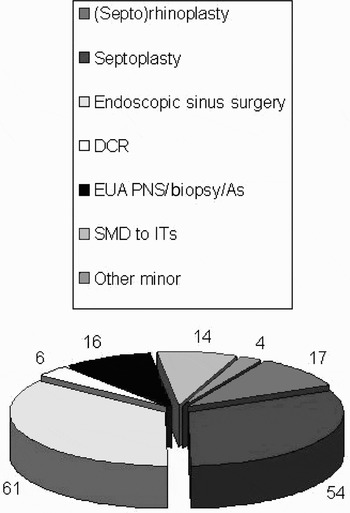
One hundred and fifty-one adult patients were eligible for inclusion in the study (one patient underwent two procedures during the study period). Ninety-six male and 54 female patients were included, with an age range of 16–87 years and a mean age of 51 years. The procedures undertaken are illustrated in Figure 1 (note that some patients had more than one of these procedures at the same time). None of the patients were found to be MRSA positive, although 62 did not have routine MRSA screening performed. Seven sets of notes were unavailable for examination, but these patients’ microbiology results were available on the hospital pathology database.
Procedures undergone by study patients (some patients had more than one procedure). DCR = dacryocystorhinostomy; EUA PNS = examination under anaesthesia (post-nasal space); As = adenoidectomy; SMD = submucous diathermy; ITs = inferior turbinates

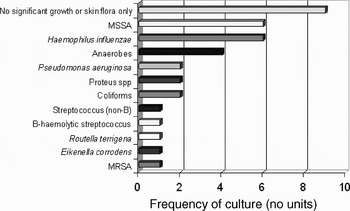
Nasal swabs results were available for 25 patients, in whom purulence was observed peri-operatively or infection suspected. These results were from either middle meatal swabs or antral aspirates, taken either at the time of endoscopic sinus surgery or other nasal procedure, or in the out-patient clinic. Of these samples, only one grew MRSA – a middle meatal swab from a patient undergoing endoscopic sinus surgery, who had not been MRSA positive pre-operatively. Furthermore, this patient did not require any specific antimicrobial treatment for MRSA, suggesting colonisation rather than infection. The other results showed a mixture of organisms, with methicillin-sensitive S aureus and Haemophilus influenzae being the most common species found (see Figure 2). We found a 5 per cent rate of MRSA detection within those patients deemed to have an infective process within the nose or sinuses.
Bacteriological findings for peri-operative middle meatal and antral swabs. MSSA = methicillin-sensitive Staphylococcus aureus; MRSA = methicillin-resistant S aureus

Discussion
This study demonstrated only one case of MRSA ‘infection’ amongst those patients attending for in-patient nasal surgery, suggesting that this strain has a negligible role as a rhinological pathogen. We also detected a nil carriage rate, suggesting a discordance with published carrier rates of up to 20 per cent or more, as outlined above. However the 5% detection rate in peri-operative swabs does tally with a recent study of pathogens in acute rhinosinusitis,Reference Huang and Hung25 albeit compared with a relatively small pool of patients in our study. This may suggest that MRSA is not a commensal of the middle meati but only of the nares. Its presence in the meatal region may suggest pathogenicity, but how any pathogenic potential is determined in these patients is still unclear.Reference Wertheim, Melles, Vos, van Leeuwen, van Belkum and Verbrugh26 However, previous nasal surgery may be a risk factor at subsequent screeningsReference Gerencer23 and has been shown elsewhere to be a factor in post-endoscopic sinus surgery ‘sinusitis’.Reference Gerencer23, Reference Jiang, Jang and Hsu27 Gerencer, however, admits that the ‘MRSA sinusitis’ findings reported may simply represent colonisation rather than frank infection.Reference Gerencer23 This study also demonstrates high sensitivity of the MRSA isolates to tetracycline, rifampicin, gentamicin, trimethoprim and vancomycin.
• Methicillin-resistant Staphylococcus aureus (MRSA) infections are becoming an increasing problem in clinical practice
• The link with symptomatic sino-nasal infection has not previously been quantified
• This study investigated 151 patients undergoing endonasal surgery. All patients had pre-operative nasal swabs taken
• Only one middle meatal swab contained MRSA. No patients had MRSA detected on pre-operative screening. Haemophilus influenzae was the most common organism detected
• Methicillin-resistant S aureus infection does not represent a significant source of morbidity in the authors’ clinical rhinological practice
Other studies of paranasal sinus bacteriology have also found H influenzae to be a common isolate,Reference Jiang, Hsu and Jang28 and have found S aureus to be present intra-nasally at greater rates (as much as 71 per cent) than found in the present study.Reference Biel, Brown, Levinson, Garvis, Paisner and Sigel29–Reference Damm, Quante, Jurk and Sauer36 The S aureus detected has often been considered as normal flora or a contaminant. A recent study on the effects of septoplasty on the nasal flora found that 16 per cent of patients had coagulase negative S aureus cultured post-operatively;Reference Eviatar, Kessler, Segal, Vaiman and Kalmovich37 again, this would appear to represent colonisation only. Other reported findings suggest that chronic rhinosinusitis (CRS) patients have coagulase negative Staphylococcus aureus carriage rates of between 17 and 25 per cent.Reference Suzuki, Nishimura and Baba38, Reference Damm, Quante, Jurk and Sauer39 (Middle meatal swabs would appear to be equally as valid as antral aspirates for determining the microbiological population of the maxillary antrum.)Reference Brook, Frazier and Foote30, Reference Vaidya, Chow, Stankiewicz, Young and Mathews40, Reference Dubin, Ebert, Coffey, Melroy, Sonnenburg and Senior41 Other organisms grown readily from nasal swabs and mucosal specimens include Citrobacter diversus, Streptococcus viridans and Staphylococcus epidermidis.Reference Jiang, Hsu and Jang28 It has been suggested that organisms resistant to penicillin may play a role in shielding other susceptible organisms from antibiotic therapy.Reference Brook42
Conclusion
In our practice, MRSA did not appear to play a significant role in any peri-operative sino-nasal infections.
Acknowledgements
We thank Dr Rebecca Tilley, Department of Microbiology, West Suffolk Hospital, UK.