Introduction
Neuropsychological tests are valid but imperfect predictors of everyday functioning (e.g., Barker-Collo & Feigin, Reference Barker-Collo and Feigin2006; Boyle, Cohen, Paul, Moser, & Gordon, Reference Boyle, Cohen, Paul, Moser and Gordon2002; Farias et al., Reference Farias, Cahn-Weiner, Harvey, Reed, Mungas, Kramer and Chui2009). They measure abilities that presumably are important across a variety of functional tasks. Use of neuropsychological tests as an approximation for functional abilities is efficient and generally accurate, especially considering that it is impossible to directly measure every behavior associated with independent living or working. The predictive validity of neuropsychological tests has been studied extensively (Barker-Collo et al., Reference Barker-Collo and Feigin2006; Marcotte & Grant, Reference Marcotte and Grant2010; Sbordone & Long, Reference Sbordone and Long1996). Unfortunately, the association between neuropsychological abilities and everyday functioning has relied largely on questionnaires of activities of daily living (ADL) such as the Lawton and Brody (Lawton & Brody, Reference Lawton and Brody1969) or the Functional Activities Questionnaire (Jette et al., Reference Jette, Davies, Cleary, Calkins, Rubenstein, Fink and Delbanco1986). Performance-based assessment of everyday functioning is studied far less frequently than questionnaire-based methods. There are only a few investigations in the stroke population that assess instrumental activities of daily living (IADLs) through performance-based assessment (Bernspång & Fisher, Reference Bernspång and Fisher1995; Buxbaum, Schwartz, & Montgomery, Reference Buxbaum, Schwartz and Montgomery1998; Corbett, Jefferies, & Lambon Ralph, Reference Corbett, Jefferies and Lambon Ralph2009; Kangas & Tate, Reference Kangas and Tate2006; Schwartz et al., Reference Schwartz, Buxbaum, Montgomery, Fitzpatrick-DeSalme, Hart, Ferraro and Coslett1999; Shih, Rogers, & Holm, Reference Shih, Rogers and Holm2009), and existing performance-based assessments are limited in the range of behaviors they evaluate.
Performance-based assessment of IADLs is important because interviews and questionnaires are prone to error from several sources. Self-report is often inaccurate, especially as the severity of impairment increases and when aphasia or anosognosia is present. Informant report can vary in accuracy depending on the closeness of the informant to the patient and on the presence of cognitive impairment in the informant (Dassel & Schmitt, Reference Dassel and Schmitt2008; Demers, Oremus, Perrault, Champoux, & Wolfson, Reference Demers, Oremus, Perrault, Champoux and Wolfson2000; Ready, Ott, & Grace, Reference Ready, Ott and Grace2004; Sikkes, de Lange-de Klerk, Pijnenburg, Scheltens, & Uitdehaag, Reference Sikkes, de Lange-de Klerk, Pijnenburg, Scheltens and Uitdehaag2008). There is little research on the quality of the most common questionnaires, and the existing research reveals significant problems with the scales (Sikkes et al., Reference Sikkes, de Lange-de Klerk, Pijnenburg, Scheltens and Uitdehaag2008). From a sampling perspective, if there is no caregiver present, then the patient is often excluded from studies of everyday functioning. This can result in biased sampling that excludes single persons and over-samples married couples. Performance-based measures do not require a caregiver or informant, thus making them appropriate for use with any individual.
In contrast to the limited research on performance-based assessment of IADLs in stroke, traditional neuropsychological measures have been extensively investigated in stroke (e.g., Festa, Lazar, & Marshall, Reference Festa, Lazar and Marshall2008; Lezak, Howieson, & Loring, Reference Lezak, Howieson and Loring2004; Mitrushina, Boone, Razani, & D'Elia, Reference Mitrushina, Boone, Razani and D'Elia2005; Strauss, Sherman, & Spreen, Reference Strauss, Sherman and Spreen2002). The Neuropsychological Assessment Battery (NAB; Stern & White, Reference Stern and White2003) is a relatively new comprehensive test battery that, aside from the small clinical samples presented in the technical manual, has only one published study across all five NAB modules in a stroke sample (Stricker, Tyber, Sadek, & Haaland, Reference Stricker, Tyber, Sadek and Haaland2010). The NAB covers five cognitive domains: Attention, Language, Memory, Spatial, and Executive Functions. We are aware of only two studies examining the NAB's association with functional skills, and neither used the entire NAB.
One study (Temple et al., Reference Temple, Zgaljardic, Abreu, Seale, Ostir and Ottenbacher2009) in a traumatic brain injury sample found that the NAB screening module, which is an abbreviated version covering the five domains, correlated with the Functional Impairment Measure, a clinician-rating of functioning, above and beyond the effects of age and sex (adjusted R2△ 0.26; p < .0001). A second study correlated the NAB driving scenes subtest with a standardized on-road driving evaluation in a mild dementia sample (r = .55; Brown et al., Reference Brown, Stern, Cahn-Weiner, Rogers, Messer, Lannon and Ott2005). There are no existing data on the predictive validity of the full NAB with everyday functioning.
In the present study we use the Functional Impact Assessment (FIA), which is a performance-based assessment of everyday functioning (Heaton, Miller, et al., Reference Heaton, Miller, Taylor and Grant2004). The FIA is a combination of existing instruments with newly developed tests that were added to increase the number of measured IADLs and to increase the range of scores to avoid ceiling effects. Several parts of the FIA have established validity and reliability, including the medication management test (Albert et al., Reference Albert, Weber, Todak, Polanco, Clouse, McElhiney and Marder1999) and the Direct Assessment of Functioning (finances, shopping, and communication subtests; Loewenstein & Bates, Reference Loewenstein and Bates1992; Loewenstein et al., Reference Loewenstein, Amigo, Duara, Guterman, Hurwitz, Berkowitz and Eisdorfer1989). The initial study by Heaton and colleagues (Heaton, Marcotte, et al., Reference Heaton, Marcotte, Mindt, Sadek, Moore and Bentley2004) established that the FIA is sensitive to functional deficits in an HIV-infected sample with cognitive impairment, including on the newly designed subtests of financial management and cooking. The original 2004 paper provided evidence that, in a younger neuropsychologically impaired sample, worse performance on the FIA was associated with unemployment, cognitive complaints, self-reported IADL decline, and degree of neuropsychological impairment.
Our group has provided additional data on the FIA's sensitivity to impairment associated with dementia (Karver, Teshiba, Haaland, Adair, & Sadek, Reference Karver, Teshiba, Haaland, Adair and Sadek2008; Sadek, Haaland, Adair, Teshiba, & Karver, Reference Sadek, Haaland, Adair, Teshiba and Karver2010; Teshiba, Haaland, Adair, & Sadek, Reference Teshiba, Haaland, Adair and Sadek2008). The data presented by Karver and colleagues supports that the FIA is associated with traditional neuropsychological measures of learning (Spearman's ρ = .73), memory (ρ = .62), speed of information processing (ρ = .83), and language (ρ = .74) in a sample of twenty patients with either vascular or Alzheimer's dementia (Karver et al., Reference Karver, Teshiba, Haaland, Adair and Sadek2008). In the same sample, Teshiba and colleagues presented data showing that the FIA is correlated with both informant and patient report of functional deficits using the Dementia Deficits Scale (Snow et al., Reference Snow, Norris, Doody, Molinari, Orengo and Kunik2004), with stronger correlations between the FIA and the informant report (ρ = −.75) than with the patient report (ρ = −.51). Finally, in the dementia sample the FIA correlated with the MMSE, r = .84 (Sadek et al., Reference Sadek, Haaland, Adair, Teshiba and Karver2010). Between the study by Heaton et al. (Reference Heaton, Miller, Taylor and Grant2004) and our recent studies, there is evidence for construct validity in that the FIA is highly correlated with traditional measures of functional impairment and is consistently lower in patients with neuropsychological impairment.
The goals of the current study were to determine if this new performance-based assessment of everyday functioning—the FIA—is sensitive to the presence of unilateral stroke, and whether a new neuropsychological test battery (NAB) was associated with everyday functioning in a stroke sample. We predicted that the stroke sample would obtain lower scores on the FIA and that the NAB total score would be correlated with FIA total score. We also compared the FIA to an established questionnaire of IADLs (Functional Activities Questionnaire or FAQ; Pfeffer, Kurosaki, Harrah, Chance, & Filos, Reference Pfeffer, Kurosaki, Harrah, Chance and Filos1982) to assess external validity. Although left and right hemisphere functioning was not a primary focus of this study, we also explored the general impact of lesion laterality on the FIA.
Methods
Participants
Forty-five right-handed stroke patients and 37 right-handed healthy controls participated in the study. The institutional review board of the New Mexico Veterans Administration Healthcare System at the University Of New Mexico School Of Medicine approved the study according to the Declaration of Helsinki, and informed consent was obtained from each participant. Patients were included in the study if they had a radiologically confirmed stroke that damaged either the right or left hemisphere. Twenty-five of the stroke patients had left hemisphere damage (LHD) and 20 had right hemisphere damage (RHD). All stroke patients were at least six months post-stroke at the time of evaluation. The majority were chronic stroke patients (median years post stroke = 7.7). Exclusion criteria included (1) neurological diagnosis other than stroke; (2) neuroradiological evidence of damage to the cerebellum or brain stem, extensive periventricular white matter changes or significant cortical atrophy; (3) a major psychiatric diagnosis (e.g., schizophrenia); (4) hospital admission for substance abuse or dependence in the last ten years, or (5) peripheral neurological disorders affecting sensation or movement of the upper extremities. Control participants were excluded for the same reasons as well as for any evidence of stroke.
Neuropsychological Assessment Battery
The NAB (Stern & White, Reference Stern and White2003) was administered to all participants according to the published standardized administration. Each of the five domain modules (Attention, Language, Memory, Spatial, and Executive Functions) was administered, but the screening module was not administered. Age-, education-, and sex-corrected standard scores were used for all analyses.
Performance-Based Assessment of Everyday Functioning
The FIA is a battery of tests comprised of previously published measures of common instrumental activities of daily living, supplemented with new cooking and financial skills items. The subtests of the FIA are listed in Table 1. Scores on each subtest were combined to yield a FIA total score with a range of 0–115. All tests have been published and described previously (Albert et al., Reference Albert, Weber, Todak, Polanco, Clouse, McElhiney and Marder1999; Heaton, Marcotte, et al., Reference Heaton, Marcotte, Mindt, Sadek, Moore and Bentley2004a; Loewenstein & Bates, Reference Loewenstein and Bates1992). The entire battery is administered in the clinic setting and takes approximately 1 hour. Financial Skills (e.g., calculating currency, balancing a checkbook), Shopping (e.g., selecting items from a previously presented grocery list), and Communication (using a telephone, preparing a letter to mail) measures were selected from the Direct Assessment of Functional Status instrument (DAFS; Loewenstein & Bates, 1992). The DAFS was designed for use with demented, elderly individuals and has been shown to be sensitive to decline after 1-year test–retest interval in patients with Alzheimer's disease (Loewenstein, Rubert, & Duara, Reference Loewenstein, Rubert and Duara1995). These three tests take approximately 35 minutes to complete.
Subtests and skills assessed by the Functional Impact Assessment (FIA)

Two new functional measures that assess important skills include advanced finances and cooking. In advanced finances, individuals are asked to pay fictitious bills and manage a fictitious checkbook. The task takes approximately 10 minutes to administer and there are 13 possible points. The more basic DAFS Financial Skills and the new advanced finances tasks were merged into one measure, the Finances task. In the cooking task, individuals are required to follow recipes and coordinate a fictitious meal (no items are actually cooked, but the steps for cooking are followed). Participants are provided with three recipe cards of varying levels of complexity. Points are awarded for following instructions, as well as completing the items at the same time. The task takes approximately 10 minutes to administer, and there are 30 possible points.
Medication management ability is evaluated with a revised version of the Medication Management Test (MMT; Albert et al., Reference Albert, Weber, Todak, Polanco, Clouse, McElhiney and Marder1999; revised by Heaton, Miller, et al., Reference Heaton, Miller, Taylor and Grant2004). In the “pill dispensing” component, participants are observed and scored with respect to their ability to dispense 1 day's dosage and follow a fictitious prescription regimen using a pillbox. In the “medication inference” component, participants are required to answer questions regarding five mock medications, as well as one over-the-counter medication insert. The MMT takes 10–15 min to administer and scores range from 0 to 16. Total administration for the FIA is approximately 1 hour.
Questionnaire-Based Assessment of Everyday Functioning
Patients and their caregivers completed the Functional Activities Questionnaire (FAQ; Pfeffer et al., Reference Pfeffer, Kurosaki, Harrah, Chance and Filos1982), which is a 10-item rating scale for IADLs such as preparing meals, remembering appointments, transportation, etc. Each item can receive a rating of 0 (normal performance) to 3 (completely unable to do task). The range of possible scores is 0–30, with higher scores representing greater functional impairment. The patient completed the questionnaire alone before testing. If the informant was present for the evaluation, he or she completed the FAQ at the same time in another room. If the informant did not attend the evaluation, the questionnaire was sent home with the patient with explicit instructions that the informant complete the questionnaire without the patient's input. For the controls, only self-report FAQ was collected.
Lesion Reconstruction Methods
MRI scans were obtained in 39 stroke patients, and CT scans were obtained in 6 stroke patients. Scans were obtained at least 3 months after stroke. The scans were used to create digital reconstructions of the lesions onto 11 axial template slices from an atlas (DeArmond, Fusco, & Dewey, Reference DeArmond, Fusco and Dewey1989) using a computer program generated at the VA Northern California Health Care System (Frey, Woods, Knight, Scabini, & Clayworth, Reference Frey, Woods, Knight, Scabini and Clayworth1987). A board certified neurologist with extensive experience and proven reliability (RT Knight; Knight, Scabini, Woods, & Clayworth, Reference Knight, Scabini, Woods and Clayworth1988) verified and traced the lesions blinded to the behavioral data. We (Haaland, Prestopnik, Knight, & Lee, Reference Haaland, Prestopnik, Knight and Lee2004; Rinehart, Singleton, Adair, Sadek, & Haaland, Reference Rinehart, Singleton, Adair, Sadek and Haaland2009; Schaefer, Haaland, & Sainburg, Reference Schaefer, Haaland and Sainburg2007) and others (Bates et al., Reference Bates, Wilson, Saygin, Dick, Sereno, Knight and Dronkers2003) have used similar techniques. The χ2 analysis indicated that the percent of stroke patients with anterior (28.9%), posterior (35.6%) or both anterior and posterior (35.6%) involvement was comparable across the RHD and LHD groups, χ2(2) = 2.05, p = .36. The majority of strokes were in the territory of the middle cerebral artery (90% of RHD group; 92% of LHD group). Lesion volume did not significantly differ between RHD and LHD groups, t(29.6) = 1.8, p = .08 though the trend was for RHDs to have larger lesion volumes than LHDs.
Statistical Analysis
Simple group comparisons were conducted using Student's t tests, and simple comparisons of categorical data were conducted with χ2 tests. Multiple regression (simultaneous entry and block entry) was used to determine the unique contribution of various factors to FIA total score, with Pearson correlations to describe the bivariate relationships. Semi-partial correlation coefficients (ra(b,c)) are presented to specify the unique variance explained by each predictor variable. Logistic regression was used when the dependent variable was dichotomous and predictors were continuous. To assess the sensitivity and specificity of the NAB total score, receiver operating characteristic (ROC) curves were obtained predicting impaired (<1 SD below the control group mean) or normal scores on the FIA. All analyses were conducted using SPSS 13.0.
Results
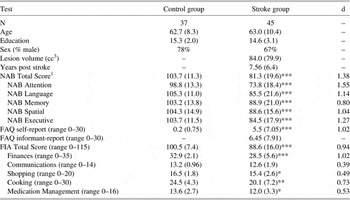
Table 2 contains demographic and test score performances for the stroke and control groups. The groups were not significantly different in terms of age, education, or sex. Stroke patients were impaired on the FIA relative to the control group, including significantly lower scores on four of the five subtests [finances t(80) = 4.45; p < .001; shopping t(80) = 2.14; p = .04; cooking t(80) = 3.26; p = .002; and medication management t(80) = 2.43; p = .02)], but not communication skills, though patients scored marginally lower than the control group, t(80) = 1.73, p = .09. Stroke patients scored lower than controls on all NAB domains.
Demographic characteristics and test scores of the stroke and control groups

Note. See Stricker et al., Reference Stricker, Tyber, Sadek and Haaland2010, for a detailed NAB analysis in this sample
1Standard score, mean = 100, SD = 15; *p < .05. **p < .01. ***p < .001; d = Cohen's d effect size (Cohen, Reference Cohen1988).
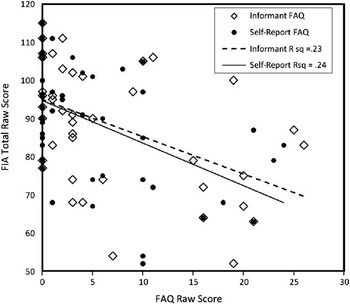
For the stroke group, the FIA total score was significantly correlated with both self- and informant report of IADLs from the FAQ (see Figure 1). Even though the distribution was not homogeneous around the regression line, the parametric and nonparametric correlations were both significant. The correlations between self-reported IADLs and the FIA were r = −.41, p < .01, and Spearman's ρ = −.51, p < .001, and for informant report r = −.48, p < .01, and Spearman's ρ = −.54, p < .001. Also note that the self- and informant-report FAQ were correlated, r = .73, p < .001. The correlation between the NAB total score and FIA total score was r = .83, p < .001. Comparing the absolute value of the correlations of the self-report FAQ and the NAB total score with the FIA total score using Fisher's Z, the correlation between the NAB and FIA was significantly greater than the correlation between self-report FAQ and FIA, Fisher's Z = −3.42, p < .001 and informant-report FAQ and FIA (Fisher's Z = −3.01; p = .001).
Self- and Informant Report versus FIA Total Score in the Stroke Group.

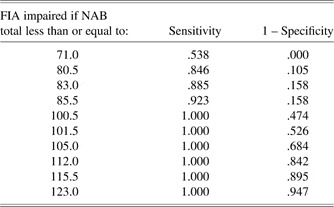
ROC analysis was conducted to determine the sensitivity and specificity of the NAB total score to FIA impairment. FIA impairment was defined as at least 1 SD below the control mean. The analysis indicated that for stroke patients the NAB total score was a significant predictor of impairment on the FIA, area under the curve = .96, p < .001, 95% CI .90–1.0. Sensitivity and specificity for NAB total scores from this sample are contained in Table 3. A standardized NAB total score of 80.5 yielded 85% sensitivity and 90% specificity for impairment on the FIA, while a traditional 1 SD cutoff on the NAB total score (85) yielded 92% sensitivity but 84% specificity.
Sensitivity and specificity of NAB total score for predicting impairment on the FIA in the stroke group

Note. FIA impairment defined as less than or equal to 1 SD from the control mean, or FAI total ⩽ 93.1.
We assessed whether specific cognitive domains would predict functional abilities in the stroke group first by calculating bivariate correlations between each of the five NAB domains and FIA total score. Each of the five domains correlated with the FIA total score with all r's greater than .7 and all p-values less than .001. We entered each domain simultaneously as predictor variables into a regression with FIA total score as the dependent variable. The overall model with the five NAB domains was significant, F(38,5) = 21.6, p < .001, R 2 = .74. Only the spatial domain uniquely predicted FIA total scores, t = 3.54, p = .001. It should be noted that there is a possibility of multicollinearity causing some lack of reliability of this regression. For example, inspection of bivariate correlations between NAB domains indicates that Memory is correlated with Language and Executive domains with r's of .84 and .83, respectively. Collinearity statistics for this model indicates moderately high variance inflation factors for attention (3.9), language (4.1), memory (5.7), spatial (1.7), and executive (4.5) domains. Bowerman and O'Connell (Reference Bowerman and O’ Connell1990) suggest that collinearity could be a problem if the average variance inflation factor is greater than 1. We acknowledge this possible statistical problem and interpret this regression cautiously. Since multicollinearity can obscure the unique effects of individual predictors in multiple regression, it is possible that unique predictive value of individual NAB domains is present but undetected due to multicollinearity. The spatial domain has the lowest collinearity, perhaps explaining why it was the only significant predictor.
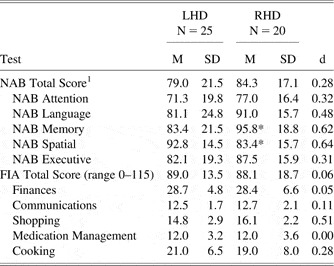
We did not conduct this analysis for each stroke group because of the multicollinearity concerns and because the small sample sizes would not achieve a ratio of number of subjects to number of factors to yield sufficient power in the regression. It is worth noting, however that the RHD and LHD groups were significantly different on memory and spatial domains of the NAB (Table 4). The RHD and LHD group's performance was not significantly different on the FIA.
NAB and FIA test scores for LHD and RHD stroke groups

1Standard Score, mean = 100, SD = 15; *p < .05
d = Cohen's d effect size (Cohen, Reference Cohen1988)
Discussion
Our findings indicate that a new performance-based assessment of everyday functioning, the FIA, is sensitive to functional impairment in a chronic stroke population. The stroke group was impaired relative to the control group on the FIA overall score and on all subtests except the Communication subtest. The NAB was strongly correlated with the FIA in the stroke group, providing evidence that the NAB is strongly associated with a performance-based measure of everyday functioning. The standardized total score for the NAB was sensitive and specific to performance-based IADL impairment.
Performance-Based IADL Assessment in Stroke
Our finding that performance-based assessment is worse in the stroke sample relative to a healthy control group is not a new finding, but it establishes that this new measure is sensitive to IADL impairment in a sample of patients with chronic unilateral stroke. Although there are many performance-based tests in existence, the FIA is one of the most comprehensive in the range of behaviors it samples (cooking, finances, shopping, medication management, and communications) and is useful when detailed assessment is desirable. All of the skill areas are central to independent living in any population. Importantly, the FIA total score does not suffer from ceiling effects, even in healthy controls, which is an advantage over many commonly used questionnaires (Sikkes et al., Reference Sikkes, de Lange-de Klerk, Pijnenburg, Scheltens and Uitdehaag2008). The administration time of 1 hour and the need for substantial test materials makes it suitable primarily for clinical or laboratory assessment, which can be a limitation for larger research studies. A very similar battery is sensitive to impairment in HIV-infected individuals (Heaton, Marcotte, et al., Reference Heaton, Marcotte, Mindt, Sadek, Moore and Bentley2004), and the same battery is sensitive to dementia (Karver et al., Reference Karver, Teshiba, Haaland, Adair and Sadek2008). This study extends validity to the stroke population. As discussed in the introduction, the need for empirically validated performance-based functional assessments is obvious in the case where informants are unreliable or absent, and where patient self report instruments have limited validity or reliability due to problems such as significant impairment in auditory comprehension or anosognosia.
Four of the five FIA subtests were significantly more impaired in the stroke group than the control group: finances, shopping, medication management, and cooking. Only the communication subtest score was not different from the control group. This subtest is relatively simple (e.g., dialing a telephone, addressing and closing an envelope), and does have a ceiling effect (range, 0–14; with mean patient score of 12.6 and control score of 13.2). While this subtest is impaired in dementia (Loewenstein et al., Reference Loewenstein, Amigo, Duara, Guterman, Hurwitz, Berkowitz and Eisdorfer1989), it is not impaired in our stroke sample. The likely reason for this is that the Loewenstein Alzheimer's sample was selected based on impaired cognition and daily functioning, whereas our subjects were selected only on the basis of having a unilateral stroke without necessarily having cognitive deficits. Thus, our sample contained a full range of cognitive abilities, while the Loewenstein patients were presumably all impaired and therefore more likely to have a lower mean score even on simple functional tests, such as the communication subtest (mean of 10.58 in Loewenstein et al., Reference Loewenstein, Amigo, Duara, Guterman, Hurwitz, Berkowitz and Eisdorfer1989). Indeed, when we stratified our stroke groups by impairment on the NAB total score (<85), the NAB impaired stroke group scored significantly lower on the communications subtest, t(43) = 2.99, p = .005, n = 26.
It is worth noting that the FIA subtests were not sensitive to side of stroke, since both RHD and LHD groups scored similarly on the total score and all subtests despite the fact that the RHD and LHD groups performed differently on NAB memory and spatial modules. The small sample sizes of the RHD and LHD groups and the statistical concerns about multicollinearity make it impossible at this point to conduct regression analyses to determine whether specific NAB domains are associated with functional impairment within each stroke group. There are data from other disorders, including dementia, mild cognitive impairment, schizophrenia, and intellectual disabilities, that support executive functioning and/or memory to be the best neuropsychological predictors of IADLs (Aubin, Stip, Golinas, Rainville, & Chapparo, Reference Aubin, Stip, Golinas, Rainville and Chapparo2009; Boyle et al., Reference Boyle, Cohen, Paul, Moser and Gordon2002, Reference Boyle, Malloy, Salloway, Cahn-Weiner, Cohen and Cummings2003; Farias et al., Reference Farias, Cahn-Weiner, Harvey, Reed, Mungas, Kramer and Chui2009; Mackin & Arean, Reference Mackin and Arean2009; Schmitter-Edgecombe, Woo, & Greeley, Reference Schmitter-Edgecombe, Woo and Greeley2009; Sherod et al., Reference Sherod, Griffith, Copeland, Belue, Krzywanski, Zamrini and Marson2009; Su, Chen, Wuang, Lin, & Wu, Reference Su, Chen, Wuang, Lin and Wu2008). None of these previous investigations used the NAB, and the specific memory and executive tests tended to vary. Only two studies used a comprehensive neuropsychological battery (Sherod et al., Reference Sherod, Griffith, Copeland, Belue, Krzywanski, Zamrini and Marson2009; Su et al., Reference Su, Chen, Wuang, Lin and Wu2008). Sherod and colleagues did not report intercorrelations of the neuropsychological predictors, and the only IADL they measured was financial management, so it is not clear from this study how reliable or generalizable beyond financial skills their findings are. Su and colleagues used structural equation modeling to predict parent ratings to cognitive abilities in a developmentally disabled sample. Structural equation modeling may be vulnerable to the effects of multicollinearity (Grewal, Cote, & Baumgartner, Reference Grewal, Cote and Baumgartner2004), making their finding that verbal memory and comprehension predicts everyday functioning also open to question. In addition, most of the above cited investigations used questionnaire-based assessment of functional abilities. Further research will be necessary to determine whether the NAB memory and executive domains have greater ecological validity relative to other neuropsychological tests in cognitively impaired patients, or whether the NAB's psychometric properties (high correlation between domains in patient populations) obscure statistical evidence of the unique contribution of NAB domains. From the data presented here, it is reasonable to conclude that lower scores overall on the NAB are sensitive to poorer everyday functioning in stroke. Because of the overall small sample size and the even smaller sample sizes when the stroke group is separated by lesion laterality, because multiple regression with small sample size can be unreliable, and because of multicollinearity of NAB domains, we cannot be certain whether any single NAB domain has any unique predictive validity. While psychometric issues could explain the lack of NAB domain predictive validity, it is also possible that the FIA requires multiple cognitive abilities, resulting in no single domain as a unique predictor of FIA performance. More studies are needed that include a comprehensive neuropsychological battery to determine whether there is truly domain specificity in predicting everyday functioning.
There is one performance-based scale, the Texas Functional Living Scale (TFLS; Cullum, Weiner, & Saine, Reference Cullum, Weiner and Saine2009) that was administered during the standardization of the Wechsler Adult Intelligence Scale–Fourth Edition (WAIS-IV; Wechsler, Reference Wechsler2008) and Wechsler Memory Scale–Fourth Edition (WMS-IV; Wechsler, Reference Wechsler2009). While the WAIS-IV and WMS-IV are not considered comprehensive neuropsychological batteries, the relationship between them and the TFLS provides a comparison of the FIA's relationship to the NAB. Similar to the FIA/NAB correlations, the TFLS/WAIS-IV correlations were high (r's from .63 to .80) across most WAIS-IV subtests and domains in the mixed clinical sample (n = 190, no stroke group; Drozdick & Cullum, Reference Drozdick and Cullum2010). Correlations were slightly lower but still strong for the mixed clinical sample between the TFLS and WMS-IV (r's from .52 to .80; n = 212, no stroke group; Drozdick & Cullum, Reference Drozdick and Cullum2010). This highlights the need for further research into the issue of whether some neuropsychological abilities, such as executive functioning (Boyle et al., Reference Boyle, Malloy, Salloway, Cahn-Weiner, Cohen and Cummings2003) and memory (Farias et al., Reference Farias, Cahn-Weiner, Harvey, Reed, Mungas, Kramer and Chui2009), are better predictors than other abilities for IADLs. As importantly, more data are needed to determine whether different domains are better predictors across different patient populations. For example, one might expect that the domain of greatest impairment in particular diagnostic groups would be the best predictor of functional impairment. While memory dysfunction is the most common presenting sign for Alzheimer's disease and one of the best predictors of functional impairment, the most common deficits after stroke vary with inter- and intra-hemispheric lesion location. Therefore, in a pooled group of unilateral stroke patients with widely varied lesion locations throughout the hemisphere, the pattern of deficits is likely to vary widely making it more difficult to find consistent relationships between pattern of cognitive performance and daily living skills.
Despite its face validity, one significant issue that requires further study is that the FIA should be directly compared to daily functioning when daily functioning is measured in the patient's home by an observer (e.g., the Observed Tasks of Daily Living; Diehl et al., Reference Diehl, Marsiske, Horgas, Rosenberg, Saczynski and Willis2005). We recognize that the new combination of older tests that were validated separately does not automatically lead to a new valid test, and that the battery needs to be validated as a new instrument. This will improve confidence that the FIA is a valid test of everyday functioning. There is already sufficient evidence that the FIA is sensitive to impairment in patients with HIV infection and with dementia (Heaton, Marcotte, et al., Reference Heaton, Marcotte, Mindt, Sadek, Moore and Bentley2004; Heaton, Miller, et al., Reference Heaton, Miller, Taylor and Grant2004; Karver et al., Reference Karver, Teshiba, Haaland, Adair and Sadek2008; Teshiba et al., Reference Teshiba, Haaland, Adair and Sadek2008; Sadek et al., Reference Sadek, Haaland, Adair, Teshiba and Karver2010). The present data provide additional evidence for construct validity of the FIA as a test of everyday functioning by establishing its sensitivity to stroke-related cognitive impairment.
Summary and Implications
In summary, this study provides evidence that the FIA is sensitive to stroke-related neuropsychological disability, that the NAB is highly correlated with the FIA after stroke, but that the NAB domains may not have unique predictive validity for everyday functioning. The clinical implications of these data with regard to stroke patients include that: (1) specific NAB domain scores should be interpreted cautiously when predicting a patient's functional limitations; and (2) the FIA appears to be a sensitive test of IADL impairment in stroke. More research is needed before the FIA can be considered a valid and reliable test, but the present data provide some preliminary evidence for its validity. Future research should focus on whether the psychometric properties of the NAB obscure statistical evidence for domain-specific ecological validity. The FIA still needs test–retest reliability data in a clinical sample to be sure that it is a stable measure of everyday functioning. Left and right hemisphere stroke patients need to be compared to determine if domains that are most impaired are the domains that are also most predictive of IADLs.
Acknowledgments
This work was supported by the Department of Veterans Affairs (Rehabilitation Research and Development Merit Review grant, B4125R and Clinical Services Research and Development Merit Review grant). The authors thank Dr. Robert T. Knight for neuroimaging consultation and Ms. Melissa Daniels for formatting assistance. The authors report no conflicts of interest. Dr. Thomas Hammeke acted as the editor for this paper to avoid a conflict of interest since the senior author, Dr. Haaland, is the current editor-in-chief of JINS. The information in this manuscript has never been published electronically or in print.