Many debates have already taken place on the reliability of the results obtained by means of sphygmographs. The following remarks may contribute to clarify some still unsettled points.
The first sphygmograph was the kymographion constructed by Ludwig.Footnote 1 It is too well known to be described again in full detail here. The instrument consists essentially of a column of mercury contained in a siphon-shaped glass tube kept, by virtue of its gravity, in a certain state of equilibrium and caused to move by the variations in blood pressure. On the one hand, the open tube is in contact with an open artery; on the other hand, the quicksilver column supports a floating gauge that inscribes the column's movement onto a rotating drum.
VierordtFootnote 2 first noticed that the curve recorded by the kymographion was not merely caused by variations in blood pressure, but also that the curve reflected the oscillations proper to the quicksilver column. Redtenbacher's calculations fully confirmed this hypothesis. According to Redtenbacher's reckoning, the curve recorded by the kymographion would only seldom resemble the true curve of the blood pressure. FickFootnote 3 very rightly objects to the fact, however, that R[edtenbacher] did not take into account a very fundamental factor, namely the motion resistance. If one takes this resistance into consideration, then the matter turns out quite differently. Two modes of oscillation coincide in the quicksilver's movement: one corresponding to the period of the varying blood pressure, and a second corresponding to the oscillation a quicksilver column would adopt whenever it is upset from its state of equilibrium. This latter type of oscillation is constantly dampened by obstacles to its motion such that it ultimately becomes unnoticeable. According to Fick, therefore, the kymographion does not function as poorly as Vierordt and Redtenbacher assume.Footnote 4
VierordtFootnote 5 presents an instrument he christens sphygmograph that is said to avoid the imperfections of the kymographion. If considered from the point of view of mechanics, however, Vierordt's instrument is identical to that of the kymographion. Hence, similar flaws are likely to be found. In Vierordt's instrument, a lever replaces the quicksilver column; it is pressed again the radial artery with a weight and set in motion by the pulse, and its movements are also registered on a rotating drum. The mass of the weighted lever is considerable, but the pivot friction is small. Its inertia and thus its own oscillations possibly have an even greater impact than in Ludwig's quicksilver column. The tracings obtained both by Ludwig's and Vierordt's instruments are in fact highly similar in shape. The theoretical prediction is thus confirmed.
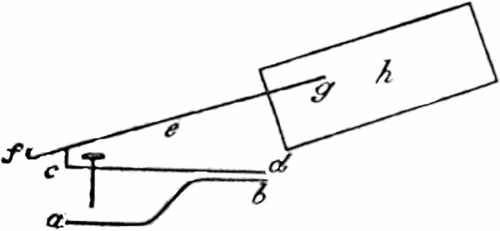
Marey modified the sphygmograph in a most ingenious way. A stable [hard] spring a b (see figure 1) rests firmly upon the radial artery and is moved minimally by the pulse. By way of the intermediate lever c d, which rotates around d and is regulated by the screw e e, this movement [of the first lever] is transferred to the very light writing lever f g, which, in turn, is pressed against c by a fine spring. The end g writes unto the plate h, which is kept moving by a clock mechanism. As we will see, the theory shows such a combination to be very advantageous. One may convince oneself of both the sensitivity and the utility of the instrument, for while Ludwig and Vierordt obtained very similar curves under extremely differing conditions, Marey found, for example, characteristically different lines for various pathological conditions. Incidentally, Marey undertook an impressive series of analyses by means of this instrument.Footnote 6
Fig. 1.

The general schema of a sphygmograph is represented by figure 2. A mass A (Ludwig's column of mercury, Vierordt's weighted lever, Marey's spring a b) is kept in the state of equilibrium O by a certain force, which is to say by a force acting directly proportional to the distance from the state of equilibrium (gravity in the case of Ludwig and Vierordt, elasticity in the case of Marey). By virtue of the varying blood pressure, this mass A is made to oscillate along the line x’ x, thereby transferring its movements to a mass B, which inscribes this movement on a moving piece of paper. If B is small relative to A, the oscillation of A is hardly altered by being combined with B.
Fig. 2.

If theoretical considerations are based upon such a schema, one may arrive at some useful results by means of calculations.Footnote 7 When considering the design of a sphygmograph so that the oscillation of mass A and thus the recorded curve represents the variations of the blood pressure with optimal accuracy, one learns that this accuracy is greatest when the resistance opposed to movement is minimal and when the force that maintains the oscillating mass A in the state of equilibrium O increases as quickly as possible in proportion to the distance from the state of equilibrium. If this force were, for example, elasticity of a spring, then the solidity of the spring increases accuracy. The movement of A may decrease the more the said solidity increases, but we are free to increase this movement by a writing lever.
The first condition of accuracy is evident in and of itself. If and only if the resistance is small can mass A easily follow each excitation. Why the second condition is also necessary can be shown in the following manner. According to Vierordt, Ludwig's kymographion does not reproduce the curve of the blood pressure because the quicksilver column accelerates in each of its movements, so that not only the variable force, but also the acquired speed are expressed in each subsequent element of motion. The barometer belongs to the same sort of case as the kymographion in principle, and yet it has not occurred to anyone in making barometric observations to take into account the speed that the column might have acquired. It would in fact amount to a ridiculous accuracy, for the changes of the positions of the column of mercury are so minimal and occur so slowly that one cannot even speak of acquired speeds. Now, if one could so significantly increase the weight or the specific gravity of the column of mercury in the kymographion that the column could then hardly be disturbed from its state of equilibrium, then sharp variations of pressure would result in only minor variations in the position of the column; and even these sharp variations of pressure would then be registered by the kymographion with the same accuracy as the barometer registers minimal variations of pressure. Obviously, the quicksilver column is not of essential importance. In Marey's instrument, the much more easily movable column of mercury is replaced by an almost immovable spring that makes only small movements and thus acquires only minimal speed.
The theory forces one to acknowledge that of all sphygmographs ever constructed Marey's instrument is the best. Were one to suggest a modification of Marey's instrument from the theoretical standpoint, it would be to omit the heavy lever c d, which increases the mass of spring a b to its disadvantage, and to establish a direct connection between ab and fg.
In order to examine the extent to which the favorable theoretical assessment is corroborated by experience, I performed an experimental analysis of Marey's sphygmograph. The main points of this analysis are briefly summarized below.
-
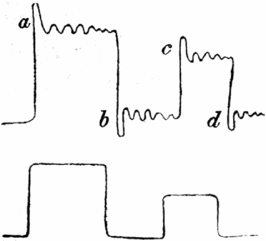
1. I first wanted to get a general idea of the accuracy of the sphygmograph and thus proceeded in the following manner. The instrument was applied to an 8’’ rubber tube filled with water, closed on one end and on the other connected to a syringe that was able to produce random variations of pressure within the tube. The experiment was so designed that the movements of the lever h g were registered on the one side of the plate h, and the movements of the syringe piston on the other side of that plate.Footnote 8 Since the small length of the tube nearly entirely prevented reflection waves, the curve of the sphygmograph, provided it registered with accuracy, had to show the same trace as the curve produced by the syringe once the syringe and the clockwork mechanism were set in motion.
-
Figure 3 shows two such coordinated curves, the upper one representing the curve of the sphygmograph, the lower one the corresponding curve of the syringe. If one recalls that the syringe produced rectilinear movements, but the sphygmograph lever curvilinear ones, translating each variation of pressure into an enlarged scale, one must indeed consider the concordance to be strong, except for the jagged lines in a, b, c, and d. It later turned out that even these small deviations were not caused by a faulty instrument.
-
2. In order to examine how much the instrument's own oscillations contributed to the recording of the pulse waves, the individual components of the sphygmograph were caused to oscillate themselves and tested. The spring a b and the lever f g are prone to oscillating by themselves, but it turned out that these oscillations appear only under extremely unfavorable conditions, such as under heavy blows to the instrument or when the moment of inertia is deliberately increased, conditions, however, that never obtain when examining of the pulse. The peculiarities of the pulse waves can therefore in no way be derived from the instrument's own oscillations. Thus, Meissner's assertions must be considered unfounded.Footnote 9
-
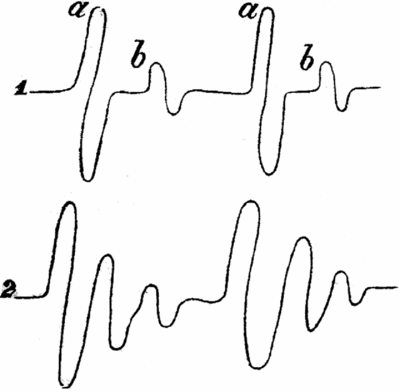
3. If the sphygmograph is applied to elastic tubes of greater length (of approximately 120’’) filled with water, the reflection waves may be easily observed. When applied to a tube of 120’’ the sphygmograph produced, for example, the curve in figure 4.1, when at one of the tube's ends periodic waves were produced by means of a sudden increase in pressure. In this curve, an intervening space of complete calm is visible between the primary wave a and the reflection wave. As soon as the tube is shortened, this intervening space ultimately disappears; the reflection waves occur closer together and increase in number, by which one obtains figure 4.2. If the moment of inertia of the lever f g increases so that the duration of its oscillation is modified, this condition does not have a significant impact upon on the recorded waves of the tube, as would have to be the case if the instrument's own oscillations were partially responsible for the shape of the waves. When the moment of inertia is changed, the human pulse wave likewise displays only a modified height, not a modified shape. Contrary to Meissner, dicrotism thus cannot be ascribed to the instrument's oscillation.
-
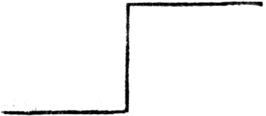
4. Even with shortest elastic tubes, one is never entirely free of reflection waves or standing oscillations in these tubes. For this reason I came up with the idea of examining the instrument's behavior against variations in pressure without using a tube. The instrument was fixed in such a way that the spring a b could freely move. A long thread holding a lead weight p was attached to the spring at a. Once the clock mechanism was moving and after some time the lead weight p was suddenly caught by hand, the pressure then dropped around p. Provided the instrument was recording correctly, it had to draw the curve in figure 5; and this is what in fact happened without showing the slightest trace of reverberations.Footnote 10 Suddenly varying pressure is of course the most disadvantageous thing for the instrument, but if the instrument proves to work in this case, one may trust it even more to function in all other cases.
Fig. 3.

Fig 4.

Fig 5.

The experimental testing leads to the same favorable assessment of the instrument as the theory does. Marey's sphygmograph is an instrument that registers with great accuracy variations of pressure and that renders the shape of the pulse wave with a fidelity that for present purposes proves entirely satisfactory. The instrument may therefore be recommended to the practicing physician.