THEODOR ADORNO'S LATE LECTURES on Metaphysics propose a “shocking thesis”: “metaphysics began with Aristotle” (15). A “doubly shocking” thesis, Adorno tells his audience, because it gives credit where credit is not usually given, and declines to give it where most students of philosophy would understand that it belongs–with Plato (18). The Platonic doctrine of Ideas misses the essential criterion for metaphysics. Plato never fully accepted that the tension between the sphere of transcendence and the sphere of “direct experience” is not merely an adjunct of metaphysical inquiry but its defining subject matter (18). Aristotle understood this, and understood also that metaphysics has always a “twofold aim”; for, even as Aristotelian metaphysics criticizes Plato's attempt to define essence in opposition to the world of the senses, it tries to “extract an essential being from the sensible, empirical world, and thereby to save it.” True metaphysics, Adorno claims, is an effort to go beyond thought in the very act of defining the boundaries of thought. In his words, it is “the exertion of thought to save what at the same time it destroys” (20).
In the midst of this setting out of the definitional ground for metaphysics, however, another subject keeps coming into view: a subject not obviously germane to the philosophical work at hand. Investigating the boundedness of thought, Adorno keeps being drawn to the idea of the boundedness of the human life–not just in the general sense of mortality, but in the more specific sense of the temporal, biological limit on lives. Adorno is not particularly concerned in these lectures with philosophy as intellectual history, but, in accounting for Plato's contribution to the subject, he takes a moment to refer his students to a line of historical argument that would allow Plato a firmer claim to metaphysics proper. “[I]n the Anglo-Saxon countries,” he notes, “one not infrequently comes across the hypothesis that Plato as an old man was influenced retrospectively by his pupil Aristotle; or that, as a result of his political disappointments in his attempts to set up the world purely on the basis of the Idea, he was forced to give greater recognition to that which is, the scattered, the merely existent” (17). One can, then, see signs in Plato of a late life Aristotelian turn that, for want of time, never resulted in a fully reconceived metaphysics.
The word “retrospectively” (Rückläufig in the German [31]1
Rückläufig implies a process operating or flowing in reverse. There is no near equivalent in English.
) is not obviously necessary to this statement. Redundant, even misleading though it may seem (what would it mean to be “influenced retrospectively”?), its inclusion makes an issue of the temporal boundedness of the philosopher's existence. There are more obvious ways of presenting the trajectory of influence between Plato and Aristotle, but Adorno goes out of his way here to imagine the pupil/teacher relation from Plato's perspective as an old man: contemplating the limits Aristotle would impose on Platonic Idealism, but unable, at the end of his life, to do justice to the challenge. “I am only mentioning this to show you how complex these relationships are,” Adorno tells his students (17). But in the context of the whole lecture series, the glance toward Plato's last years is less incidental than he makes it sound. For Adorno, thinking about metaphysics has surprisingly much to do with old age, as if–and the potential for embarrassment colors the suggestion throughout these lectures–reflecting on the temporal boundedness of human lives were a particular imperative to thinking about the boundedness of “the sensible, empirical world.”
In what follows, I explore what these two boundaries might have to do with each other: the boundary between life and death, as figured (Adorno claims) in the decline of the very old, and the philosophical boundary between the physical and the metaphysical. I do this by bringing into conjunction two pieces of writing by Adorno and one by Dickens. These authors have been brought together many times before, almost always through the young Adorno's 1931 lecture on The Old Curiosity Shop. Here I reread that work in the light of the less well-known lectures on metaphysics, delivered at the other end of his teaching career, just four years before his death at the age of 66. The young Adorno was drawn to The Old Curiosity Shop in part because he saw Dickens as having grasped the critical power of anachronism. The older Adorno was much more alert to the critical power of human age, and its capacity to draw us towards certain kinds of encounter with the limits of thinking. The boundaries in question are, inevitably, different for Dickens and for Adorno–indeed, different for Adorno at a remove of thirty-four years from his younger self. But my aim here is to explore the idea of a critical distance on life and on thought, achieved through the contemplation of age. Not least, taking another lead from Adorno, I want to explore the kind of distance old age might afford on the idea of the writer's career as a “quasi-organic whole,” an “immanent unfolding” (134). Putting age to the fore, the later Adorno comes first.
INTRODUCING THE LECTURE SERIES on Metaphysics: Concepts and Problems (delivered in Frankfurt in the winter term of 1965–66 and first translated in 20002
The lectures on metaphysics were delivered in conjunction with the writing of the final section of Negative Dialectics, “Meditations on Metaphysics.” Unlike other lectures closely related to the composition of that book, this series differs substantially. Most obviously, Negative Dialectics excludes Adorno's extended argument for seeing Aristotle as the founding figure of metaphysics, by virtue of his treatment of the distinction between concept and form. The book also shows very little trace of the lectures' preoccupation with old age.
), Adorno recollected his early, and thwarted, attempt to engage with metaphysics:
I recall my own early experience as a schoolboy when I first came across Nietzsche, who, as any of you who are familiar with his work will know, is not sparing in his complaints about metaphysics; and I remember how difficult I found it to get my bearings with regard to metaphysics. When I sought the advice of someone considerably older than myself, I was told that it was too early for me to understand metaphysics but that I would be able to do so one day. (2)
The “considerably older” adviser appears to have fobbed off the young Adorno with a platitude (“wisdom is the preserve of age”; perhaps more sourly, “you will see the point of metaphysics when you come closer to dying”). But it is clear that the older Adorno sees within or behind the deflective reply the germ of a more serious response.
Now thirty-four years on, lecturing on metaphysics to an audience considerably younger than himself (“You are so young,” he remarks at one point [127]), Adorno does indeed understand the modern problem of metaphysics in relation to age. In the lecture with which I am mainly concerned here, number seventeen, he attributes the persistent appeal of metaphysical thinking, even within “advanced consciousness” (135), to the inadequacy of modern culture in the face of death. Pitting himself, as so often, against Heidegger (his “posture of tight-lipped readiness”; the “impotence” of a metaphysics which has degenerated into “a kind of propaganda for death” [131]), Adorno finds proof of the irreconcilability of life and death in the contemplation of extreme old age. The epic ideal of a wholeness to human life–Abraham dying “old and sated with life”–is no longer tenable, he argues. We cannot today see age as a state of wisdom and plenitude, death as “reconciliation,” “life…rounded and closed in on itself” (106–07). And this failure of our culture to “integrate death” impels us towards metaphysics: “thoughts which seek to penetrate beyond the boundaries of experience” (130).
Seen from this angle, metaphysical thinking is a confrontation with despair, imaged in the “immeasurable sad[ness]” that attaches to age.
with the decline of very old people, the hope of non confundar, of something which will be preserved from death, is…eroded, because, especially if one loves them, one becomes so aware of the decrepitude of that part of them which one would like to regard as the immortal that one can hardly imagine what is to be left over from such a poor, infirm creature which is no longer identical with itself. Thus, very old people, who are really reduced to what Hegel would call their mere abstract existence, those who have defied death longest, are precisely the ones who most strongly awaken the idea of absolute annulment. Nevertheless,…because the mind has wrested itself so strongly from what we merely are, has made itself so autonomous, this in itself gives rise to a hope that mere existence might not be everything.
[T]he very curious persistence of the idea of immortality may be connected to this. (135)
This “very curious” rising or “resurrection” (133) of hope flies in the face of strenuous post-Kantian efforts to eliminate metaphysical talk from philosophy, and to prohibit thinking “beyond the boundaries of experience.” But by doing so it becomes, for Adorno, a means of bringing into focus his own wish not to rule out metaphysical speculation altogether, and to acknowledge instead its ongoing entanglement with materialism. Metaphysics does not require belief in an afterlife, he reminds his students at several points in the lecture series–but there are reasons why metaphysics and theology have so often found themselves on the same ground, and there is something to be rescued from the structure, though not the content, of that hope for something beyond “mere existence” (a hope that Adorno, too, seems to experience as a temptation
3 The “immeasurable sad[ness]” associated with old age is not a general diagnosis of the culture but something approaching a personal confession: “as far as my experience extends, there is…something immeasurably sad in the fact” (135).
). Metaphysics shares with theology a disposition to think beyond the constraints of materialism and positivism: a “manner of seeking to elevate itself above immanence, above the empirical world” (6).
In the closest thing to a definition of traditional metaphysics in these lectures, Adorno speaks of “an attempt to determine the absolute, or the constitutive structures of being, on the basis of thought alone” (7). Metaphysical systems are “doctrines according to which concepts form a kind of…constitutional support on which what is naively called ‘the objective world’…is founded and finally depends” (8). To think metaphysically is to put to the test the dominant view that concepts are merely signs with no autonomous existence of their own. To the fundamental question of metaphysics as he defines it, “whether thought and its constitutive forms are in fact the absolute” (99), Adorno's answer is an unhesitating no–but a no qualified by insistence that the business of metaphysics today is not to assert the autonomy of concepts, but to think the question of their possible autonomy. “To put it trenchantly: negative metaphysics is metaphysics no less than positive metaphysics” (qtd. by Tiedemann 196).
The sadness derived from the spectacle of advanced old age thus becomes, for Adorno, a means of acknowledging, and then seeking to rescue something for philosophy out of the modern reduction of metaphysics to mere survivalist need, “the material want of human beings” (Tiedemann 196). The wish to think the possibility of transcendence, of immortality, of something beyond the physical, becomes at that point no longer merely a panicked reflex of modernity, but the means to imagining the potential freedom of thought. This is not an endorsement of thinking beyond experience (especially not in the form of a hoped-for life after death), but it is an endorsement of the possibility of thinking that possibility, thereby enabling thought to think its own “conditionedness” (Jarvis 216). Metaphysics is “thinking about thinking,” Aristotle said; for Adorno it is also, and more imperatively, thinking about the boundaries of thinking.
AGAINST THIS LATE-CAREER INTEREST in the contemplation of old age as a prompt to thinking about the boundaries of thinking, I want to place the much earlier and (among Victorianists) more widely known essay by Adorno: the brief discussion of The Old Curiosity Shop first translated into English in 1989. Since then it has attracted attention from critics interested in the cultural history of Victorian material objects (see Bowen, Hollington, Leslie) but for the purposes of this paper I want to take a cue instead from Joseph Litvak's “Forum” essay in the Autumn 2001 issue of Victorian Studies, where he draws attention to Adorno's technique, when he reads Dickens, of bringing the old into disturbing conjunction with the new. Adorno teaches “the unsettling power of the primitive,” Litvak writes, “the outmoded, the awkwardly old-world” (33).
The lecture on The Old Curiosity Shop treats Dickens's novel as an exploration of the critical power of anachronism. Projecting a pre-bourgeois view of the world into the bourgeois industrialized “life space” of the nineteenth century, this avowedly “allegorical” tale makes visible the death-riddenness of the modern, commodified “object-world.” For Adorno, Little Nell is a “victim of the mythic powers of bourgeois fate and at the same time the slender ray of light that fleetingly illuminates the bourgeois” sphere (172). Unable to “take hold of the object-world” or to resist the injustices it has bred, she becomes a symbolic sacrifice to its power. But, Adorno concludes (no more than gesturally), Dickens also recognizes the possibility of “transition and dialectical rescue,” figured in the “powerful allegory of money with which the depiction of the industrial city ends: ‘two old, battered, smoke-encrusted penny pieces. Who knows but they shone as brightly in the eyes of angels as golden gifts that have been chronicled on tombs?’” (177).
In juxtaposing this 1931 reading of The Old Curiosity Shop with Adorno's thinking in 1965 about age and metaphysics, I want to suggest that the late lectures might productively be read back into the earlier to allow it to say more than it currently does about how old age can function as a spur to critical thought–for Adorno, for readers of Dickens, and (tentatively) in relation to nineteenth- and twentieth-century writing more generally. I should make it clear that my interest in taking the late Adorno's thinking about old age and metaphysics “back” to the early Adorno's materialist analysis of Dickens does not rest on a close analysis of the Adornian defense of metaphysics per se. That is, I am not concerned here with the detail of Adorno's reading of Aristotle; nor with the lingering strains of existentialism within Adorno's thinking about metaphysics: that post-World War II fixation on meaning's relation to death which, for many readers of Adorno, constitutes an “incorrect” aspect of the late thought.4
Not surprisingly, “Meditations on Metaphysics” is the chapter that gives Jameson greatest trouble in his influential defence of Adorno, Late Marxism: Adorno, or, The Persistence of the Dialectic: “this final, logical stage in ‘negative dialectics’ seems to me the only moment in which Habermas's fear–that this profound critique of reason and rationality might end up in the cul de sac of irrationalism–seems potentially justifiable” (112).
Neither do I want to follow these ideas into the deconstructive/Heideggerian debate over the “destruction” of metaphysics–or what sometimes looks like a competition for the credit of having murdered it (Derrida
v. Nietzsche). My focus here is specifically on old age and the part it has played in two distinct but overlapping traditions of inquiry into the boundedness of human experience.
In part what is in question must be the concept of the writer's own old age: the integrity or otherwise of a writer's work when viewed from the perspective of his or her “late writing.” In an obvious sense, “late writing” is a relative thing: “late Keats” is a more limited notion than “late Wordsworth”; and the idea of “late Adorno” may similarly have less analytical potency than, say, “late Habermas.” Adorno himself would very probably have objected to such characterizations. There is an ironically self-reflexive move early on in lecture seventeen of the Metaphysics when he reminds his audience of his 1955 introduction to Benjamin's Schriften, where he argued that “a concept such as ‘the life's work’ has become problematic today because our existence has long ceased to follow a quasi-organic law immanent to it, but is determined by all kinds of powers which deny it such an immanent unfolding” (133–34). So, when I propose reading the late Adorno back into the early Adorno, I do so on the (as it happens, sustainedly) Adornian assumption that they are, in a fundamental sense, not the same writer: that there is no whole or final Adornian reading of The Old Curiosity Shop to be achieved, but that a late Adornian approach to metaphysics may nevertheless, by its very discontinuities with the earlier thought, open up the novel to a more fully dialectical reading.
In his critical introduction to Adorno (1998), Simon Jarvis observes the tension within Adorno's philosophy of history between resistance to the concept of historical progress and almost equal dissatisfaction with “the presentation of history as sheer disconnection” (37–38). Appeals to historical discontinuity “turn out to be no less metaphysical than a teleological insistence on historically unified progress.” In Adorno's own, more aphoristic phrase, “History is the unity of continuity and discontinuity” (qtd. in Jarvis 38). So Jarvis goes on to present Adorno's major collaborative work with Horkheimer, The Dialectic of Enlightenment, as “a simultaneous construction and denial of universal history” (39). I am suggesting a similar approach to the question of the writer's own temporal development: one conceived in terms of both the integrity and the distinctness of different moments of writing. The late Adorno evidently shares much with the Adorno who, more than thirty years earlier, had recognized the power of formal anachronism in Dickens's novels to “dissolve the very bourgeois world” depicted (172). But the older writer also “goes beyond” the young Adorno in ways which make for a reading more attuned to the critical valency of age in Dickens's story.
ONE OF THE ODDITIES of Adorno's 1931 reading of The Old Curiosity Shop is that, for all its attention to the outdated and outmoded, it makes no distinction between age and youth in relation to Little Nell and her grandfather. They are taken to be constituent parts of one mythic pairing: “the group portrayed in the old woodcut on the title page: Nell and her grandfather. Formed of the same material, the two remain inseparable; neither could exist as an autonomous human being” (172–73).5
The original German reads “Es ist die Gruppe des alten Titelholzschnittes: Nell und ihr Grossvater.” (“Rede über den Raritätenlanden von Charles Dickens” 1–2 [1b]). The reference is puzzling. The first English editions of The Old Curiosity Shop were indeed illustrated by woodcuts, rather than the more usual steel engravings, but there was no title page image. It is possible that Adorno was referring to George Cattermole's frontispiece for Volume 1 of Master Humphrey's Clock, which contains two framing images of Nell and her grandfather, but the frontispiece is very rarely reproduced in editions of The Old Curiosity Shop. It is more likely that whichever edition of the novel Adorno was using (he doesn't say) included one of the original woodcuts from the main text by way of title page decoration. The image which comes closest to his description is that at the end of chapter 12, showing Nell and her grandfather leaving the old curiosity shop arm in arm. The accent on “oldness” is interestingly superfluous, in tune with Adorno's particular attentiveness here to age.
That reading subsumes the grandfather into the morally dominant figure of the child, burdened with his guilt and made its “propitiatory sacrifice” (173). “The novel is nothing but the story of her sacrifice,” Adorno says (173). The grandfather's words thus become, in this reading, hers too, expressing a mutual, allegorized desire to escape the demonic world of industrial capitalism. Adorno draws attention to the following lines, spoken by Old Trent on the eve of their flight from London:
we will travel afoot through fields and woods, and by the side of rivers, and trust ourselves to God in the places where He dwells. It is far better to lie down at night beneath an open sky like that yonder– see how bright it is–than to rest in close rooms which are always full of care and weary dreams. Thou and I together, Nell, may be cheerful and happy yet, and learn to forget this time, as if it had never been.” (103; ch. 12, Adorno 175)
Isolating that speech allows Adorno to establish a “deep dialectical ambiguity” (174) in the novel: the “somewhat romantic” and polemical vision, here, of an escape from the cares of the city, that is also an escape from old age back into childhood; and, opposed to it, the “concrete presentation” of the city, which Adorno finds “incomparably more powerful” (175). But this fusion of the child and the old man into one figure ignores Dickens's clear wish to refute the impression of their romantic unity–not least by the echoes throughout this chapter of Shakespeare's “foolish, fond” Lear, begging Cordelia to “forget and forgive” (IV.vi.53, 76–77).6
To this extent I am in agreement with Sturgis's reading of The Old Curiosity Shop, in which he argues that Nell is represented at a remove from her own allegorization–conscious of it, and actively accepting (“orchestrating,” is Sturgis's stronger claim) her own martyrdom (300). Sturgis concentrates almost entirely on the dark doubling of Nell and Quilp (he does not discuss Quilp's age), and on Dickens's failure to bring them to a final dramatic confrontation, which could not but contaminate Nell. I am more inclined to see Quilp as a grotesque externalization and displacement of the more intimate threat posed to Nell's happiness, and ultimately her existence, by her grandfather.
“We'll…be as free and happy as the birds,” the grandfather tells Nell at the end of this fleeting access of hope; “We two alone will sing like birds i'th' cage” was Lear's more thinly strung line (V.iii.9) (like Nell's bird, perhaps, left behind in London and returned to her only after her death). The young Adorno all but dismisses these lines. The older Adorno would have recognized the double movement of thought on the grandfather's part, or rather articulated through him, which can understand its own imprisonment only by expressing the impossible hope of escaping its bounds.
Time and again in The Old Curiosity Shop Dickens is verbally closest to Shakespeare when he seeks to express the old man's awareness that there can be no escape from material existence. Something akin to the “immeasurable sadness” with which the Adorno of the Metaphysics contemplates old age speaks, at these moments, through the old man's querulous romanticism. “Ah! poor houseless, wandering, motherless child!” he cries out, in one of Dickens's most verbally direct Shakespearean borrowings: “clasping his hands, and gazing as if for the first time upon [Nell's] anxious face, her travel-stained dress, and bruised and swollen feet; “has all my agony of care brought her to this at last! Was I a happy man once, and have I lost happiness and all I had, for this!” (340; ch. 44; cf. KL, III.iv.26–32; and see Poole). But Dickens pays homage to Shakespeare (and possibly to Nahum Tate) in such a way as to invoke only the Lear of Act 5, brokenly leaning upon a daughter who, he knows too late, honored and loved him. He consciously excludes the Lear of Act 3 who rages against his condition. So, immediately after the lines just quoted, Dickens cut several lines from the proof text of the story in order to fit Part 30 to the required space for serialization. He could, he told John Forster, “easily” lose them, though they might have been thought crucial to a psychological understanding of the old man.7
Adorno argued that the dated form of Dickens's novel means that “there is no psychology in it, or rather, that it absorbs psychological approaches into the objective meanings the novels depict” (172).
His hat fell off as he raised his hands, pressed convulsively together above his head, and, his white hair streaming in the wind, uttered this complaint with a passion and energy that shook him like an ague. Terrified to see him thus, the child clung to him and besought him to be calm. “Brought me to this! To what?” she said cheerfully, “one night without a bed to lie on! What matters that! We shall laugh at this one day; and when we are sitting before a good fire, we shall feel glad to think how cold and wet we were to-night. Come, let us find some corner where we can lie down to rest. There are many, many poor creatures in this town, dear, who will not sleep half so soundly as you and I to-night!” For a moment she turned away her face. There was something in the action with which she pressed her hand upon her drooping heart, sorely at variance with her speech; but next moment she looked with a smiling hope into the old man's face, and that was all he saw.8
Clarendon ed., Appendix A, 585. On the revision at proof state see Letters 2: 131.
If
The Old Curiosity Shop is “a Lear story … virtually without a Lear” (Welsh 2: 1405), it was this late-stage textual decision which secured it as such. When Dickens removed this passage, he cut out the most Lear-like scene he had imagined for Old Trent. The excision turned Nell's grandfather from a man capable in spirit, if not in rhetoric, of Lear's confrontation with the “unaccommodated” human condition, to a senile figure who never gets beyond fitful and fearful expostulation. The cut lowers his register from tragedy to “feeble-mindedness” (Adorno 173). It also excludes a speech in which Nell would have taken on more eloquently and deliberately than anywhere in the published text the redemptive function of Cordelia, seeking to give a future to the old man. Nowhere else does Nell come so close to Cordelia's tender reassurance “No cause, no cause” (IV.vi.68; but see ch. 54 for the nearest approximation). The effect is to remove an exchange which could have been seen as strongly upholding the young Adorno's claim of her symbolic unity with the old man.
As the final text stands, the frailty and querulousness of the old man's hopes, and her almost-silent assumption of his cares, debar identification of him with Nell's youth, opening up instead a dialectical fissure within the novel's representation of age. Immediately before the “somewhat romantic” passage depreciated by Adorno, Dickens indeed denounces as travesty the superficial likeness between Little Nell's childhood and her grandfather's age:
he seemed unable to contemplate their real position more distinctly, and was still the listless, passionless creature, that suffering of mind and body had left him.
We call this a state of childishness, but it is the same poor hollow mockery of it, that death is of sleep. Where, in the dull eyes of doating men, are the laughing light and life of childhood…? Send forth the child and childish man together, and blush for the pride that libels our own old happy state, and gives its title to an ugly and distorted image. (101–02; ch. 12)
This irreconcilable separation of youth and age is as crucial and ambiguous a dialectic as the opposition between romance and concrete presentation of material life. Indeed, it is in significant measure a translation or extension of that other dialectic. One part of the dialectic belongs with the older Adorno's observation that, in the modern world, the old, “too weak to preserve their own lives, are turned into objects” (“objects of science–the science of gerontology” [
Metaphysics 106]). Nell's grandfather, first seen among the “old and curious things” which clutter his shop, is one more “thing” among them: “There was nothing in the whole collection but was in keeping with himself; nothing that looked older or more worn than he” (10; ch. 1). This is the reduction of human life to the merely material: as the later Adorno put it, “what we merely are” ushering in “the idea of absolute annulment.” On the other side of the dialectic, childhood–or its allegorization in Little Nell–is made to seem the guarantor of something beyond this bounded existence. “Beyond”, both in the historically confined sense of “an afterlife” and in the deeper sense of a something “above immanence, above the empirical world.” Hence the inordinate burden of sentiment Nell has to bear. Heaven is where nothing dies or ever grows old, Dickens tells us (57; ch. 6). It is, in other words, only for the young. Old age, by contrast, is face to face with the boundary of death and the inescapability of care (a word which shares the same Latin root as “curiosity,” John Bowen notes [133n.]).
But in practice the old are feeble parties to this moral and philosophical exploitation of children. Witness the many old men and women in The Old Curiosity Shop who mourn inconsolably the death of young loved ones, but whose hope for something beyond their histories of death amounts to no more than a very faltering stoicism. The old man in chapter 15 who lost his son; the old woman in chapter 17 whose husband died in their youth; the schoolmaster who has lost his favorite pupil; the Birmingham laborer who has seen all three of his children die: each of these people recalls a dead child or lover or pupil with a pathos which has very little to do with the hope of an afterlife. The one who comes closest to looking for a “beyond,” the old woman in chapter 17, can still only imagine a life after death for the girl she was when her young husband died, not for the old woman she has become:
now that five-and-fifty years were gone, she spoke of the dead man as if he had been her son or grandson, with a kind of pity for his youth, growing out of her own old age, and an exalting of his strength and manly beauty as compared with her own weakness and decay…she spoke about him as her husband too, and thinking of herself in connexion with him, as she used to be and not as she was now, talked of their meeting in another world as if he were dead but yesterday, and she, separated from her former self, were thinking of the happiness of that comely girl who seemed to have died with him. (138)
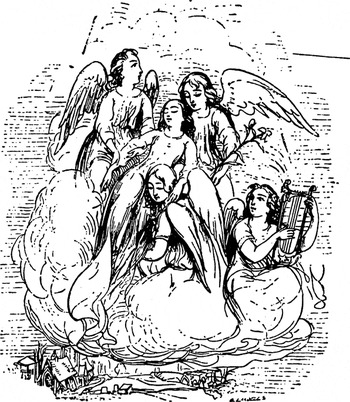
Much the more determined sentimentalization of the spirituality of children comes from the narrative voice. Something, indeed, might be made in this context of the notorious dropping of Old Master Humphrey as the novel's narrator, and the taking up of that role by an anonymous voice, conventionally ascribed to Dickens himself. Leaving behind the “infirm” and melancholic old man (see especially the first two pages of his narrative) allows the novel to insist more strongly and more “romantically” on Nell's positive connection to the metaphysical–what Bowen has called her absorption in “spirit” and her centrality to the novel's compulsion toward “the Beyond” (150–51). But the result is a discomfiting conflict of convictions in the novel. On the one hand we have the narrative (Dickens, if you will) steering the child towards and then beyond her death, to that triumph of early Victorian sentimentalism encapsulated in George Cattermole's woodcut of Nell, ascending to heaven in the arms of the angels (Figure 11). On the other we have a gradually intensifying psychologization of Nell (pace the young Adorno), which makes it plain that she fears death and feels its oppression.
George Cattermole, Little Nell ascending to heaven. Woodcut, from Charles Dickens, The Old Curiosity Shop. London: Chapman and Hall, 1841. 223. Courtesy of the Brotherton Library, University of Leeds.
Specifically, she fears what the adults around her fear: that death is categorically the end. There is nothing beyond the grave, and nothing that can rescue her from the death-ridden material world. When the old sexton tells her that the little shrubs and flowers she has seen in the churchyard “grow but poorly” because those who have planted them quickly forgot the dead who lie below, she responds earnestly: “I grieve to hear it…Perhaps the mourners learn to look to the blue sky by day, and to the stars by night; and to think that the dead are there, and not in graves.” “Perhaps so,” replies the old man–but “doubtfully” (418–19; ch. 44). And as the novel nears its conclusion, those doubts grow the more pressing in proportion as they are denied expression in the novel's “official” passages of philosophy. “A black and dreadful place!”, Nell calls the deep, dark well in the crypt of the church–and Cattermole's illustration hones in intently on the ghoul-like oppressiveness of the old man who forces her to look down into its grave-like depths, then wonders aloud “on what gay heads other earth will have closed, when the light is shut out from here” (429–30; ch. 55) (Figure 12).
George Cattermole, Little Nell at the crypt. Woodcut, from Charles Dickens, The Old Curiosity Shop. London: Chapman and Hall, 1841. 108. Courtesy of the Brotherton Library, University of Leeds.
In scenes such as these, the novel seems to be protesting against its own death-dealingness towards children: its wish to kill them off in order to set them up as guardians of the possibility that there may be something beyond material existence–something beyond what old age (as represented here) tells us. Dickens himself was not unaware of his hypocrisy in the matter. After Nell's exchange with the sexton, he put words of eloquent consolation in the mouth of the schoolmaster: “do you think…that an unvisited grave, a withered tree, a faded flower or two, are tokens of forgetfulness or cold neglect? Do you think there are no deeds far away from here, in which these dead may be best remembered? Nell, Nell, there may be people busy in the world at this instant, in whose good actions and good thoughts these very graves–neglected as they look to us–are the chief instruments” (421; ch. 54). Washington Irving wrote to Dickens to express his delight in this and other passages, “which come upon us suddenly and gleam forth apparently undesignedly, but which are perfect gems of language” (Dickens, Letters 2: 270n.). Privately, Dickens was prepared to confess that this was all they were. As he approached the writing of Little Nell's death, he admitted to John Forster that the situation threw him back into the distraught state he had been in after the death of her real-life counterpart, the seventeen-year-old Mary Hogarth: “I am the wretchedest of the wretched…. Old wounds bleed afresh when I think of the way of doing it…I can't preach to myself the schoolmaster's consolation, though I try” (Letters 2: 181–82).
That apostasy is the more pointed because the moral he sought to apply is essentially no more religious than the secular humanism preached by George Eliot at the end of Middlemarch. This is metaphysics of a markedly post-Kantian kind, in which what is sought are not theological truths, but rather a more expansive basis for the conceptualisation of experience. And the pressure of the need for it–what the later Adorno would call the “wresting” of the mind “so strongly from what we merely are” (135)–can be felt not just in the text itself, but in those other writings which have become integral to The Old Curiosity Shop's reception in English: the letters of the writer who confronted his own mortality, and the boundedness of his own life and thought, in the dialectical opposition between the old age toward which he felt himself to be slowly growing, and the young girl he would like to have believed might rescue him from the promised end.
Age thus operates as a deep fissure within the allegorical figure both the younger Adorno and Dickens himself wanted to identify in The Old Curiosity Shop's imagined pairing of an old man and a young child.9
The term “allegory” was a late addition. Dickens took it from Thomas Hood's enthusiastic review of the serialized version of The Old Curiosity Shop and introduced it into the text of ch. 1 (“she seemed to exist in a kind of allegory”) at the point where he detached the story from Master Humphrey's Clock. See Letters 2: 221n.
The dialectical relation of age and youth in fact drives the novel's confrontation with early-industrial English society, and, from the vantage point of Adorno's later writing on metaphysics, might also drive a revised Adornian reading of that confrontation. What would then emerge would be not only the child's sacrifice, but a larger philosophical and literary picture in which that sacrifice would be seen to be upheld but also denied: endorsed as the hope of a beyond, and exposed as the murderous proof that “mere existence” is all we have.
IF THE OLD CURIOSITY SHOP bears witness nevertheless to the resurrective powers of comedy (Dick Swiveller returned from the brink of death; the Marchioness as Little Nell's comic double) (Bowen 142, 153–56), what does this mean for Adorno's and Dickens's thinking about old age and death? Is there any kind of dialectical relationship between the cruelty of Little Nell and her grandfather's story, and the novel's “affirmative delight in linguistic and metaphysical play” (Bowen 142)? There is certainly a humanist protest to be made along just the lines Bowen sets out, against this essay's emphasis on the “immeasurable sadness” attached to old age, and the homicidal impulse implicit in its treatment of childhood. A redemptive reading could do much with the large cast of children, besides Little Nell and the young scholar, who are victimized by the “material object-world” of adults, but whose response is of a very different mode and tenor. There is, indeed, something like a test-case for an alternative imagining of childhood's relationship with old age in the first publishing context for The Old Curiosity Shop. One of the magazine pieces written by Dickens to appear in tandem with his new novel when it started magazine serialization in Master Humphrey's Clock, capitalized on the popularity of Pickwick Papers by reviving the characters of Sam Weller and his father Tony. In the sixth weekly number of the periodical, between the first and second chapters of The Old Curiosity Shop, Mr Pickwick arrives for a meeting of the Clock club, with the Wellers in attendance. When Master Humphrey commends Mr. Weller senior on his appearance of good health, the response is a proud announcement: “‘Samivel Veller, sir,’ said the old man, ‘has conferred upon me the ancient title o’ grandfather vich had long laid dormouse, and wos s'posed to be nearly hextinct, in our family.’” The two year-old Tony Weller “‘is the blessedest boy,’” he crows, “‘as ever I see in my days! of all the charmin'est infants as ever I heered tell on, includin’ them as wos kivered over by the robin redbreasts arter they'd committed sooicide with blackberries, there never wos any like that ‘ere little Tony’” (103–04). He is referring to the old ballad of the “Babes in the Wood,” abandoned to their deaths, but whose corpses are then tenderly covered with strawberry leaves by the robins: “Poor babes in the wood, who never did wrong.” In Tony Weller's voice such sentimentalism is comically robust. His young namesake, who duly appears a few numbers on, is evidently in no danger of suffering the fate of those tender babes. He is a stout and precocious replica of his grandparent, given to winking at women in imitation of Weller senior, knocking back quarts of ale, smoking bits of firewood, and announcing “Now I'm grandfather!” In these vignettes of grandsire and grandson Weller, The Old Curiosity Shop's commitment to a murderous sentimentalism, whereby children become the symbolic sacrifices to an adult need for metaphysical reassurance, might seem pre-empted and forestalled by its comic alternative.
Within the novel itself there is opportunity enough for identifying comic resistance to the enlistment of children in a deathly metaphysics. The Marchioness may, like Nell, be emotionally neglected and all but starved physically (indeed her plight is much worse, locked into a dank basement and compelled to work as slavey by a grotesque amazon of a mother who has never named, let alone acknowledged, her child). But the Marchioness has resilience, and “cunning” (394; ch. 51, 445; ch. 57, 451; ch. 58), as well as a capacity for love, which enable her to break free of her bondage. With a view to old age, the closer analogies and richer counterparts to Nell's situation are the two boys roughly her own age whose lives are entwined with the demonic Quilp: Kit, who eludes the dwarf's plot to ruin him, and–more closely–Tom Scott, the child whom Quilp employs to run his errands and keep watch over his waste-ground “summer house.” Critics rarely pick up on the statement of Quilp's age that accompanies his first appearance. “The child [Nell] was closely followed by an elderly man of remarkably hard features and forbidding aspect, and so low in stature as to be quite a dwarf, though his head and face were large enough for the body of a giant” (26–27; ch. 3). No account of his appearance or behavior thereafter reminds us of his age (though it adds a “January and May” frisson to his sado-masochistic relationship with the young and pretty Mrs. Quilp). Instead, everything about Quilp demonstrates extreme physical hardiness and savage energy. His relationship with Tom Scott brings to the surface of the plot the (half-) buried murderousness that characterises the adult world's imaginative response to children. “You dog,” Quilp snarls: “I'll beat you with an iron rod, I'll scratch you with a rusty nail, I'll pinch your eyes…I'll cut one of your feet off” (47–48; ch. 5). Like Tony Weller senior he seems to take a perverse delight in having the boy mimic his own adult behavior. Quilp's uncanny athleticism is mirrored in Tom Scott's passion for tumbling and for walking around on his hands, and on one occasion Quilp forces him to copy his habit of chain smoking: “Luckily the boy was case-hardened, and would have smoked a small lime-kiln if anybody had treated him with it” (95; ch. 11).
In this parodic doubling of Nell's relationship with her grandfather, one might see writ large the desire of the old to take the young as surrogates for, and symbolic defenders against, their own mortality. Like Mrs. Quilp, Tom is in an evidently sado-masochistic relationship with the old man's desire to use and to wound him. He weeps, we are told, at Quilp's inquest. But by the end, when he disappears into the streets of London to earn his living as an “Italian” tumbling boy, Tom Scott's resilience seems to have been offered to us, the readers, as compensation for the lack of a comparable hardiness in Nell. Not all children will fade away. There are those like Tom who exist under the protection of a comic view of the world as a place where death constantly threatens but is never realized, and in which a child can belong wholly and sufficiently to the “material object world.”
There are several points in The Old Curiosity Shop where the question of comedy's alliance with death and metaphysics enters fully into the allegorical spirit of Nell and her grandfather's story. One of the most tonally agile of those scenes is the response of the grandfather to Short and Codlin's puppet theater (a scene to which Adorno, in 1931, makes repeated allusion). Short and Codlin enter the novel as a strained but companionable pairing of the tragic and comic spirits. They are first seen laboring to repair the tools of their trade, one of them “binding together a small gallows with thread” while the other repairs the “radical neighbour” puppet (131; ch. 16). When they look up they encounter the “curious” gaze of the old man and his young companion (132; ch. 16) (Dickens works the two meanings of “curiosity” together throughout this chapter with more than usual deliberateness). Little Nell at this point recedes into the background, but the old man expresses “extreme delight” at his first sight of Mr. Punch off the stage, venturing to touch one of the puppets,” and laughing “a shrill laugh” (133; ch. 16). Phiz's illustration (Figure 13) quietly underlines this unexpected moment of recognition and covert doubling, mirroring Mr. Punch's hook nose, sagging jaw, and gangling limbs in the figure of the old man.
Hablot K. Browne (“Phiz”), Codlin and Short. Woodcut, from Charles Dickens, The Old Curiosity Shop. London: Chapman and Hall, 1841. 177. Courtesy of the Brotherton Library, University of Leeds.
Again, there is a strong humanist tradition of reading Dickens which would want to seize upon this scene as a redemptive moment in what is otherwise tragedy. Such a reading would no doubt light upon Little Nell's volunteering to take over the mending of the puppets (so offering herself as a willing prop to the adult world), and it might well find support from Hablot Browne's sly signing of the illustration with his initials on a tombstone: “H. B.” But if Old Trent and Mr. Punch are on the same territory (allied, not least, in their unkindness to children), that doesn't mean that the novel's thinking about aging, metaphysics, and death is overruled or negated by the energies of comedy. And if other children in The Old Curiosity Shop escape the deathly metaphysics that requires Little Nell to be sacrificed, that does not mean that they in any significant sense challenge it. Each of them who comes into contact with her casts off his or her comic role in response to her death. Nor does the presence of comedy obviate the later Adorno's case for old age's power to bring thought to a confrontation with its own limits. Indeed there is something finely redundant about Bowen's complaint that Adorno's reading is “profoundly negative” (142). Adorno himself was (consistently) clear about the limits of comedy's ability to rescue the world. In “Is Art Lighthearted?” written in 1967, a year after the lectures on metaphysics, he quoted Hölderlin's “Die Scherzhaften,” or “The Ones Who Make Jokes”: “Are you always playing and joking? You have to! Oh friends, this affects me deeply, for only the desperate have to do that.” Adorno was in agreement. Art as a whole is “a critique of the brute seriousness that reality imposes upon human beings,” he wrote, but the individual work of art cannot do so. “Where art tries of its own accord to be lighthearted…it is reduced to the level of a human need and its truth content is betrayed. Its ordained cheerfulness fits into the way of the world. It encourages people to submit to what is decreed, to comply. This is the form of objective despair” (Notes to Literature, 2: 248, 250).
Which takes me back to Joseph Litvak's short forum article in Victorian Studies–an essay more concerned as it goes on with Adorno's comedic sense than with his interest in the old. “What complicates Adorno's gravity is his levity,” Litvak writes: “his Jewish…way of developing the comic tendency of style's ontological lightness. I am aware that this may sound laughable” (34). Not to a humanist reader of Adorno and Dickens, for whom it is necessary (as Adorno jibed) that there should be a connection–non-obvious but potent–between the critical work of old age and the work of comedy. In that tradition of criticism, there is a well-recognised kinship between age and comedy (Lear with flowers in his hair, pursued around the stage by the gentlemen) and it would be entirely in accord with it to think that such yokings of tragedy and farce, by breaching the boundaries of decorum, might amount to a concept of freedom. But for Adorno, that reading can only be a knee-jerk reaction of those unwilling to face the “brute seriousness [of] reality.” Comedy, in the single work of art, is only a way of shoring up our boundaries, not a way of putting them seriously to the test of thought.
IN THE INTRODUCTION to the first English translation of Adorno's essay on The Old Curiosity Shop, Michael Hollington quoted a passage from Benjamin's The Origin of German Tragic Drama (1963) which he saw as pointing back to Adorno on Dickens: “Allegorical characters, these are what people mostly see. Children are hopes, young girls are wishes and requests” (90). Adorno's later writing on metaphysics suggests a bleak end-point to that list: the very old are fears. But if–or indeed because –they are fears, they also generate in those of us who are neither children nor yet very old, hopes of a beyond. Reading Dickens through the Adorno of the lectures on metaphysics as well as the Adorno of the 1931 essay, helps us to see one way in which those hopes have been expressed dramatically, and not just allegorically, with reference to the temporality of human lives. For the young Adorno, old age and childhood seemed bound by Dickens into one allegorical figure; for the older Adorno, I have been suggesting, that allegorical figure would have had to be seen as dialectically split. Reading The Old Curiosity Shop in the light of the late Adorno, one can then see a darker playing-out of the impulse towards metaphysics than even he imagined. In Dickens's novel, contemplating the “immeasurable sadness of old age” does indeed prompt the hope that there may be something beyond material existence, but it gives form to that hope only by enlisting the help of children. That is, the need for something beyond material existence is met in this story only by taking mortality away from the very old and giving it instead to children, on whom its pressure seems so much less immediate and so much less necessary.
For Adorno, the spur old age gave to metaphysical thinking was illegitimate if it had the effect of encouraging us to believe, in spite of all that has been written and experienced, in some form of existence beyond death or beyond the material object world. It was legitimate if one took the structure of the impulse toward a “beyond” and used it to push philosophy toward thinking about the limits of thinking. Reading Dickens, it would be easy to stop at the point where the version of metaphysics suggested by his novel is exposed as “illegitimate” in those terms. And yet one of the aspects of The Old Curiosity Shop which drew it to the attention of the young Adorno, and which might be expected to have given it enduring appeal for the later Adorno, is that it too reaches a point where it knows what it has imagined to be a kind of murder, and no rescue at all from the “brute seriousness that reality imposes upon human beings” (“I am slowly murdering that poor child,” Dickens wrote to Macready [Letters 2: 180]). It reaches a point, in other words, where it knows that it is caught in the double-bind that was, for Adorno, the definitive predicament of metaphysics: trying to save what at the same time it destroys.